
Life, 1888-04-19 · page 6 of 18
Life — April 19, 1888 — page 6: what you’re looking at
What you’re looking at
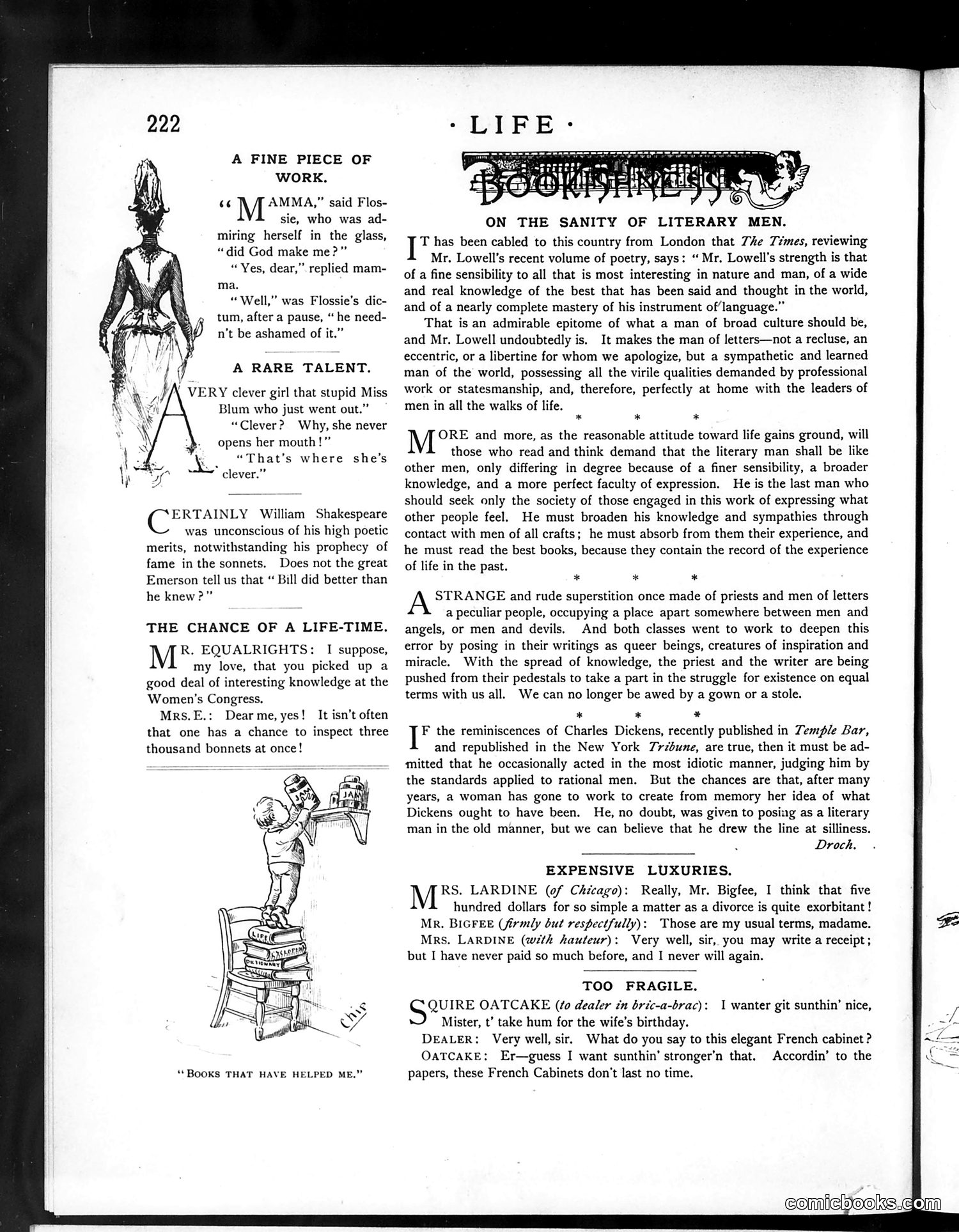
This page contains several short humorous sketches rather than political cartoons: **"A Fine Piece of Work"**: A dialogue joking that Flossie admires herself in a mirror, asking if God made her. The humor relies on vanity. **"A Rare Talent"**: A brief joke about a stupid girl named Miss Blum, with wordplay suggesting she's "clever" because she's absent-minded. **"The Chance of a Lifetime"**: Mr. Equalrights boasts to Mrs. E. about inspecting "three thousand bonnets at once" at the Women's Congress—satirizing women's suffrage activism or women's rights conventions. **Illustrations** include a decorative female figure and a cherub on stacked books labeled "Books that have helped me." The remaining content comprises brief comic dialogues about expensive divorces and fragile furniture—general domestic humor typical of early-20th-century satirical magazines.
📄 Transcribed text from this page (OCR, searchable)
Machine-transcribed from the original scan — historical spelling and the odd misread are preserved.
A FINE PIECE OF WORK. “cc AMMA,” said Flos- sie, who was ad- miring herself in the glass, “did God make me?” “Yes, dear,” replied mam- ma. “Well,” was Flossie’s dic- tum, after a pause, “he need- n't be ashamed of it.” A RARE TALENT. Blum who just went out.” “Clever? Why, she never opens her mouth!” “That’s where she’s clever.” Begs! William Shakespeare was unconscious of his high poetic merits, notwithstanding his prophecy of fame in the sonnets. Does not the great Emerson tell us that “ Bill did better than he knew?” THE CHANCE OF A LIFE-TIME. R. EQUALRIGHTS: I suppose, my love, that you picked up a good deal of interesting knowledge at the Women’s Congress. Mrs.E.: Dear me, yes! It isn’t often that one has a chance to inspect three thousand bonnets at once! ‘BOOKS THAT HAVE HELPED ME.” ON THE SANITY OF LITERARY MEN. T has been cabled to this country from London that Zhe Times, reviewing Mr. Lowell’s recent volume of poetry, says: “ Mr. Lowell's strength is that of a fine sensibility to all that is most interesting in nature and man, of a wide and real knowledge of the best that has been said and thought in the world, and of a nearly complete mastery of his instrument of/language.”” That is an admirable epitome of what a man of broad culture should be, and Mr. Lowell undoubtedly is. It makes the man of letters—not a recluse, an eccentric, or a libertine for whom we apologize, but a sympathetic and learned man of the world, possessing all the virile qualities demanded by professional work or statesmanship, and, therefore, perfectly at home with the leaders of men in all the walks of life. * * ORE and more, as the reasonable attitude toward life gains ground, will those who read and think demand that the literary man shall be like other men, only differing in degree because of a finer sensibility, a broader knowledge, and a more perfect faculty of expression. He is the last man who should seek only the society of those engaged in this work of expressing what other people feel. He must broaden his knowledge and sympathies through contact with men of all crafts; he must absorb from them their experience, and he must read the best books, because they contain the record of the experience of life in the past. * * * STRANGE and rude superstition once made of priests and men of letters a peculiar people, occupying a place apart somewhere between men and angels, or men and devils. And both classes went to work to deepen this error by posing in their writings as queer beings, creatures of inspiration and miracle. With the spread of knowledge, the priest and the writer are being pushed from their pedestals to take a part in the struggle for existence on equal terms with us all. We can no longer be awed by a gown or a stole. * * * F the reminiscences of Charles Dickens, recently published in Zemf/e Bar, and republished in the New York 7rzéune, are true, then it must be ad- mitted that he occasionally acted in the most idiotic manner, judging him by the standards applied to rational men. But the chances are that, after many years, a woman has gone to work to create from memory her idea of what Dickens ought to have been. He, no doubt, was given to posing as a literary man in the old manner, but we can believe that he drew the line at silliness. Droch. EXPENSIVE LUXURIES. RS. LARDINE (of Chicago): Really, Mr. Bigfee, I think that five hundred dollars for so simple a matter as a divorce is quite exorbitant ! MR. BIGFEE (firmly but respectfully): Those are my usual terms, madame. Mrs. LARDINE (with hauteur): Very well, sir, you may write a receipt; but I have never paid so much before, and I never will again. TOO FRAGILE. QUIRE OATCAKE (¢o dealer in bric-a-brac): Mister, t’ take hum for the wife’s birthday. DEALER: Very well, sir. What do you say to this elegant French cabinet ? OaTCAKE: Er—guess I want sunthin’ stronger’n that. Accordin’ to the papers, these French Cabinets don't last no time. I wanter git sunthin’ nice,