
Life, 1888-04-19 · page 3 of 18
Life — April 19, 1888 — page 3: what you’re looking at
What you’re looking at
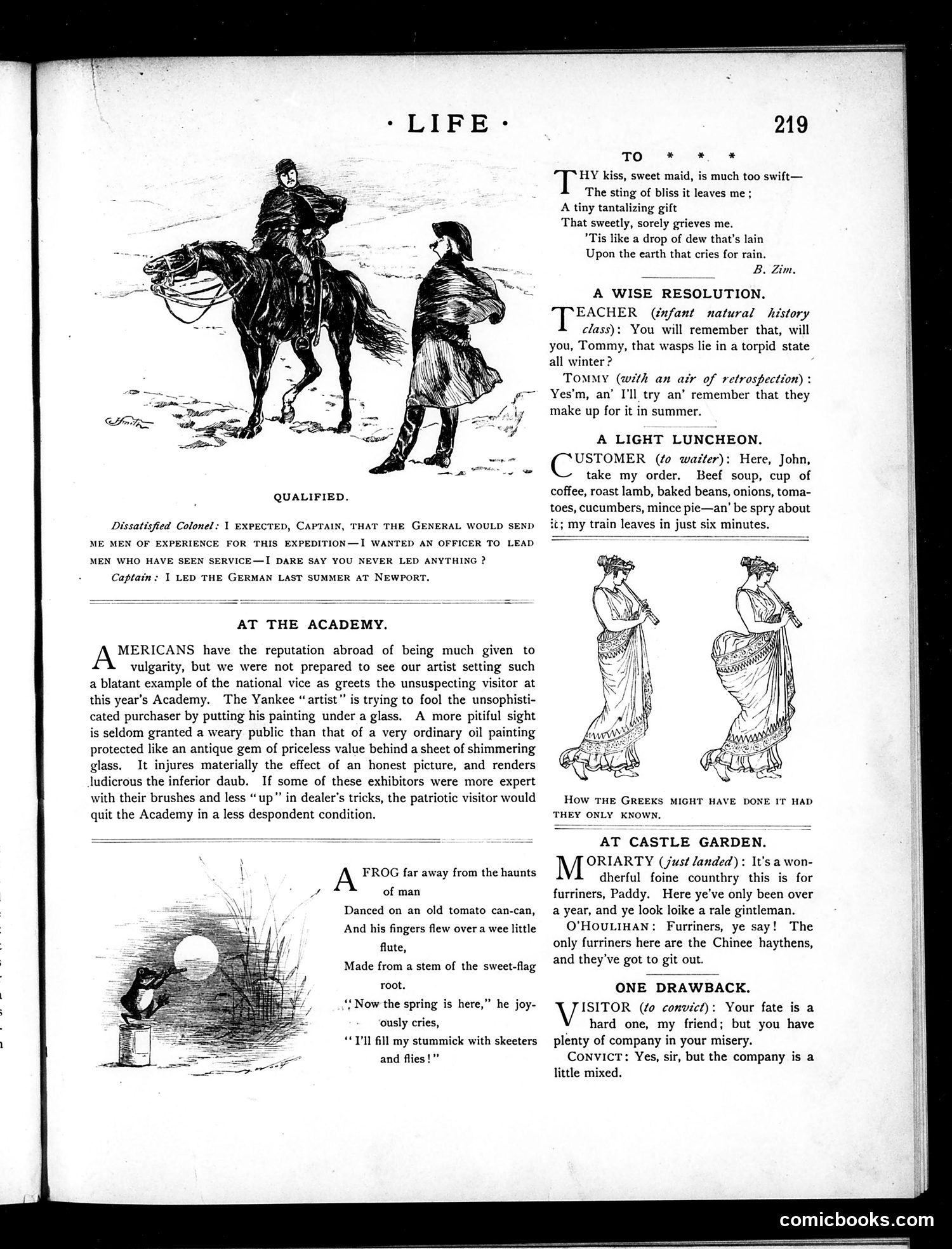
This page from *Life* magazine contains several unrelated satirical pieces: **"Qualified"** mocks military incompetence through a dialogue between a dissatisfied Colonel and a Captain. The Colonel wanted experienced officers for an expedition; the Captain admits he only led "the German last summer at Newport"—suggesting Newport was a minor social event, not actual military service. The satire targets officers with purely social credentials rather than genuine combat experience. **"At the Academy"** criticizes American artists exhibiting at the Academy for passing off mediocre work as masterpieces—specifically calling out a "Yankee artist" attempting to deceive buyers by displaying paintings under glass to make them appear valuable. It's a commentary on artistic fraud and American cultural pretension. The remaining pieces are lighter social humor and poetry.
📄 Transcribed text from this page (OCR, searchable)
Machine-transcribed from the original scan — historical spelling and the odd misread are preserved.
QUALIFIED. Dissatisfied Colonel: | EXPECTED, CAPTAIN, THAT THE GENERAL WOULD SEND ME MEN OF EXPERIENCE FOR THIS EXPEDITION—I WANTED AN OFFICER TO LEAD MEN WHO HAVE SEEN SERVICE—I DARE SAY YOU NEVER LED ANYTHING ? Captain: | LED THE GERMAN LAST SUMMER AT NEWPORT. AT THE ACADEMY. MERICANS have the reputation abroad of being much given to vulgarity, but we were not prepared to see our artist setting such a blatant example of the national vice as greets the unsuspecting visitor at this year’s Academy. The Yankee “artist” is trying to fool the unsophisti- cated purchaser by putting his painting under a glass. A more pitiful sight is seldom granted a weary public than that of a very ordinary oil painting protected like an antique gem of priceless value behind a sheet of shimmering glass. It injures materially the effect of an honest picture, and renders ludicrous the inferior daub. If some of these exhibitors were more expert with their brushes and less “up” in dealer's tricks, the patriotic visitor would quit the Academy in a less despondent condition. FROG far away from the haunts of man Danced on an old tomato can-can, And his fingers flew over a wee little flute, Made from a stem of the sweet-flag root. ‘‘ Now the spring is here,” he joy- ously cries, “‘’ll fill my stummick with skeeters and flies!” TO * * # HY kiss, sweet maid, is much too swift— The sting of bliss it leaves me ; A tiny tantalizing gift That sweetly, sorely grieves me. ’Tis like a drop of dew that’s lain Upon the earth that cries for rain. B, Zim, A WISE RESOLUTION. EACHER (znfant natural history class): You will remember that, will you, Tommy, that wasps lie in a torpid state all winter ? TOMMY (weth an air of retrospection) : Yes’m, an’ I'll try an’ remember that they make up for it in summer. A LIGHT LUNCHEON. USTOMER (fo wazter): Here, John, take my order. Beef soup, cup of coffee, roast lamb, baked beans, onions, toma- toes, cucumbers, mince pie—an’ be spry about ic; my train leaves in just six minutes. How THE GREEKS MIGHT HAVE DONE IT HAD THEY ONLY KNOWN. AT CASTLE GARDEN. ORIARTY (just landed): It's a won- dherful foine counthry this is for furriners, Paddy. Here ye’ve only been over a year, and ye look loike a rale gintleman. O’HOULIHAN: Furriners, ye say! The only furriners here are the Chinee haythens, and they've got to git out. ONE DRAWBACK. ISITOR (¢o convict): Your fate is a hard one, my friend; but you have plenty of company in your misery. Convict: Yes, sir, but the company is a little mixed. comicbooks.com