
Life, 1888-04-19 · page 2 of 18
Life — April 19, 1888 — page 2: what you’re looking at
What you’re looking at
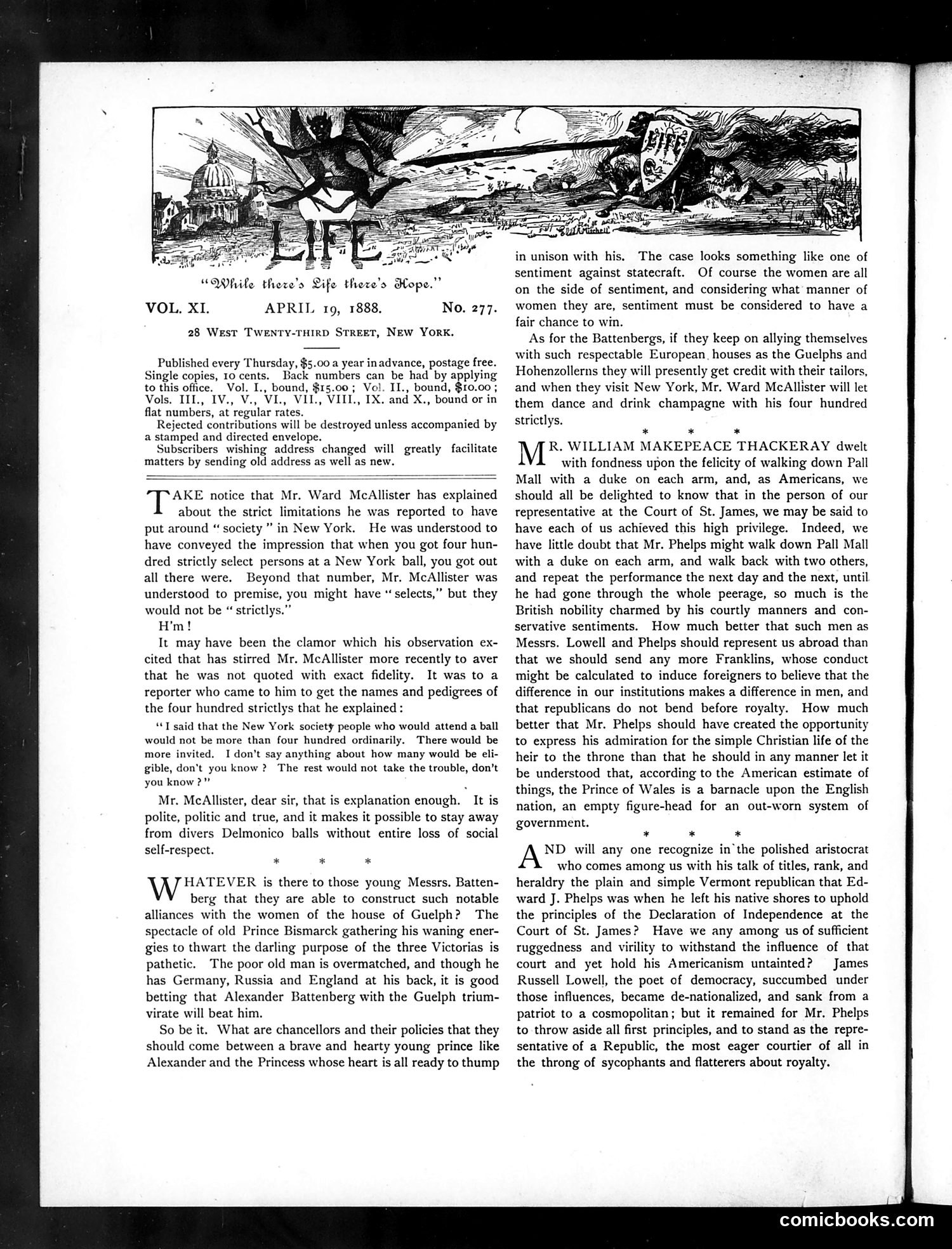
The masthead cartoon depicts **Death** (skeleton with scythe) surveying a battlefield landscape with a domed building (possibly the Capitol), satirizing mortality and national strife. The text discusses **Mr. Ward McAllister** and New York high society's strict exclusivity. McAllister allegedly claimed that only "four hundred" people qualified for elite society balls. The article mocks his pretentiousness, noting that calling attendees "selects" rather than "strictlys" doesn't change the arbitrary gatekeeping. Later passages critique **Mr. Phelps** (apparently a diplomat) for excessive deference to European nobility and royalty while representing American republican values abroad. The satire suggests he's abandoned democratic principles to curry favor with European aristocrats—betraying American ideals for cosmopolitan snobbery. The overall tone ridicules both American social climbing and compromised patriotism.
📄 Transcribed text from this page (OCR, searchable)
Machine-transcribed from the original scan — historical spelling and the odd misread are preserved.
“White there's Life there's Hope.’ VOL. XI. APRIL 19, 1888, 28 West TWENTY-THIRD STREET, NEw York. No. 277. Published every Thursday, $5.00 a year inadvance, postage free. Single copies, 10 cents. Back numbers can be had by applying to this office.’ Vol. I., bound, $15.00; Vol. II., bound, $10.00 ; Vols. IIl., IV., V., VL, VIL, VIIL., IX. and X., bound or in flat numbers, at regular rates. Rejected contributions will be destroyed unless accompanied by a stamped and directed envelope. Subscribers wishing address changed will greatly facilitate matters by sending old address as well as new. AKE notice that Mr. Ward McAllister has explained about the strict limitations he was reported to have put around “ society ” in New York. He was understood to have conveyed the impression that when you got four hun- dred strictly select persons at a New York ball, you got out all there were. Beyond that number, Mr. McAllister was understood to premise, you might have “selects,” but they would not be “ strictlys.” H'm! It may have been the clamor which his observation ex- cited that has stirred Mr. McAllister more recently to aver that he was not quoted with exact fidelity. It was to a reporter who came to him to get the names and pedigrees of the four hundred strictlys that he explained : “T said that the New York society people who would attend a ball would not be more than four hundred ordinarily. There would be more invited. I don’t say anything about how many would be eli- gible, don't you know ?- The rest would not take the trouble, don’t you know ?”” . Mr. McAllister, dear sir, that is explanation enough. It is polite, politic and true, and it makes it possible to stay away from divers Delmonico balls without entire loss of social self-respect. * * * HATEVER is there to those young Messrs. Batten- berg that they are able to construct such notable alliances with the women of the house of Guelph? The spectacle of old Prince Bismarck gathering his waning ener- gies to thwart the darling purpose of the three Victorias is pathetic. The poor old man is overmatched, and though he has Germany, Russia and England at his back, it is good betting that Alexander Battenberg with the Guelph trium- virate will beat him. So be it. What are chancellors and their policies that they should come between a brave and hearty young prince like Alexander and the Princess whose heart is all ready to thump in unison with his. The case looks something like one of sentiment against statecraft. Of course the women are all on the side of sentiment, and considering what manner of women they are, sentiment must be considered to have a fair chance to win. As for the Battenbergs, if they keep on allying themselves with such respectable European. houses as the Guelphs and Hohenzollerns they will presently get credit with their tailors, and when they visit New York, Mr. Ward McAllister will let them dance and drink champagne with his four hundred strictlys. * * * R. WILLIAM MAKEPEACE THACKERAY dwelt with fondness upon the felicity of walking down Pall Mall with a duke on each arm, and, as Americans, we should all be delighted to know that in the person of our representative at the Court of St. James, we may be said to have each of us achieved this high privilege. Indeed, we have little doubt that Mr. Phelps might walk down Pall Mall with a duke on each arm, and walk back with two others, and repeat the performance the next day and the next, until he had gone through the whole peerage, so much is the British nobility charmed by his courtly manners and con- servative sentiments. How much better that such men as Messrs. Lowell and Phelps should represent us abroad than that we should send any more Franklins, whose conduct might be calculated to induce foreigners to believe that the difference in our institutions makes a difference in men, and that republicans do not bend before royalty. How much better that Mr. Phelps should have created the opportunity to express his admiration for the simple Christian life of the heir to the throne than that he should in any manner let it be understood that, according to the American estimate of things, the Prince of Wales is a barnacle upon the English nation, an empty figure-head for an out-worn system of government. * * * ND will any one recognize in’the polished aristocrat who comes among us with his talk of titles, rank, and heraldry the plain and simple Vermont republican that Ed- ward J. Phelps was when he left his native shores to uphold the principles of the Declaration of Independence at the Court of St. James? Have we any among us of sufficient ruggedness and virility to withstand the influence of that court and yet hold his Americanism untainted? James Russell Lowell, the poet of democracy, succumbed under those influences, became de-nationalized, and sank from a patriot to a cosmopolitan; but it remained for Mr. Phelps to throw aside all first principles, and to stand as the repre- sentative of a Republic, the most eager courtier of all in the throng of sycophants and flatterers about royalty. comicbooks.com