
Life, 1888-04-19 · page 10 of 18
Life — April 19, 1888 — page 10: what you’re looking at
What you’re looking at
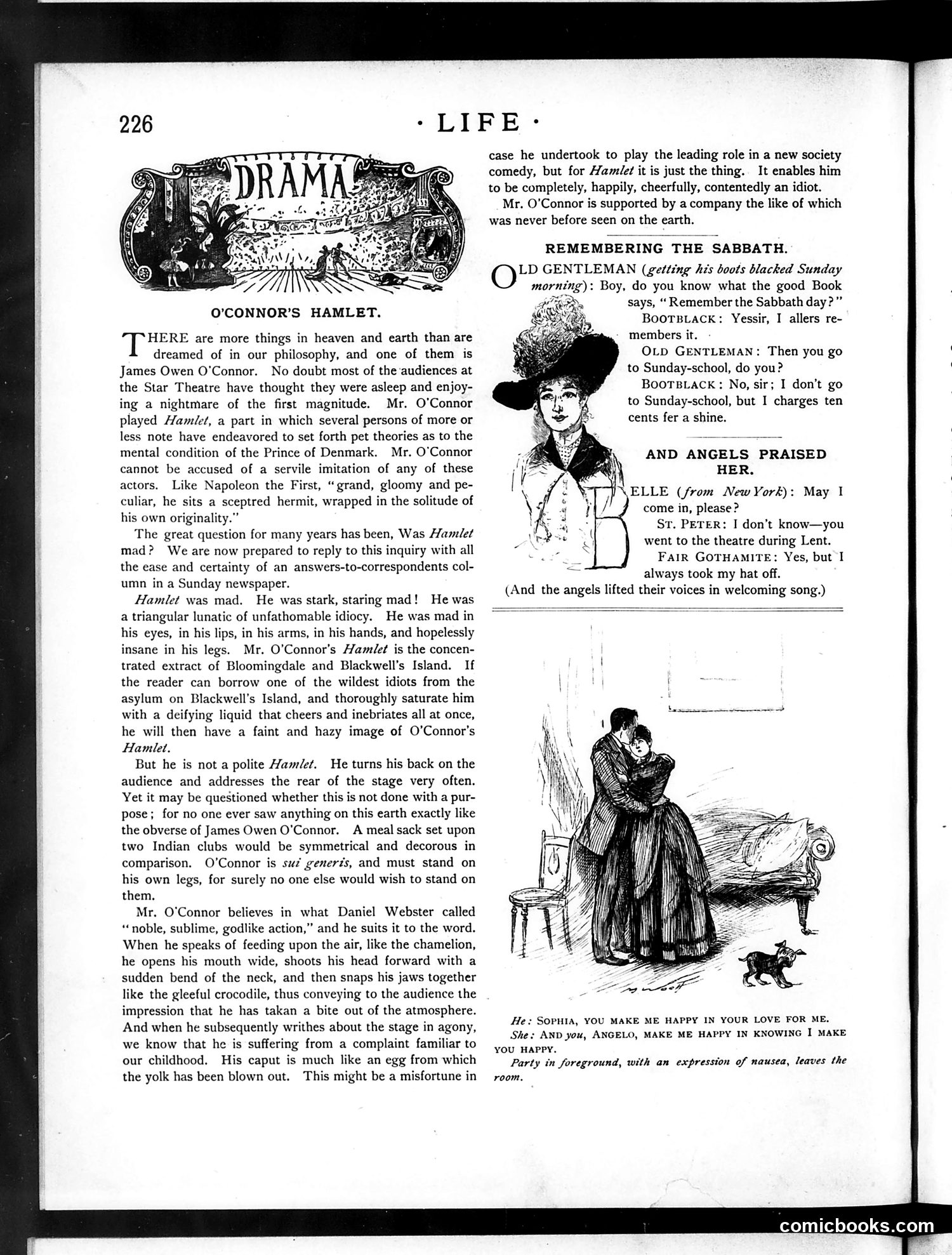
This page discusses James Owen O'Connor's theatrical performance as Hamlet. The text humorously describes O'Connor's eccentric interpretation: he plays the role as "mad" in an extreme, physical way—described as "a triangular lunatic of unfathomable idiocy" who is "mad in his eyes, in his hips, in his arms, in his hands, and hopelessly insane in his legs." The critique suggests O'Connor turns his back on audiences, addresses the rear of the stage, and employs exaggerated physical comedy. The satire mocks both his unconventional staging choices and what the writer considers his misguided theatrical philosophy, suggesting his interpretation prioritizes spectacle and peculiar physicality over the psychological depth Shakespeare's character demands.
📄 Transcribed text from this page (OCR, searchable)
Machine-transcribed from the original scan — historical spelling and the odd misread are preserved.
* LIFE: O’CONNOR’S HAMLET. HERE are more things in heaven and earth than are dreamed of in our philosophy, and one of them is James Owen O'Connor. No doubt most of the ‘audiences at the Star Theatre have thought they were asleep and enjoy- ing a nightmare of the first magnitude. Mr. O'Connor played Hamiet, a part in which several persons of more or less note have endeavored to set forth pet theories as to the mental condition of the Prince of Denmark. Mr. O'Connor cannot be accused of a servile imitation of any of these actors. Like Napoleon the First, “grand, gloomy and pe- culiar, he sits a sceptred hermit, wrapped in the solitude of his own originality.” The great question for many years has been, Was Hamlet mad? We are now prepared to reply to this inquiry with all the ease and certainty of an answers-to-correspondents col- umn in a Sunday newspaper. Hamlet was mad. He was stark, staring mad! He was a triangular lunatic of unfathomable idiocy. He was mad in his eyes, in his lips, in his arms, in his hands, and hopelessly insane in his legs. Mr. O'Connor's Hamlet is the concen- trated extract of Bloomingdale and Blackwell’s Island. If the reader can borrow one of the wildest idiots from the asylum on Blackwell's Island, and thoroughly saturate him with a deifying liquid that cheers and inebriates all at once, he will then have a faint and hazy image of O’Connor’s Hamlet. But he is not a polite Ham/et. He turns his back on the audience and addresses the rear of the stage very often. Yet it may be questioned whether this is not done with a pur- pose; for no one ever saw anything on this earth exactly like the obverse of James Owen O'Connor. A meal sack set upon two Indian clubs would be symmetrical and decorous in comparison. O'Connor is sw: generis, and must stand on his own legs, for surely no one else would wish to stand on them, Mr. O'Connor believes in what Daniel Webster called “noble, sublime, godlike action,” and he suits it to the word. When he speaks of feeding upon the air, like the chamelion, he opens his mouth wide, shoots his head forward with a sudden bend of the neck, and then snaps his jaws together like the gleeful crocodile, thus conveying to the audience the impression that he has takan a bite out of the atmosphere. And when he subsequently writhes about the stage in agony, we know that he is suffering from a complaint familiar to our childhood. His caput is much like an egg from which the yolk has been blown out. This might be a misfortune in case he undertook to play the leading role in a new society comedy, but for Hamlet it is just the thing. It enables him to be completely, happily, cheerfully, contentedly an idiot. Mr. O'Connor is supported by a company the like of which was never before seen on the earth. REMEMBERING THE SABBATH. LD GENTLEMAN (getting his boots blacked Sunday says, “ Remember the Sabbath day?” BOOTBLACK: Yessir, I allers re- members it. OLD GENTLEMAN: Then you go to Sunday-school, do you? BoorBLaCck: No, sir; I don’t go to Sunday-school, but I charges ten cents fer a shine. AND ANGELS PRAISED HER. ELLE (from New York): May 1 come in, please? Sr. PETER: I don’t know—you went to the theatre during Lent. FaiR GOTHAMITE: Yes, but I always took my hat off. (And the angels lifted their voices in welcoming song.) He: SOPHIA, YOU MAKE ME HAPPY IN YOUR LOVE FOR ME. She: AND you, ANGELO, MAKE ME HAPPY IN KNOWING I MAKE YOU HAPPY. Party in foreground, with an expression of nausea, leaves the room. comicbooks.com