
A complete issue · 16 pages · 1888
Life — April 12, 1888
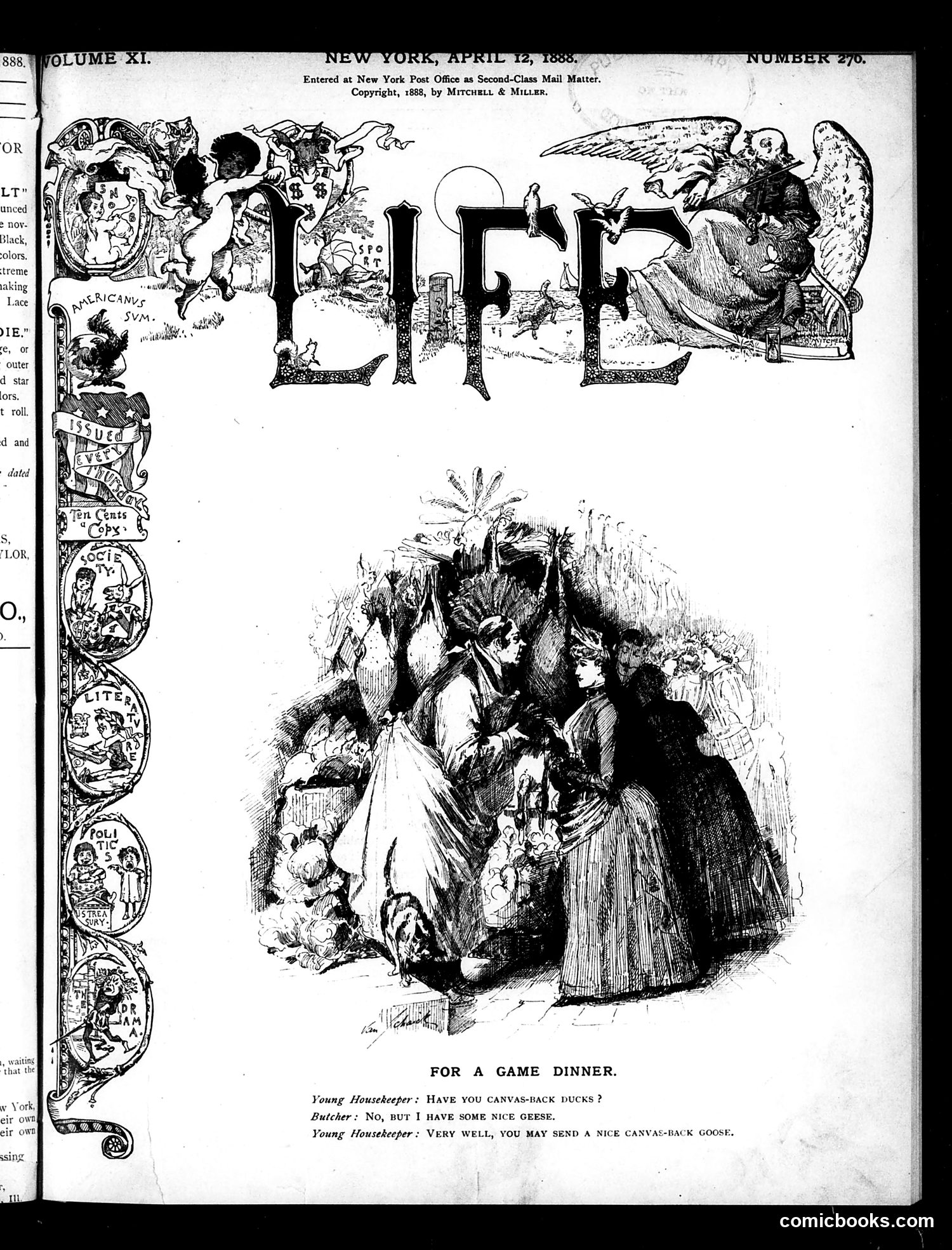
The bottom cartoon presents a domestic joke about procurement. A young housekeeper asks a butcher whether he has canvas-back ducks. The butcher replies he has only geese, prompting the housekeeper to suggest sending a canvas-back goose instead. The humor relies on wordplay: "canvas-back" refers to a specific, prized duck species (valued for game dinners), but the butcher's substitution of a goose—a comically inferior alternative—misses the mark entirely. The satire mocks either the butcher's incompetence or the housekeeper's naive acceptance of an absurd compromise, reflecting Victorian-era anxieties about servants, shopping, and maintaining proper social standards through refined dining.
This page contains three satirical essays rather than illustrated cartoons. The main topics are: 1. **Sunday stage coaches**: Debate over whether Fifth Avenue omnibuses (carriages) should operate on Sundays. Anti-Puritans argue this provides working-class recreation; critics counter that it violates the Sabbath and prevents drivers from attending church. 2. **Mr. Gould's reputation**: Satirizing Jay Gould's attempt to improve his public image by distancing himself from newspapers critical of him. The writer questions whether reputation-laundering can erase his notorious standing as a capitalist. 3. **Jake Sharp's health**: References to a specific scandal involving Sharp and Thomas Gould's acquittal in an "Occasional Abstinence Society" case involving illegal licensing—apparently a celebrated local incident among readers.
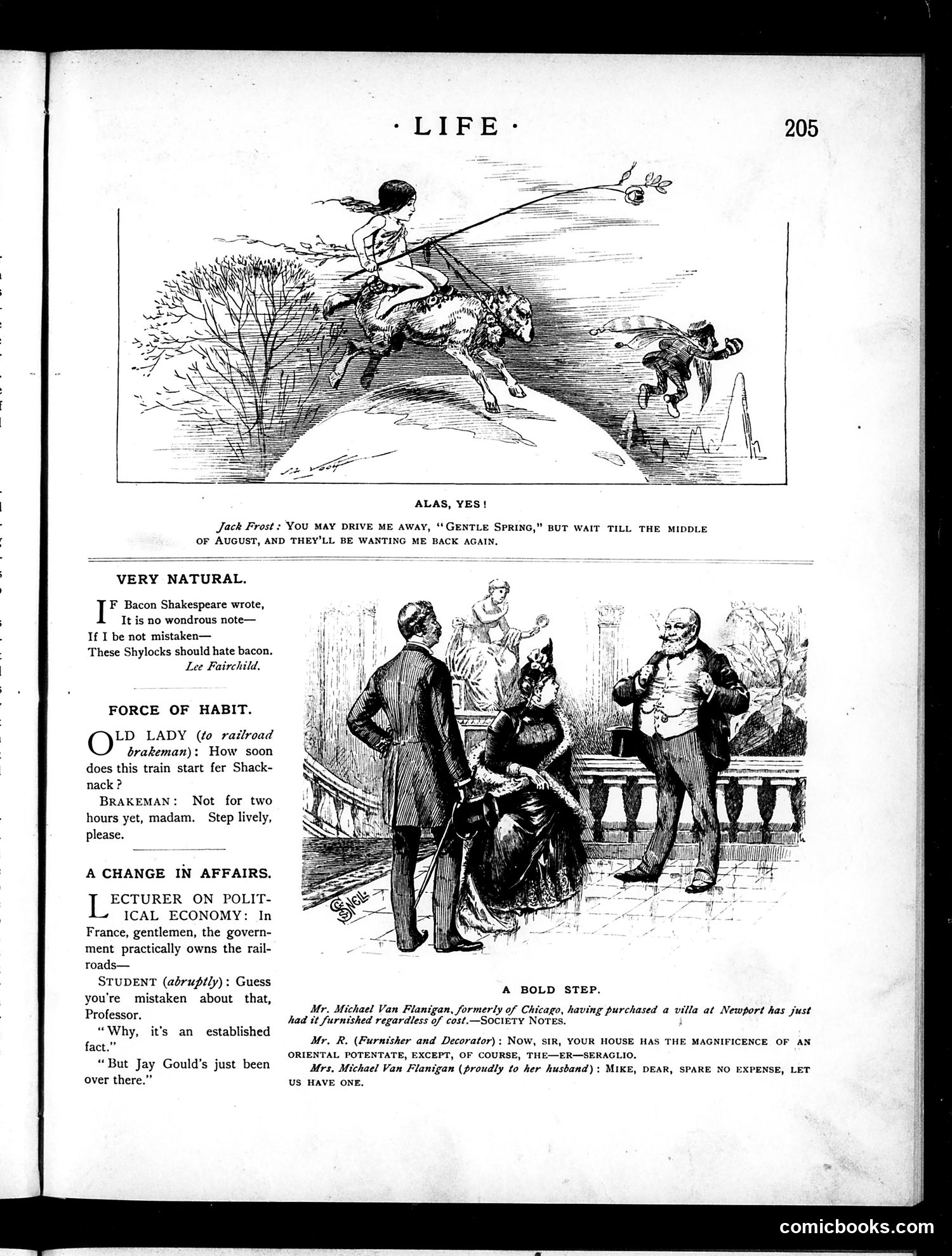
This page contains three separate satirical items: 1. **"Alas, Yes!"** (top): A whimsical illustration of a cherub riding a dog, with Jack Frost speaking. The joke plays on seasonal absence—someone warns Jack Frost to wait until mid-August when people will want him back (suggesting summer heat). 2. **"Very Natural"** and **"Force of Habit"**: Brief joke items mocking Shakespeare scholarship and railroad operations respectively. 3. **"A Bold Step"** (bottom): The main cartoon depicts a wealthy man (Mr. Michael Van Flanigan, identified in caption) proudly showing off his newly purchased Oriental porcelain to others. The humor satirizes nouveau riche pretension—his wife urges him to spare no expense displaying their acquisition, emphasizing status-conscious materialism among the wealthy. These pieces represent typical Life magazine humor: social satire targeting literary pretension and class affectation.
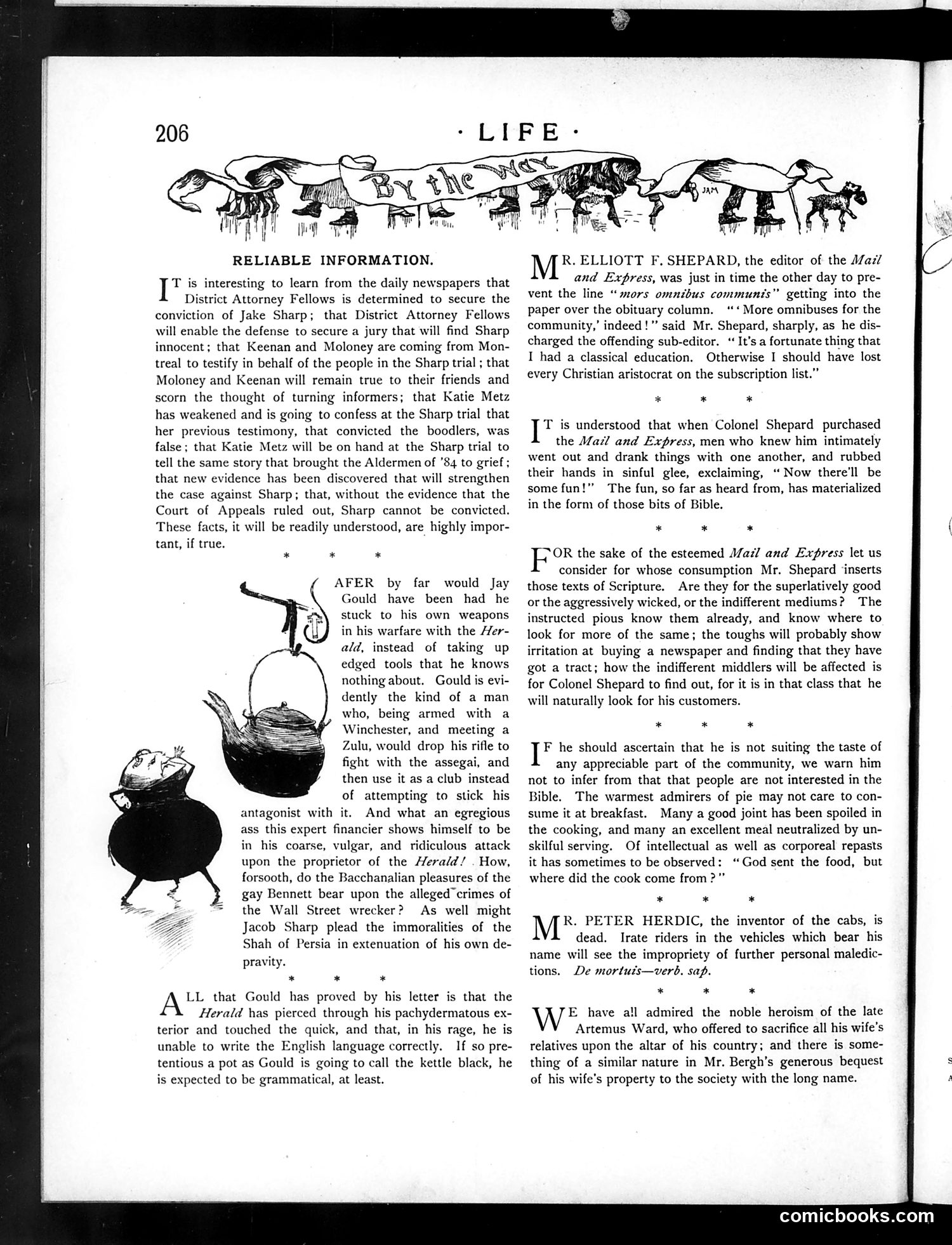
The cartoon depicts a man (labeled "Gould") attempting to fight an assegai (African spear) with a rifle—but using it as a club instead of firing it. The satire targets Gould's incompetence and poor judgment in conflict. The text discusses the Herald newspaper's coverage of the Sharp trial and related legal matters. It then mocks Mr. Elliott F. Shepard, editor of the *Mail and Express*, for inserting Bible passages into his newspaper, sarcastically suggesting these scripture quotations are meant for his readers' spiritual edification rather than serving legitimate editorial purposes. The piece uses humor to criticize both journalistic practices and editorial pretension, implying Shepard uses religious content cynically rather than sincerely.
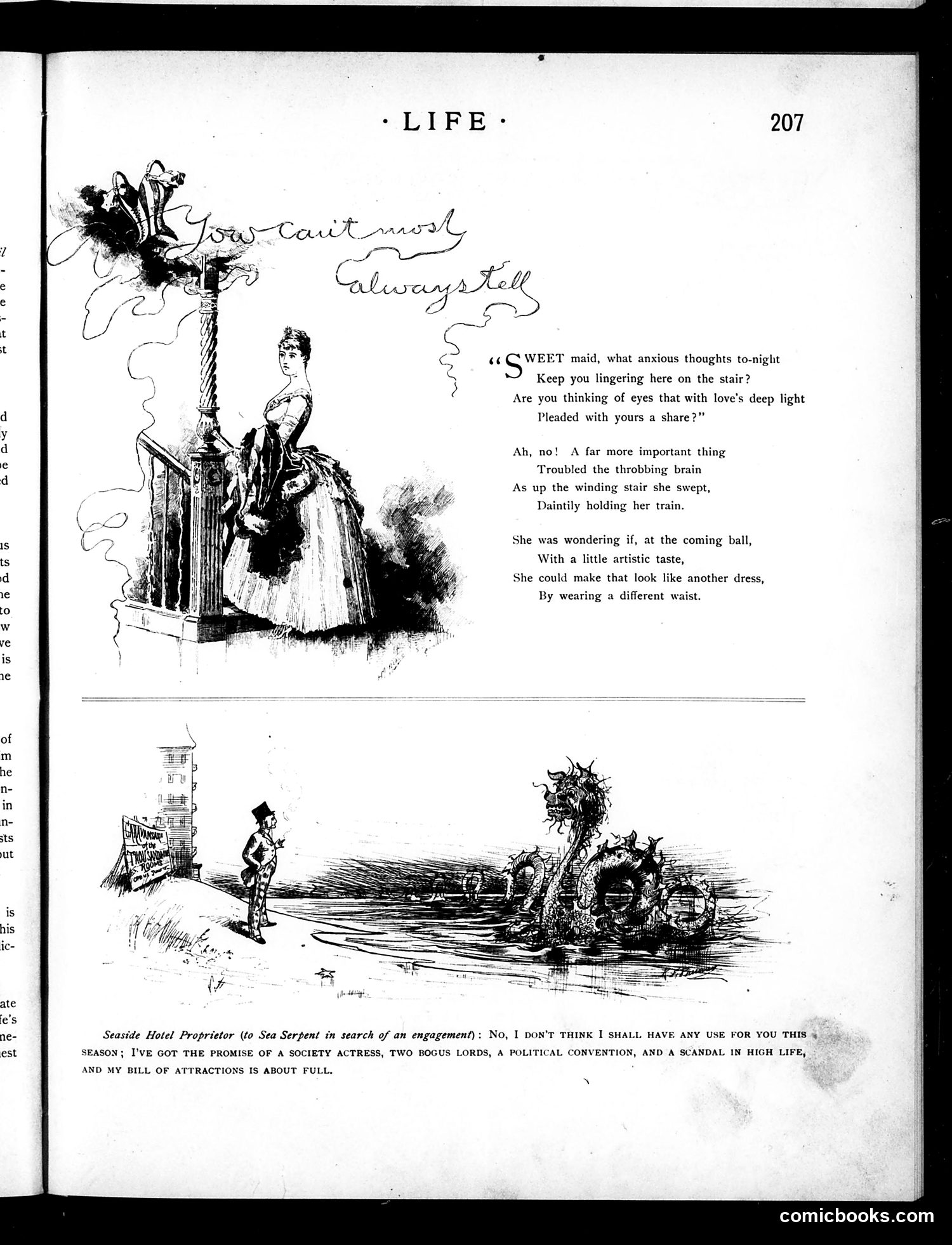
This page contains two unrelated satirical pieces: **Top illustration:** A poem about a young woman on a staircase worried about her appearance at an upcoming ball. The satire gently mocks female vanity—her "throbbing brain" is preoccupied not with romance but with whether her dress's waistline looks flattering enough. This reflects late Victorian/Edwardian social anxieties about fashion and female propriety. **Bottom illustration:** Depicts a "Seaside Hotel Proprietor (in Sea Serpent disguise)" rejecting a potential customer. The caption sardonically lists his excuses: he's already promised space to "a society actress, two bogus lords, a political convention, and a scandal in high life." This mocks both hotel overbooking and the absurd celebrity/scandal culture that proprietors seemingly prioritized over regular guests.
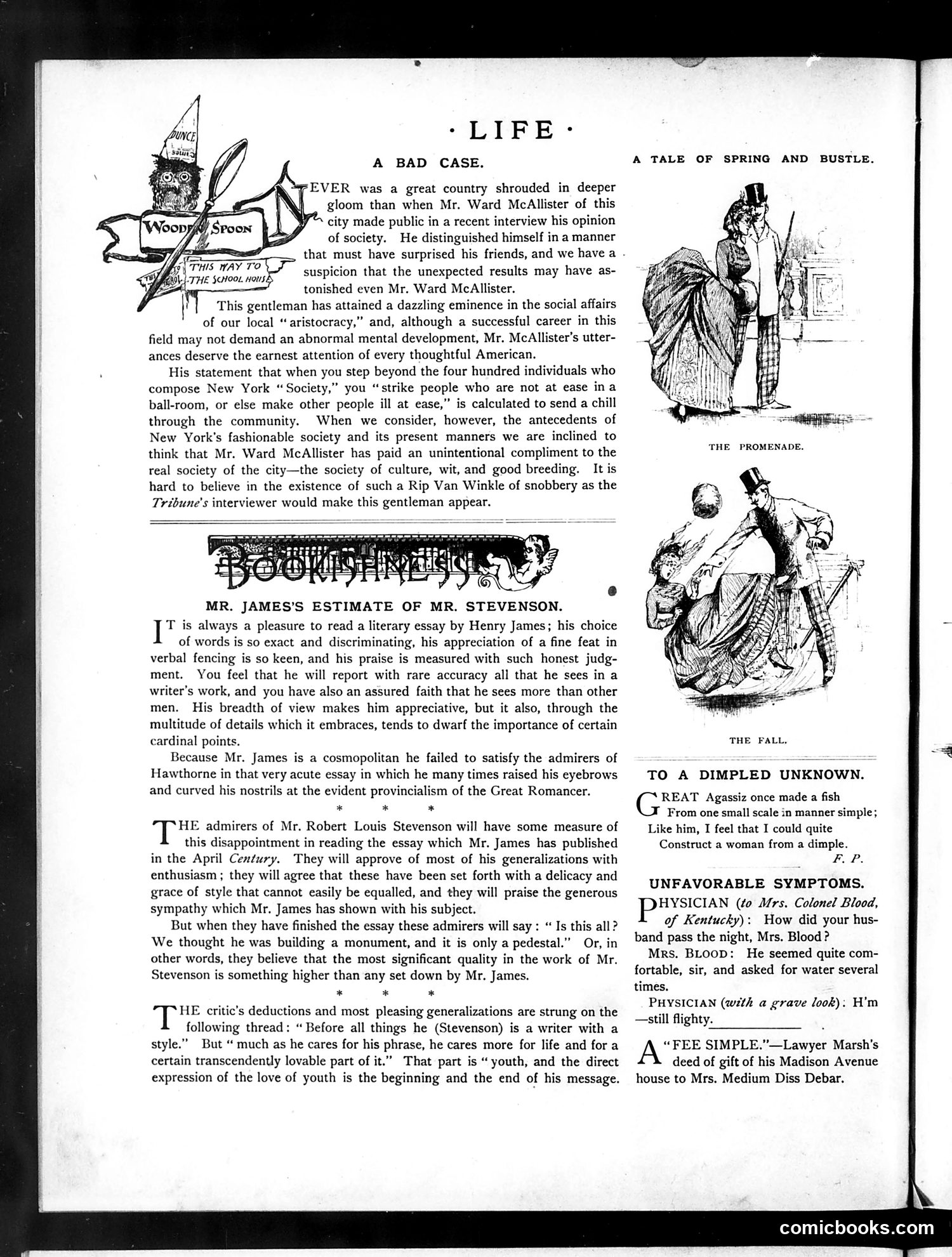
This page contains three distinct sections: **"A Bad Case"** critiques Ward McAllister, a prominent New York society figure, for claiming that only 400 people constitute "Society" and that others "strike people who are not at ease." The article sarcastically suggests McAllister has inadvertently complimented rather than insulted actual cultured society. **"Mr. James's Estimate of Mr. Stevenson"** reviews Henry James's literary essay on Robert Louis Stevenson, praising James's discriminating style while suggesting his analysis, though elegant, may obscure Stevenson's significance by over-emphasis on minor details. The right side contains three small illustrations and humorous brief items, including a crude joke about constructing a woman "from a dimple" and medical humor about a restless night. The satire targets social pretension and literary over-analysis.
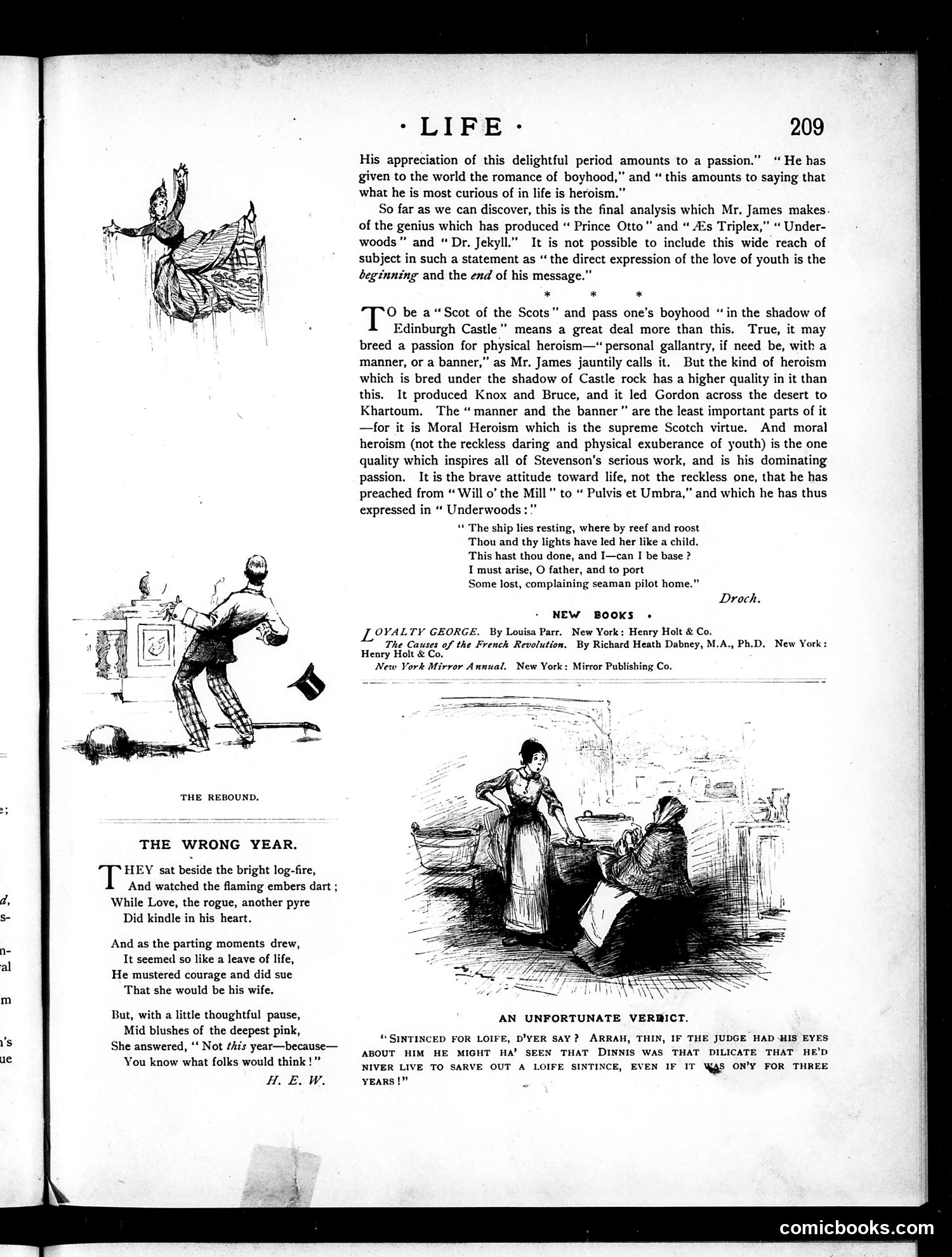
This page contains literary content rather than political satire. The main article discusses Scottish author Robert Louis Stevenson's works, analyzing the "moral heroism" present in his writing—the brave, principled attitude toward life he portrays rather than reckless physical daring. The illustrations are literary sketches: "The Rebound" shows a figure in dynamic motion, while "An Unfortunate Verbatim" depicts a domestic scene with the caption presenting a humorous exchange about marriage timing. Below is a poem titled "The Wrong Year" by H.E.W., also domestic in nature, discussing a couple's hesitation about marriage due to social concerns. The page concludes with brief book notices. Overall, this is a cultural/literary page rather than political commentary.
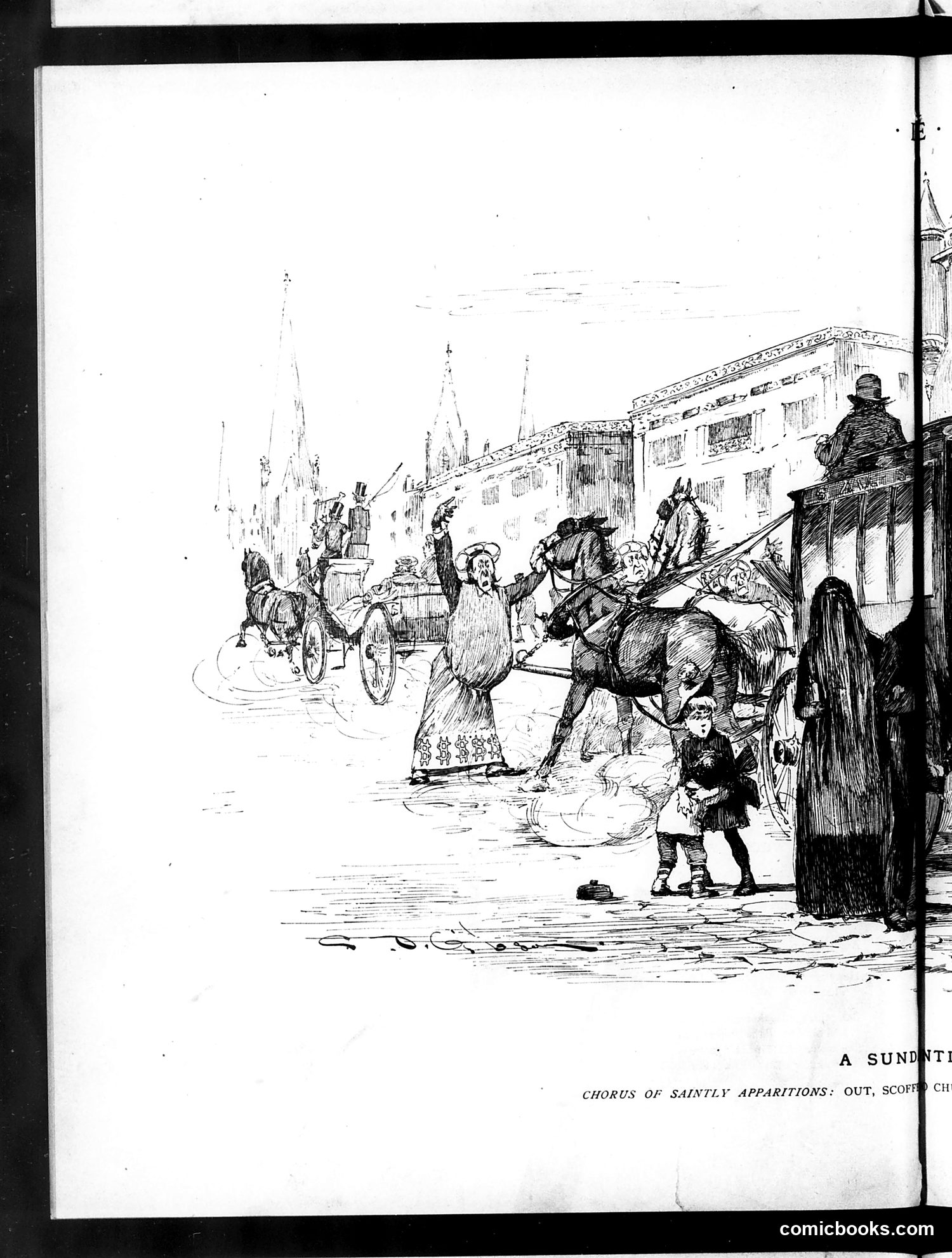
This appears to be a satirical illustration from Life magazine depicting a street scene, likely in Scotland based on the caption reference to "SCOT[S]" and the architectural style shown. The image shows what appears to be a public gathering or procession with horses, carriages, and various figures in period dress. The caption references "CHORUS OF SAINTLY APPARITIONS: OUT, SCOT[S]..." suggesting the scene satirizes supernatural or ghostly visions. Without the complete caption text visible, the specific political or social target is unclear. However, the gathering of figures and the reference to "saintly apparitions" suggests this may be mocking either Scottish religious enthusiasm, a specific political gathering, or a contemporary social phenomenon framed as ghostly manifestations. The detailed period illustration style is typical of Life's satirical approach to current events of its era.
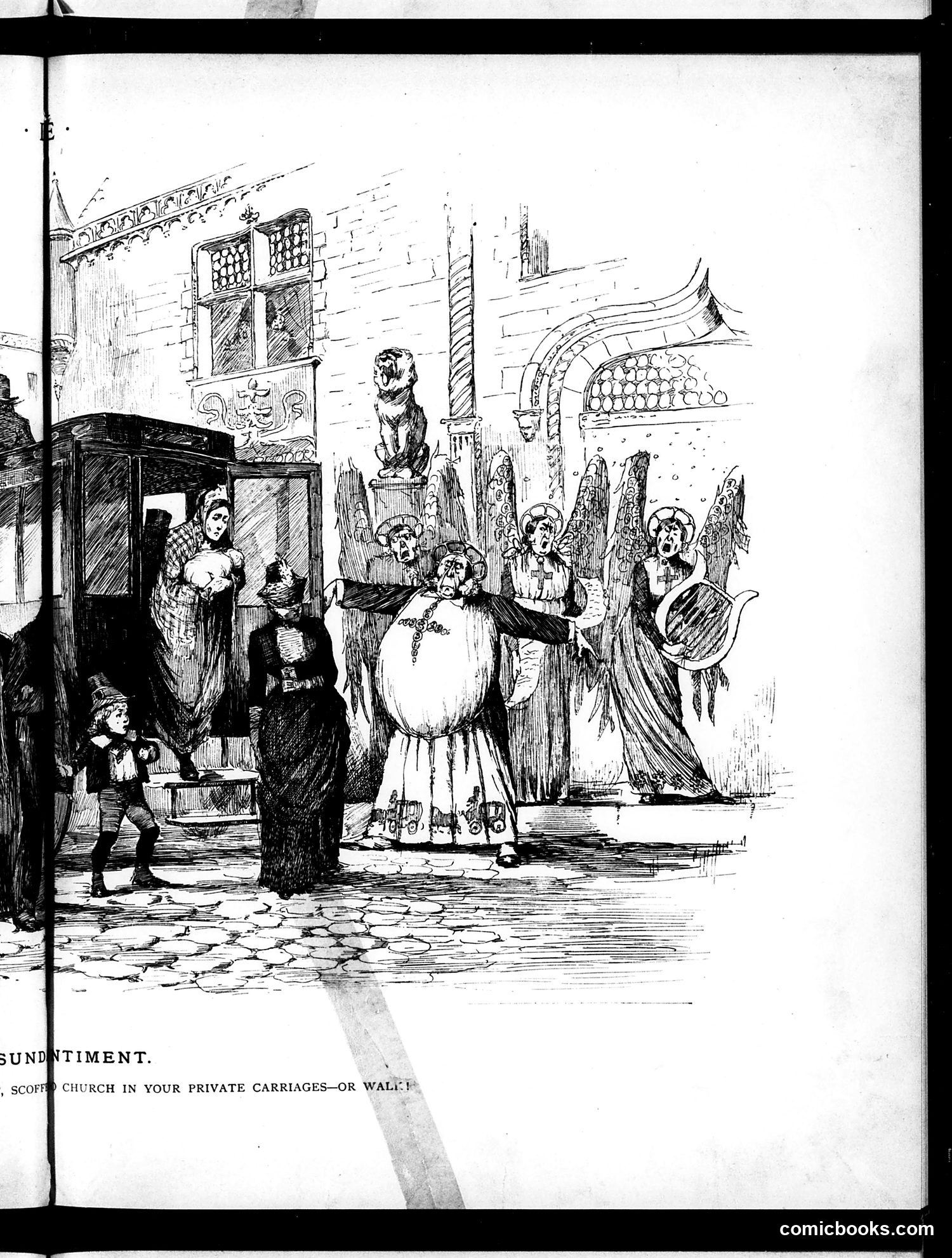
This appears to be a satirical cartoon about Sunday church attendance, likely from the late 19th or early 20th century. The visible text references "SUNDAY SENTIMENT" and mentions attending "SCOTCH CHURCH IN YOUR PRIVATE CARRIAGES—OR WALK." The cartoon depicts wealthy, well-dressed church figures (identifiable by halos, suggesting religious hypocrisy) emerging from a church building alongside ordinary townspeople. The satire seems to critique the class divide in religious practice—the wealthy arriving by private carriage while the poor walk—and suggests mockery of ostentatious religious observance among the affluent. The dog statue on a pedestal and the architectural details suggest a Scottish church setting. The overall message appears to be social commentary on the disconnect between professed religious values and actual class-based behavior among church attendees.
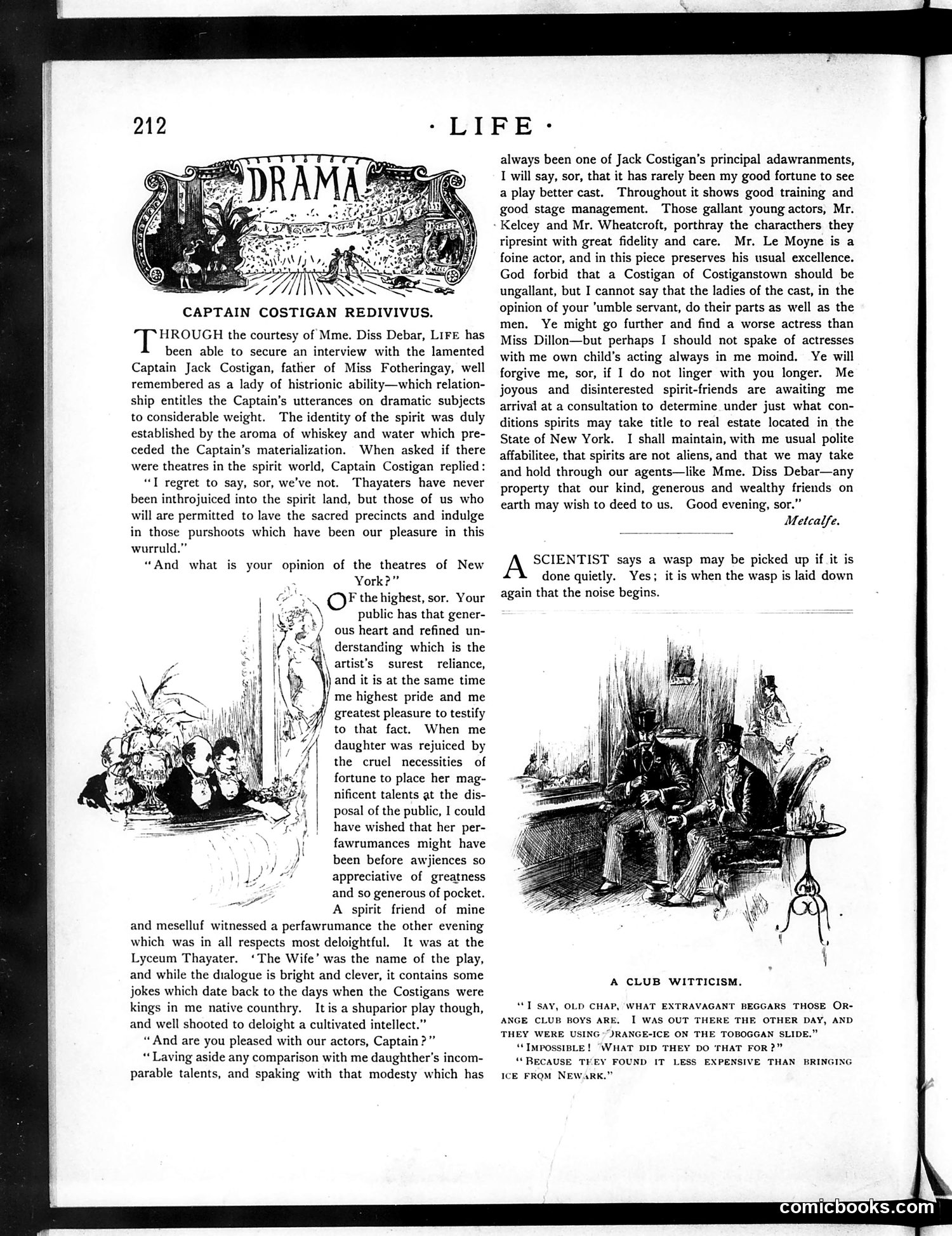
This page features an interview with **Captain Jack Costigan** about theatrical life, conducted through a spiritualist medium (Mme. Diss Debar). The "Drama" masthead indicates this is the magazine's theater criticism section. The two illustrated cartoons appear to be: 1. **Left cartoon**: Figures in conversation, likely depicting the spiritualist séance setup 2. **Right cartoon**: "A Club Witticism" - showing gentlemen at what appears to be a social club, with dialogue about bringing ice from Newark being cheaper than other options The text mocks both theatrical pretensions and spiritualism (popular in this era). The Costigan interview uses the spiritualist framing satirically—suggesting the need for supernatural means to communicate with theater people. The club cartoon jokes about absurdly economical thinking among wealthy clubmen.
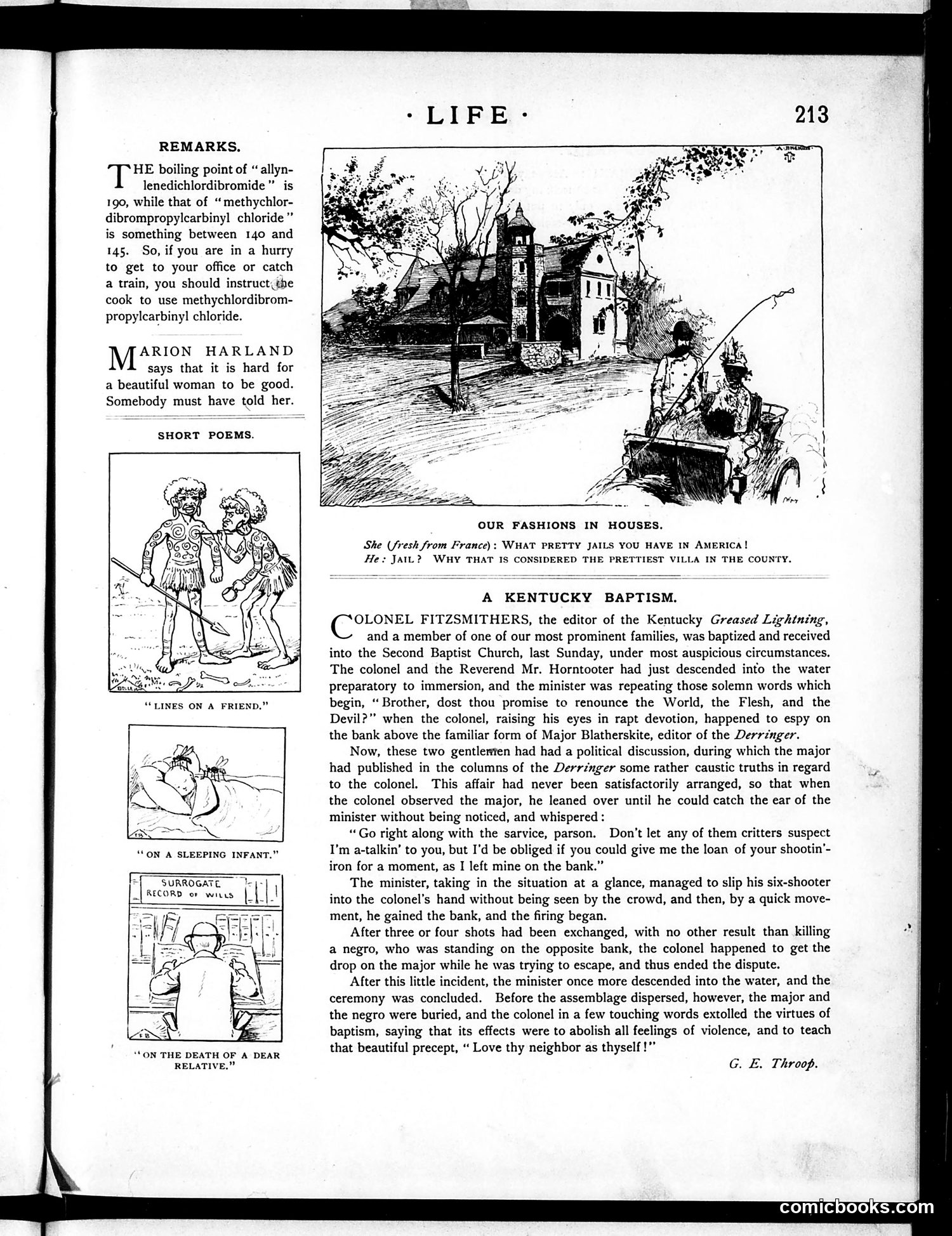
This page contains satirical commentary on American society circa the late 19th/early 20th century. **"Our Fashions in Houses"**: A French visitor marvels at an American villa, calling it a "jail." The joke mocks American architectural taste—suggesting wealthy Americans build homes resembling prisons, or that Americans imprison themselves in ugly structures. **"A Kentucky Baptism"**: The main satire depicts Colonel Fitzsmithers interrupting his own baptism to borrow the minister's gun and shoot his political rival, Major Blatherskite, over a newspaper dispute. A Black bystander is killed in the crossfire. After burying the major and the unnamed Black victim, Fitzsmithers delivers touching remarks about baptism promoting peace and "Love thy neighbor." The satire targets Southern violence, hypocrisy regarding Christian values, and racial indifference—a Black death is treated as incidental. It satirizes how violence and feuds permeate Southern (particularly Kentucky) culture, even penetrating sacred religious ceremonies. The minister's casual complicity emphasizes how normalized such behavior was.
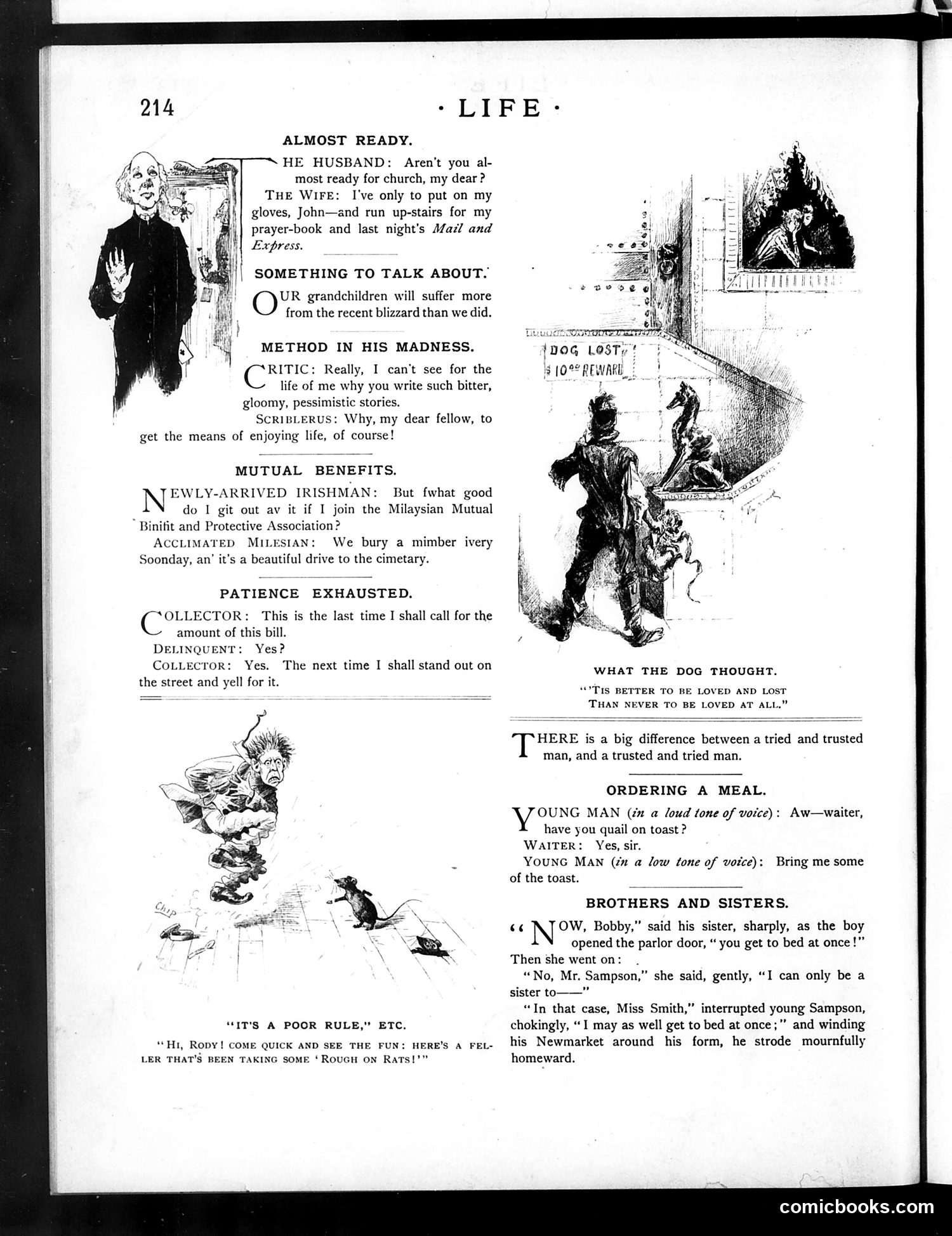
This page from *Life* magazine contains several brief humorous sketches mocking everyday social situations and human foibles: **"Almost Ready"** ridicules wives' endless preparation routines—the wife claims she only needs to put on gloves, then mentions fetching her prayer-book *and* last night's newspapers, suggesting women prioritize gossip over religious devotion. **"Method in His Madness"** jokes that a bitter, pessimistic writer deliberately crafts gloomy stories to earn money for enjoying life—ironic commentary on artistic motivation. **"Mutual Benefits"** uses Irish immigrant stereotypes and dialect to humorously suggest the "mutual benefit" of an Irish association is that weekly funeral processions to the cemetery provide entertainment. **"Patience Exhausted"** depicts a debt collector threatening to publicly shame a delinquent debtor by shouting in the street. **"Ordering a Meal"** satirizes class-conscious affectation: a young man loudly orders expensive quail on toast, then quietly requests only the cheap toast when alone. **"Brothers and Sisters"** plays on romantic rejection—a young man's dignified exit after being "friend-zoned" provides dark comedy.
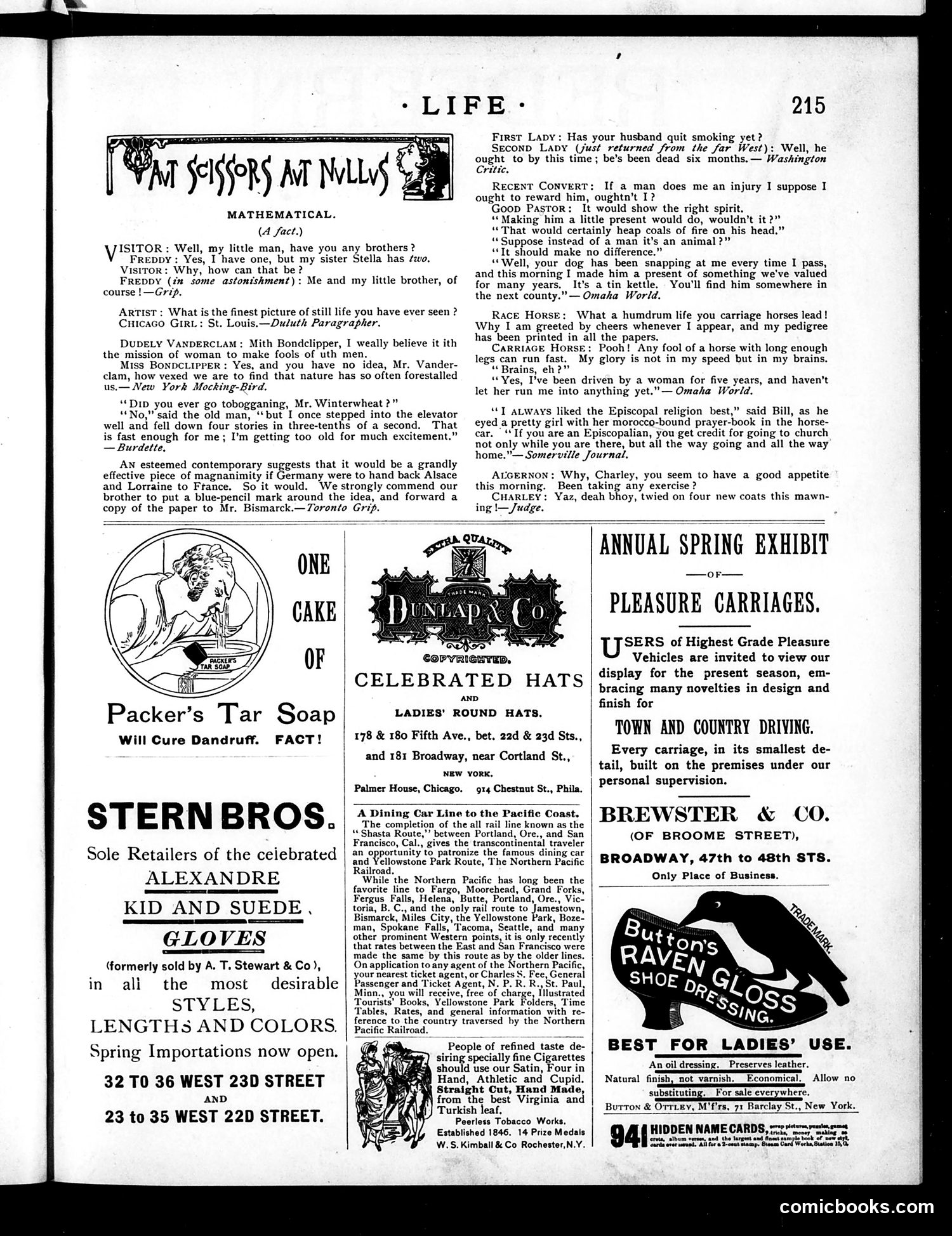
This page from *Life* magazine contains primarily **short humorous anecdotes** rather than political cartoons. The jokes rely on wordplay and social observation typical of late 19th-century American humor. Notable examples: - **"Mathematical"**: A child's logic puzzle about siblings that creates confusion through literal interpretation - **Woman vs. Man**: A quip about women's "mission" to make fools of men, with a woman cleverly turning it back on the man - **Dog as Gift**: Social satire where a man gives an annoying dog a tin kettle as "reward," getting revenge while appearing virtuous - **Carriage Horse**: A working horse's pride in intelligence (not speed) demonstrated by safely navigating five years under female driver - **Religion Joke**: Mockery of Episcopalian practice as requiring church attendance only during the actual visit The remainder consists of **period advertisements** for tar soap, gloves, hats, pleasure carriages, and shoe polish—standard commercial content. No clear political commentary or identifiable caricatures appear on this page.
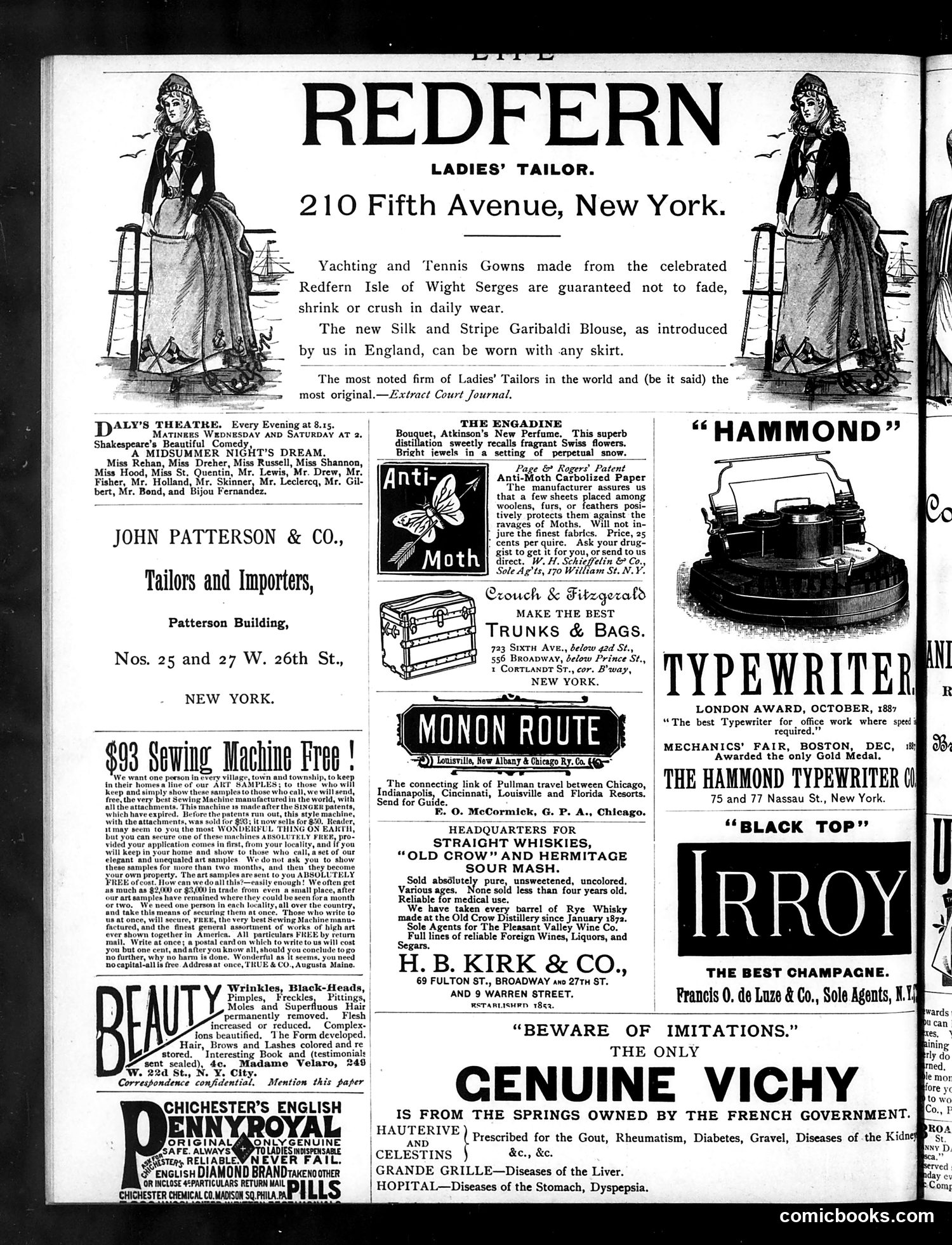
This is primarily an **advertising page** from Life magazine, not a satirical cartoon. The page features various commercial advertisements typical of late 19th-century American publications, including: **Major Ads:** - **Redfern Ladies' Tailor** (top): High-end clothing for yachting and tennis - **Daly's Theatre**: Shakespeare production casting - **Sewing Machine giveaway** and beauty treatments - **Hammond Typewriter**: Office equipment winning awards - **H.B. Kirk & Co.**: Whisky distributor - **Vichy Water**: French mineral water for medical conditions **Notable Context for Modern Readers:** The advertisements reflect period concerns—anti-moth paper for woolens, remedies for gout and rheumatism, and emphasis on "genuine" products (warning against counterfeits). The heavy presence of medical/pharmaceutical ads suggests less regulation than today. The page demonstrates how Life supplemented satirical content with commercial revenue, targeting affluent readers interested in imported luxury goods, theater, and fashionable clothing.
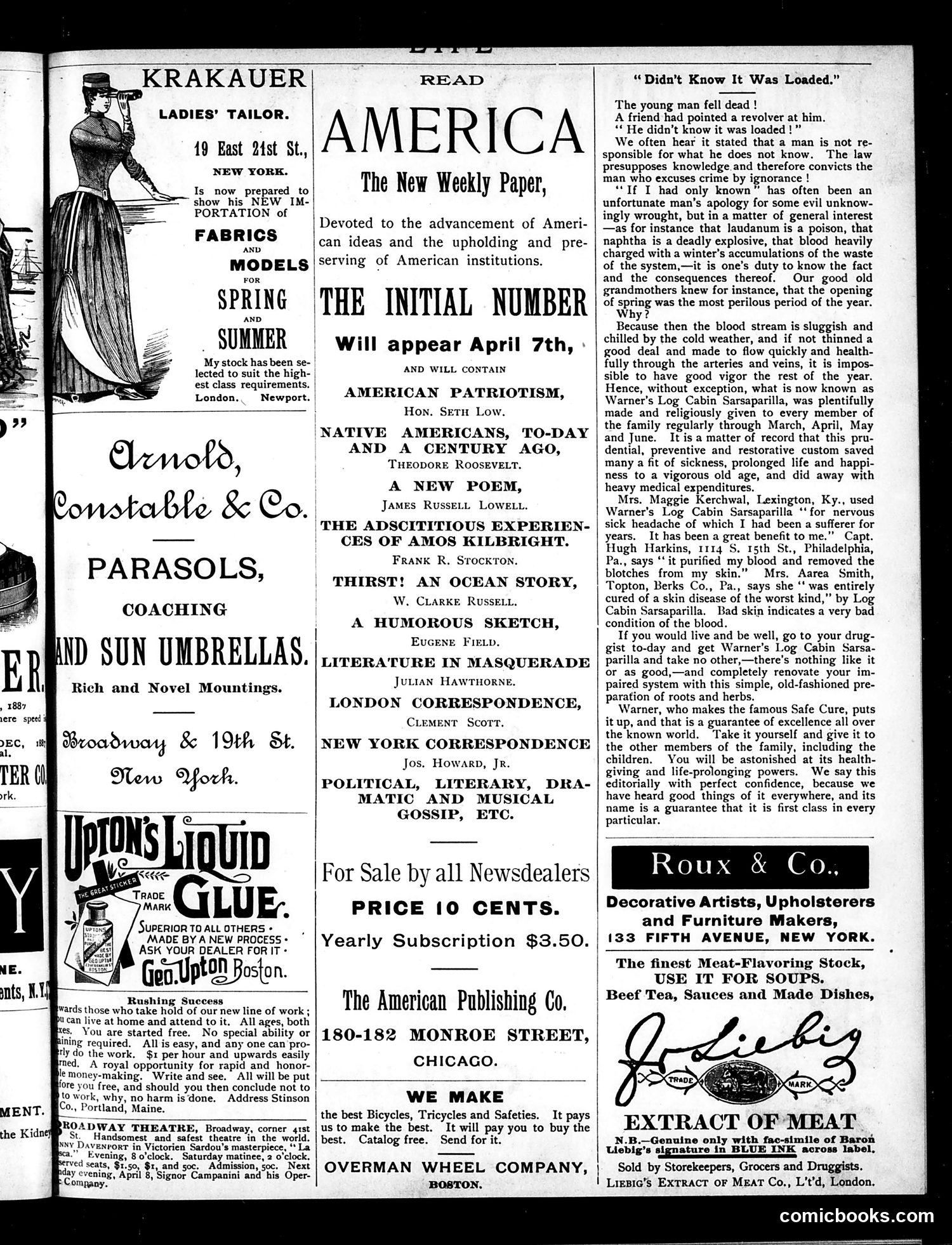
This is primarily a **title/announcement page** for a new publication called "America: The New Weekly Paper," debuting April 7th. Rather than containing satire or political cartoons, the page announces the magazine's patriotic mission and lists content by notable contributors including Theodore Roosevelt and James Russell Lowell. The page is dominated by **advertisements**—for a ladies' tailor, parasols, bicycles, and prominently, **Warner's Log Cabin Sarsaparilla** (a patent medicine). The longest editorial content is a **health/moral argument** titled "Didn't Know It Was Loaded," using a fatal shooting accident as a metaphor. It argues ignorance is no excuse—people have a *duty* to know facts, particularly health facts. It then pivots to promoting sarsaparilla as a spring blood-purifier, claiming grandmothers traditionally used such tonics to prevent seasonal illness. **The satire here is subtle**: the piece uses tragic moralizing about responsibility to sell patent medicine—a common 19th-century advertising tactic conflating ethical duty with product consumption.
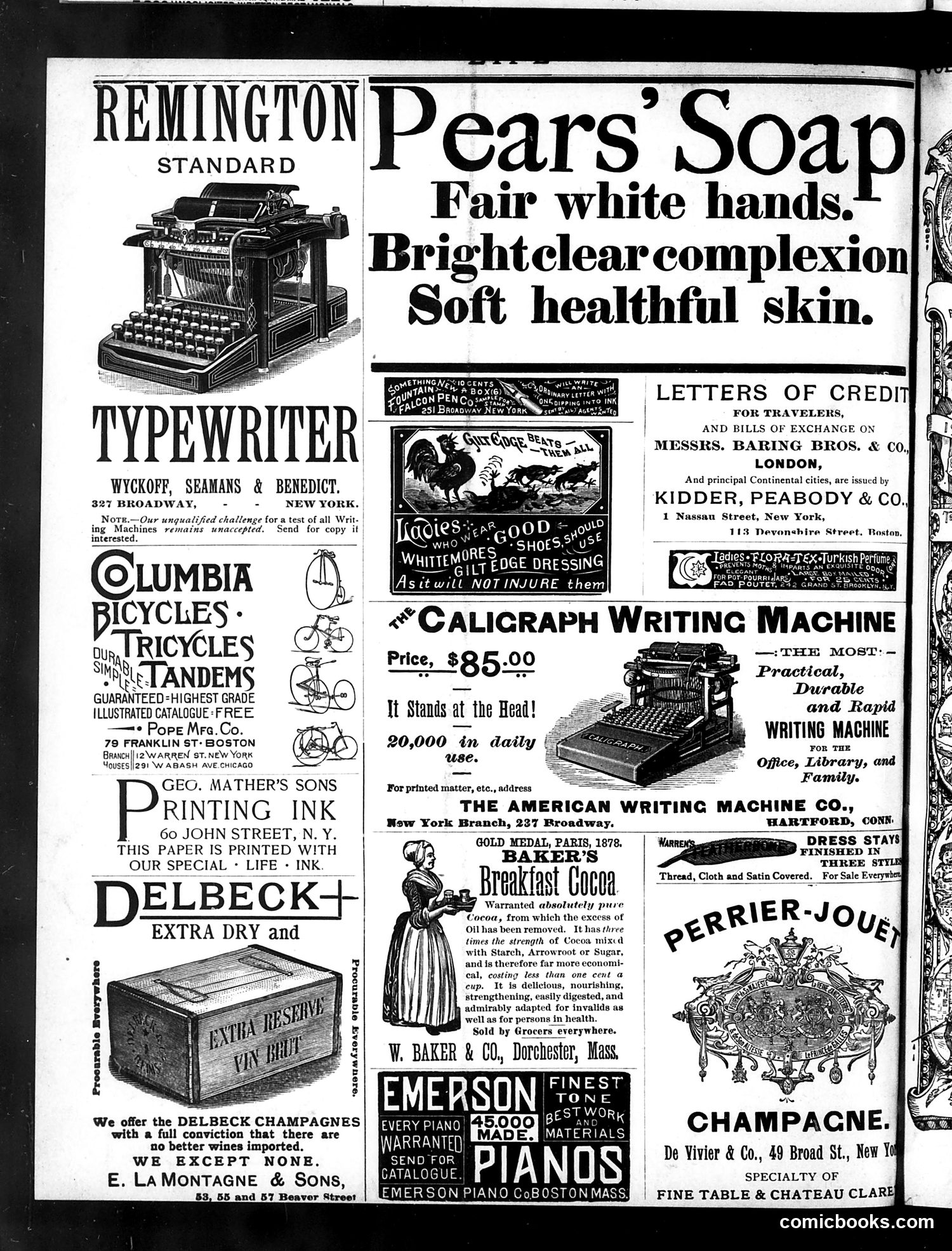
This is primarily a **advertising page** from an American publication (Life magazine), likely from the 1880s based on product styles and typography. There are no political cartoons or satirical content visible. The page contains typical Victorian-era advertisements for: - **Writing machines** (typewriters) — Remington, Caligraph, American Writing Machine - **Consumer goods** — Pears' Soap (emphasizing "fair white hands" and "bright clear complexion"), Baker's Breakfast Cocoa, champagne - **Bicycles and tricycles** — Columbia brand - **Musical instruments** — Emerson pianos - **Financial services** — Kidder, Peabody & Co. offering letters of credit The Pears' Soap advertisement reflects **period racial attitudes**: its emphasis on "fair white hands" and skin-brightening properties reflects problematic Victorian beauty standards that privileged pale complexions. Otherwise, this is a straightforward commercial page with no identifiable political satire or cartoon commentary.