
Life, 1888-04-12 · page 6 of 16
Life — April 12, 1888 — page 6: what you’re looking at
What you’re looking at
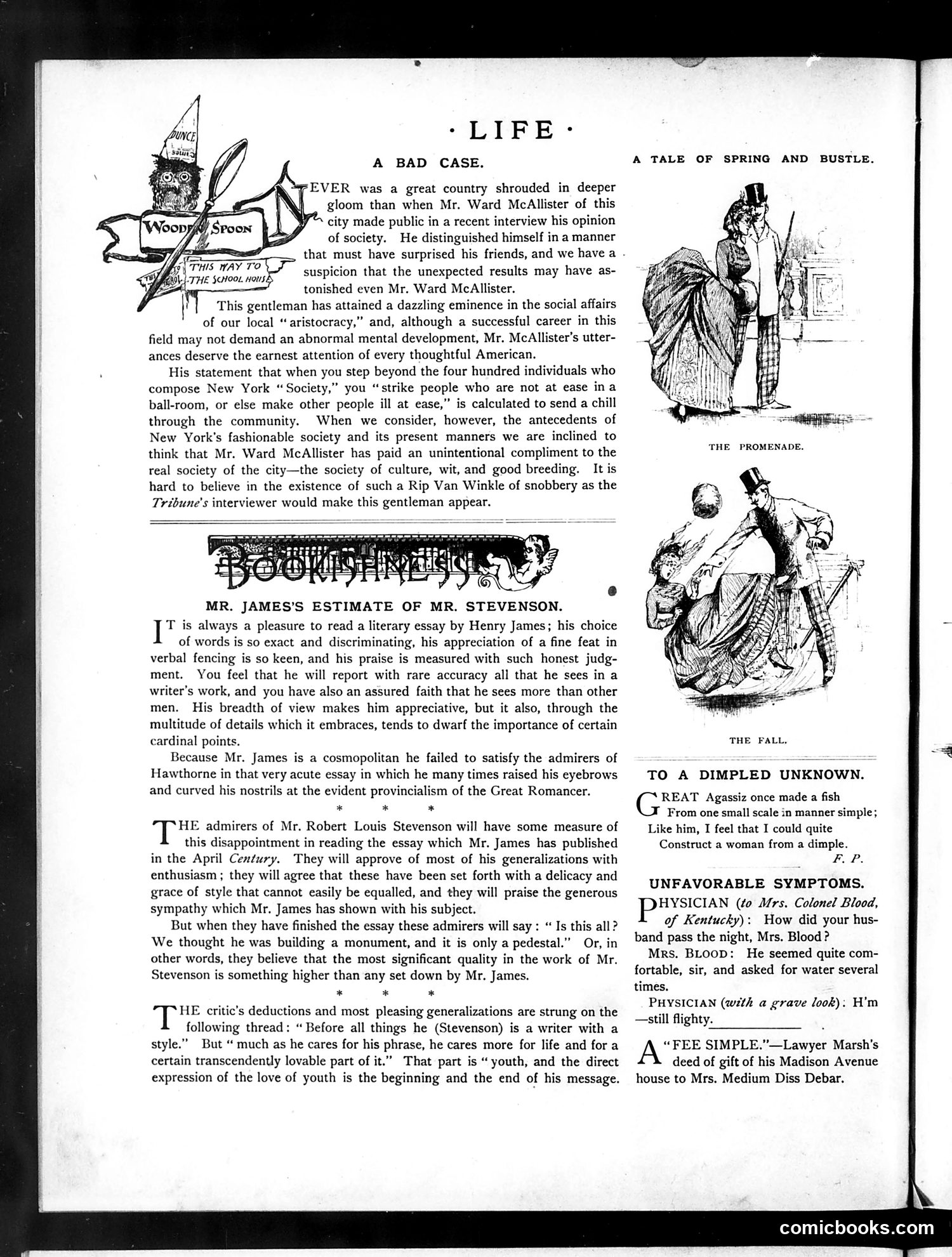
This page contains three distinct sections: **"A Bad Case"** critiques Ward McAllister, a prominent New York society figure, for claiming that only 400 people constitute "Society" and that others "strike people who are not at ease." The article sarcastically suggests McAllister has inadvertently complimented rather than insulted actual cultured society. **"Mr. James's Estimate of Mr. Stevenson"** reviews Henry James's literary essay on Robert Louis Stevenson, praising James's discriminating style while suggesting his analysis, though elegant, may obscure Stevenson's significance by over-emphasis on minor details. The right side contains three small illustrations and humorous brief items, including a crude joke about constructing a woman "from a dimple" and medical humor about a restless night. The satire targets social pretension and literary over-analysis.
📄 Transcribed text from this page (OCR, searchable)
Machine-transcribed from the original scan — historical spelling and the odd misread are preserved.
- LIFE: A BAD CASE, gloom than when Mr. Ward McAllister of this city made public in a recent interview his opinion of society. He distinguished himself in a manner that must have surprised his friends, and we have a - suspicion that the unexpected results may have as- tonished even Mr. Ward McAllister. This gentleman has attained a dazzling eminence in the social affairs of our local “aristocracy,” and, although a successful career in this field may not demand an abnormal mental development, Mr. McAllister’s utter- ances deserve the earnest attention of every thoughtful American. His statement that when you step beyond the four hundred individuals who compose New York “Society,” you “strike people who are not at ease ina ball-room, or else make other people ill at ease,” is calculated to send a chill through the community. When we consider, however, the antecedents of New York's fashionable society and its present manners we are inclined to think that Mr. Ward McAllister has paid an unintentional compliment to the real society of the city—the society of culture, wit, and good breeding. It is hard to believe in the existence of such a Rip Van Winkle of snobbery as the Tribune's interviewer would make this gentleman appear. MR. JAMES’S ESTIMATE OF MR. STEVENSON. T is always a pleasure to read a literary essay by Henry James; his choice of words is so exact and discriminating, his appreciation of a fine feat in verbal fencing is so keen, and his praise is measured with such honest judg- ment. You feel that he will report with rare accuracy all that he sees in a writer’s work, and you have also an assured faith that he sees more than other men. His breadth of view makes him appreciative, but it also, through the multitude of details which it embraces, tends to dwarf the importance of certain cardinal points. Because Mr. James is a cosmopolitan he failed to satisfy the admirers of Hawthorne in that very acute essay in which he many times raised his eyebrows and curved his nostrils at the evident provincialism of the Great Romancer. * * * HE admirers of Mr. Robert Louis Stevenson will have some measure of this disappointment in reading the essay which Mr. James has published in the April Century. They will approve of most of his generalizations with enthusiasm ; they will agree that these have been set forth with a delicacy and grace of style that cannot easily be equalled, and they will praise the generous sympathy which Mr. James has shown with his subject. But when they have finished the essay these admirers will say : “ Is this all ? We thought he was building a monument, and it is only a pedestal.” Or, in other words, they believe that the most significant quality in the work of Mr. Stevenson is something higher than any set down by Mr. James. * * * TH critic's deductions and most pleasing generalizations are strung on the following thread: “ Before all things he (Stevenson) is a writer with a style.” But “ much as he cares for his phrase, he cares more for life and for a certain transcendently lovable part of it.” That part is “ youth, and the direct expression of the love of youth is the beginning and the end of his message. A TALE OF SPRING AND BUSTLE. THE FALL, TO A DIMPLED UNKNOWN. REAT Agassiz once made a fish From one small scale in manner simple; Like him, I feel that I could quite Construct a woman from a dimple. Vs 2A UNFAVORABLE SYMPTOMS. HYSICIAN (¢o Mrs. Colonel Blood, of Kentucky): How did your hus- band pass the night, Mrs. Blood? Mrs. BLooD: He seemed quite com- fortable, sir, and asked for water several times. PHYSICIAN (wth a grave look): H’m —still flighty. ATE SIMPLE.”—Lawyer Marsh's deed of gift of his Madison Avenue house to Mrs. Medium Diss Debar. comicbooks.com