
Life, 1888-04-12 · page 2 of 16
Life — April 12, 1888 — page 2: what you’re looking at
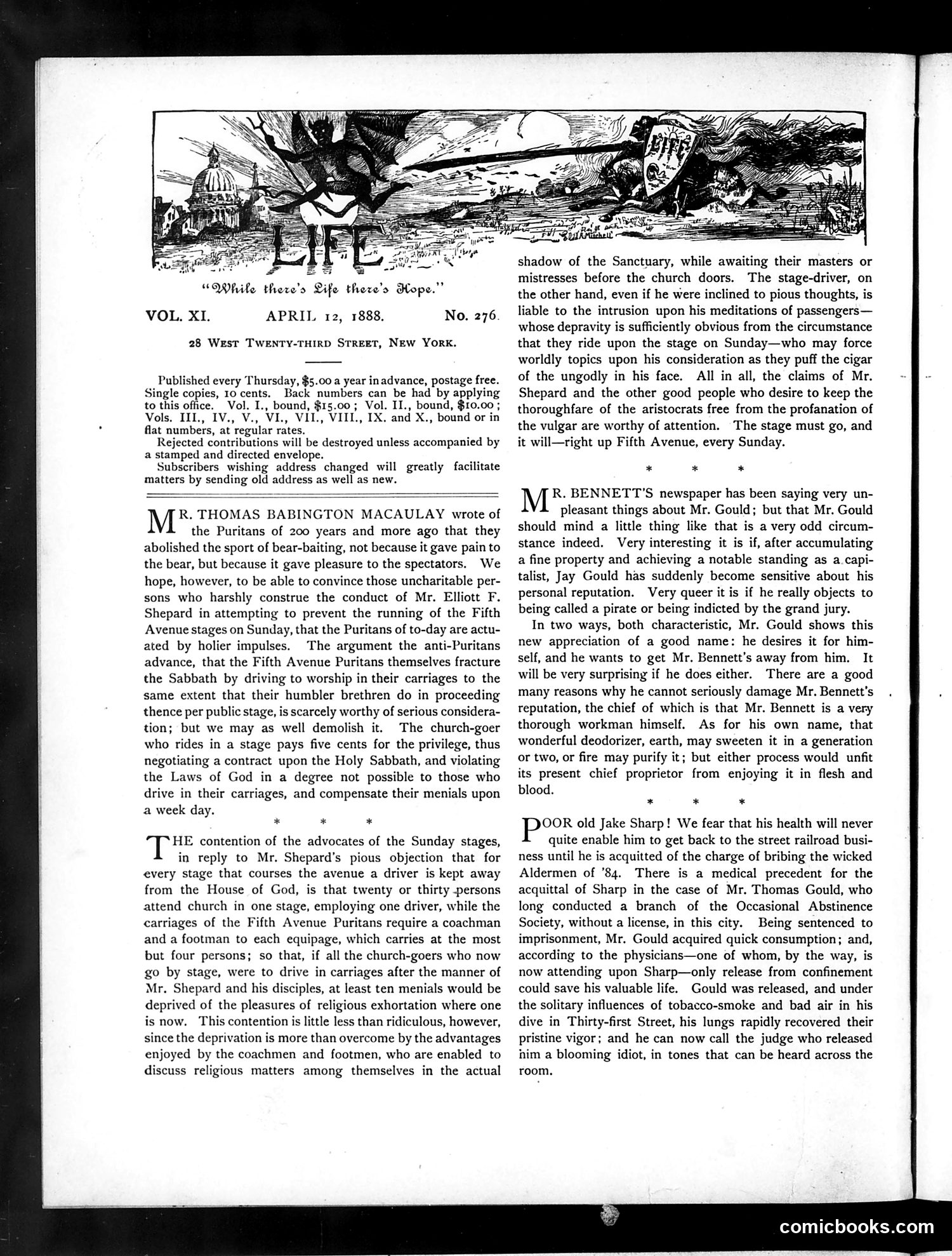
What you’re looking at
This page contains three satirical essays rather than illustrated cartoons. The main topics are: 1. **Sunday stage coaches**: Debate over whether Fifth Avenue omnibuses (carriages) should operate on Sundays. Anti-Puritans argue this provides working-class recreation; critics counter that it violates the Sabbath and prevents drivers from attending church. 2. **Mr. Gould's reputation**: Satirizing Jay Gould's attempt to improve his public image by distancing himself from newspapers critical of him. The writer questions whether reputation-laundering can erase his notorious standing as a capitalist. 3. **Jake Sharp's health**: References to a specific scandal involving Sharp and Thomas Gould's acquittal in an "Occasional Abstinence Society" case involving illegal licensing—apparently a celebrated local incident among readers.
📄 Transcribed text from this page (OCR, searchable)
Machine-transcribed from the original scan — historical spelling and the odd misread are preserved.
- = a “While there's Life there's Hope.” VOL. XI. APRIL 12, 1888. No. 276 28 West TWENTY-THIRD STREET, NEw YorK. Published every Thursday, $5.00 a year inadvance, postage free. Single copies, 10 cents. Back numbers can be had by applying to this office. Vol. I., bound, $15.00; Vol. II., bound, $10.00 ; Vols. III., IV., V., VI., VII., VIIL., IX. and X., bound or in flat numbers, at regular rates. Rejected contributions will be destroyed unless accompanied by a stamped and directed envelope. Subscribers wishing address changed will greatly facilitate matters by sending old address as well as new. R. THOMAS BABINGTON MACAULAY wrote of the Puritans of 200 years and more ago that they abolished the sport of bear-baiting, not because it gave pain to the bear, but because it gave pleasure to the spectators. We hope, however, to be able to convince those uncharitable per- sons who harshly construe the conduct of Mr. Elliott F. Shepard in attempting to prevent the running of the Fifth Avenue stages on Sunday, that the Puritans of to-day are actu- ated by holier impulses. The argument the anti-Puritans advance, that the Fifth Avenue Puritans themselves fracture the Sabbath by driving to worship in their carriages to the same extent that their humbler brethren do in proceeding thence per public stage, is scarcely worthy of serious considera- tion; but we may as well demolish it. The church-goer who rides in a stage pays five cents for the privilege, thus negotiating a contract upon the Holy Sabbath, and violating the Laws of God in a degree not possible to those who drive in their carriages, and compensate their menials upon a week day. * * * HE contention of the advocates of the Sunday stages, in reply to Mr. Shepard’s pious objection that for every stage that courses the avenue a driver is kept away from the House of God, is that twenty or thirty persons attend church in one stage, employing one driver, while the carriages of the Fifth Avenue Puritans require a coachman and a footman to each equipage, which carries at the most but four persons; so that, if all the church-goers who now go by stage, were to drive in carriages after the manner of Mr. Shepard and his disciples, at least ten menials would be deprived of the pleasures of religious exhortation where one is now. This contention is little less than ridiculous, however, since the deprivation is more than overcome by the advantages enjoyed by the coachmen and footmen, who are enabled to discuss religious matters among themselves in the actual shadow of the Sanctuary, while awaiting their masters or mistresses before the church doors. The stage-driver, on the other hand, even if he were inclined to pious thoughts, is liable to the intrusion upon his meditations of passengers— whose depravity is sufficiently obvious from the circumstance that they ride upon the stage on Sunday—who may force worldly topics upon his consideration as they puff the cigar of the ungodly in his face. All in all, the claims of Mr. Shepard and the other good people who desire to keep the thoroughfare of the aristocrats free from the profanation of the vulgar are worthy of attention. The stage must go, and it will—right up Fifth Avenue, every Sunday. * * * R. BENNETT'S newspaper has been saying very un- pleasant things about Mr. Gould; but that Mr. Gould should mind a little thing like that is a very odd circum- stance indeed. Very interesting it is if, after accumulating a fine property and achieving a notable standing as a.capi- talist, Jay Gould has suddenly become sensitive about his personal reputation. Very queer it is if he really objects to being called a pirate or being indicted by the grand jury. In two ways, both characteristic, Mr. Gould shows this new appreciation of a good name: he desires it for him- self, and he wants to get Mr. Bennett’s away from him. It will be very surprising if he does either. There are a good many reasons why he cannot seriously damage Mr. Bennett's reputation, the chief of which is that Mr. Bennett is a very thorough workman himself. As for his own name, that wonderful deodorizer, earth, may sweeten it in a generation or two, or fire may purify it; but either process would unfit its present chief proprietor from enjoying it in flesh and blood. * * * OOR old Jake Sharp! We fear that his health will never quite enable him to get back to the street railroad busi- ness until he is acquitted of the charge of bribing the wicked Aldermen of ’84. There is a medical precedent for the acquittal of Sharp in the case of Mr. Thomas Gould, who long conducted a branch of the Occasional Abstinence Society, without a license, in this city. Being sentenced to imprisonment, Mr. Gould acquired quick consumption; and, according to the physicians—one of whom, by the way, is now attending upon Sharp—only release from confinement could save his valuable life. Gould was released, and under the solitary influences of tobacco-smoke and bad air in his dive in Thirty-first Street, his lungs rapidly recovered their pristine vigor; and he can now call the judge who released him a blooming idiot, in tones that can be heard across the room, comicbooks.com