
A complete issue · 20 pages · 1888
Life — April 5, 1888
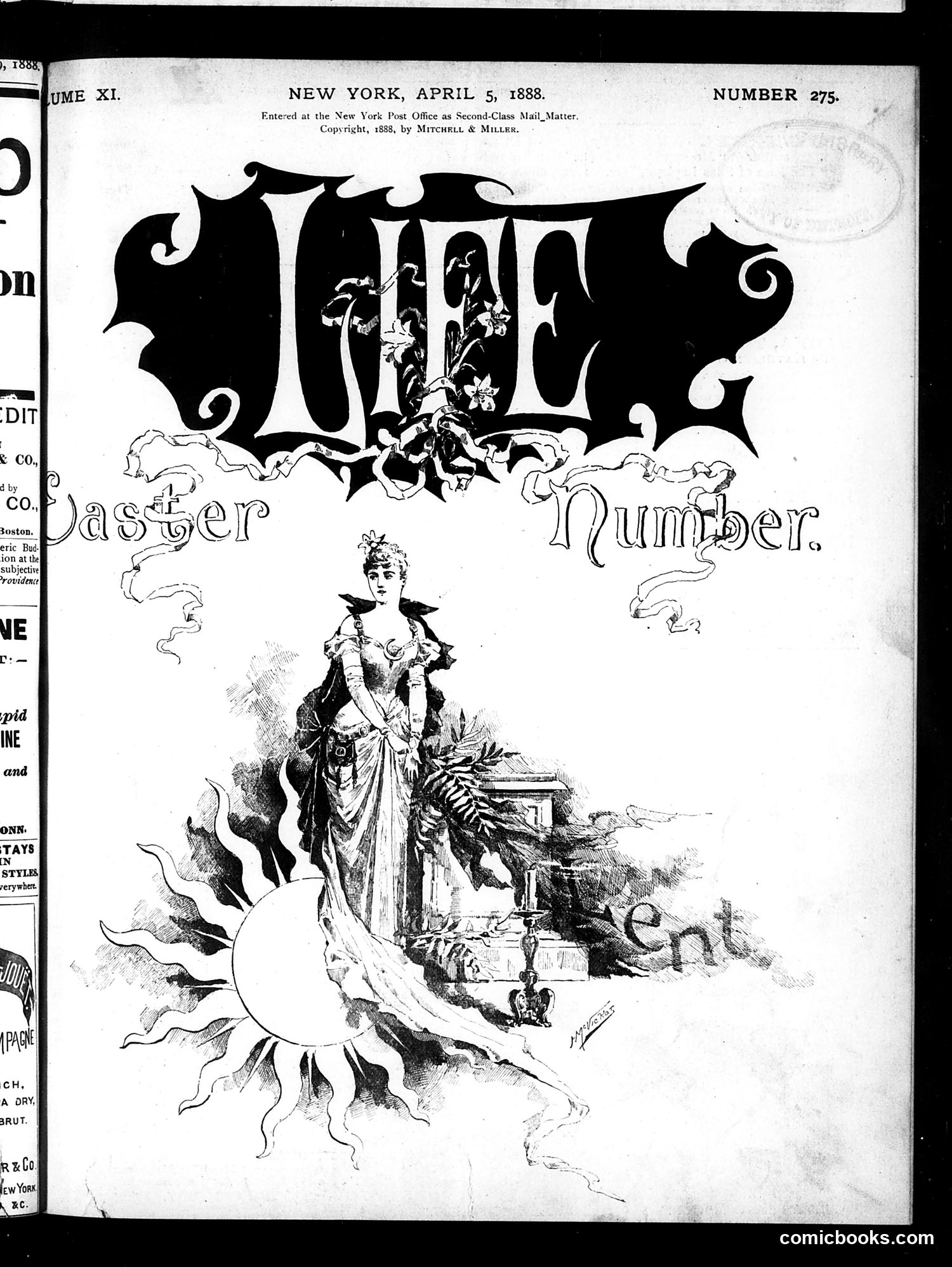
This is the cover of Life's Easter issue (Volume XI, Number 275). The large decorative title "LIFE" dominates the top in ornate Victorian lettering, with "Easter Number" displayed below in flowing script. The central illustration depicts a fashionably dressed woman in 1880s attire standing amid Easter symbolism—a prominent sun and flowering plants. She wears an elaborate dark jacket with decorative elements and an ornate bonnet, embodying the "Easter parade" tradition of displaying new spring fashions. The image celebrates Easter as a secular fashion event rather than primarily religious occasion—a common satirical theme in Gilded Age publications. The woman's refined pose and expensive clothing suggest Life is commenting on the commercialization and vanity associated with Easter festivities among wealthy Americans.
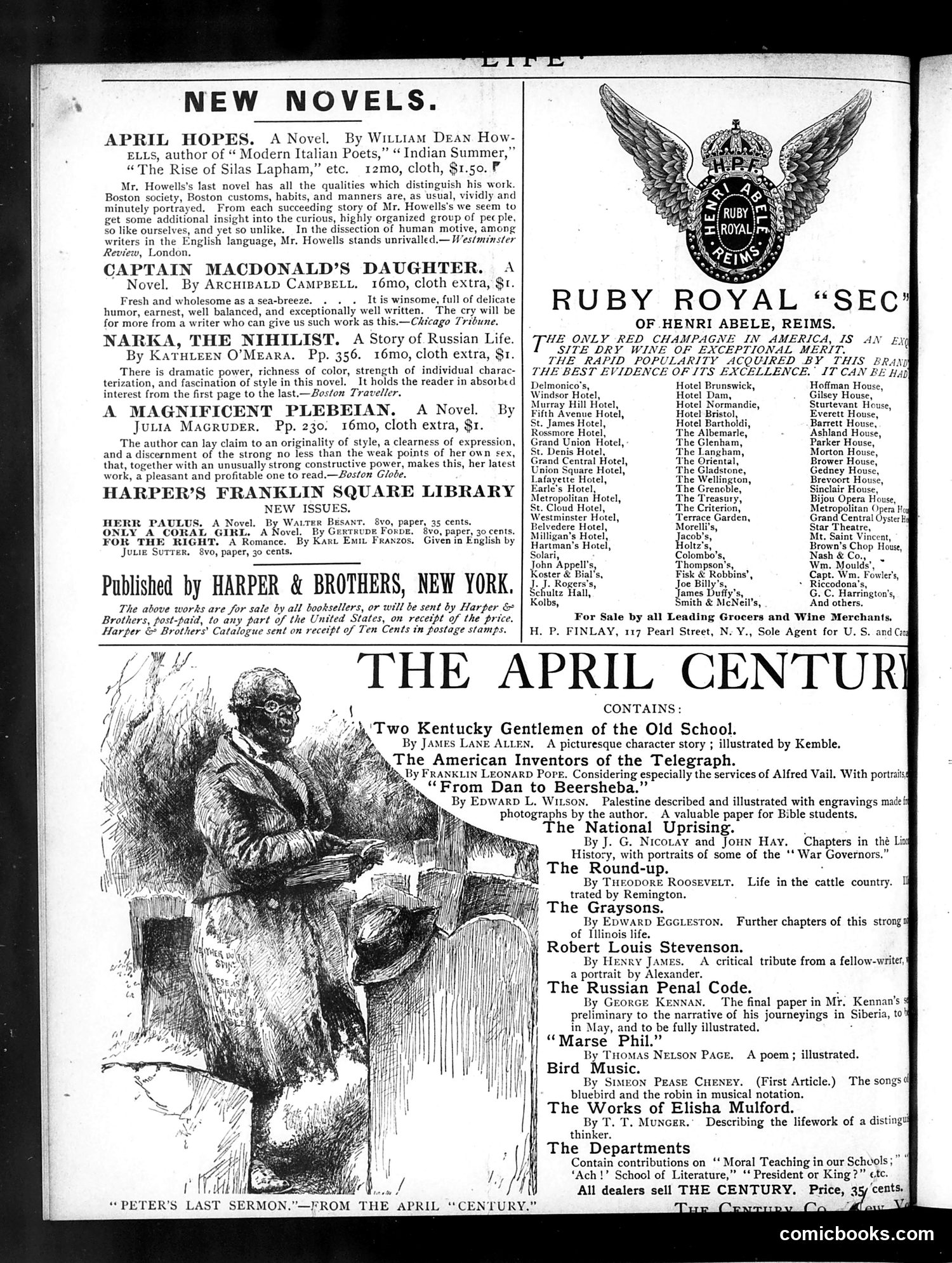
This page is primarily **advertising and literary content** rather than satire. The main illustration, captioned "PETER'S LAST SERMON"—FROM THE APRIL "CENTURY," shows a seated figure in period dress reading or holding papers, likely depicting a historical or biblical scene from an article in *The Century* magazine. The page consists of: - Book advertisements (Harper & Brothers publications) - Descriptions of articles in the upcoming April *Century* magazine, including pieces on Kentucky gentlemen, telegraph inventors, Palestine, and Russian penal codes - An advertisement for Ruby Royal champagne There is **no apparent political cartoon or satire** on this page. It functions as a literary journal's contents listing and commercial advertising section typical of late 19th-century magazines.
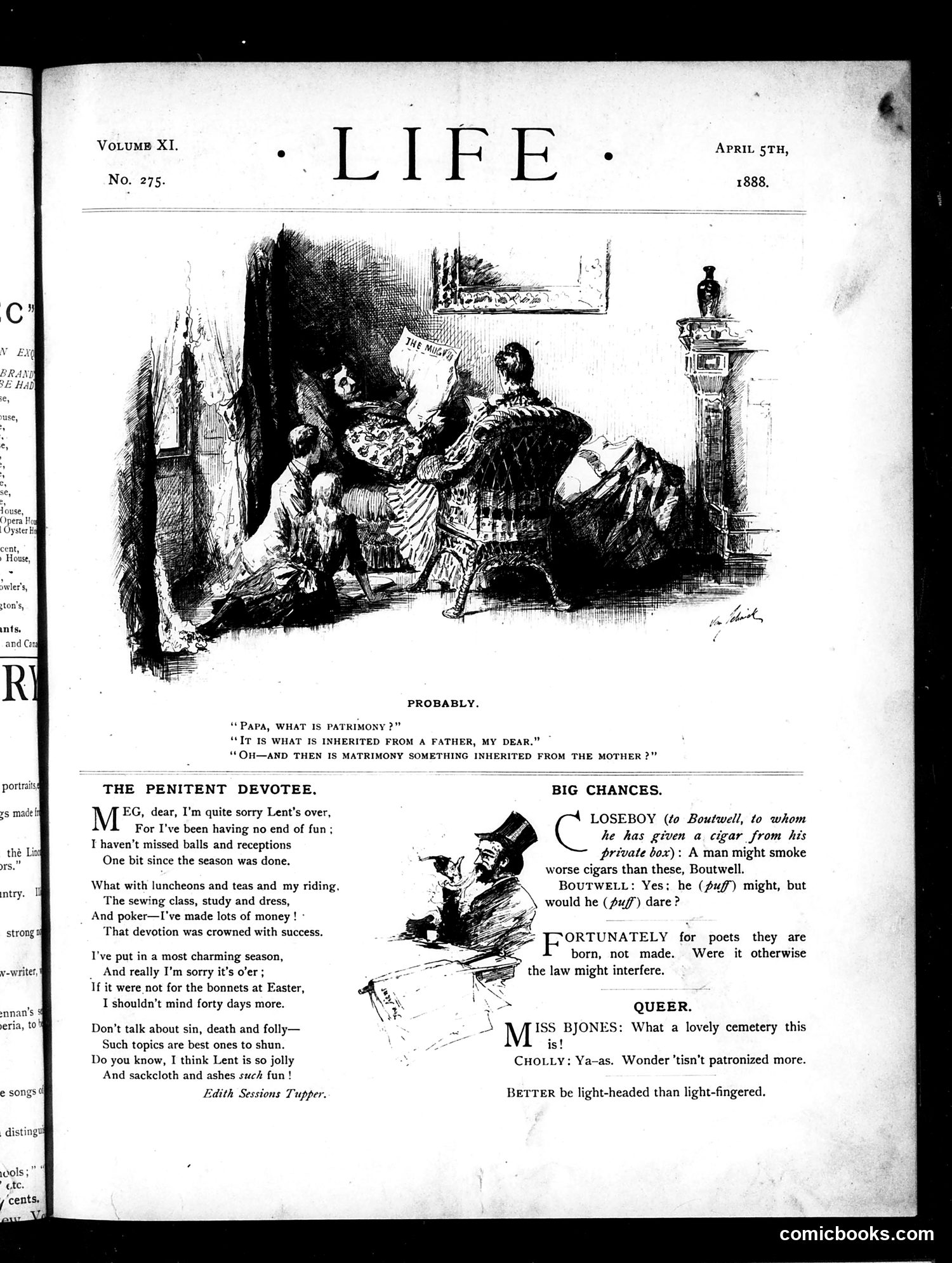
**Main Cartoon ("Probably")**: This sketch depicts a domestic scene where a child asks their father about patrimony (inheritance). The father explains that patrimony comes from the father, then adds that matrimony is something inherited from the mother—a joke playing on the similarity of the words and suggesting wives are inherited burdens. **"The Penitent Devotee"**: A poem by Edith Sessions Tupper about a woman relieved that Lenten season ended, allowing her to resume social activities (balls, riding, sewing) she'd sacrificed for religious observance. It's gentle satire on superficial piety. **"Big Chances" and "Queer"**: Brief humorous exchanges between characters, including wordplay about poets and cemetery patronage, typical of the magazine's light satirical format.
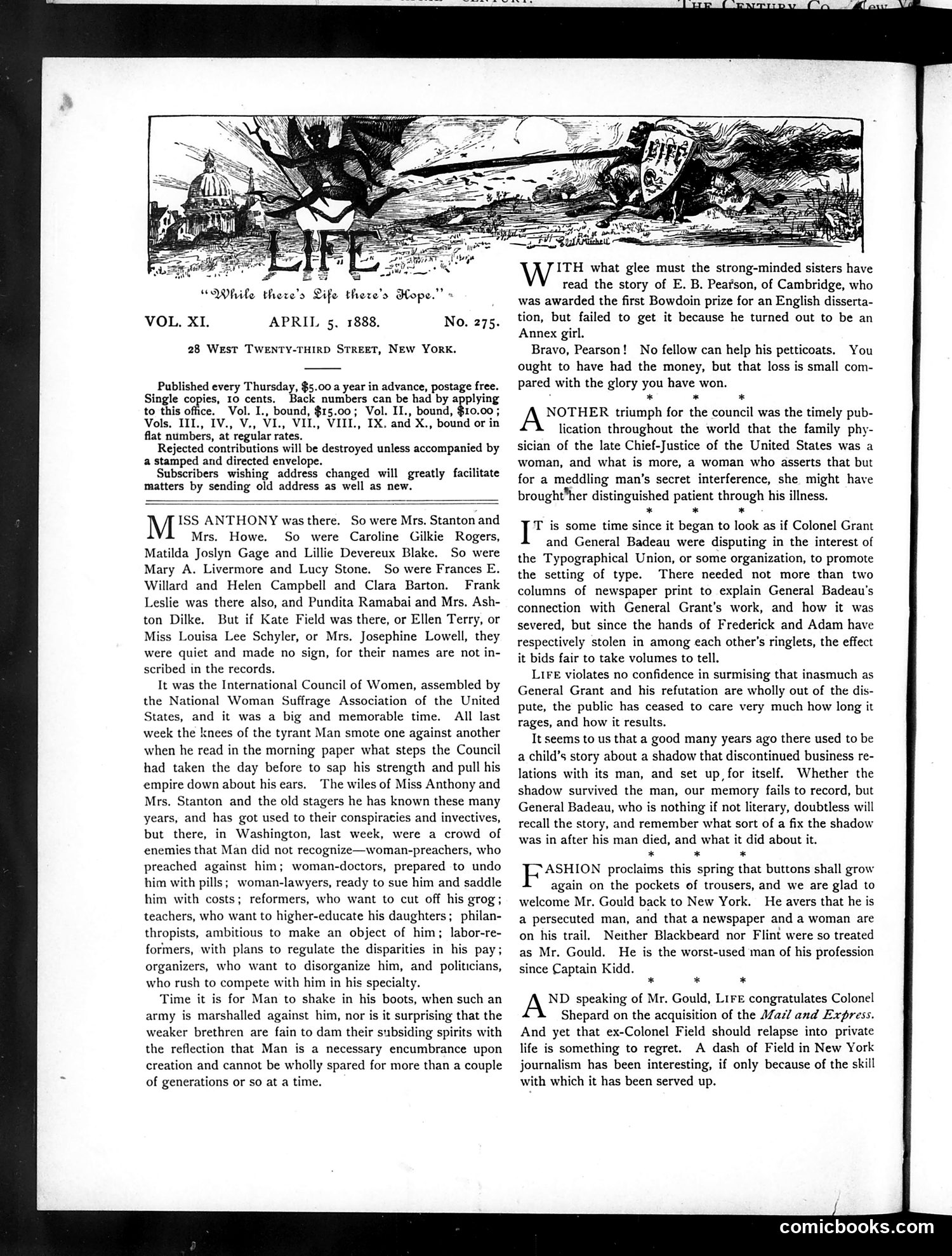
The masthead cartoon depicts a landscape with a bare tree, a classical dome building, and a flag labeled "LIFE," illustrating the magazine's motto "While there's Life there's Hope." The text is satirical commentary on contemporary figures and events. It celebrates E.B. Pearson of Cambridge winning a Bowdoin Prize, mocks General Grant's reputation being damaged by allegations of favoritism toward a woman, and critiques various reform movements opposing established male power structures—including suffragists, woman doctors, temperance advocates, and labor reformers. The piece sarcastically portrays these groups as threats to traditional order, suggesting that strong resistance to social change is inevitable and justified. The tone is conservative and dismissive of progressive causes.
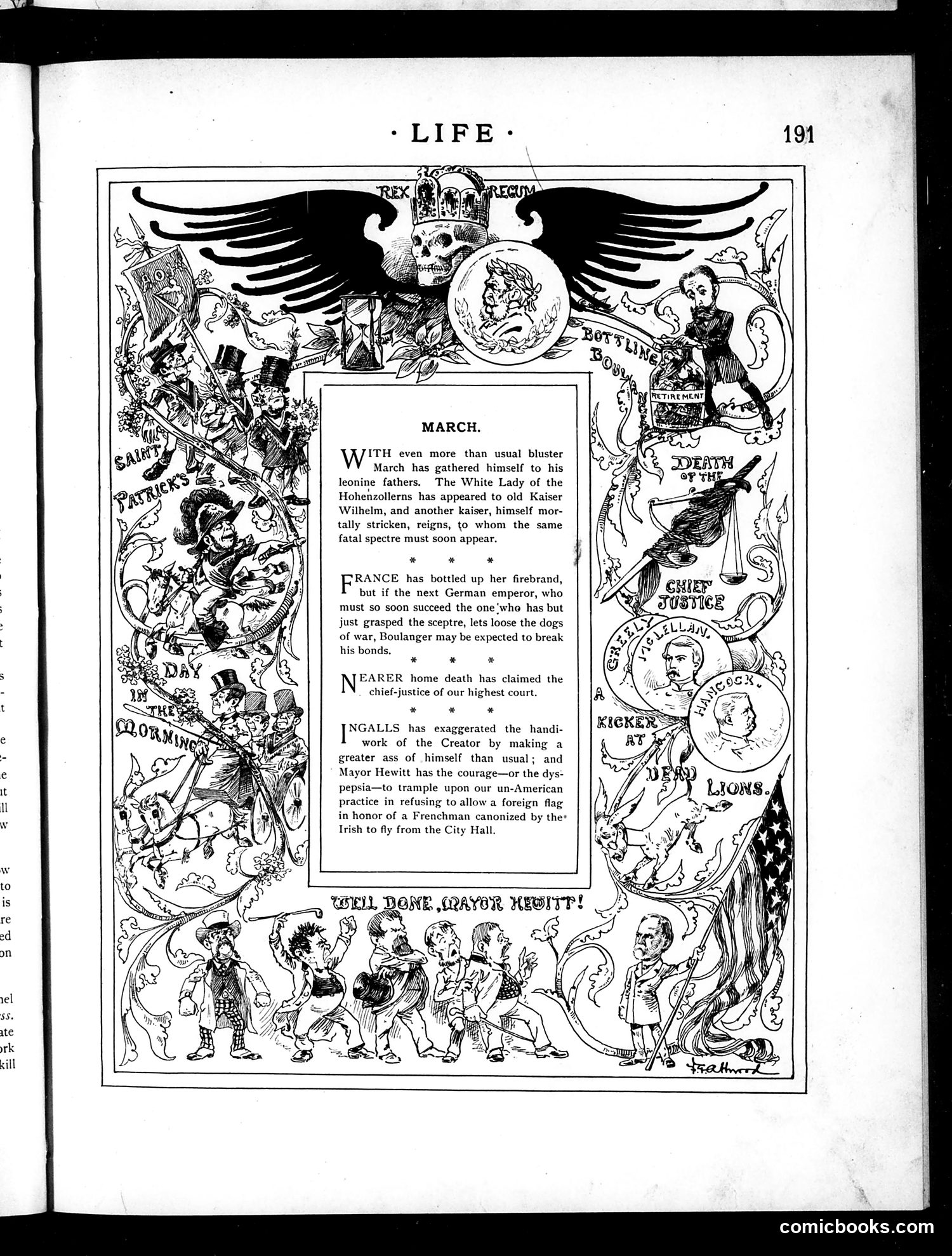
This Life magazine page satirizes early 20th-century European and American political crises. The elaborate border illustrations reference: - **"Saint Patrick's Day"** and **"The Mourning"** (left side): Likely Irish-American concerns, possibly related to independence movements or immigration issues. - **Central text** criticizes multiple governments: France "bottling up her firebrand," Germany's unstable succession, and a chief-justice death affecting America's highest court. - **Ingalls and Hewitt** references (right side): Likely American political figures involved in disputes over flag protocol and French-Irish relations. The bottom panel shows figures in period dress, suggesting diplomatic or political turmoil. The overall tone mocks governmental incompetence and international tensions of the era, though specific names and dates require additional historical context to identify precisely.
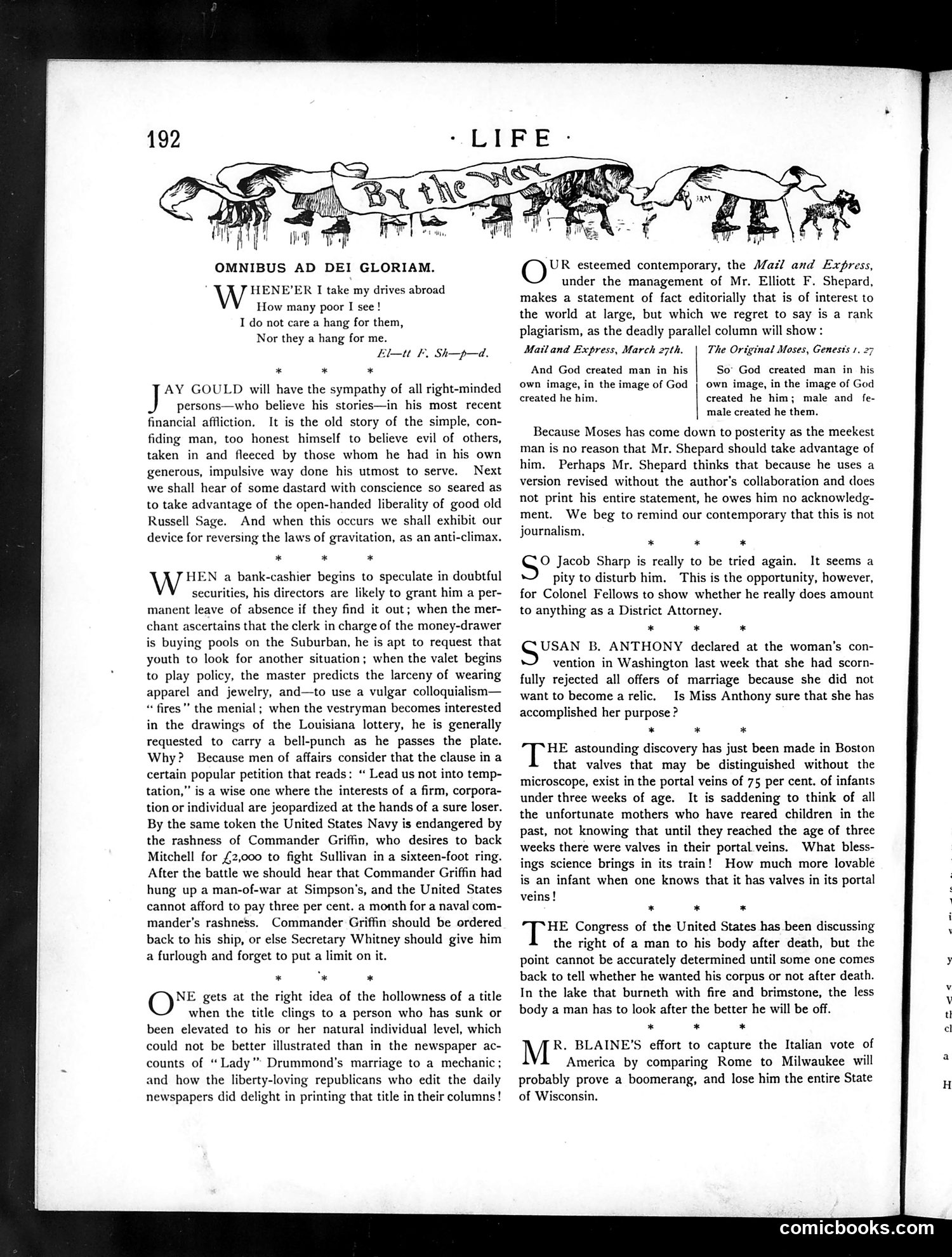
The page contains several satirical editorial commentary pieces rather than cartoons. The header "Omnibus ad Dei Gloriam" introduces critiques of contemporary figures and issues. The text references: - **Jay Gould** - criticized for financial exploitation - **A bank-cashier** - satirizing speculation and financial mismanagement - **Commander Griffin** - attacked for naval misadventure involving £2,000 - **"Lady" Drummond** - mocked for marrying a mechanic, criticized by newspapers - **Jacob Sharp** - facing trial - **Susan B. Anthony** - noted for rejecting marriage proposals at a women's convention - **Mr. Blaine** - attempting to capture Italian-American votes by comparing Rome to Milwaukee The satire targets Gilded Age financial corruption, naval incompetence, gender politics, and political manipulation of ethnic voters. The tone is acerbic commentary on contemporary scandals and social hypocrisy.
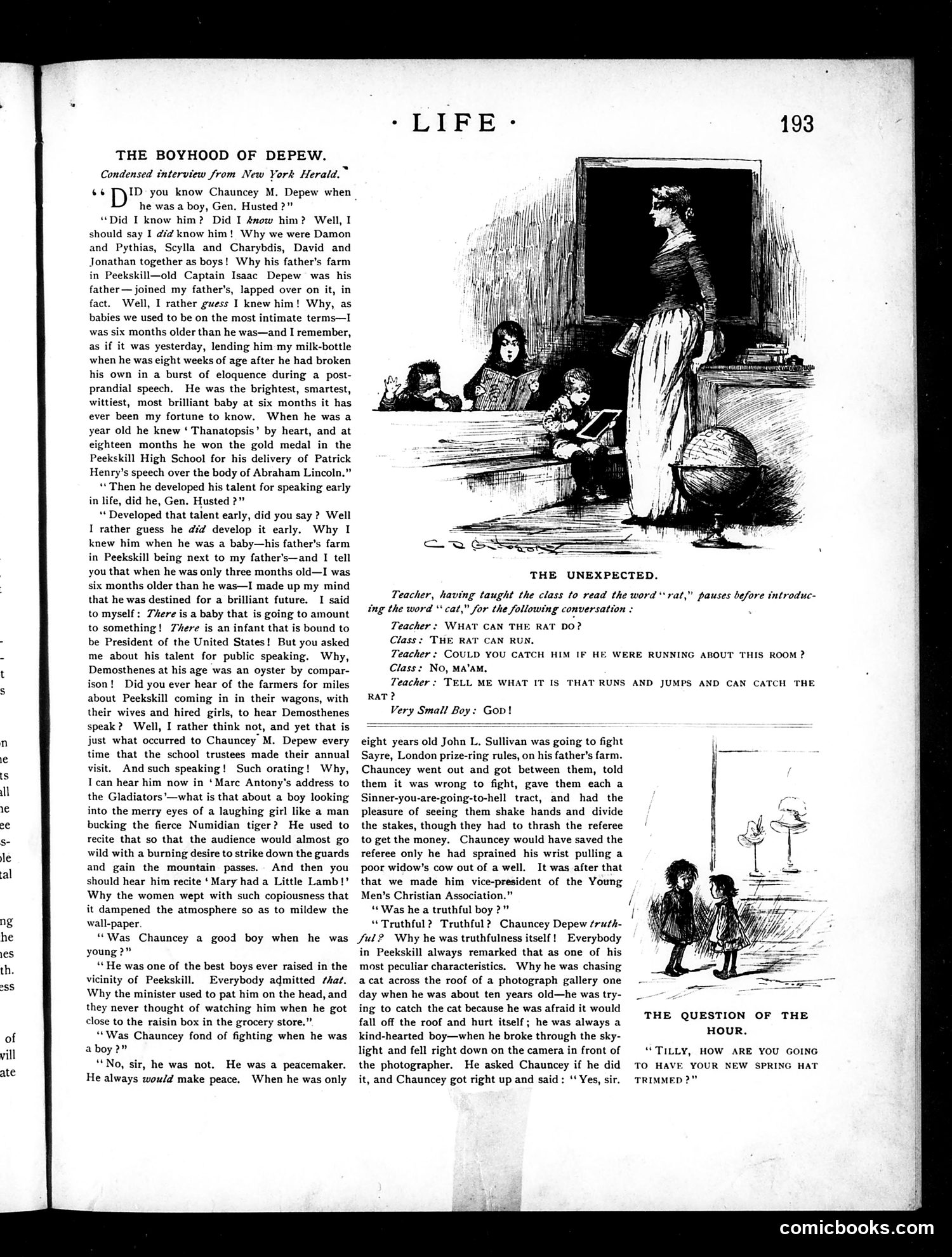
This page contains two distinct sections: **"The Boyhood of Depew"** is an interview recounting Chauncey M. Depew's childhood. The text describes his precocious speaking abilities and peaceful temperament, establishing his character as a brilliant but non-violent boy. **The cartoons** illustrate two brief satirical scenes: "The Unexpected" shows a teacher asking students what a rat can do, with a small boy's crude answer providing comic relief through childish directness. "The Question of the Hour" depicts two figures discussing a new spring hat, likely satirizing contemporary fashion concerns or social pretension. These appear to be light humorous vignettes typical of Life's satirical approach—using domestic and school scenes to gently mock human behavior rather than engage in pointed political commentary.
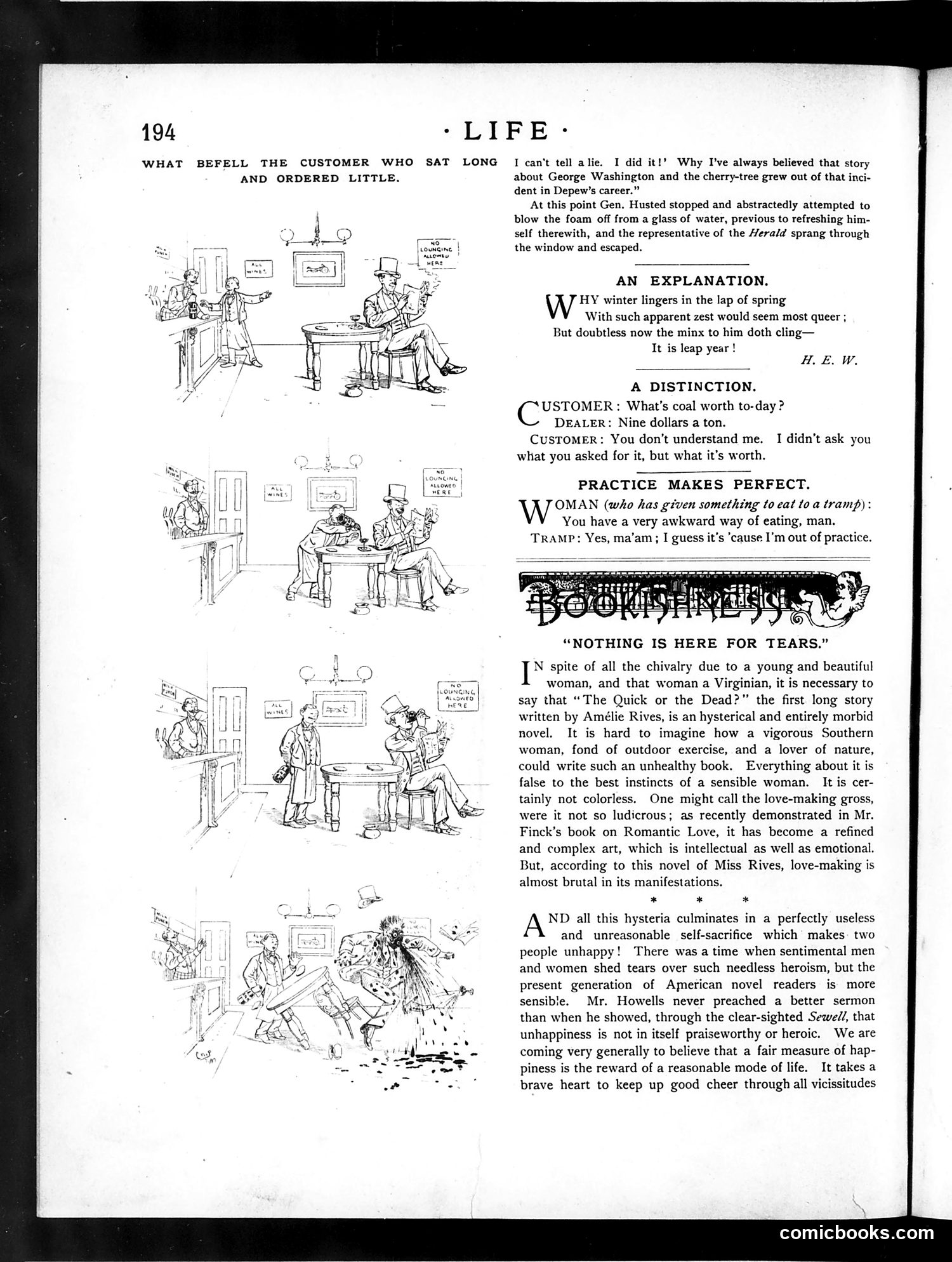
This page contains **four separate comic sketches** (left) and **three brief humorous anecdotes** (right), typical of Life's satirical format. The main cartoon sequence depicts a **waiter or server interacting with a difficult customer** who "sat long and ordered little"—a familiar restaurant scenario. The progressive panels show escalating tension, culminating in chaos, likely satirizing both cheap customers and frustrated service workers. The anecdotes mock various social types: a coal dealer's price-gouging, a tramp's excuse-making, and a book review criticizing author Amelie Rives's novel "The Quick or the Dead?" for its unhealthy sensationalism. The humor relies on **class-based social observation**—poking fun at working-class interactions, consumer behavior, and literary pretension—reflecting early 20th-century American satirical conventions.
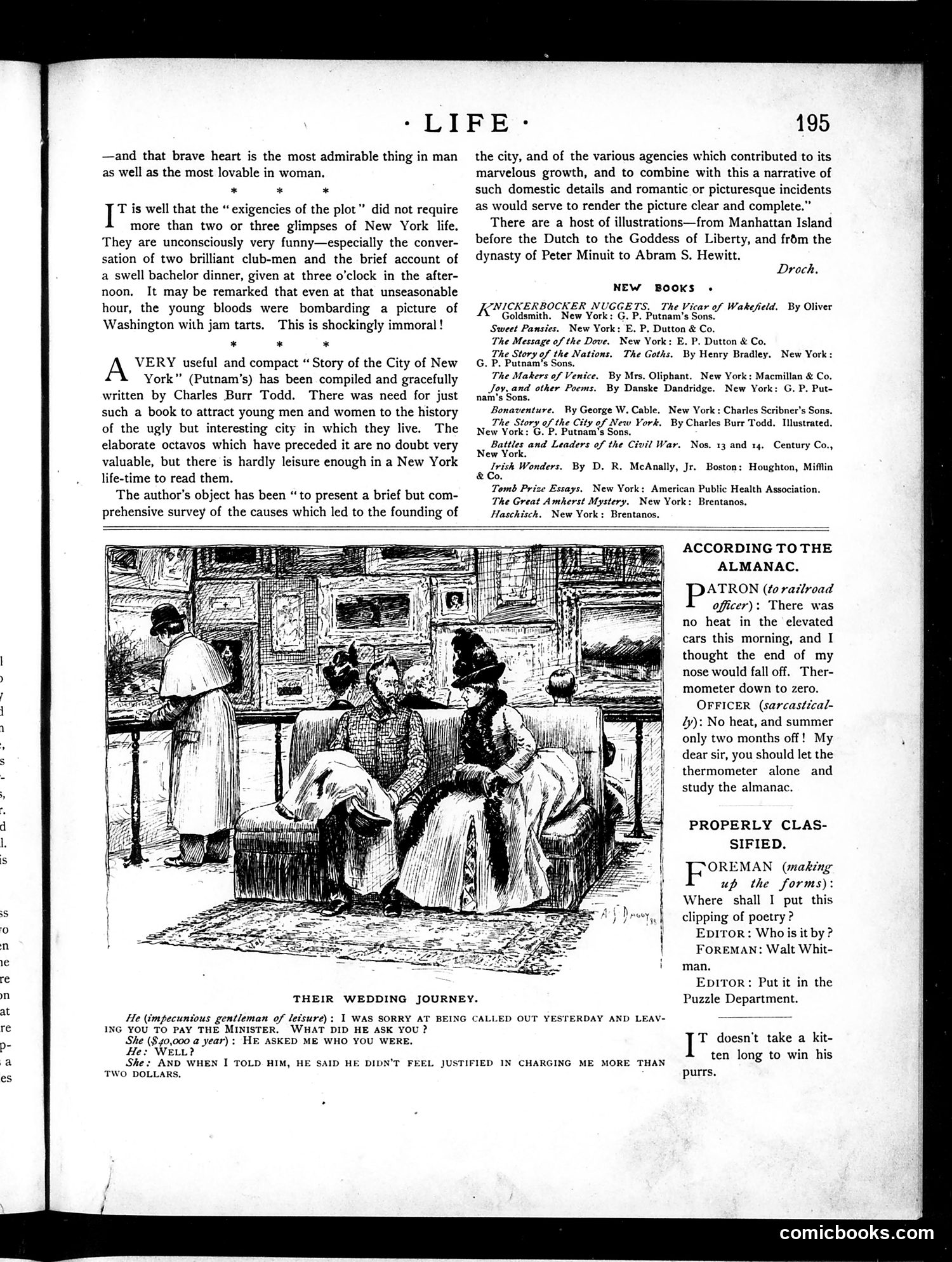
The main cartoon depicts a train car interior with passengers observing a couple, captioned "Their Wedding Journey." The accompanying dialogue is a joke about a newlywed couple's honeymoon: A man (described as "an unprecendentious [sic] gentleman of leisure") apologizes for being called out by a minister, claiming financial hardship. When asked why he didn't pay the minister, he replies he didn't feel justified charging only two dollars—implying the minister's services were worth more, or alternatively, that he viewed the fee as insulting. The humor relies on class-conscious awkwardness about payment for clergy services during the Gilded Age. The cartoon satirizes the social tensions and economic anxieties of the era's middle and upper classes regarding proper etiquette and monetary transactions.
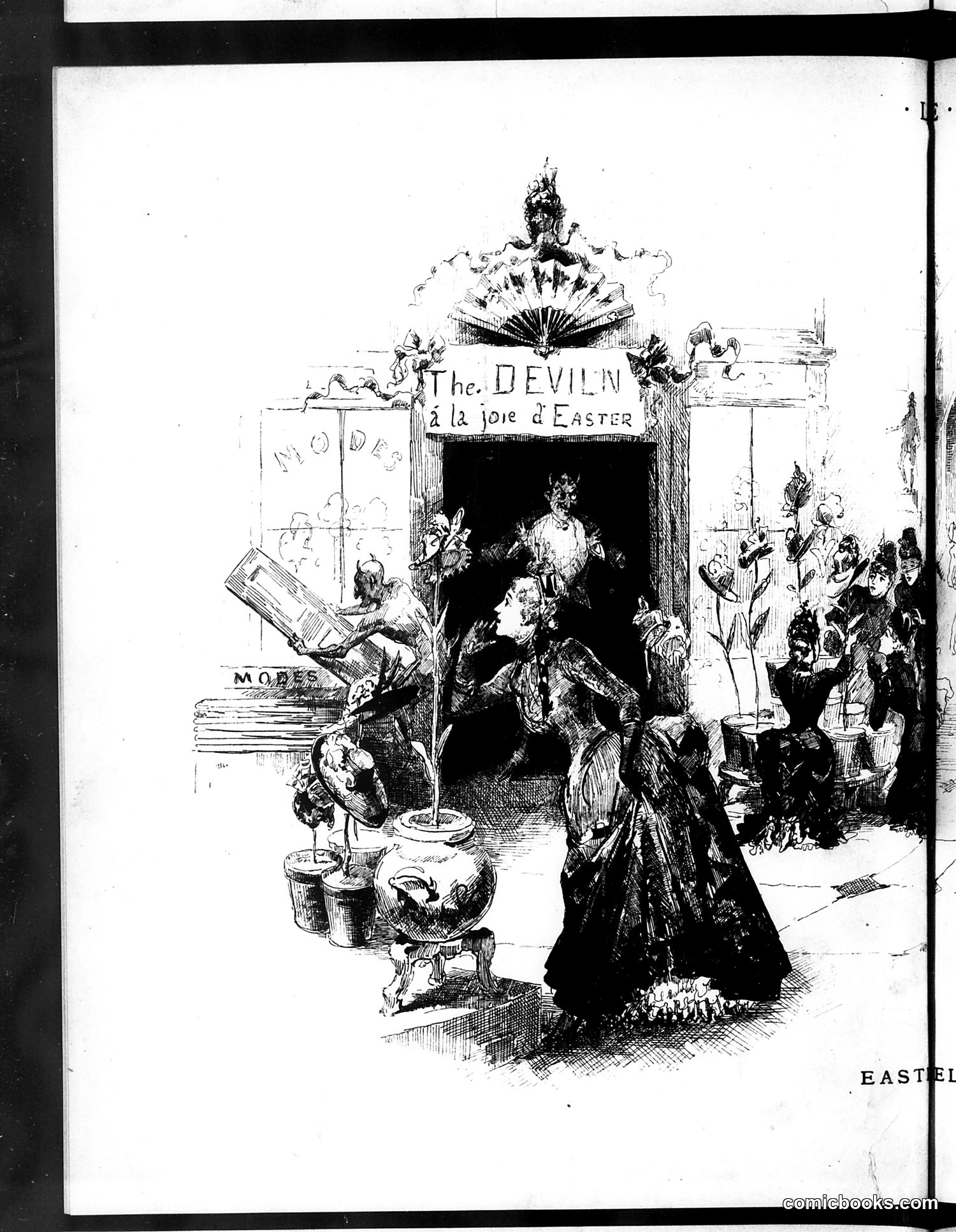
This is a theatrical satire titled "The DEVLIN à la Joie d'Easter" (a play on words mixing a name with French). The image shows what appears to be a fashionable woman in an elaborate dress viewing an Easter-themed theatrical display or shop window. The storefront is ornately decorated with Easter imagery, including cherubs and a fan motif above the entrance. The sign reads "MODES" (fashions), suggesting this satirizes the commercialization and fashionable extravagance surrounding Easter celebrations. The crowded street scene with well-dressed onlookers suggests this mocks how Easter had become a social spectacle focused on expensive clothing and conspicuous consumption rather than religious observance. The theatrical framing emphasizes the performative, artificial nature of high society's Easter traditions. The satire targets upper-class affectation and materialism disguised as holiday observance.
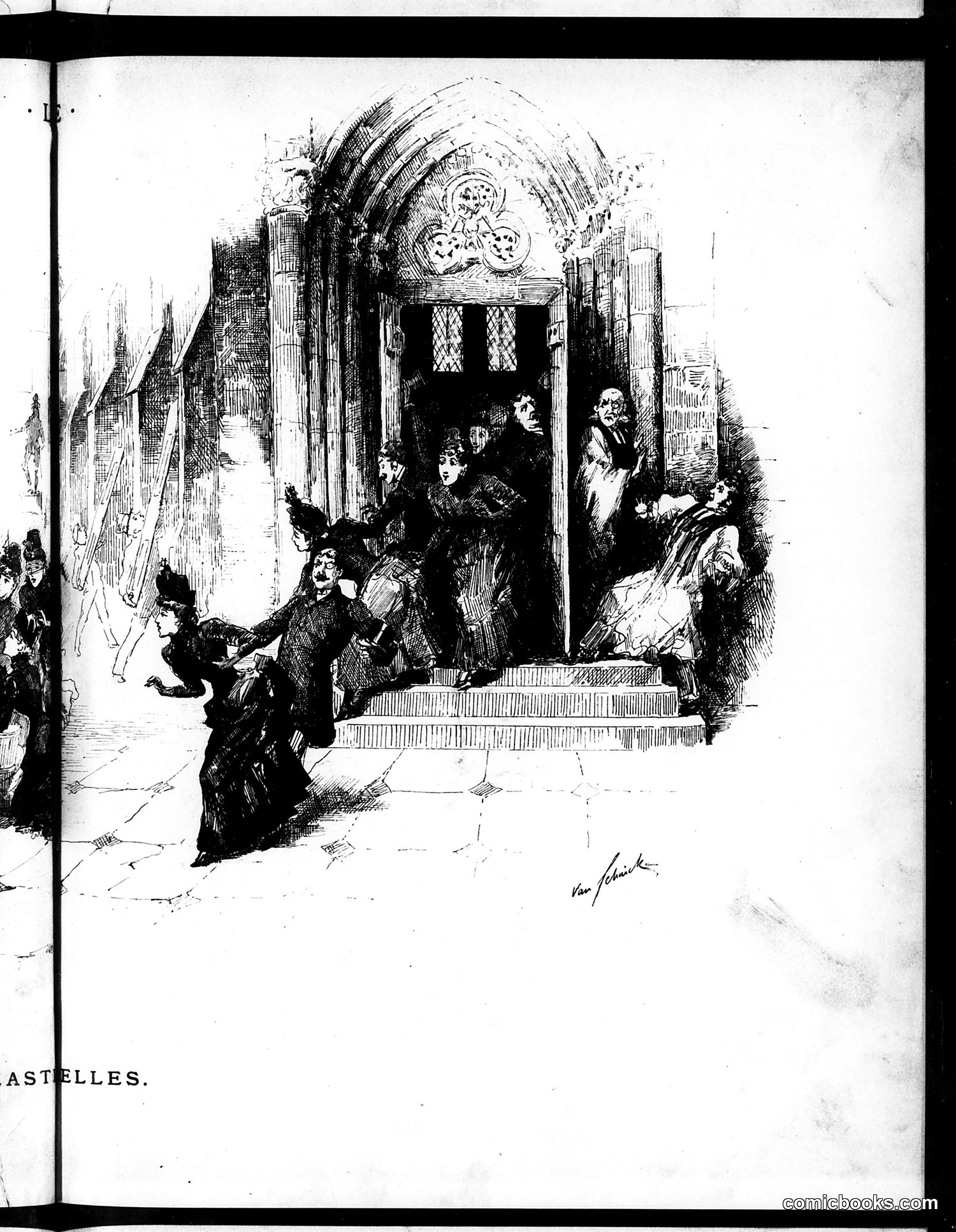
This page appears to be from **Life magazine** and shows a satirical illustration titled "ASTELLES" (though the text is partially obscured). The sketch depicts a **church or cathedral doorway** with Gothic architectural elements. A crowd of well-dressed figures in Victorian-era clothing gathers outside, while others stand in the darkened doorway entrance, which features an ornate rose window above. The satire likely comments on **religious hypocrisy or social class divisions** — possibly mocking how people present themselves differently in public versus in private, or critiquing the relationship between wealthy society and religious institutions. However, **without clearer OCR text or more context about the specific date and issue**, I cannot definitively identify which social or political event this references, or confirm the precise satirical point intended by the artist (whose signature appears at bottom right).
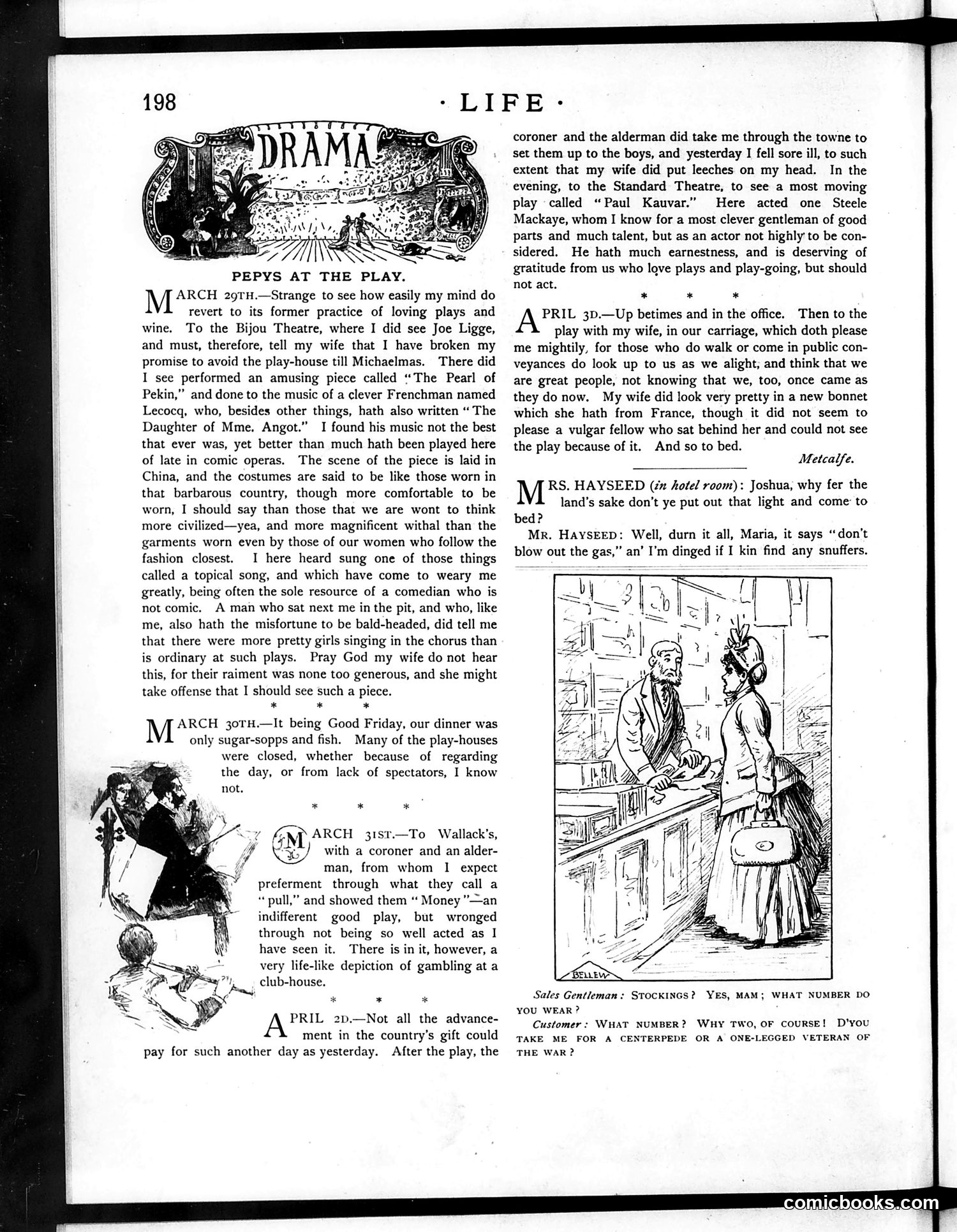
This page from *Life* magazine contains satirical commentary on 1880s theater and social pretension, written in the voice of Samuel Pepys (the famous 17th-century diarist). The satire works by having Pepys observe contemporary theater through his historical lens, creating humor via anachronism. **The main section** mocks theater-goers' snobbery: Pepys attends plays, breaks promises to his wife, and notes the revealing costumes of chorus girls. The implicit joke is that respectable people pretend theater attendance is cultured while actually being drawn by spectacle and scandal. **The cartoons below** show separate jokes unrelated to Pepys: 1. **Mrs. Hayseed**: Rural characters confused by hotel gas lighting—humor from perceived rural ignorance about modern technology. 2. **Sales Gentleman**: A shop clerk's joke about a customer's stocking size, making a crude reference to centipedes (many legs) and disabled war veterans—dark humor typical of the period. The page satirizes theatrical pretension, rural/urban class divides, and era-specific anxieties about modernity and propriety.
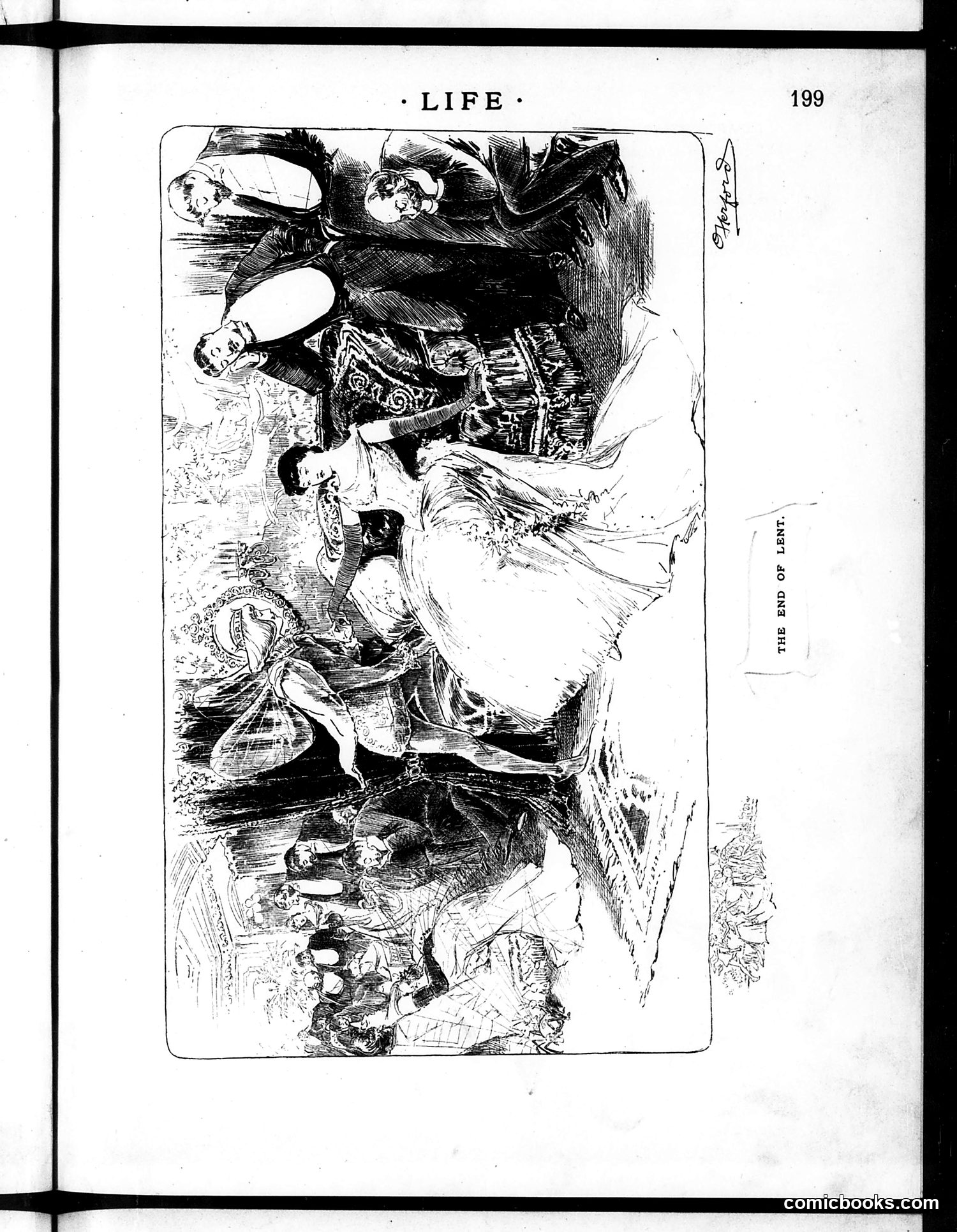
This page contains a single black-and-white sketch illustration titled "THE END OF LENT" (visible on the right margin). The image appears to be a satirical scene depicting the conclusion of the Lenten period, a Christian season of fasting and abstinence. The sketch shows figures in what appears to be a celebratory or indulgent moment, likely satirizing the contrast between Lenten restraint and the feasting that traditionally follows Easter. The detailed cross-hatching and loose sketch style is characteristic of Life magazine's satirical illustrations from the early 20th century. The specific figures and social commentary are difficult to identify with certainty from the image quality, but the cartoon likely mocks either religious hypocrisy or the eagerness with which people abandon dietary restrictions after Lent concludes.
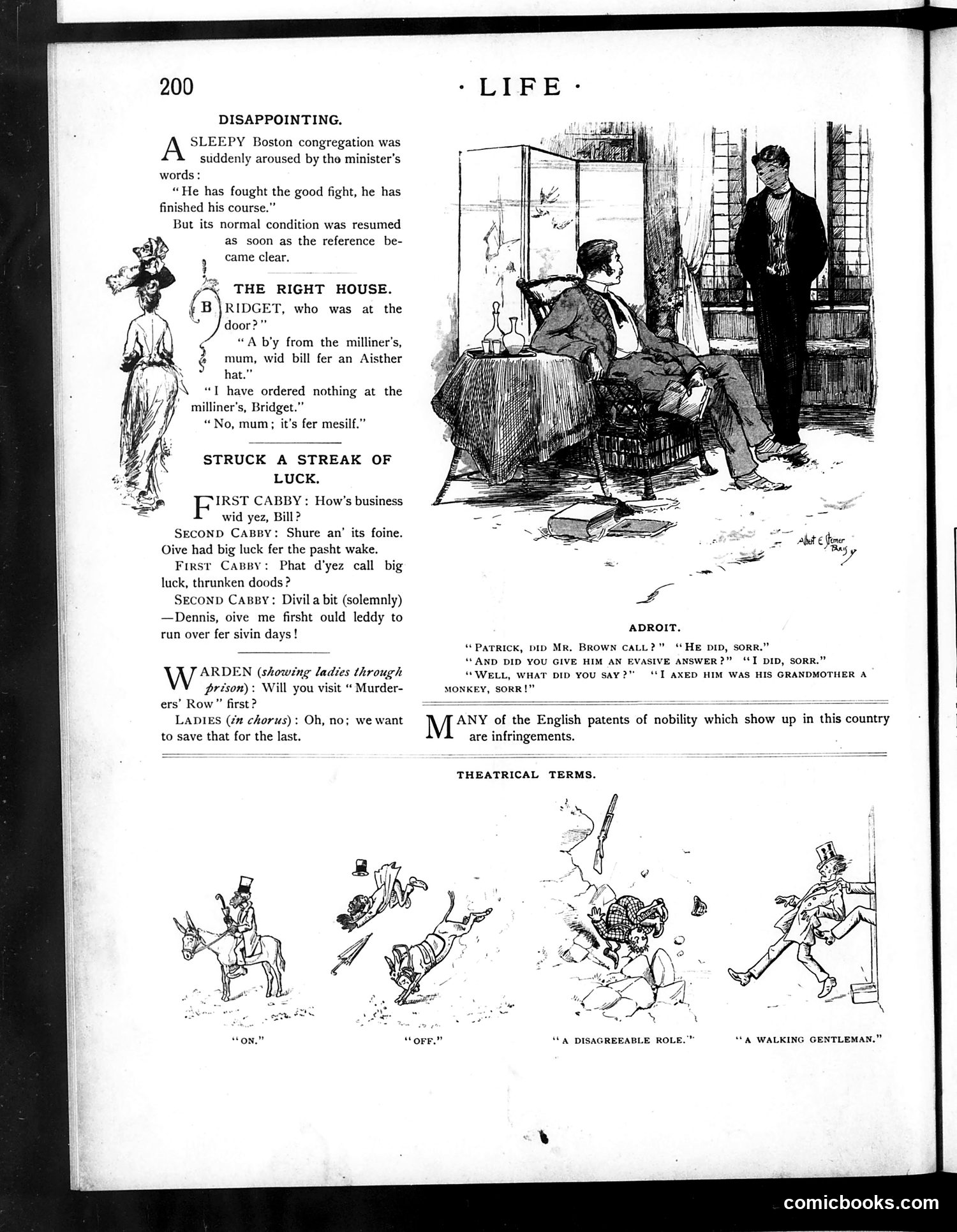
This page contains six separate satirical sketches typical of *Life* magazine's humor: 1. **"Disappointing"**: A Boston minister's eulogy phrase ("finished his course") initially excites a sleepy congregation, who think it's scandalous gossip—then deflate when they realize it's biblical. 2. **"The Right House"**: Irish servant Bridget orders an Easter hat, billing it to her employer rather than paying herself—a joke about servants' presumption. 3. **"Struck a Streak of Luck"**: Two Irish cab drivers; one's "luck" is hitting and killing a woman—dark humor about urban hazards. 4. **"Warden"**: Female prison tourists want to see "Murderers' Row" last, suggesting it's the most sensational attraction—mocking voyeuristic tourism. 5. **"Adroit"**: A servant cleverly gives his employer's visitor an evasive answer, then admits his grandmother gave him the technique—praising deceptive sophistication. 6. **"English Patents of Nobility"**: A brief comment that American "nobles" are counterfeit—mocking American aristocratic pretensions. The page uses ethnic dialect humor (Irish servants) and class-based satire typical of the era.
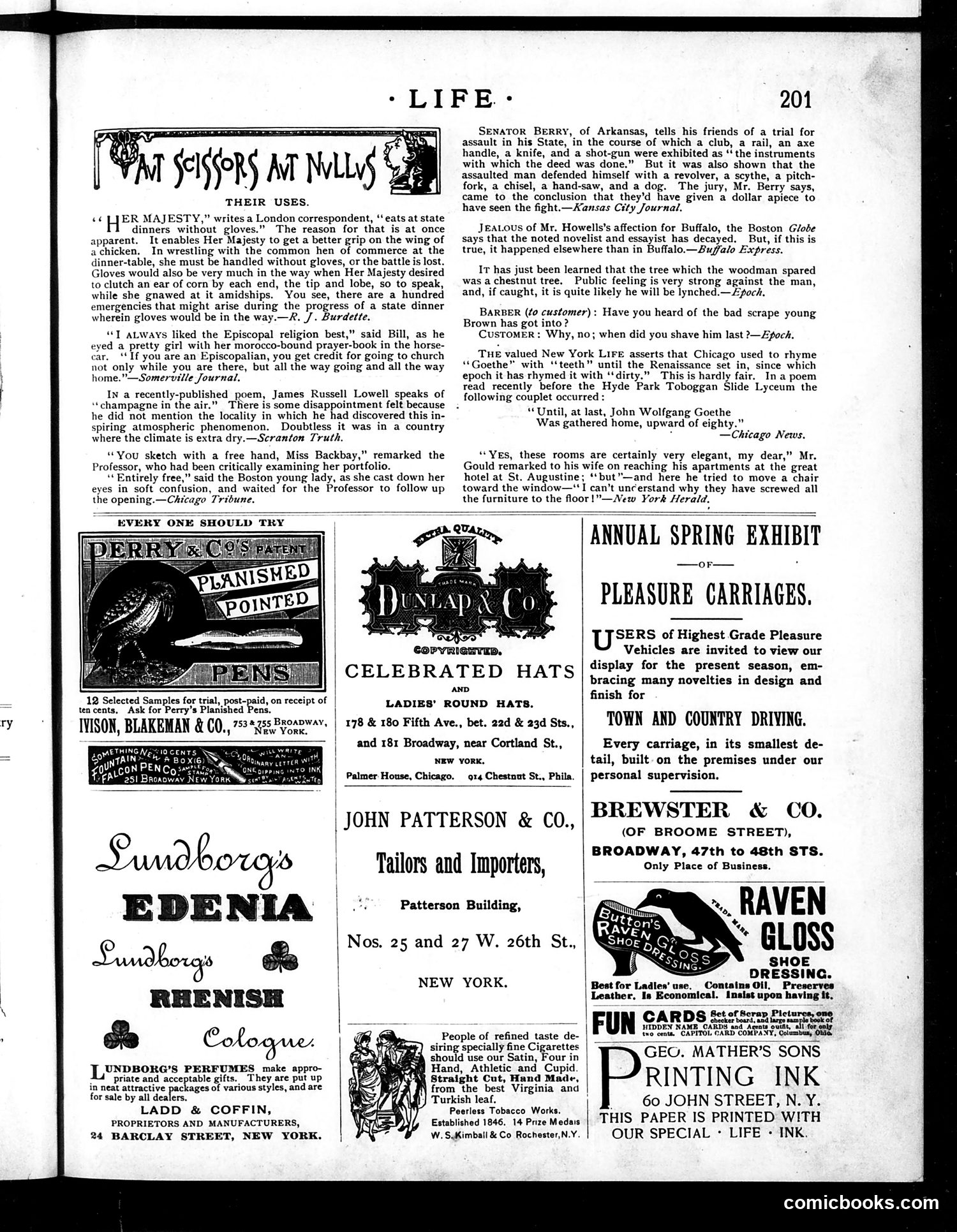
This page is primarily **light humor and advertising**, with no political cartoon. The content consists of brief satirical anecdotes typical of Life's style. ## Key Humorous Items: **Queen Victoria's glove-wearing**: A joke imagining the Queen eating chicken at state dinners without gloves so she can "get a better grip" on food—satirizing both her formality and the absurdity of strict etiquette. **The Arkansas trial**: Senator Berry recounts an assault case where both attacker and defender employed ridiculous numbers of weapons (clubs, axes, scythes, dogs). The jury found it entertainingly balanced—likely mocking frontier violence and legal absurdity in the American South. **Champagne in the air**: A jab at poet James Russell Lowell for vague, unsubstantiated poetic claims. **The Boston girl's "free" sketching**: A mild flirtation joke playing on double meaning. The rest consists of product advertisements for pens, hats, perfume, and carriages. No major political figures or events are referenced—this is simply a sample of Life's accessible, genteel satirical humor aimed at educated American readers.
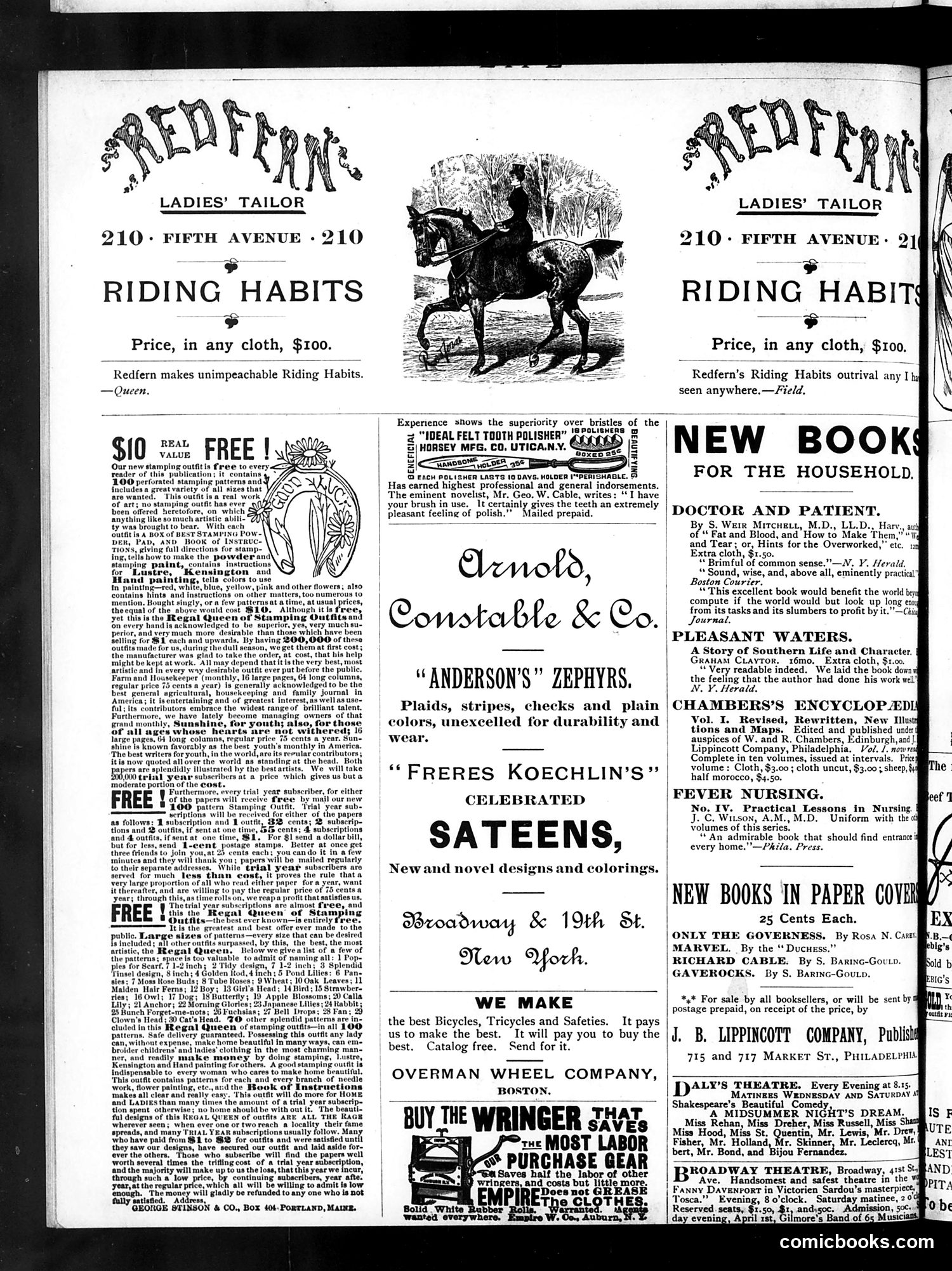
This is primarily an **advertisement page**, not a political cartoon. It features commercial notices typical of Life magazine's era, likely late 19th century. The main content includes: **Fashion/Goods Ads:** - Redfern's riding habits for women ($100) - Anderson's Zephyrs fabric - Freres Koechlin's sateté cloth **Notable promotions:** - A "$10 Real Value FREE" stamping outfit offer (with detailed instructions for decorative home stamping—a period craft trend) - Overman Wheel Company bicycles/tricycles - An Empire Wringer (a laundry device) **Book promotions:** - Medical/domestic advice books including one by Dr. S. Weir Mitchell The ads reflect **late Victorian consumer culture**: emphasis on ladies' fashion, home beautification crafts, new mechanical conveniences, and self-improvement literature. There is no satire or political content visible—this is straightforward commercial advertising designed to generate revenue for Life magazine.
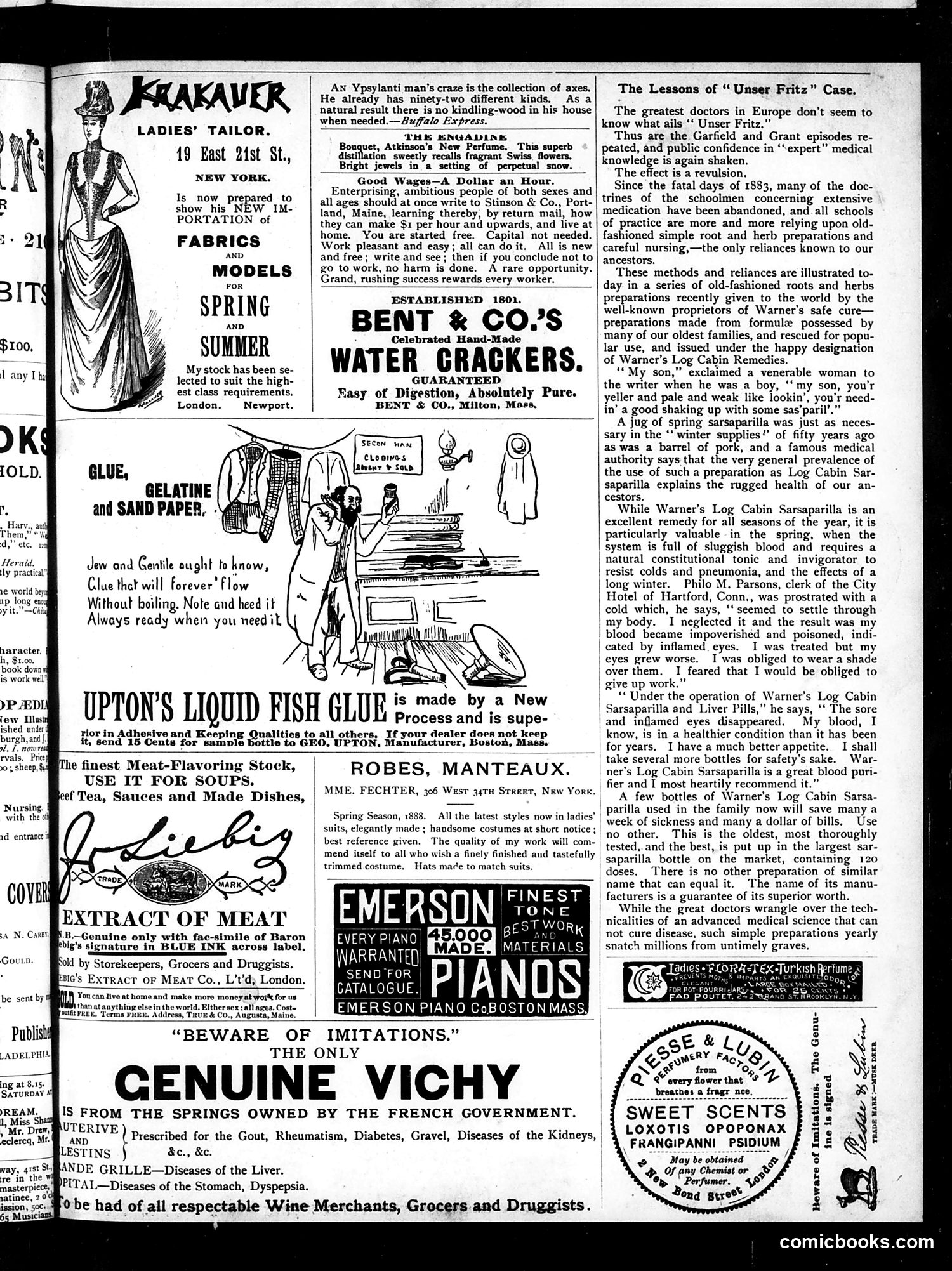
This page is primarily **advertising**, not political satire. It contains numerous Victorian-era product advertisements (perfume, crackers, glue, meat extract, pianos, clothing, mineral water) typical of *Life* magazine's commercial content. The only editorial content is "The Lessons of 'Unser Fritz' Case" (right column), which discusses European medical skepticism following the illness of "Unser Fritz"—likely referring to **Frederick III of Germany**, who died in 1888. The piece argues that high-profile cases of prominent figures treated by celebrated physicians but still failing have undermined public confidence in "expert" medical knowledge. It advocates a return to simpler remedies: traditional root and herb preparations plus nursing care. This reflects late-19th-century debates about medical professionalization and the emerging alternative health movement, not direct political commentary on German affairs.
This page is primarily **advertising**, not political satire or editorial cartoon content. The large "Pears Soap" text at the top appears to be a masthead or section header for what follows. The bulk of the page contains **commercial advertisements** for luxury goods targeting wealthy consumers: champagne (Delbeck, Monon Route brands), French dressing, trunks and bags, silk fabrics from James McCreery & Co., whiskey (Old Crow), and other upscale products. These ads emphasize prestige through "International Awards," Paris Exposition medals, and exclusive importations. There is **no discernible political cartoon or satirical commentary** visible in the image itself—no caricatured figures, political figures, or social critique. The page simply represents typical late-19th-century *Life* magazine advertising strategy: pairing the publication's brand with high-end merchants to appeal to affluent readers. The one notable element is an **anti-moth product advertisement**, which represents period consumer concerns about household pests.
This page contains **no political cartoons or satire**—it is primarily **advertising and editorial content**. The main text is J. Wilkinson Elliott's promotional piece for hardy flowers, emphasizing their artistic and practical advantages over bedding plants. He's advertising his pamphlet "The Garden of Hardy Flowers" and offering a Japanese iris lithograph. The page includes advertisements for: - **Decker Brothers pianos** (Union Square, NY) - **Paillard's music boxes** (Broadway) - **Outing magazine** (for April) - **United States Mutual Accident Association** (insurance) There is no discernible cartoon or satirical commentary. This appears to be a standard magazine page from the early 1900s mixing editorial gardening advice with commercial advertisements typical of *Life* magazine's business model during that era.
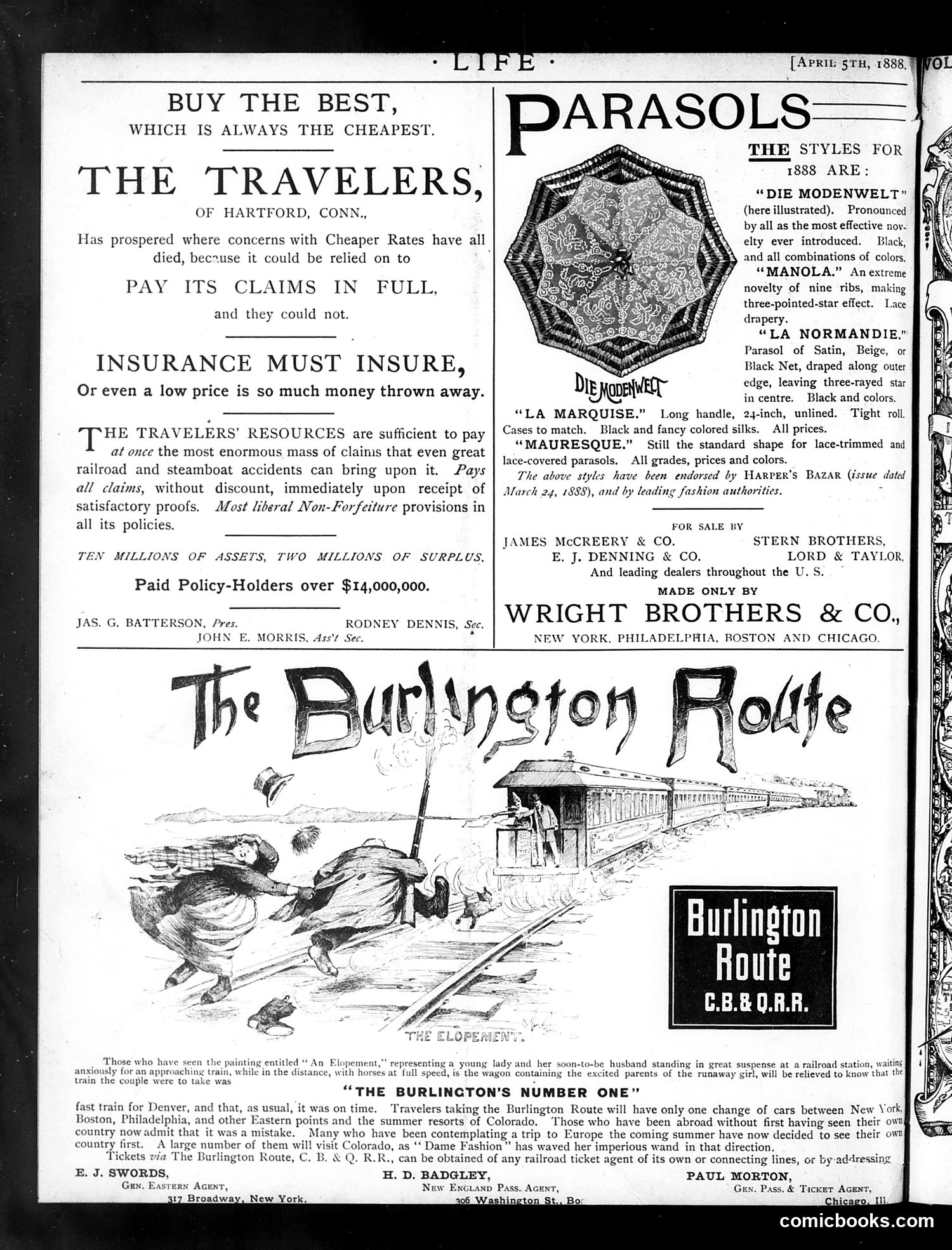
This page is primarily **advertising**, not satire or political commentary. The main cartoon, "The Elopement," illustrates a melodramatic scenario: a young couple waits anxiously at a train station while her parents pursue them by horseback. The image supports The Burlington Route railroad's advertisement claiming reliable, timely service—the fast train departs "on time" as expected, safely delivering the eloping couple to Denver. The satire is gentle: the cartoon mocks Victorian anxieties about elopements while using the couple's predicament to advertise the railroad's dependability. The message: trust Burlington's punctuality even in romantic emergencies. The page also contains insurance advertisements (The Travelers) and parasol promotions, reflecting 1888 consumer goods and fashion endorsements by Harper's Bazaar.