
Life, 1888-04-05 · page 8 of 20
Life — April 5, 1888 — page 8: what you’re looking at
What you’re looking at
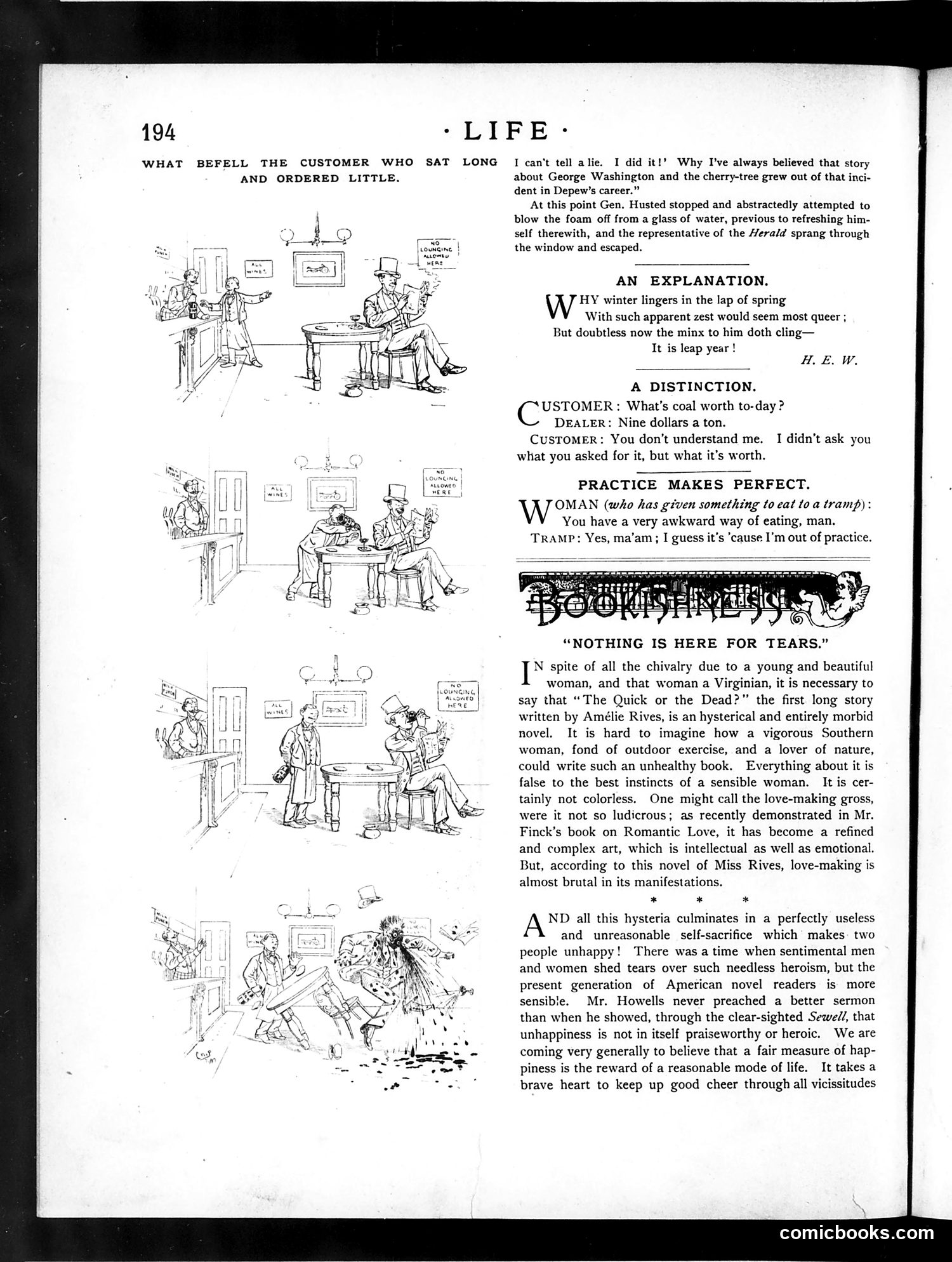
This page contains **four separate comic sketches** (left) and **three brief humorous anecdotes** (right), typical of Life's satirical format. The main cartoon sequence depicts a **waiter or server interacting with a difficult customer** who "sat long and ordered little"—a familiar restaurant scenario. The progressive panels show escalating tension, culminating in chaos, likely satirizing both cheap customers and frustrated service workers. The anecdotes mock various social types: a coal dealer's price-gouging, a tramp's excuse-making, and a book review criticizing author Amelie Rives's novel "The Quick or the Dead?" for its unhealthy sensationalism. The humor relies on **class-based social observation**—poking fun at working-class interactions, consumer behavior, and literary pretension—reflecting early 20th-century American satirical conventions.
📄 Transcribed text from this page (OCR, searchable)
Machine-transcribed from the original scan — historical spelling and the odd misread are preserved.
194 - LIFE: WHAT BEFELL THE CUSTOMER WHO SAT LONG JI can't tell alie. I did it!’ Why I've always believed that story AND ORDERED LITTLE. about George Washington and the cherry-tree grew out of that inci- dent in Depew’s career.” At this point Gen. Husted stopped and abstractedly attempted to blow the foam off from a glass of water, previous to refreshing him- self therewith, and the representative of the Hera/d sprang through the window and escaped. AN EXPLANATION. HY winter lingers in the lap of spring With such apparent zest would seem most queer ; But doubtless now the minx to him doth cling— It is leap year! HE W. A DISTINCTION. USTOMER: What's coal worth to-day ? DEALER: Nine dollars a ton. CUSTOMER: You don’t understand me. I didn’t ask you what you asked for it, but what it’s worth. PRACTICE MAKES PERFECT. OMAN (who has given something to eat toa tramp): You have a very awkward way of eating, man. TRAMP: Yes, ma’am ; I guess it’s ‘cause I’m out of practice. “NOTHING IS HERE FOR TEARS.” [* spite of all the chivalry due to a young and beautiful woman, and that woman a Virginian, it is necessary to say that “The Quick or the Dead?” the first long story written by Amélie Rives, is an hysterical and entirely morbid novel. It is hard to imagine how a vigorous Southern woman, fond of outdoor exercise, and a lover of nature, could write such an unhealthy book. Everything about it is false to the best instincts of a sensible woman. It is cer- tainly not colorless. One might call the love-making gross, were it not so ludicrous; as recently demonstrated in Mr. Finck’s book on Romantic Love, it has become a refined and complex art, which is intellectual as well as emotional. But, according to this novel of Miss Rives, love-making is almost brutal in its manifestations. * * * ND all this hysteria culminates in a perfectly useless and unreasonable self-sacrifice which makes: two people unhappy! There was a time when sentimental men and women shed tears over such needless heroism, but the present generation of American novel readers is more sensible. Mr. Howells never preached a better sermon than when he showed, through the clear-sighted Sewe//, that unhappiness is not in itself praiseworthy or heroic. We are coming very generally to believe that a fair measure of hap- piness is the reward of a reasonable mode of life. It takes a brave heart to keep up good cheer through all vicissitudes comicbooks.com