
Life, 1888-04-05 · page 4 of 20
Life — April 5, 1888 — page 4: what you’re looking at
What you’re looking at
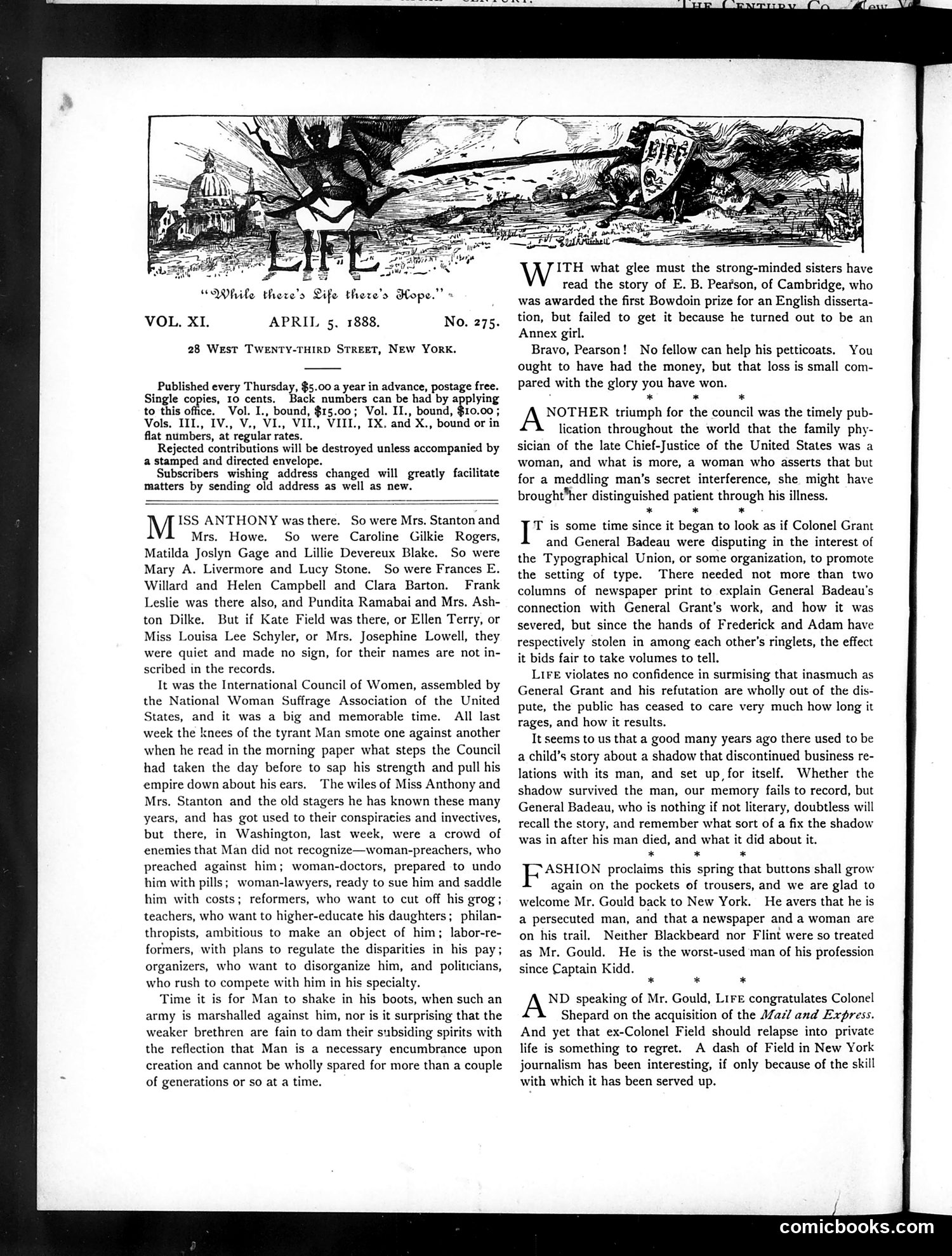
The masthead cartoon depicts a landscape with a bare tree, a classical dome building, and a flag labeled "LIFE," illustrating the magazine's motto "While there's Life there's Hope." The text is satirical commentary on contemporary figures and events. It celebrates E.B. Pearson of Cambridge winning a Bowdoin Prize, mocks General Grant's reputation being damaged by allegations of favoritism toward a woman, and critiques various reform movements opposing established male power structures—including suffragists, woman doctors, temperance advocates, and labor reformers. The piece sarcastically portrays these groups as threats to traditional order, suggesting that strong resistance to social change is inevitable and justified. The tone is conservative and dismissive of progressive causes.
📄 Transcribed text from this page (OCR, searchable)
Machine-transcribed from the original scan — historical spelling and the odd misread are preserved.
“While there's Sife there's Hope.” = VOL. XI. APRIL 5, 1888. No. 275. 28 West TWENTY-THIRD STREET, NEW YorK. Published every Thursday, $5.00 a year in advance, postage free. Single copies, 10 cents. Back numbers can be had by applying to this office. Vol. I., bound, $15.00; Vol. II., bound, $10.00 ; Vols, III., 1V., V., VI., VII, VIII., IX. and X., bound or in flat numbers, at regular rates. Rejected contributions will be destroyed unless accompanied by a stamped and directed envelope. Subscribers wishing address changed will greatly facilitate matters by sending old address as well as new. ISS ANTHONY was there. So were Mrs. Stanton and Mrs. Howe. So were Caroline Gilkie Rogers, Matilda Joslyn Gage and Lillie Devereux Blake. So were Mary A. Livermore and Lucy Stone. So were Frances E. Willard and Helen Campbell and Clara Barton. Frank Leslie was there also, and Pundita Ramabai and Mrs. Ash- ton Dilke. But if Kate Field was there, or Ellen Terry, or Miss Louisa Lee Schyler, or Mrs. Josephine Lowell, they were quiet and made no sign, for their names are not in- scribed in the records. It was the International Council of Women, assembled by the National Woman Suffrage Association of the United States, and it was a big and memorable time. All last week the knees of the tyrant Man smote one against another when he read in the morning paper what steps the Council had taken the day before to sap his strength and pull his empire down about his ears. The wiles of Miss Anthony and Mrs. Stanton and the old stagers he has known these many years, and has got used to their conspiracies and invectives, but there, in Washington, last week, were a crowd of enemies that Man did not recognize—woman-preachers, who preached against him; woman-doctors, prepared to undo him with pills; woman-lawyers, ready to sue him and saddle him with costs; reformers, who want to cut off his grog; teachers, who want to higher-educate his daughters; philan- thropists, ambitious to make an object of him; labor-re- formers, with plans to regulate the disparities in his pay; organizers, who want to disorganize him, and politicians, who rush to compete with him in his specialty. Time it is for Man to shake in his boots, when such an army is marshalled against him, nor is it surprising that the weaker brethren are fain to dam their subsiding spirits with the reflection that Man is a necessary encumbrance upon creation and cannot be wholly spared for more than a couple of generations or so at a time. ITH what glee must the strong-minded sisters have read the story of E. B. Pearson, of Cambridge, who was awarded the first Bowdoin prize for an English disserta- tion, but failed to get it because he turned out to be an Annex girl. Bravo, Pearson! No fellow can help his petticoats. You ought to have had the money, but that loss is small com- pared with the glory you have won. * * * NOTHER triumph for the council was the timely pub- lication throughout the world that the family phy- sician of the late Chief-Justice of the United States was a woman, and what is more, a woman who asserts that but for a meddling man’s secret interference, she might have brought*her distinguished patient through his illness. * * * T is some time since it began to look as if Colonel Grant and General Badeau were disputing in the interest of the Typographical Union, or some organization, to promote the setting of type. There needed not more than two columns of newspaper print to explain General Badeau's connection with General Grant’s work, and how it was severed, but since the hands of Frederick and Adam have respectively stolen in among each other's ringlets, the effect it bids fair to take volumes to tell. LiFe violates no confidence in surmising that inasmuch as General Grant and his refutation are wholly out of the dis- pute, the public has ceased to care very much how long it rages, and how it results. It seems to us that a good many years ago there used to be a child’s story about a shadow that discontinued business re- lations with its man, and set up for itself. Whether the shadow survived the man, our memory fails to record, but General Badeau, who is nothing if not literary, doubtless will recall the story, and remember what sort of a fix the shadow was in after his man died, and what it did about it. * * * ASHION proclaims this spring that buttons shall grow again on the pockets of trousers, and we are glad to welcome Mr. Gould back to New York. He avers that he is a persecuted man, and that a newspaper and a woman are on his trail. Neither Blackbeard nor Flint were so treated as Mr. Gould. He is the worst-used man of his profession since Captain Kidd. * * AS speaking of Mr. Gould, Lire congratulates Colonel Shepard on the acquisition of the Maz/ and Express. And yet that ex-Colonel Field should relapse into private life is something to regret. A dash of Field in New York journalism has been interesting, if only because of the skill with which it has been served up. comicbooks.com