
Life, 1888-04-05 · page 12 of 20
Life — April 5, 1888 — page 12: what you’re looking at
What you’re looking at
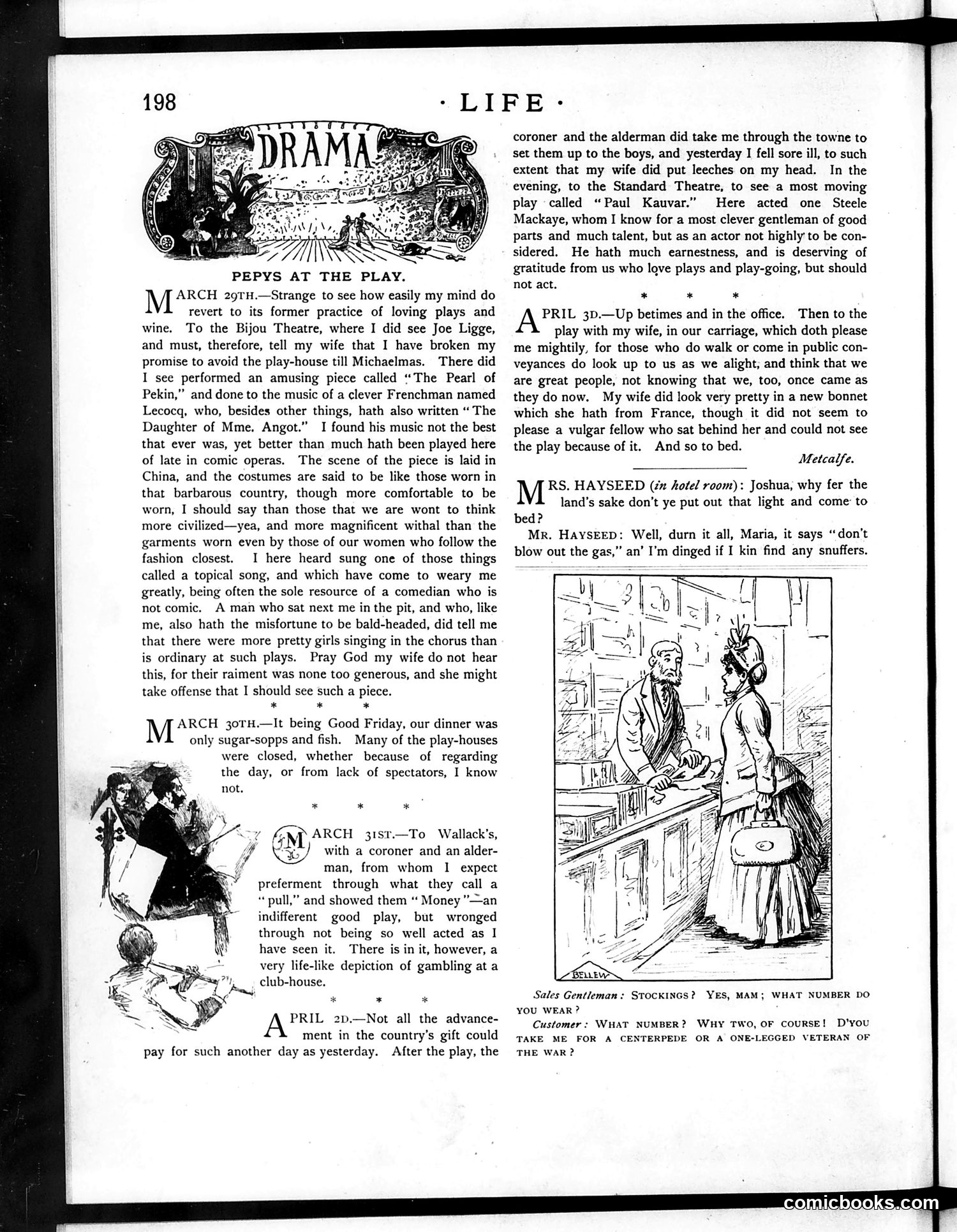
This page from *Life* magazine contains satirical commentary on 1880s theater and social pretension, written in the voice of Samuel Pepys (the famous 17th-century diarist). The satire works by having Pepys observe contemporary theater through his historical lens, creating humor via anachronism. **The main section** mocks theater-goers' snobbery: Pepys attends plays, breaks promises to his wife, and notes the revealing costumes of chorus girls. The implicit joke is that respectable people pretend theater attendance is cultured while actually being drawn by spectacle and scandal. **The cartoons below** show separate jokes unrelated to Pepys: 1. **Mrs. Hayseed**: Rural characters confused by hotel gas lighting—humor from perceived rural ignorance about modern technology. 2. **Sales Gentleman**: A shop clerk's joke about a customer's stocking size, making a crude reference to centipedes (many legs) and disabled war veterans—dark humor typical of the period. The page satirizes theatrical pretension, rural/urban class divides, and era-specific anxieties about modernity and propriety.
📄 Transcribed text from this page (OCR, searchable)
Machine-transcribed from the original scan — historical spelling and the odd misread are preserved.
> LIFE: PEPYS AT THE PLAY. ARCH 29TH.—Strange to see how easily my mind do revert to its former practice of loving plays and To the Bijou Theatre, where I did see Joe Ligge, and must, therefore, tell my wife that I have broken my promise to avoid the play-house till Michaelmas. There did I see performed an amusing piece called “The Pearl of Pekin,” and done to the music of a clever Frenchman named Lecocq, who, besides other things, hath also written “The Daughter of Mme. Angot.” I found his music not the best that ever was, yet better than much hath been played here of late in comic operas. The scene of the piece is laid in China, and the costumes are said to be like those worn in that barbarous country, though more comfortable to be worn, I should say than those that we are wont to think more civilized—yea, and more magnificent withal than the garments worn even by those of our women who follow the fashion closest. I here heard sung one of those things called a topical song, and which have come to weary me greatly, being often the sole resource of a comedian who is not comic. A man who sat next me in the pit, and who, like me, also hath the misfortune to be bald-headed, did tell me that there were more pretty girls singing in the chorus than is ordinary at such plays. Pray God my wife do not hear this, for their raiment was none too generous, and she might take offense that I should see such a piece. * * * M ARCH 30TH.—It being Good Friday, our dinner was only sugar-sopps and fish. Many of the play-houses were closed, whether because of regarding the day, or from lack of spectators, I know not. wine. * * * GNP ARCH 31s1.—To Wallack's, “x, with a coroner and an alder- man, from whom 1 expect preferment through what they call a “pull,” and showed them “ Money "—an indifferent good play, but wronged through not being so well acted as I have seen it. There is in it, however, a very life-like depiction of gambling at a in| club-house. NP A’ 2D.—Not all the advance- ment in the country’s gift could pay for such another day as yesterday. After the play, the coroner and the alderman did take me through the towne to set them up to the boys, and yesterday I fell sore ill, to such extent that my wife did put leeches on my head. In the evening, to the Standard Theatre, to see a most moving play called “Paul Kauvar.” Here acted one Steele Mackaye, whom I know for a most clever gentleman of good parts and much talent, but as an actor not highly to be con- sidered. He hath much earnestness, and is deserving of gratitude from us who love plays and play-going, but should not act. * * * PRIL 3D.—Up betimes and in the office. Then to the play with my wife, in our carriage, which doth please me mightily, for those who do walk or come in public con- veyances do look up to us as we alight, and think that we are great people, not knowing that we, too, once came as they do now. My wife did look very pretty in a new bonnet which she hath from France, though it did not seem to please a vulgar fellow who sat behind her and could not see the play because of it. And so to bed. Metcalfe. M RS. HAYSEED (¢x hotel room): Joshua, why fer the land’s sake don’t ye put out that light and come to bed? Mr. HAYSEED: Well, durn it all, Maria, it says “don't blow out the gas,” an’ I'm dinged if I kin find any snuffers. Sales Gentleman: STOCKINGS? YES, MAM; WHAT NUMBER DO YOU WEAR? Customer: WHAT NUMBER? WHY TWO, OF CouRSE! D'you TAKE ME FOR A CENTERPEDE OR A ONE-LEGGED VETERAN OF THE WAR?