
A complete issue · 20 pages · 1888
Life — March 8, 1888
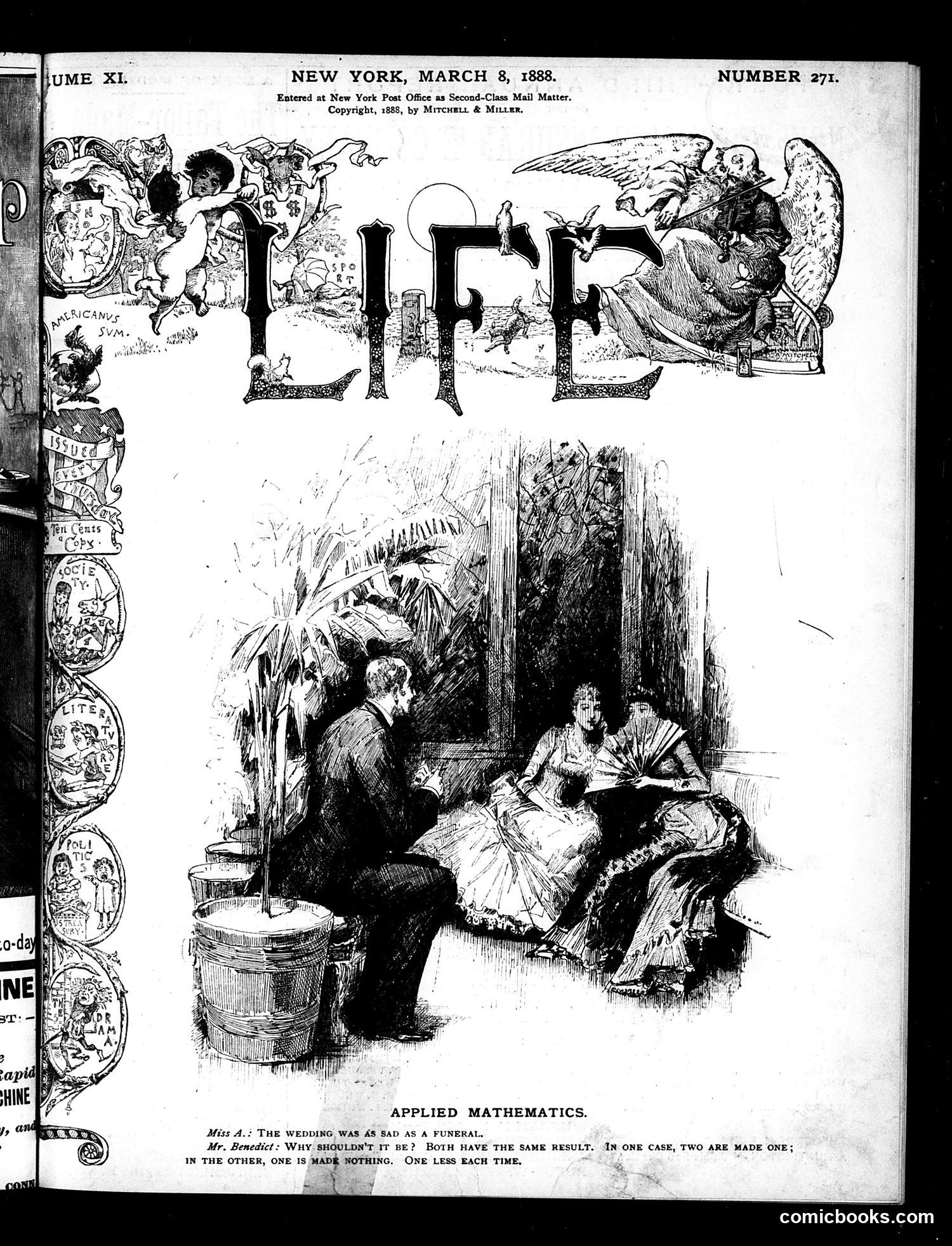
The main illustration is captioned "APPLIED MATHEMATICS" and depicts a domestic scene with the heading: "Miss A.: The wedding was as bad as a funeral. / Mr. Benedict: Why shouldn't it be? Both have the same result. In one case, two are made one; in the other, one is made nothing. One less each time." This is a cynical joke about marriage. The cartoon satirizes matrimony by comparing a wedding to a funeral—both allegedly reduce the number of living individuals. Mr. Benedict's quip suggests marriage destroys individual identity (two become one) while death also eliminates a person (one becomes nothing), so the mathematical result is identical loss. The illustration shows what appears to be a domestic interior with figures, reinforcing the married-life theme. This reflects late-19th-century bachelor humor mocking marriage as a loss of freedom.
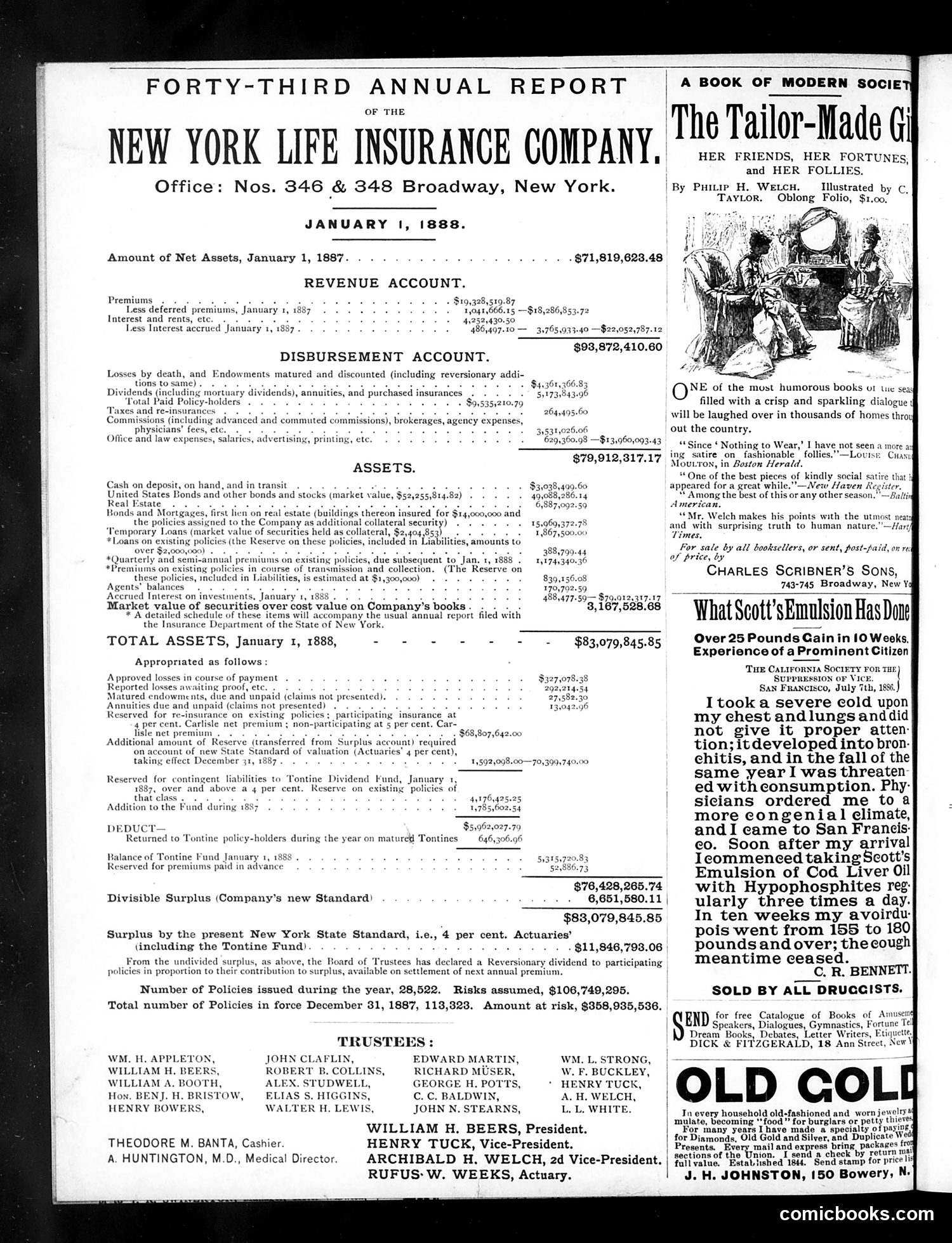
This page is **primarily an insurance company financial report** (New York Life Insurance Company's 43rd annual report, January 1, 1888), not a satirical cartoon page. The right side contains **book advertisements** and testimonials, including "The Tailor-Made Girl" by Philip H. Welch and Scott's Emulsion (a cod liver oil product). A small illustration shows a social gathering, likely depicting the book's subject matter about fashionable women. The testimonial about Scott's Emulsion describes treating consumption (tuberculosis), a serious health concern of the era. **This is not a political cartoon or satirical content**—it's a standard magazine page mixing financial reporting with commercial advertising, typical of 19th-century publications.
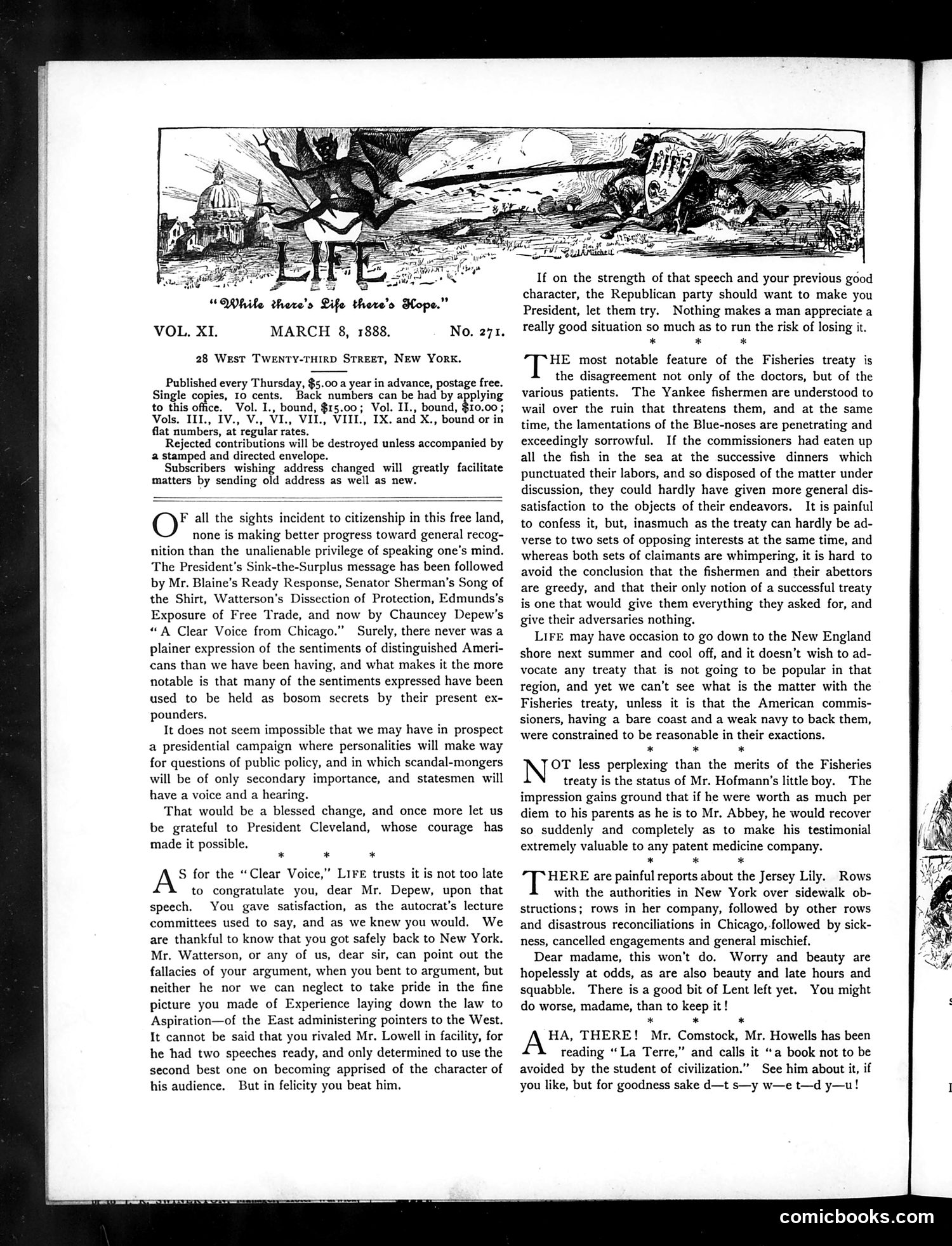
The page header cartoon shows a figure labeled "White's there's Life there's Hope," likely referencing a contemporary political figure or public personality. The main text discusses several satirical topics: 1. **Presidential campaigns**: Commentary on Republican and Democratic candidates, suggesting internal party disputes over treaty negotiations. 2. **The Fisheries Treaty**: Extended discussion mocking disagreements between American and Canadian negotiators over fishing rights—both sides appear greedy and unwilling to compromise. 3. **Various social commentary**: References to patent medicine testimonials, the Jersey Lily (actress Lillie Langtry), and literary criticism of "La Terre." The overall tone mocks political posturing, diplomatic ineffectiveness, and contemporary social pretenses. Without identifying specific individuals with certainty, the page satirizes mid-1880s American political and cultural debates.
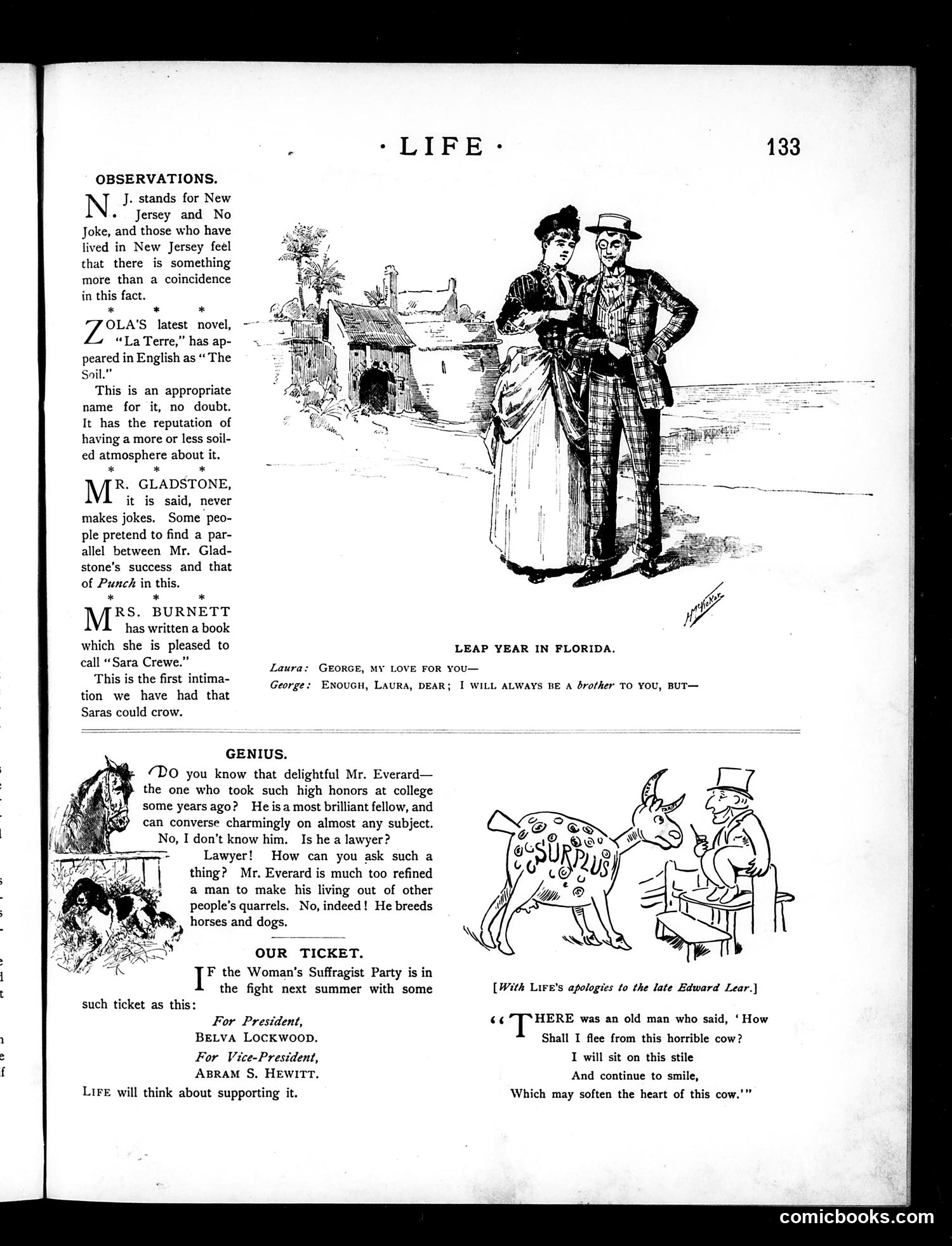
**Main Cartoon: "Leap Year in Florida"** This depicts a woman (Laura) proposing to a man (George) during leap year—when tradition permitted women to propose. George refuses, claiming he'll be a "brother" instead. The satire mocks the awkwardness of reversed gender roles in courtship, a common theme in early 20th-century humor about women's changing social position. **"Genius" Section** Discusses an unnamed Mr. Everard, a college-educated man of refined manners who breeds horses and dogs rather than pursuing professional work—satirizing wealthy idleness disguised as gentlemanly pursuits. **"Our Ticket"** Proposes Belva Lockwood for President and Abram S. Hewitt for Vice-President, supporting women's suffrage activism (Lockwood was an actual suffrage advocate).
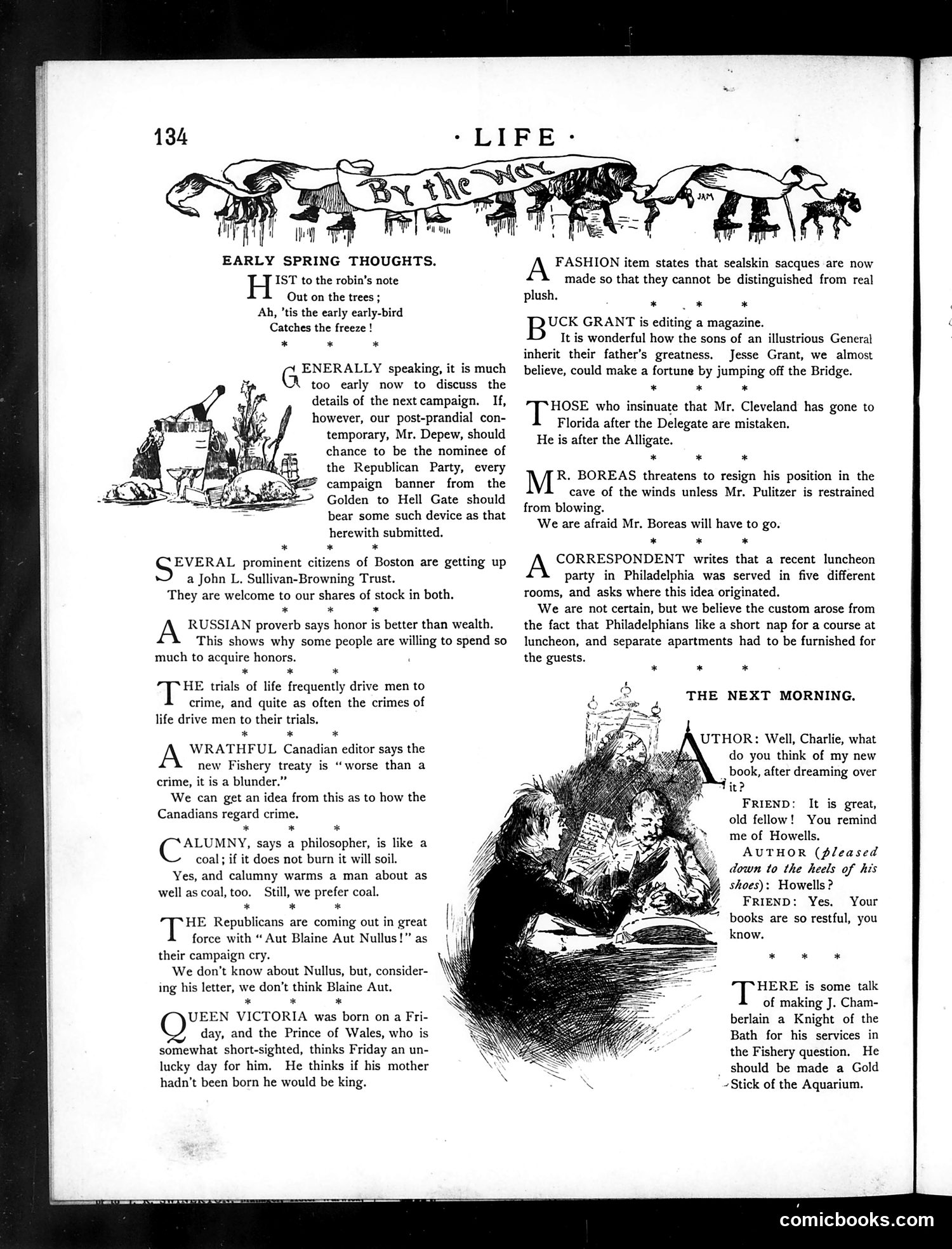
This page collects brief satirical observations on current events, rather than featuring unified cartoons. **Key References:** - **Buck Grant** editing a magazine—likely refers to General Grant's son inheriting his father's prominence - **Mr. Cleveland and Florida/the Delegate**—appears to reference Grover Cleveland and contested political matters involving Florida (possibly echoing 1876 Electoral Commission disputes) - **Mr. Boreas threatening resignation**—unclear reference, possibly mythological or figurative - **Philadelphia luncheon custom**—mocks upper-class dining practices requiring separate apartments for guests - **"The Next Morning" sketch**—depicts an author discussing his book with a friend, playing on how writers' dreams of success contrast with reality The **"Early Spring Thoughts"** section offers cynical observations about politics, crime, and human nature. The overall tone is characteristic of *Life*'s satirical approach to contemporary American politics and society during the 1880s-1890s.
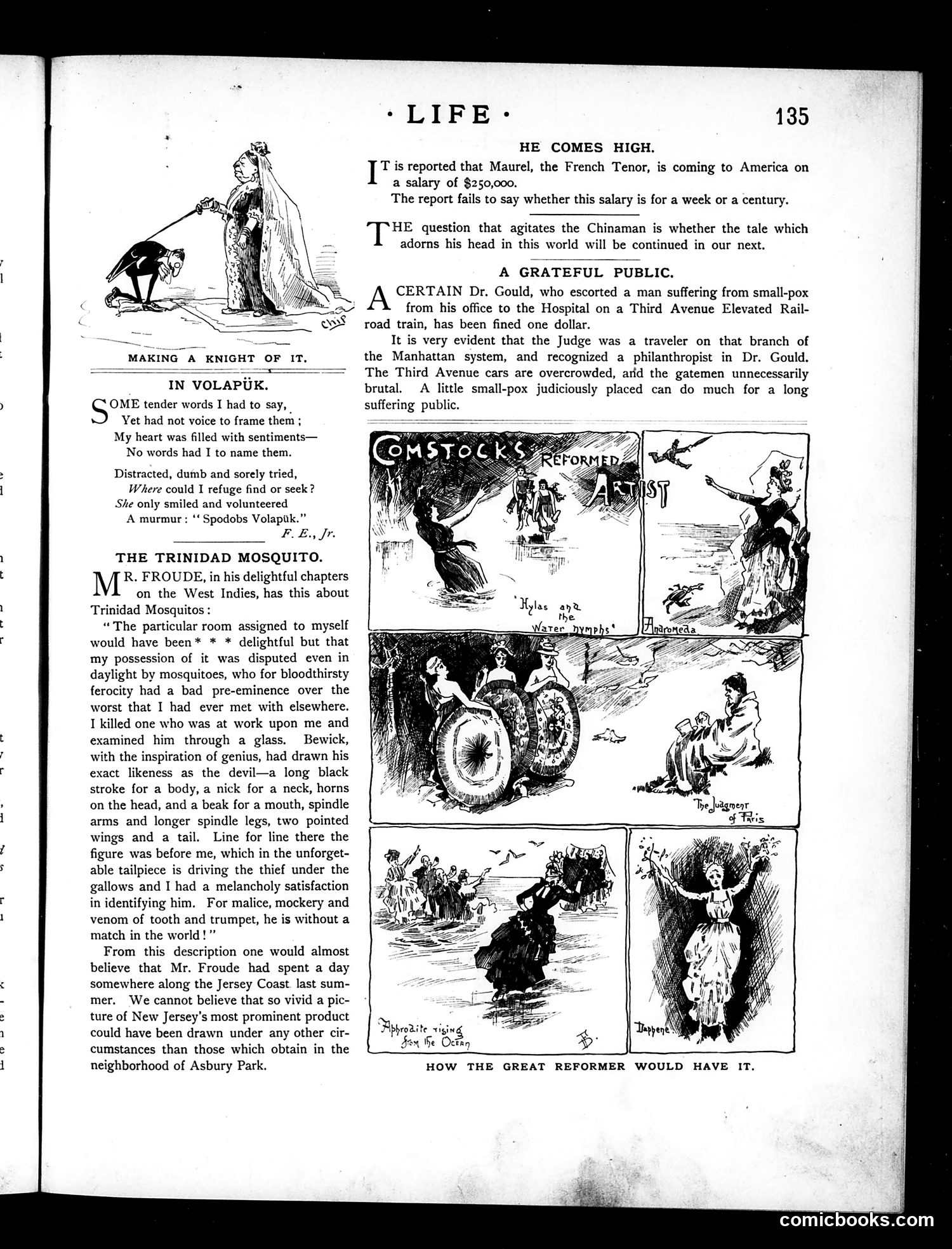
This page contains three distinct satirical pieces from *Life* magazine: 1. **"He Comes High"**: A brief joke about French tenor Maurel's $250,000 salary to America—mocking that the payment period is unspecified (week or century). 2. **"A Grateful Public"**: Satire on Dr. Gould, who escorted a smallpox patient via Third Avenue elevated train. The joke criticizes overcrowded NYC transit and suggests the doctor's act, while kind, highlights public health failures. 3. **"The Trinidad Mosquito"**: A longer satirical piece by Mr. Froude describing an unusually vicious mosquito. The accompanying comic panels show "How the Great Reformer Would Have It"—likely mocking Anthony Comstock (visible as reference) and his censorship efforts by depicting absurdist "reformed" scenarios, suggesting his moral crusades were equally ridiculous.
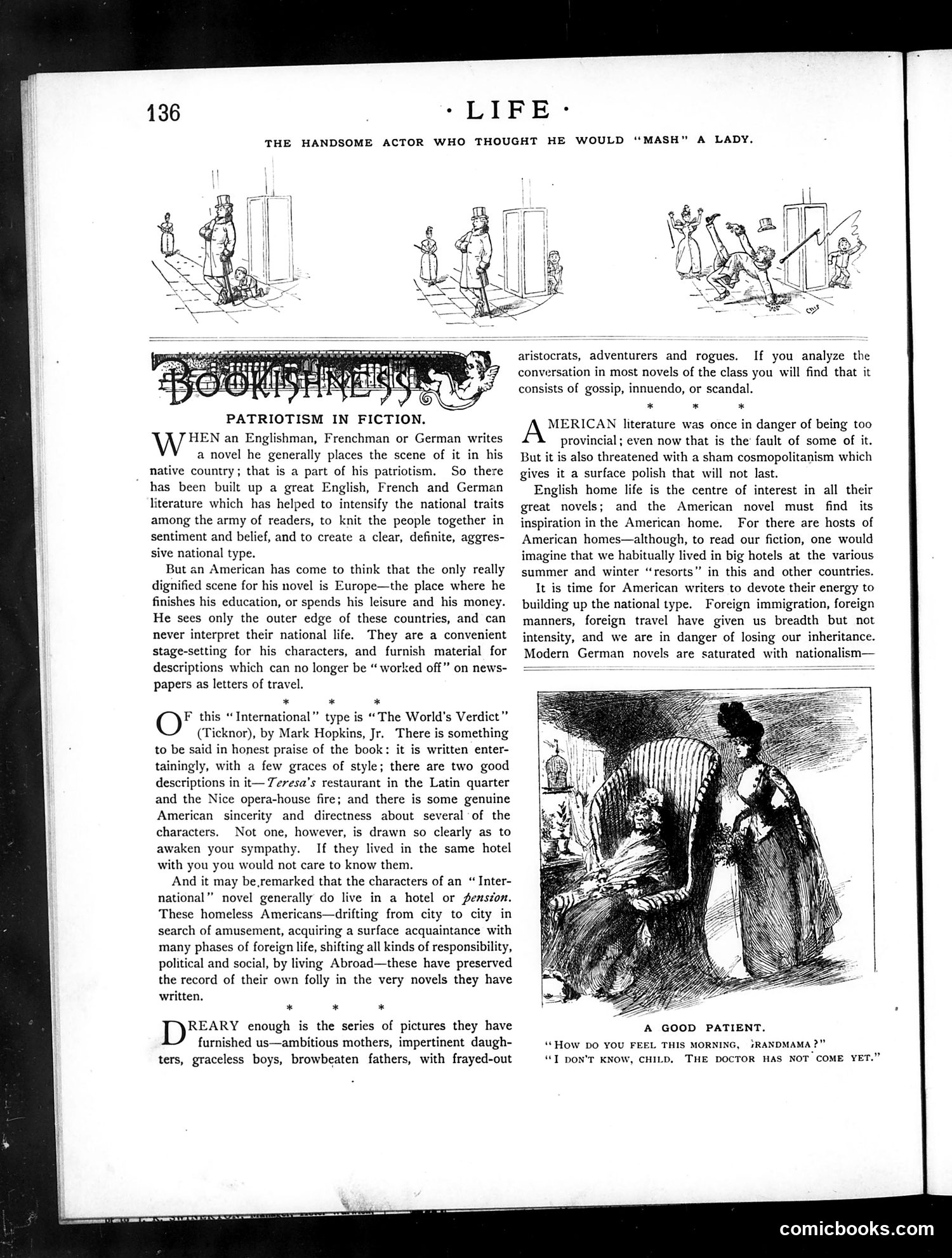
This page contains a literary criticism article titled "Patriotism in Fiction" rather than political cartoons. The text critiques American novelists who set their works in Europe rather than America, arguing they're avoiding depicting genuine American national life. The author contends that American literature should focus on American homes and society instead of chasing cosmopolitan European settings. Three small sketches at the top illustrate "The Handsome Actor Who Thought He Would 'Mash' a Lady"—depicting a man's unsuccessful romantic advances. The larger illustration labeled "A Good Patient" shows a doctor's visit, with a patient asking the grandmother how she feels and noting the doctor hasn't arrived yet. These appear to be humorous vignettes separate from the main article.
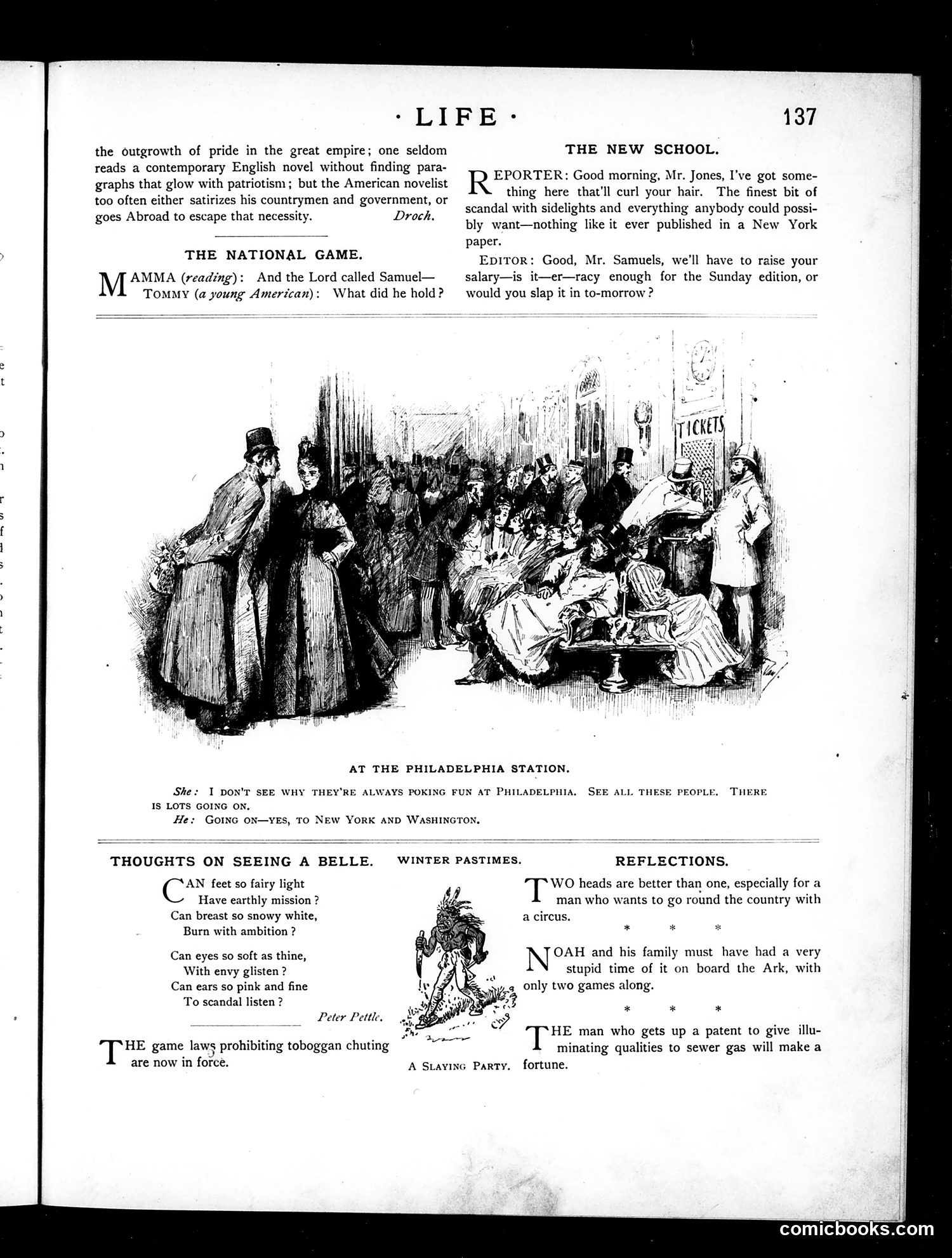
This page contains several satirical pieces about American life and manners: **"The National Game"** presents a dialogue mocking American patriotism—a mother reads biblical passages to her son, who responds with crude American materialism, suggesting the nation's values are skewed. **"At the Philadelphia Station"** cartoon depicts crowded travelers. The joke critiques Philadelphia's status as a transit hub where people rush through to reach "New York and Washington"—implying Philadelphia lacks appeal compared to major cities. **"Thoughts on Seeing a Belle"** is romantic poetry mocking sentimental verse about beautiful women. **"Winter Pastimes"** and **"Reflections"** offer brief satirical observations on social absurdities and human nature. The page overall reflects *Life*'s role as social commentary on 19th-century American culture, manners, and pretensions.
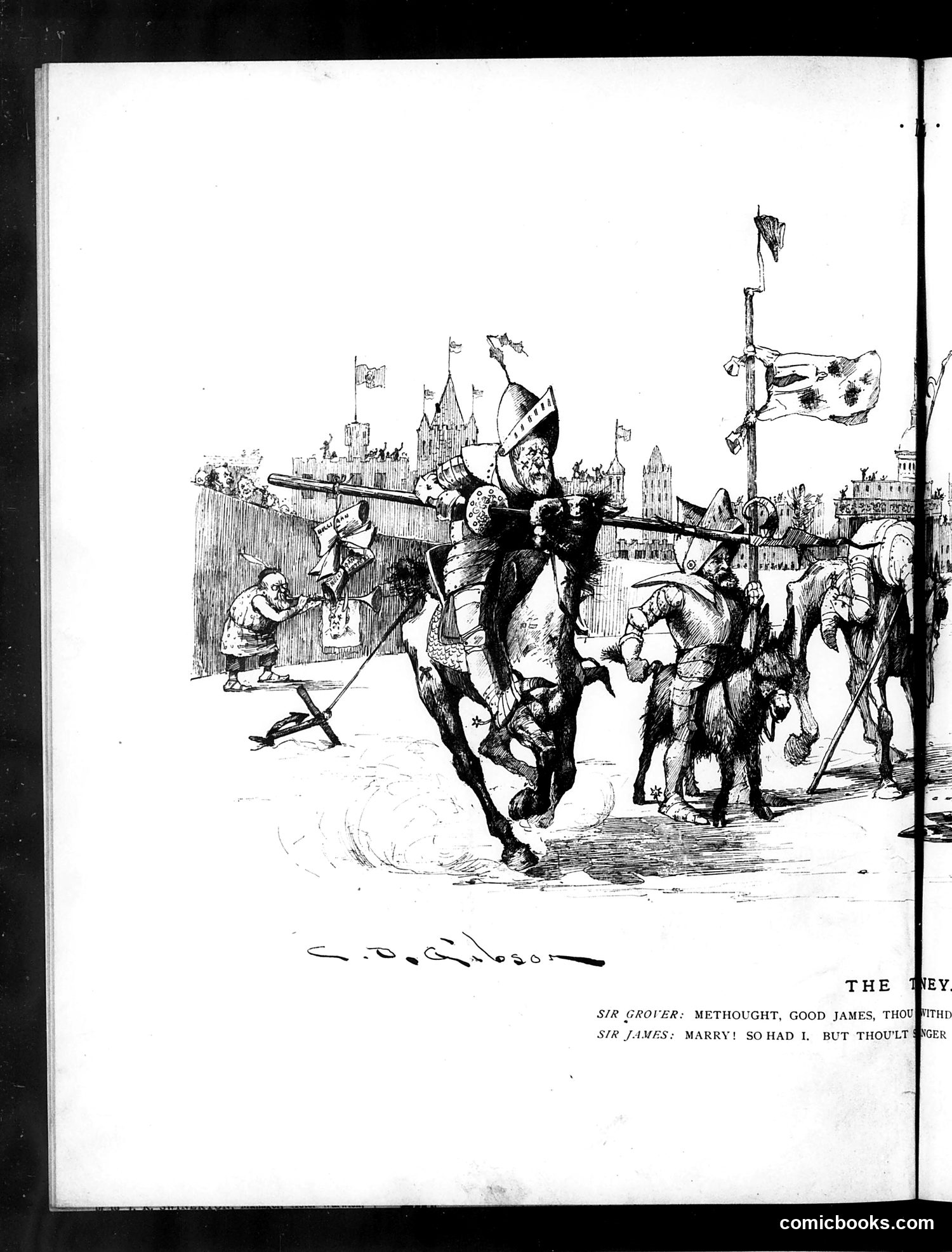
This is a satirical illustration by C.D. Gibson depicting a medieval jousting scene. The image shows armored knights on horseback in combat before a castle, with soldiers and spectators surrounding them. The dialogue caption reads: "SIR GROVER: METHOUGHT, GOOD JAMES, THOU HITHERTO—" and "SIR JAMES: MARRY! SO HAD I. BUT THOU'T [sic] INGER—" The satire appears to mock either pretentious medieval romanticism or possibly contemporary political figures using medieval jousting as metaphor. The incomplete, awkward dialogue in pseudo-Shakespearean English adds comedic effect. Without additional context identifying "Sir Grover" and "Sir James," it's unclear whether these refer to specific historical or political figures of the era, but the juxtaposition of elaborate medieval pageantry with satirical commentary was typical of *Life* magazine's social criticism.
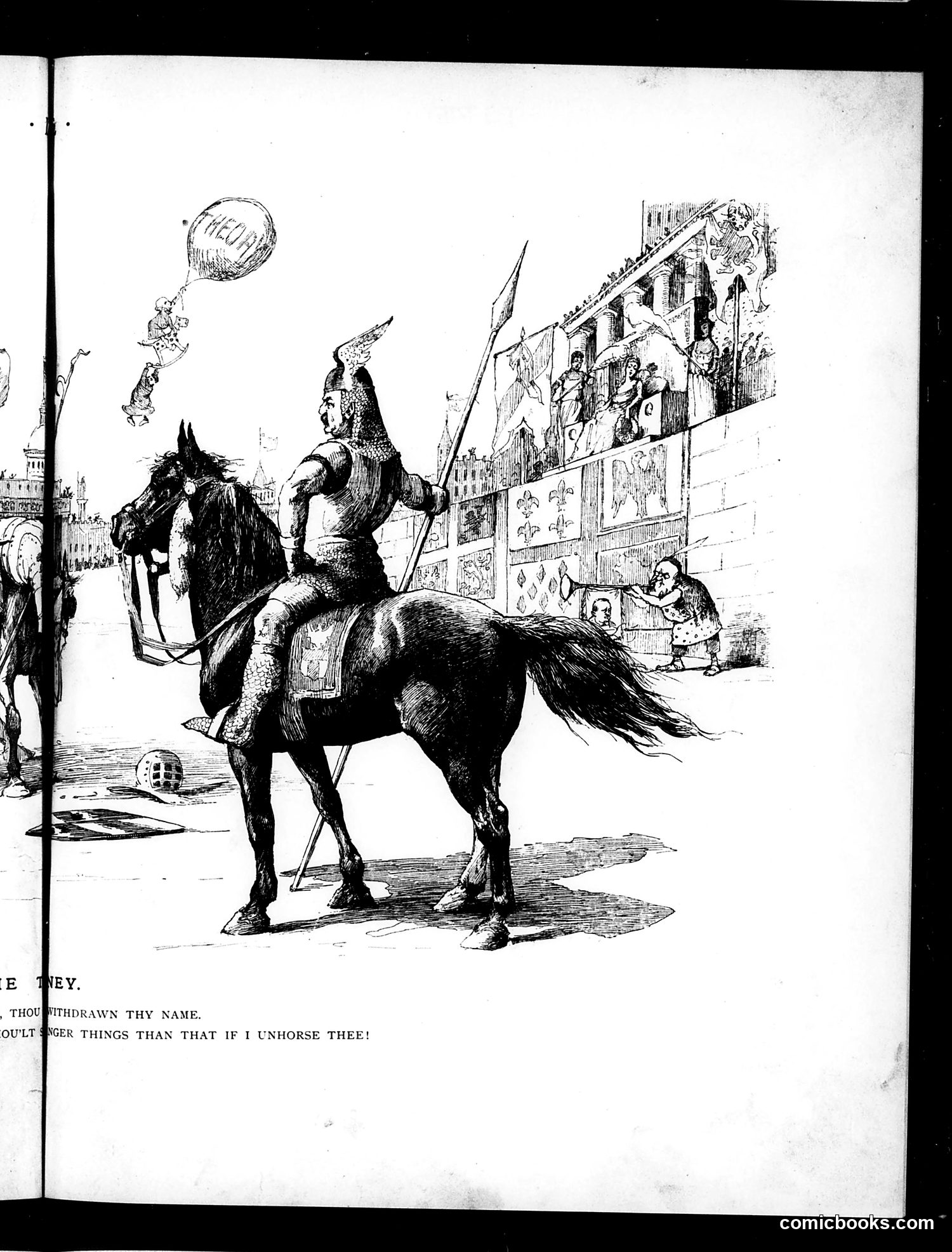
This appears to be a satirical cartoon from Life magazine depicting a medieval joust scene. A heavily armored knight on horseback holds a lance and balloon labeled "HIGH" while facing an ornate structure (likely representing an institution or authority). Spectators watch from stands and windows. The fragmentary text references "withdrawn thy name" and threatening language about unhorsing someone, suggesting a political conflict or challenge to authority. The balloon and medieval imagery likely mock grandiose or inflated pretensions—the "HIGH" label may reference lofty ambitions or arrogance being challenged or deflated. Without complete text or publication date, I cannot identify the specific political figures or events referenced. The satire appears to critique someone's overblown power or claims through mock-heroic medieval imagery.
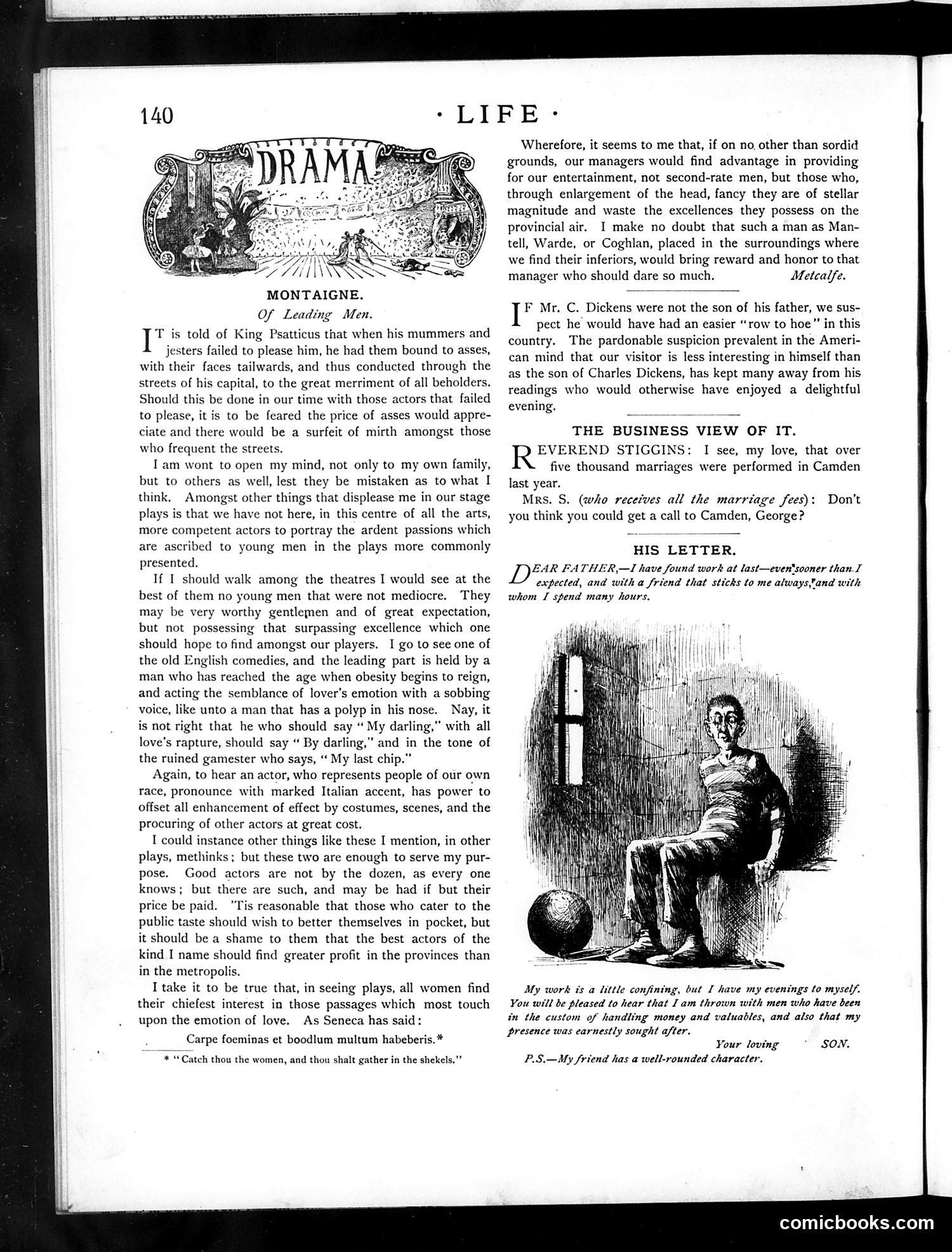
This page from *Life* magazine contains two satirical pieces critiquing American theater and society. **"Montaigne: Of Leading Men"** (main essay) attacks the poor quality of leading actors in American theaters. The author complains that established theaters employ aging, mediocre performers—men who are obese, mispronounce lines, or affect inappropriate accents—rather than hiring genuinely talented actors available in the provinces. He names "Mantell, Warde, or Coghlan" as superior alternatives. The satire suggests theater managers prioritize profit over quality and shamefully waste excellent talent outside major cities. **Secondary items** include a brief jab at Charles Dickens Jr.'s American readings, suggesting audiences attended more for his famous father's name than his own merit, and a comedic domestic dialogue about Camden marriages. The **illustration** depicts a young man in distress at a window, accompanying a sentimental letter about work and hardship—likely accompanying a separate story on the page. The overall tone mocks both theatrical mediocrity and American audience superficiality.
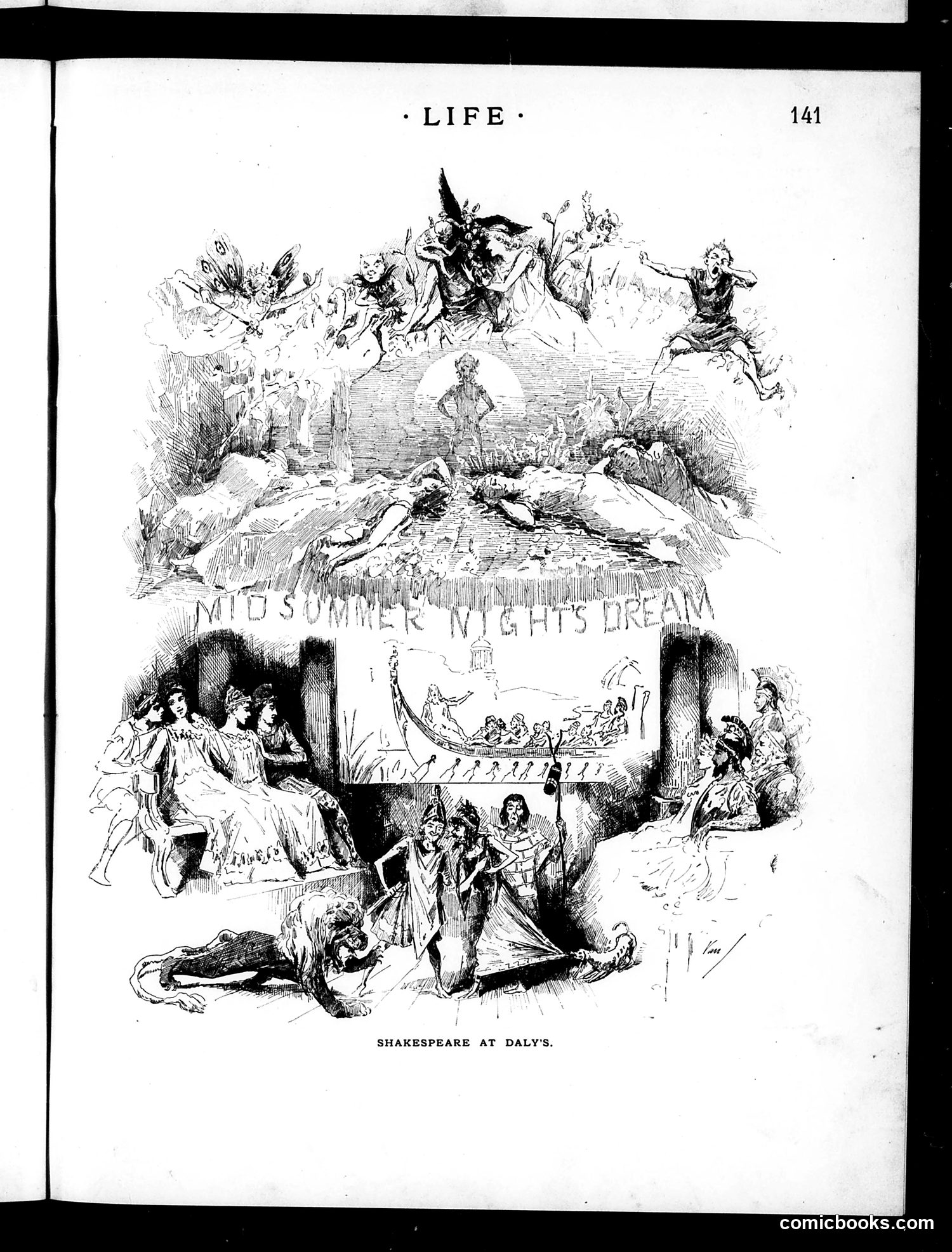
This is a satirical illustration commenting on a theatrical production of Shakespeare at Daly's Theatre (a prominent American playhouse of the era). The image depicts two contrasting scenes: the upper portion shows the actual Shakespeare play—appearing chaotic with supernatural or comedic elements—while the lower section shows the *audience* at the theater, seemingly more dramatic and entertaining than the performance itself. The satire suggests that the real spectacle lies not in the staged Shakespeare production but in the social theater of the audience members themselves—their reactions, posturing, and interactions. This mocks both pretentious theater-goers and perhaps the quality of the theatrical production, implying the audience's behavior outshines the actual drama on stage. The title references "A Midsummer Night's Dream" (visible text fragment).
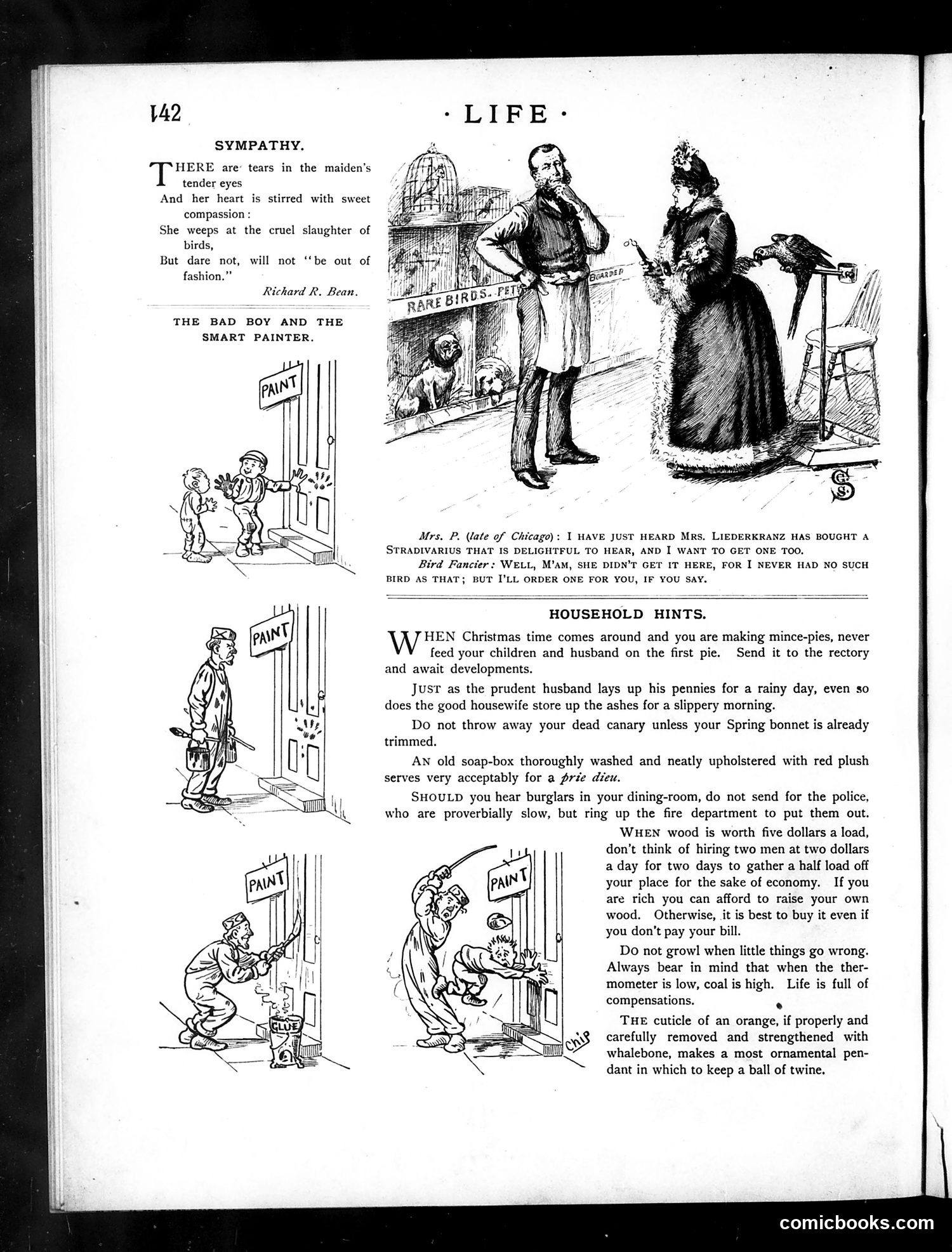
This page contains three distinct satirical pieces: **"Sympathy"** mocks fashionable sentimentality—a woman weeps over bird slaughter yet refuses to abandon the cruel fashion of wearing dead birds on hats, as was common in the Edwardian era. **"The Bad Boy and the Smart Painter"** shows a con artist bird seller who, when a wealthy Chicago woman (Mrs. P.) asks for a "Stradivarius" bird (confusing the violin maker's name with a bird species), claims he's never heard of such a bird but will happily order one—clearly planning to swindle her. **"Household Hints"** is satirical domestic advice mocking middle-class penny-pinching and absurd economies (saving canary feathers for hat trim, using soap boxes as furniture, calling the fire department instead of police for burglars). The humor lies in the ridiculous suggestions presented deadpan. All three pieces target Victorian/Edwardian social hypocrisy and class pretension.
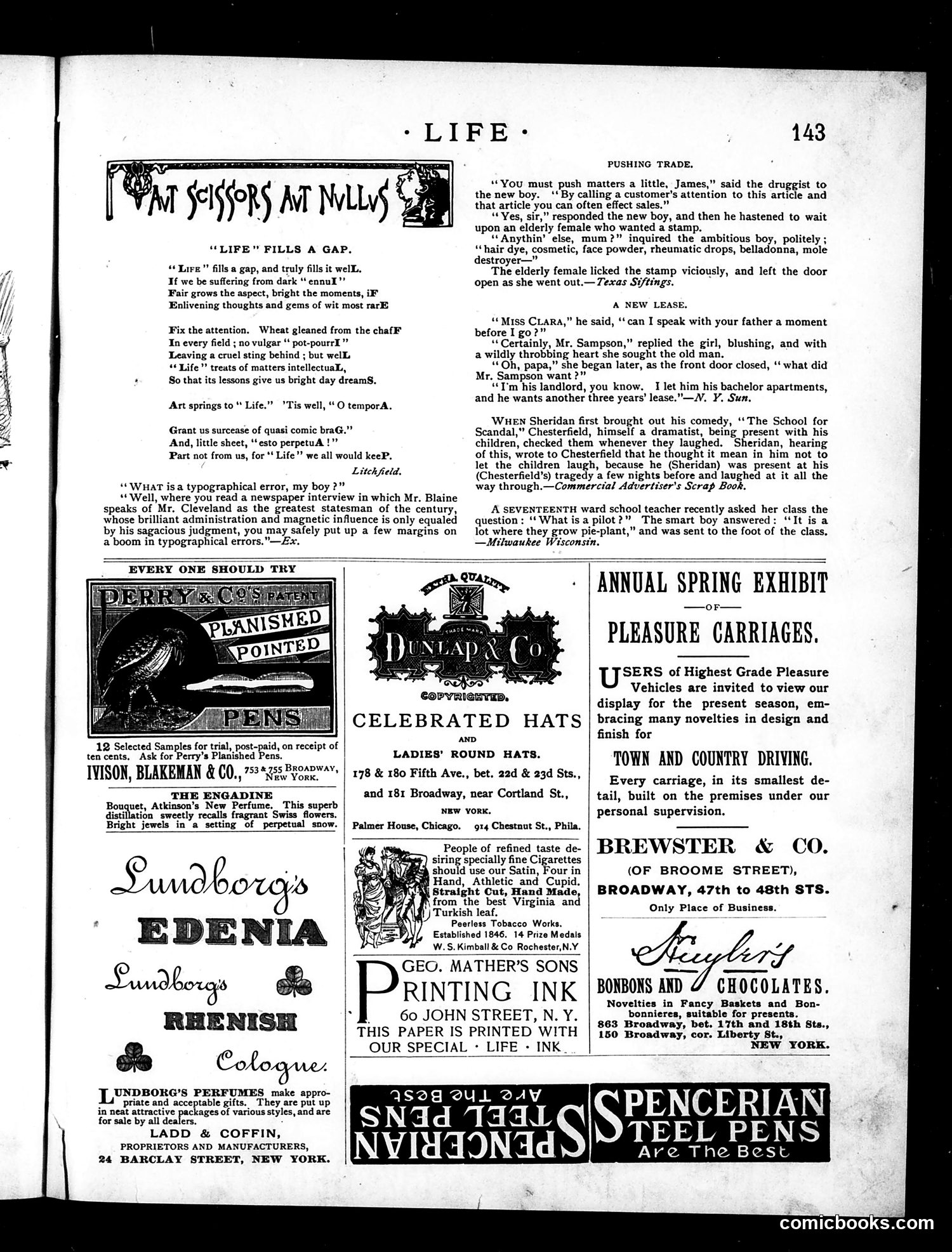
This page is primarily **advertising with some light humor pieces**. The cartoons and jokes are minor: **Main Content:** - Several brief humorous anecdotes ("Pushing Trade," "A New Lease," "School Incident") typical of period satirical magazines—simple, punchy jokes about everyday situations - A typographical error joke referencing **James G. Blaine and Grover Cleveland**, 1880s political rivals, mocking the absurdity of a newspaper misprint claiming Blaine praised Cleveland as a great statesman **Dominant Feature:** The page is crowded with **period advertisements** for pens, perfume, hats, carriages, printing ink, cigars, and chocolates—typical commercial content from the era. **Notable Detail:** A reference to playwright Sheridan's witty retort to Lord Chesterfield about theatrical etiquette represents the magazine's cultural aspirations. Overall, this is **not primarily a political cartoon page** but rather a typical 19th-century magazine mix of light humor and advertising.
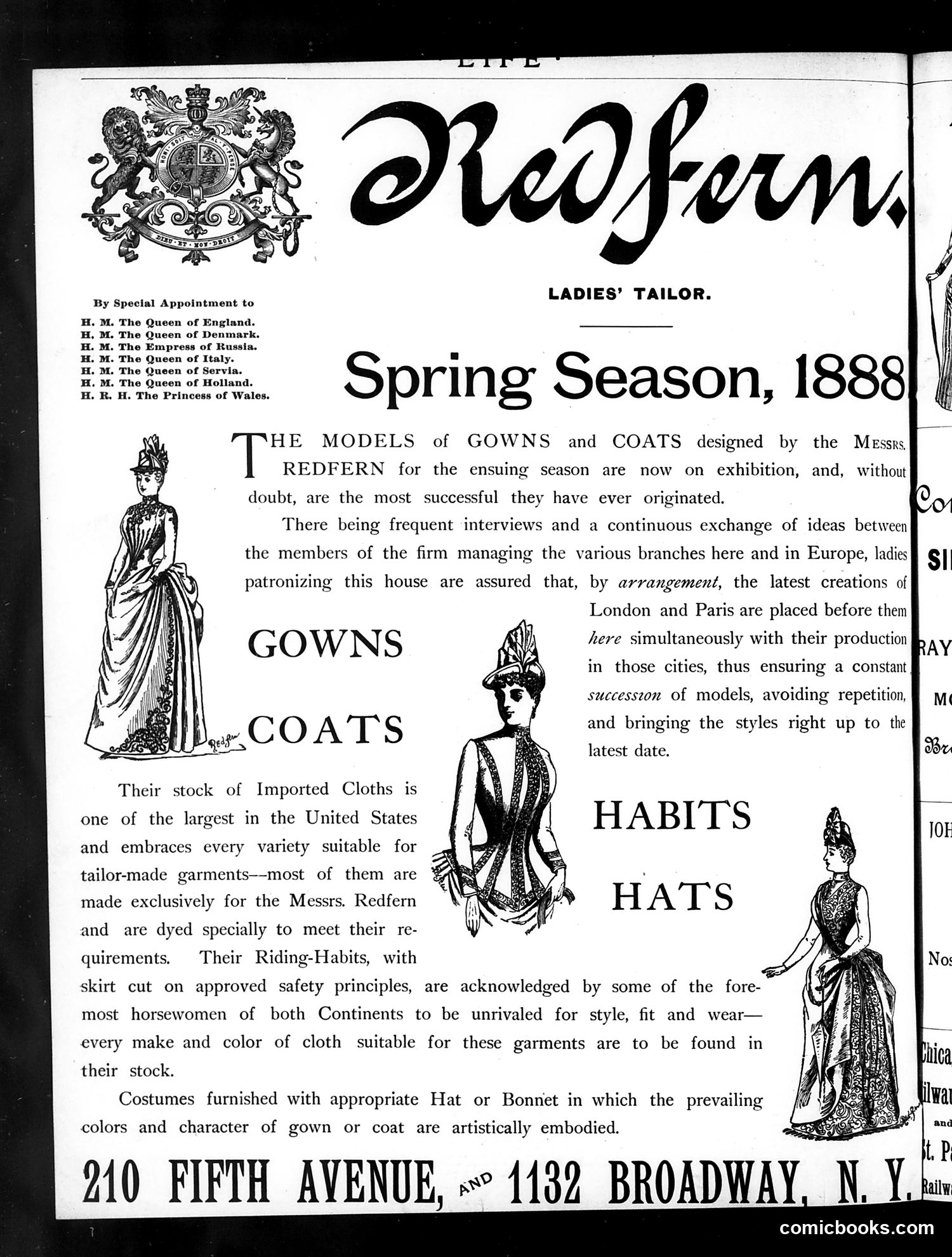
This is a **fashion advertisement**, not satire or political content. It promotes Redfern, a high-end ladies' tailor with locations at Fifth Avenue and Broadway in New York. The page displays three illustrated women modeling fashionable 1888 spring clothing—gowns, coats, habits (riding outfits), and hats. The text emphasizes Redfern's exclusivity: they hold royal warrants from European monarchs (Queen of England, Empress of Russia, etc.), import fine cloths exclusively, and coordinate designs simultaneously with London and Paris to offer the latest fashions. Notable detail: the advertisement stresses their riding habits feature "skirt cut on approved safety principles"—reflecting late-Victorian concerns about women's safety while horseback riding in restrictive clothing. This represents aspirational marketing targeting wealthy American women who wanted European sophistication and royal approval.
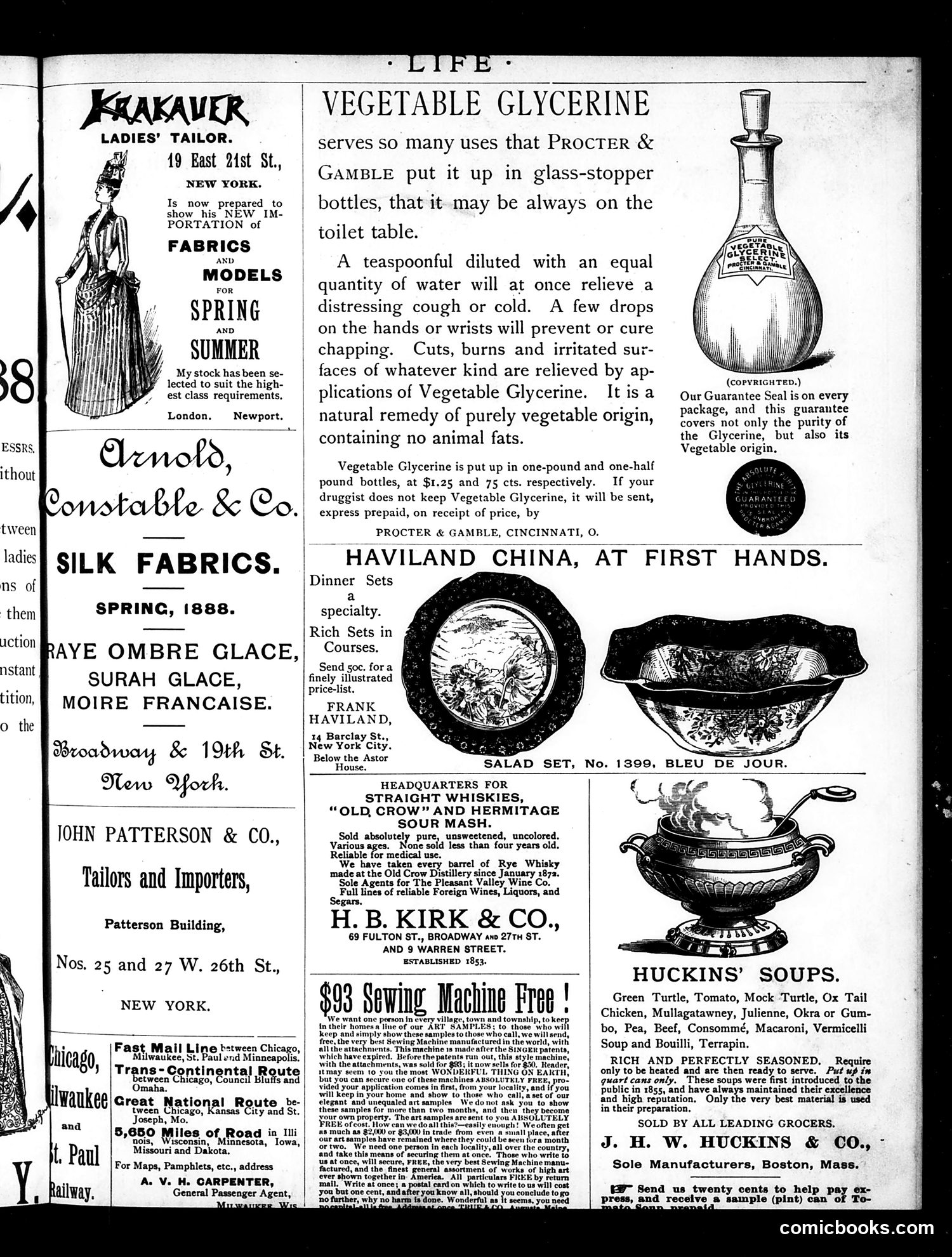
This page is **primarily advertising** from Life magazine (circa 1888, based on "Spring, 1888" notation). There are no political cartoons or satirical illustrations with identifiable figures. The content consists of period product advertisements: ladies' tailoring and fabrics, Procter & Gamble's Vegetable Glycerine (a multi-purpose remedy), Haviland china, whiskey, silk fabrics, sewing machines, and Huckins' soups. The only visual elements are **product illustrations**—a glycerine bottle with guarantee seal, china dinnerware pieces, and soup tureens—designed to showcase merchandise to wealthy urban consumers in New York and beyond. The tone reflects late-Victorian consumer culture, emphasizing quality, purity, and reliability. There is **no satire or political commentary** visible on this page. It represents straightforward commercial advertising typical of 19th-century society magazines aimed at affluent readers.
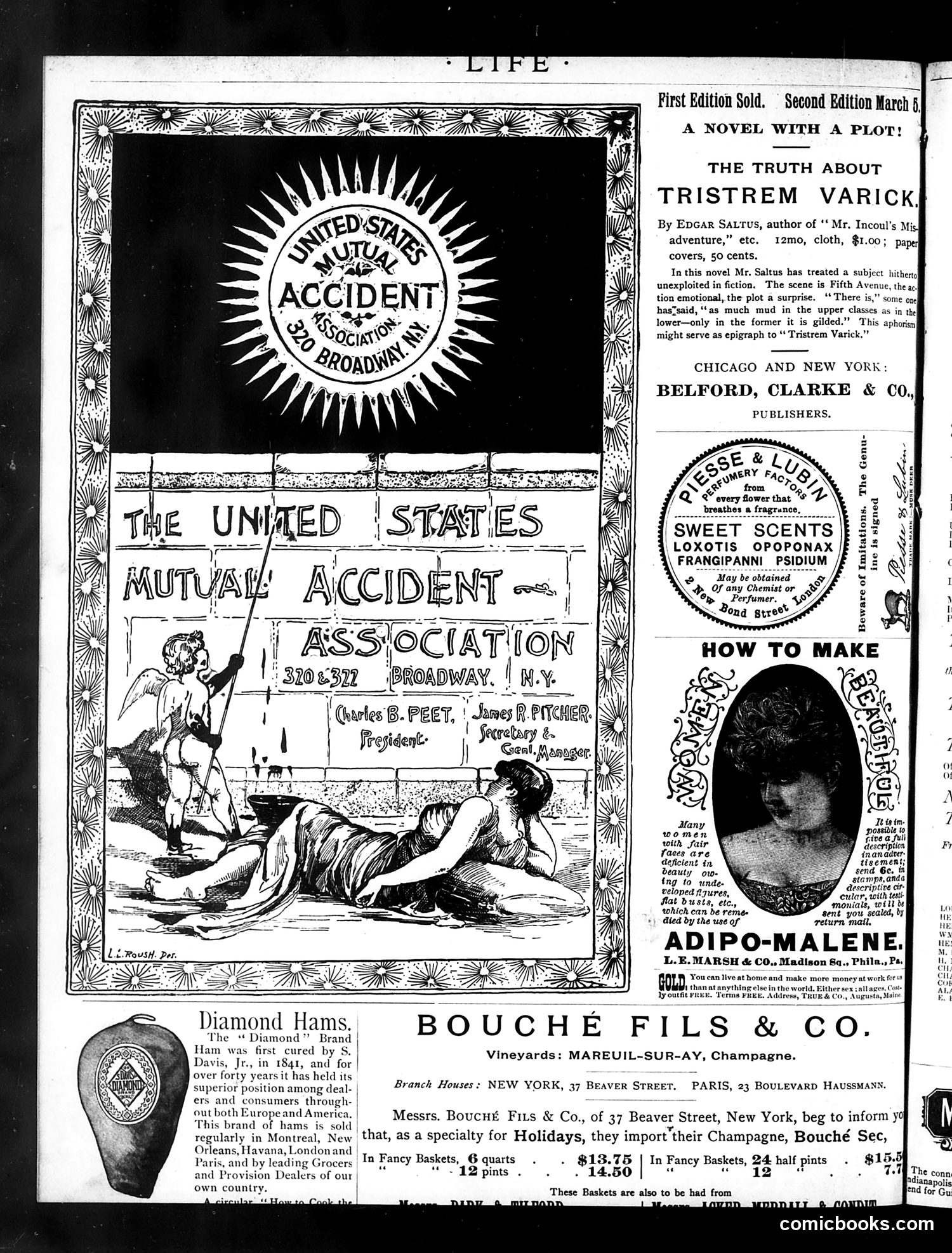
This page is primarily **advertising and book promotion** rather than political satire. The dominant left-side image advertises "The Truth About Tristrem Varick," a novel by Edgar Saltus about wealthy Fifth Avenue society. The accompanying illustration shows an allegorical female figure (likely representing Justice or Fate) pointing downward at a reclining woman, visualizing the book's theme that "the upper classes" contain "as much mud" as lower classes—just "gilded" over. The right side contains product advertisements typical of 1880s-90s Life magazine: beauty products (Adipo-Malene for "undeveloped figures"), perfume, champagne, and Diamond Brand hams. These ads reveal period concerns about female appearance and luxury consumption rather than political commentary. No identifiable political figures or satire appear on this page.
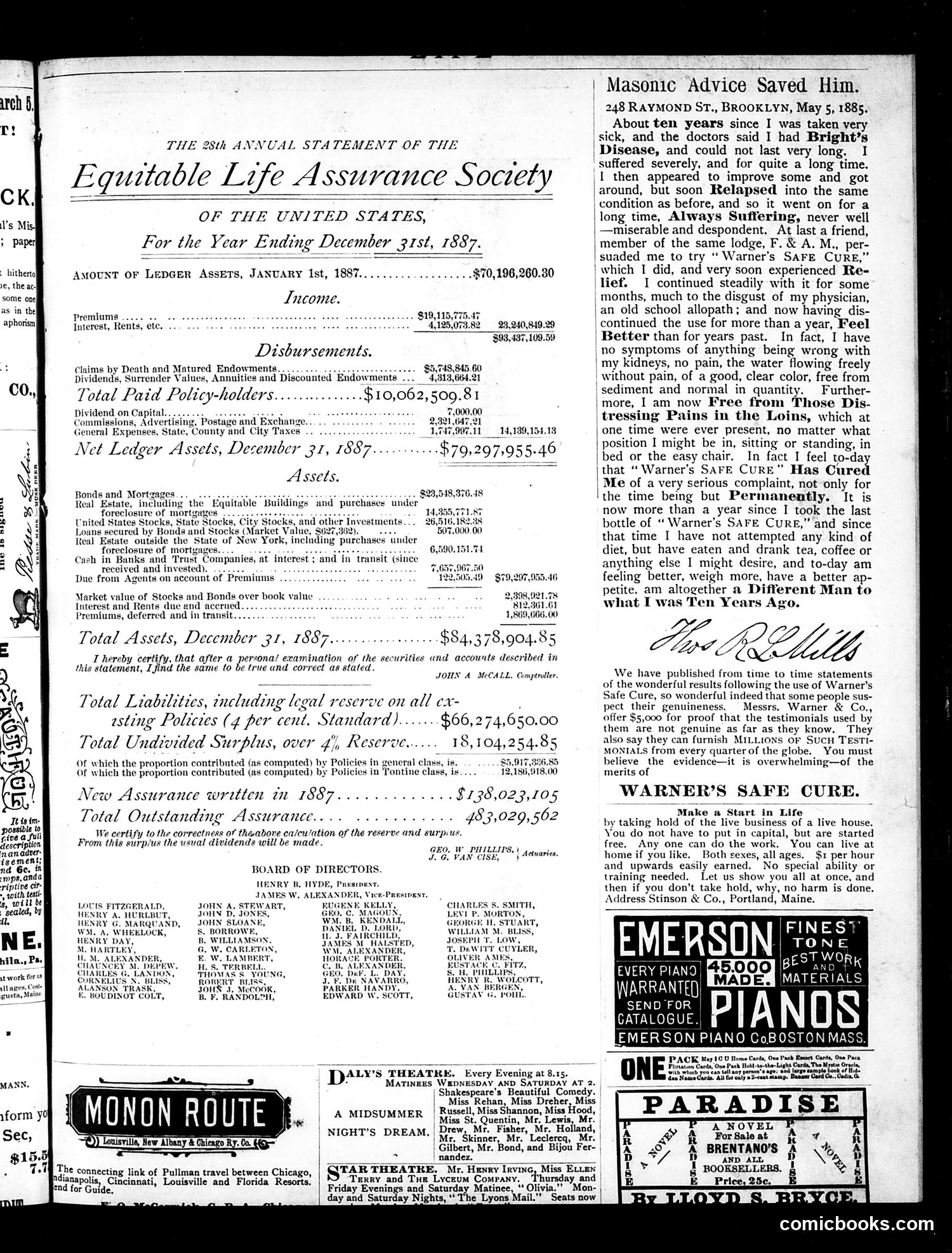
This page is primarily a **financial statement**, not a satirical cartoon. It presents the 28th Annual Statement of the Equitable Life Assurance Society for 1887, detailing assets, liabilities, income, and disbursements for the major insurance company. The only satirical content appears in the **right column**: a testimonial titled "Masonic Advice Saved Him" advertising "Warner's Safe Cure." This is a patent medicine advertisement disguised as a genuine endorsement from a Brooklyn man claiming the product cured his Bright's Disease after doctors failed. The "Masonic" framing—mentioning a Masonic lodge member's recommendation—adds false credibility. This was common 19th-century advertising: fabricated testimonials praising dubious remedies. The irony for modern readers is that such unproven medicines were marketed alongside respectable financial institutions on the same pages, lending false legitimacy to quack cures. The page otherwise contains legitimate insurance industry data and theater advertisements for *A Midsummer Night's Dream* and other productions.
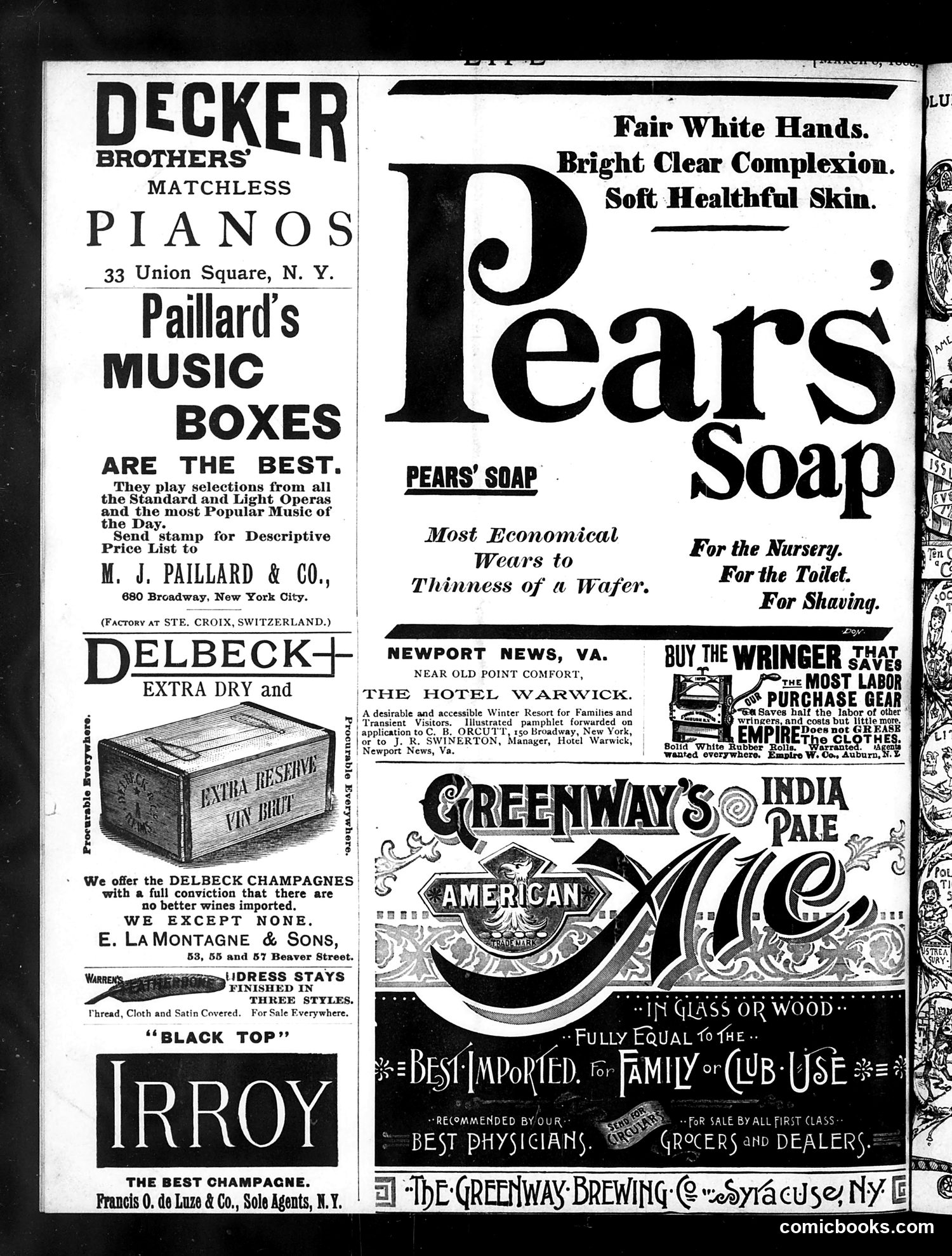
This page consists entirely of **advertisements** rather than editorial cartoons or satirical content. It showcases late 19th/early 20th-century consumer products targeting affluent Americans. Notable ads include: - **Pears' Soap**: Emphasizes "Fair White Hands" and "Bright Clear Complexion"—reflecting the era's problematic beauty standards valorizing pale skin - **Delbeck and Irroy Champagnes**: Premium imported wines marketed to wealthy consumers - **Decker Pianos and Paillard Music Boxes**: Luxury entertainment goods - **Hotel Warwick** (Newport News, VA): Winter resort destination - **Greenway's India Pale Ale**: Beer marketed as "equal to the best imported" and "recommended by our best physicians" The page reflects Gilded Age consumer culture, with emphasis on European imports, refined taste, and aspirational status symbols. The medical endorsement of ale is particularly notable—reflecting pre-regulation pharmaceutical/alcohol claims. There are **no political cartoons or satire visible** on this page.