
Life, 1888-03-08 · page 8 of 20
Life — March 8, 1888 — page 8: what you’re looking at
What you’re looking at
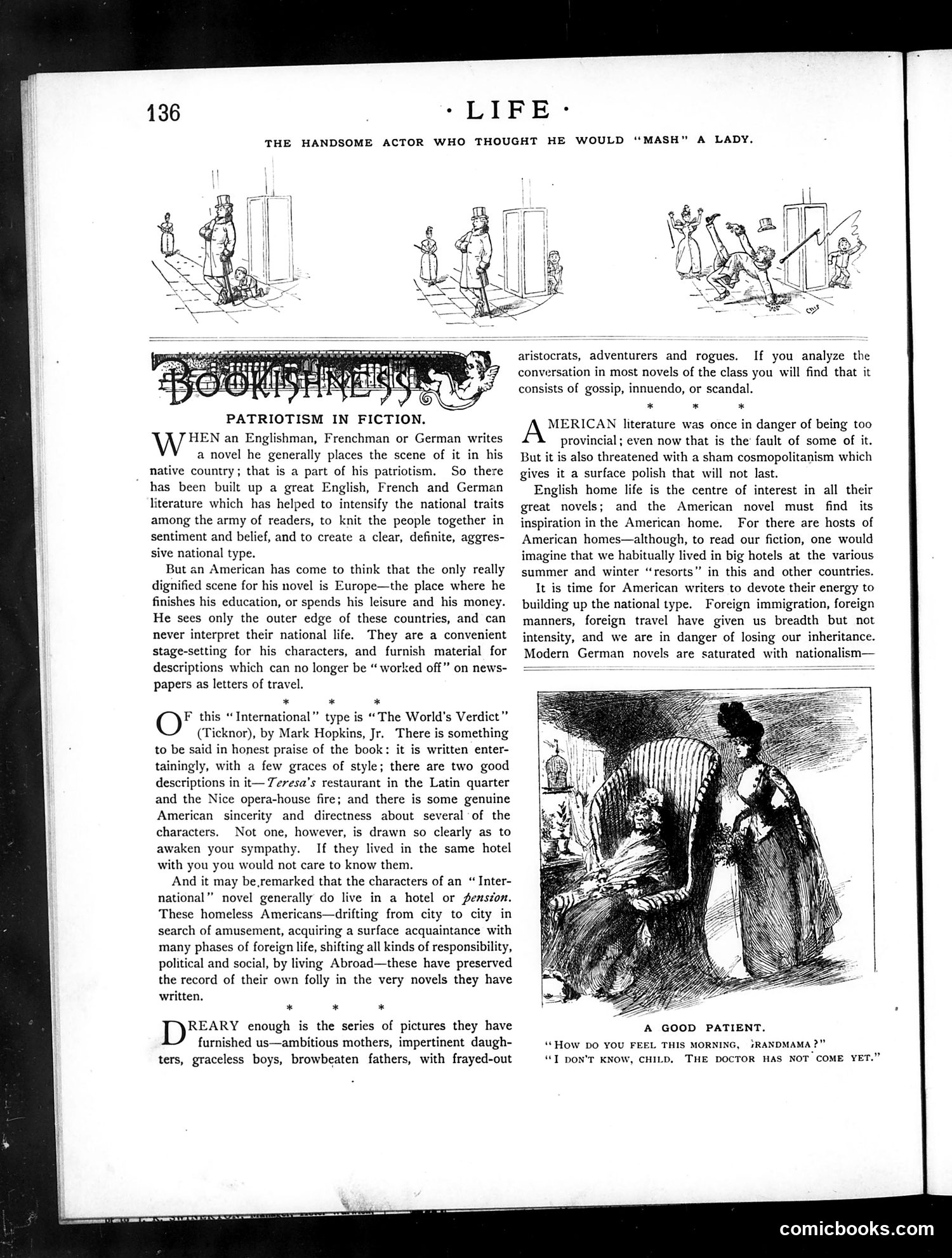
This page contains a literary criticism article titled "Patriotism in Fiction" rather than political cartoons. The text critiques American novelists who set their works in Europe rather than America, arguing they're avoiding depicting genuine American national life. The author contends that American literature should focus on American homes and society instead of chasing cosmopolitan European settings. Three small sketches at the top illustrate "The Handsome Actor Who Thought He Would 'Mash' a Lady"—depicting a man's unsuccessful romantic advances. The larger illustration labeled "A Good Patient" shows a doctor's visit, with a patient asking the grandmother how she feels and noting the doctor hasn't arrived yet. These appear to be humorous vignettes separate from the main article.
📄 Transcribed text from this page (OCR, searchable)
Machine-transcribed from the original scan — historical spelling and the odd misread are preserved.
- LIFE: THE HANDSOME ACTOR WHO THOUGHT HE WOULD PATRIOTISM IN FICTION. HEN an Englishman, Frenchman or German writes a novel he generally places the scene of it in his native country; that is a part of his patriotism. So there has been built up a great English, French and German literature which has helped to intensify the national traits among the army of readers, to knit the people together in sentiment and belief, and to create a clear, definite, aggres- sive national type. But an American has come to think that the only really dignified scene for his novel is Europe—the place where he finishes his education, or spends his leisure and his money. He sees only the outer edge of these countries, and can never interpret their national life. They are a convenient stage-setting for his characters, and furnish material for descriptions which can no longer be “ worked off” on news- papers as letters of travel. * * * F this “International” type is “The World's Verdict” (Ticknor), by Mark Hopkins, Jr. There is something to be said in honest praise of the book: it is written enter- tainingly, with a few graces of style; there are two good descriptions in it—Zeresa’s restaurant in the Latin quarter and the Nice opera-house fire; and there is some genuine American sincerity and directness about several of the characters. Not one, however, is drawn so clearly as to awaken your sympathy. If they lived in the same hotel with you you would not care to know them. And it may be,remarked that the characters of an “ Inter- national” novel generally do live in a hotel or Jension. These homeless Americans—drifting from city to city in search of amusement, acquiring a surface acquaintance with many phases of foreign life, shifting all kinds of responsibility, political and social, by living Abroad—these have preserved the record of their own folly in the very novels they have written. * * * REARY enough is the series of pictures they have furnished us—ambitious mothers, impertinent daugh- ters, graceless boys, browbeaten fathers, with frayed-out “MASH" A LADY. aristocrats, adventurers and rogues. If you analyze the conversation in most novels of the class you will find that it consists of gossip, innuendo, or scandal. * * * MERICAN literature was once in danger of being too provincial ; even now that is the fault of some of it. But it is also threatened with a sham cosmopolitanism which gives it a surface polish that will not last. English home life is the centre of interest in all their great novels; and the American novel must find its inspiration in the American home. For there are hosts of American homes—although, to read our fiction, one would imagine that we habitually lived in big hotels at the various summer and winter “resorts” in this and other countries. It is time for American writers to devote their energy to building up the national type. Foreign immigration, foreign manners, foreign travel have given us breadth but not intensity, and we are in danger of losing our inheritance. Modern German novels are saturated with nationalism— A GOOD PATIENT. ‘““HOW DO YOU FEEL THIS MORNING, sRANDMAMA ?” “I DoNn'T KNOW, CHILD, THE DOCTOR HAS NOT COME YET.” comicbooks.com