
Life, 1888-03-08 · page 4 of 20
Life — March 8, 1888 — page 4: what you’re looking at
What you’re looking at
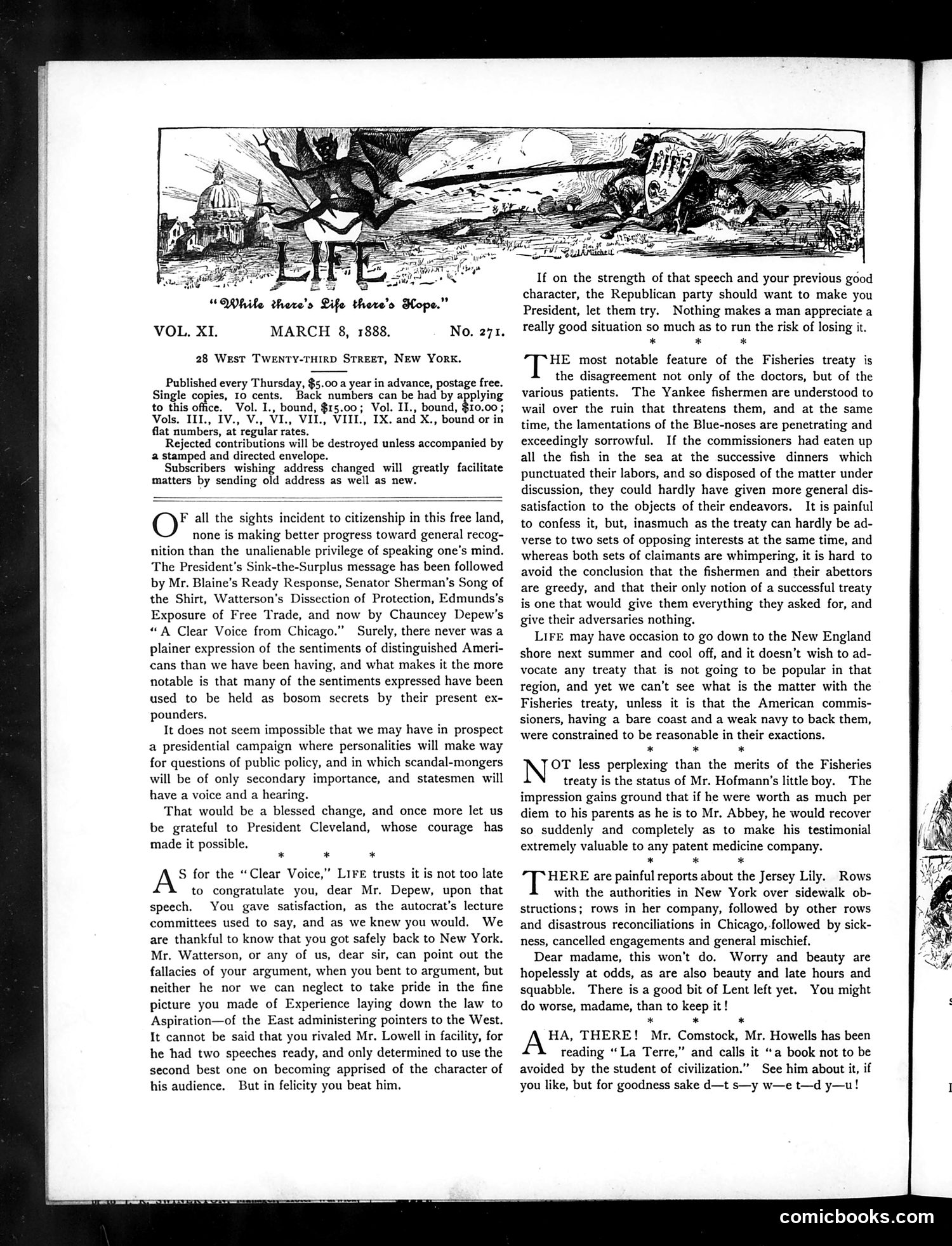
The page header cartoon shows a figure labeled "White's there's Life there's Hope," likely referencing a contemporary political figure or public personality. The main text discusses several satirical topics: 1. **Presidential campaigns**: Commentary on Republican and Democratic candidates, suggesting internal party disputes over treaty negotiations. 2. **The Fisheries Treaty**: Extended discussion mocking disagreements between American and Canadian negotiators over fishing rights—both sides appear greedy and unwilling to compromise. 3. **Various social commentary**: References to patent medicine testimonials, the Jersey Lily (actress Lillie Langtry), and literary criticism of "La Terre." The overall tone mocks political posturing, diplomatic ineffectiveness, and contemporary social pretenses. Without identifying specific individuals with certainty, the page satirizes mid-1880s American political and cultural debates.
📄 Transcribed text from this page (OCR, searchable)
Machine-transcribed from the original scan — historical spelling and the odd misread are preserved.
VOL. XI. MARCH 8, 1888, No. 271. 28 West TWENTY-THIRD STREET, NEW YorK. Published every Thursday, $5.00 a year in advance, postage free. Single copies, 10 cents. Back numbers can be had by applying to this office. Vol. I., bound, $15.00; Vol. II., bound, $10.00 ; Vols. IIL, IV., V., VI., VIL, VIIL, IX. and X., bound or in flat numbers, at regular rates. Rejected contributions will be destroyed unless accompanied by a stamped and directed envelope. Subscribers wishing address changed will greatly facilitate matters by sending old address as well as new. F all the sights incident to citizenship in this free land, none is making better progress toward general recog- nition than the unalienable privilege of speaking one’s mind. The President's Sink-the-Surplus message has been followed by Mr. Blaine’s Ready Response, Senator Sherman’s Song of the Shirt, Watterson’s Dissection of Protection, Edmunds’s Exposure of Free Trade, and now by Chauncey Depew’s “A Clear Voice from Chicago.” Surely, there never was a plainer expression of the sentiments of distinguished Ameri- cans than we have been having, and what makes it the more notable is that many of the sentiments expressed have been used to be held as bosom secrets by their present ex- pounders. It does not seem impossible that we may have in prospect a presidential campaign where personalities will make way for questions of public policy, and in which scandal-mongers will be of only secondary importance, and statesmen will have a voice and a hearing. That would be a blessed change, and once more let us be grateful to President Cleveland, whose courage has made it possible. * * S for the “Clear Voice,” Lire trusts it is not too late to congratulate you, dear Mr. Depew, upon that speech. You gave satisfaction, as the autocrat’s lecture committees used to say, and as we knew you would. We are thankful to know that you got safely back to New York. Mr. Watterson, or any of us, dear sir, can point out the fallacies of your argument, when you bent to argument, but neither he nor we can neglect to take pride in the fine picture you made of Experience laying down the law to Aspiration—of the East administering pointers to the West. It cannot be said that you rivaled Mr. Lowell in facility, for he had two speeches ready, and only determined to use the second best one on becoming apprised of the character of his audience. But in felicity you beat him. If on the strength of that speech and your previous good character, the Republican party should want to make you President, let them try. Nothing makes a man appreciate a really good situation so much as to run the risk of losing it. * * * HE most notable feature of the Fisheries treaty is the disagreement not only of the doctors, but of the various patients. The Yankee fishermen are understood to wail over the ruin that threatens them, and at the same time, the lamentations of the Blue-noses are penetrating and exceedingly sorrowful. If the commissioners had eaten up all the fish in the sea at the successive dinners which punctuated their labors, and so disposed of the matter under discussion, they could hardly have given more general dis- satisfaction to the objects of their endeavors. It is painful to confess it, but, inasmuch as the treaty can hardly be ad- verse to two sets of opposing interests at the same time, and whereas both sets of claimants are whimpering, it is hard to avoid the conclusion that the fishermen and their abettors are greedy, and that their only notion of a successful treaty is one that would give them everything they asked for, and give their adversaries nothing. LIFE may have occasion to go down to the New England shore next summer and cool off, and it doesn’t wish to ad- vocate any treaty that is not going to be popular in that region, and yet we can’t see what is the matter with the Fisheries treaty, unless it is that the American commis- sioners, having a bare coast and a weak navy to back them, were constrained to be reasonable in their exactions. * * * OT less perplexing than the merits of the Fisheries treaty is the status of Mr. Hofmann’s little boy. The impression gains ground that if he were worth as much per diem to his parents as he is to Mr. Abbey, he would recover so suddenly and completely as to make his testimonial extremely valuable to any patent medicine company. * * * [Re are painful reports about the Jersey Lily. Rows with the authorities in New York over sidewalk ob- structions; rows in her company, followed by other rows and disastrous reconciliations in Chicago,-followed by sick- ness, cancelled engagements and general mischief. Dear madame, this won’t do. Worry and beauty are hopelessly at odds, as are also beauty and late hours and squabble. There is a good bit of Lent left yet. You might do worse, madame, than to keep it! * * * HA, THERE! Mr. Comstock, Mr. Howells has been reading “La Terre,” and calls it “a book not to be avoided by the student of civilization.” See him about it, if you like, but for goodness sake d—t s—y w—e t—d y—u! comicbooks.com