
Life, 1888-03-08 · page 12 of 20
Life — March 8, 1888 — page 12: what you’re looking at
What you’re looking at
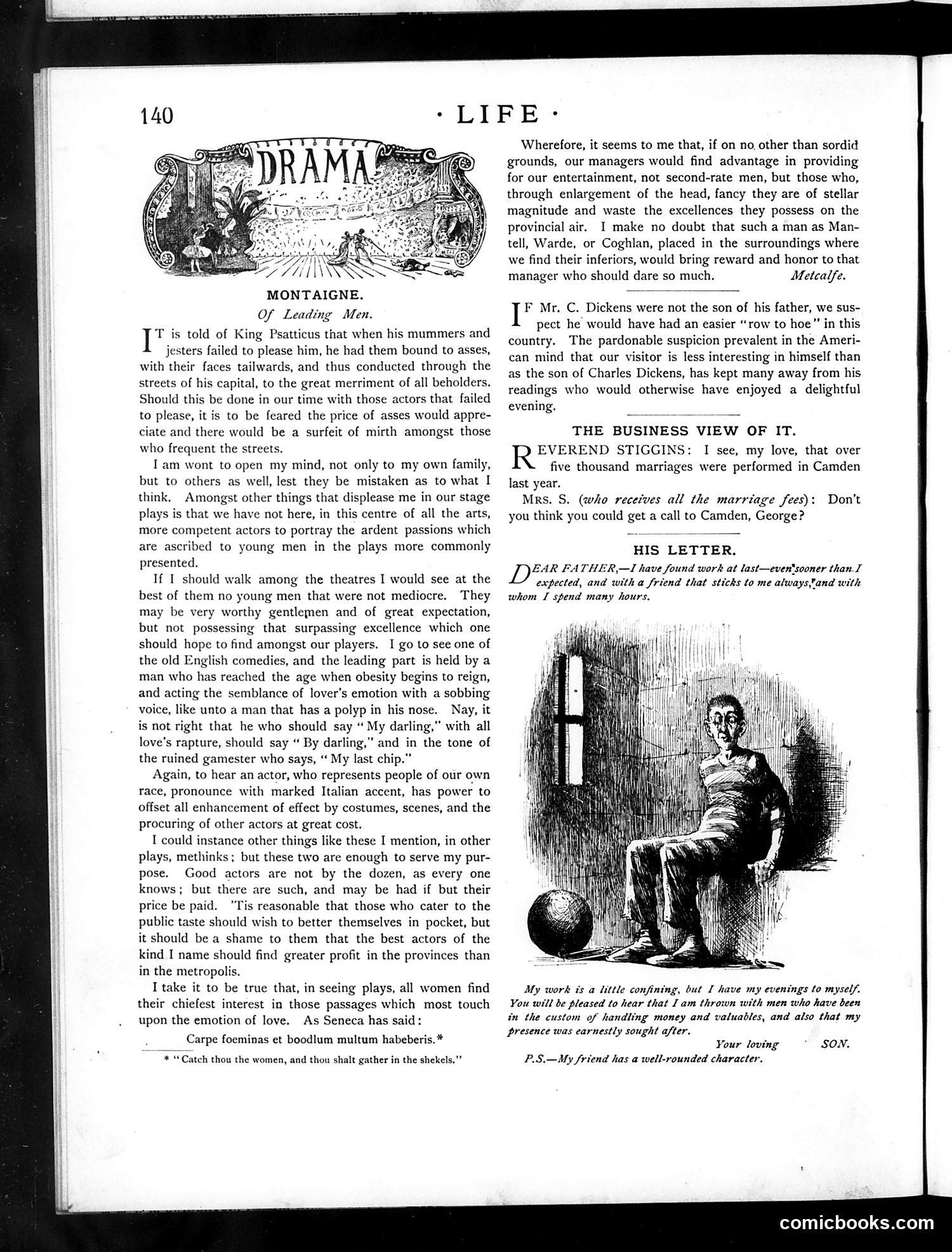
This page from *Life* magazine contains two satirical pieces critiquing American theater and society. **"Montaigne: Of Leading Men"** (main essay) attacks the poor quality of leading actors in American theaters. The author complains that established theaters employ aging, mediocre performers—men who are obese, mispronounce lines, or affect inappropriate accents—rather than hiring genuinely talented actors available in the provinces. He names "Mantell, Warde, or Coghlan" as superior alternatives. The satire suggests theater managers prioritize profit over quality and shamefully waste excellent talent outside major cities. **Secondary items** include a brief jab at Charles Dickens Jr.'s American readings, suggesting audiences attended more for his famous father's name than his own merit, and a comedic domestic dialogue about Camden marriages. The **illustration** depicts a young man in distress at a window, accompanying a sentimental letter about work and hardship—likely accompanying a separate story on the page. The overall tone mocks both theatrical mediocrity and American audience superficiality.
📄 Transcribed text from this page (OCR, searchable)
Machine-transcribed from the original scan — historical spelling and the odd misread are preserved.
LIFE MONTAIGNE. Of Leading Men. T is told of King Psatticus that when his mummers and jesters failed to please him, he had them bound to asses, with their faces tailwards, and thus conducted through the streets of his capital, to the great merriment of all beholders. Should this be done in our time with those actors that failed to please, it is to be feared the price of asses would appre- ciate and there would be a surfeit of mirth amongst those who frequent the streets. I am wont to open my mind, not only to my own family, but to others as well, lest they be mistaken as to what I think. Amongst other things that displease me in our stage plays is that we have not here, in this centre of all the arts, more competent actors to portray the ardent passions which are ascribed to young men in the plays more commonly presented. If I should walk among the theatres I would see at the best of them no young men that were not mediocre. They may be very worthy gentlemen and of great expectation, but not possessing that surpassing excellence which one should hope to find amongst our players. I go to see one of the old English comedies, and the leading part is held by a man who has reached the age when obesity begins to reign, and acting the semblance of lover's emotion with a sobbing voice, like unto a man that has a polyp in his nose. Nay, it is not right that he who should say “ My darling,” with all love's rapture, should say “ By darling,” and in the tone of the ruined gamester who says, ‘‘ My last chip.” Again, to hear an actor, who represents people of our own race, pronounce with marked Italian accent, has power to offset all enhancement of effect by costumes, scenes, and the procuring of other actors at great cost. I could instance other things like these I mention, in other plays, methinks; but these two are enough to serve my pur- pose. Good actors are not by the dozen, as every one knows; but there are such, and may be had if but their price be paid. ‘Tis reasonable that those who cater to the public taste should wish to better themselves in pocket, but it should be a shame to them that the best actors of the kind I name should find greater profit in the provinces than in the metropolis. I take it to be true that, in seeing plays, all women find their chiefest interest in those passages which most touch upon the emotion of love. As Seneca has said: Carpe foeminas et boodlum multum habeberis.* * “Catch thou the women, and thou shalt gather in the shekels.”” Wherefore, it seems to me that, if on no, other than sordid grounds, our managers would find advantage in providing for our entertainment, not second-rate men, but those who, through enlargement of the head, fancy they are of stellar magnitude and waste the excellences they possess on the provincial air. I make no doubt that such a man as Man- tell, Warde, or Coghlan, placed in the surroundings where we find their inferiors, would bring reward and honor to that manager who should dare so much. Metcalfe. F Mr. C. Dickens were not the son of his father, we sus- pect he would have had an easier “row to hoe” in this country. The pardonable suspicion prevalent in the Ameri- can mind that our visitor is less interesting in himself than as the son of Charles Dickens, has kept many away from his readings who would otherwise have enjoyed a delightful evening. THE BUSINESS VIEW OF IT. EVEREND STIGGID I see, my love, that over five thousand marriages were performed in Camden last year. Mrs. S. (who receives all the marriage fees): Don’t you think you could get a call to Camden, George? HIS LETTER. EAR FATHER,—I have found work at last—even sooner than.I expected, and with a friend that sticks to me alwaysftand with whom I spend many hours. My work is a little confining, but I have my evenings to myself. You will be pleased to hear that I am thrown with men who have been in the custom of handling money and valuables, and also that my presence was earnestly sought after. Your loving SON. P.S.—My friend has a well-rounded character. comicbooks.com