
A complete issue · 20 pages · 1888
Life — February 16, 1888
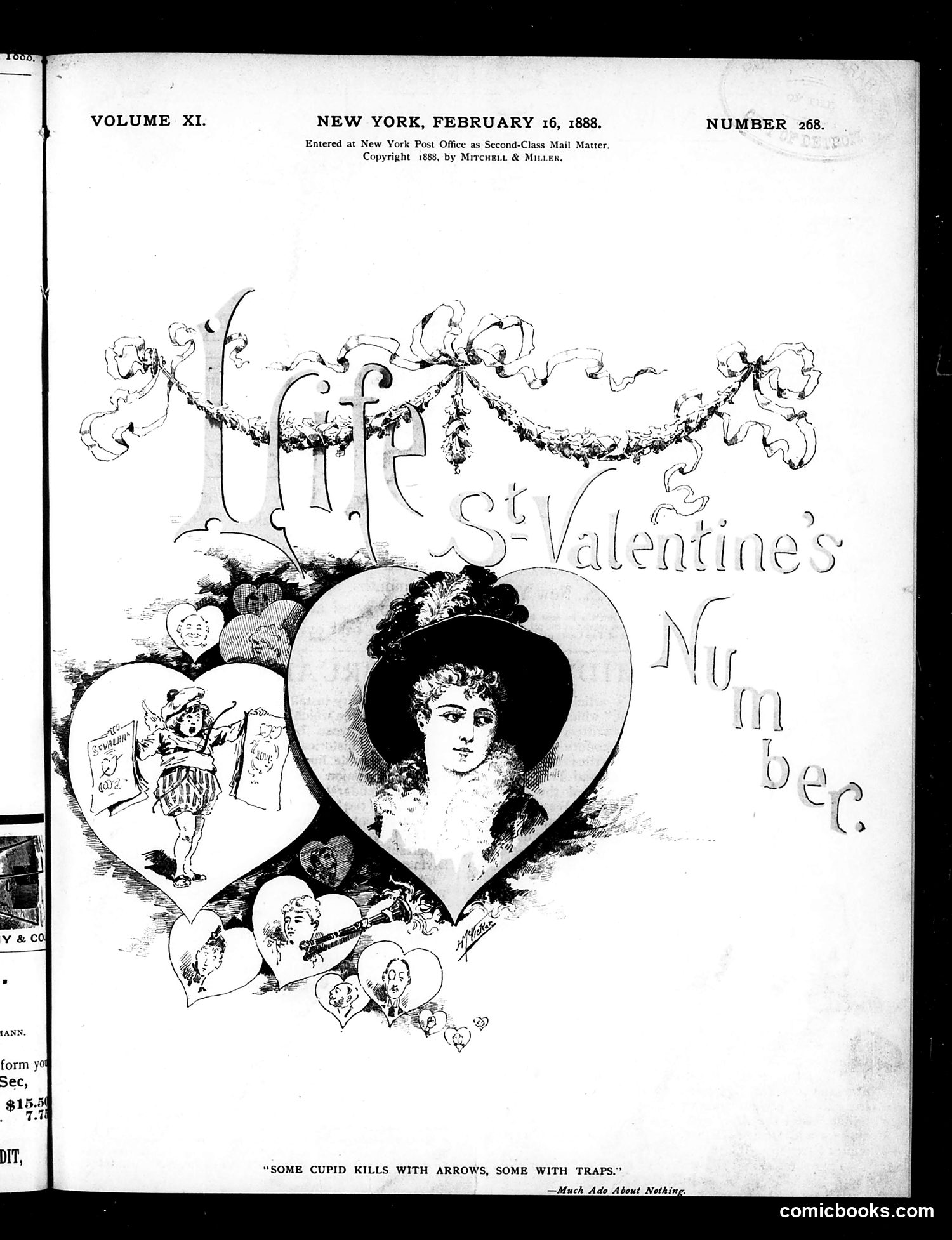
This is a Valentine's Day-themed cover for *Life* magazine (February 16, 1888). The central image depicts a fashionable woman's portrait within a large heart, surrounded by smaller hearts containing various figures and scenes. At the top, decorative garland and Cupid imagery frame the text "First Valentines Wreaked." The caption below reads: "Some Cupid kills with arrows, some with traps"—a Shakespeare reference (from *A Midsummer Night's Dream*). The satire appears to mock romantic courtship rituals and the commercialization of Valentine's Day. The smaller hearts contain what appear to be various romantic scenarios and character types, suggesting different approaches to love and romance. The overall effect satirizes both the sentimentality of Valentine traditions and perhaps the superficiality of romantic pursuits among contemporary society.
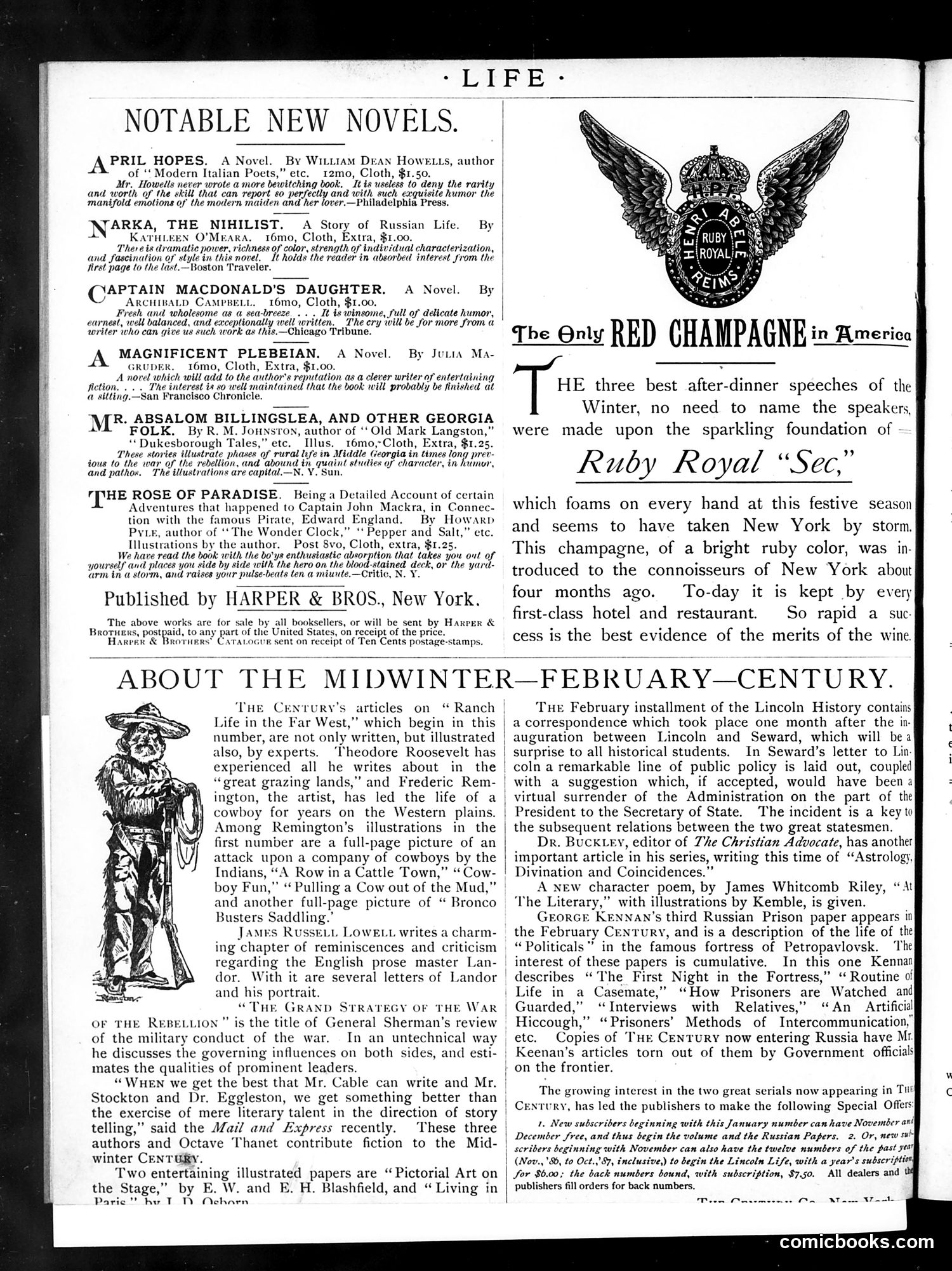
This page is primarily **book advertisements and literary criticism**, not political satire. The left side features reviews of new novels by William Dean Howells, Kathleen O'Meara, and others. The only illustration is a **cowboy or rancher figure** (wearing a wide-brimmed hat) accompanying text about "The Century's" articles on ranch life in the American West. The figure appears to be a generic Western character rather than a specific political caricature. The right side advertises **Ruby Royal champagne**, claiming it's "the only RED CHAMPAGNE in America" and noting its recent introduction to New York society. The bottom section discusses upcoming **Century magazine** content on Lincoln history and military strategy, plus various literary contributions. This is essentially a **magazine contents/advertising page** with minimal satirical content.
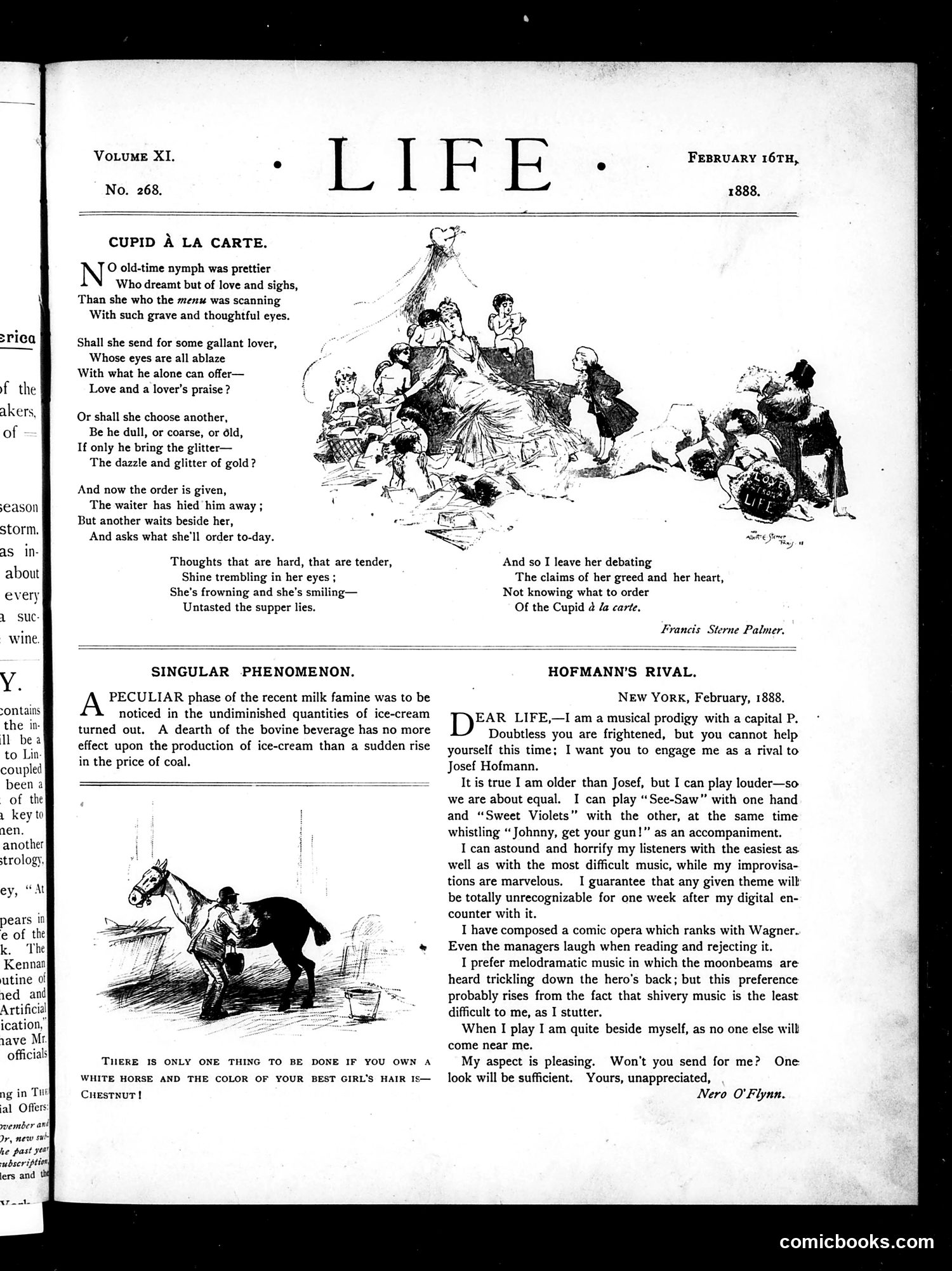
This satirical poem mocks the uncertainty of romantic choice. An old nymph studying a menu (representing suitors) cannot decide whom to pursue: should she send for a "gallant lover," choose another man ("dull, or coarse, or old"), or request wealth ("dazzle and glitter of gold")? The accompanying illustration shows Cupid presiding over a scene of multiple figures—apparently representing various romantic options—as if love were a restaurant menu to be ordered from rather than an authentic emotion. The satire targets wealthy Victorian women's mercenary approach to romance: reducing love to a transactional choice based on appearance, status, or wealth rather than genuine feeling. The "à la carte" metaphor emphasizes this commodification of romance.
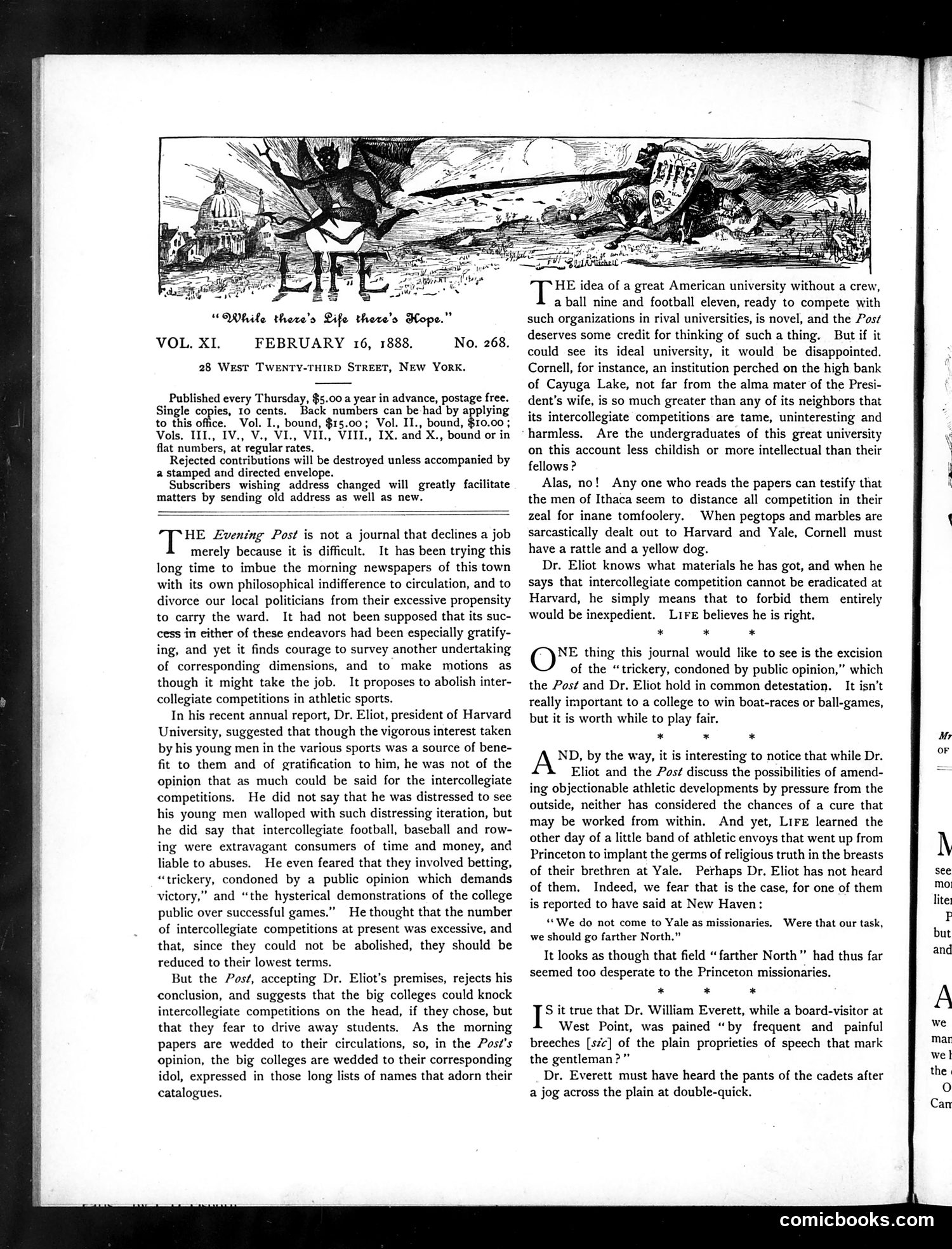
The masthead cartoon depicts "LIFE" as a winged figure surveying a landscape, with the motto "While there's Life there's Hope." The editorial content criticizes Harvard President Dr. Eliot's proposal to abolish intercollegiate athletic competitions. The piece sarcastically defends college sports, arguing that while competitions may be excessive, completely eliminating them would be worse. The satire targets Dr. Eliot's idealism, suggesting his vision of a university without athletic organizations is impractical. The author also mocks Princeton's strict religious culture, quoting a cadet who refuses Yale missionary work, preferring to "go farther North." Additionally, the piece humorously questions Dr. William Everett's remarks about cadets' speech at West Point, joking that he must have overheard soldiers' complaints after physical exertion.
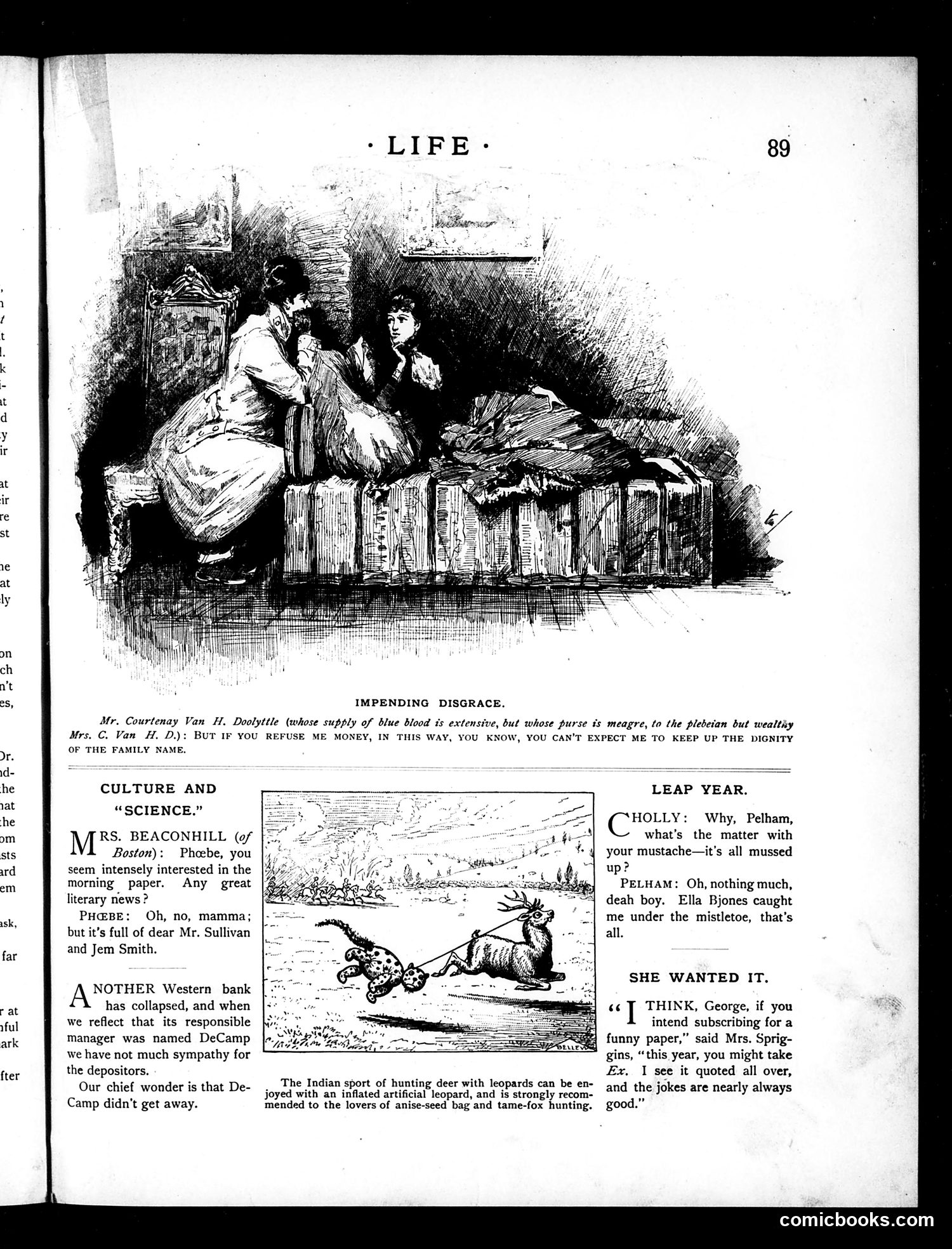
**Top Cartoon - "Impending Disgrace":** This depicts a domestic financial dispute between Mr. Courtenay Van H. Doolyttle (described as having "blue blood" but "meagre" purse) and Mrs. C. Van H. D. The satire mocks wealthy families maintaining social pretense while facing money troubles. The husband refuses his wife money to preserve "family dignity," a commentary on aristocratic hypocrisy during financial strain. **Middle Section - "Culture and Science":** A brief humor piece mocking pretentious literary discussion, where Mrs. Beaconhill claims to read "great literary news" but admits it's mostly gossip about Sullivan and Smith. **Bottom - "Leap Year" and "She Wanted It":** Light romantic humor about courtship customs and newspaper subscriptions. The page reflects early 20th-century American satirical commentary on class pretension and domestic economics.
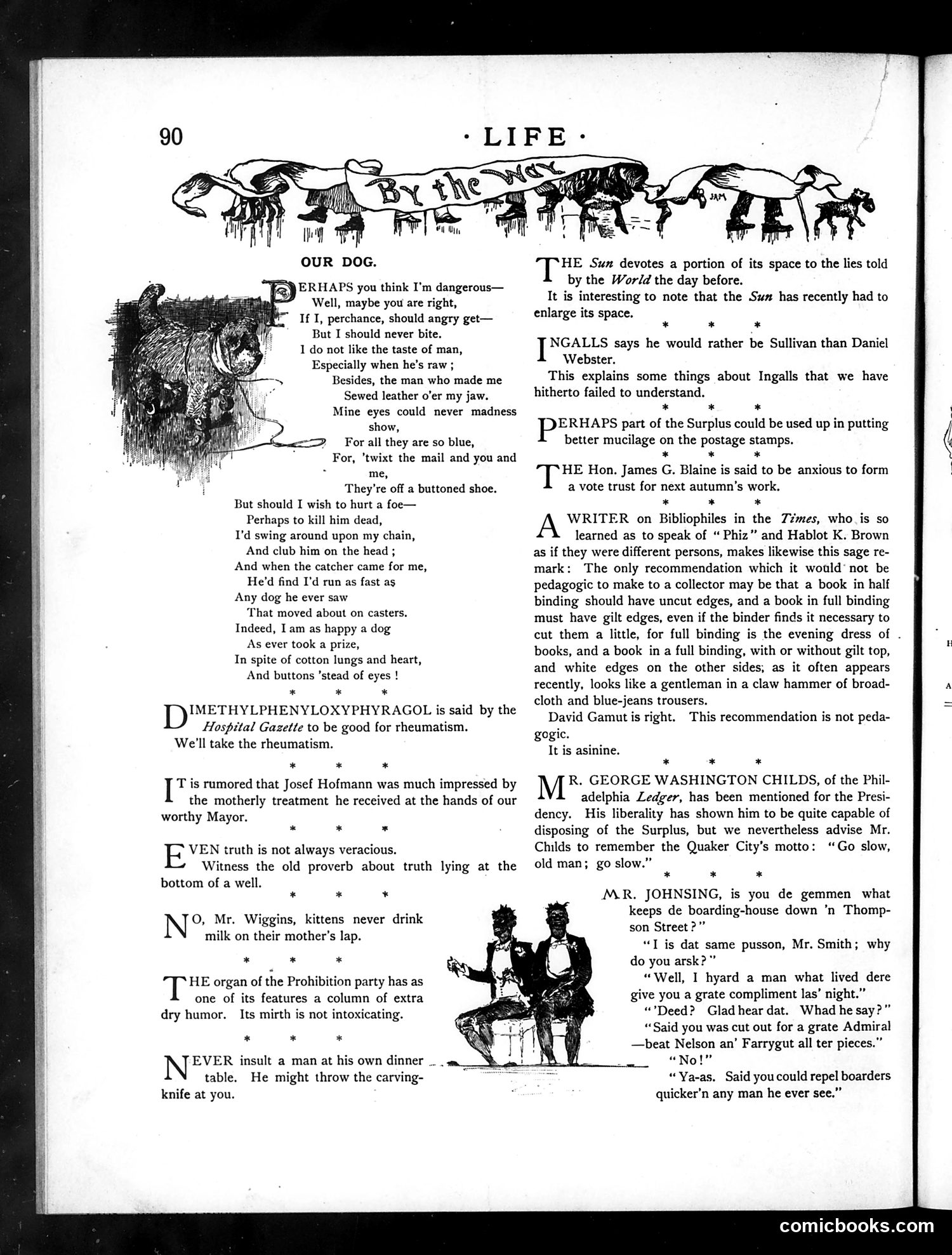
**"Our Dog" Poem:** The left side features a humorous monologue from a dog's perspective, personifying canine loyalty and behavior. The illustration shows a shaggy dog. The poem addresses common concerns about dog ownership—the animal's potential dangerousness contrasted with its fundamental trustworthiness and affection. **Right Column Miscellany:** The page contains brief satirical notes on various contemporary topics: the *Sun* newspaper enlarging its space, politician Ingalls, government surplus funds, Hon. James G. Blaine forming a vote trust, and bibliophile collecting practices. A dialogue at bottom satirizes Irish boarding-house proprietors through stereotyped dialect and working-class humor. The page exemplifies Life's mix of social observation, light satire, and cultural commentary typical of late 19th-century American humor magazines.
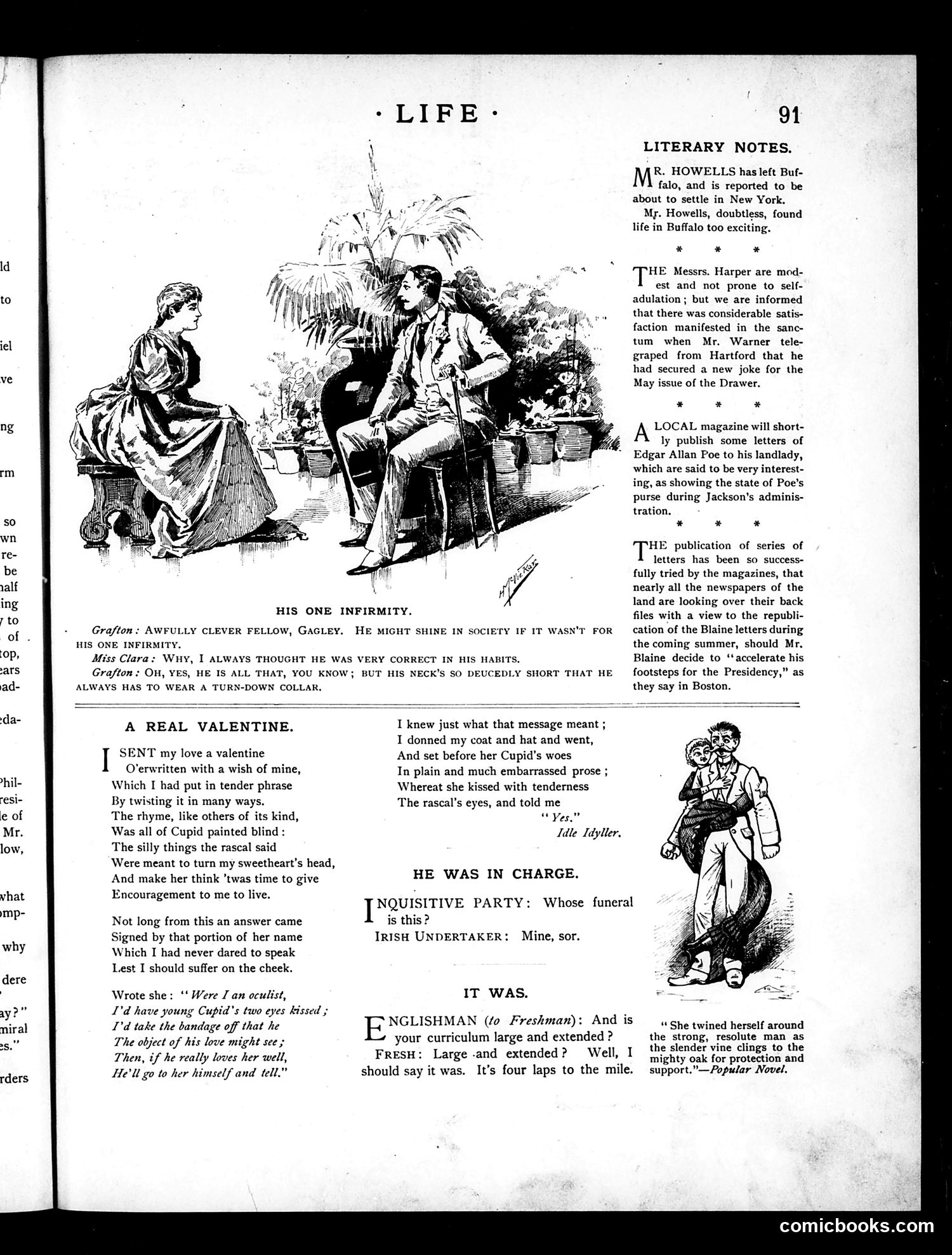
This page contains three separate humor pieces rather than a unified political cartoon: **"His One Infirmity"** depicts a dialogue between Grafton and Miss Clara about a man named Gagley who has good social habits except for wearing a turn-down collar (apparently considered improper formal attire at the time). The satire mocks trivial social pretensions. **"A Real Valentine"** is sentimental poetry about love and Cupid, not political satire. **"He Was in Charge"** and **"It Was"** are brief joke exchanges about funerals and curriculum length—genteel humor with no political content. The accompanying illustrations show period-appropriate domestic and social scenes. This page represents Life's lighter satirical content focused on social manners and courtship rather than political commentary.
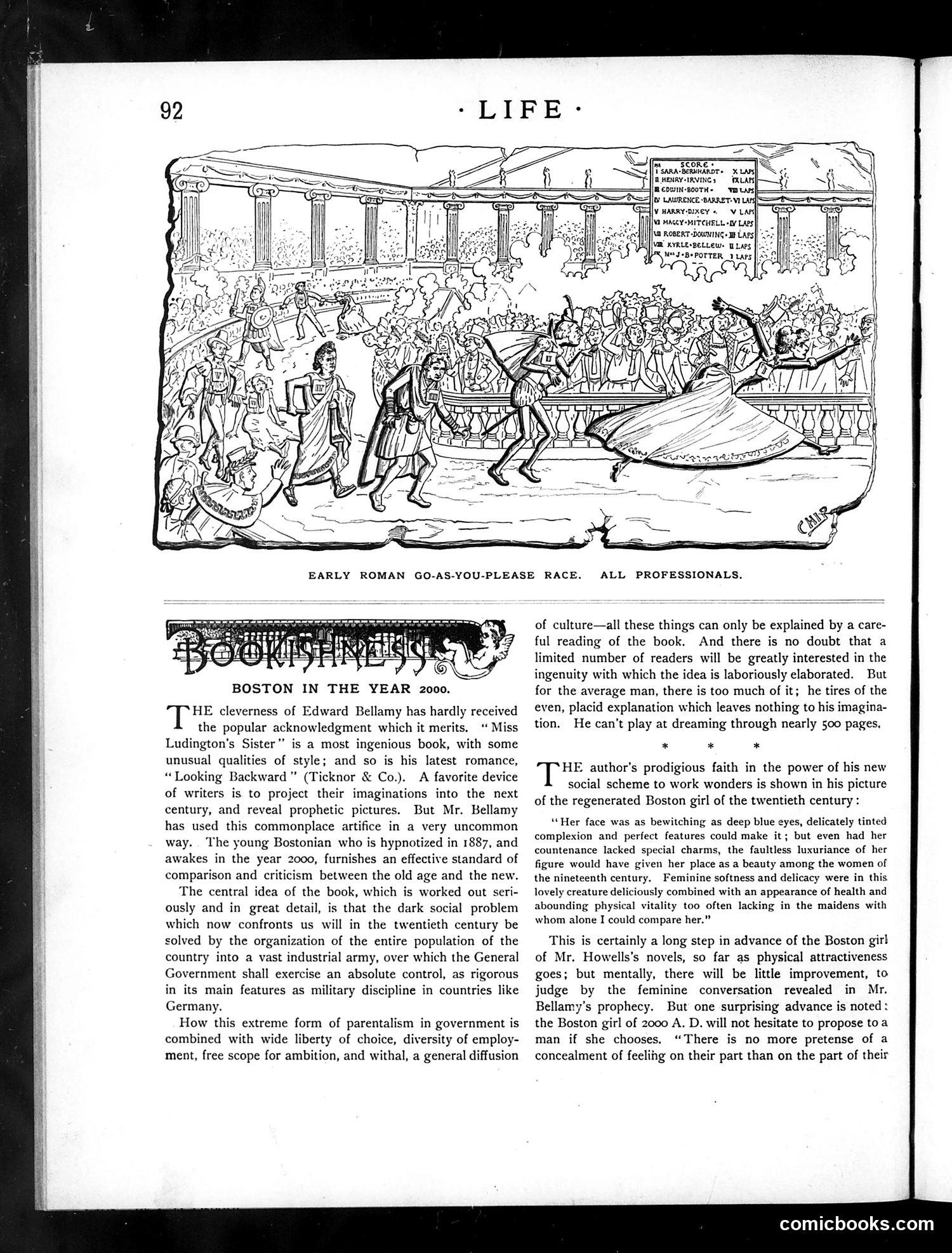
**The Cartoon:** The illustration depicts an "Early Roman Go-As-You-Please Race. All Professionals" — a satirical take on ancient Roman spectacles, showing competitors racing in an arena before crowds in a columned structure. The style mimics classical engravings. **The Satire:** This appears to be mocking contemporary professional racing or sporting competitions by presenting them as equivalent to ancient Roman entertainment. The "go-as-you-please" format suggests chaotic, anything-goes competition, satirizing modern professional sports as descended from (or morally equivalent to) brutal Roman amusements. **The Text Section:** Below discusses Edward Bellamy's novel "Looking Backward" and its vision of Boston in the year 2000, critiquing both Bellamy's social predictions and contemporary Boston society. The page juxtaposes ancient decadence with modern ambitions.
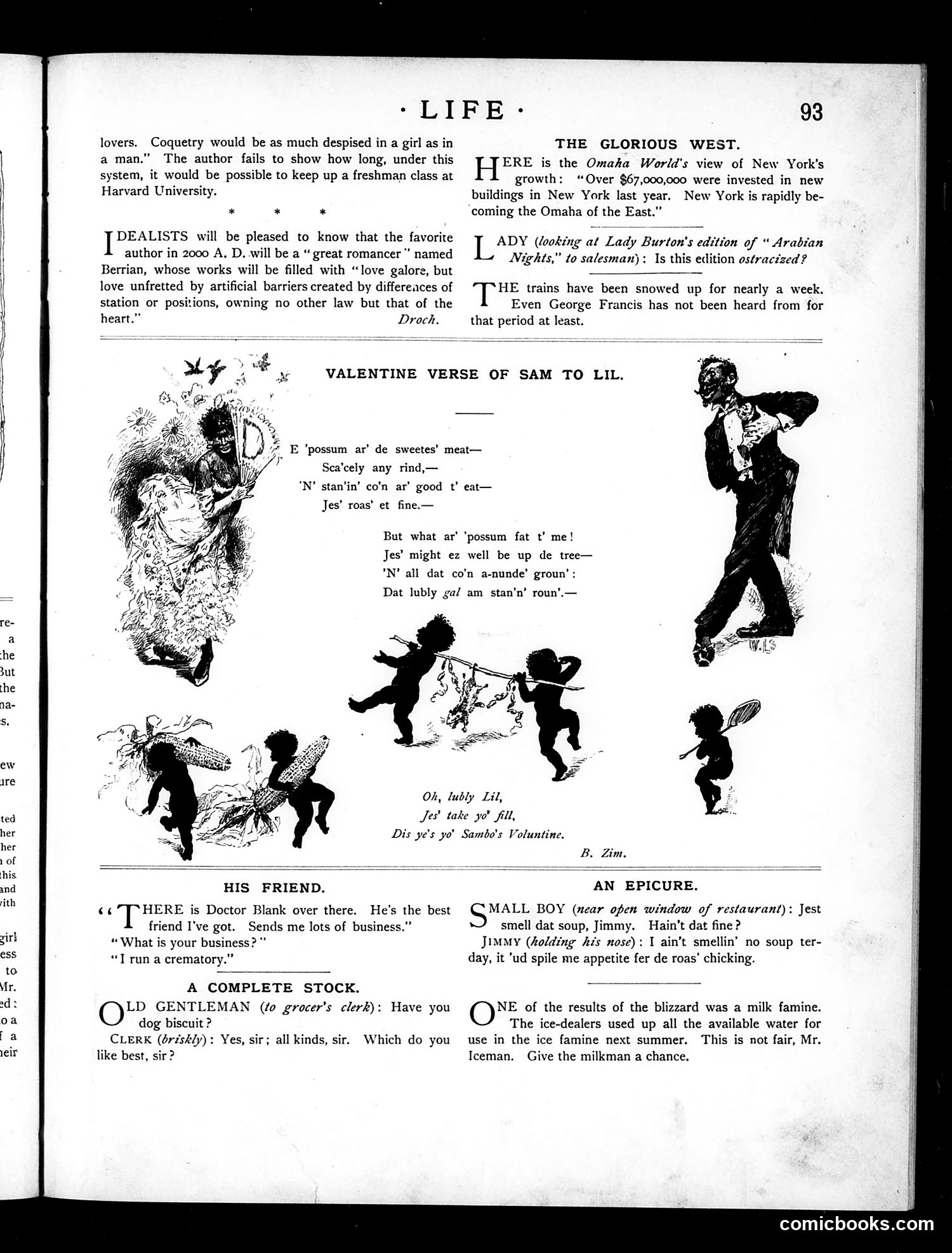
This page contains several humorous sketches and brief comedic vignettes rather than political cartoons. The main feature is "Valentine Verse of Sam to Lil," a dialect poem with accompanying illustrations of Black figures in romantic and playful scenarios. The verse uses phonetic spelling to represent African American vernacular speech. Below are shorter joke items: "His Friend" (about a doctor), "A Complete Stock" (grocer's clerk banter about dog biscuits), "An Epicure" (boy near restaurant window), and a blizzard ice-cream joke. The humor derives from period stereotypes, wordplay, and social observation rather than political commentary. This reflects early 1900s American magazine comedy conventions, which frequently relied on dialect humor and racial caricature—content that would be considered offensive by modern standards.
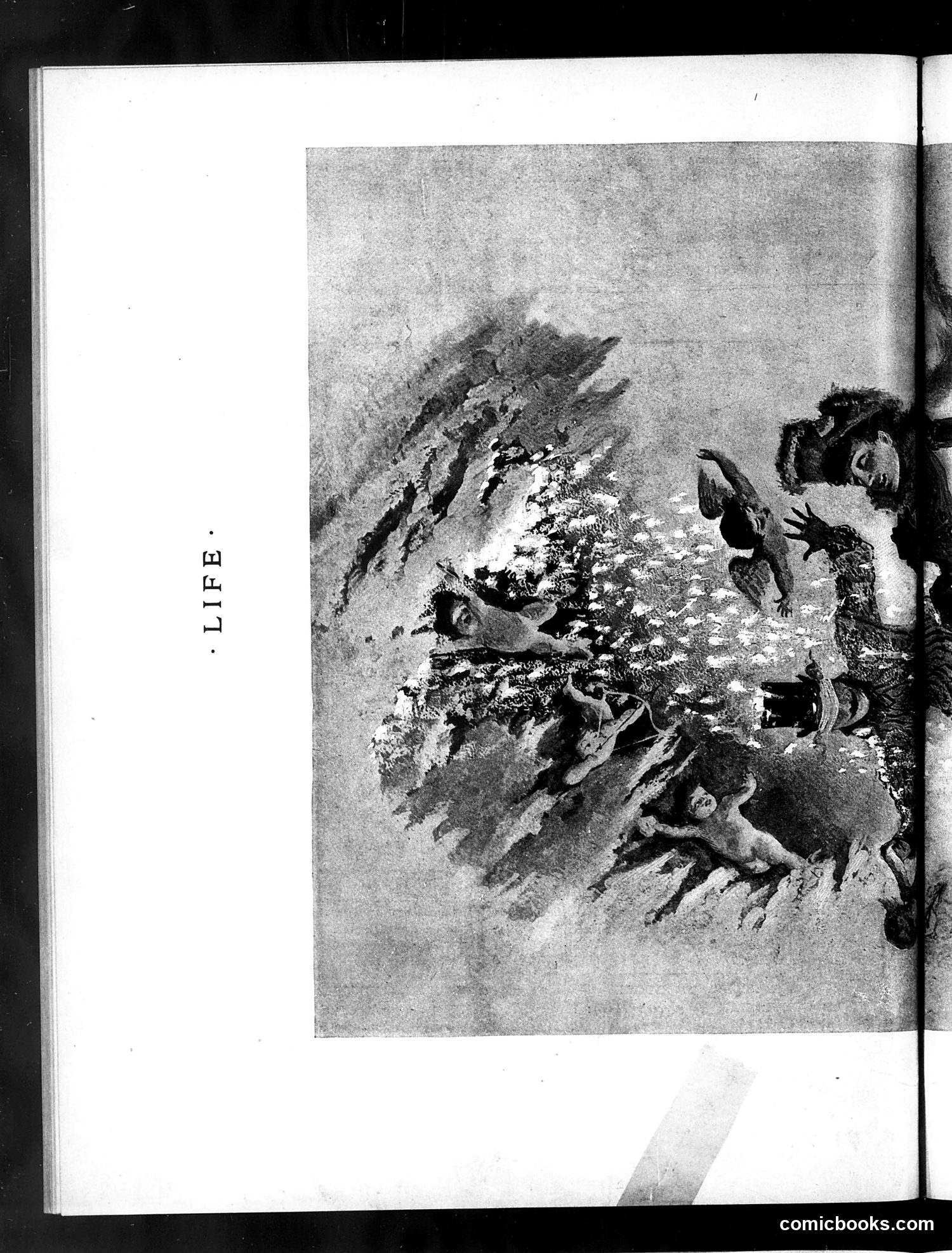
This appears to be a chapter or section title page from *Life* magazine, with the single word "LIFE" printed vertically on the left margin. The right side contains a dark, dramatic illustration depicting what looks like figures in motion or conflict—possibly showing animals or people in an energetic, chaotic scene with dynamic brushwork and strong contrasts between light and shadow. However, without additional context from surrounding pages, OCR text, or a visible date, I cannot definitively identify: - The specific satirical subject or political reference - Which figures are caricatured - The intended meaning or joke - What historical event this addresses The artistic style suggests early-to-mid 20th century work, but the image quality and lack of accompanying caption or text make detailed interpretation unreliable.
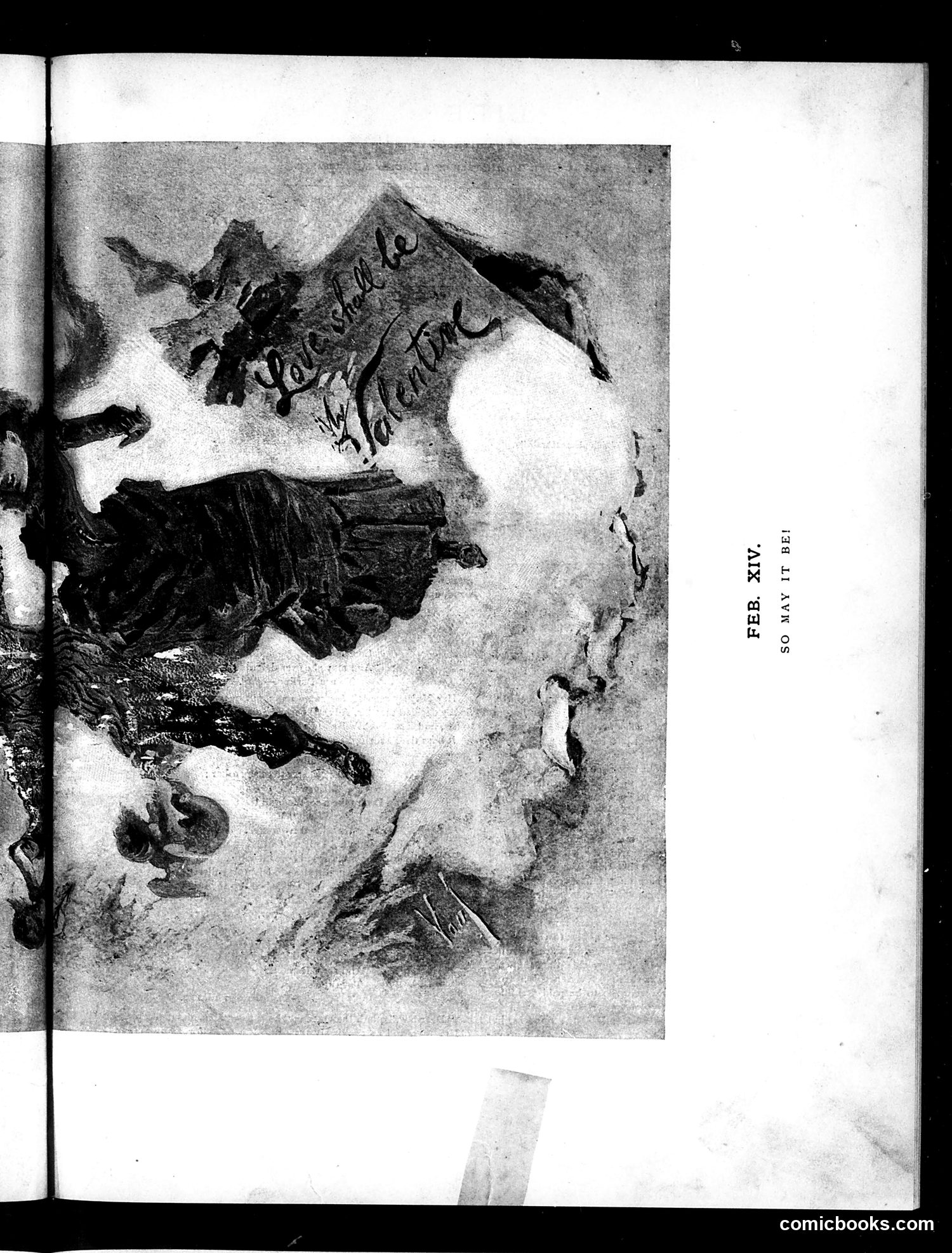
This page shows a sketch portrait dated "FEB. XIX" (February 19) with handwritten inscription that appears to read "Your affectionate [name]" — likely an autographed celebrity photograph or illustration. The image quality and OCR text are too degraded for me to identify the specific figure with confidence or discern clear satirical content. The handwriting and formal presentation suggest this is a signed portrait rather than political satire. Without clearer text or visual markers identifying the subject or publication date, I cannot reliably explain what political or social commentary this page intended. The "comicbooks.com" watermark indicates this is a digitized archive image, but that doesn't clarify the original Life magazine's satirical purpose here.
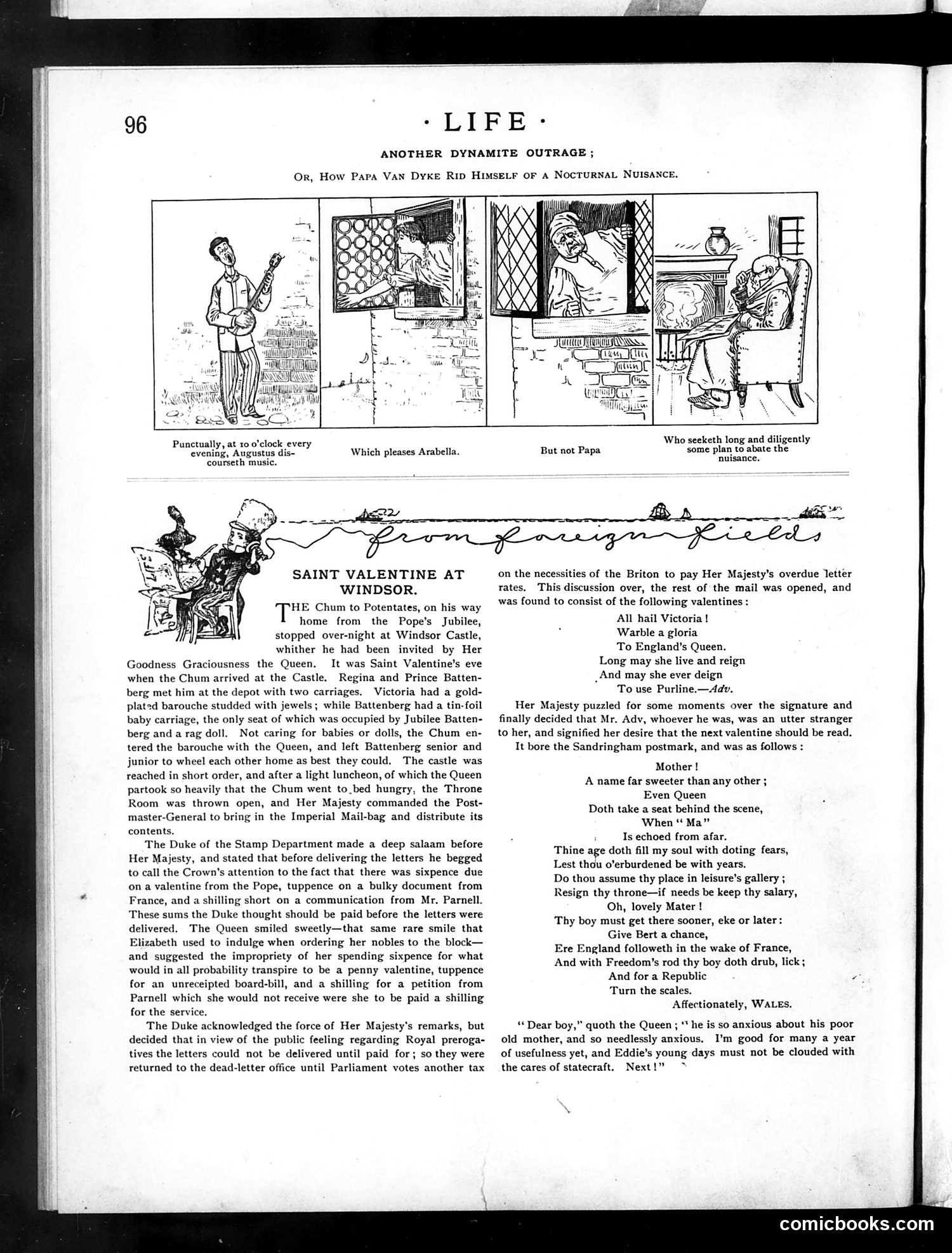
This page contains two distinct satirical pieces from *Life* magazine: **Top Comic Strip ("Another Dynamite Outrage"):** A four-panel joke about "Papa Van Dyke" whose neighbor "Augustus" plays loud music every evening at 10 o'clock. The strip satirizes the frustration of noise complaints, culminating with Papa plotting revenge—likely involving dynamite (a common comedic threat of the era). The humor relies on exaggerated domestic annoyance. **Main Article ("Saint Valentine at Windsor"):** A satirical story mocking Queen Victoria and the British royal postal system. It ridicules: - Postage due charges on royal correspondence (the Pope's valentine, French documents, Parnell's petition) - Victoria's refusal to pay modest fees while enjoying royal privileges - Prince of Wales's (Bert's) valentine pleading with his mother to retire and let him rule, invoking French republicanism as a threat The satire targets British class privilege, royal entitlement, and the tension between aging Victoria and her impatient heir—contemporary political anxieties wrapped in absurdist humor.
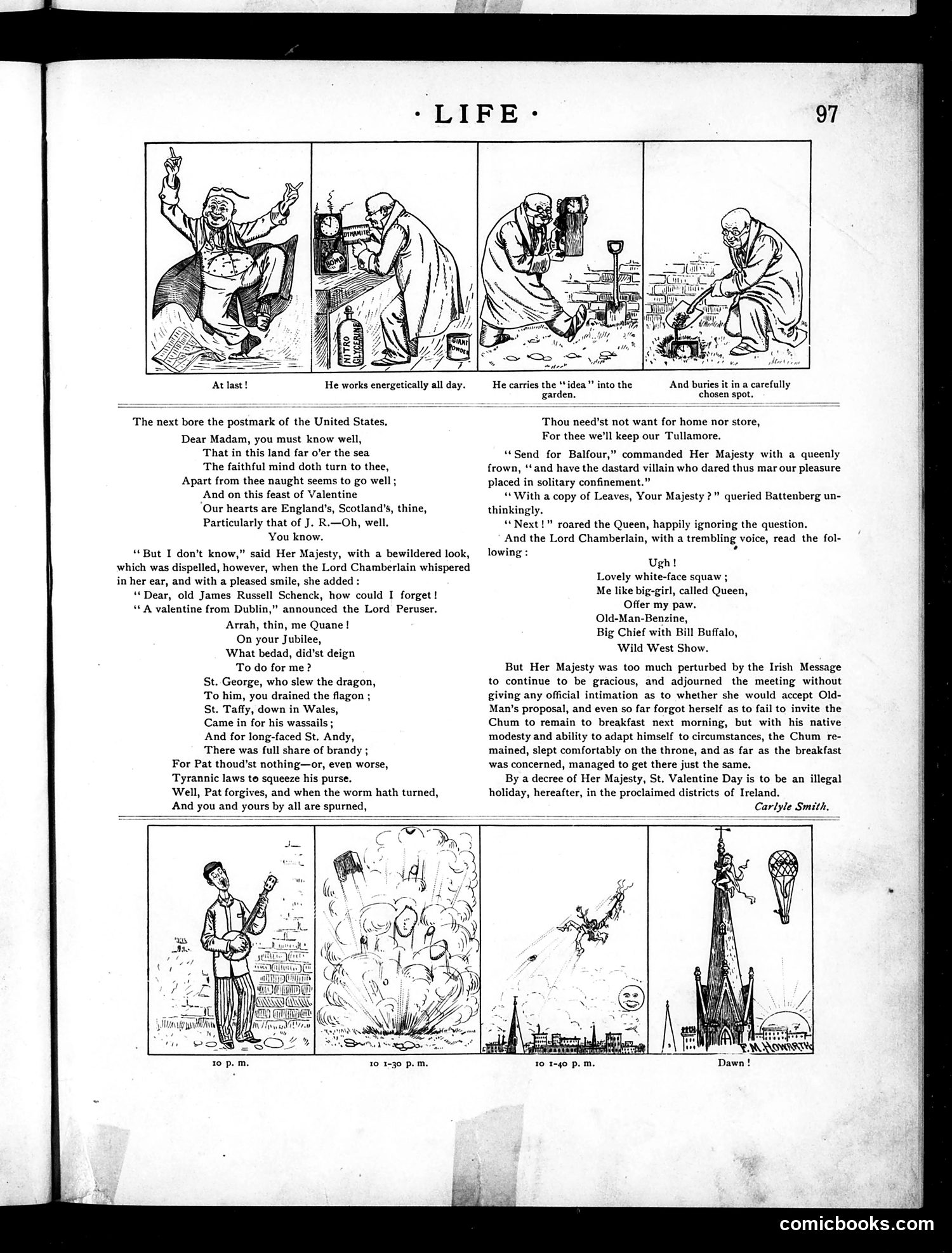
This Life magazine page satirizes Queen Victoria receiving Valentine's Day messages. The top comic strip shows a character with an obsessive "idea" he buries—a metaphor for Irish nationalist sentiment being suppressed. The text presents three Valentine messages to the Queen: a sentimental American one (referencing James Russell Schenck), an **Irish message in dialect** complaining that while other saints (St. George, St. Taffy/Wales, St. Andrew/Scotland) received royal favor, "Pat" (Ireland) received only "tyrannic laws to squeeze his purse." The Irish sender ironically promises to "keep" the Queen's memory alive by burying the idea carefully. A third absurdist message from "Old-Man-Benzine" (unclear reference, possibly mocking Western American culture) adds comic confusion. **The satire's point:** Ireland's grievances are real but politely buried beneath comic absurdity. The ending—declaring St. Valentine's Day illegal in Irish districts—darkly jokes that suppressing celebration means suppressing Irish expression itself.
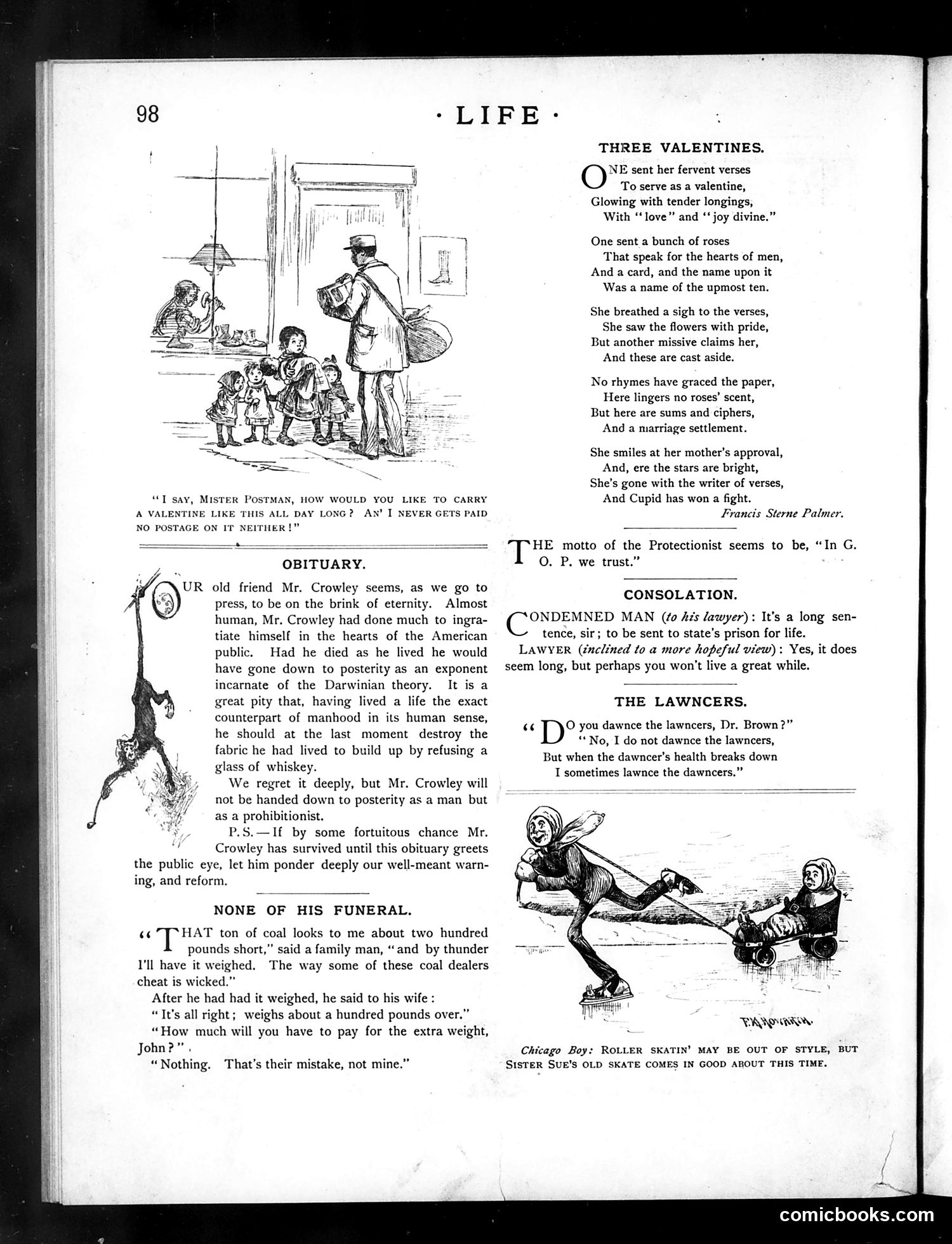
This page contains multiple short satirical pieces typical of early Life magazine: **Top cartoon**: A postal worker complains to a postman about delivering Valentine's Day cards—a joke about the volume and burden of Valentine's mail traffic, with the carrier never receiving postage compensation for the work. **"Obituary"**: Mock-serious commentary on someone named Crowley, apparently a public figure known for opposing Prohibition. The satire suggests he undermined his own legacy by refusing alcohol at the end of his life, thus becoming "a prohibitionist" despite living otherwise. **"None of His Funeral"**: A coal dealer short-weights a customer's delivery, but when the customer has it re-weighed, it's actually over. The joke's moral irony: the customer keeps the excess without guilt, reversing the dealer's dishonesty. **Other pieces**: Include "Three Valentines" (a poem about women choosing financial security over romance), jokes about lawyers, and skating children. The overall tone mocks human nature—greed, hypocrisy, and self-interest—rather than targeting specific political figures.
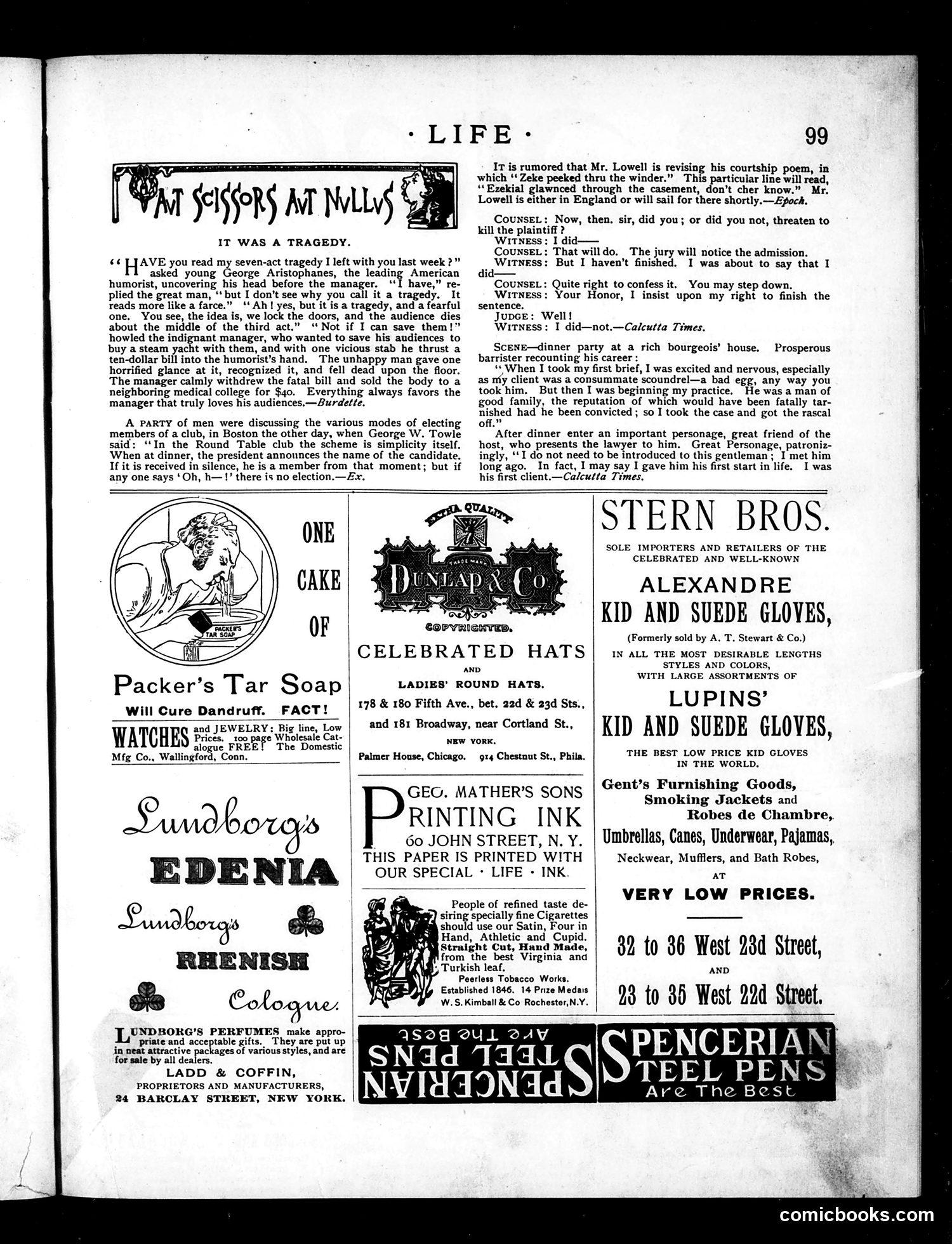
This page contains several brief comic sketches (mostly text-based) rather than visual cartoons. The jokes satirize professional pretension and social hypocrisy: 1. **"It Was a Tragedy"**: A humorist pitches a terrible play as tragic; a theater manager bribes him to leave, then sells his corpse to a medical college—satirizing how money corrupts even death. 2. **Club Election**: A club's membership system where silence means acceptance but saying "Oh, h—!" (an exclamation) means rejection—mocking absurd institutional rules. 3. **Legal Admission**: A witness tries explaining he *didn't* threaten someone, but the lawyer cuts him off after he admits to threatening, then won't let him finish—mocking lawyers who twist testimony. 4. **The Barrister**: A lawyer reveals he defended a "scoundrel" successfully, then discovers his first client was actually the powerful man introducing him—satirizing how lawyers serve the corrupt and powerful while pretending to justice. The page is largely filled with period advertisements for soap, hats, gloves, ink, and perfume.
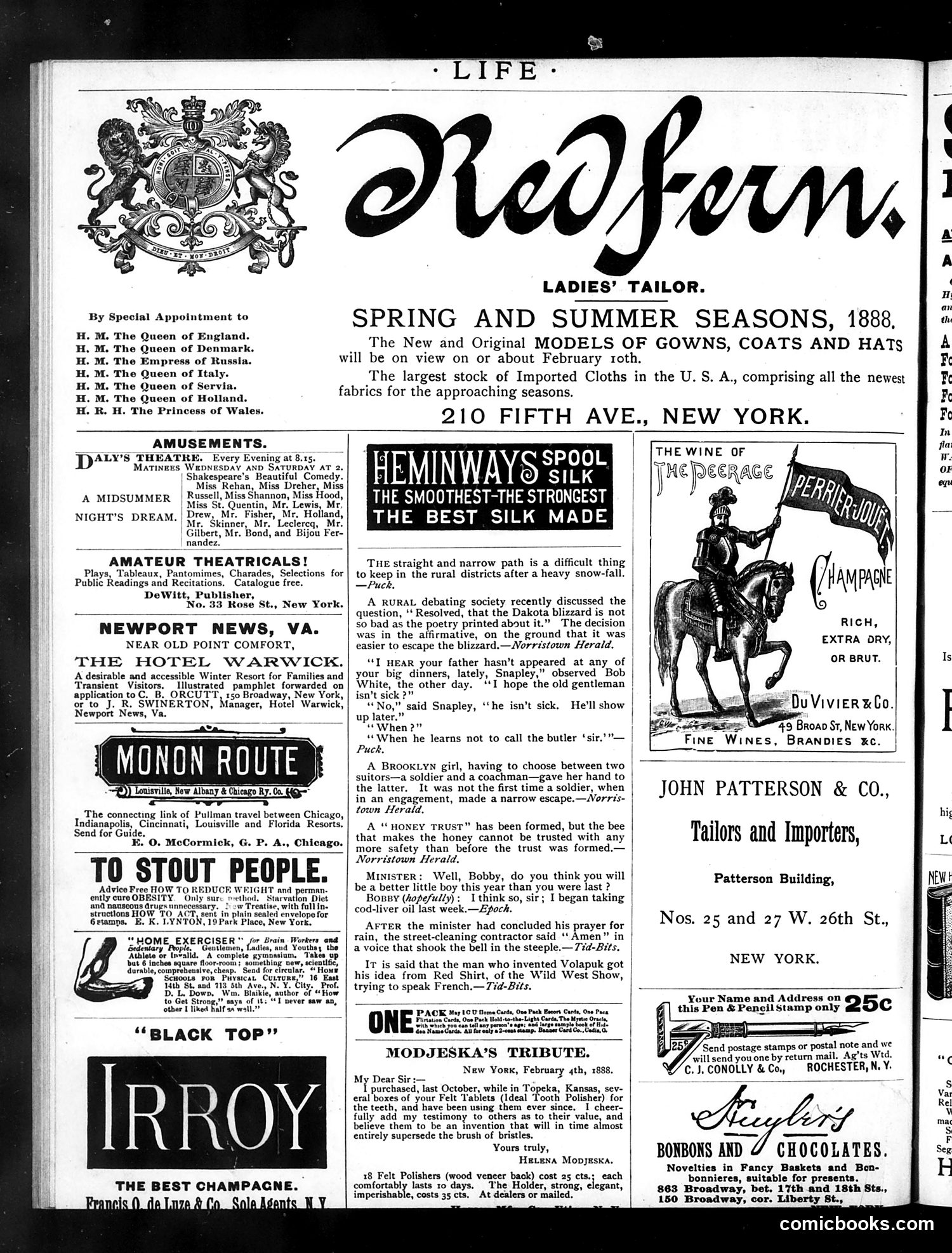
This is primarily an **advertising page** with minimal editorial content. The dominant feature is a large advertisement for **Red Fern, a ladies' tailor** on Fifth Avenue, prominently listing royal and aristocratic patronage (Queen of England, Empress of Russia, etc.)—a common marketing strategy of the era to establish prestige. The page includes scattered **humorous anecdotes** typical of Life's satirical style: - A joke about Dakota blizzards being overexaggerated in poetry - A quip about a soldier's "narrow escape" from engagement (wordplay on military vs. romantic engagement) - Commentary on a "honey trust" (likely referencing real trust-building scandals of the 1880s) Most other content consists of **theater listings, resort advertisements, and patent remedies** (obesity treatments, etc.). The small **"Wine of Bergerac" advertisement** with a mounted figure appears to be wine promotion, unrelated to satire. The page reflects Life's business model: combining modest editorial humor with profitable advertising space for luxury goods and services targeting affluent readers.
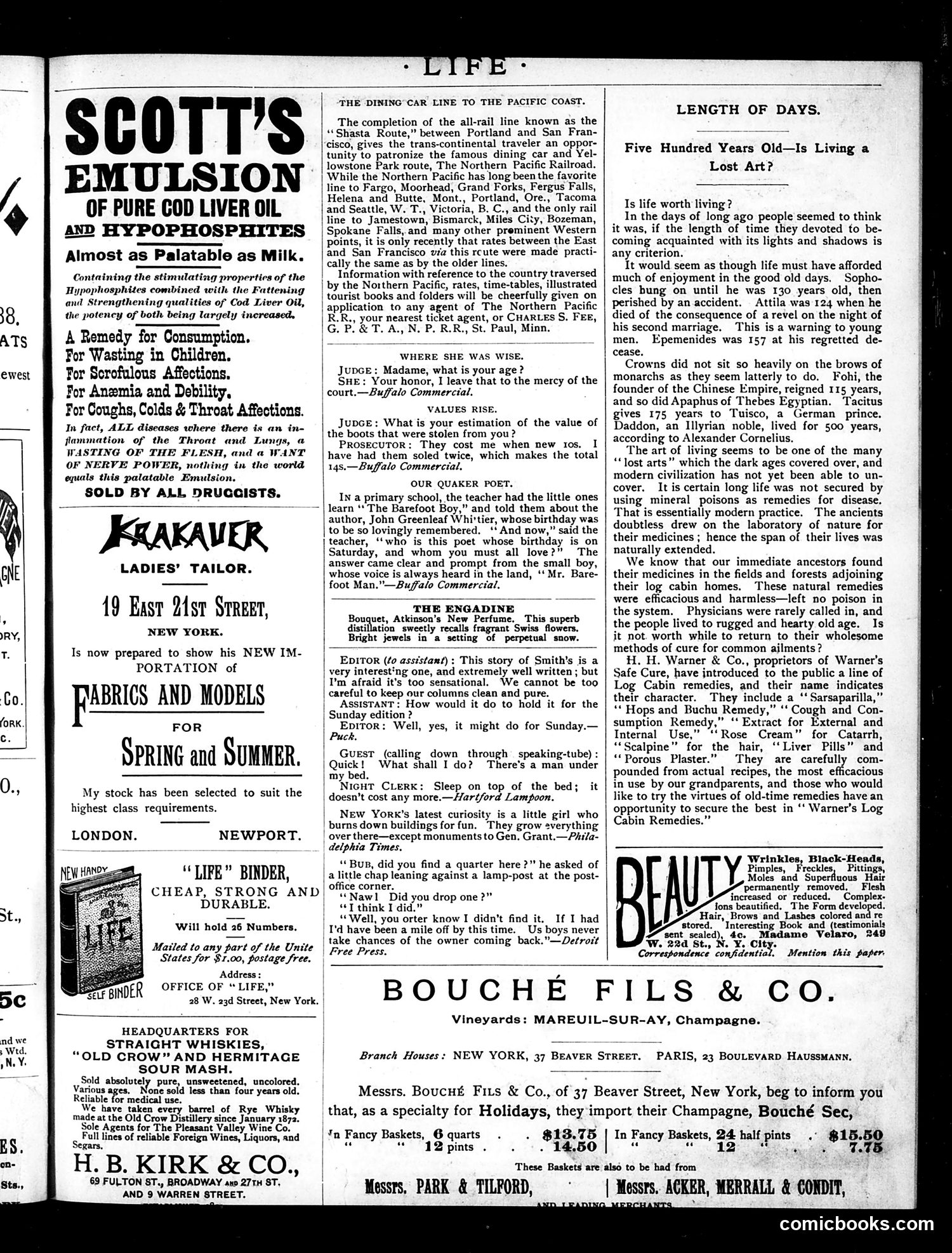
This page is primarily **advertising**, not political satire. It contains product advertisements typical of late 19th-century American magazines: Scott's Emulsion (cod liver oil remedy), a ladies' tailor, whiskey, book binders, and perfume. The non-advertising content consists of three brief **humorous anecdotes**: 1. A woman in court cleverly deflects a question about her age to judicial mercy 2. A man's boot valuation absurdly inflates through repeated repairs 3. A schoolchild misidentifies poet John Greenleaf Whittier as "Mr. Barefoot Man" (confusing the poem "The Barefoot Boy" with the author) These are gentle, domestic jokes without political content. The page also includes a railroad advertisement for the Northern Pacific route to the Pacific Coast. **No political cartoons or caricatures appear on this page.** It represents routine Life magazine content from approximately the 1880s-1890s—a mix of advertising and light humor.
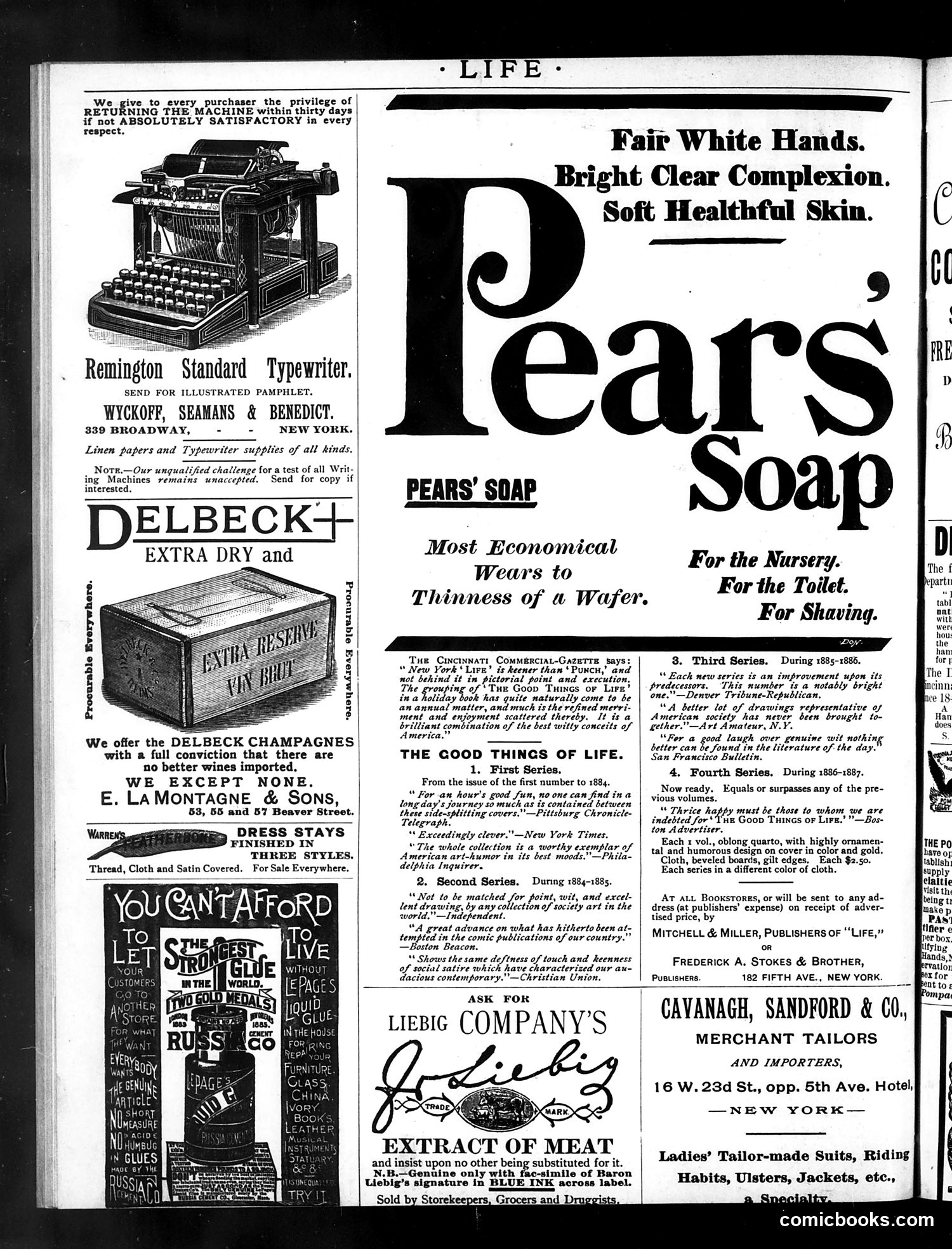
This page is **primarily advertising**, not satirical content. It showcases period products and services typical of 1880s America: **Notable advertisements include:** - **Remington Standard Typewriter** — promoting business modernization - **Pears' Soap** — emphasizing Victorian beauty ideals ("Fair White Hands. Bright Clear Complexion") - **Liebig's Extract of Meat** — a popular concentrated meat product - **Cavanagh, Sandford & Co.** — merchant tailors advertising women's fashions **The page's main content** promotes bound collections called "The Good Things of Life" (Series 1-4), which were compilations of humorous drawings and social satire from *Life* magazine itself. The quoted testimonials praise the artwork's wit and commentary on "American society." **Historical context:** The emphasis on whiteness in soap advertising and tailored fashion reflects late-Victorian consumer culture and class consciousness. The typewriter advertisement reflects industrial-era business expansion. This is essentially a catalog page rather than a satirical cartoon page.
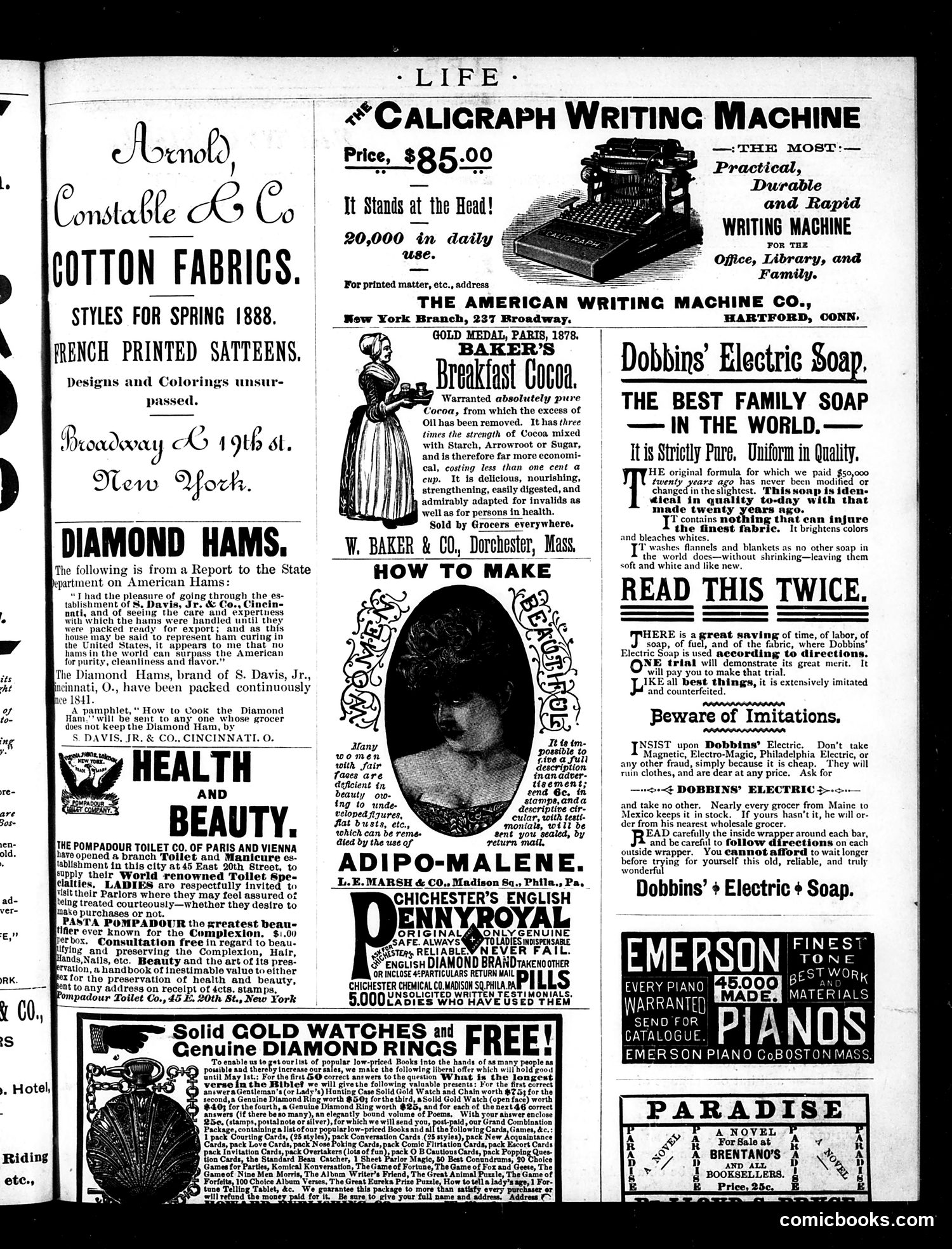
This page is primarily **advertising with no political cartoons**. It's a commercial compilation typical of late-19th-century magazines. The advertisements target middle and upper-class consumers with products reflecting 1888 priorities: the Caligraph Writing Machine ($85—expensive, positioned as essential for offices); Baker's Breakfast Cocoa (marketed as pure and economical); Diamond Hams (emphasizing American quality and purity); and luxury items like gold watches and diamond rings. Notable is the prevalence of **beauty and women's health products**: Pompadour cosmetics, Adipo-Malene (for "developing figures"), and Chichester's Pills (coded language for contraceptives, then illegal to advertise directly). These ads reveal period anxieties about female appearance and fertility, marketed with pseudoscientific claims. The page reflects Gilded Age consumer culture—new technologies, imperial claims of superiority ("American hams surpass the world"), and aggressive marketing tactics targeting women's insecurities.
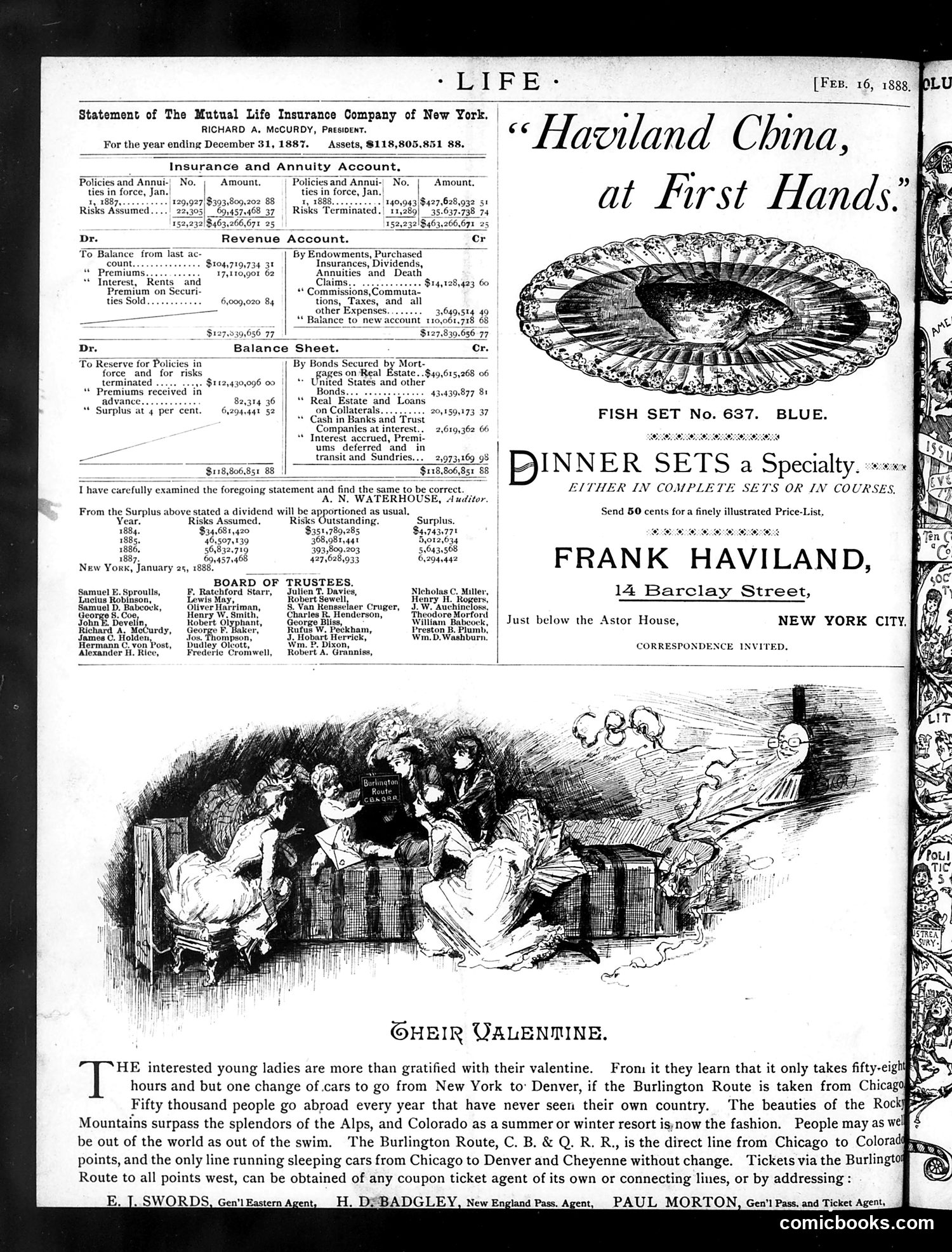
This page combines insurance company financial statements with advertisements and a satirical cartoon titled "Their Valentine." **The Cartoon:** The illustration depicts young women receiving valentines promoting train travel to Colorado and Denver via the Burlington Route. The satire mocks the romantic appeal of these travel advertisements to unmarried women. The accompanying text notes that fifty thousand Americans annually travel abroad without seeing their own country, and promotes Colorado as fashionable for summer/winter vacations—comparing it favorably to the Alps. **The Joke:** The satirical premise is that young ladies are receiving these railroad promotional materials as "valentines" (romantic gifts)—a tongue-in-cheek commentary on how commercial advertising had infiltrated even romantic occasions. The piece gently ridicules both the marketing strategy and the fashion-consciousness of young women who found distant travel destinations romantic. **Context:** This reflects 1880s expansion of American railroad infrastructure and the emerging tourist industry promoting the American West as a desirable destination.