
Life, 1888-02-16 · page 4 of 20
Life — February 16, 1888 — page 4: what you’re looking at
What you’re looking at
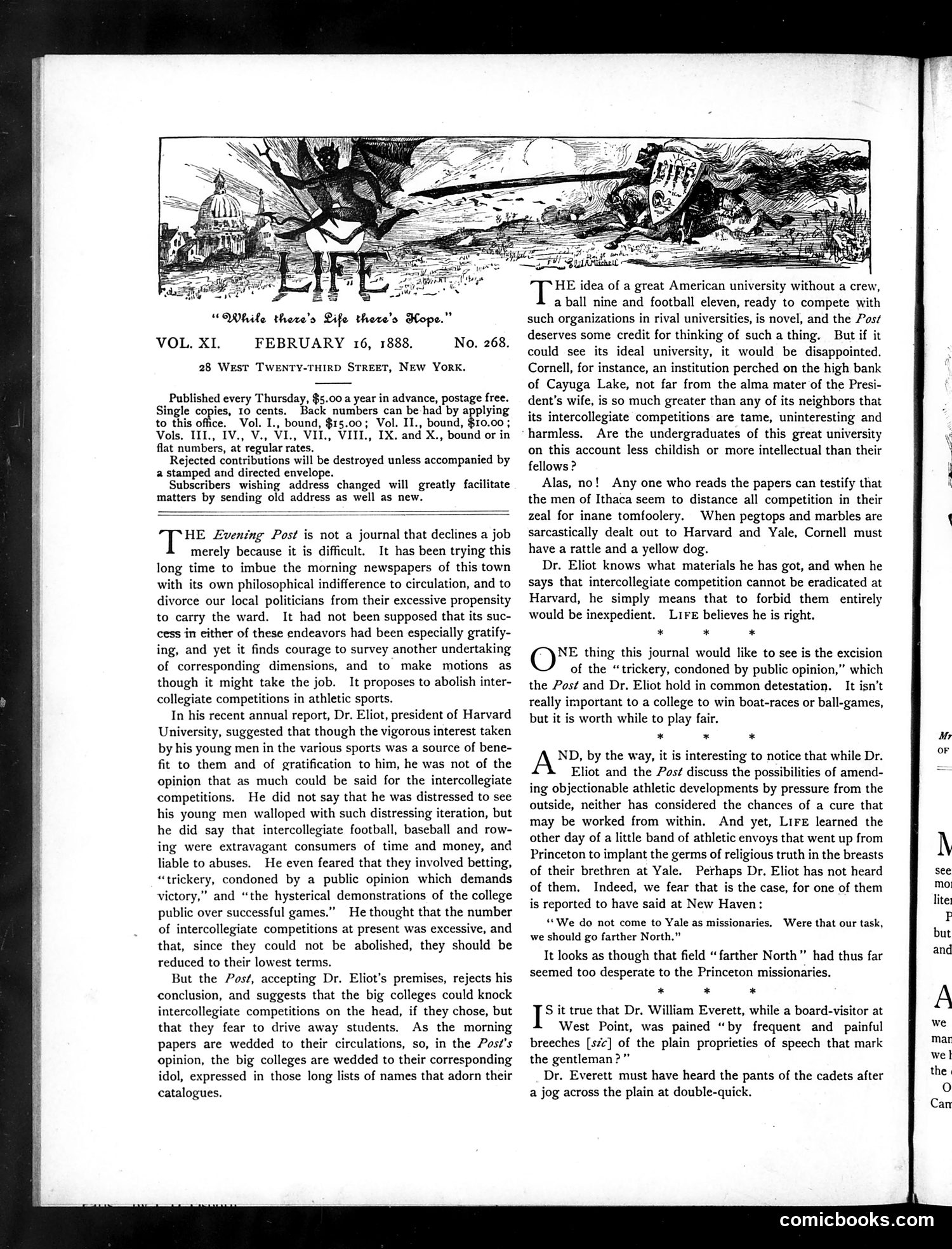
The masthead cartoon depicts "LIFE" as a winged figure surveying a landscape, with the motto "While there's Life there's Hope." The editorial content criticizes Harvard President Dr. Eliot's proposal to abolish intercollegiate athletic competitions. The piece sarcastically defends college sports, arguing that while competitions may be excessive, completely eliminating them would be worse. The satire targets Dr. Eliot's idealism, suggesting his vision of a university without athletic organizations is impractical. The author also mocks Princeton's strict religious culture, quoting a cadet who refuses Yale missionary work, preferring to "go farther North." Additionally, the piece humorously questions Dr. William Everett's remarks about cadets' speech at West Point, joking that he must have overheard soldiers' complaints after physical exertion.
📄 Transcribed text from this page (OCR, searchable)
Machine-transcribed from the original scan — historical spelling and the odd misread are preserved.
“While there's Life there’s Hop VOL. XI. FEBRUARY 16, 1888. No. 268. 28 West TWENTY-THIRD STREET, NEW YorK. Published every Thursday, $5.00 a year in advance, postage free. Single copies, 10 cents. Back numbers can be had by applying to this office. Vol. 1., bound, $15.00; Vol. II., bound, $10.00 ; Vols. III., IV., V., VI., VIL, vn, IX. and X., bound or in flat numbers, at regular rates. Rejected contributions will be destroyed unless accompanied by a stamped and directed envelope. Subscribers wishing address changed will greatly facilitate matters by seating old address as well as new. HE Lvening Post is not a journal that declines a job merely because it is difficult. It has been trying this long time to imbue the morning newspapers of this town with its own philosophical indifference to circulation, and to divorce our local politicians from their excessive propensity to carry the ward. It had not been supposed that its suc- cess in either of these endeavors had been especially gratify- ing, and yet it finds courage to survey another undertaking of corresponding dimensions, and to make motions as though it might take the job. It proposes to abolish inter- collegiate competitions in athletic sports. In his recent annual report, Dr. Eliot, president of Harvard University, suggested that though the vigorous interest taken by his young men in the various sports was a source of bene- fit to them and of gratification to him, he was not of the opinion that as much could be said for the intercollegiate competitions. He did not say that he was distressed to see his young men walloped with such distressing iteration, but he did say that intercollegiate football, baseball and row- ing were extravagant consumers of time and money, and liable to abuses. He even feared that they involved betting, “trickery, condoned by a public opinion which demands victory,” and “the hysterical demonstrations of the college public over successful games.” He thought that the number of intercollegiate competitions at present was excessive, and that, since they could not be abolished, they should be reduced to their lowest terms. But the Post, accepting Dr. Eliot’s premises, rejects his conclusion, and suggests that the big colleges could knock intercollegiate competitions on the head, if they chose, but that they fear to drive away students. As the morning papers are wedded to their circulations, so, in the Pos?’s opinion, the big colleges are wedded to their corresponding idol, expressed in those long lists of names that adorn their catalogues. HE idea of a great American university without a crew, a ball nine and football eleven, ready to compete with such organizations in rival universities, is novel, and the Post deserves some credit for thinking of such a thing. But if it could see its ideal university, it would be disappointed. Cornell, for instance, an institution perched on the high bank of Cayuga Lake, not far from the alma mater of the Presi- dent’s wife, is so much greater than any of its neighbors that its intercollegiate competitions are tame, uninteresting and harmless. Are the undergraduates of this great university on this account less childish or more intellectual than their fellows ? Alas, no! Any one who reads the papers can testify that the men of Ithaca seem to distance all competition in their zeal for inane tomfoolery. When pegtops and marbles are sarcastically dealt out to Harvard and Yale, Cornell must have a rattle and a yellow dog. Dr. Eliot knows what materials he has got, and when he says that intercollegiate competition cannot be eradicated at Harvard, he simply means that to forbid them entirely would be inexpedient. LiFe believes he is right. * * * NE thing this journal would like to see is the excision of the “trickery, condoned by public opinion,” which the Post and Dr. Eliot hold in common detestation. It isn’t really important to a college to win boat-races or ball-games, but it is worth while to play fair. * * * ND, by the way, it is interesting to notice that while Dr. Eliot and the Post discuss the possibilities of amend- ing objectionable athletic developments by pressure from the outside, neither has considered the chances of a cure that may be worked from within. And yet, LIFE learned the other day of a little band of athletic envoys that went up from Princeton to implant the germs of religious truth in the breasts of their brethren at Yale. Perhaps Dr. Eliot has not heard of them. Indeed, we fear that is the case, for one of them is reported to have said at New Haven: “*We do not come to Yale as missionaries. Were that our task, we should go farther North.” It looks as though that field “farther North” had thus far seemed too desperate to the Princeton missionaries. * * * S it true that Dr. William Everett, while a board-visitor at West Point, was pained “by frequent and painful breeches [szc] of the plain proprieties of speech that mark the gentleman?” Dr. Everett must have heard the pants of the cadets after a jog across the plain at double-quick. M oF comicbooks.com