
Life, 1888-02-16 · page 8 of 20
Life — February 16, 1888 — page 8: what you’re looking at
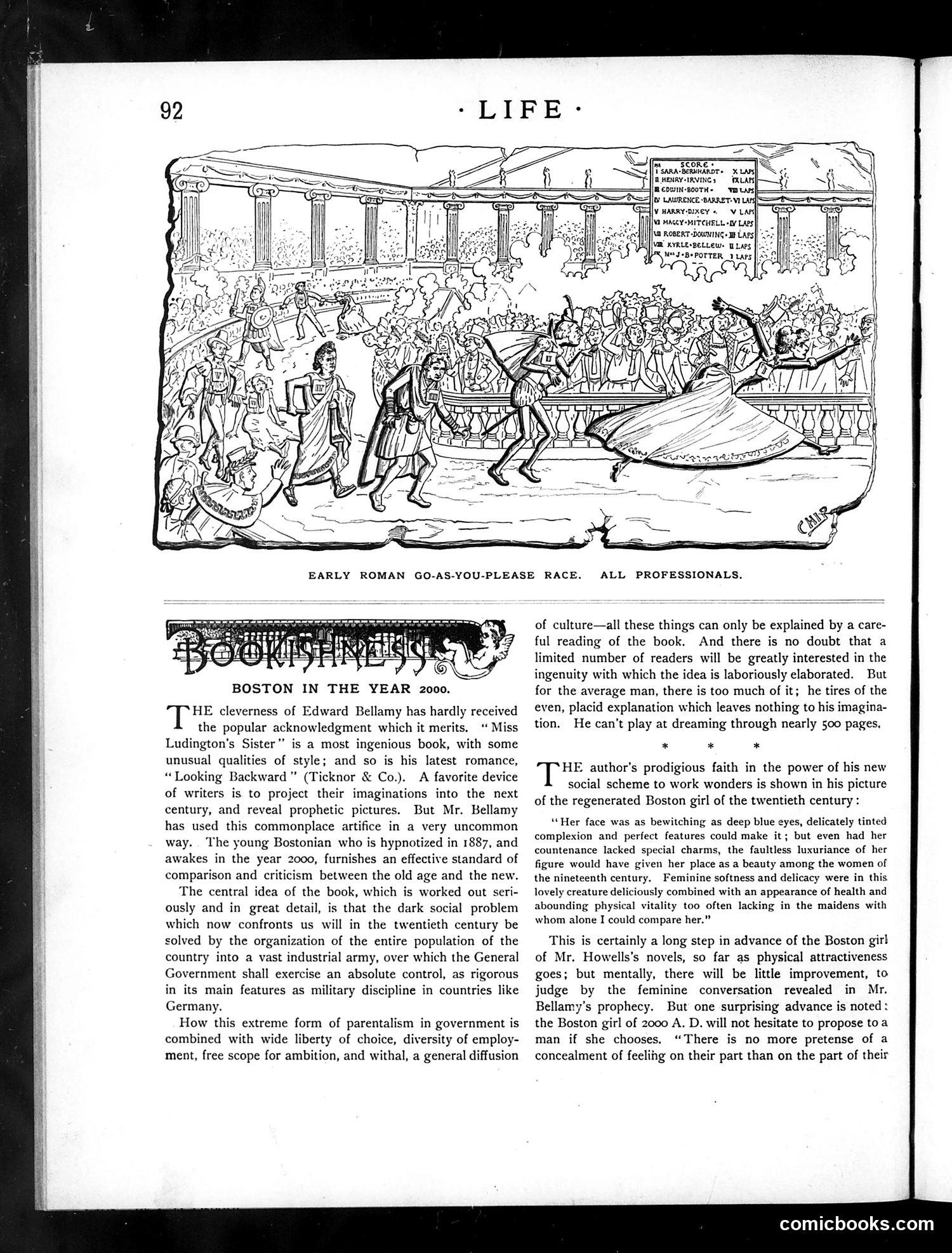
What you’re looking at
**The Cartoon:** The illustration depicts an "Early Roman Go-As-You-Please Race. All Professionals" — a satirical take on ancient Roman spectacles, showing competitors racing in an arena before crowds in a columned structure. The style mimics classical engravings. **The Satire:** This appears to be mocking contemporary professional racing or sporting competitions by presenting them as equivalent to ancient Roman entertainment. The "go-as-you-please" format suggests chaotic, anything-goes competition, satirizing modern professional sports as descended from (or morally equivalent to) brutal Roman amusements. **The Text Section:** Below discusses Edward Bellamy's novel "Looking Backward" and its vision of Boston in the year 2000, critiquing both Bellamy's social predictions and contemporary Boston society. The page juxtaposes ancient decadence with modern ambitions.
📄 Transcribed text from this page (OCR, searchable)
Machine-transcribed from the original scan — historical spelling and the odd misread are preserved.
EARLY ROMAN GO-AS-YOU-PLEASE RACE. BOSTON IN THE YEAR 2000. HE cleverness of Edward Bellamy has hardly received the popular acknowledgment which it merits. ‘ Miss Ludington's Sister’ is a most ingenious book, with some unusual qualities of style; and so is his latest romance, “Looking Backward” (Ticknor & Co.). A favorite device of writers is to project their imaginations into the next century, and reveal prophetic pictures. But Mr. Bellamy has used this commonplace artifice in a very uncommon way. The young Bostonian who is hypnotized in 1887, and awakes in the year 2000, furnishes an effective standard of comparison and criticism between the old age and the new. The central idea of the book, which is worked out seri- ously and in great detail, is that the dark social problem which now confronts us will in the twentieth century be solved by the organization of the entire population of the country into a vast industrial army, over which the General Government shall exercise an absolute control, as rigorous in its main features as military discipline in countries like Germany. How this extreme form of parentalism in government is combined with wide liberty of choice, diversity of employ- ment, free scope for ambition, and withal, a general diffusion NM MACY “MITCHELL of LARS [Wa ROBERT DOWNING «IF Laps] Vm KYRLEBELLEWs W LAPS ALL PROFESSIONALS, of culture—all these things can only be explained by a care- ful reading of the book. And there is no doubt that a limited number of readers will be greatly interested in the ingenuity with which the idea is laboriously elaborated. But for the average man, there is too much of it; he tires of the even, placid explanation which leaves nothing to his imagina- tion. He can’t play at dreaming through nearly 500 pages, * * * HE author's prodigious faith in the power of his new social scheme to work wonders is shown in his picture of the regenerated Boston girl of the twentieth century : “Her face was as bewitching as deep blue eyes, delicately tinted complexion and perfect features could make it; but even had her countenance lacked special charms, the faultless luxuriance of her figure would have given her place as a beauty among the women of the nineteenth century. Feminine softness and delicacy were in this lovely creature deliciously combined with an appearance of health and abounding physical vitality too often lacking in the maidens with whom alone I could compare her.” This is certainly a long step in advance of the Boston girl of Mr. Howells’s novels, so far as physical attractiveness goes; but mentally, there will be little improvement, to judge by the feminine conversation revealed in Mr. Bellamy’s prophecy. But one surprising advance is noted : the Boston girl of 2000 A. D. will not hesitate to propose to a man if she chooses. “There is no more pretense of a concealment of feeling on their part than on the part of their comicbooks.com