
Life, 1888-02-16 · page 6 of 20
Life — February 16, 1888 — page 6: what you’re looking at
What you’re looking at
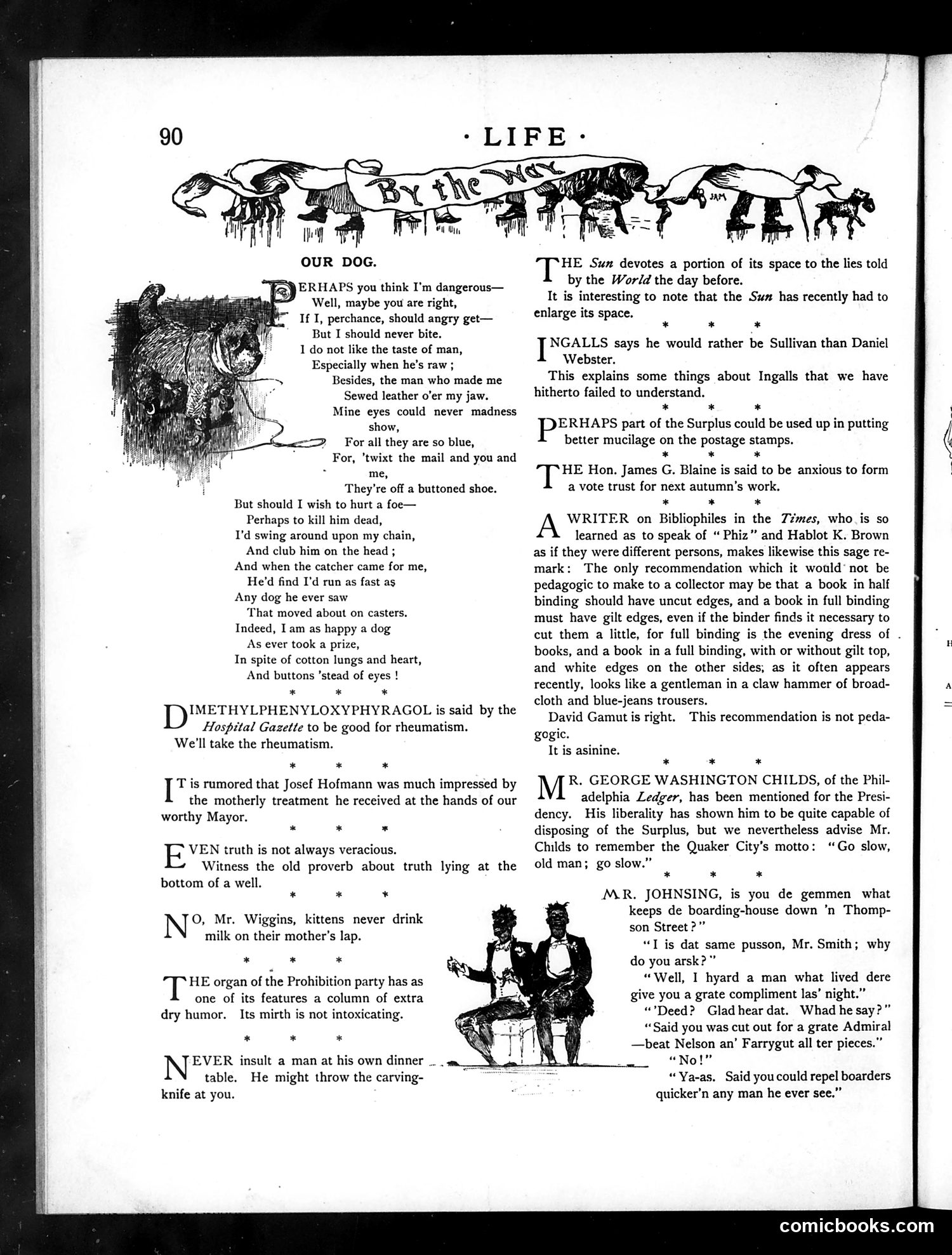
**"Our Dog" Poem:** The left side features a humorous monologue from a dog's perspective, personifying canine loyalty and behavior. The illustration shows a shaggy dog. The poem addresses common concerns about dog ownership—the animal's potential dangerousness contrasted with its fundamental trustworthiness and affection. **Right Column Miscellany:** The page contains brief satirical notes on various contemporary topics: the *Sun* newspaper enlarging its space, politician Ingalls, government surplus funds, Hon. James G. Blaine forming a vote trust, and bibliophile collecting practices. A dialogue at bottom satirizes Irish boarding-house proprietors through stereotyped dialect and working-class humor. The page exemplifies Life's mix of social observation, light satire, and cultural commentary typical of late 19th-century American humor magazines.
📄 Transcribed text from this page (OCR, searchable)
Machine-transcribed from the original scan — historical spelling and the odd misread are preserved.
OUR DOG. ERHAPS you think I'm dangerous— Well, maybe you are right, If I, perchance, should angry get— But I should never bite. 1 do not like the taste of man, Especially when he’s raw ; Besides, the man who made me Sewed leather o’er my jaw. Mine eyes could never madness show, For all they are so blue, For, 'twixt the mail and you and me, They're off a buttoned shoe. But should I wish to hurt a foe— Perhaps to kill him dead, I'd swing around upon my chain, And club him on the head ; And when the catcher came for me, He’d find I'd run as fast as Any dog he ever saw ‘That moved about on casters. Indeed, I am as happy a dog As ever took a prize, In spite of cotton lungs and heart, And buttons ’stead of eyes ! * * * IMETHYLPHENYLOXYPHYRAGOL is said by the Hospital Gazette to be good for rheumatism. We'll take the rheumatism. * * * T is rumored that Josef Hofmann was much impressed by the motherly treatment he received at the hands of our worthy Mayor. * * VEN truth is not always veracious. Witness the old proverb about truth lying at the bottom of a well. * * O, Mr. Wiggins, kittens never drink milk on their mother’s lap. * * * HE organ of the Prohibition party has as one of its features a column of extra dry humor. Its mirth is not intoxicating. * * * EVER insult a man at his own dinner _. . table. He might throw the carving- knife at you. HE Sun devotes a portion of its space to the lies told by the World the day before. It is interesting to note that the Su# has recently had to enlarge its space. * * * NGALLS says he would rather be Sullivan than Daniel Webster. This explains some things about Ingalls that we have hitherto failed to understand. * * * ERHAPS part of the Surplus could be used up in putting better mucilage on the postage stamps. * * * HE Hon. James G. Blaine is said to be anxious to form a vote trust for next autumn’s work, * * * WRITER on Bibliophiles in the Zzmes, who is so learned as to speak of “ Phiz” and Hablot K. Brown as if they were different persons, makes likewise this sage re- mark: The only recommendation which it would’ not be pedagogic to make to a collector may be that a book in half binding should have uncut edges, and a book in full binding must have gilt edges, even if the binder finds it necessary to cut them a little, for full binding is the evening dress of . books, and a book in a full binding, with or without gilt top, and white edges on the other sides, as it often appears recently, looks like a gentleman in a claw hammer of broad- cloth and blue-jeans trousers. David Gamut is right. This recommendation is not peda- gogic. It is asinine. * * * R. GEORGE WASHINGTON CHILDS, of the Phil- adelphia Ledger, has been mentioned for the Presi- dency. His liberality has shown him to be quite capable of disposing of the Surplus, but we nevertheless advise Mr. Childs to remember the Quaker City’s motto: “Go slow, old man; go slow.” * * MR. JOHNSING, is you de gemmen what keeps de boarding-house down ’n Thomp- son Street?” “T is dat same pusson, Mr. Smith; why do you arsk?” “Well, I hyard a man what lived dere give you a grate compliment las’ night.” “’Deed? Gladhear dat. Whad he say?” “Said you was cut out for a grate Admiral —beat Nelson an’ Farrygut all ter pieces.” “No!” “Ya-as. Said you could repel boarders quicker’n any man he ever see.” comicbooks.com