
A complete issue · 16 pages · 1888
Life — January 26, 1888
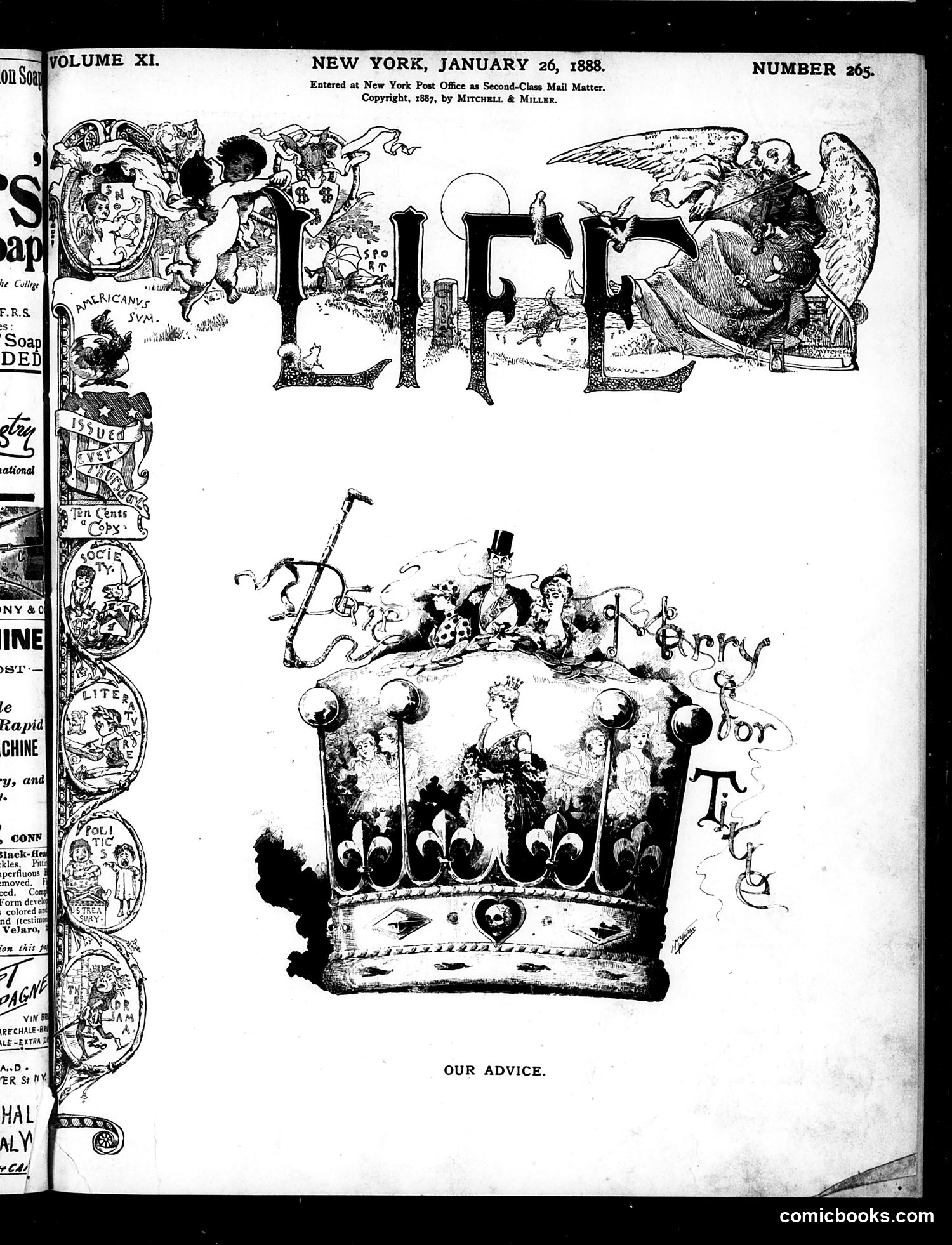
This satirical page features two illustrations under the heading "OUR ADVICE." The top image shows the word "LIFE" in decorative letters surrounded by classical and allegorical figures—cherubs, angels, and mythological characters—suggesting the magazine's role as arbiter of culture and morality. The lower illustration depicts a crown atop which sit various figures in top hats and formal dress, appearing to conduct business or make decisions. The crown itself features fleur-de-lis patterns and ornamental details. The satirical point appears to critique those in power—likely political or social elites of the Gilded Age—suggesting they operate under pretense of royal authority while actually serving narrow interests. The crowded figures suggest competing power-brokers or a mockery of governance itself.
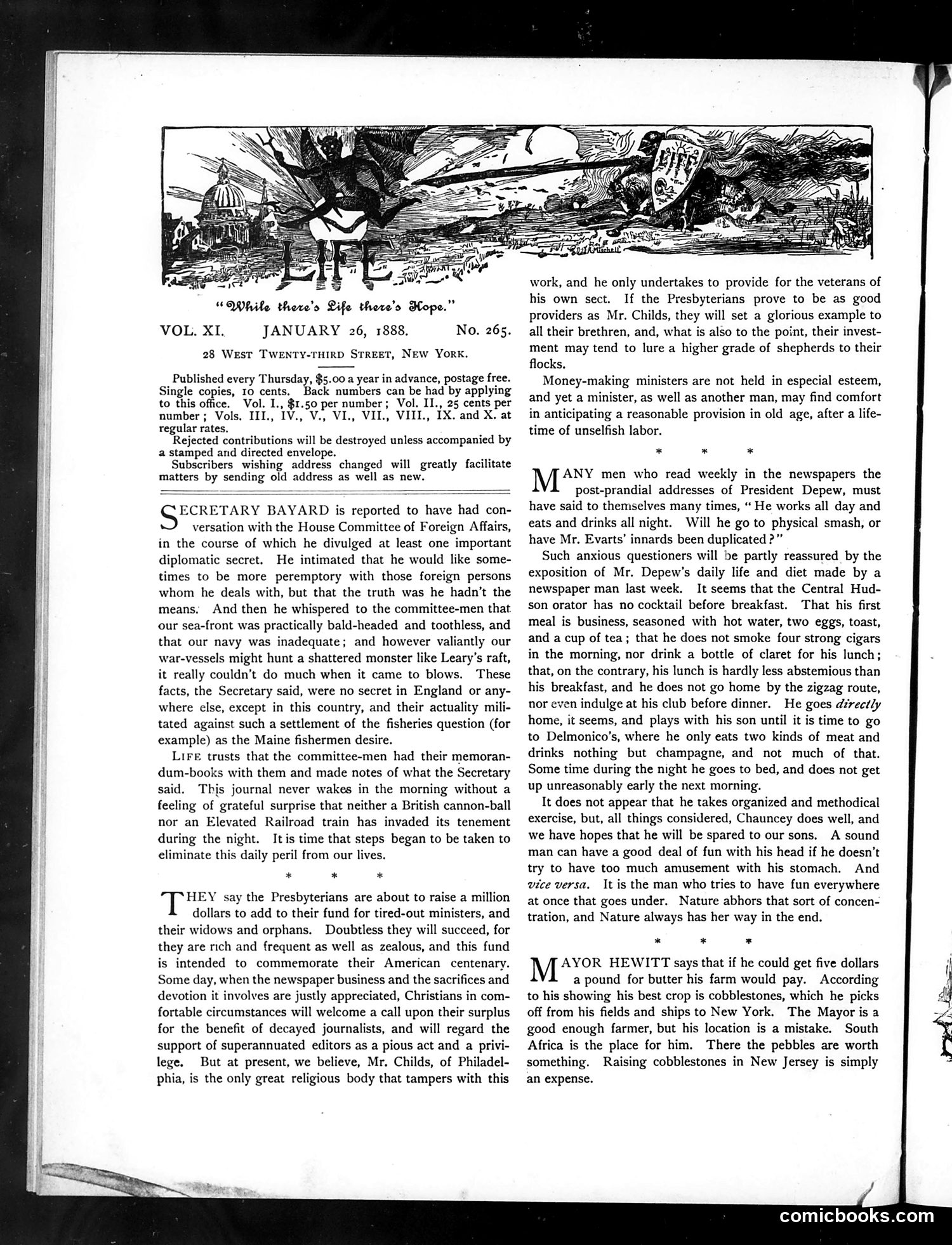
The masthead illustration depicts a figure labeled "Life" with the motto "While there's Life there's 'Scope.'" The image shows a nighttime scene with buildings and landscape, rendered in dramatic woodcut style typical of the era. The text on this page consists of satirical commentary on contemporary figures and issues rather than a traditional political cartoon. Items discuss Secretary Bayard's alleged indiscretion regarding diplomatic secrets, Presbyterian fundraising efforts, and Mayor Hewitt's farming ventures in New Jersey. The satire focuses on criticizing these public figures' judgment and competence in their respective roles, using humor and irony rather than visual caricature. The commentary appears aimed at educated readers familiar with current New York politics and society.
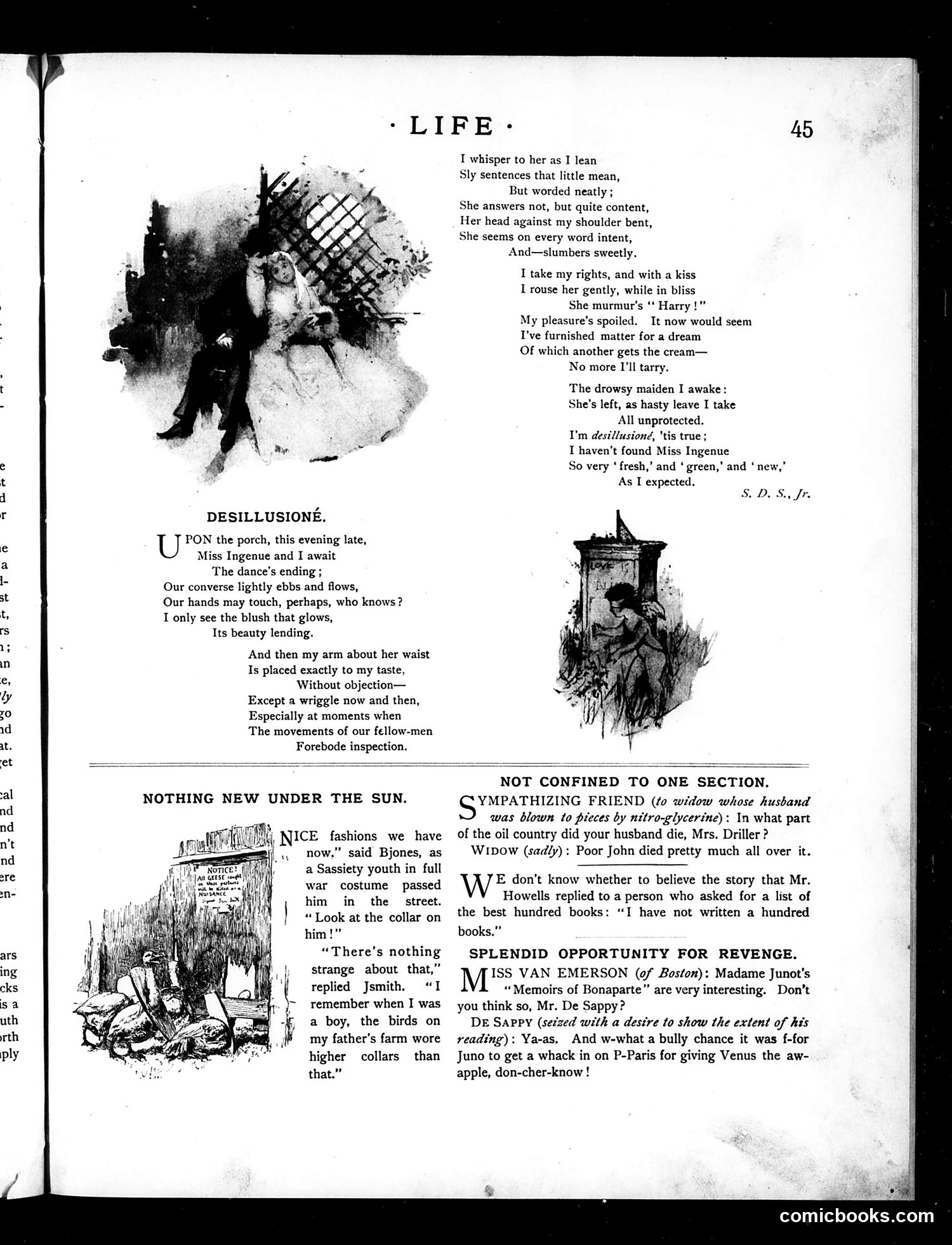
This page contains three distinct sections: **Top:** "Desillusionie," a romantic poem by S.D.S., Jr., accompanied by an illustration of a couple in an intimate moment. The poem describes courtship and disenchantment in love. **Bottom Left:** "Nothing New Under the Sun" features a dialogue between Bjones and Jsmith, two men discussing changing fashion standards. Bjones notes that high collars were fashionable in his youth, while Jsmith observes "There's nothing strange about that"—a commentary on cyclical fashion trends. **Bottom Right:** Brief social humor items including wordplay about a widow, a book review joke about Mr. Howells, and a satirical anecdote about Miss Van Emerson's "Memoirs of Bonaparte," mocking pretentious literary aspirations and vanity publishing. The page's humor targets romantic naïveté, fashion cycles, and literary pretension.
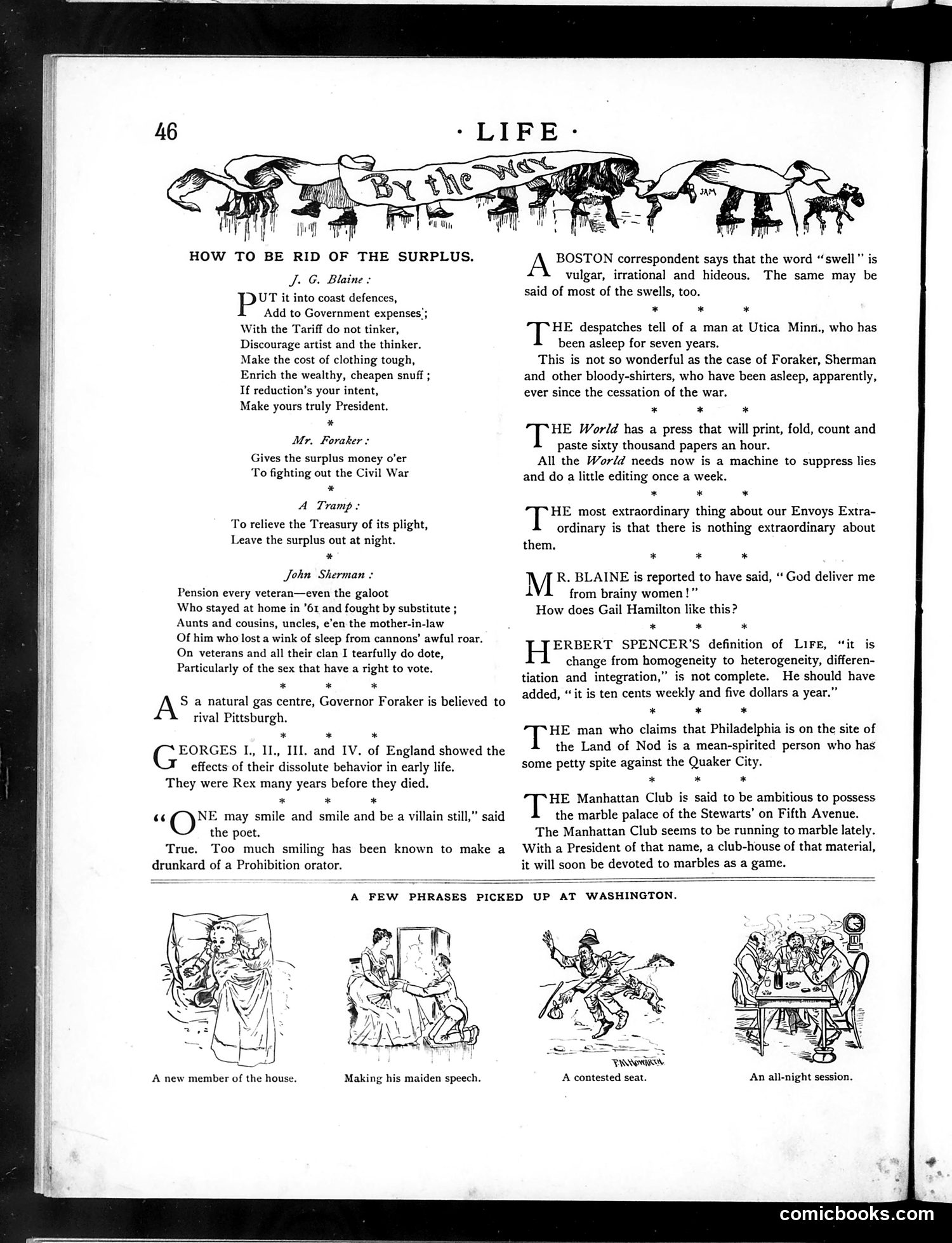
This satirical page critiques post-Civil War fiscal policy. The main section "How to Be Rid of the Surplus" features verse commentary by J.G. Blaine, Mr. Foraker, and John Sherman—likely Republican politicians debating how to spend budget surpluses. Their suggestions range from inflating government expenses to military pensions to relieving the Treasury "at night," satirizing wasteful spending proposals. The right column contains brief social commentary items, including a joke about M.R. Blaine (possibly James G. Blaine) and "brainy women," and criticism of Herbert Spencer's definition of life as incomplete. Below, four small cartoons labeled "A Few Phrases Picked Up at Washington" depict congressional antics: a new representative, maiden speeches, contested seats, and all-night sessions—mocking legislative procedures and partisan behavior.
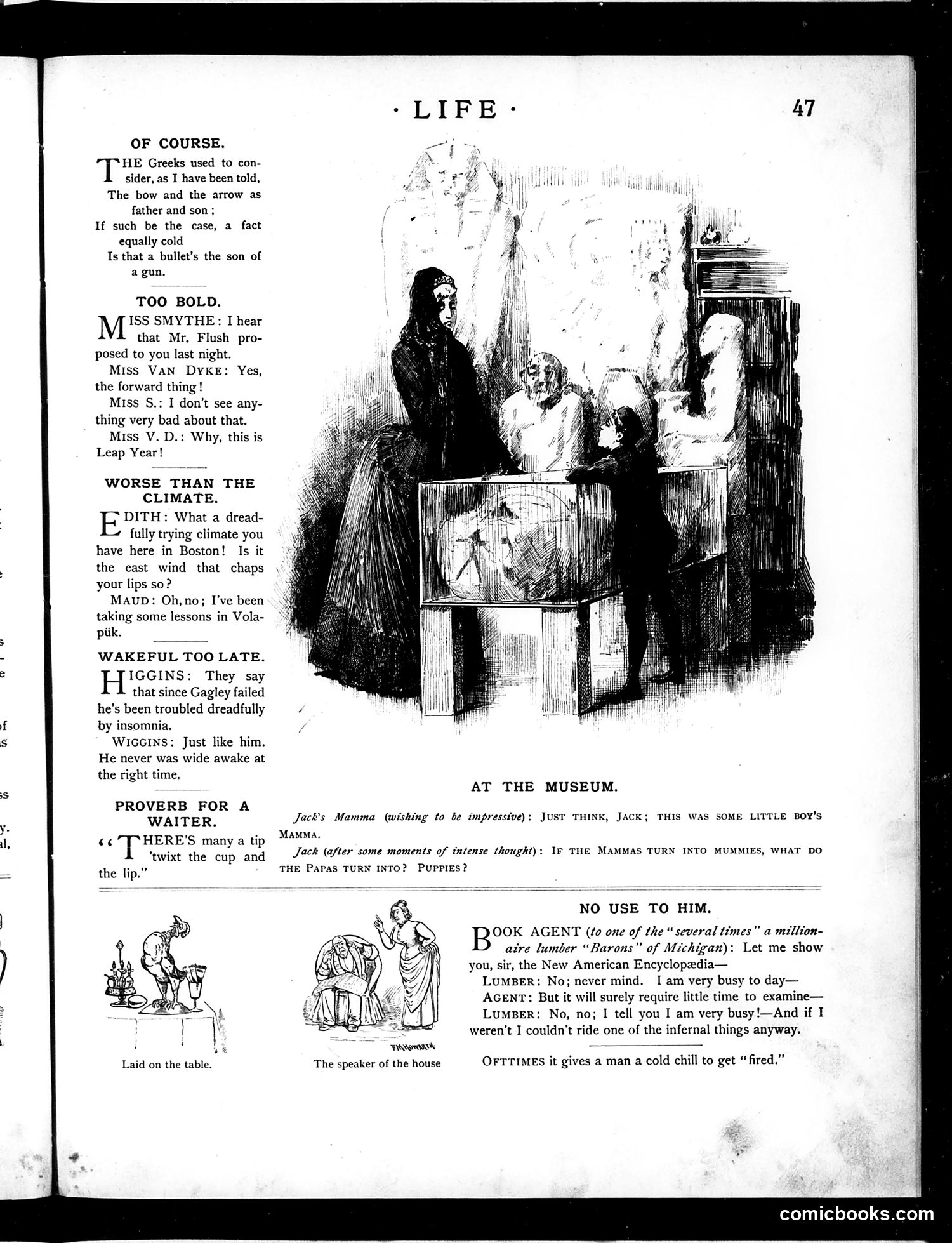
This page contains several brief satirical items typical of Life's humor section: **"At the Museum"** shows visitors at what appears to be a natural history museum examining mummies and papyri. The humor derives from Jack's innocent question: if mummies come from preserved humans, what do papyri become? The joke plays on the child's literalist misunderstanding of the word "papyri" (ancient Egyptian documents made from papyrus plants) as if it were a creature that transforms, like "mummies" do. The other items are brief verbal jokes about Greek philosophy, Boston weather, insomnia, and waiter etiquette—typical ephemeral humor of the period requiring no specific historical context beyond general knowledge of classical topics and domestic situations.
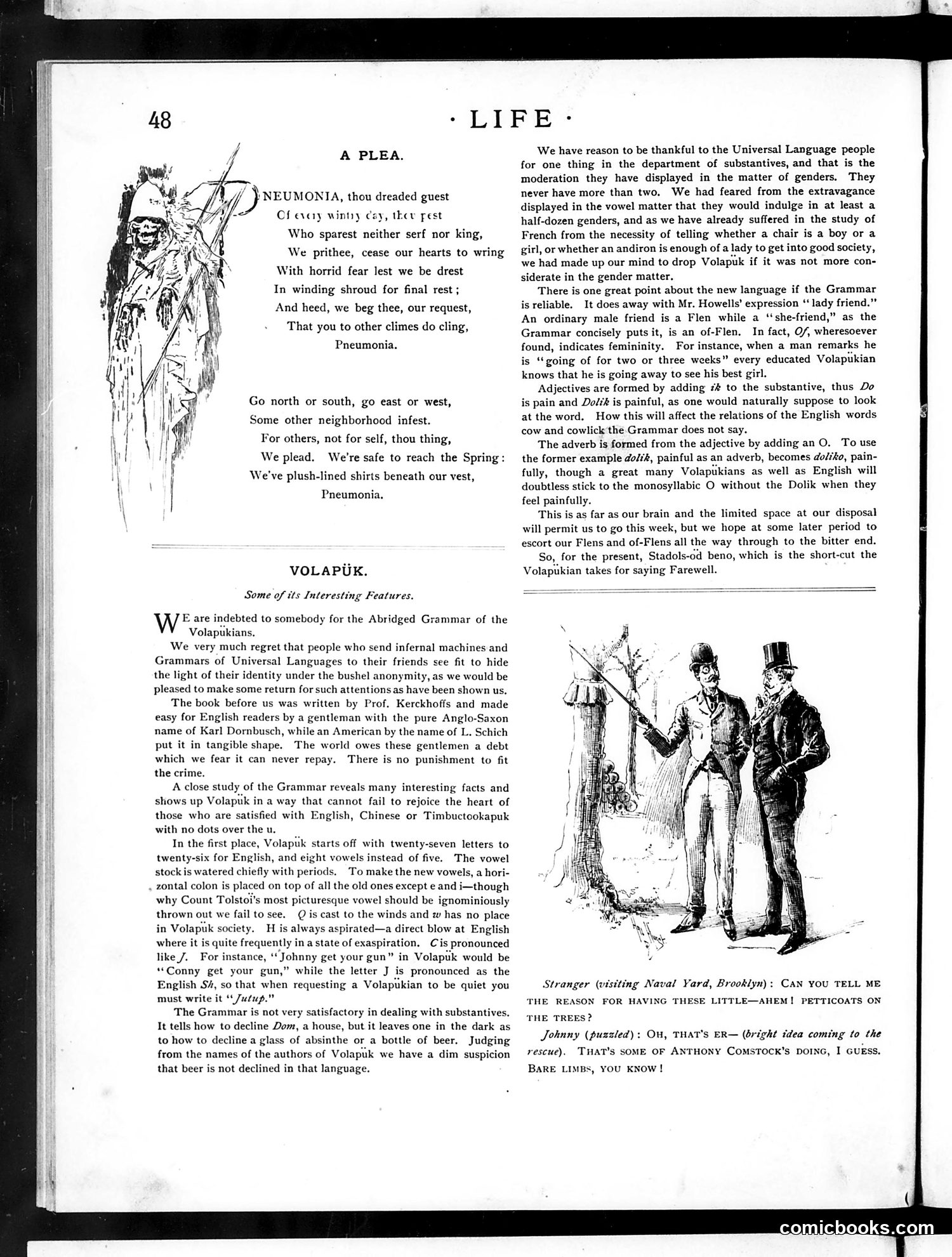
This page contains literary content rather than political cartoons. "A Plea" is a poem addressed to Pneumonia (personified as a skeletal, grim-reaper-like figure shown on the left) requesting the disease spare the speaker until spring arrives. The main section discusses **Volapük**, an artificial universal language created in the 1880s. The text humorously critiques its impracticality—noting it has 27 letters, 8 vowels, and complex grammar rules. The cartoon below shows three men in top hats, apparently representing speakers of different languages attempting communication, illustrating the satire about Volapük's failure as a universal solution to language barriers. The page gently mocks both the pretensions of artificial language creation and linguistic pedantry of the era.
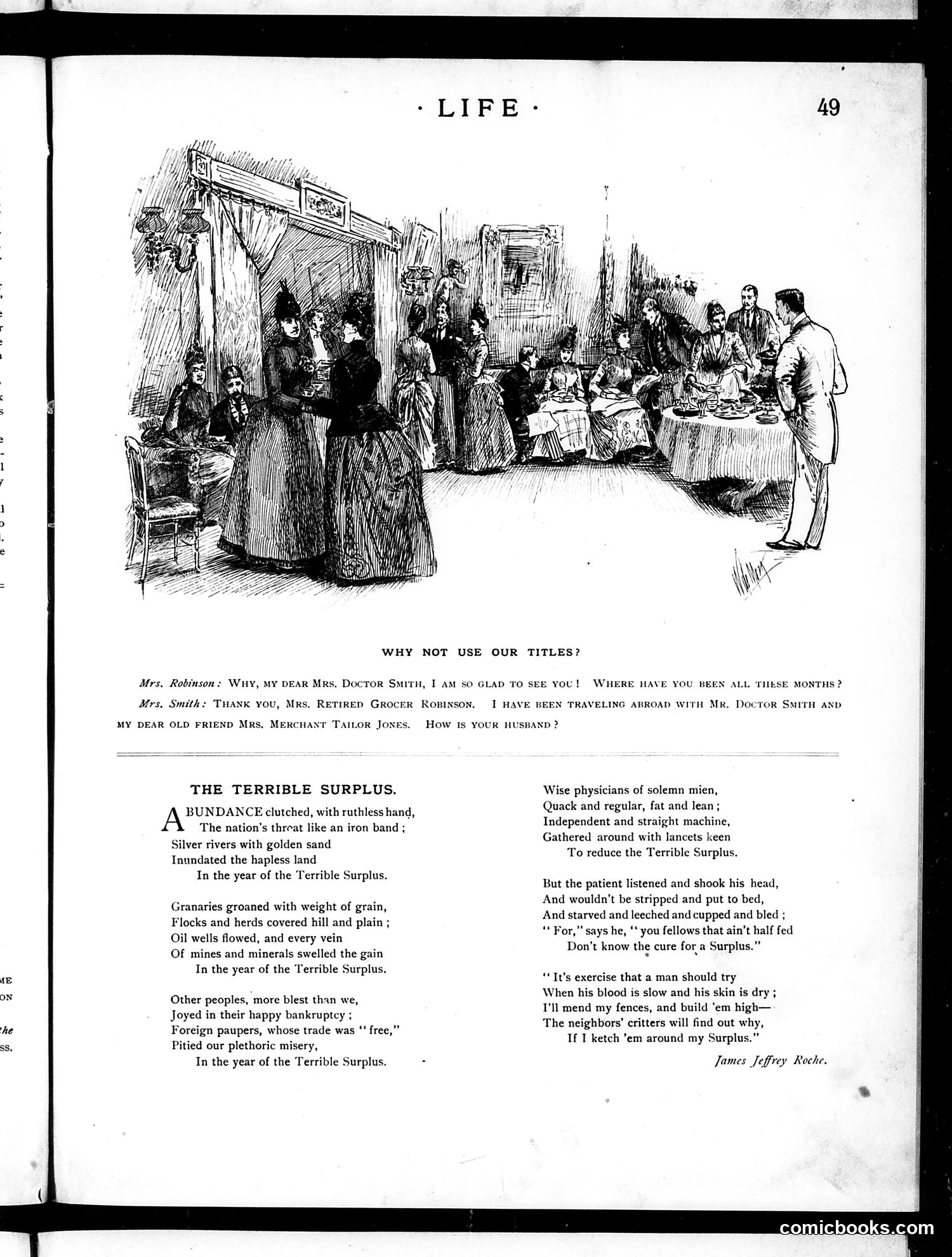
**Top Cartoon ("Why Not Use Our Titles?"):** This satirizes social pretension among the upper classes. Mrs. Robinson addresses "Mrs. Doctor Smith" by her husband's professional title rather than using her own name—a common practice that reduced women to their husbands' identities. Mrs. Smith's response about traveling abroad with "Mr. Doctor Smith" and visiting "Mrs. Merchant Tailor Jones" highlights the absurdity: women are being referred to only through male relations' occupations. The satire critiques how women's social status derived entirely from men, lacking independent identity or recognition. **Bottom Poem ("The Terrible Surplus"):** This addresses economic overproduction during an era of apparent national wealth. Despite abundant resources (grain, oil, minerals), people suffered poverty. A patient refuses medical treatment, saying he cannot afford the "cure for a Surplus"—satirizing how abundance paradoxically coexisted with widespread hardship and economic inequality.
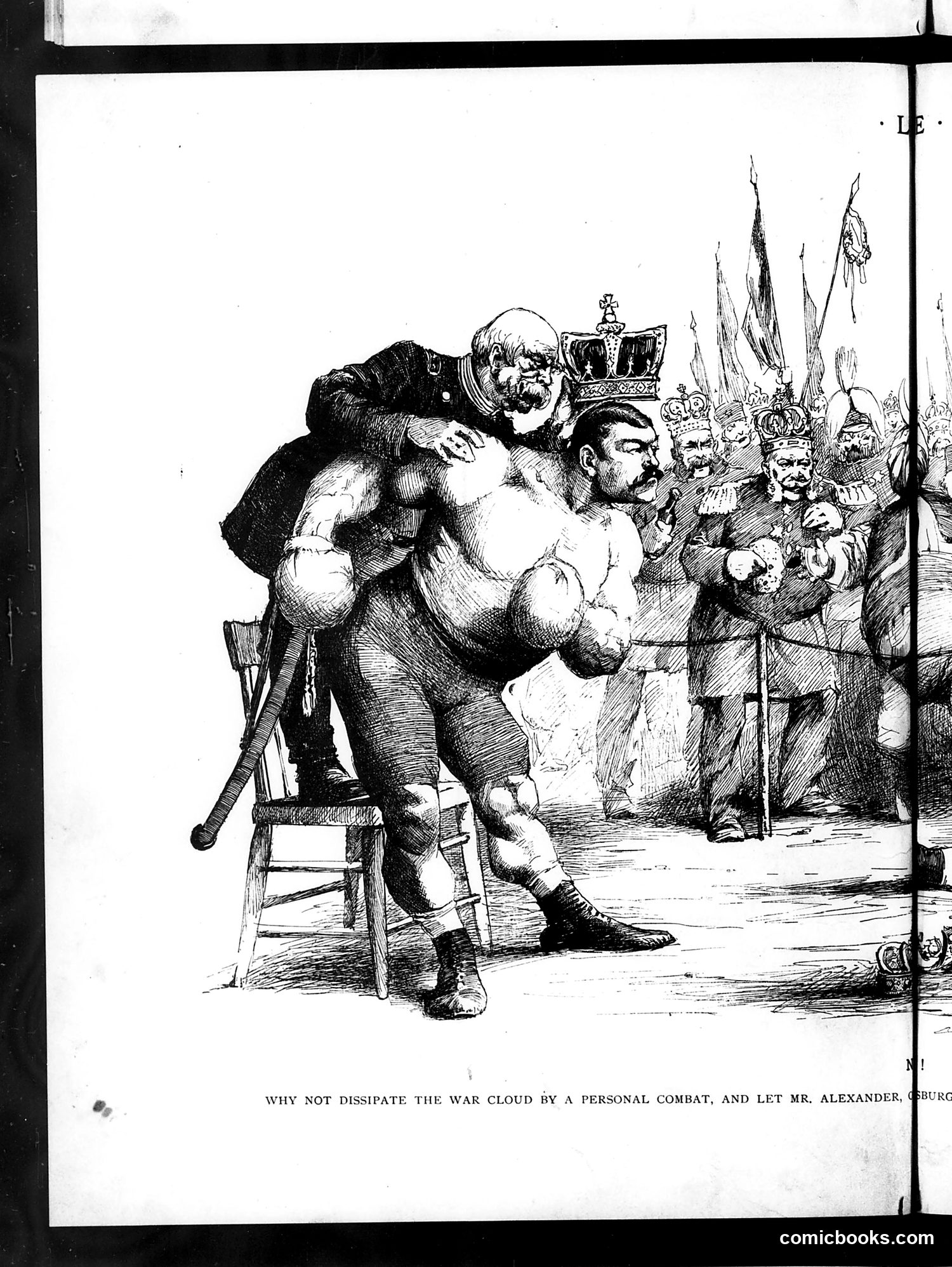
This is a satirical cartoon from *Life* magazine's political section. The caption reads: "WHY NOT DISSIPATE THE WAR CLOUD BY A PERSONAL COMBAT, AND LET MR. ALEXANDER, OF BURG..." (text cuts off). The cartoon depicts a heavily muscled, exaggerated male figure seated and bearing a crown, with what appears to be a military or political figure riding on his shoulders. Behind them stands a formal military/royal court with flags and uniformed officials. The satire suggests resolving international conflict through single combat rather than warfare—a mockery of both militarism and leadership. The reference to "Mr. Alexander, of Burg" appears incomplete, making specific identification difficult, though "Alexander" suggests a European royal or military figure from the early 20th century. The grotesque physique and crowning mock both imperial pretension and brute-force politics.
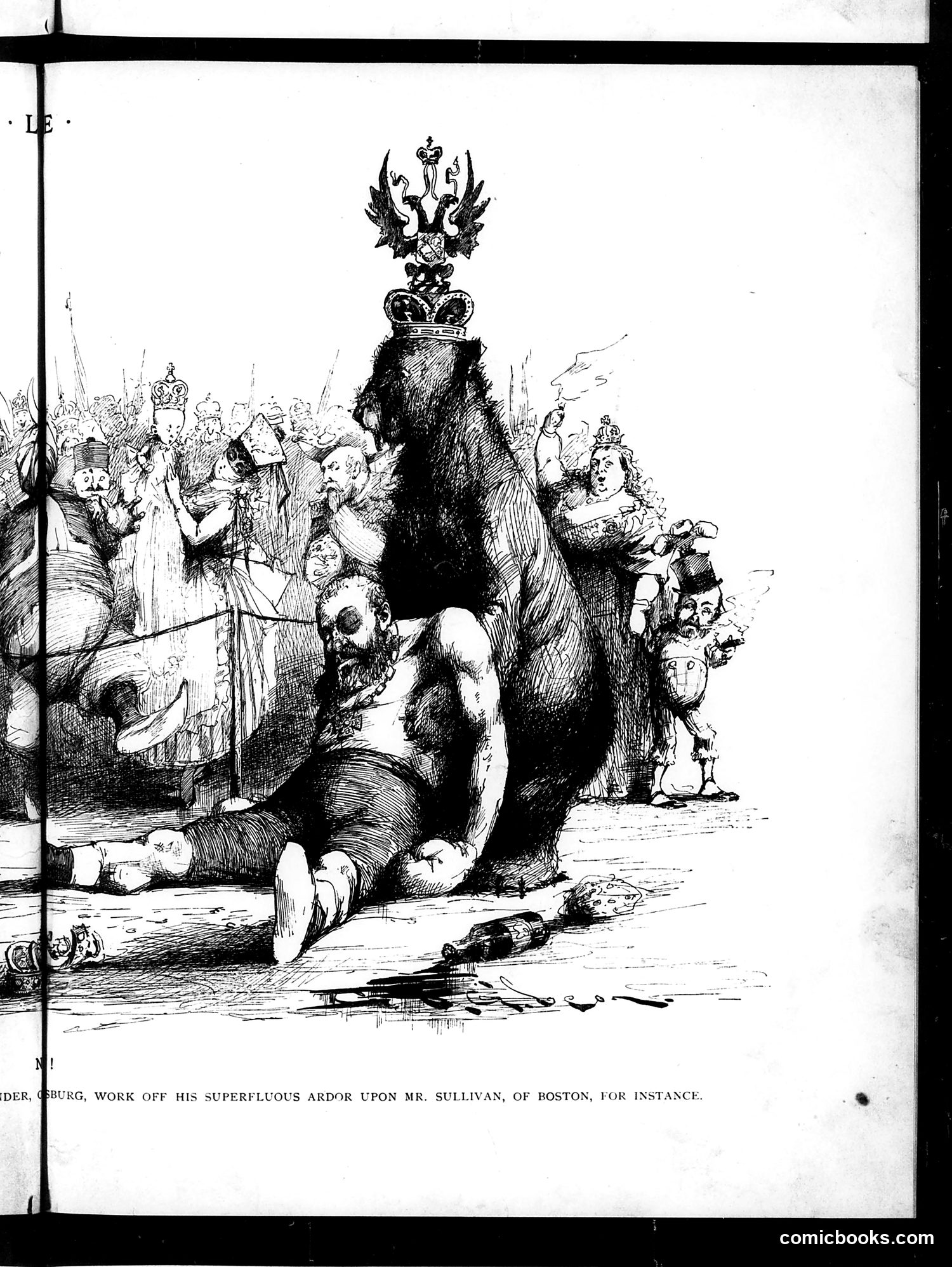
This satirical engraving depicts a bear wearing a crown being presented to or paraded before royalty and nobility. The caption references "UNDER GSBURG, WORK OFF HIS SUPERFLUOUS ARDOR UPON MR. SULLIVAN, OF BOSTON, FOR INSTANCE." The bear appears to represent Russia (a common 19th-century symbol), wearing imperial regalia. The surrounding figures in crowns likely represent European royalty. The cartoon satirizes Russian imperial ambitions or aggression, suggesting Russia should "work off" its excess aggression against American targets like Sullivan of Boston, rather than threatening Europe. This reflects 19th-century anxieties about Russian expansion and imperial competition among world powers. The satire criticizes either Russian belligerence or, conversely, suggests redirecting Russian aggression away from European interests.
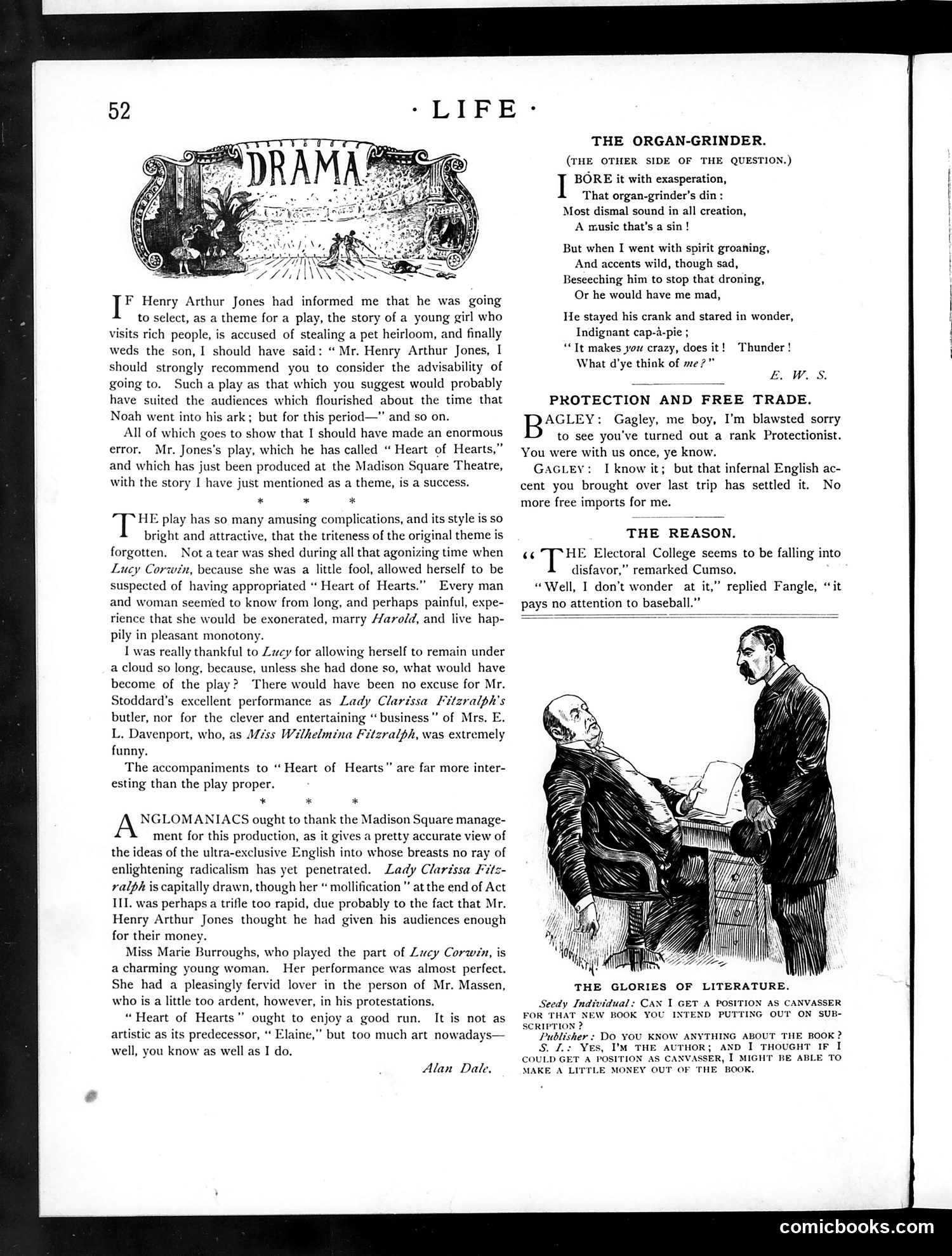
This page contains theater criticism and satirical commentary rather than political cartoons. The main content discusses Henry Arthur Jones's play "Heart of Hearts," with critics debating its artistic merit. The illustration shows two men in conversation—likely representing a publisher and author discussing a new book subscription, based on "The Glories of Literature" section below. The satire targets: - **Anglomaniac exclusivity**: Mocking ultra-exclusive English social circles and their pretensions - **Literary commercialism**: The publisher's question about making money from the subscription reveals tension between art and profit - **Theater criticism standards**: Debating whether "Heart of Hearts" is artistically valid or merely commercially successful The humor hinges on the gap between artistic aspiration and financial reality in Gilded Age publishing and theater.
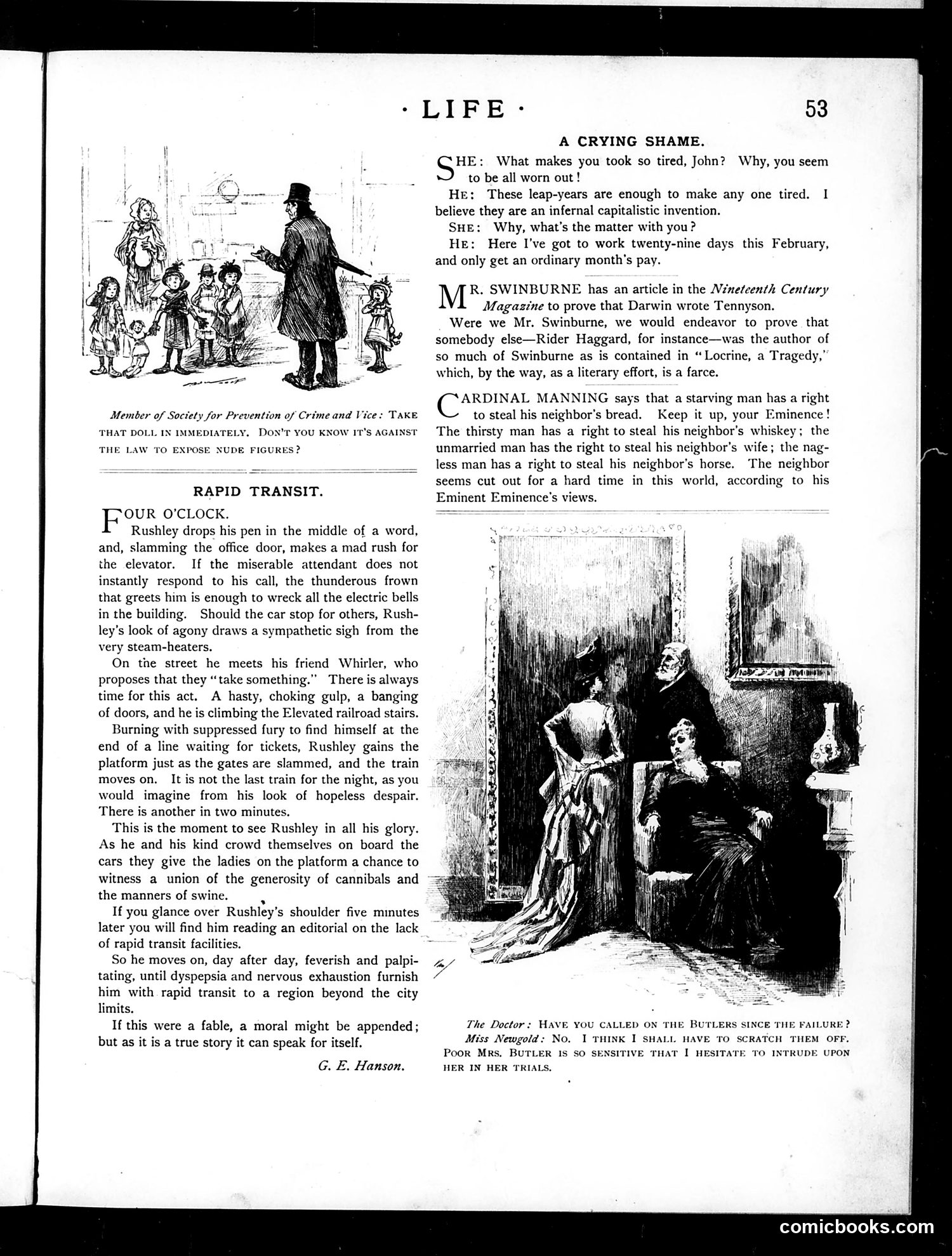
This page contains multiple satirical pieces targeting contemporary issues of the late 19th century: **"A Crying Shame"** mocks leap-year labor practices, where a worker must labor 29 days in February but receives only standard monthly pay—satirizing exploitative employment. **"Rapid Transit"** portrays "Rushley," an impatient businessman whose obsessive rushing through city life (elevators, trains, drinking) ultimately destroys his health, reducing him to "rapid transit to a region beyond the city limits" (death). The satire critiques urban anxiety and workaholism while he hypocritically reads editorials complaining about poor transit. The upper cartoon warns against exposing "nude figures" on dolls—likely satirizing Victorian prudishness. Other sections mock Cardinal Manning's statements about stealing (sardonically extending his logic), and debate whether Darwin or Tennyson wrote which works, questioning literary authorship claims. The illustration shows a domestic scene, likely supporting one of these social commentary pieces.
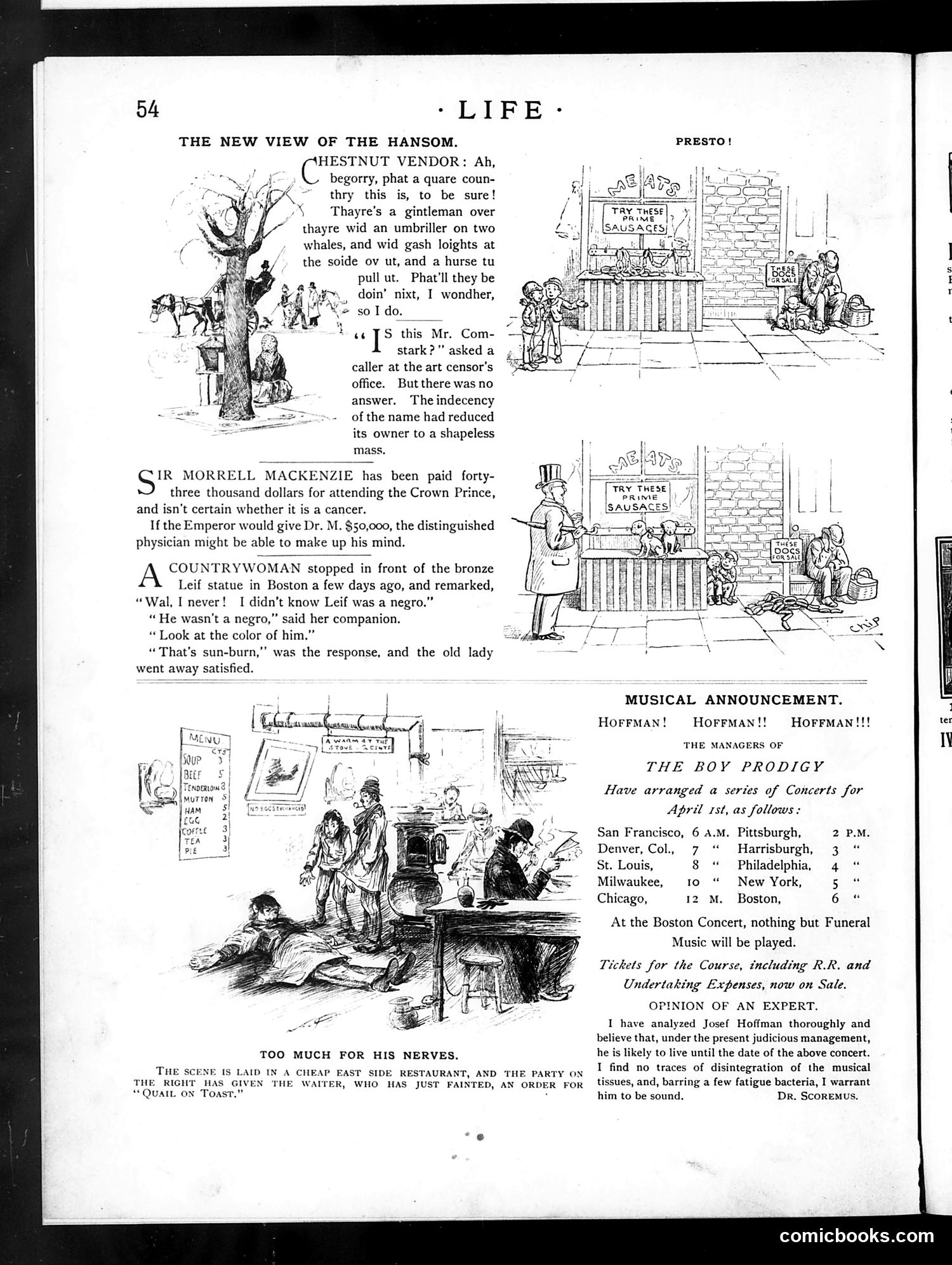
This page contains several brief satirical pieces mocking contemporary figures and social absurdities: **"The New View of the Hansom"** features an Irish chestnut vendor marveling at a two-wheeled hansom cab with gas lights—satirizing the bewilderment of immigrants at modern American conveniences. **The Comstock reference** jokes about Anthony Comstock, the famous (or infamous) art censor who campaigned against obscenity. The satire suggests his crusades have literally reduced him to "a shapeless mass." **"Leif" statue anecdote** ridicules American ignorance: a woman mistakes the bronze Viking statue for a Black man, then accepts "sun-burn" as explanation—mocking racial assumptions and historical illiteracy. **Josef Hoffman concert announcement** is cruel satire about the famous child pianist. The joke: concerts scheduled with "Funeral Music" at Boston, and tickets include "Undertaking Expenses"—implying the child prodigy will be worked to death by his managers. Dr. Scoremus's mock expert opinion darkly predicts Hoffman will "live until" the concert tour ends. The page reflects period anxieties about child labor and entertainment exploitation.
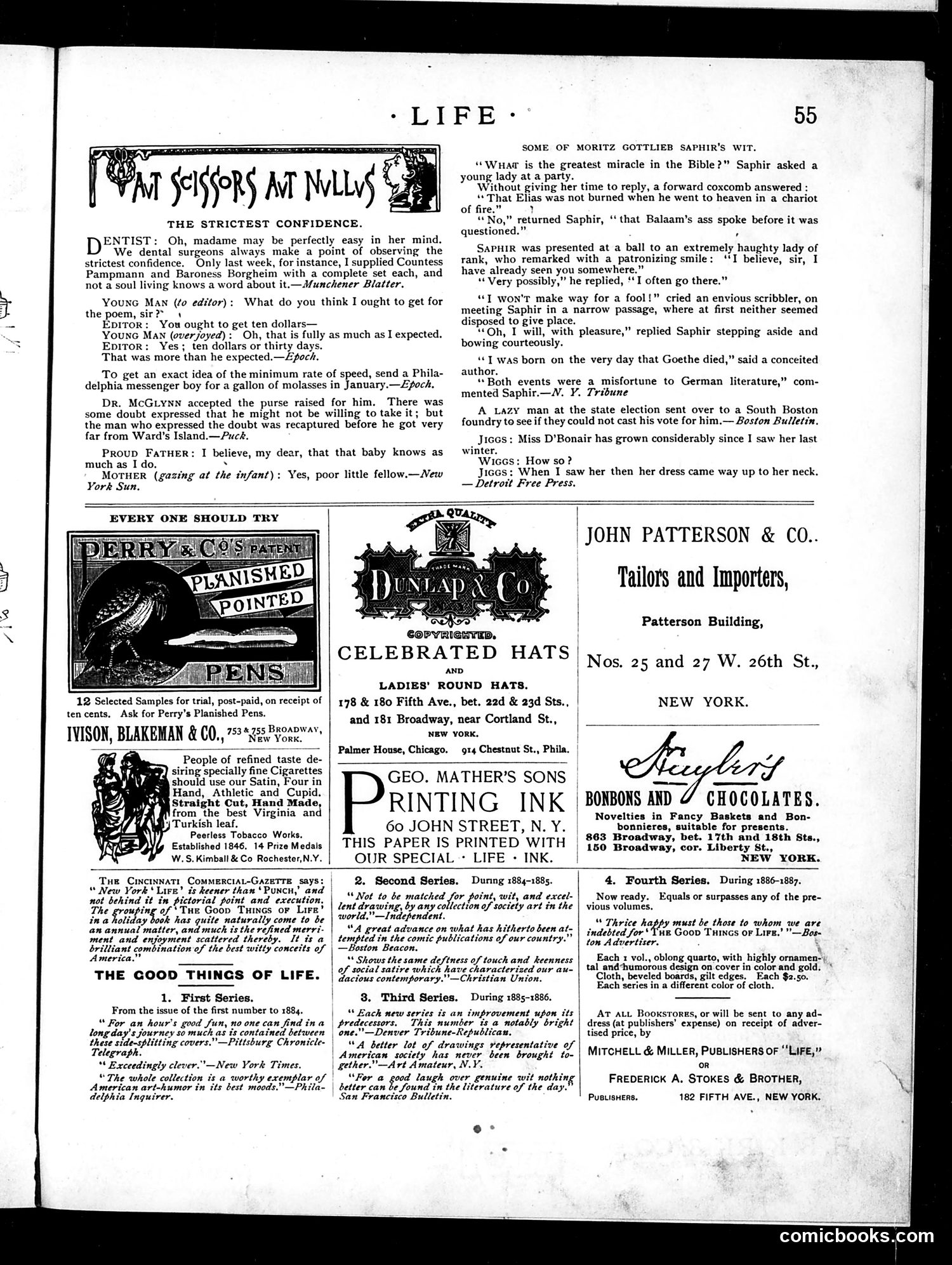
This page is primarily a collection of short humorous anecdotes and advertisements rather than political cartoons. The main content features: **"The Strictest Confidence"** section collects brief jokes from various sources (Münchener Blatter, Epoch, Puck, New York Sun). These include: - A dentist's ironic boast about keeping secrets while gossiping - Wordplay about payment rates and messengers - A joke about Dr. McGlynn (likely the 19th-century Irish-American priest) **"Some of Moritz Gottlieb Saphir's Wit"** reprints witticisms attributed to the 19th-century Austrian humorist, including clever retorts about miracles, social pretension, and authorship. The remaining jokes target lazy men and social awkwardness. **The bottom half is dominated by period advertisements** for hats, pens, printing ink, tailoring, and chocolates—typical commercial content for this era's magazines. No significant political satire appears on this page; it's entertainment and commerce.
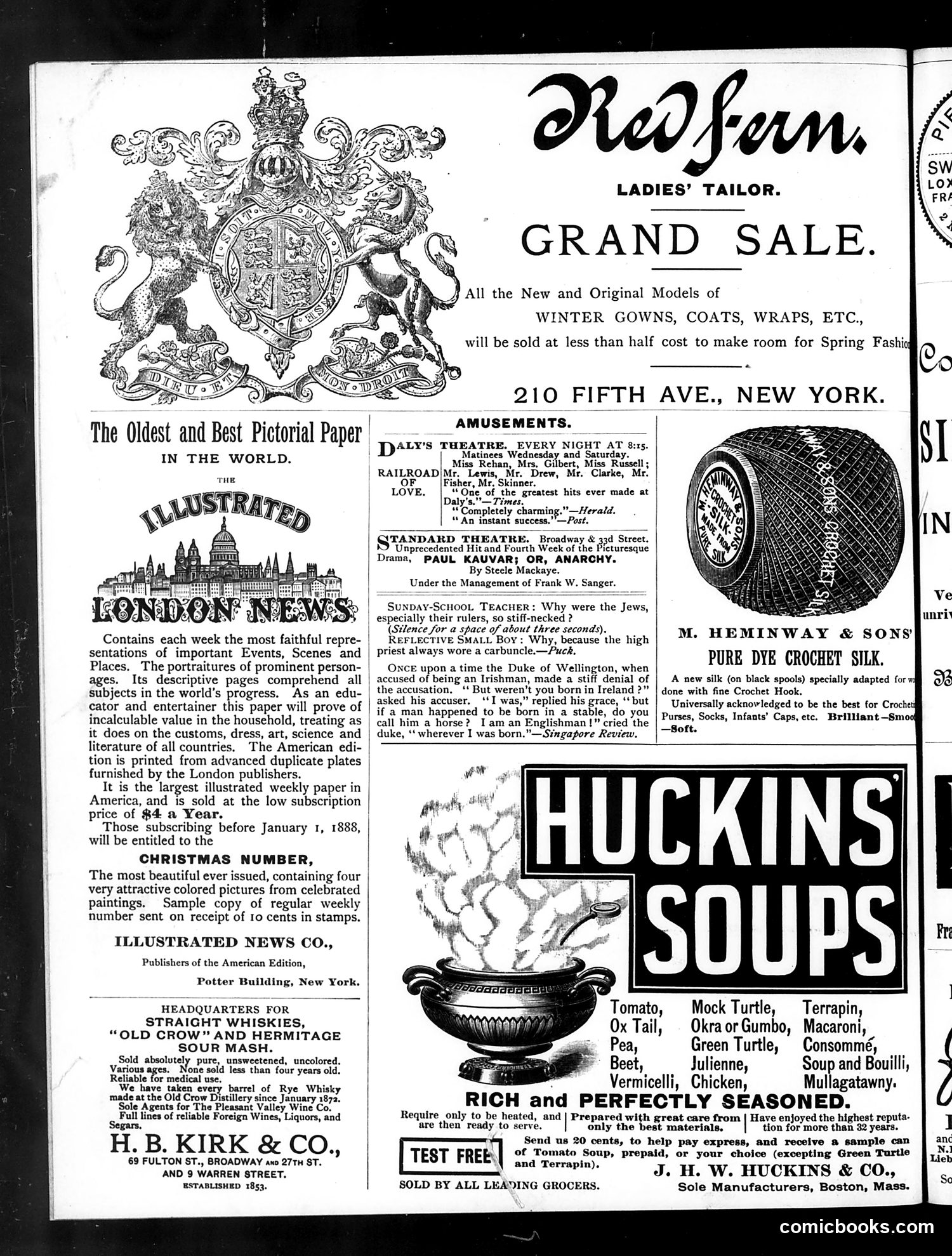
This is primarily an advertising page, not a political cartoon. The page contains several advertisements and amusement listings from what appears to be a late-1880s publication. The main content includes: - An advertisement for *The Illustrated London News* American edition, promoted as "the oldest and best pictorial paper in the world" - Theater listings for *Daily's Theatre* and *Standard Theatre*, advertising productions including what appears to be contemporary plays - Two brief humor items presented as jokes from *Puck* magazine: one about a Sunday school lesson punning on "stiff-necked," another featuring the Duke of Wellington's famous quip about not being Irish (he was born in Dublin but claimed English identity) - Various product advertisements (whiskey, women's clothing, silk thread, soup) The page serves primarily as a commercial vehicle for ads and entertainment listings rather than containing satirical political cartoons or commentary.
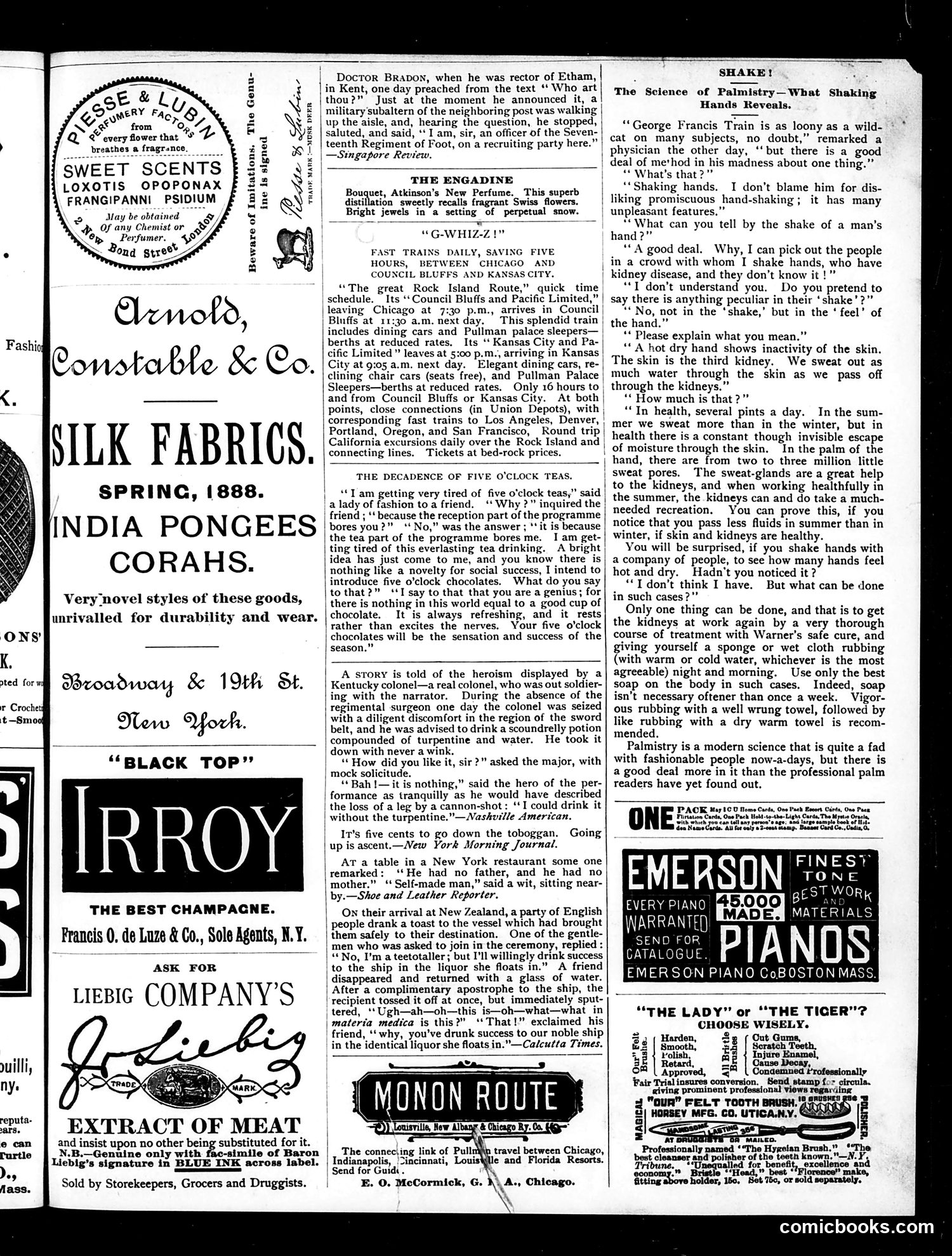
This is primarily a **advertising page** from Life magazine (Spring 1888), not a political cartoon. The page is dominated by commercial advertisements for luxury goods: perfumes (Liebig's Extract of Meat, Liebig Company's products), silk fabrics, champagne, and rail travel. The only satirical content appears in small **anecdotal humor pieces** scattered among the ads: - A joke about a military officer mistakenly answering a rector's sermon question "Who art thou?" - A fashion satire about a society lady tired of five o'clock teas, proposing five o'clock *chocolates* instead as a novelty - An exaggerated tale of a Kentucky colonel heroically drinking turpentine These brief humorous stories mock **upper-class pretensions** and military pomposity—typical Life magazine fare. There are no identifiable political figures or major satirical cartoons visible on this page. It reflects 1880s consumer culture and drawing-room humor for an affluent readership.
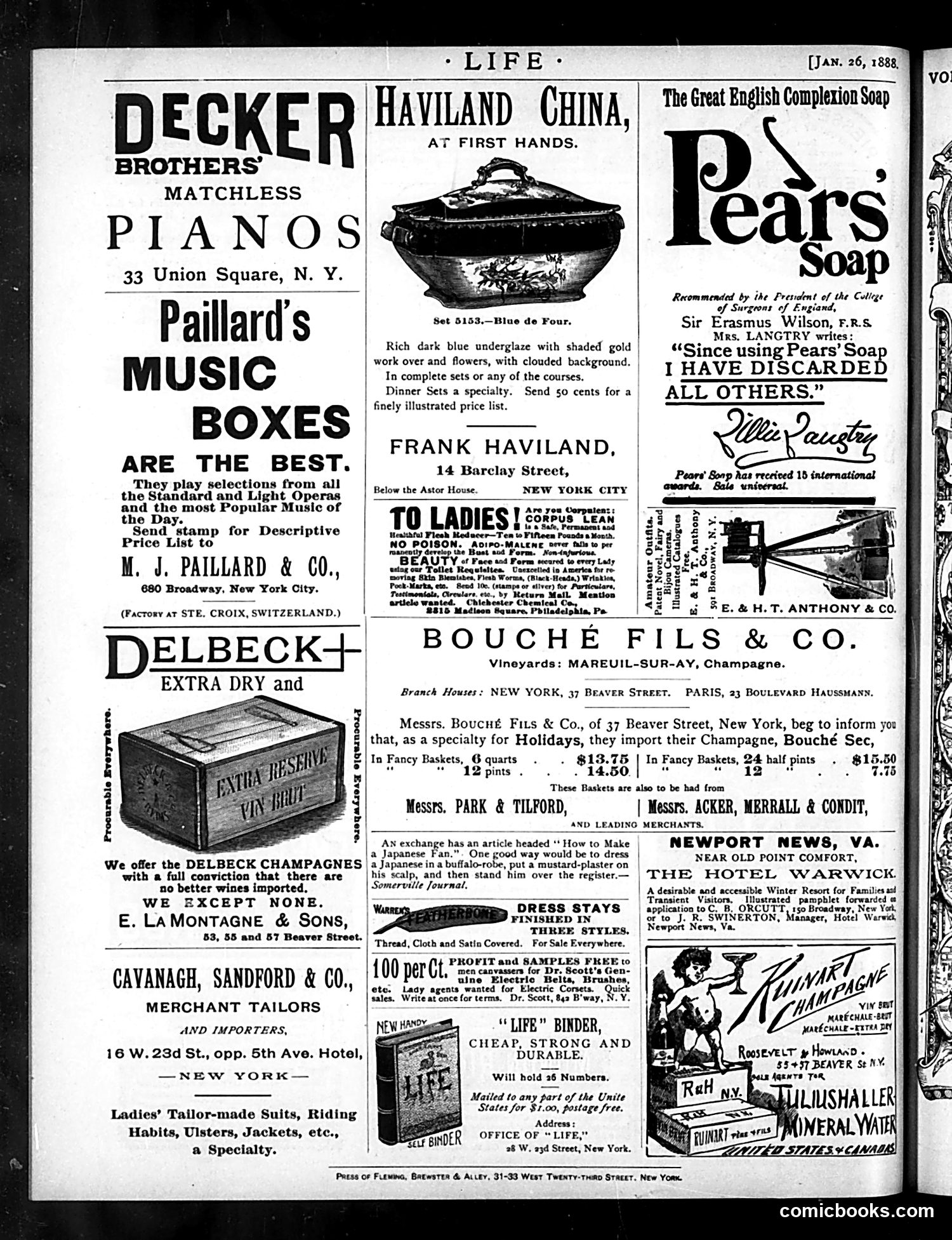
This page is **primarily advertisements** with one brief satirical item embedded among them. The **sole joke/satire** appears in the middle section: "How to Make a Japanese Fan." The text suggests dressing a Japanese person in a buffalo-robe, applying a mustard-plaster to their scalp, and standing them over a heat register—implying they would fan themselves from discomfort. This reflects **late-19th-century racist humor** that treated Asian people as exotic objects for mockery. The rest of the page contains typical Gilded Age luxury advertisements: Decker pianos, Paillard music boxes, Haviland china, Delbeck champagne, Pears' soap (endorsed by actress Lillie Langtry), and various beauty/patent medicine products. Notable is the "Corpus Lean" ad promising to reduce obesity—reflecting period preoccupations with body modification. These advertisements collectively reveal what affluent 1888 readers aspired to: European imports, fine furnishings, and dubious remedies for physical "imperfections."