
Life, 1888-01-26 · page 11 of 16
Life — January 26, 1888 — page 11: what you’re looking at
What you’re looking at
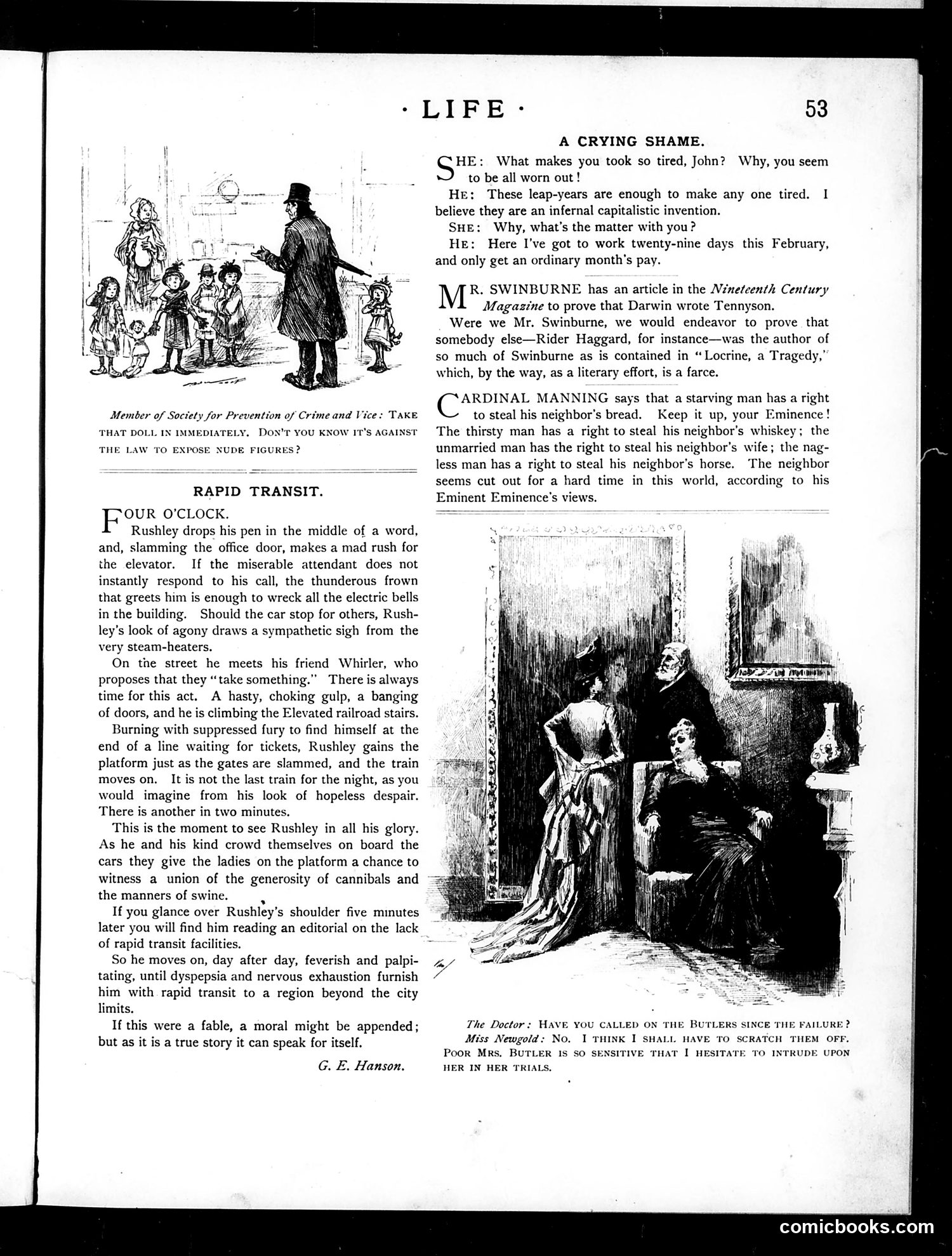
This page contains multiple satirical pieces targeting contemporary issues of the late 19th century: **"A Crying Shame"** mocks leap-year labor practices, where a worker must labor 29 days in February but receives only standard monthly pay—satirizing exploitative employment. **"Rapid Transit"** portrays "Rushley," an impatient businessman whose obsessive rushing through city life (elevators, trains, drinking) ultimately destroys his health, reducing him to "rapid transit to a region beyond the city limits" (death). The satire critiques urban anxiety and workaholism while he hypocritically reads editorials complaining about poor transit. The upper cartoon warns against exposing "nude figures" on dolls—likely satirizing Victorian prudishness. Other sections mock Cardinal Manning's statements about stealing (sardonically extending his logic), and debate whether Darwin or Tennyson wrote which works, questioning literary authorship claims. The illustration shows a domestic scene, likely supporting one of these social commentary pieces.
📄 Transcribed text from this page (OCR, searchable)
Machine-transcribed from the original scan — historical spelling and the odd misread are preserved.
THAT DOLL IN IMMEDIATELY, DON’T YOU KNOW IT'S AGAINST THE LAW TO EXPOSE NUDE FIGURES? RAPID TRANSIT. OUR O'CLOCK. Rushley drops his pen in the middle of a word, and, slamming the office door, makes a mad rush for the elevator. If the miserable attendant does not instantly respond to his call, the thunderous frown that greets him is enough to wreck all the electric bells in the building. Should the car stop for others, Rush- ley’s look of agony draws a sympathetic sigh from the very steam-heaters. On the street he meets his friend Whirler, who proposes that they “take something.” There is always time for this act. A hasty, choking gulp, a banging of doors, and he is climbing the Elevated railroad stairs. Burning with suppressed fury to find himself at the end of a line waiting for tickets, Rushley gains the platform just as the gates are slammed, and the train moves on. It is not the last train for the night, as you would imagine from his look of hopeless despair. There is another in two minutes. This is the moment to see Rushley in all his glory. As he and his kind crowd themselves on board the cars they give the ladies on the platform a chance to witness a union of the generosity of cannibals and the manners of swine. If you glance over Rushley’s shoulder five minutes later you will find him reading an editorial on the lack of rapid transit facilities. So he moves on, day after day, feverish and palpi- tating, until dyspepsia and nervous exhaustion furnish him with rapid transit to a region beyond the city limits. If this were a fable, a moral might be appended; but as it is a true story it can speak for itself. G. E. Hanson. LIFE: 53 A CRYING SHAME. HE: What makes you took so tired, John? to be all worn out! HE: These leap-years are enough to make any one tired. believe they are an infernal capitalistic invention. SHE: Why, what's the matter with you? HE: Here I've got to work twenty-nine days this February, and only get an ordinary month's pay. Why, you seem I R. SWINBURNE has an article in the Nineteenth Century Magazine to prove that Darwin wrote Tennyson. Were we Mr. Swinburne, we would endeavor to prove that somebody else—Rider Haggard, for instance—was the author of so much of Swinburne as is contained in “Locrine, a Tragedy,’ which, by the way, as a literary effort, is a farce. ARDINAL MANNING says that a starving man has a right to steal his neighbor's bread. Keep it up, your Eminence! The thirsty man has a right to steal his neighbor’s whiskey; the unmarried man has the right to steal his neighbor's wife; the nag- less man has a right to steal his neighbor's horse. The neighbor seems cut out for a hard time in this world, according to his Eminent Eminence’s views. Miss Newgold: No. 1 THINK 1 Poor MRS. BUTLER IS SO SENSITIVE HER IN HER TRIALS, . HAVE TO SC! v I HESITA’ U comicbooks.com