
Life, 1888-01-26 · page 6 of 16
Life — January 26, 1888 — page 6: what you’re looking at
What you’re looking at
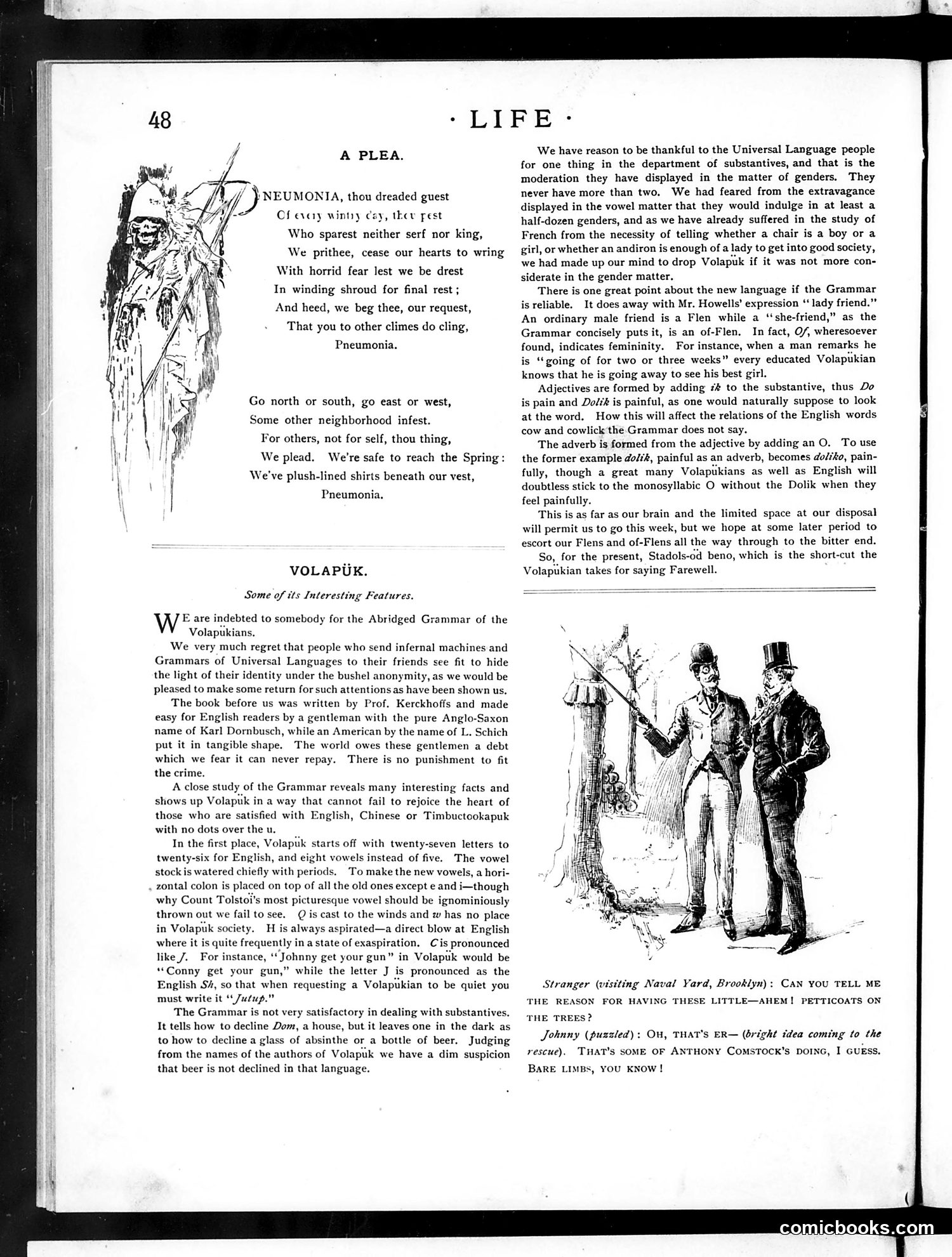
This page contains literary content rather than political cartoons. "A Plea" is a poem addressed to Pneumonia (personified as a skeletal, grim-reaper-like figure shown on the left) requesting the disease spare the speaker until spring arrives. The main section discusses **Volapük**, an artificial universal language created in the 1880s. The text humorously critiques its impracticality—noting it has 27 letters, 8 vowels, and complex grammar rules. The cartoon below shows three men in top hats, apparently representing speakers of different languages attempting communication, illustrating the satire about Volapük's failure as a universal solution to language barriers. The page gently mocks both the pretensions of artificial language creation and linguistic pedantry of the era.
📄 Transcribed text from this page (OCR, searchable)
Machine-transcribed from the original scan — historical spelling and the odd misread are preserved.
LIFE A PLEA. } NEUMONIA, thou dreaded guest Of vay wintry czy, thew pest Who sparest neither serf nor king, We prithee, cease our hearts to wring With horrid fear lest we be drest In winding shroud for final rest ; And heed, we beg thee, our request, ‘That you to other climes do cling, Pneumonia. Go north or south, go east or west, Some other neighborhood infest. For others, not for self, thou thing, We plead. We've plush-lined shirts beneath our vest, We're safe to reach the Spring: Pneumonia. VOLAPUK. Some of its Interesting Features, We are indebted to somebody for the Abridged Grammar of the Volapikians. We very much regret that people who send infernal machines and Grammars of Universal Languages to their friends see fit to hide the light of their identity under the bushel anonymity, as we would be pleased to make some return for such attentions as have been shown us, The book before us was written by Prof. Kerckhoffs and made easy for English readers by a gentleman with the pure Anglo-Saxon name of Karl Dornbusch, while an American by the name of L. Schich put it in tangible shape. The world owes these gentlemen a debt which we fear it can never repay. There is no punishment to fit the crime. A close study of the Grammar reveals many interesting facts and shows up Volapuk in a way that cannot fail to rejoice the heart of those who are satisfied with English, Chinese or Timbuctookapuk with no dots over the u. In the first place, Volapiik starts off with twenty-seven letters to twenty-six for English, and eight vowels instead of five. The vowel stock is watered chiefly with periods, To make the new vowels, a hori- . zontal colon is placed on top of all the old ones except e and i—though why Count Tolstoi’s most picturesque vowel should be ignominiously thrown out we fail to see. Q is cast to the winds and w has no place in Volapuk society. H is always aspirated—a direct blow at English where it is quite frequently in a state of exaspiration. Cis pronounced like J. For instance, “Johnny get your gun” in Volapuk would be “Conny get your gun,” while the letter J is pronounced as the English S/, so that when requesting a Volapukian to be quiet you must write it “Juup." ‘The Grammar is not very satisfactory in dealing with substantives. It tells how to decline Dom, a house, but it leaves one in the dark as to how to decline a glass of absinthe or a bottle of beer. Judging from the names of the authors of Volapuk we have a dim suspicion that beer is not declined in that language. We have reason to be thankful to the Universal Language people for one thing in the department of substantives, and that is the moderation they have displayed in the matter of genders. They never have more than two. We had feared from the extravagance displayed in the vowel matter that they would indulge in at least a half-dozen genders, and as we have already suffered in the study of French from the necessity of telling whether a chair is a boy or a girl, or whether an andiron is enough of a lady to get into good society, we had made up our mind to drop Volapuk if it was not more con- siderate in the gender matter. ‘There is one great point about the new language if the Grammar is reliable. It does away with Mr. Howells’ expression ‘lady friend.” An ordinary male friend is a Flen while a ‘“‘she-friend,” as the Grammar concisely puts it, is an of-Flen. In fact, Q/, wheresoever found, indicates femininity. For instance, when a man remarks he is ‘going of for two or three weeks” every educated Volapukian knows that he is going away to see his best girl. Adjectives are formed by adding # to the substantive, thus Do is pain and Do/té is painful, as one would naturally suppose to look at the word. How this will affect the relations of the English words cow and cowlick the Grammar does not say. The adverb is formed from the adjective by adding an O. To use the former example do/i, painful as an adverb, becomes do/iko, pain- fully, though a great many Volapukians as well as English will doubtless stick to the monosyllabic O without the Dolik when they feel painfully. This is as far as our brain and the limited space at our disposal will permit us to go this week, but we hope at some later period to escort our Flens and of-Flens all the way through to the bitter end. So, for the present, Stadols-od beno, which is the short-cut the Volapukian takes for saying Farewell. Stranger (visiting Naval Yard, Brooklyn): CAN YOU TELL ME THE REASON FOR HAVING THESE LITTLE—AHEM! PETTICOATS ON THE TREES? Johnny (puzzled) : rescue). Ou, THAT's ER— (bright idea coming to the Tuat’s SOME OF ANTHONY ComsTOck’s DOING, I GUESS, BARE LIMBS, You KNOW!