
A complete issue · 16 pages · 1888
Life — January 12, 1888
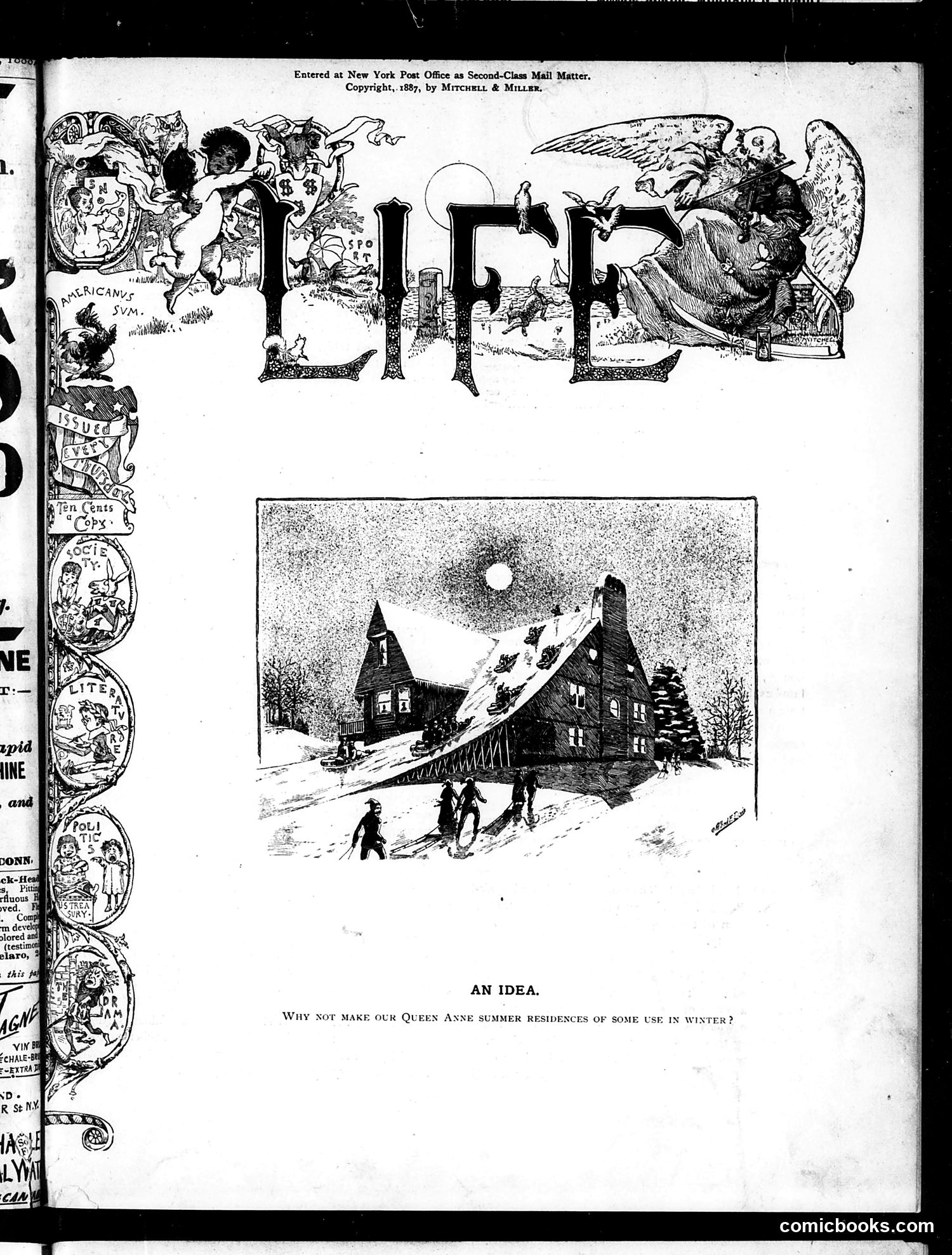
This page features the magazine's ornate title treatment with decorative classical and allegorical figures. Below is a winter scene illustration accompanying the text "AN IDEA: Why not make our Queens Anne summer residences of some use in winter?" The satire targets the architectural fashion of Queen Anne-style houses, which were popular as seasonal summer residences among wealthy Americans. The cartoon proposes a humorous solution: convert these unused winter structures into functional buildings. The point appears to be social commentary on the wastefulness of wealthy estates that sit vacant during cold months—suggesting these elaborate homes should serve practical purposes year-round rather than standing idle as seasonal playthings. The illustration's snowy cottage scene reinforces this practical winter-use concept.
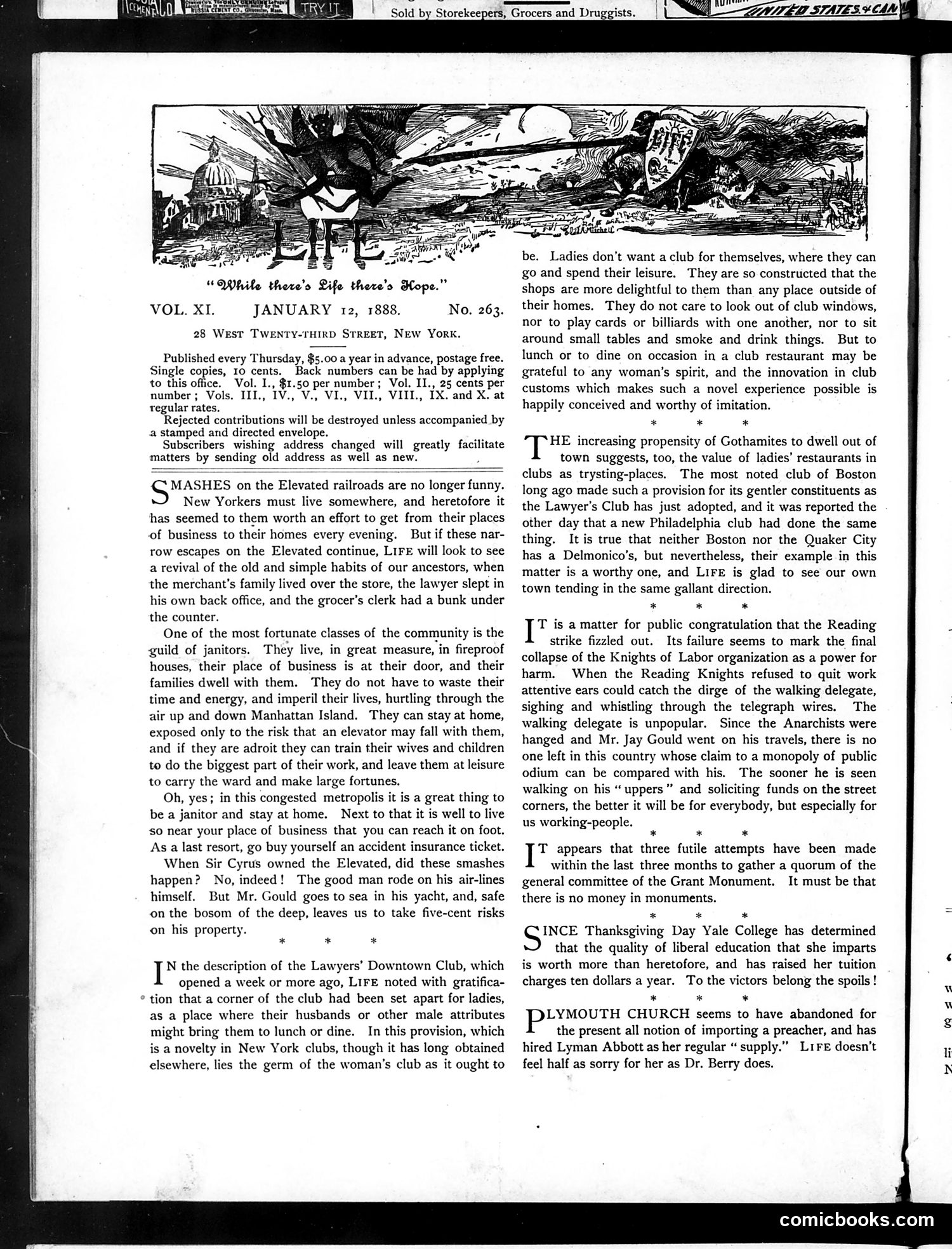
The masthead cartoon titled "While there's Life there's Hope" depicts a chaotic apocalyptic scene with destruction and turmoil—likely satirizing contemporary social anxieties or political upheaval of the 1888 era. The editorial text addresses multiple social issues: elevated railroad congestion in New York, the emerging phenomenon of women's clubs and ladies' restaurants (noting Boston's "Lawyer's Club"), the Reading railroad strike's collapse, attempts to fund a Grant Monument, Yale College's tuition increases, and Plymouth Church's hiring of preacher Lyman Abbott. The satire targets both institutional failures and social changes—particularly women's increasing independence through clubs—while defending working-class concerns. The tone suggests criticism of wealthy institutions prioritizing themselves over public welfare.
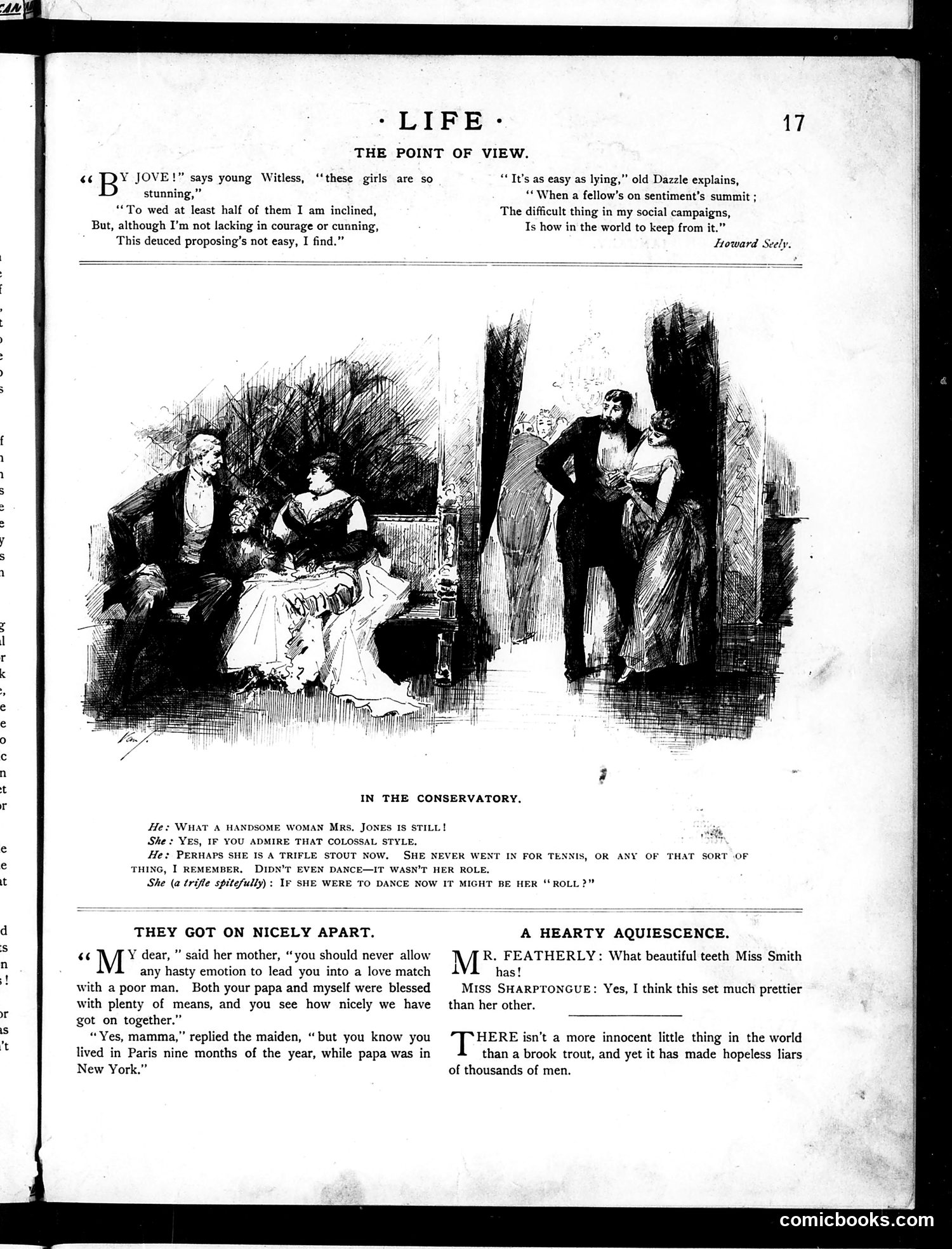
This page satirizes Victorian courtship and marriage conventions through three titled sections: **"The Point of View"** quotes young Witless expressing reluctance about proposing to "these girls," suggesting anxiety about marriage commitment despite social pressure. **"In the Conservatory"** depicts a flirtation scene where a woman's attractiveness is debated. The dialogue mocks the superficiality of social interaction—notably that she "never went in for tennis" or dancing, questioning what her actual role or value might be. **"They Got On Nicely Apart"** and **"A Hearty Acquiescence"** satirize class-conscious matchmaking, where parents approve unions based on financial compatibility rather than affection, and where women's agency is limited to accepting parental decisions. The satire targets rigid Victorian social hierarchies, shallow romantic conventions, and women's subordinate position in marriage negotiations.
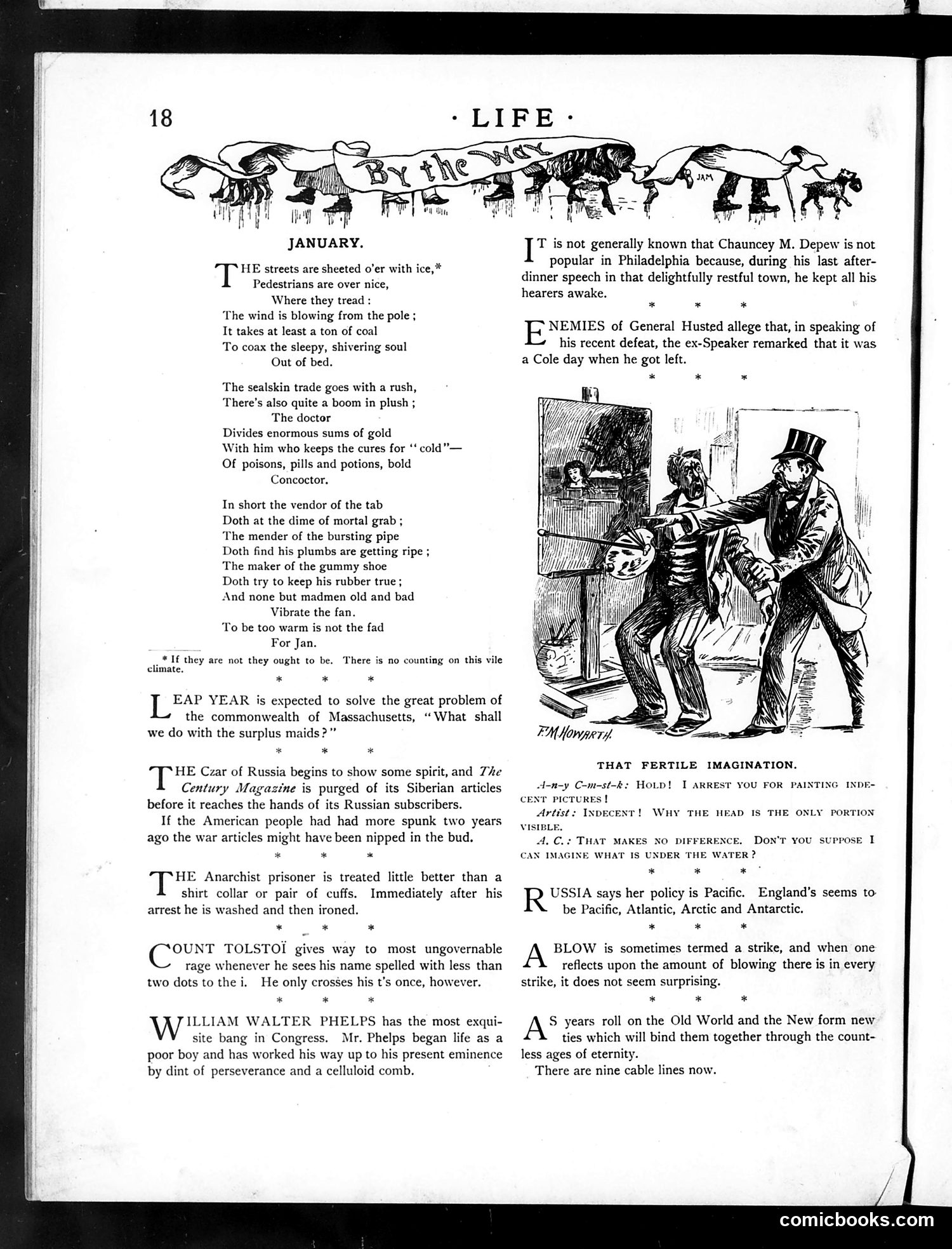
The cartoon depicts an artist showing indecent pictures to a shocked gentleman in a top hat. The dialogue satirizes artistic pretension: the artist claims the pictures are "innocent," arguing the viewer's mind supplies the indecency—that imagination, not the artwork itself, is "fertile" (productive of impropriety). This mocks a common defense of controversial art: that obscenity lies in the viewer's interpretation, not the creator's intent. The well-dressed gentleman's horrified reaction suggests the cartoonist skeptically questions whether such claims genuinely excuse crude or suggestive artwork. The satire targets both artists seeking to evade censorship through philosophical arguments and viewers expected to accept these justifications without complaint.
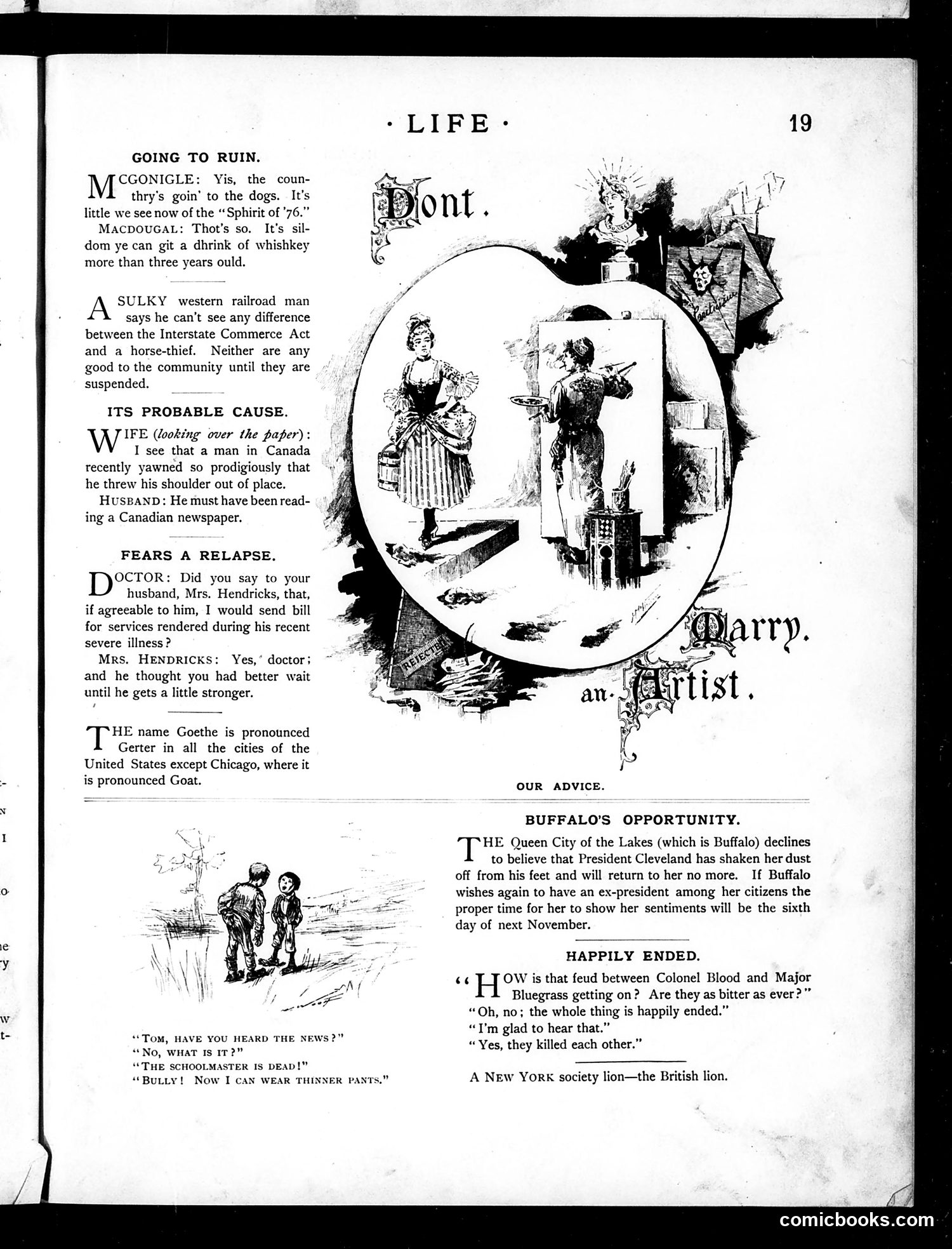
This page contains several brief satirical items typical of Life's humor section: **"Don't Marry an Artist"** (central illustration): Shows a woman contemplating marriage to an artist. The satire appears to warn against marrying creative types—likely commenting on artists' unstable finances or impractical lifestyles, common targets of period humor. **"Buffalo's Opportunity"** mocks President Cleveland's rumored departure from office, suggesting Buffalo (his hometown) should capitalize on his absence. **"Happily Ended"** jokes about a feud between Colonel Blood and Major Bluegrass supposedly resolved by mutual killing. **"A New York Society Lion"**: References the British lion, likely satirizing wealthy New Yorkers' pretensions. The page exemplifies Life's style: short, punchy jokes on social topics, politics, and contemporary figures, with accompanying illustrations.
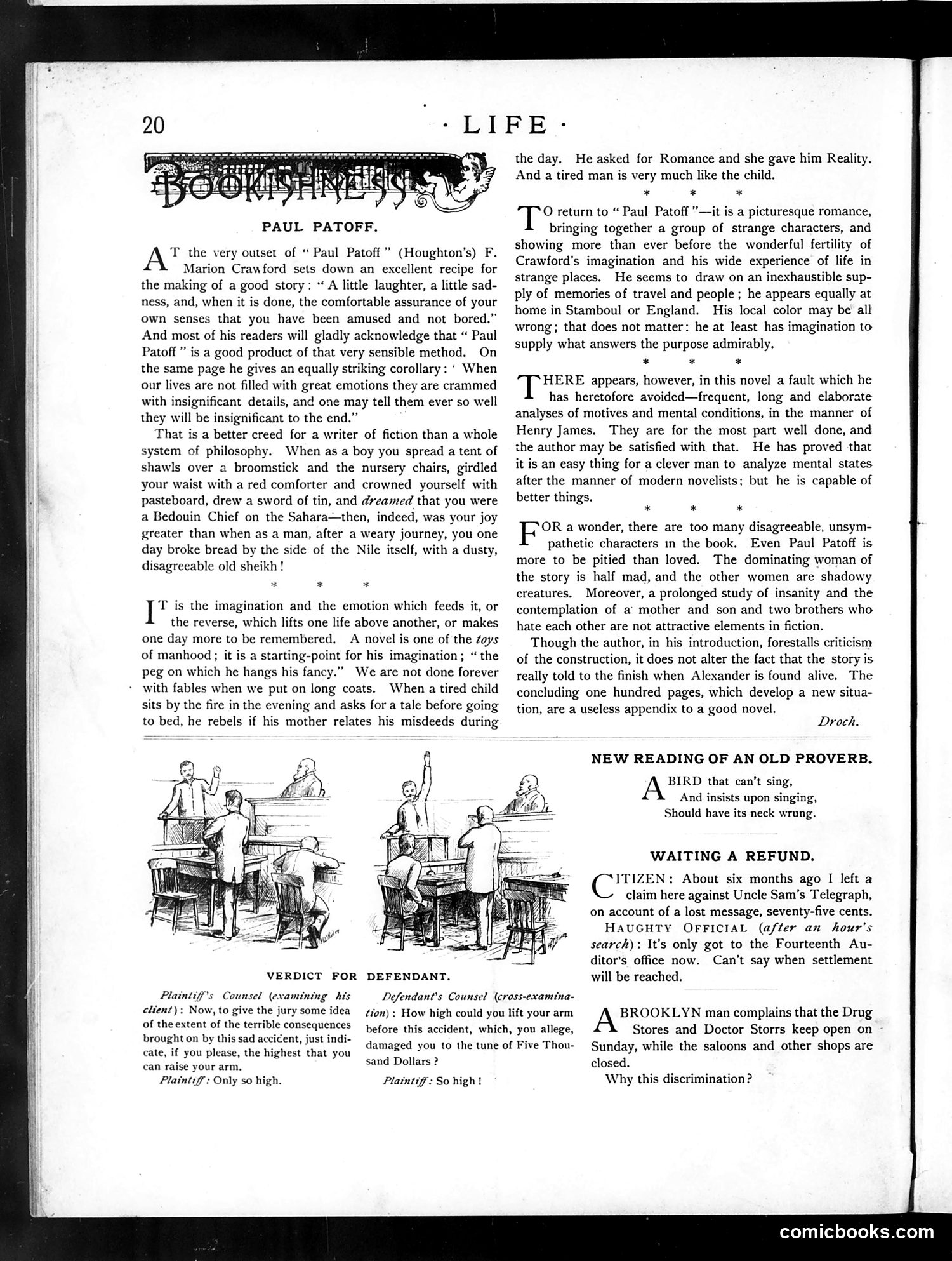
This page contains a courtroom humor cartoon depicting a legal proceeding. The illustration shows two lawyers addressing a jury about a personal injury case involving a plaintiff who allegedly suffered arm damage worth $5,000. The satire targets the absurdity of lawsuit testimony and jury deliberation. The plaintiff's counsel makes an exaggerated emotional appeal about damages, while the defendant's counsel questions the credibility of the injury claim with a simple factual challenge: "How high could you lift your arm before this accident?" The joke hinges on the contrast between theatrical legal argumentation and straightforward cross-examination that exposes inconsistencies. The cartoon mocks both the plaintiff's inflated damage claims and the performative nature of courtroom rhetoric in early 20th-century America.
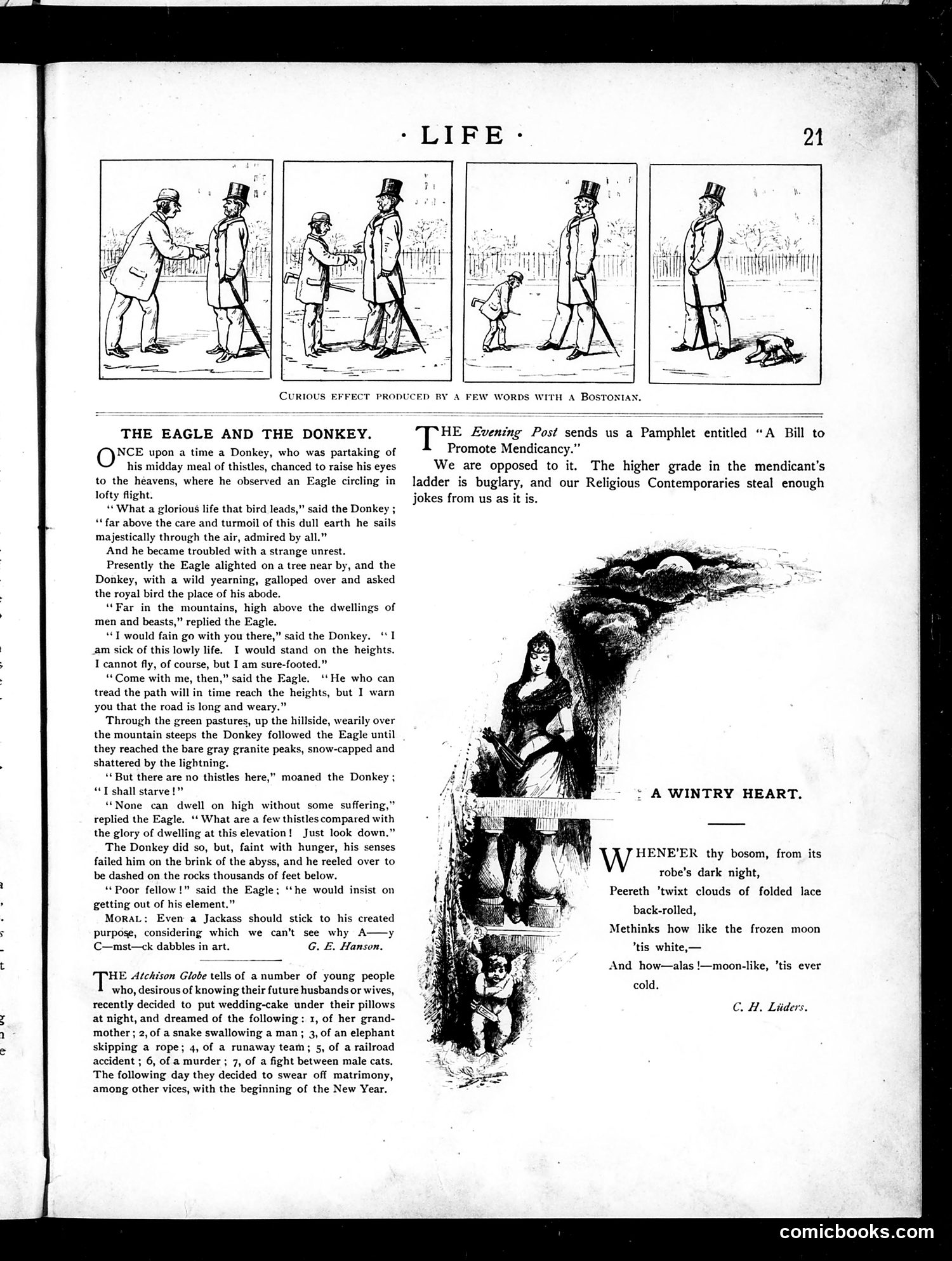
The top cartoon, "Curious Effect Produced by a Few Words with a Bostonian," shows a four-panel sequence where a man in a top hat progressively shrinks after conversing with another well-dressed gentleman. This satirizes Bostonians' reputation for intellectual superiority and cutting remarks—suggesting that interaction with a Boston native literally diminishes one's stature through verbal wit or condescension. "The Eagle and the Donkey" is a fable where a donkey admires an eagle's lofty existence but cannot endure the hardship of mountain life, ultimately plummeting to his death. This likely satirizes social ambition and the gap between aspiring to higher status and managing its actual demands. The remaining content includes poetry and unrelated editorial material.
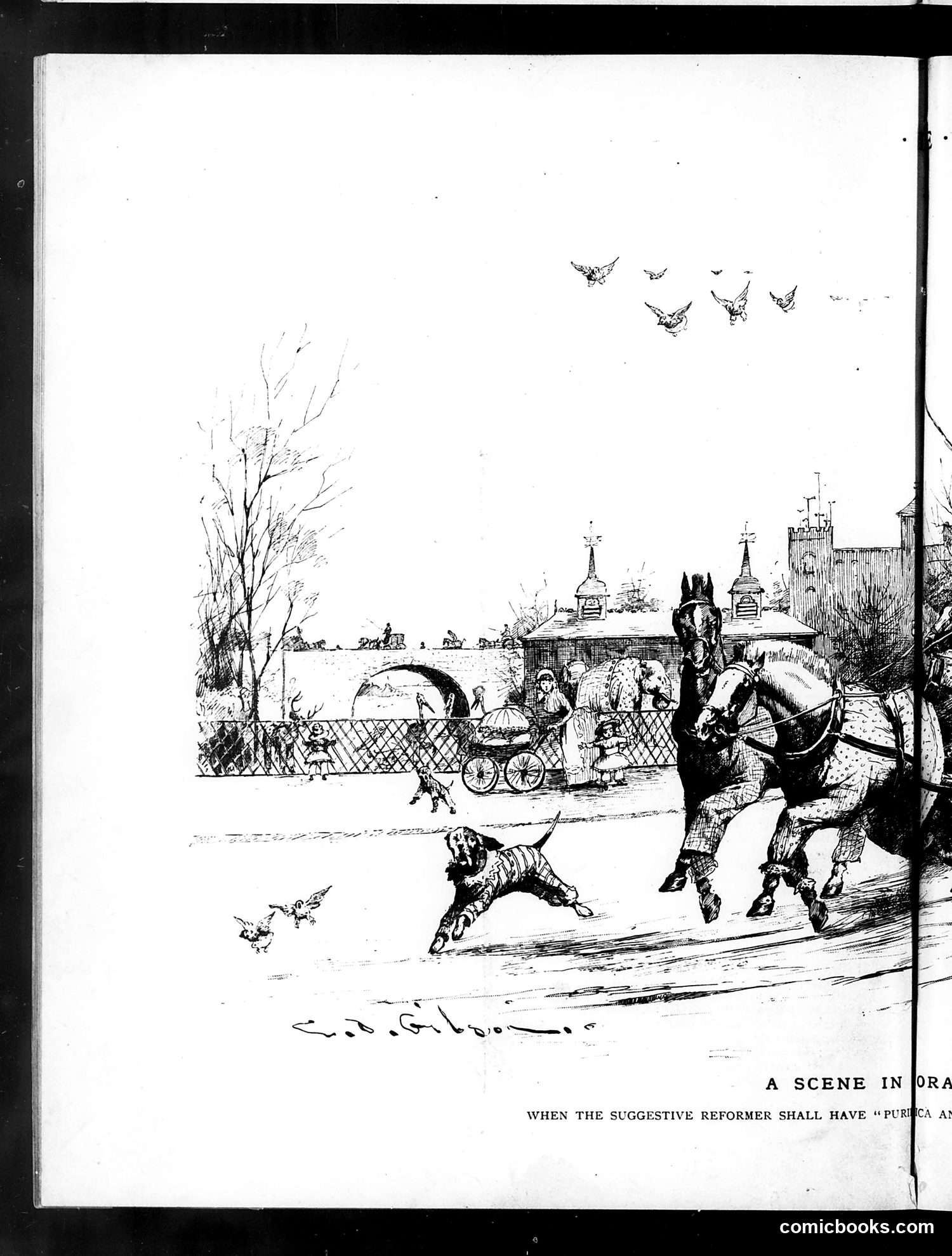
This appears to be a satirical cartoon from *Life* magazine depicting a future scene in what seems to be an urban park or public space. The visible text references "a suggestive reformer" who shall have "purcha[sed]" something (text is cut off). The cartoon shows a well-dressed man on horseback encountering a dog, with various people and horses in the background near what appears to be institutional buildings with crosses (possibly churches or hospitals). Birds fly overhead. Without the complete caption, the specific reform being satirized is unclear. However, the overall composition suggests commentary on progressive-era reformers and their social interventions, possibly mocking overzealous attempts at urban improvement or public order. The formal architectural setting and bourgeois figures suggest critique of middle-class reformist pretensions.
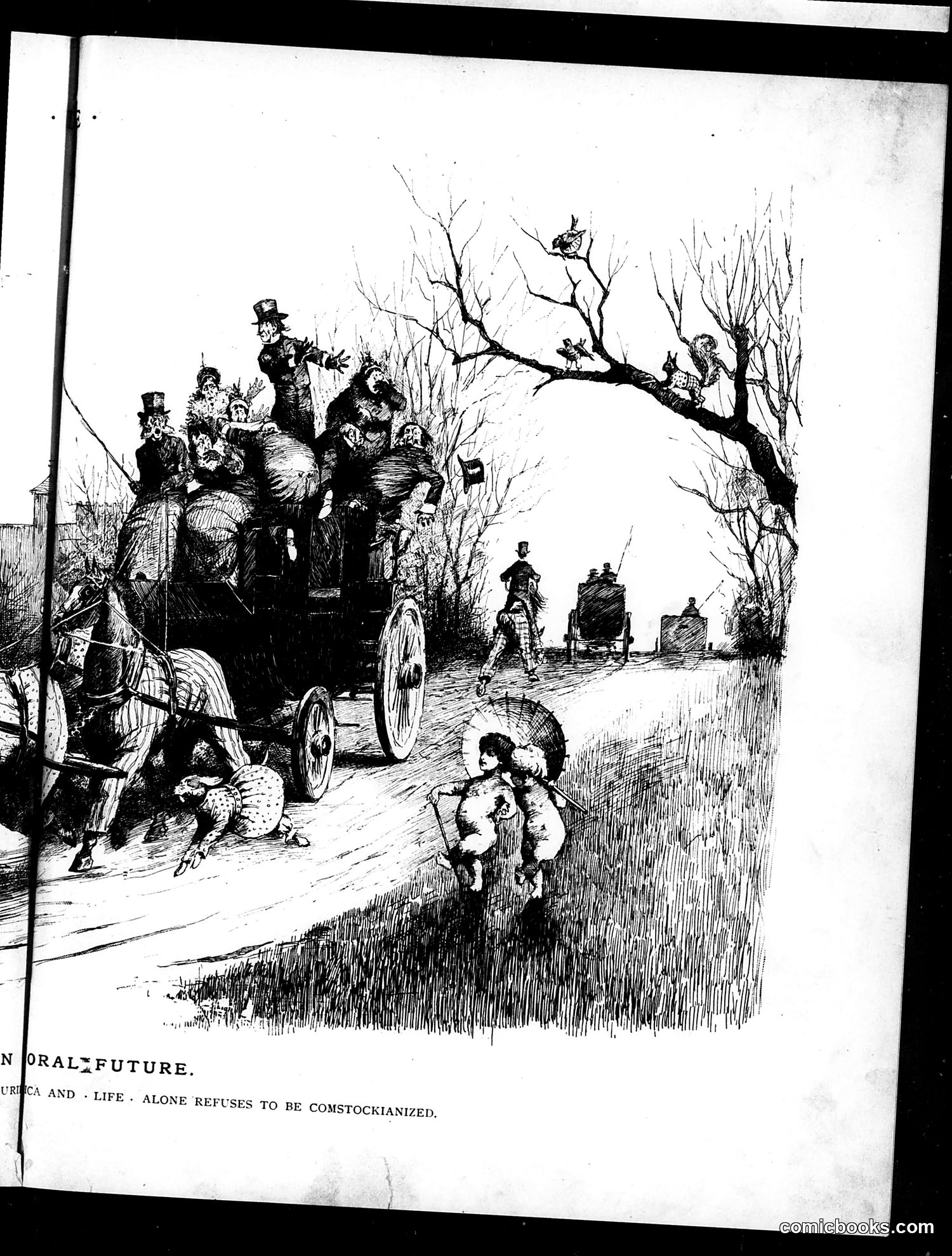
This satirical cartoon from *Life* magazine depicts what appears to be a social commentary on wealth and morality. The title references "moral future" and mentions that "Africa and life alone refuses to be comstockianized" (likely referring to Anthony Comstock, the famous anti-obscenity crusader). The scene shows elegantly dressed wealthy figures in an ornate carriage, contrasted with a poor child in tattered clothes on the roadside. The bare, dead trees suggest desolation. The satire appears to critique the hypocrisy of the wealthy and moralistic reformers—suggesting that while figures like Comstock focused on censoring "obscenity," they ignored the genuine moral failure of ignoring poverty and human suffering. The cartoon implies that true morality should address social injustice rather than cultural censorship.
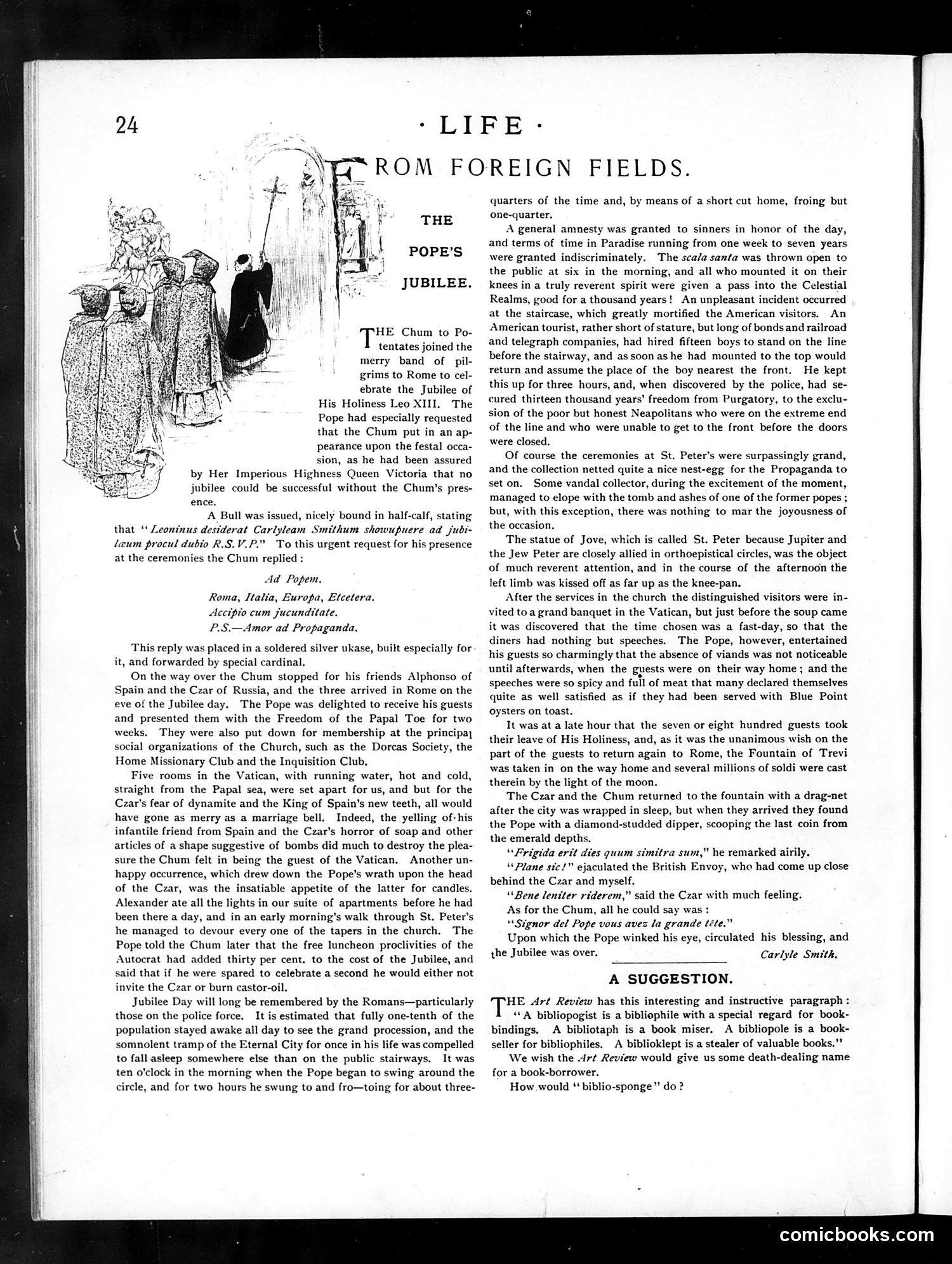
This page contains an article titled "FROM FOREIGN FIELDS: THE POPE'S JUBILEE," describing Pope Leo XIII's 1887 jubilee celebrations in Rome. The accompanying illustration shows the Pope being carried in ceremonial procession (the *sedia gestatoria*). The text satirizes various aspects of the event: the American visitors' behavior (particularly their impatience at religious ceremonies), the Vatican's logistical mishaps, and the Czar of Russia's diplomatic visit. The satire centers on the contrast between the solemn religious occasion and the mundane complications—including a servant accidentally dropping the Pope's chair and guests departing early because dinner was delayed. The piece gently mocks American tourists' irreverence during sacred proceedings.
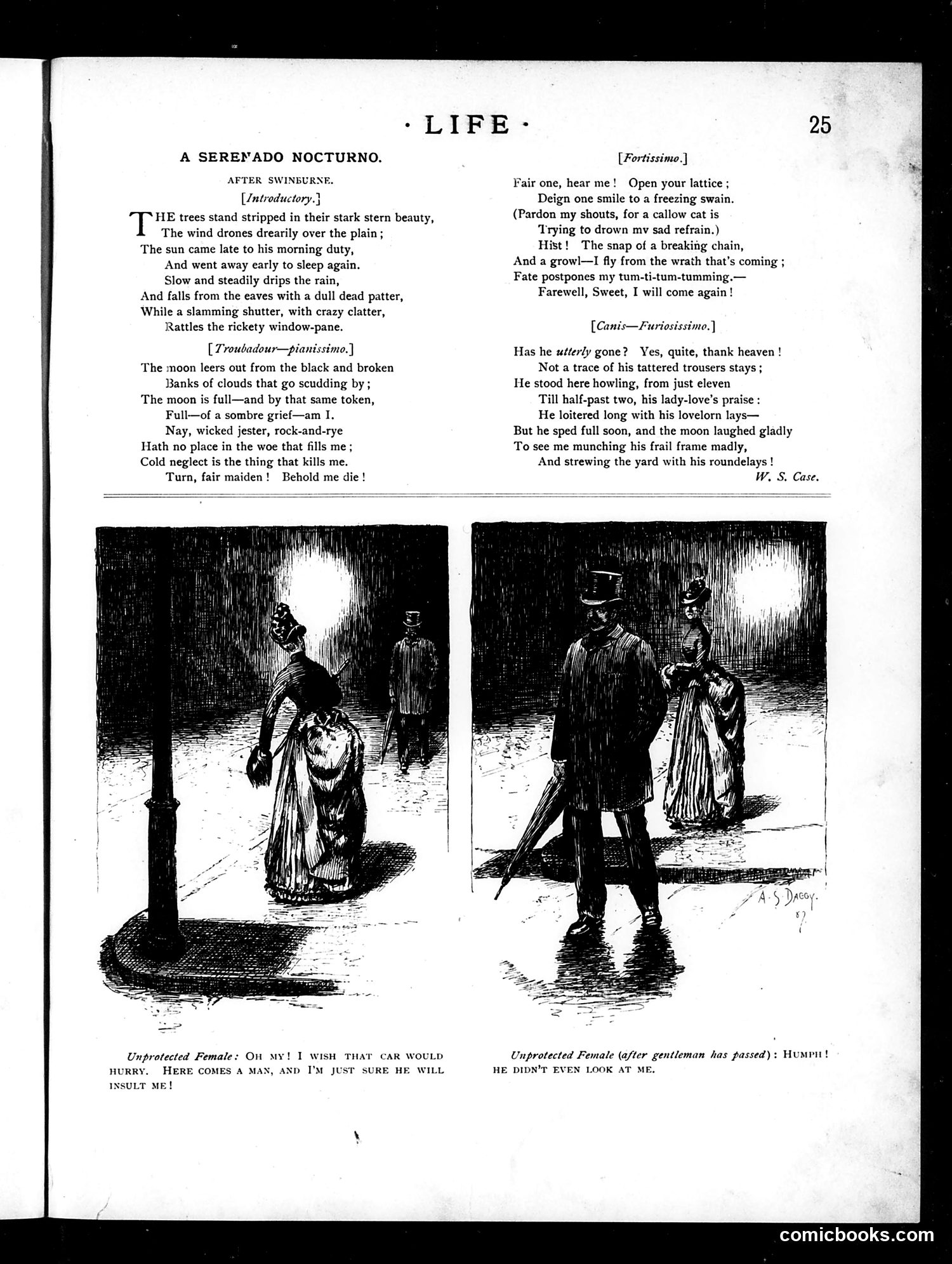
This page satirizes **romantic poetry and courtship conventions** of the Victorian/Aesthetic era (the subtitle references poet Algernon Swinburne, known for overwrought, melancholic verse). The two panels mock the disconnect between male romantic posturing and female reality: **Left panel**: An "Unprotected Female" anxiously anticipates being insulted by an approaching gentleman—assuming men are inherently predatory. **Right panel**: After he passes without acknowledging her, she's offended he *didn't* pay attention—revealing the absurdity of her anxiety. The surrounding poem parodies Swinburne's self-pitying romanticism: a lovelorn suitor serenades dramatically until a dog attacks him, chasing him away. The dog then claims credit for "munching his frail frame" and scattering his "roundelays" (love songs). **The joke**: Both the sentimental poet and the anxious woman are ridiculous—one self-absorbed, the other contradictory in her expectations. The satire targets pretentious literary culture and the irrational anxieties of courtship etiquette.
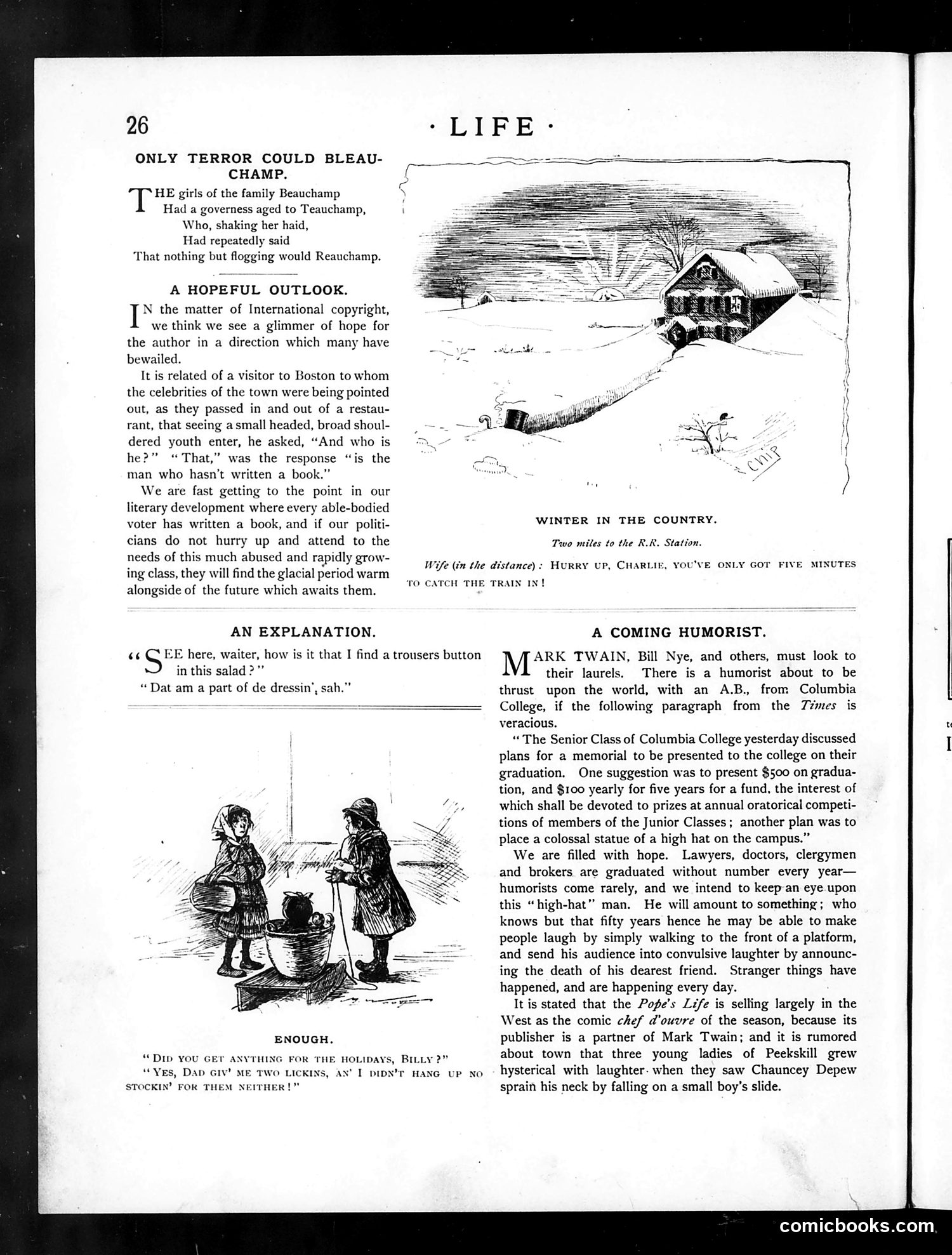
This page contains several satirical pieces typical of the era: **"Only Terror Could Bleauchamp"** is a nonsense poem mocking poor rhyming—the word "Beauchamp" is forced to rhyme with itself through creative misspellings. **"A Hopeful Outlook"** satirizes the proliferation of authors. It jokes that soon *everyone* will have written a book, creating a crisis politicians must address. The implication: too many mediocre writers flooding the market. **"An Explanation"** is a joke about a waiter's malapropism—"dressing" (salad dressing) sounds like "dressin'" (clothing), explaining a trouser button in the salad. **"Winter in the Country"** depicts a rural wife frantically rushing her husband to catch a train. **"A Coming Humorist"** mocks Columbia College's plan to erect a "colossal statue of a high hat" as a class memorial. Life sarcastically suggests this Columbia graduate might become a great humorist, comparing him to Mark Twain and Bill Nye, while poking fun at Chauncey Depew's accident.
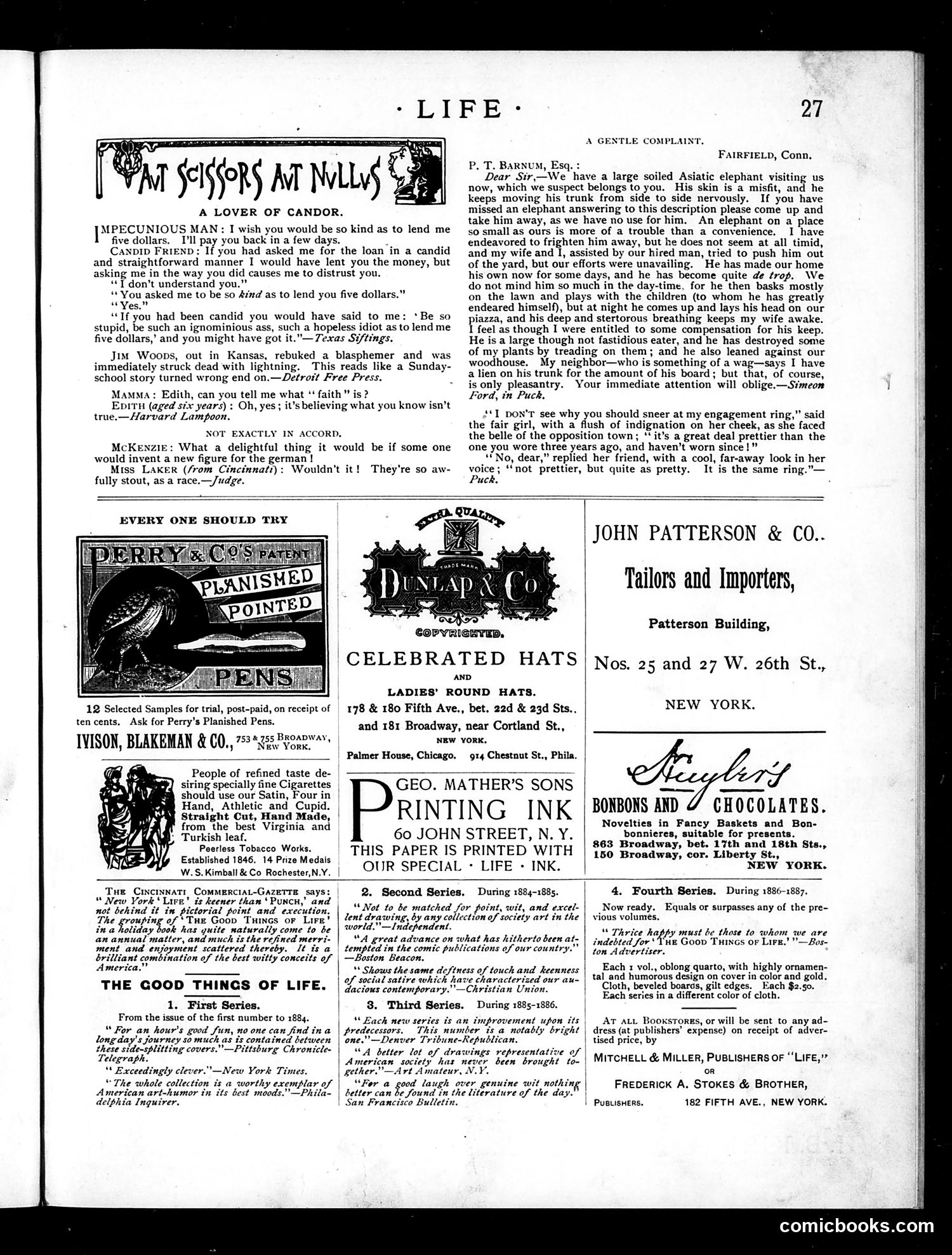
This page contains **multiple short humorous anecdotes** rather than a single cartoon. The jokes satirize social hypocrisy and absurdity: 1. **"Impecunious Man"**: A beggar asks for a loan politely; his friend refuses, saying he'd only lend money if asked with brutally honest insults ("be so stupid"). The joke mocks how social pretense prevents genuine human help. 2. **"A Gentle Complaint"**: A letter claims someone's escaped circus elephant is destroying the writer's property. The humor lies in the polite, formal tone applied to an absurd situation—treating property damage by a massive animal as a minor inconvenience requiring bureaucratic resolution. 3. **Engagement Ring story**: Two women discuss rings; one reveals her rival's "new" ring is actually the same one worn three years prior, implying the woman recycled or lost her original. The joke mocks vanity and pretended sophistication. The page is primarily **advertisements** for products (pens, hats, ink, tailoring services), which was standard for Life magazine's revenue model.
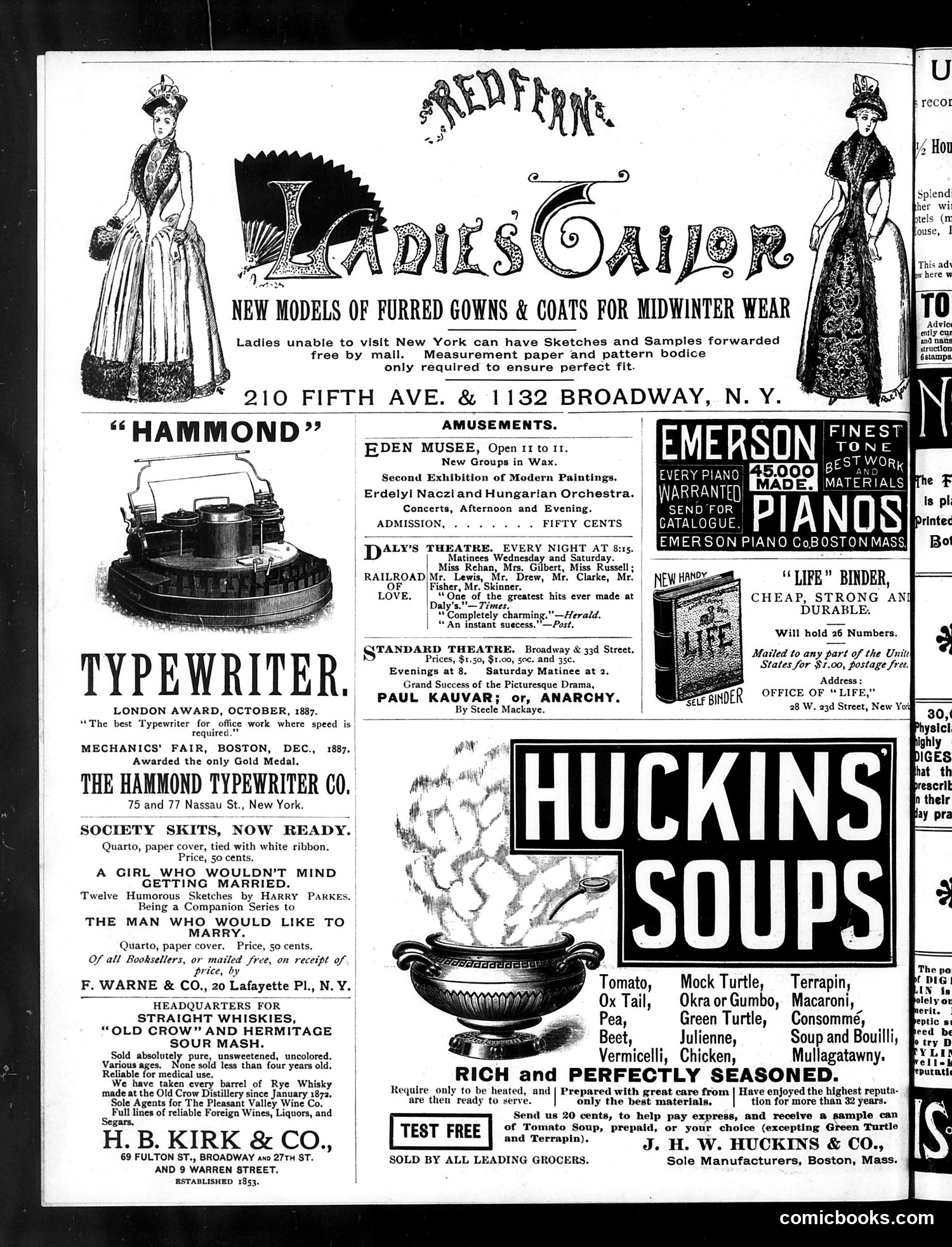
This is primarily a **advertisements page**, not a satirical cartoon page. The content reflects late-1880s consumer goods and entertainment. **Notable advertisements include:** - **Redfern Ladies' Tailor** (top): High-fashion furried gowns and coats, with mail-order service for remote customers - **Hammond Typewriter**: Emphasizes its 1887 London and Boston awards, positioning it as superior for office work - **Society Skits books**: Humorous sketch collections, suggesting genteel entertainment - **H.B. Kirk whiskeys**: Premium "Old Crow" and "Hermitage" brands, marketed as pure and medically reliable - **Huckins Soups** (large center ad): Various soup varieties, emphasizing richness and 32-year reputation **Theater listings** promote contemporary plays including *Railroad Love* and *Paul Kauvar; or, Anarchy*. **Cultural context**: These ads reveal late-Victorian consumer aspirations—mail-order shopping, emerging office technology, premium spirits, canned convenience foods, and theatrical entertainment were status markers for the affluent readership Life targeted.
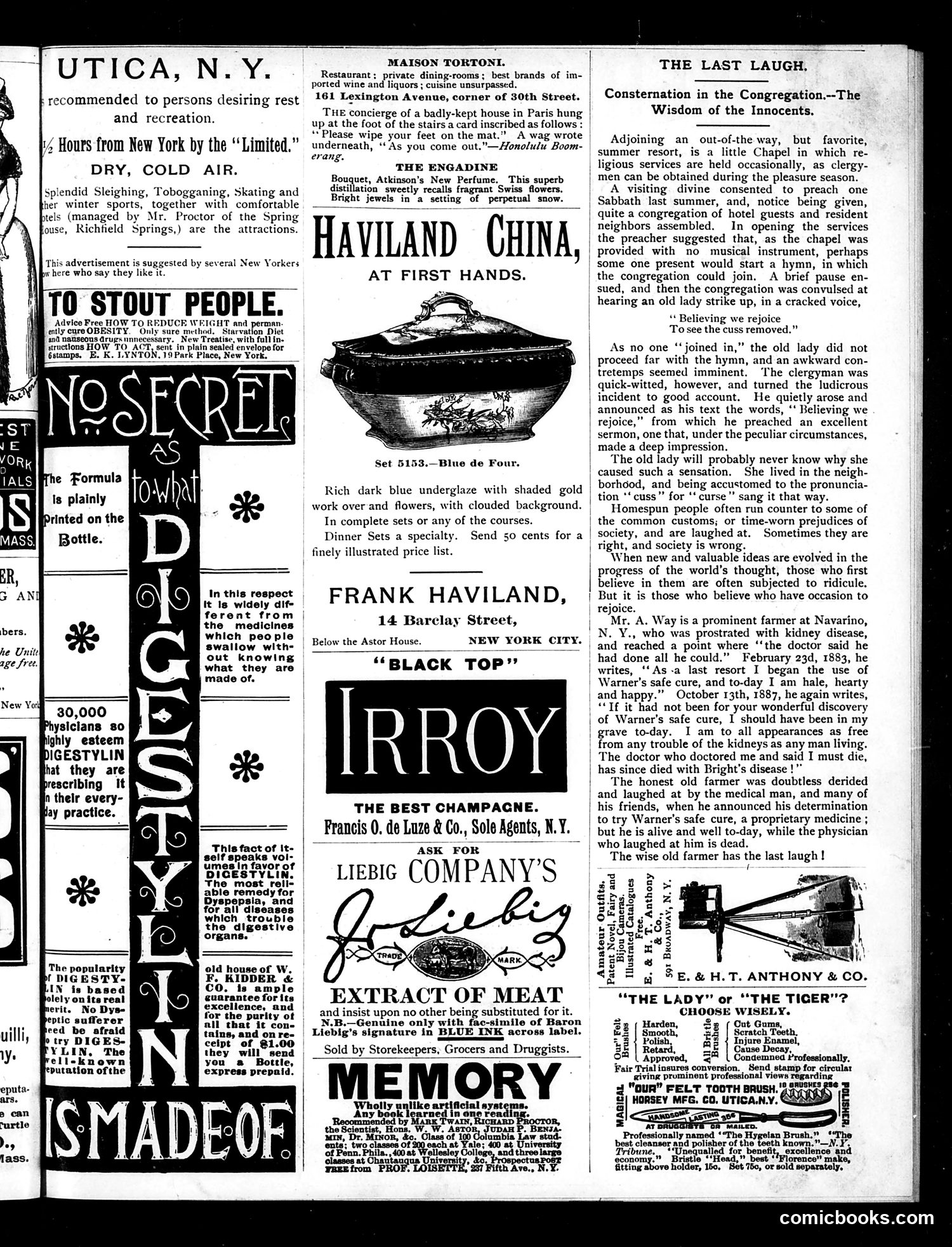
This is primarily an advertisement and editorial page, not a political cartoon. The main content is a humorous anecdote titled "The Last Laugh: Consternation in the Congregation—The Wisdom of the Innocents." The story mocks social pretension: an elderly woman at a chapel service, unfamiliar with proper pronunciation, sings "cuss" instead of "curse" in a hymn. The congregation finds this absurd; the visiting clergyman, however, cleverly uses her mispronunciation as his sermon text, turning embarrassment into edification. The moral: common people sometimes possess accidental wisdom that society dismisses through laughter. The piece gently satirizes both rustic ignorance and urban snobbery—suggesting that "homespun people" and "new valuable ideas" often challenge society's prejudices, implying society is sometimes wrong to ridicule them. The page is otherwise filled with period product advertisements (china, perfume, obesity remedies, champagne).
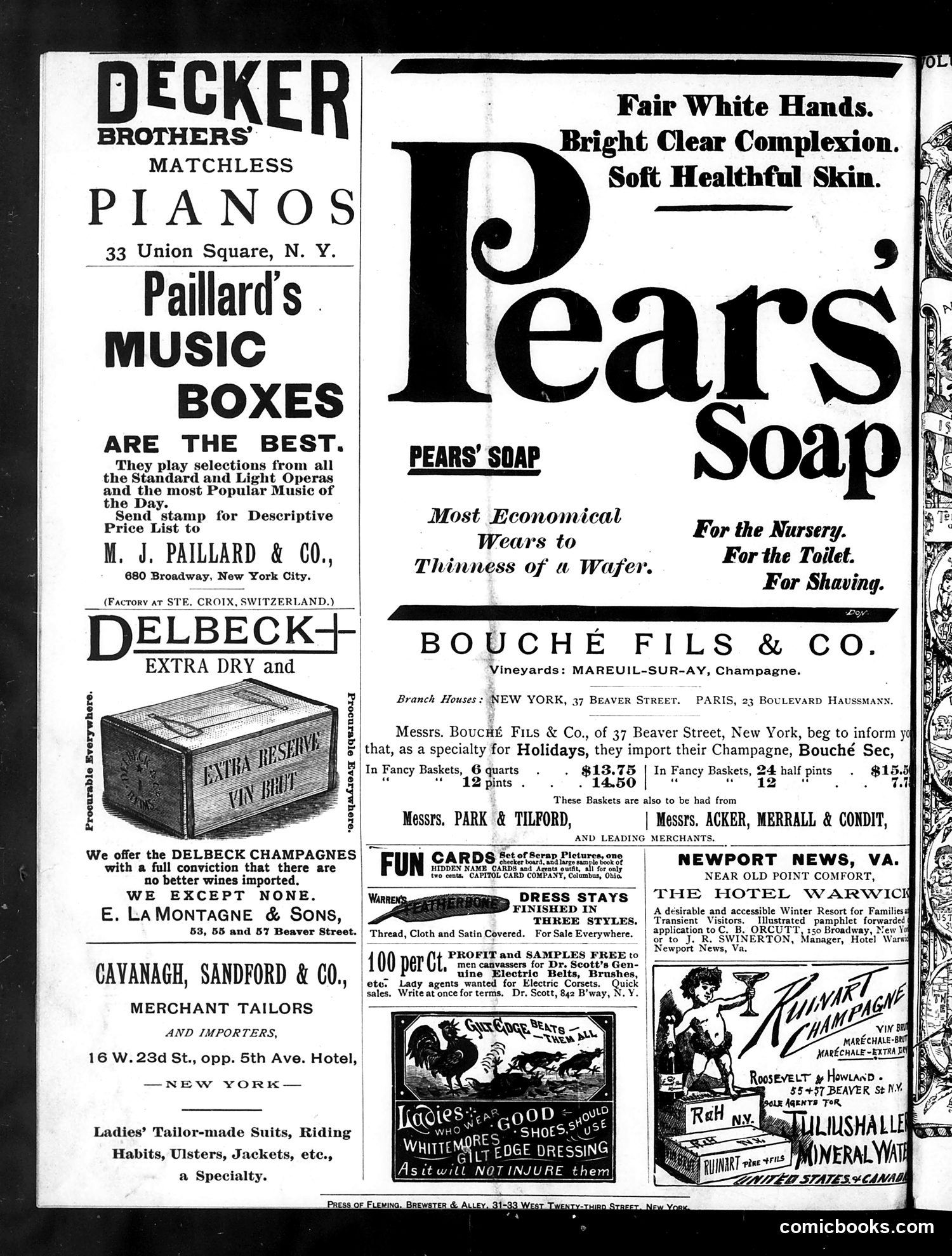
This is primarily an **advertisement page**, not a satirical cartoon page. It contains various commercial advertisements typical of late 19th/early 20th-century American magazines. The notable content includes: **Pears' Soap advertisement** (center): Prominently advertises the product with claims about "Fair White Hands," "Bright Clear Complexion," and "Soft Healthful Skin." This reflects period beauty standards emphasizing pale skin—associated with leisure class status and avoiding manual labor or sun exposure. The messaging is aspirational for middle/upper-class consumers. **Other ads**: Piano boxes, champagne importers, tailor services, dress stays, electric health devices, and miscellaneous products typical of the era. **Social context**: The prominent skin-lightening claims in Pears' advertising reflect Victorian-era prejudices about complexion and class status. These ads reveal what consumers were being sold and what values the magazine's audience held. This page lacks significant satire or political commentary—it's straightforward commercial advertising that inadvertently documents period attitudes about beauty, wealth, and consumption.