
Life, 1888-01-12 · page 6 of 16
Life — January 12, 1888 — page 6: what you’re looking at
What you’re looking at
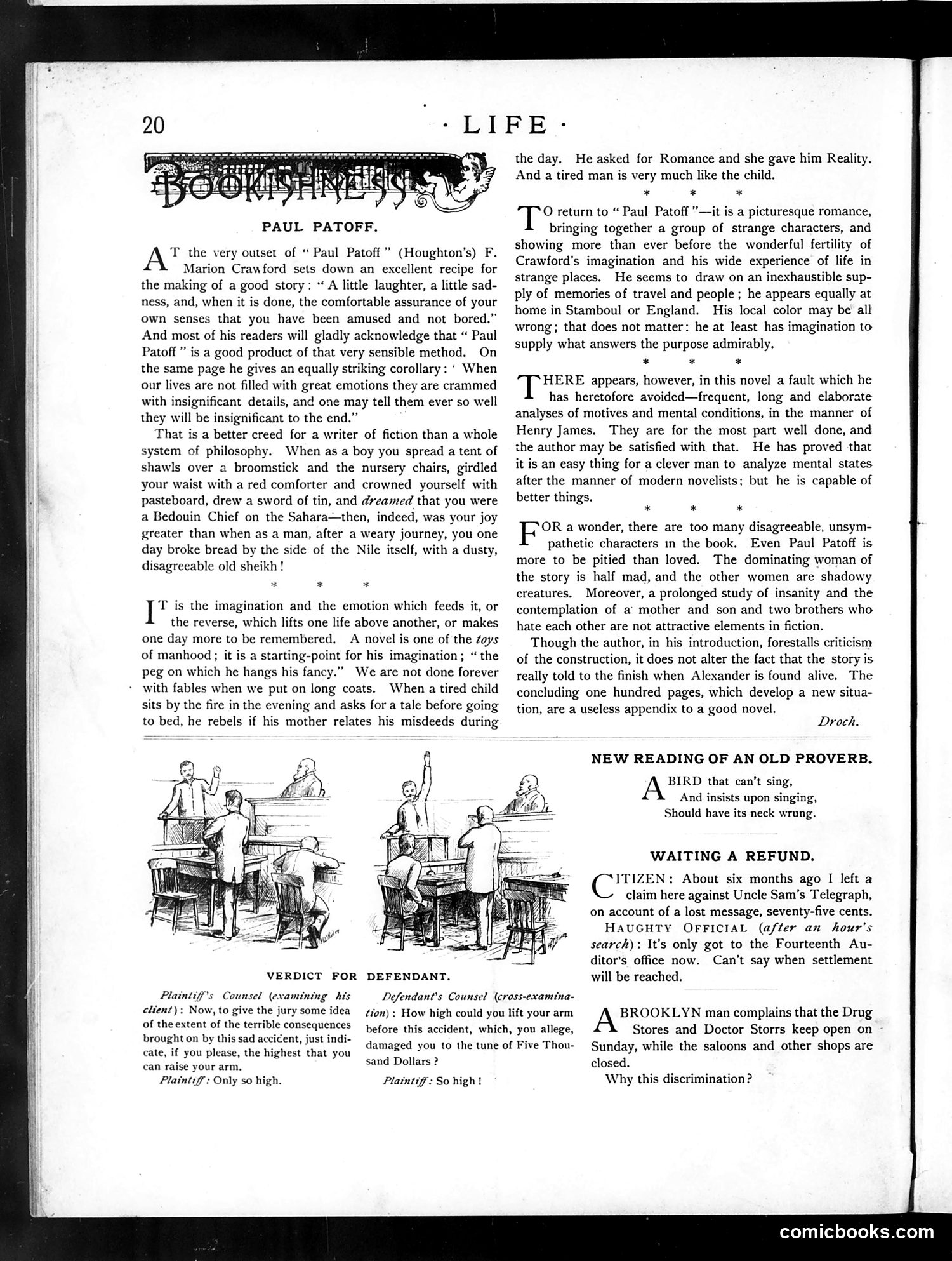
This page contains a courtroom humor cartoon depicting a legal proceeding. The illustration shows two lawyers addressing a jury about a personal injury case involving a plaintiff who allegedly suffered arm damage worth $5,000. The satire targets the absurdity of lawsuit testimony and jury deliberation. The plaintiff's counsel makes an exaggerated emotional appeal about damages, while the defendant's counsel questions the credibility of the injury claim with a simple factual challenge: "How high could you lift your arm before this accident?" The joke hinges on the contrast between theatrical legal argumentation and straightforward cross-examination that exposes inconsistencies. The cartoon mocks both the plaintiff's inflated damage claims and the performative nature of courtroom rhetoric in early 20th-century America.
📄 Transcribed text from this page (OCR, searchable)
Machine-transcribed from the original scan — historical spelling and the odd misread are preserved.
-. LIFE: PATOFF. T the very outset of “ Paul Patoff” (Houghton’s) F. Marion Crawford sets down an excellent recipe for the making of a good story: “A little laughter, a little sad- ness, and, when it is done, the comfortable assurance of your own senses that you have been amused and not bored.” And most of his readers will gladly acknowledge that “ Paul Patoff” is a good product of that very sensible method. On the same page he gives an equally striking corollary : ‘ When our lives are not filled with great emotions they are crammed with insignificant details, and one may tell them ever so well they will be insignificant to the end.” That is a better creed for a writer of fiction than a whole system of philosophy. When as a boy you spread a tent of shawls over a broomstick and the nursery chairs, girdled your waist with a red comforter and crowned yourself with pasteboard, drew a sword of tin, and dreamed that you were a Bedouin Chief on the Sahara—then, indeed, was your joy greater than when as a man, after a weary journey, you one day broke bread by the side of the Nile itself, with a dusty, disagreeable old sheikh! * * * T is the imagination and the emotion which feeds it, or the reverse, which lifts one life above another, or makes one day more to be remembered. A novel is one of the zoys of manhood; it is a starting-point for his imagination; “ the peg on which he hangs his fancy.” We are not done forever with fables when we put on long coats. When a tired child sits by the fire in the evening and asks for a tale before going to bed, he rebels if his mother relates his misdeeds during VERDICT FOR DEFENDANT. Plaintiff's Counsel (examining his client): Now, to give the jury some idea of the extent of the terrible consequences brought on by this sad accicent, just indi- cate, if you please, the highest that you can raise your arm. Plaintiff : Only so high. sand Dollars ? Plaintiff’: So high | tion) ; How high could you lift your arm before this accident, which, you allege, damaged you to the tune of Five Thou- the day. He asked for Romance and she gave him Reality. And a tired man is very much like the child. * * * O return to “ Paul Patoff ”—it is a picturesque romance, bringing together a group of strange characters, and showing more than ever before the wonderful fertility of Crawford's imagination and his wide experience of life in strange places. He seems to draw on an inexhaustible sup- ply of memories of travel and people ; he appears equally at home in Stamboul or England. His local color may be all wrong; that does not matter: he at least has imagination to supply what answers the purpose admirably. * * * HERE appears, however, in this novel a fault which he has heretofore avoided—frequent, long and elaborate analyses of motives and mental conditions, in the manner of Henry James. They are for the most part well done, and the author may be satisfied with that. He has proved that it is an easy thing for a clever man to analyze mental states after the manner of modern novelists; but he is capable of better things. * * * OR a wonder, there are too many disagreeable, unsym- pathetic characters in the book. Even Paul Patoff is more to be pitied than loved. The dominating woman of the story is half mad, and the other women are shadowy creatures. Moreover, a prolonged study of insanity and the contemplation of a mother and son and two brothers who hate each other are not attractive elements in fiction. Though the author, in his introduction, forestalls criticism of the construction, it does not alter the fact that the story is really told to the finish when Alexander is found alive. The concluding one hundred pages, which develop a new situa- tion, are a useless appendix to a good novel. Droch. NEW READING OF AN OLD PROVERB. BIRD that can’t sing, And insists upon singing, Should have its neck wrung. WAITING A REFUND. ITIZEN: About six months ago I left a claim here against Uncle Sam’s Telegraph, on account of a lost message, seventy-five cents. HAUGHTY OFFICIAL (after an hour's search): It’s only got to the Fourteenth Au- ditor’s office now. Can’t say when settlement will be reached. Defendant's Counsel (cross-examina- BROOKLYN man complains that the Drug Stores and Doctor Storrs keep open on Sunday, while the saloons and other shops are closed. Why this discrimination? comicbooks.com