
A complete issue · 16 pages · 1888
Life — January 5, 1888
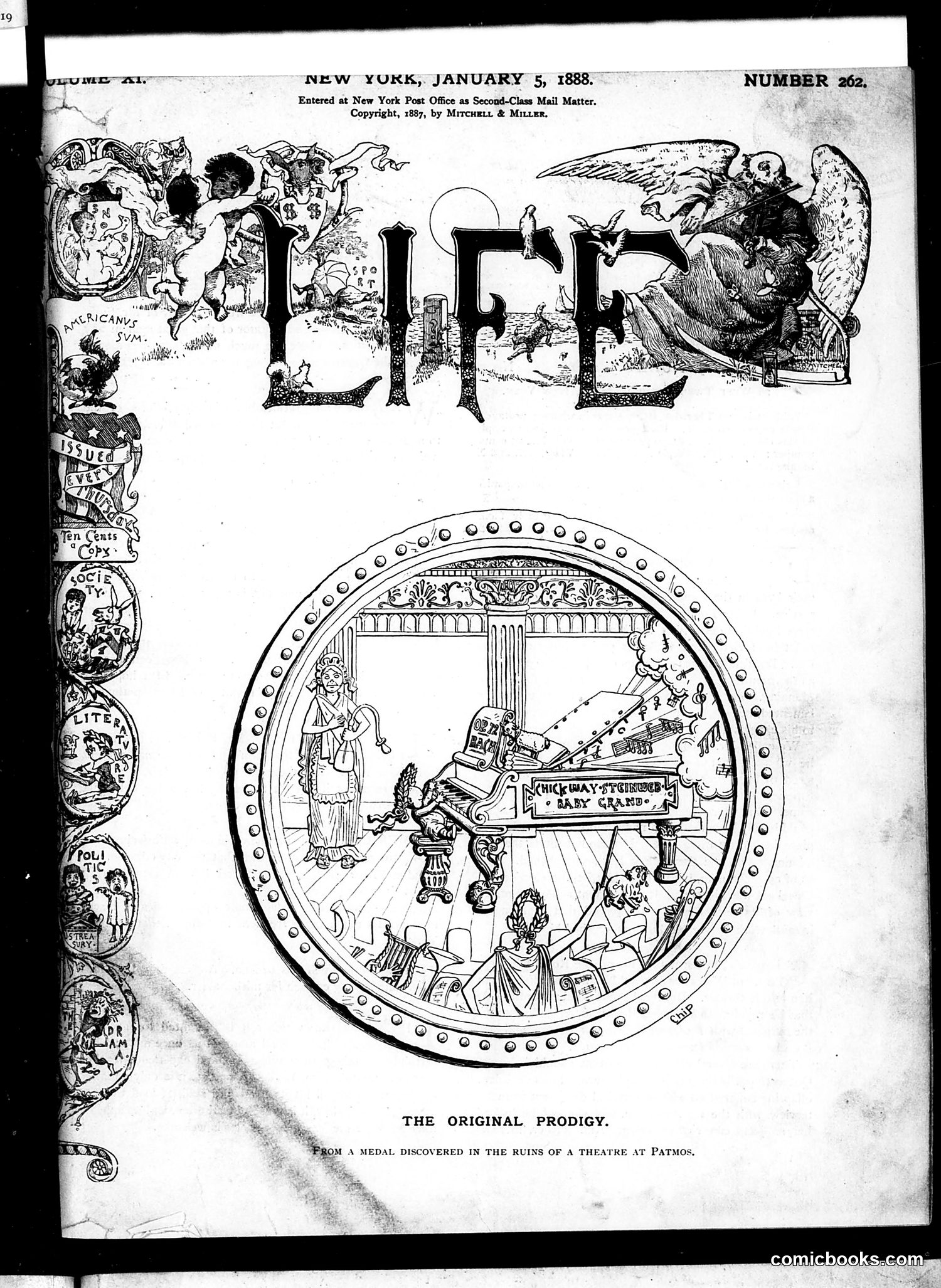
This page features two satirical illustrations. The large decorative title "LIFE" dominates the upper portion with ornamental cherubs and allegorical figures. The main cartoon below, titled "THE ORIGINAL PRODIGY," depicts a circular medallion apparently discovered in ancient theatrical ruins at Patmos. It shows a scene of a piano performance or musical recital, with an audience watching. The satire appears to mock either a contemporary child prodigy performer or perhaps criticizes the phenomenon of young musical performers as entertainment—suggesting this is an ancient practice rather than modern novelty. The "discovery" framing is ironic commentary on the era's fascination with infant performers. The left sidebar contains Life magazine's masthead and pricing information (Ten Cents per copy).
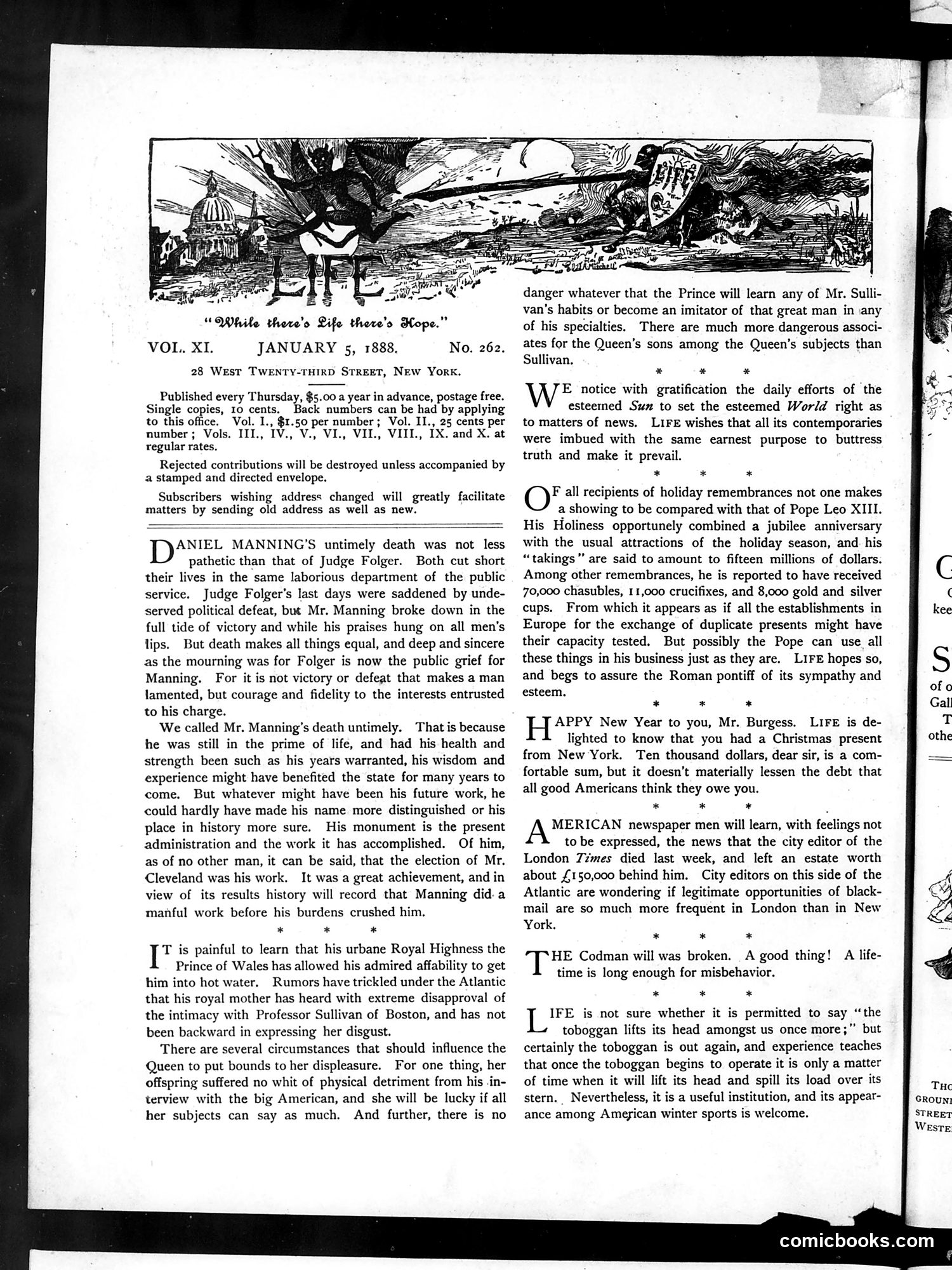
The masthead cartoon depicts a skeletal figure of Death straddling a landscape, with the caption "While there's Life there's Hope." The page contains editorial commentary rather than political cartoons. Key topics include: 1. **Daniel Manning's death**: Compares his passing to Judge Folger's, praising Manning's integrity and service. 2. **Prince of Wales scandal**: References rumors that the Prince imitated American Professor Sullivan, with concern this could influence Queen Victoria's sons negatively. 3. **Pope Leo XIII**: Notes his lavish holiday gifts (reportedly worth $150,000) and accumulated wealth. 4. **London Times editor death**: Reports the city editor of the *Times* died leaving a £150,000 estate. 5. **Toboggan safety**: Comments humorously on the toboggan as an emerging American winter sport. The page is primarily satirical social commentary rather than visual cartooning.
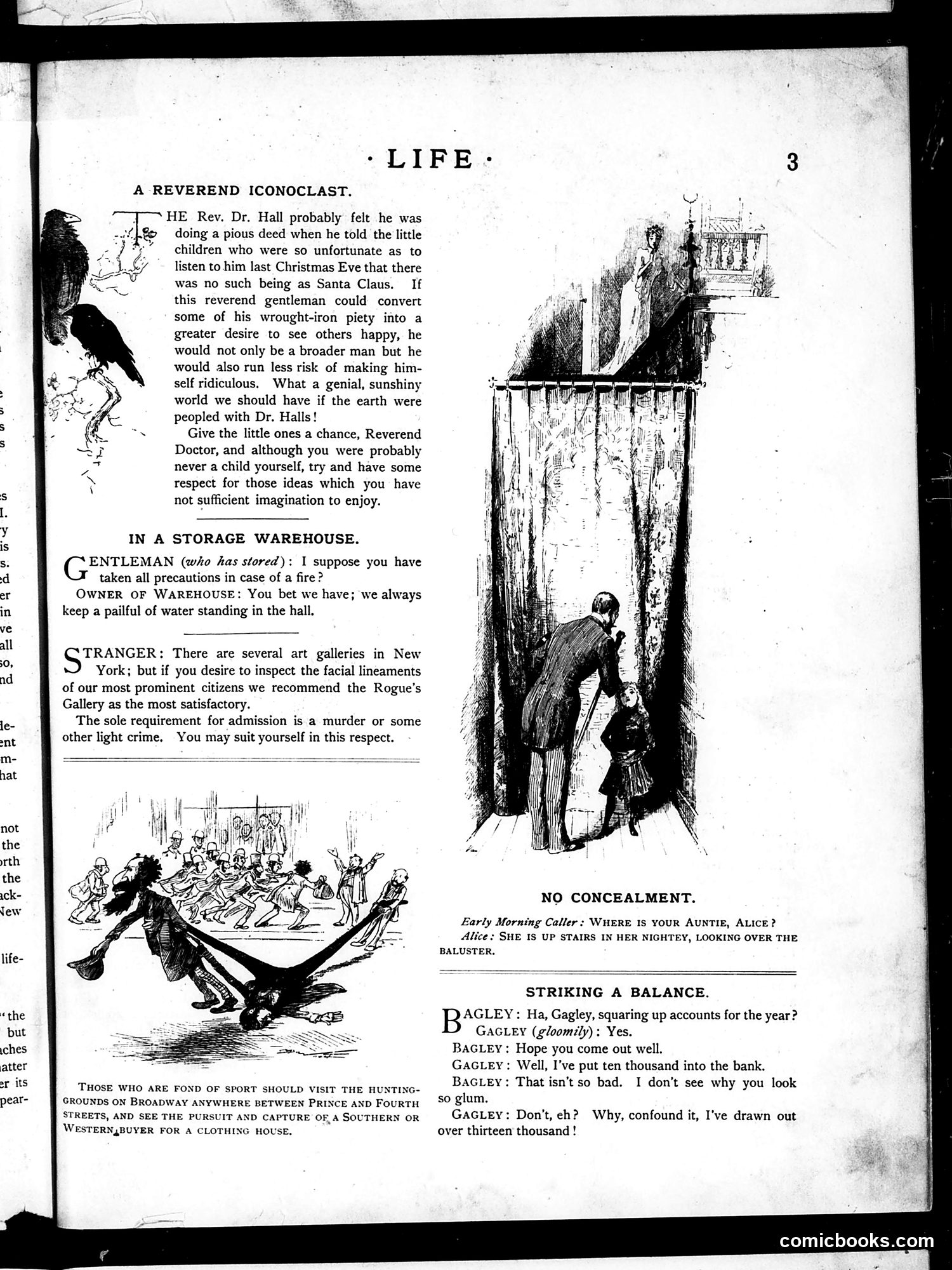
This page contains several brief satirical pieces and illustrations typical of early 20th-century Life magazine humor: **"A Reverend Iconoclast"** mocks a clergyman (Rev. Dr. Hall) who tells children Santa Claus doesn't exist, arguing this dampens their happiness and makes him seem self-righteous. **"In a Storage Warehouse"** presents a brief dialogue where a warehouse owner boasts about fire precautions, while a stranger recommends viewing prominent citizens' "facial lineaments" at the Rogue's Gallery (a police photography collection), sarcastically suggesting one must commit murder to gain admission—commenting on how crime creates notoriety. **"No Concealment"** shows a simple domestic scene with minimal text. **"Striking a Balance"** depicts a financial conversation between Bagley and Gagley about bank deposits and debt—gentle satire on personal accounting. The illustrations are typical pen-and-ink sketches characteristic of the era's satirical journalism.
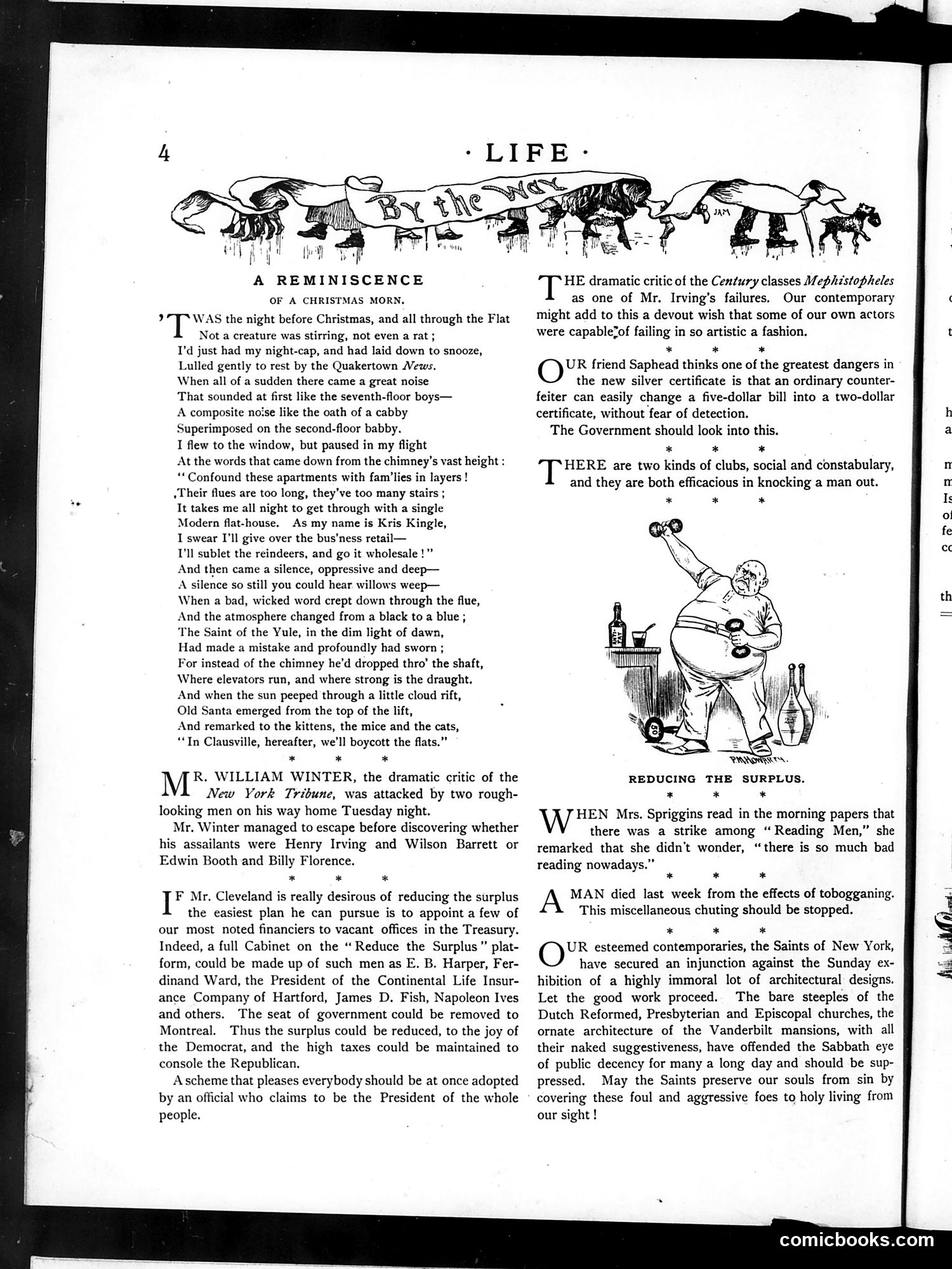
This satirical page contains several brief social commentaries rather than a single cartoon. The illustration shows a figure "reducing the surplus" - apparently a man discarding bottles and items, satirizing government efforts to manage economic surplus. The text pieces mock contemporary issues: a Christmas poem parodies sentimentality; a note about Mr. William Winter (drama critic for the New York Tribune) being attacked suggests urban crime concerns; commentary on Mr. Cleveland's proposal to reduce Treasury surplus pokes fun at government inefficiency; and a final item criticizes the "Saints of New York" for obtaining an injunction against an "immoral" architectural exhibition, mocking religious prudishness. The overall tone ridicules governmental incompetence, urban lawlessness, and moral hypocrisy of the era.
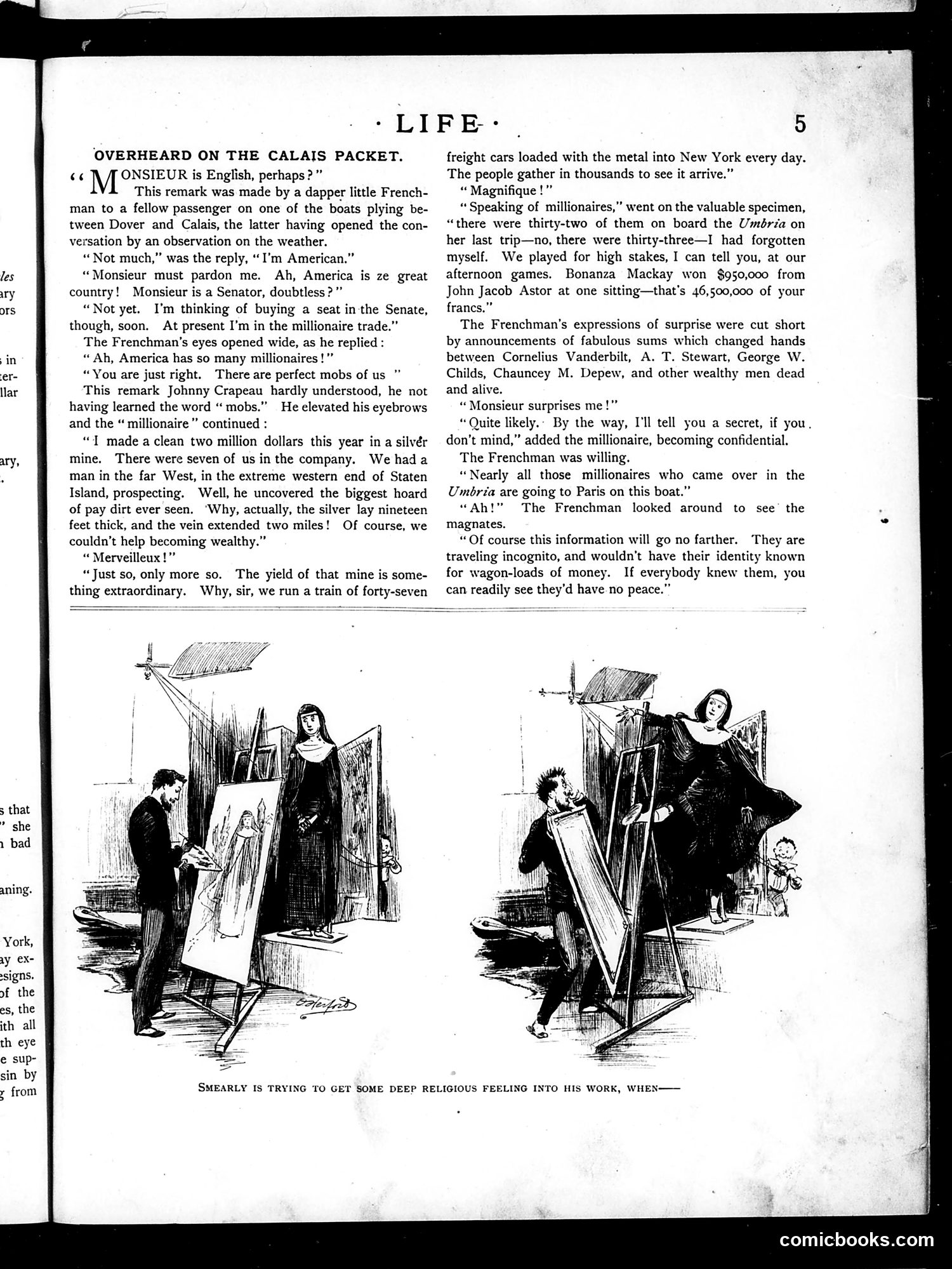
This page satirizes wealthy American millionaires traveling on the *Umbria* steamship between Dover and Calais. The dialogue mocks American nouveau riche attitudes: an American boasts of making $250,000 from a silver mine with seven partners, while a French companion expresses amazement at American wealth-accumulation. The cartoon below depicts "Smearly" (an artist character) attempting to inject "deep religious feeling" into his work while aboard ship. The two sketches show him positioning a nun figure into his canvas composition, suggesting satire of artificial sentimentality in art—adding religious elements for emotional effect rather than genuine conviction. The overall tone ridicules both crass American materialism and the pretentiousness of artists seeking emotional authenticity.
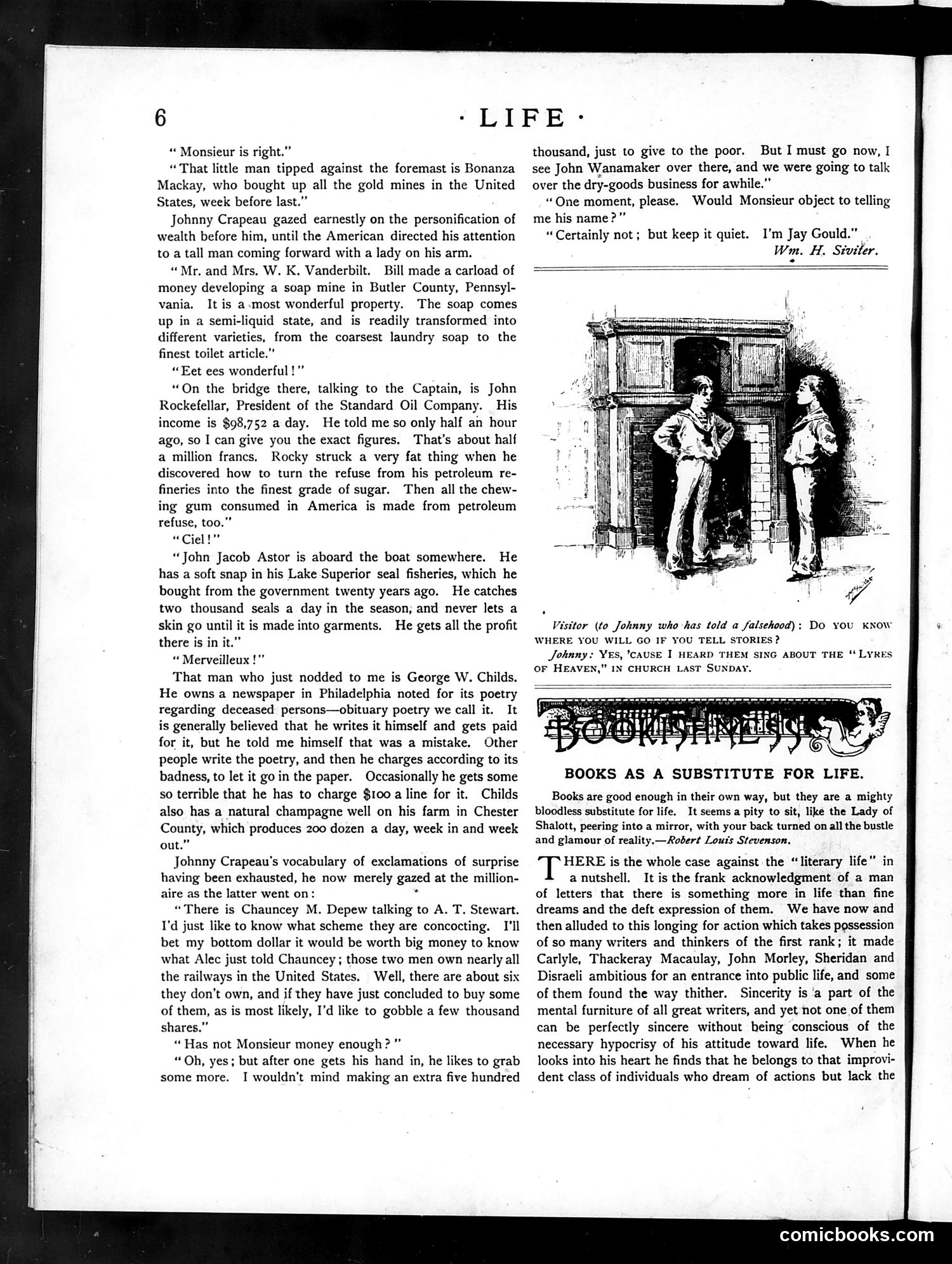
The main illustration shows a visitor confronting "Johnny" who has told a falsehood. The caption indicates Johnny claims to have heard the "Lyres of Heaven" sung in church, which the visitor questions—a joke about the child's dishonesty (the pun playing on "liars/lyres"). Below is an article titled "Books as a Substitute for Life," which critiques the notion that literary pursuits can replace real-world experience. The text references major 19th-century writers (Carlyle, Thackeray, Macaulay, Sheridan) to argue that great writers possessed both sincere observation of life and active engagement with the world—not mere armchair theorizing. The satire targets those who romanticize literature as an escape from reality rather than a reflection of it.
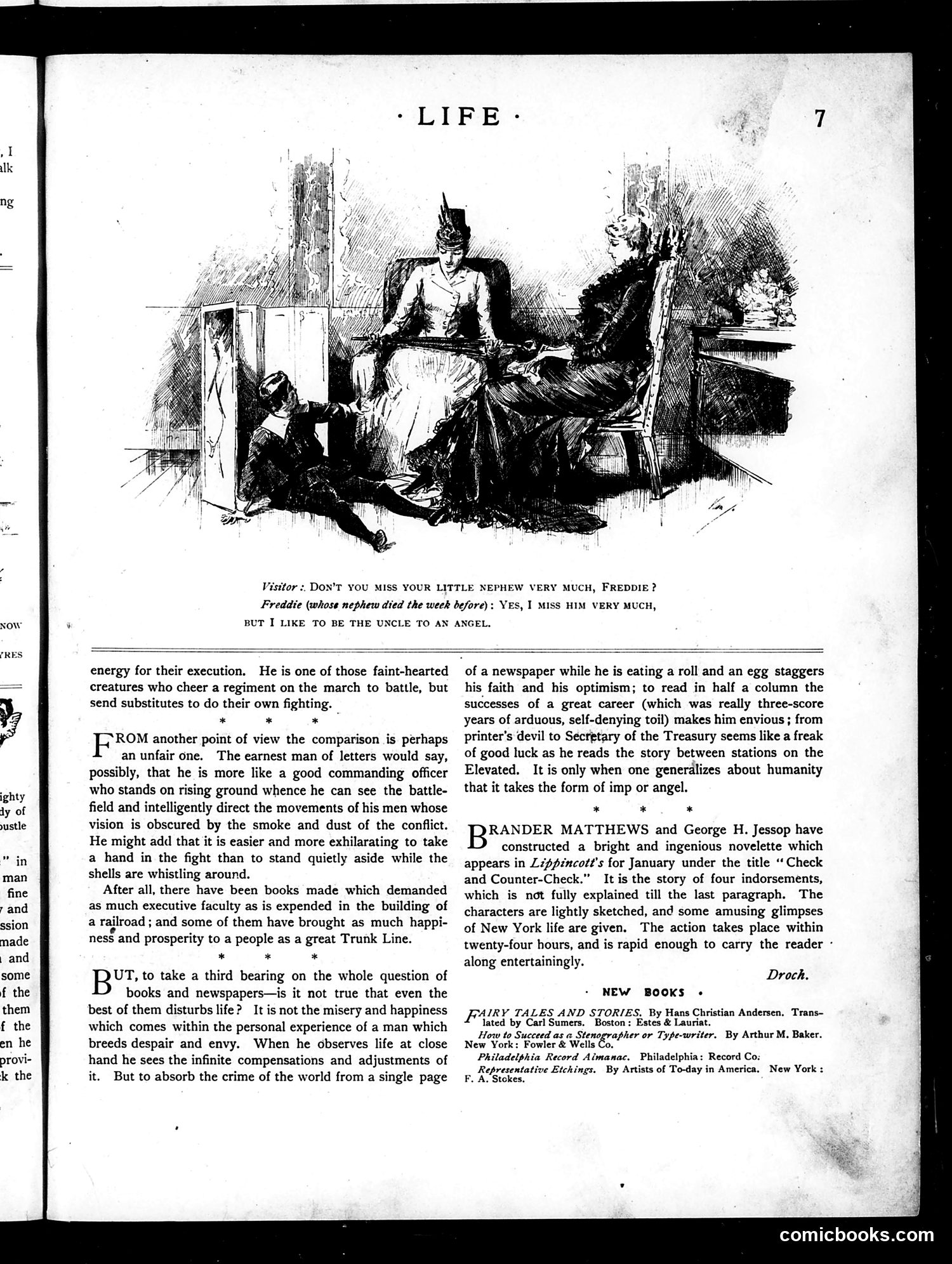
The cartoon depicts a social scene with a well-dressed woman seated while a man kneels or bows before her. The caption reads: "Don't you miss your LITTLE NEPHEW VERY MUCH, FREDDIE?" with the response "Yes, I miss him very much, but I like to be the UNCLE TO AN ANGEL." **The Satire:** This appears to be a commentary on courtship and romantic pursuit in Victorian/Edwardian society. The joke plays on the visitor's ostentatious flattery—calling the woman an "angel"—suggesting he's performing exaggerated gallantry to impress her, while using the deceased nephew as a pretext for his visit. The satire mocks the theatrical, insincere compliments men employed in social situations to advance romantic or social interests.
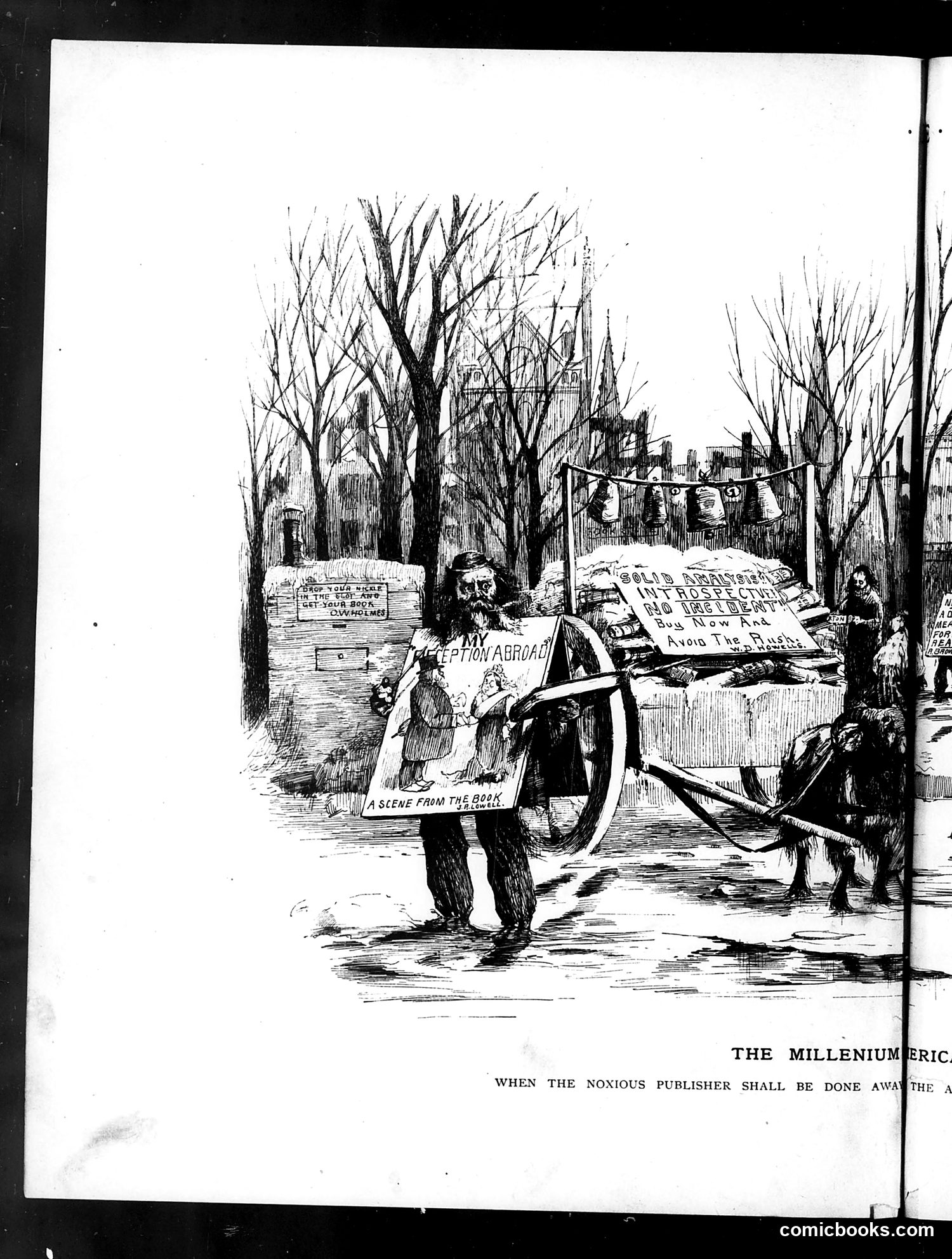
This satirical cartoon depicts a bearded figure (appearing to represent a "noxious publisher") pulling a cart laden with books and signs promoting various works. The signage visible includes references to "deception abroad" and what appears to be self-promotional material. The caption indicates this is titled "The Millennium Eric" with text reading "When the noxious publisher shall be done away, the..." (cut off). The satire targets a specific publisher—likely named Eric or operating under that name—criticized for producing sensationalist or deceptive publications. The barren winter landscape with bare trees suggests decline or spiritual emptiness. The figure's exaggerated appearance and the loaded cart of books mock aggressive commercial publishing practices of the era, with the "millennium" reference suggesting satirical optimism about a future when such publishers would disappear.
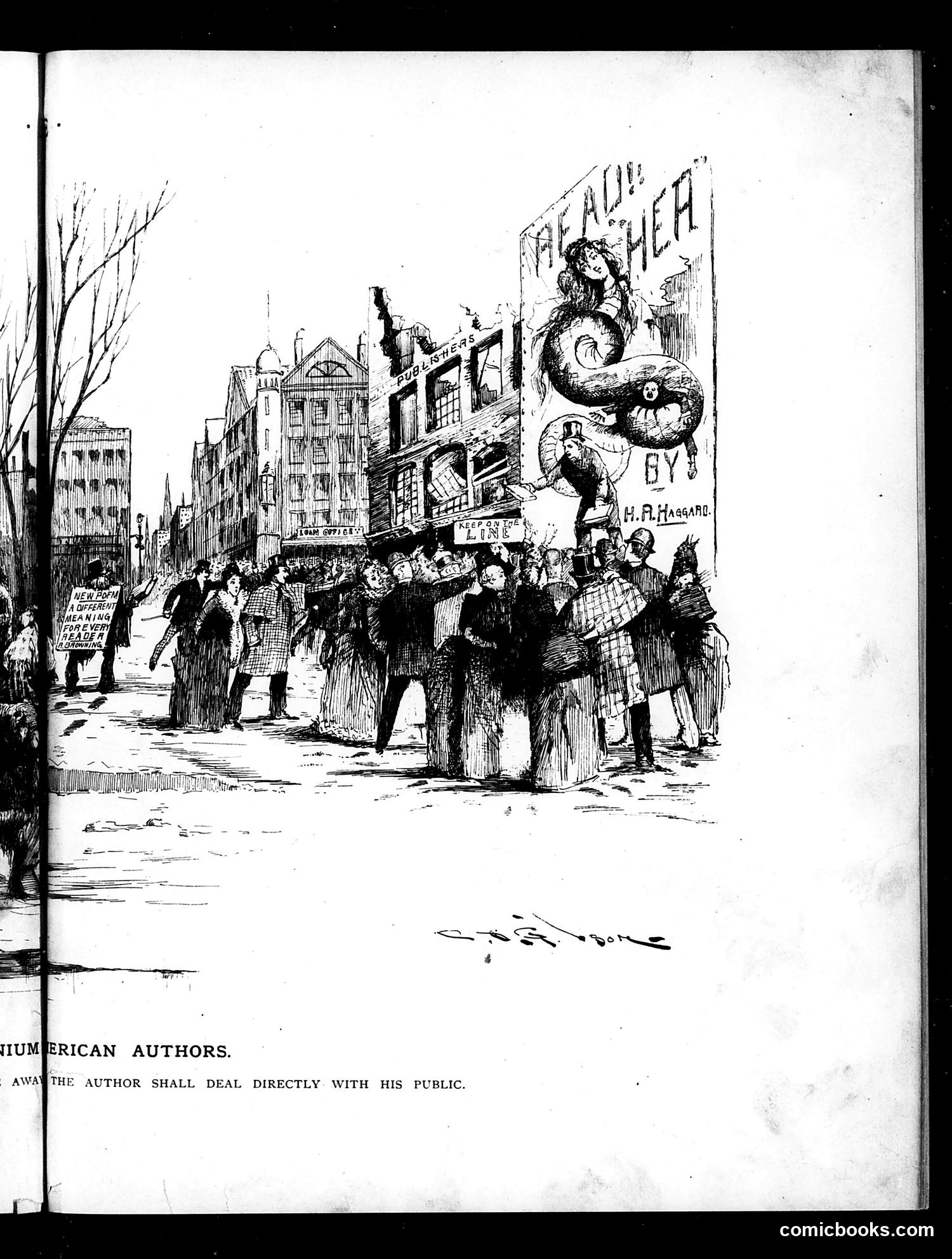
This illustration depicts a street scene with a large octopus labeled "BEEF TRUST" emerging from a building, attacking or menacing a crowd of ordinary citizens below. The octopus's tentacles appear to be grasping at people, suggesting economic exploitation. The "Beef Trust" refers to the monopolistic control of the American meat-packing industry by a small group of corporations in the early 1900s. This was a major public scandal that prompted government antitrust action. The cartoon satirizes how this monopoly (represented as a predatory octopus) directly harms everyday consumers. The signature appears to be by H.A. Haggard. At the page bottom, text about "American Authors" and authors dealing "directly with his public" suggests this may relate to broader progressive-era critiques of monopolistic practices.
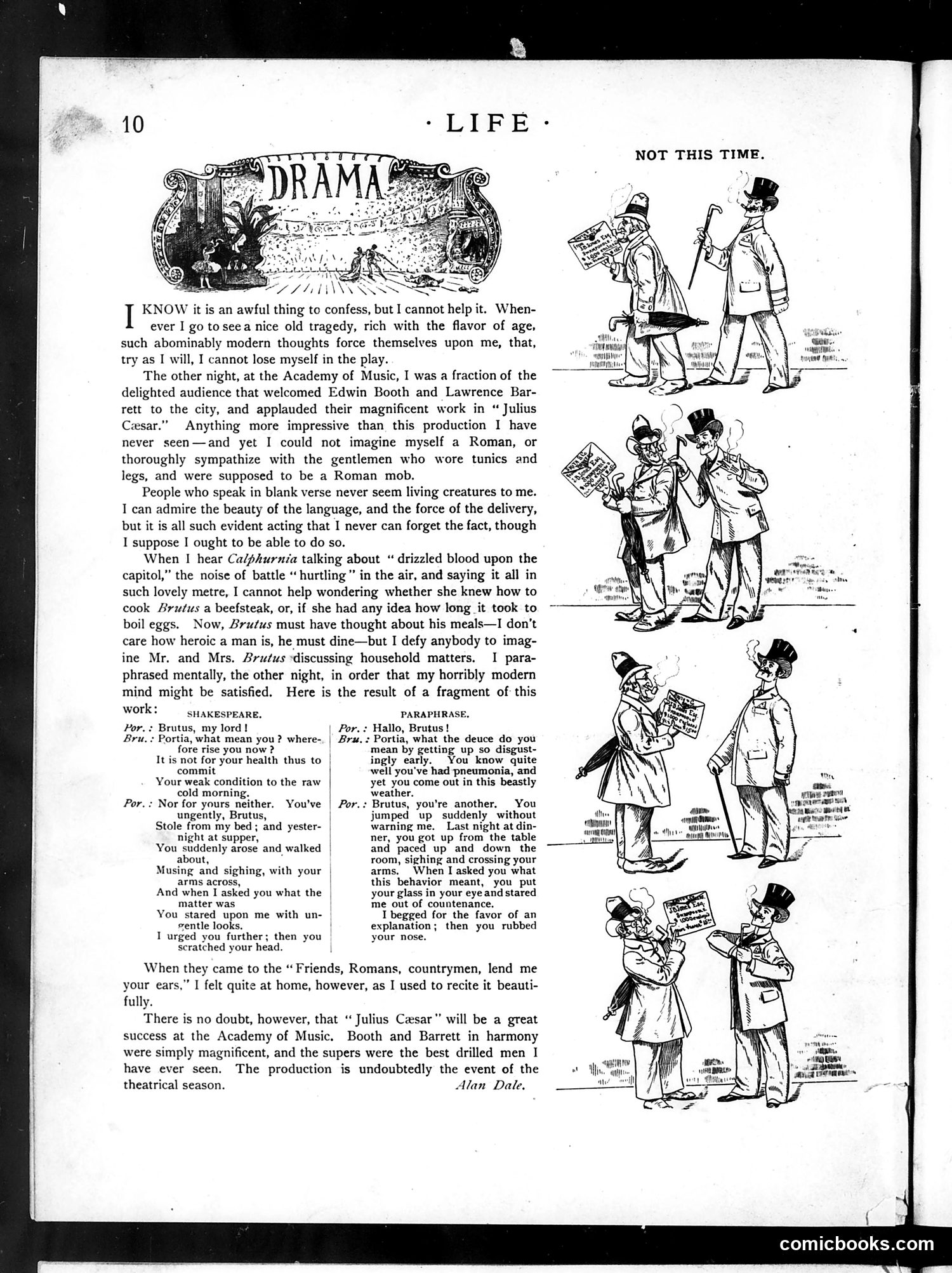
This page satirizes a contemporary production of Shakespeare's *Julius Caesar* at the Academy of Music, featuring actors Edwin Booth and Lawrence Barrett. The author confesses to being bored by the "abominably modern thoughts" the production forced upon them. The right side contains four cartoon panels labeled "NOT THIS TIME," showing two men (likely theater-goers) in top hats repeatedly attempting to discuss the play. Each panel depicts them trying to converse while holding newspapers or programs, but being interrupted or ignored—a visual joke about the difficulty of having a serious discussion about Shakespeare in modern times. The text includes a humorous Shakespeare/modern paraphrase comparing a character's neurotic behavior to trivial household concerns, mocking how contemporary audiences miss the play's grand themes.
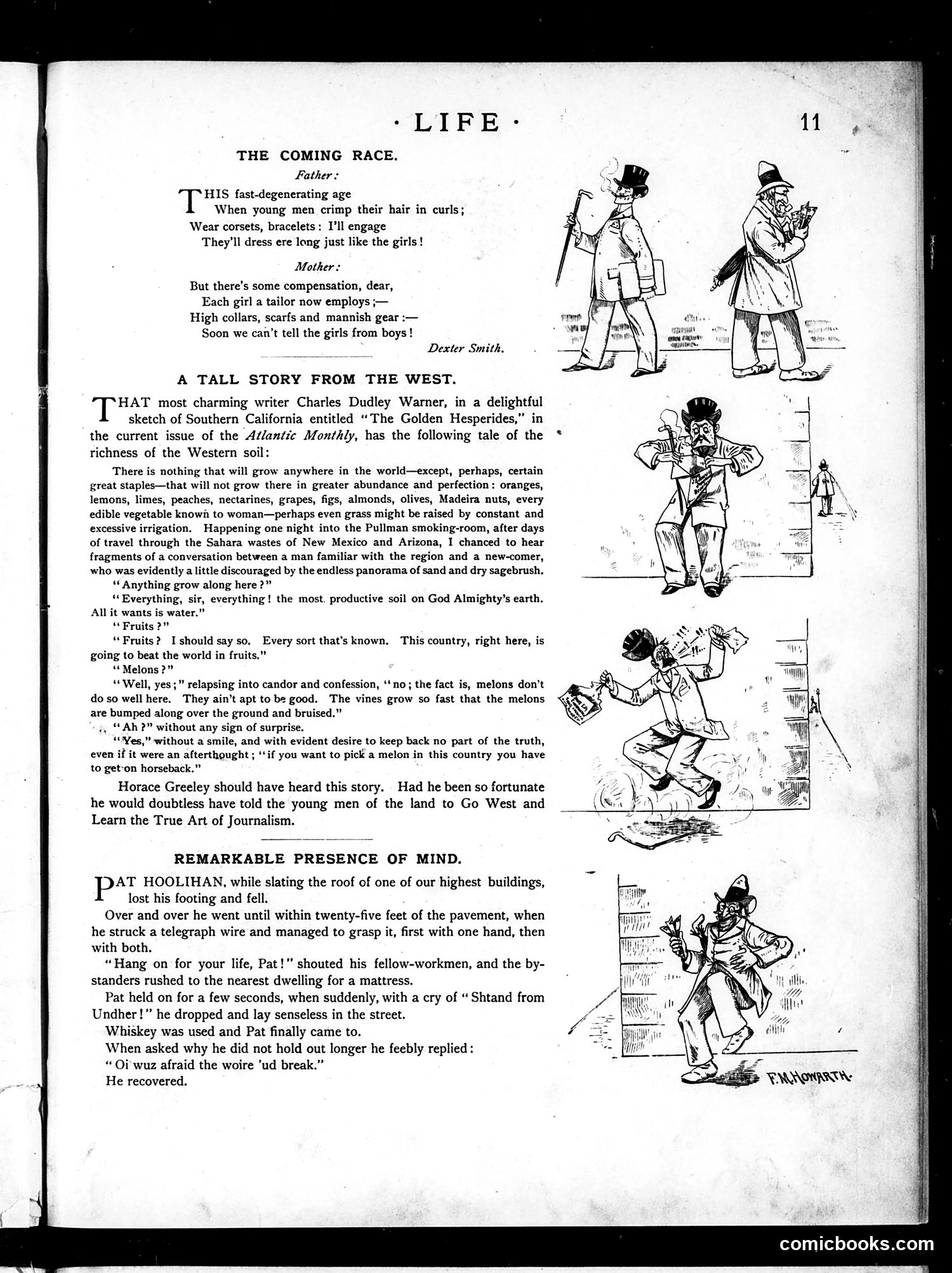
**"The Coming Race"** (top) satirizes gender role anxieties of the era. A father laments young men adopting feminine fashion (curled hair, corsets, bracelets), while the mother notes girls now wear "mannish gear"—high collars and scarves. The joke: society fears gender presentation is collapsing, making sexes indistinguishable. This reflects late 19th-century anxieties about the "New Woman" and changing social norms. **"A Tall Story from the West"** mocks Western boosterism and tall tales. Charles Dudley Warner's account of California's miraculous soil is undercut by a comic anecdote: melons grow *so fast* they get bruised rolling across the ground—you need a *horse* to pick them. The satire targets exaggerated Western promotional claims and credulous Eastern readers. **"Remarkable Presence of Mind"** presents an Irish workman (Pat Hoolihan, indicated by dialect) who survives a fall by grabbing a telegraph wire, then drops deliberately—fearing the wire will break under his weight. The dark humor: his "presence of mind" is misplaced worry about property damage while falling to certain death.
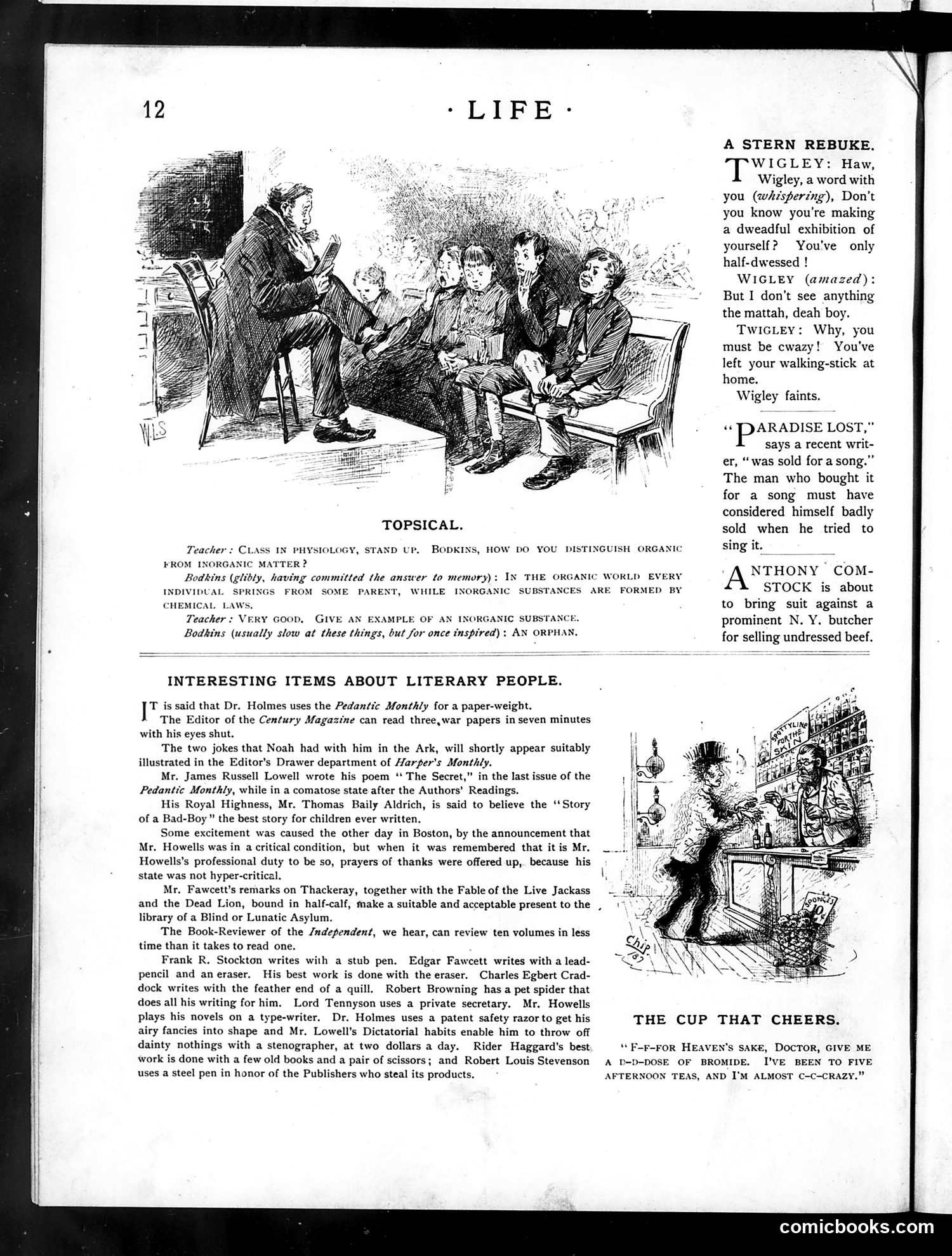
This page contains three distinct satirical pieces mocking Victorian social pretension and literary culture: **"A Stern Rebuke"** (top cartoon): Two fashionably dressed men critique each other's appearance with exaggerated upper-class affectation. The joke satirizes the obsessive concern with perfect dress codes among the wealthy—one man faints upon realizing he forgot his walking stick, treating this minor omission as social catastrophe. **"Topsical"** (middle): A classroom scene where a student recites a memorized physiology answer perfectly, then hilariously fails when asked to think independently, confusing "organic" and "inorganic." This mocks rote memorization in education. **Literary section**: Humorous observations about famous American and British writers (Holmes, Lowell, Howells, Tennyson, etc.), exaggerating their quirks—using magazines as paperweights, reviewing books while half-asleep, etc. The final anecdote about tea-induced hysteria satirizes women's social obligations and nervous exhaustion from endless afternoon social calls. The overall theme: mocking Victorian society's superficiality, pretension, and rigid social conventions.
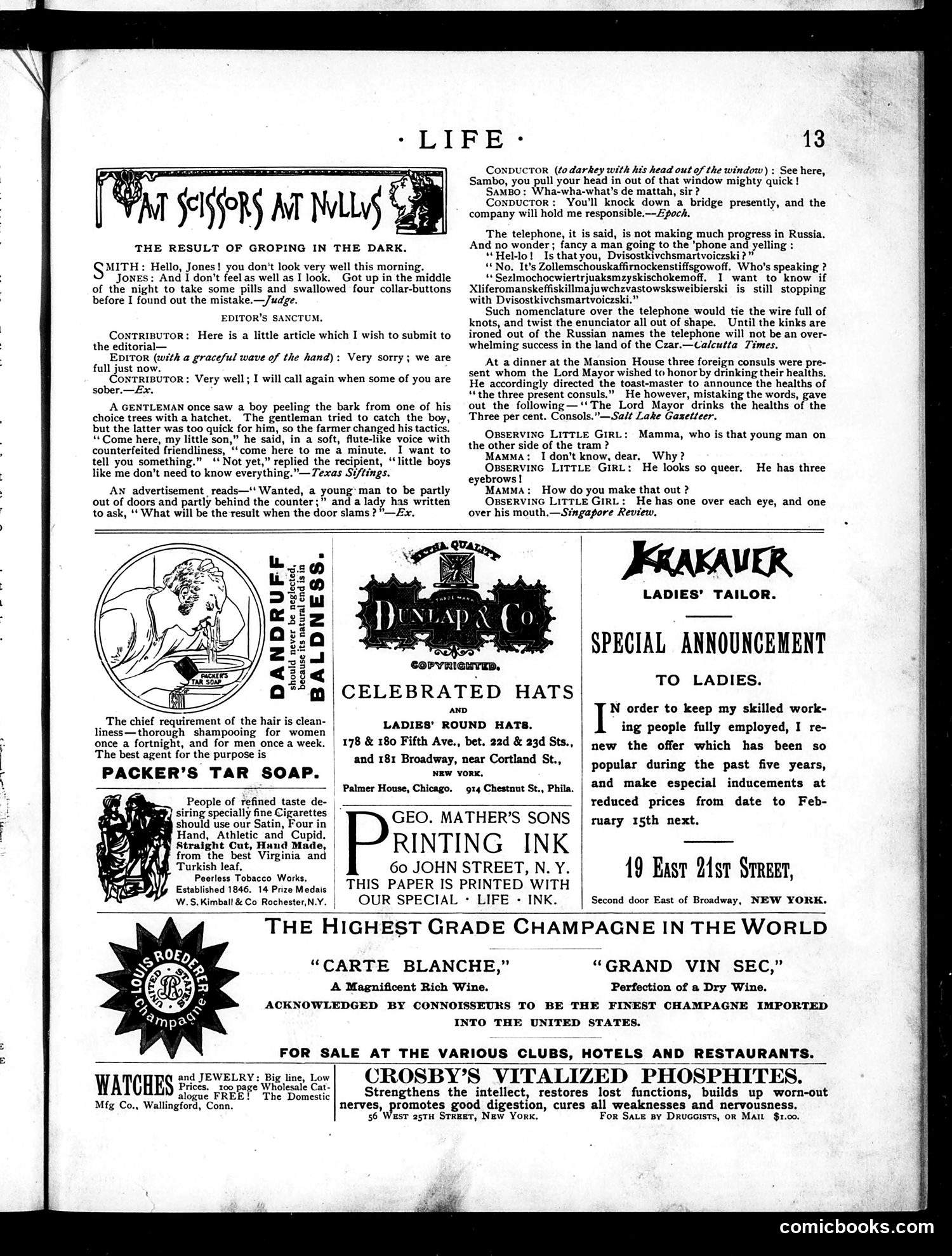
This is primarily a **humor and advertising page** from Life magazine. The main content consists of short jokes and anecdotes: **The Cartoons/Jokes:** - "Groping in the Dark" depicts a man who accidentally swallowed collar-buttons instead of pills—a visual gag about mistaking objects in darkness - References to Russian names so complex they'd jam telephone lines—satire on difficult-to-pronounce Russian nomenclature - A child observing a man has "three eyebrows" (one over each eye, one over his mouth)—jokes about unusual appearance - Anecdotes about rejection, tree damage, and a Lord Mayor confusing "consuls" with financial "consols" **Historical Context:** These represent typical early-1900s Life magazine humor: puns, absurdist scenarios, and gentle social observation. The Russian telephone joke reflects contemporary American attitudes toward foreign names as incomprehensibly complex. **The Rest:** The page is dominated by **period advertisements** for hair soap, champagne, watches, printing ink, and tailoring services—standard magazine filler of the era.
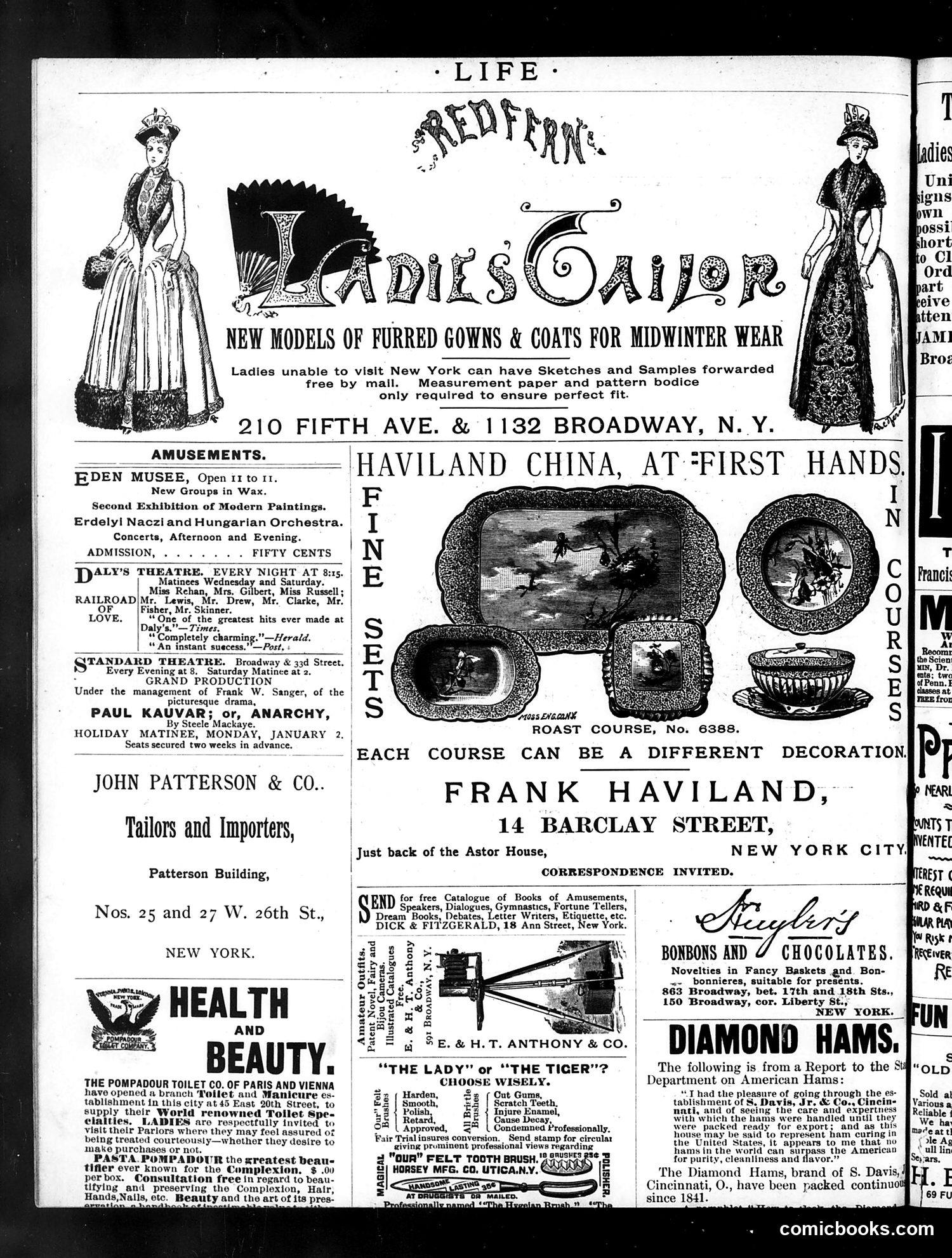
This is primarily an **advertising page** from a late 19th-century issue of Life magazine, not a political cartoon. The page contains commercial advertisements interspersed with theater listings. The main content includes: - **Fashion advertisement** (top): Redfearn's ladies' tailor shop promoting "furred gowns & coats for midwinter wear," with mail-order services for out-of-town customers - **Theater listings**: Standard entertainment venues advertising plays like "Paul Kauvar; or, Anarchy" and "Railroad of Love" - **Product advertisements**: Toilet products, chocolates, tooth brushes, and notably **Diamond Hams** from Cincinnati, featuring a testimonial about American ham quality The page reflects the commercial landscape of the era—mail-order fashion, theater culture, and emerging consumer goods marketing. The ham advertisement is notable for including a formal endorsement about product standards, suggesting growing consumer awareness of food safety and quality. There is no significant political satire or social commentary visible on this particular page.
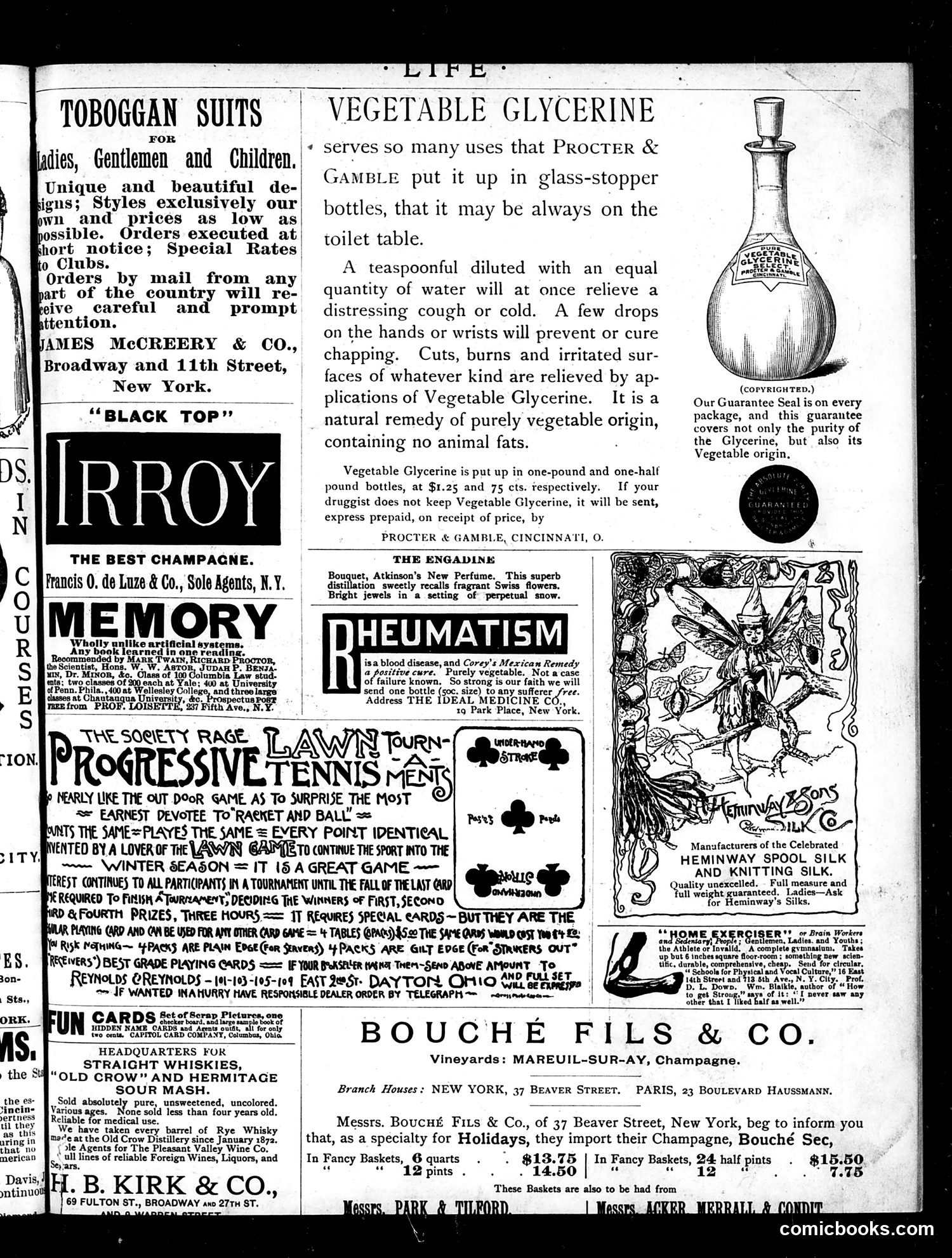
This page is primarily **advertising**, not political satire. The dominant content consists of product advertisements for late 19th/early 20th-century goods: Toboggan suits, champagne, Vegetable Glycerine (a multi-purpose remedy), perfume, and playing cards. The one illustrated feature—titled "The Society Rage: Progressive Lawn Tennis"—depicts a parlor game designed to bring outdoor lawn tennis indoors during winter months. It's marketed as entertainment for the leisure class, allowing "the most earnest devotee to racket and ball" to continue play year-round using special cards rather than actual equipment. The text emphasizes the game's accessibility and appeal: it uses identical rules to outdoor tennis but requires only cards and tables, making it suitable for winter entertainment at home. This reflects Gilded Age consumer culture where indoor amusements and sports equipment were marketed as status symbols to the wealthy. No political figures or satirical commentary are evident on this page.
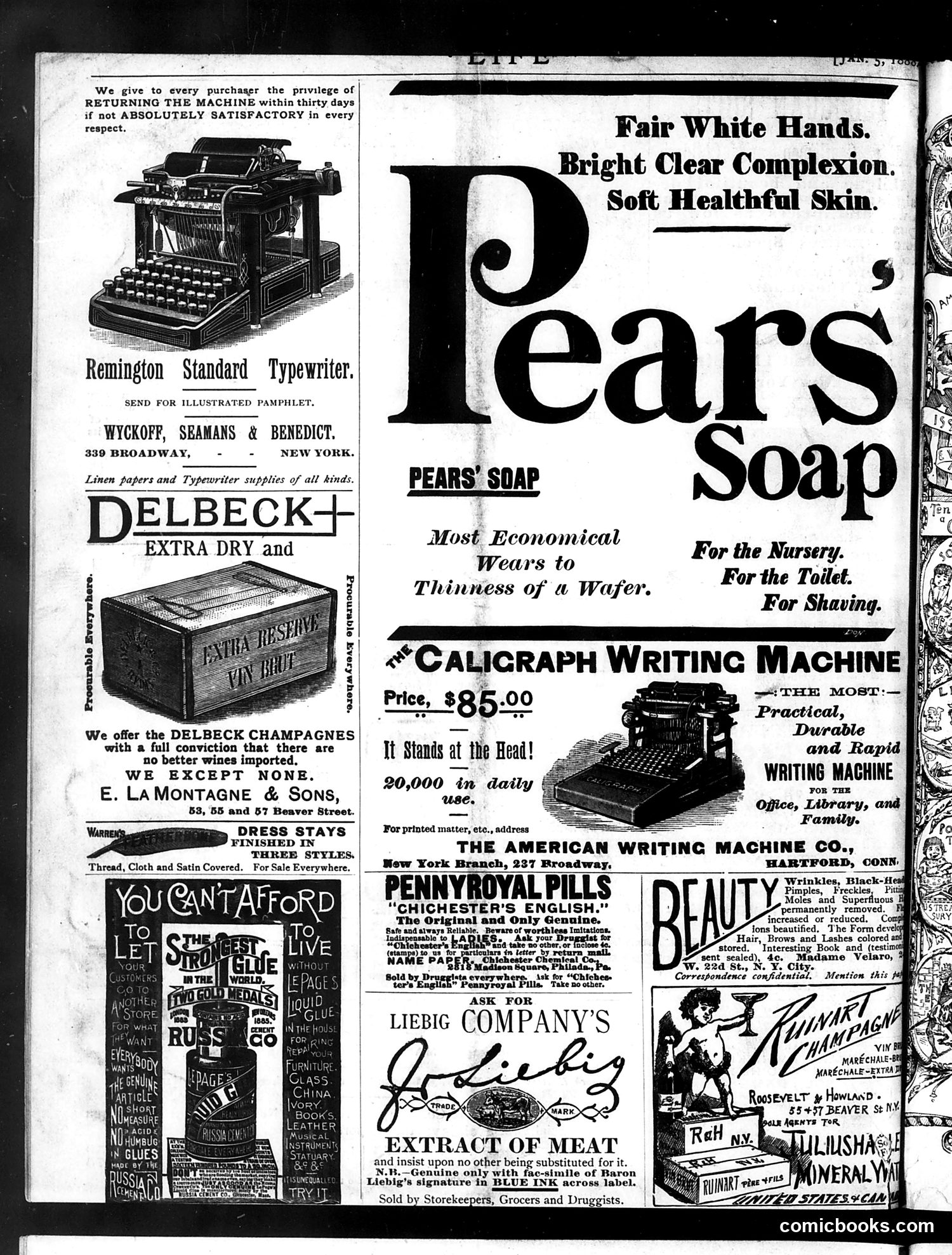
This is primarily an **advertisement page**, not a political cartoon. It contains mostly commercial ads from circa 1880s-1890s, arranged vertically and horizontally. Notable content includes: **Products advertised:** - Remington Standard Typewriter - Pears' Soap (emphasizing "Fair White Hands" and "Bright Clear Complexion"—reflecting period beauty standards) - Delbeck Champagne - Caligraph Writing Machine ($85) - Pennyroyal Pills ("Chichester's English") - Liebig's Extract of Meat **The one distinct visual element** is a tall vertical advertisement for "Street Glue" and related products, using bold typography and repetitive text to fill space—a common advertising design of the era. **Historical note:** The Pennyroyal Pills ad and beauty product emphasis reflect 19th-century consumer culture, though modern readers should note some products (like Pennyroyal) were used for purposes we'd now consider dangerous. This page documents period advertising rather than satirical content.