
Life, 1888-01-05 · page 6 of 16
Life — January 5, 1888 — page 6: what you’re looking at
What you’re looking at
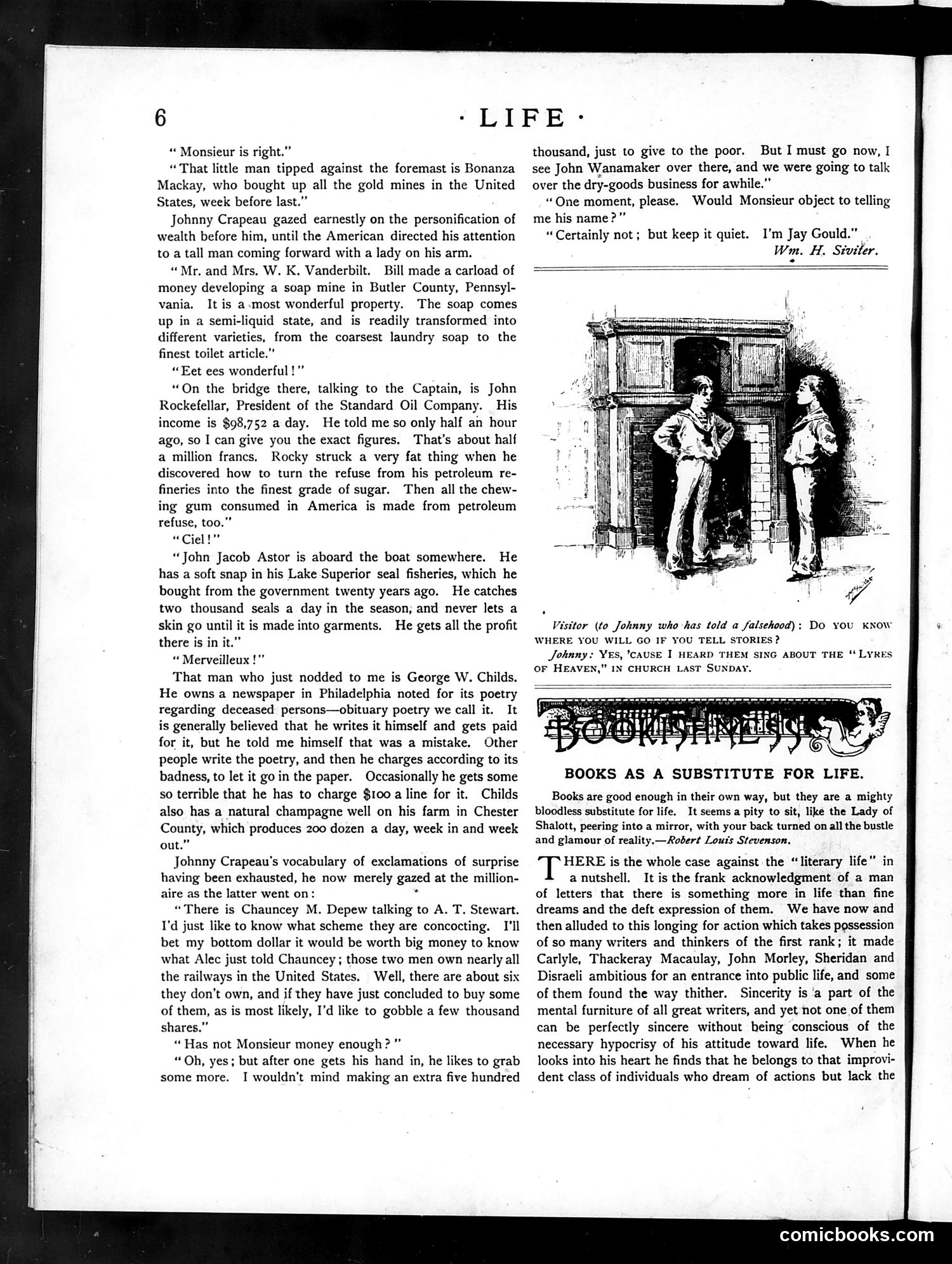
The main illustration shows a visitor confronting "Johnny" who has told a falsehood. The caption indicates Johnny claims to have heard the "Lyres of Heaven" sung in church, which the visitor questions—a joke about the child's dishonesty (the pun playing on "liars/lyres"). Below is an article titled "Books as a Substitute for Life," which critiques the notion that literary pursuits can replace real-world experience. The text references major 19th-century writers (Carlyle, Thackeray, Macaulay, Sheridan) to argue that great writers possessed both sincere observation of life and active engagement with the world—not mere armchair theorizing. The satire targets those who romanticize literature as an escape from reality rather than a reflection of it.
📄 Transcribed text from this page (OCR, searchable)
Machine-transcribed from the original scan — historical spelling and the odd misread are preserved.
6 - LIFE: “ Monsieur is right.” “That little man tipped against the foremast is Bonanza Mackay, who bought up all the gold mines in the United States, week before last.” Johnny Crapeau gazed earnestly on the personification of wealth before him, until the American directed his attention to a tall man coming forward with a lady on his arm. “Mr. and Mrs. W. K. Vanderbilt. Bill made a carload of money developing a soap mine in Butler County, Pennsyl- vania. It is a.most wonderful property. The soap comes up in a semi-liquid state, and is readily transformed into different varieties, from the coarsest laundry soap to the finest toilet article.” “Eet ees wonderful!” “On the bridge there, talking to the Captain, is John Rockefellar, President of the Standard Oil Company. His income is $98,752 a day. He told me so only half an hour ago, so I can give you the exact figures. That’s about half a million francs, Rocky struck a very fat thing when he discovered how to turn the refuse from his petroleum re- fineries into the finest grade of sugar. Then all the chew- ing gum consumed in America is made from petroleum refuse, too.” “Ciel!” “John Jacob Astor is aboard the boat somewhere. He has a soft snap in his Lake Superior seal fisheries, which he bought from the government twenty years ago. He catches two thousand seals a day in the season; and never lets a skin go until it is made into garments. He gets all the profit there is in it.” “ Merveilleux !” That man who just nodded to me is George W. Childs. He owns a newspaper in Philadelphia noted for its poetry regarding deceased persons—obituary poetry we call it. It is generally believed that he writes it himself and gets paid for it, but he told me himself that was a mistake. Other people write the poetry, and then he charges according to its badness, to let it go in the paper. Occasionally he gets some so terrible that he has to charge $100 a line for it. Childs also has a natural champagne well on his farm in Chester County, which produces 200 dozen a day, week in and week out.” Johnny Crapeau's vocabulary of exclamations of surprise having been exhausted, he now merely gazed at the million- aire as the latter went on: . “There is Chauncey M. Depew talking to A. T. Stewart. I'd just like to know what scheme they are concocting. I'll bet my bottom dollar it would be worth big money to know what Alec just told Chauncey ; those two men own nearly all the railways in the United States, Well, there are about six they don’t own, and if they have just concluded to buy some of them, as is most likely, I’d like to gobble a few thousand shares.” “Has not Monsieur money enough?” “Oh, yes; but after one gets his hand in, he likes to grab some more. I wouldn't mind making an extra five hundred thousand, just to give to the poor. But I must go now, I see John Wanamaker over there, and we were going to talk over the dry-goods business for awhile.” “One moment, please. Would Monsieur object to telling me his name?” “Certainly not ; but keep it quiet. I’m Jay Gould.” Wm. H. Siviter. Visitor (to Johnny who-has told a falsehood): Do You KNOW WHERE YOU WILL GO IF YOU TELL STORIES? Johnny: YES, 'CAUSE I HEARD THEM SING ABOUT THE ‘ LYRES OF HEAVEN,” IN CHURCH LAST SUNDAY. BOOKS AS A SUBSTITUTE FOR LIFE. Books are good enough in their own way, but they are a mighty bloodless substitute for life. It seems a pity to sit, like the Lady of Shalott, peering into a mirror, with your back turned on all the bustle and glamour of reality.—Robert Louis Stevenson. HERE is the whole case against the “literary life” in a nutshell. It is the frank acknowledgment of a man of letters that there is something more in life than fine dreams and the deft expression of them. We have now and then alluded to this longing for action which takes possession of so many writers and thinkers of the first rank; it made Carlyle, Thackeray Macaulay, John Morley, Sheridan and Disraeli ambitious for an entrance into public life, and some of them found the way thither. Sincerity is 'a part of the mental furniture of all great writers, and yet not one of them can be perfectly sincere without being conscious of the necessary hypocrisy of his attitude toward life. When he looks into his heart he finds that he belongs to that improvi- dent class of individuals who dream of actions but lack the comicbooks.com