
Life, 1888-01-05 · page 7 of 16
Life — January 5, 1888 — page 7: what you’re looking at
What you’re looking at
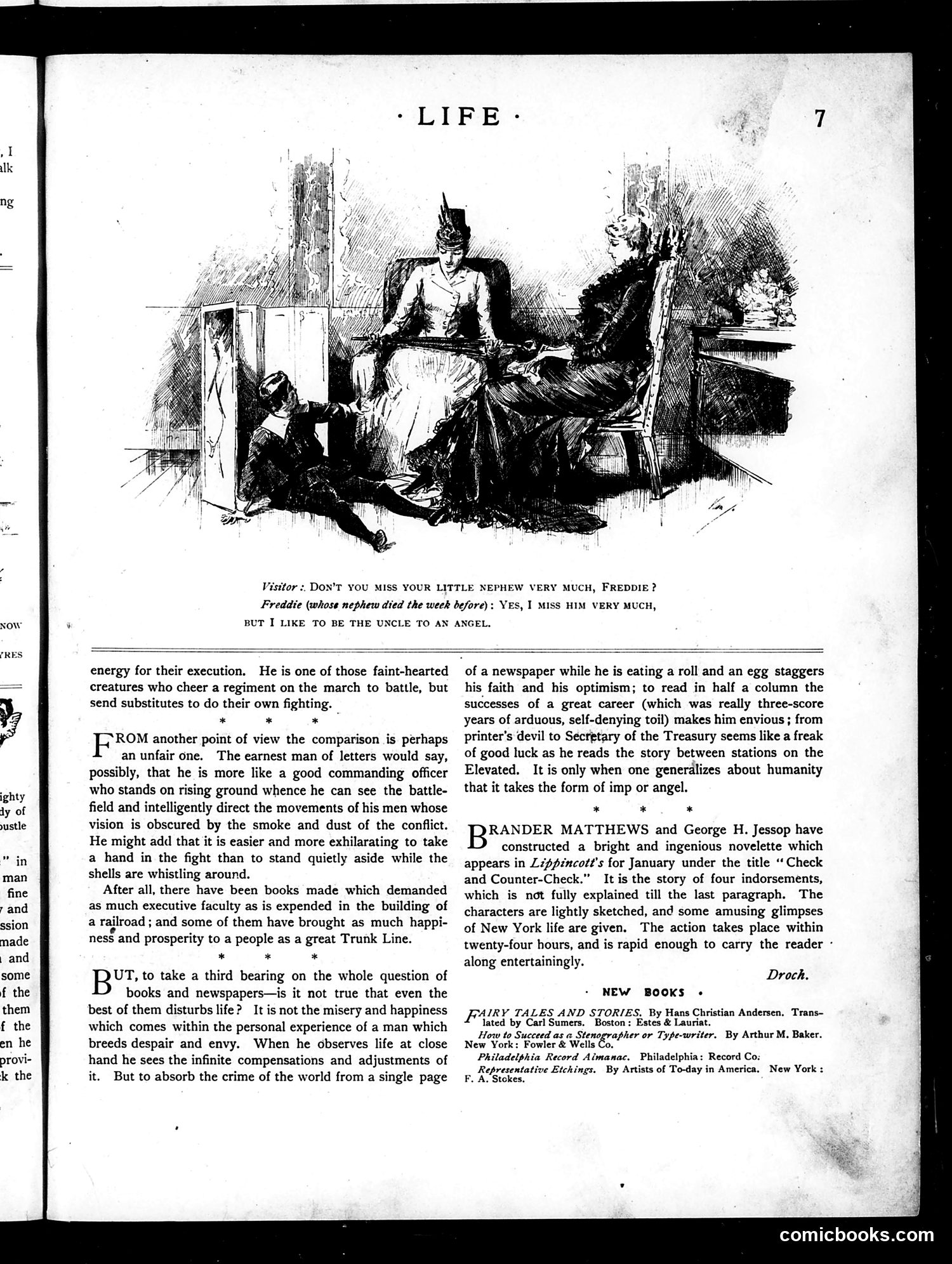
The cartoon depicts a social scene with a well-dressed woman seated while a man kneels or bows before her. The caption reads: "Don't you miss your LITTLE NEPHEW VERY MUCH, FREDDIE?" with the response "Yes, I miss him very much, but I like to be the UNCLE TO AN ANGEL." **The Satire:** This appears to be a commentary on courtship and romantic pursuit in Victorian/Edwardian society. The joke plays on the visitor's ostentatious flattery—calling the woman an "angel"—suggesting he's performing exaggerated gallantry to impress her, while using the deceased nephew as a pretext for his visit. The satire mocks the theatrical, insincere compliments men employed in social situations to advance romantic or social interests.
📄 Transcribed text from this page (OCR, searchable)
Machine-transcribed from the original scan — historical spelling and the odd misread are preserved.
Visitor :: DON’T YOU MISS YOUR LITTLE NEPHEW VERY MUCH, FREDDIE ? Freddie (whose nephew died the week before): VES, 1 MISS HIM VERY MUCH, BUT I LIKE TO BE THE UNCLE TO AN ANGEL. energy for their execution. He is one of those faint-hearted creatures who cheer a regiment on the march to battle, but send substitutes to do their own fighting. * * * pam another point of view the comparison is perhaps an unfair one. The earnest man of letters would say, possibly, that he is more like a good commanding officer who stands on rising ground whence he can see the battle- field and intelligently direct the movements of his men whose vision is obscured by the smoke and dust of the conflict. He might add that it is easier and more exhilarating to take a hand in the fight than to stand quietly aside while the shells are whistling around. After all, there have been books made which demanded as much executive faculty as is expended in the building of a railroad ; and some of them have brought as much happi- ness and prosperity to a people as a great Trunk Line. * * * UT, to take a third bearing on the whole question of books and newspapers—is it not true that even the best of them disturbs life? It is not the misery and happiness which comes within the personal experience of a man which breeds despair and envy. When he observes life at close hand he sees the infinite compensations and adjustments of it. But to absorb the crime of the world from a single page of a newspaper while he is eating a roll and an egg staggers his faith and his optimism; to read in half a column the successes of a great career (which was really three-score years of arduous, self-denying toil) makes him envious ; from printer's devil to Secretary of the Treasury seems like a freak of good luck as he reads the story between stations on the Elevated. It is only when one generalizes about humanity that it takes the form of imp or angel. * * * RANDER MATTHEWS and George H. Jessop have constructed a bright and ingenious novelette which appears in Lzppzncott's for January under the title “Check and Counter-Check.” It is the story of four indorsements, which is not fully explained till the last paragraph. The characters are lightly sketched, and some amusing glimpses of New York life are given. The action takes place within twenty-four hours, and is rapid enough to carry the reader - along entertainingly. Droch. NEW BOOKS + FAlRY TALES AND STORIES, By Hans Christian Andersen, Trans- lated by Carl Sumers, Boston: Estes & Lauriat. How to Succeed as a Stenographer or Type-writer. By Arthur M. Baker. New York: Fowler & Wells Co. Philadelphia Record Almanac. Philadelphia: Record Co: Representative Etchings. By Artists of To-day in America, New York : F. A. Stokes. comicbooks.com