
A complete issue · 16 pages · 1887
Life — December 1, 1887
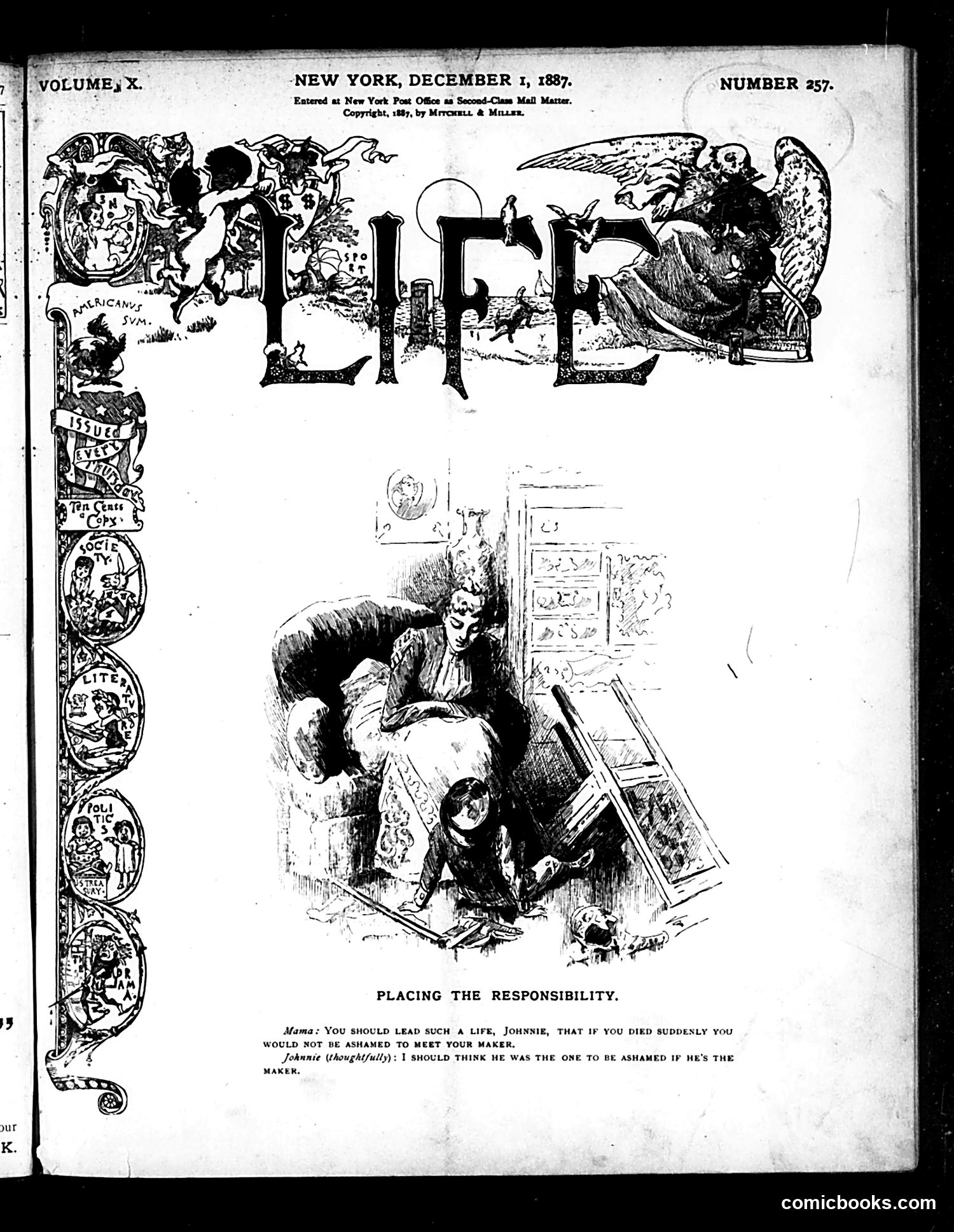
This cartoon satirizes parental discipline and moral responsibility. A mother scolds her son "Johnnie" after he's apparently misbehaved dangerously (possibly involving the rifle visible in the sketch). The mother warns him he should "lead such a life" that if he died suddenly, he wouldn't be "ashamed to meet your maker." Johnnie's caustic response—that the maker should be ashamed, since he's "the one" who created Johnnie—flips the responsibility back onto God/fate rather than accepting personal accountability. The joke critiques both permissive parenting and the boy's clever evasion of moral responsibility. It reflects Victorian anxieties about youth discipline and religious instruction in an era of rapid social change.
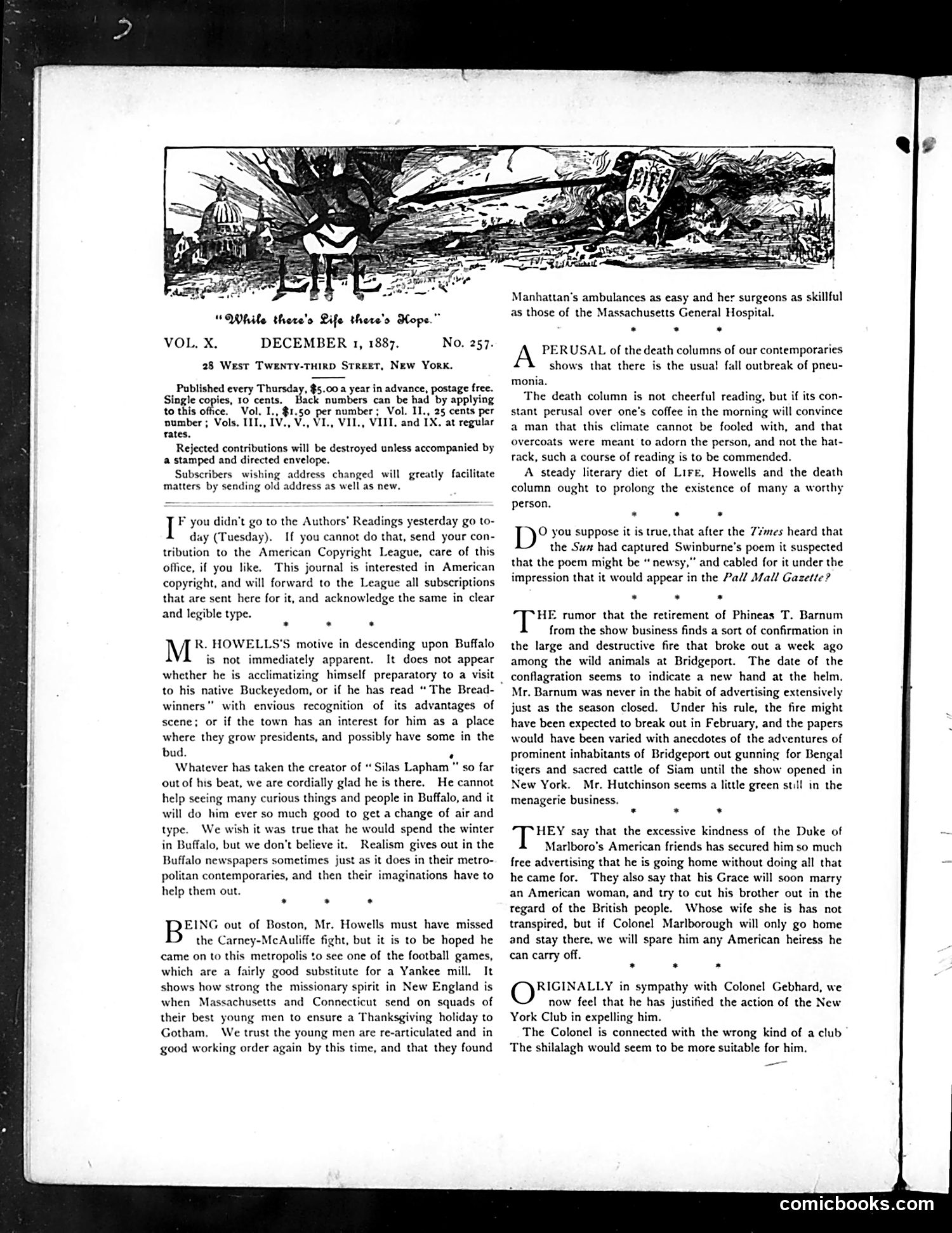
The masthead cartoon depicts a bare tree with figures beneath it and a quote: "While there's Life there's Hope." The page itself consists entirely of editorial commentary—no political cartoons appear here. The pieces discuss: 1. **Buffalo and Mr. Howells**: Commentary on writer William Dean Howells visiting Buffalo, noting it lacks the cultural attractions of major cities. 2. **Death statistics**: Discussion of pneumonia outbreaks in contemporary newspapers, recommending "Life" as preferable reading. 3. **Various gossip items**: References to Phineas T. Barnum's retirement from show business following a fire at Bridgeport, the Duke of Marlborough's American connections, and Colonel Gerhard's expulsion from the New York Club. The content is primarily satirical social commentary rather than visual political satire.
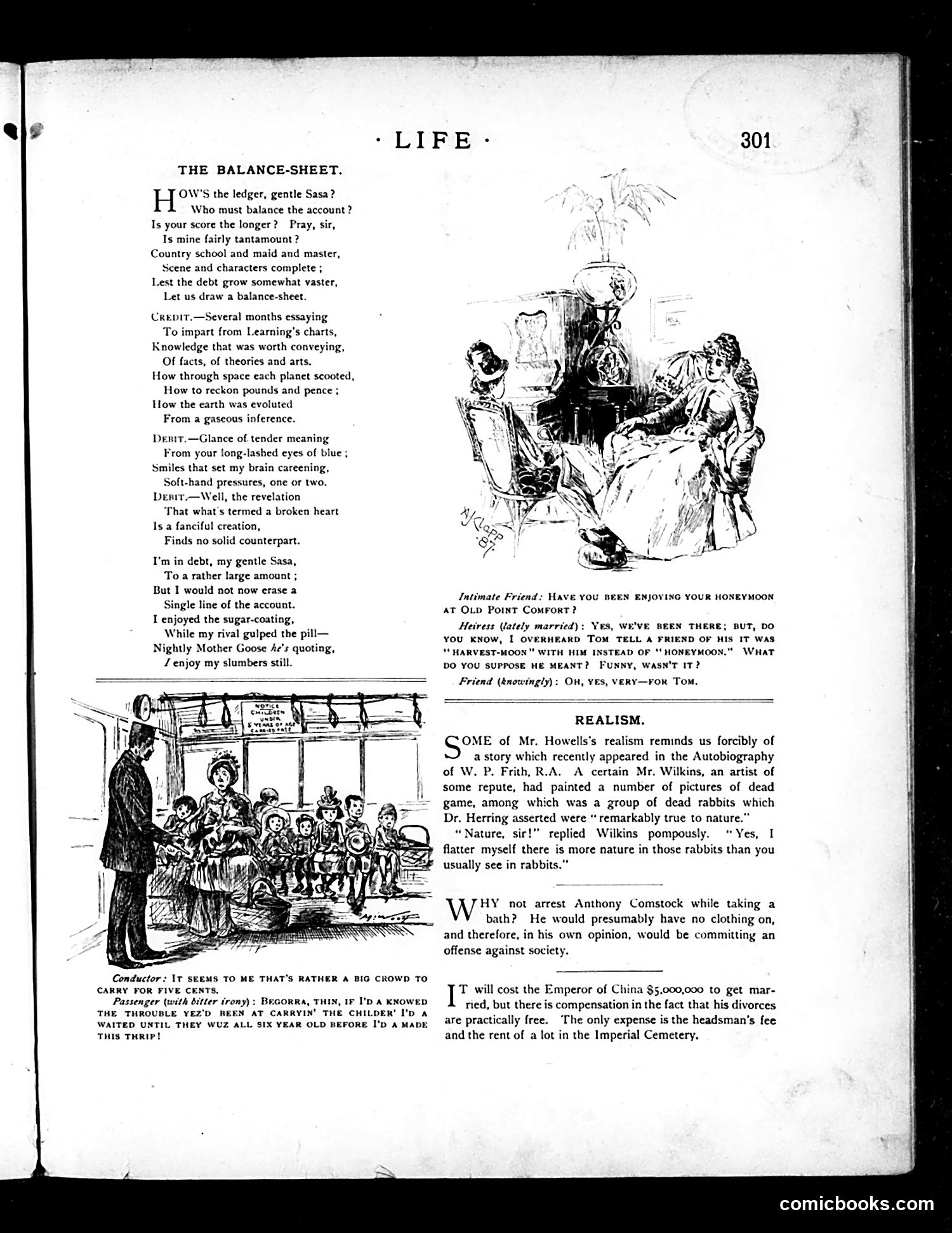
This page contains three distinct pieces of satirical content: **"The Balance-Sheet"** (top): A poem about financial debt and personal ledgers, likely satirizing Victorian-era bookkeeping obsessions and the tension between material and emotional accounts. **Middle cartoon**: Shows a street scene with what appears to be a conductor or official addressing a crowd of children on public transport, captioned about carrying "five cents" and referenced as a "known the Thimble'd need near a carryful the children I'd a waited until they wuz all six year old before I'd a made this trip!" This mocks overcrowding on public transit and parental frustration with childcare logistics. **"Realism" section**: Critiques H.G. Wells's artistic realism, referencing W.H. Frith's rabbits painting anecdote to debate authenticity in art versus stylization. **Bottom item**: A quip about Emperor of China's divorce costs. The page reflects turn-of-century American middle-class concerns: public transportation, parenting, and artistic theory.
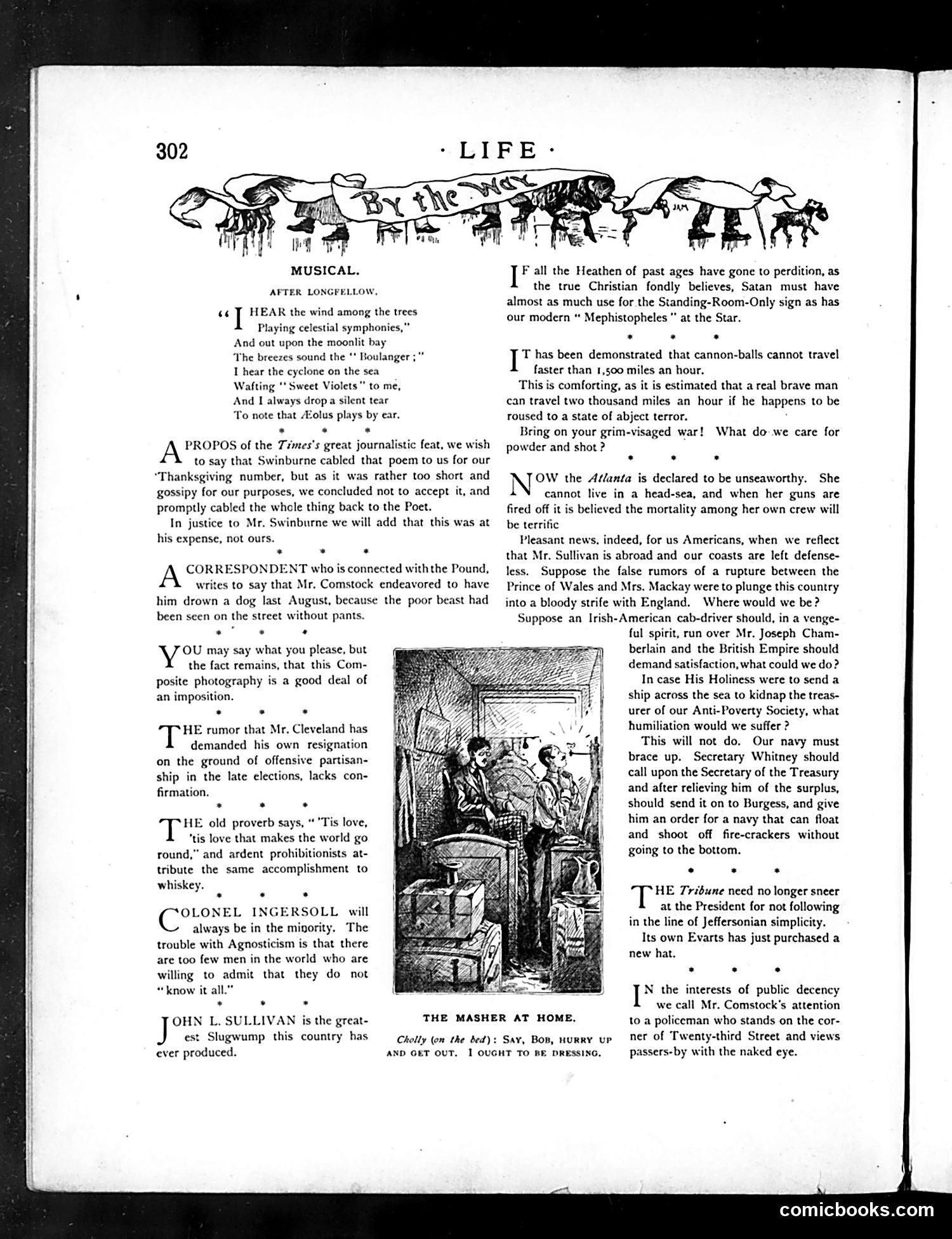
This page contains satirical commentary and a cartoon titled "The Masher at Home." The cartoon depicts a man in domestic settings, with a caption from "Cholly" (a gossip columnist persona common in Life) reading "Say, Bob, hurry up and get out. I ought to be dressing." The "masher" was period slang for an aggressive flirt or street harasser. The satire appears to target a man who pursues women in public yet proves domestically inept or awkward—likely poking fun at men who adopted aggressive courtship tactics while being incompetent in their own homes. The surrounding text includes various short satirical items mocking contemporary figures and events, typical of Life's format. Without clearer identification of specific references, the exact political targets remain unclear beyond the general social commentary on masculine behavior and hypocrisy.
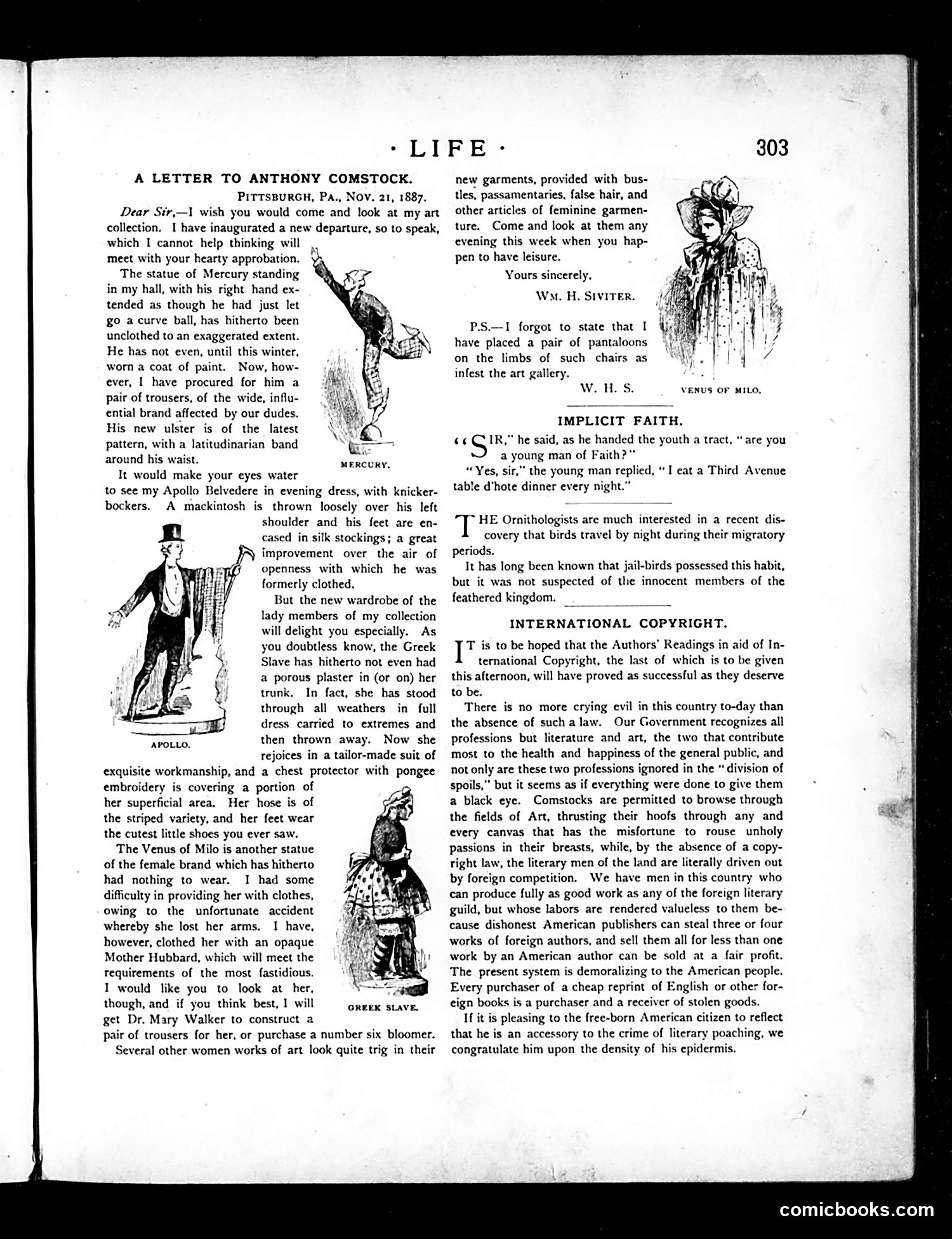
This page contains three distinct illustrations with satirical commentary on 1880s American society: 1. **Mercury and Apollo figures** (left side): Classical statues depicted in fashionable contemporary dress—Mercury in evening wear with knickerbockers, Apollo in a tailor-made suit. The satire mocks wealthy collectors who dress classical sculptures in modern clothing, treating priceless art as fashion objects. 2. **Venus of Milo illustration** (center): Shows the famous armless statue clothed in contemporary women's fashion. The text jokes about the difficulty of dressing a statue lacking arms, suggesting absurdity in the collector's practices. 3. **Greek Slave figure** (lower right): Likely references Hiram Powers' famous neoclassical sculpture, depicted in modern dress, continuing the theme of incongruous modernization of classical art. The overall satire ridicules wealthy art collectors' tastelessness in altering priceless classical works.
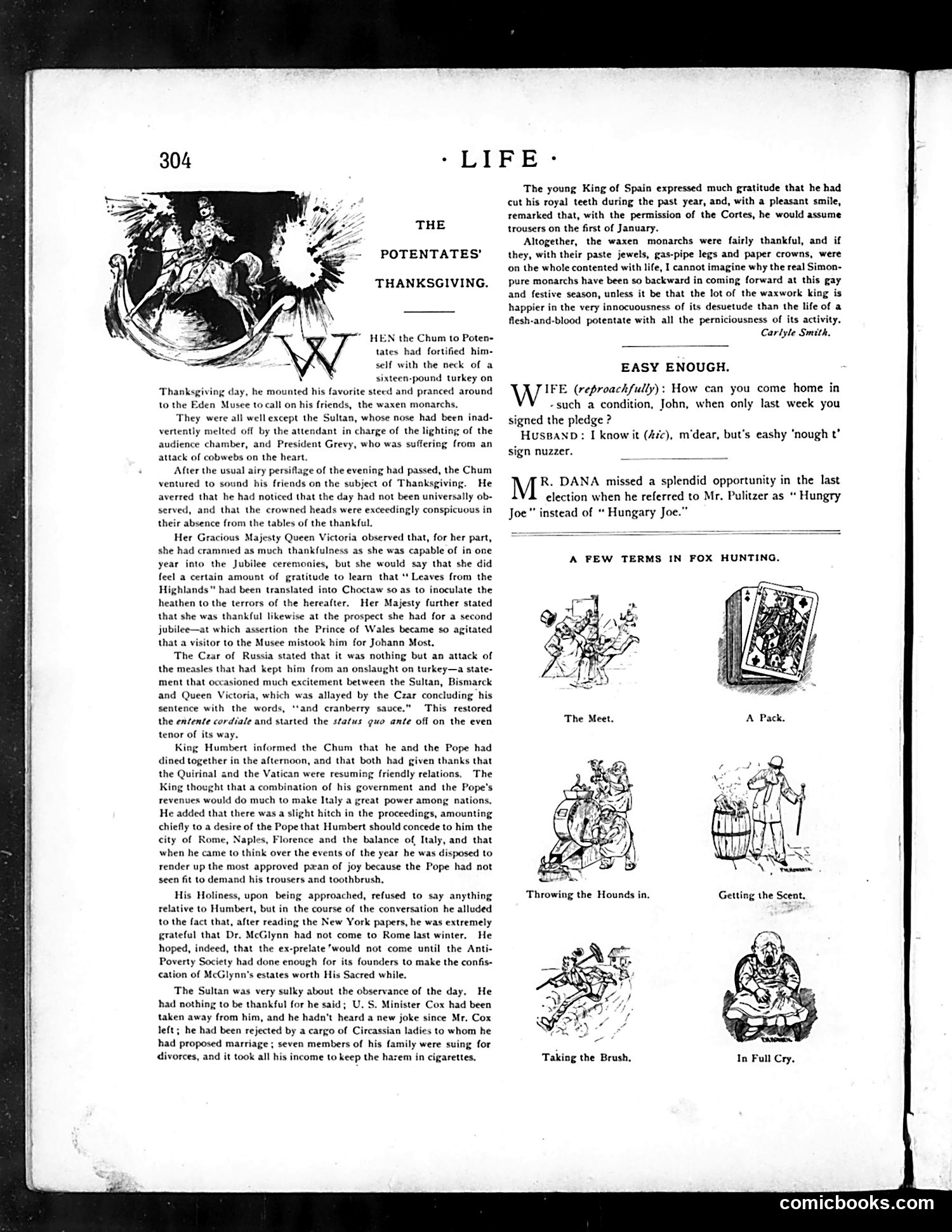
This page contains three distinct satirical pieces: **"The Potentates' Thanksgiving"** satirizes world leaders' gratitude during what appears to be a diplomatic gathering. It mocks their hollow thanks—the King of Spain is grateful for dental work; Queen Victoria claims thankfulness while actually being bitter; the Czar of Russia's "gratitude" masks violent impulses. **"Easy Enough"** is a brief marital joke about a wife catching her husband in a lie about signing a pledge. **"A Few Terms in Fox Hunting"** uses fox-hunting terminology (The Meet, A Pack, Throwing the Hounds in, Getting the Scent, Taking the Brush, In Full Cry) as humorous captions for illustrated hunting scenes. The page primarily satirizes political hypocrisy among world powers during what appears to be the late 19th century.
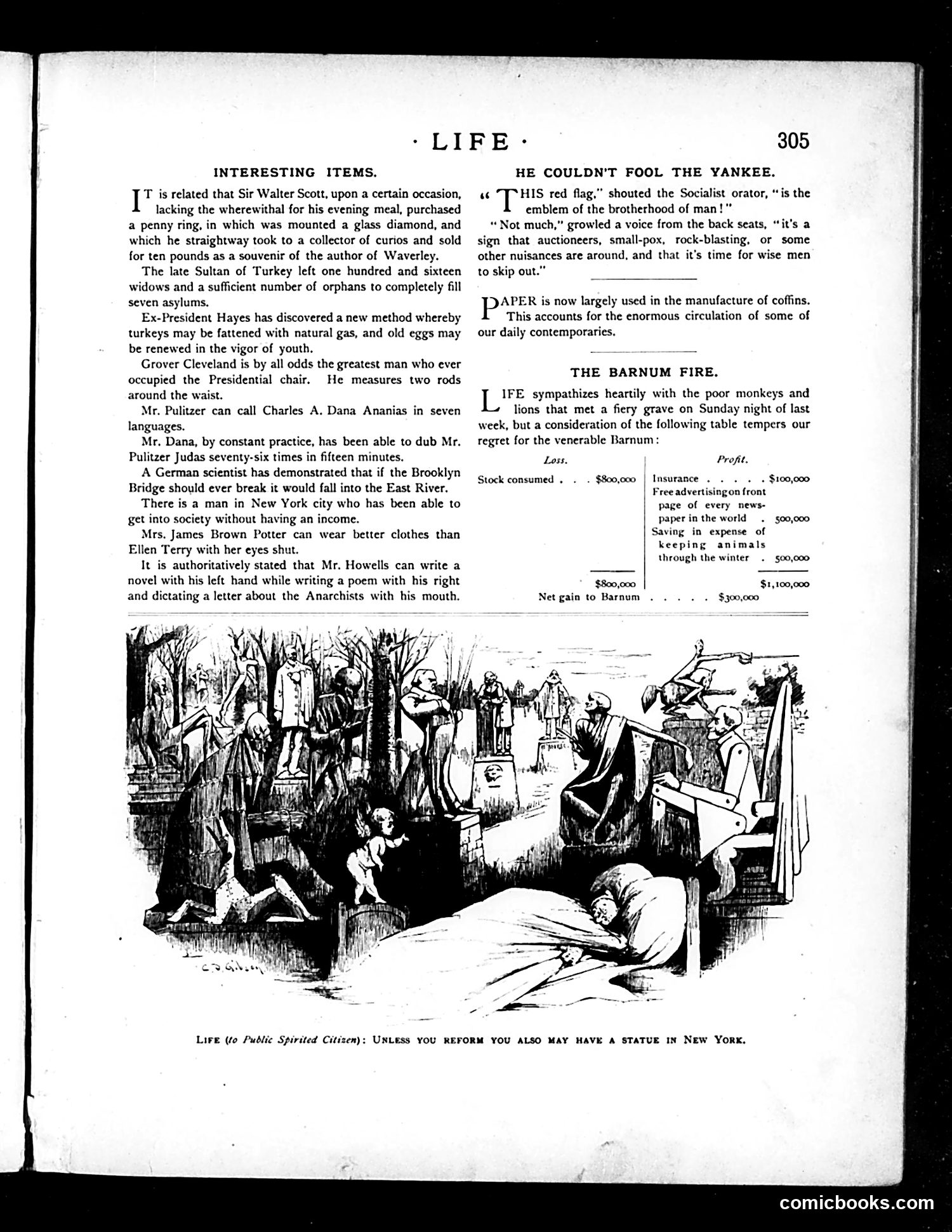
This page contains miscellaneous satirical items and a cartoon about the Barnum fire. The main illustration depicts a graveyard scene where circus animals (monkeys and lions) are being buried, with onlookers and what appears to be a coffin-maker or undertaker present. The accompanying table shows financial losses and profits from the fire, sarcastically calculating how P.T. Barnum profited from the disaster through insurance and newspaper advertising revenue. The satire targets Barnum's reputation as a showman willing to exploit any situation for publicity and profit, even animal deaths. The caption below jokes about reform and statues in New York, likely mocking Barnum's self-aggrandizement. The upper section contains brief humorous anecdotes about various public figures, typical of Life magazine's satirical style.
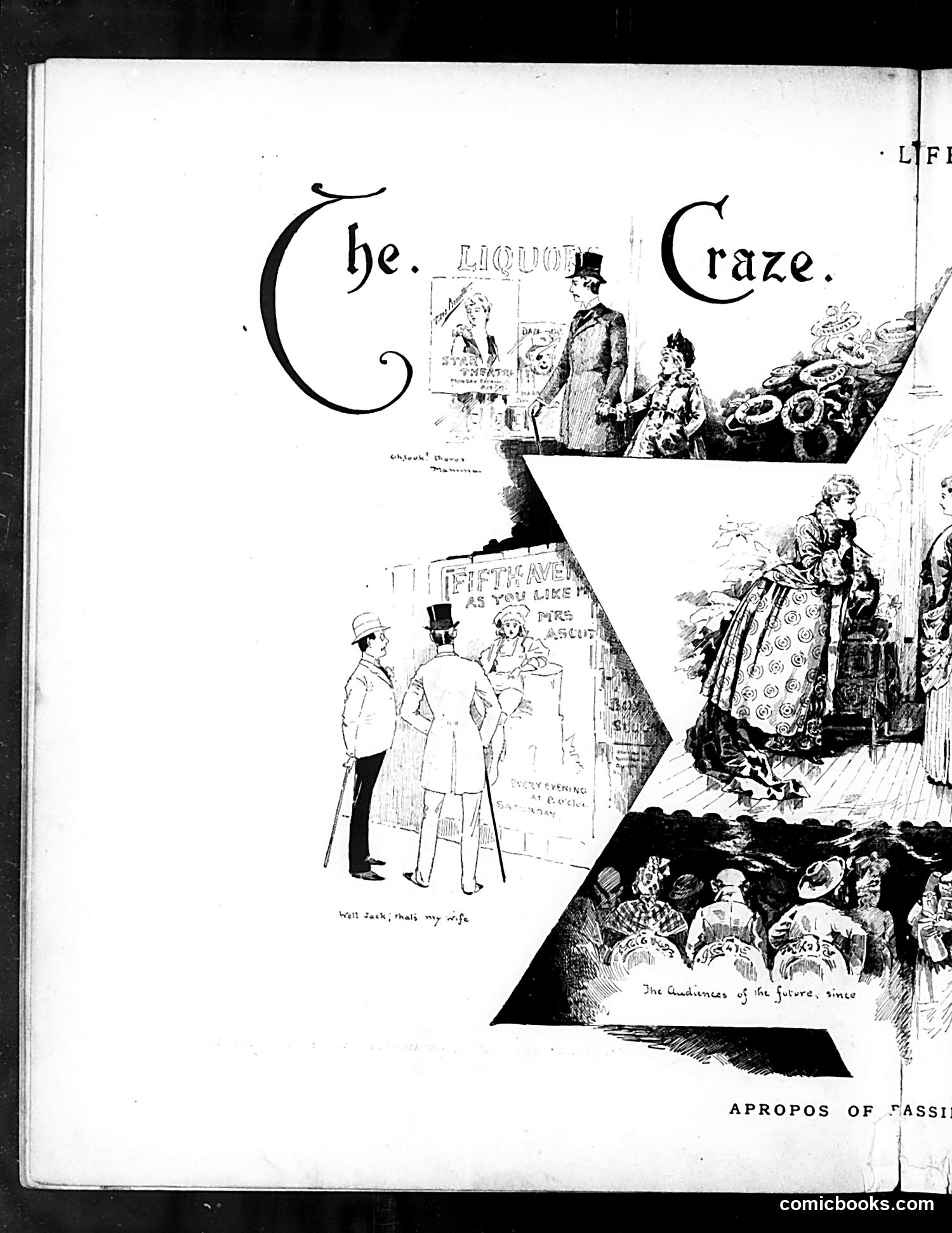
This Life magazine page satirizes the social obsession with alcohol consumption during the early 20th century (likely pre-Prohibition). The title "The Liquor Craze" appears overlaid on illustrated vignettes showing various social scenes. The cartoons depict multiple perspectives on drinking culture: wealthy patrons at establishments, theater-goers, and street scenes. One caption reads "Will Zach share my wife" (unclear exact context), while another references "The audiences of the future, since" (text cuts off). The satire critiques how alcohol consumption had become fashionable across social classes and settings—from formal venues to casual encounters. The layout's dramatic angles and multiple scenes emphasize how pervasive this "craze" had become in American society. The attribution reads "APROPOS OF PASSI[NG]" (likely "APROPOS OF PASSING").
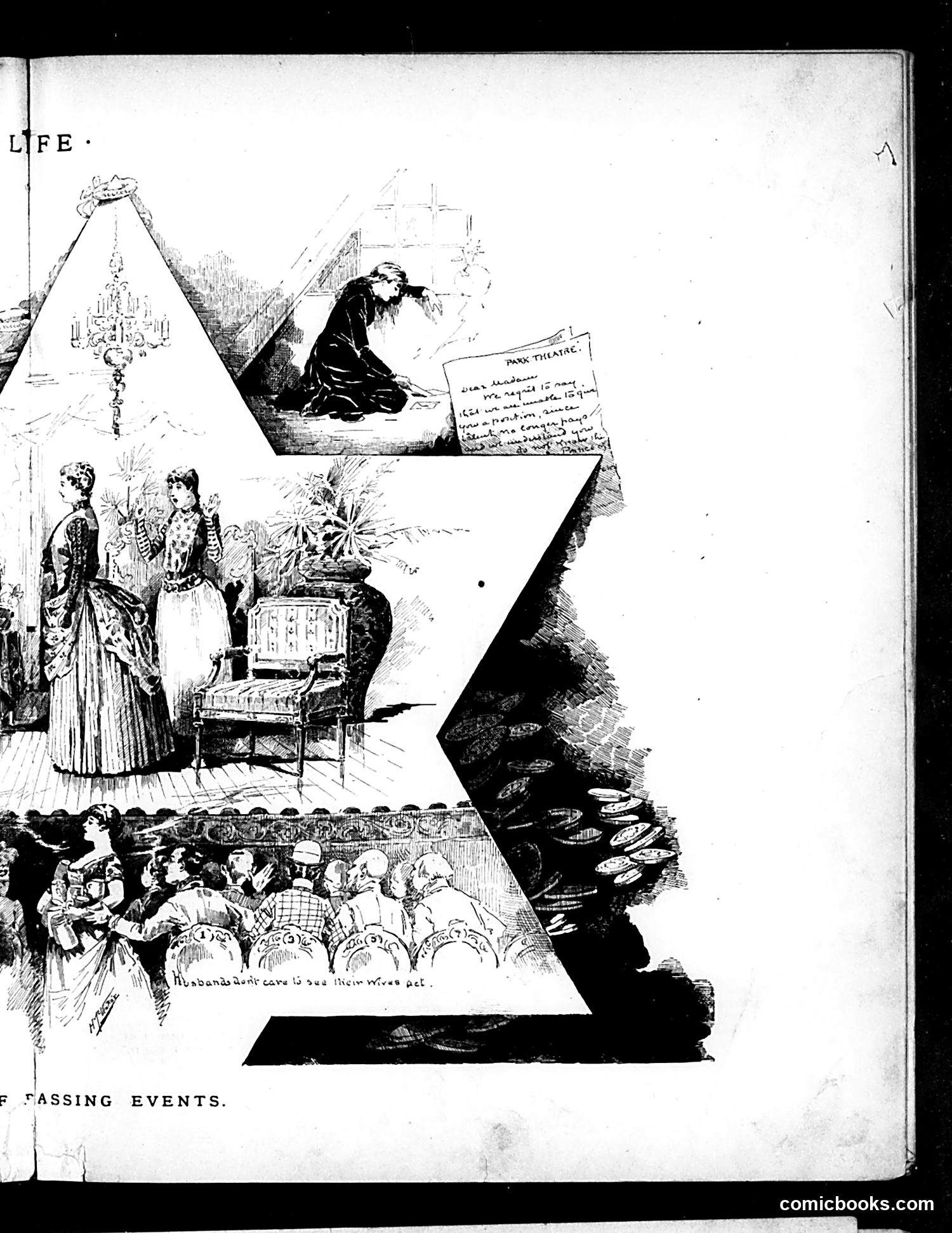
This satirical illustration depicts theatrical life through layered scenes. At the top, a figure (likely a playwright or critic) sits writing notes marked "Park Theatre," suggesting commentary on that venue's productions. Below, two well-dressed women appear to be socialites or patrons attending a performance. The central geometric shape frames what seems to be an audience or theatrical gathering. At the bottom, multiple figures in the audience are shown, with caption text (partially illegible in the OCR) that appears to make a joke about theater-goers' behavior or reactions. The overall composition satirizes the theatrical world—likely mocking either pretentious audiences, performers, or the productions themselves. The sketch style and layout are typical of *Life* magazine's social commentary cartoons from the late 19th or early 20th century.
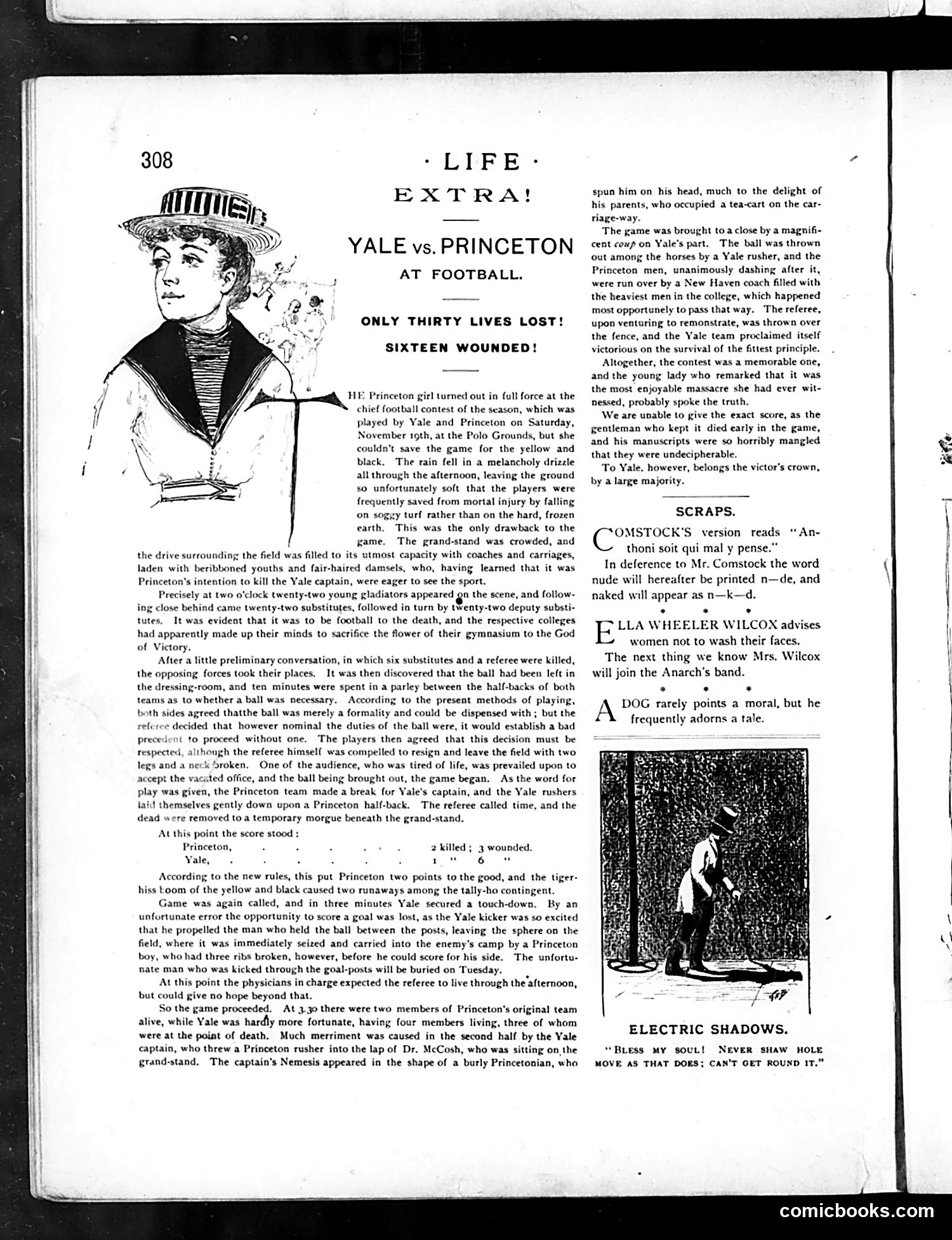
This page reports on a catastrophic 1881 football game between Yale and Princeton at the Polo Grounds. The illustrated figure on the left appears to be a young man affected by the disaster. The "LIFE EXTRA!" headline announces: "ONLY THIRTY LIVES LOST! SIXTEEN WOUNDED!" The article describes a genuinely tragic event where the ball was lost during play, causing confusion about whether to continue. Players disagreed on procedures, and amid the chaos, spectators were crushed—some fatally—by collapsing grandstands or through dangerous crowd conditions. The text notes deaths and injuries occurred, and that physicians expected the referee might not survive the afternoon. This was actual reportage of a real disaster, presented with Life magazine's characteristic satirical headline style, darkly emphasizing the contrast between sports entertainment and human tragedy.
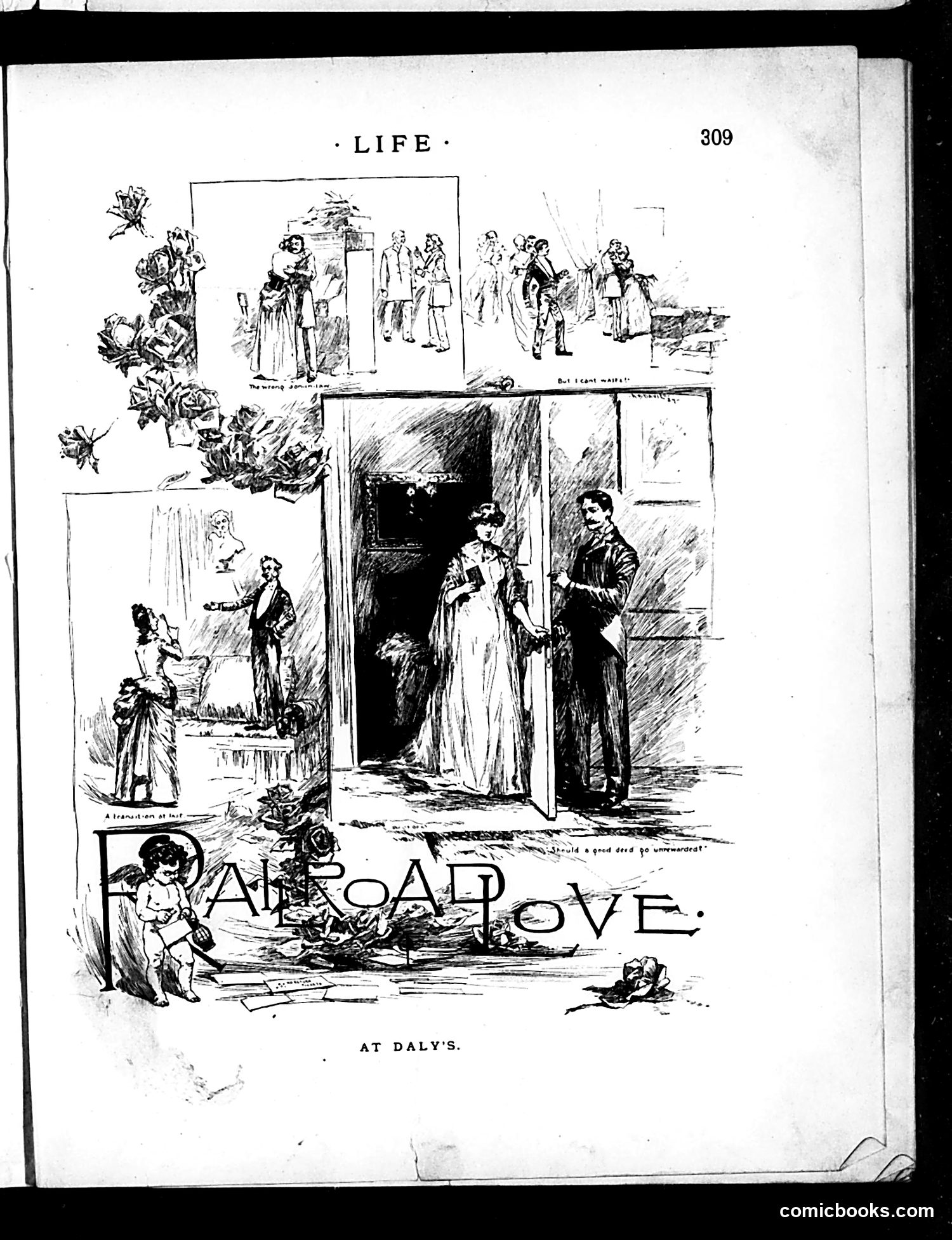
This appears to be a theatrical satire from Life magazine (page 309) depicting a scene at Daly's Theatre, a prominent New York playhouse. The sketch shows what seems to be a romantic or dramatic theatrical scene—a woman in a doorway with men in formal dress, suggesting theatrical melodrama or romantic comedy. The title "Abroad Love" and the staging suggest this mocks a specific play or theatrical production at Daly's. The illustration style, with its emphasis on exaggerated expressions and theatrical posturing, satirizes the overwrought emotionalism typical of period stage productions. The decorative floral elements framing the title enhance the romantic comedy aesthetic being lampooned. Without additional context about the specific production, the exact target of satire remains unclear.
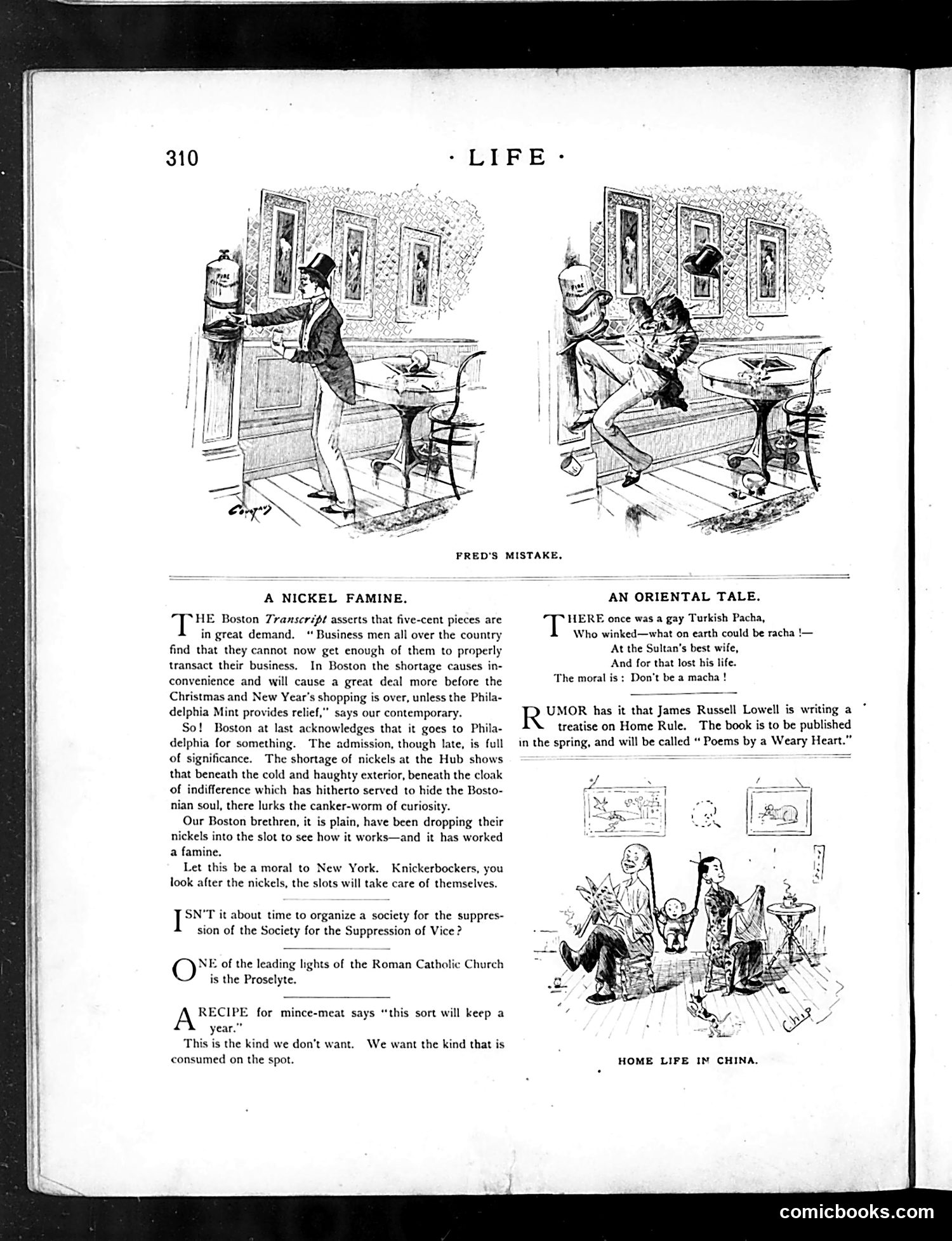
This Life magazine page contains satirical commentary on contemporary issues, circa early 1900s. **"A Nickel Famine"**: Mocks Boston's admission of a five-cent coin shortage, sarcastically suggesting Bostonians have been inserting nickels into slot machines out of curiosity—wasting coins meant for commerce. The joke ridicules Boston's reputation for snobbish superiority while implying New Yorkers ("Knickerbockers") should guard their nickels similarly. **Other brief items**: Include jabs at the Society for the Suppression of Vice, the Catholic Church's proselytizing efforts, and mince-meat recipes—typical humorous filler. **"An Oriental Tale"**: A lighthearted poem about a Turkish official losing his life over flirtation; the moral warns against infidelity in satirical verse. **"Home Life in China"**: The illustration (credited to Cesare) appears to depict exoticized Chinese domestic life, likely playing on Western stereotypes popular in the era. The page exemplifies Life's blend of political/social satire with humor and cultural commentary aimed at educated American readers.
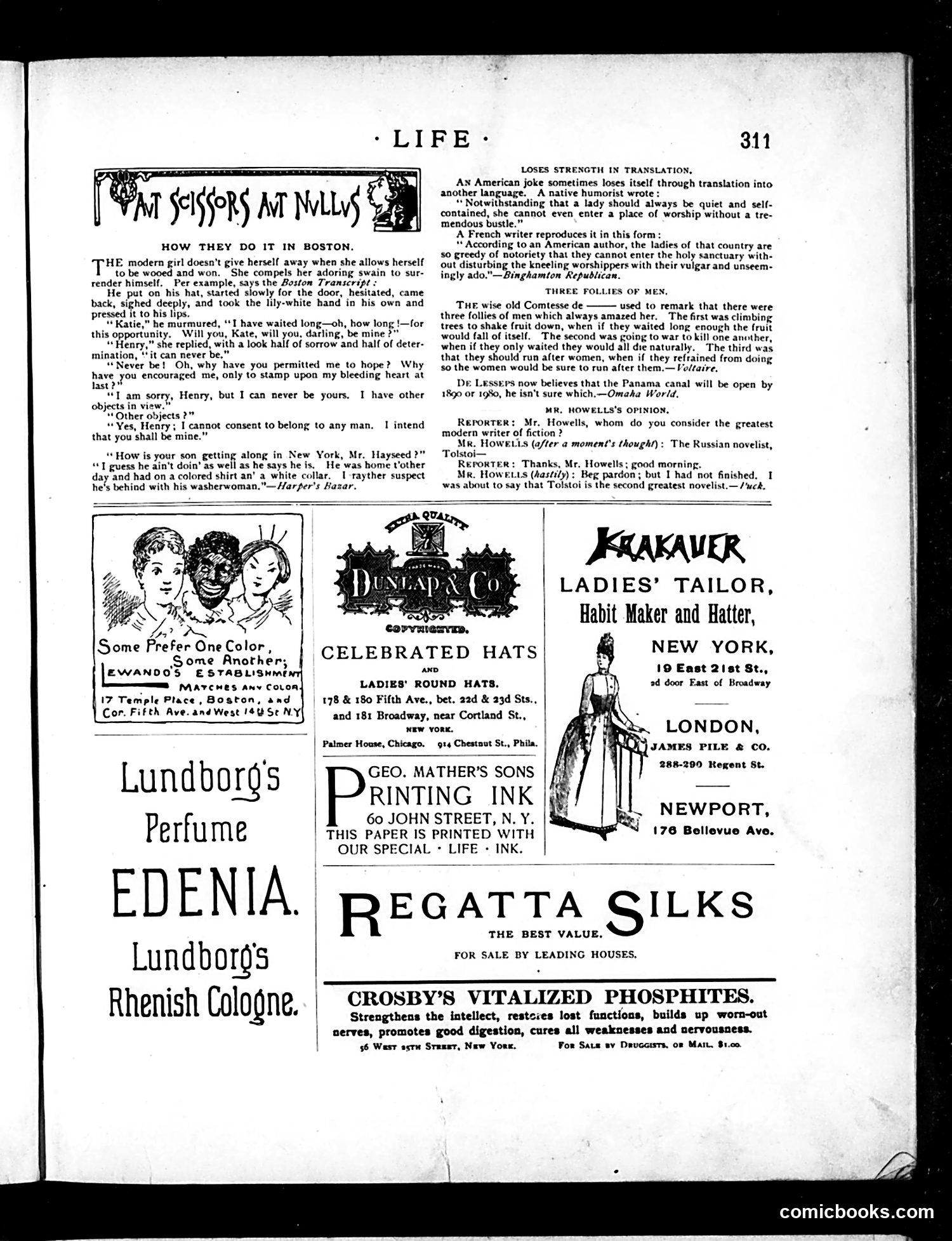
This page contains several brief satirical pieces typical of late-19th-century American humor magazines: **"How They Do It in Boston"** mocks courtship conventions by depicting a woman who strategically rejects a suitor's proposal, claiming she has "other objects in view"—meaning her own ambitions—rather than accepting him. The satire targets both male romantic presumption and female independence as shocking to social norms. **"Loses Strength in Translation"** jokes about how American humor about women's church behavior gets grotesquely mistranslated into French, becoming an accusation of female greed for notoriety rather than the original gentle observation about bustling activity. **"The Three Follies of Men"** attributes to Voltaire (likely falsely) a sardonic observation that men foolishly exert themselves when nature would accomplish the same results (fruit falls, people die anyway, women pursue men without encouragement). **"Mr. Howells's Opinion"** shows William Dean Howells (a real prominent American novelist/critic) backtracking when a reporter quotes him naming Tolstoy the greatest living writer—he hastily corrects himself to say Tolstoy is merely "second greatest," suggesting vanity. The remainder is period advertising.
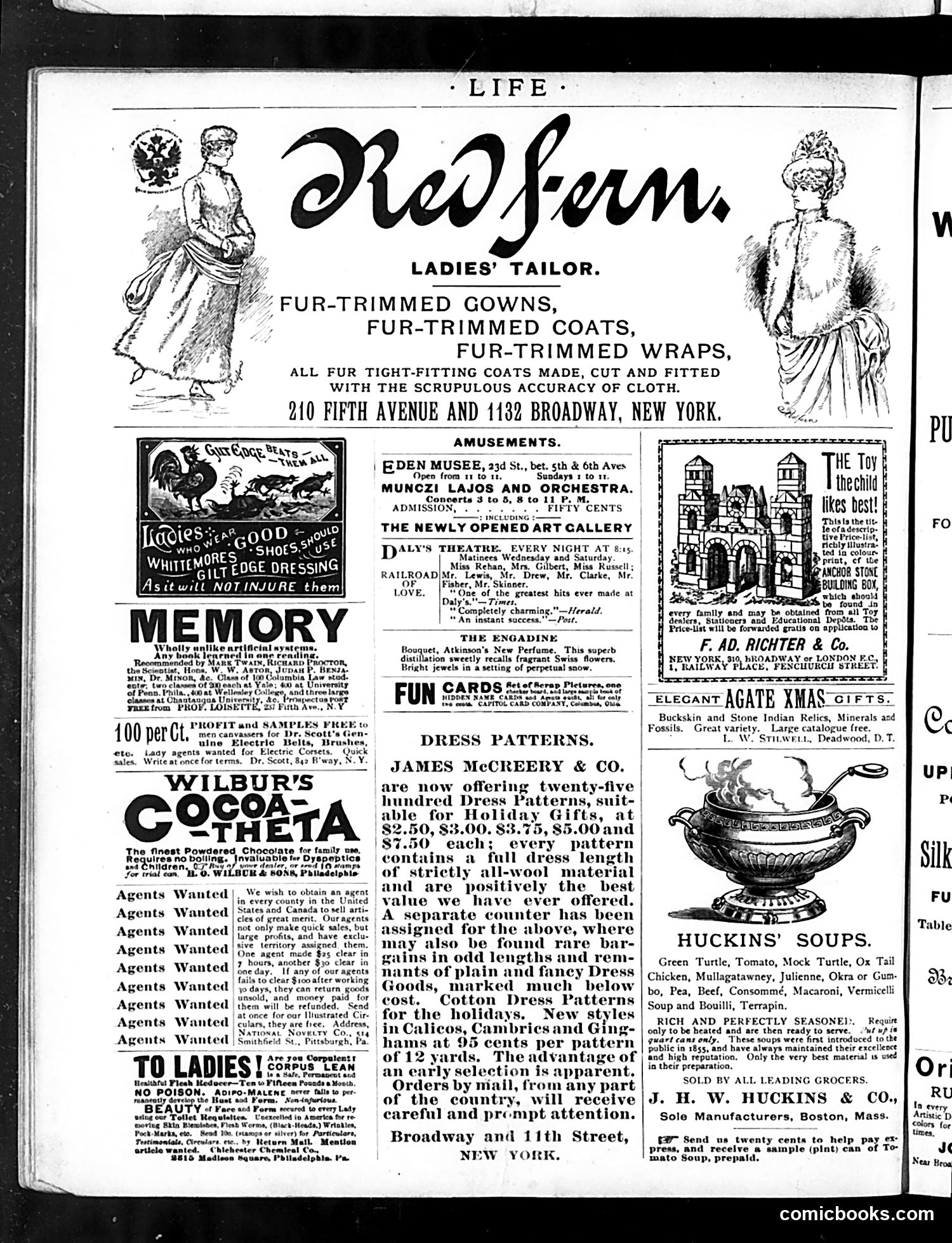
This is primarily an **advertising page** from Life magazine, not a satirical cartoon page. The dominant feature is a large advertisement for "Red Fern," a ladies' tailor specializing in fur-trimmed coats and wraps located on Fifth Avenue and Broadway in New York. The page includes typical period advertisements (circa early 1900s) for consumer goods: Wilbur's cocoa, Dr. Scott's electric corsets and belts, beauty treatments promising weight loss, and dress patterns. There are smaller amusement advertisements for theaters and museums. The two illustrated figures flanking the "Red Fern" title appear to be fashion sketches showing women in the elaborate, high-necked garments typical of the Edwardian era—likely representing the sophisticated clientele the tailor aimed to attract. This is a commercial rather than editorial page, reflecting how Life supported itself through advertising revenue.
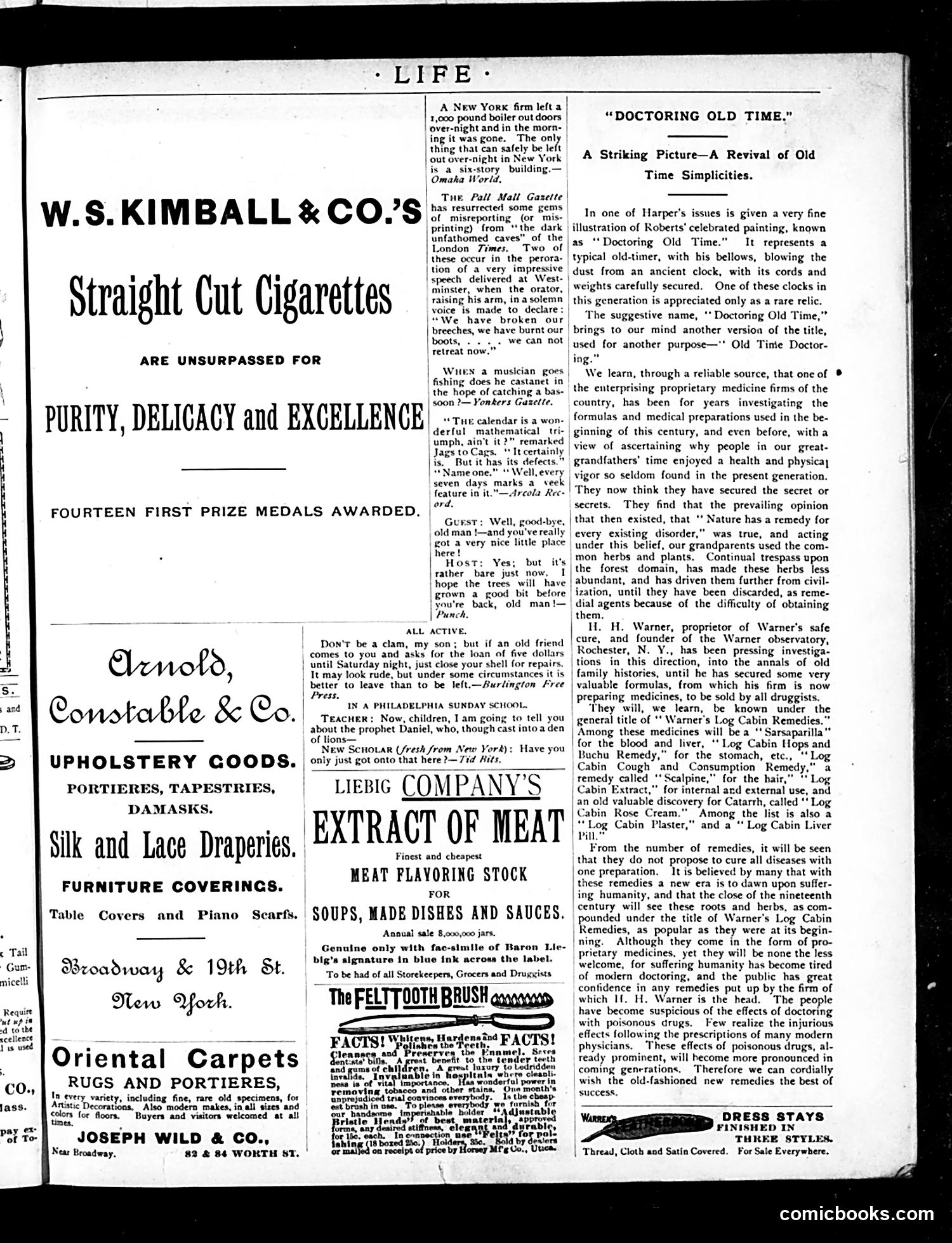
This page is primarily **advertising with minimal editorial content**. The advertisements dominate, featuring cigarettes (W.S. Kimball), furniture and upholstery goods (Arnold Constable, Joseph Wild), and patent medicines (Liebig's Extract of Meat, Felttooth Brush). The small editorial section includes brief **humorous anecdotes** typical of Life's satirical style: - A joke about New York crime (a boiler theft) - Misprint humor from the Pall Mall Gazette - Puns ("castanet/bass-soon") - A dialogue about a calendar's mathematical perfection - A schoolteacher anecdote showing urban child's irreverence toward biblical instruction The article "**Doctoring Old Time**" discusses a painting by Roberts, nostalgically depicting an old man cleaning an antique clock—a commentary on appreciation for pre-modern simplicity. The overall tone is **light, class-conscious satire** aimed at educated urban readers, mixing social observation with wordplay and gentle mockery of contemporary life.
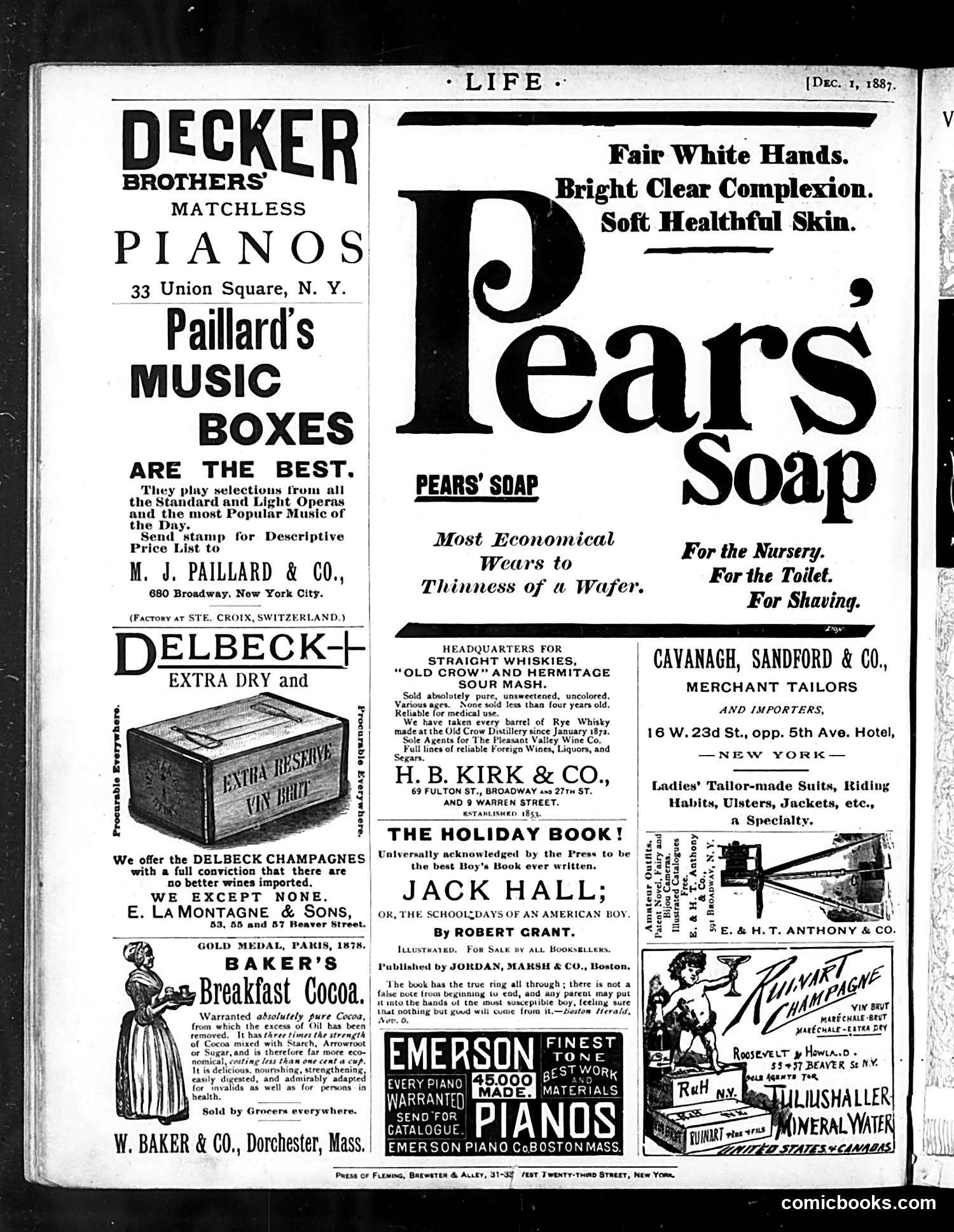
This is primarily an **advertisement page** from Life magazine (December 1, 1887), not a cartoon or satirical commentary. The page features various luxury consumer product ads typical of the Gilded Age. Notable advertisements include Pears' Soap (prominently featured with claims about "Fair White Hands" and "Bright Clear Complexion"—reflecting Victorian beauty standards emphasizing pale skin), Baker's Breakfast Cocoa, Delbeck Champagne, and Emerson Pianos. There's also an ad for "Jack Hall," a boys' adventure book described as "the best Boy's Book ever written." The page reflects late-19th-century consumer culture and advertising practices: products marketed with health/moral claims, emphasis on imported European goods (champagne, cocoa), and targeting of middle-class aspirations. The Pears' Soap ad is particularly notable for its racialized beauty standards common to that era. This is essentially a commercial page rather than editorial satire or cartooning.