
Life, 1887-12-01 · page 2 of 16
Life — December 1, 1887 — page 2: what you’re looking at
What you’re looking at
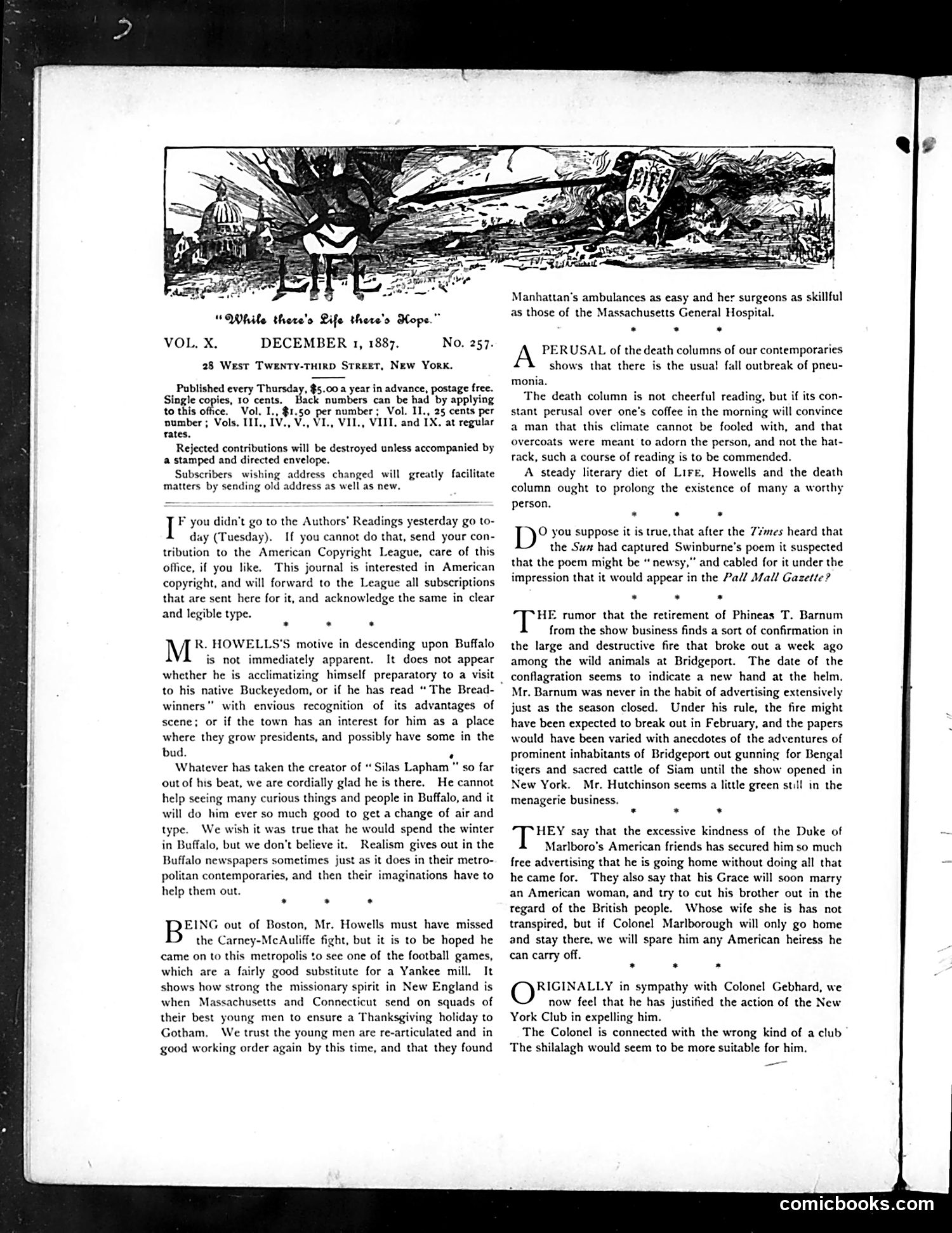
The masthead cartoon depicts a bare tree with figures beneath it and a quote: "While there's Life there's Hope." The page itself consists entirely of editorial commentary—no political cartoons appear here. The pieces discuss: 1. **Buffalo and Mr. Howells**: Commentary on writer William Dean Howells visiting Buffalo, noting it lacks the cultural attractions of major cities. 2. **Death statistics**: Discussion of pneumonia outbreaks in contemporary newspapers, recommending "Life" as preferable reading. 3. **Various gossip items**: References to Phineas T. Barnum's retirement from show business following a fire at Bridgeport, the Duke of Marlborough's American connections, and Colonel Gerhard's expulsion from the New York Club. The content is primarily satirical social commentary rather than visual political satire.
📄 Transcribed text from this page (OCR, searchable)
Machine-transcribed from the original scan — historical spelling and the odd misread are preserved.
“While there's Life there's Hope.” VOL. xX. DECEMBER 1, 1887. 28 West Twenty-THIRD Street, New York. No. 257. Published every Thursday, $5.00 a year in advance, postage free. Single copies, 10 cents, Back numbers can be had by applying to this office. Vol. I., $1.50 per number; Vol. II., 25 cents per umber; Vols. IIL, IV., V., VIL, VIL., VIL, and IX. at regular fates. Rejected contributions will be destroyed unless accompanied by a stamped and directed envelope. Subscribers wishing address changed will greatly facilitate matters by sending old address as well as new. I * you didn’t go to the Authors’ Readings yesterday go to- day (Tuesday). If you cannot do that, send your con- tribution to the American Copyright League, care of this office, if you like. This journal is interested in American copyright, and will forward to the League all subscriptions that are sent here for it, and acknowledge the same in clear and legible type. . * R. HOWELLS'S motive in descending upon Buffalo is not immediately apparent. It does not appear whether he is acclimatizing himself preparatory to a visit to his native Buckeyedom, or if he has read “ The Bread- winners” with envious recognition of its advantages of scene; or if the town has an interest for him as a place where they grow presidents, and possibly have some in the bud. “ Whatever has taken the creator of “ Silas Lapham " so far out of his beat, we are cordially glad he is there. He cannot help seeing many curious things and people in Buffalo, and it will do him ever so much good to get a change of air and type. We wish it was true that he would spend the winter in Buffalo, but we don’t believe it. Realism gives out in the Buffalo newspapers sometimes just as it does in their metro- politan contemporaries, and then their imaginations have to help them out. . . . BES out of Boston, Mr. Howells must have missed the Carney-McAuliffe fight, but it is to be hoped he came on to this metropolis to see one of the football games, which are a fairly good substitute for a Yankee mill. It shows how strong the missionary spirit in New England is when Massachusetts and Connecticut send on squads of their best young men to ensure a Thanksgiving holiday to Gotham. We trust the young men are re-articulated and in good working order again by this time, and that they found Manhattan's ambulances as easy and her surgeons as skillful as those of the Massachusetts General Hospital. PERUSAL of the death columns of our contemporaries shows that there is the usual fall outbreak of pneu- monia. The death column is not cheerful reading, but if its con- stant perusal over one’s coffee in the morning will convince a man that this climate cannot be fooled with, and that overcoats were meant to adorn the person, and not the hat- rack, such a course of reading is to be commended. A steady literary diet of Lire, Howells and the death column ought to prolong the existence of many a worthy person. O you suppose it is true, that after the 7¥mes heard that the Sua had captured Swinburne’s poem it suspected that the poem might be “newsy,” and cabled for it under the impression that it would appear in the Pall Mall Gazette? HE rumor that the retirement of Phineas T. Barnum from the show business finds a sort of confirmation in the large and destructive fire that broke out a week ago among the wild animals at Bridgeport. The date of the conflagration seems to indicate a new hand at the helm. Mr. Barnum was never in the habit of advertising extensively just as the season closed. Under his rule, the fire might have been expected to break out in February, and the papers would have been varied with anecdotes of the adventures of prominent inhabitants of Bridgeport out gunning for Bengal tigers and sacred cattle of Siam until the show opened in New York. Mr. Hutchinson seems a little green still in the menagerie business. . . . HEY say that the excessive kindness of the Duke of Marlboro's American friends has secured him so much free advertising that he is going home without doing all that he came for. They also say that his Grace will soon marry an American woman, and try to cut his brother out in the regard of the British people. Whose wife she is has not transpired, but if Colonel Marlborough will only go home and stay there, we will spare him any American heiress he can carry off. . . . RIGINALLY in sympathy with Colonel Gebhard, we now feel that he has justified the action of the New York Club in expelling him. The Colonel is connected with the wrong kind of a club The shilalagh would seem to be more suitable for him. comicbooks.com