
A complete issue · 20 pages · 1887
Life — November 24, 1887
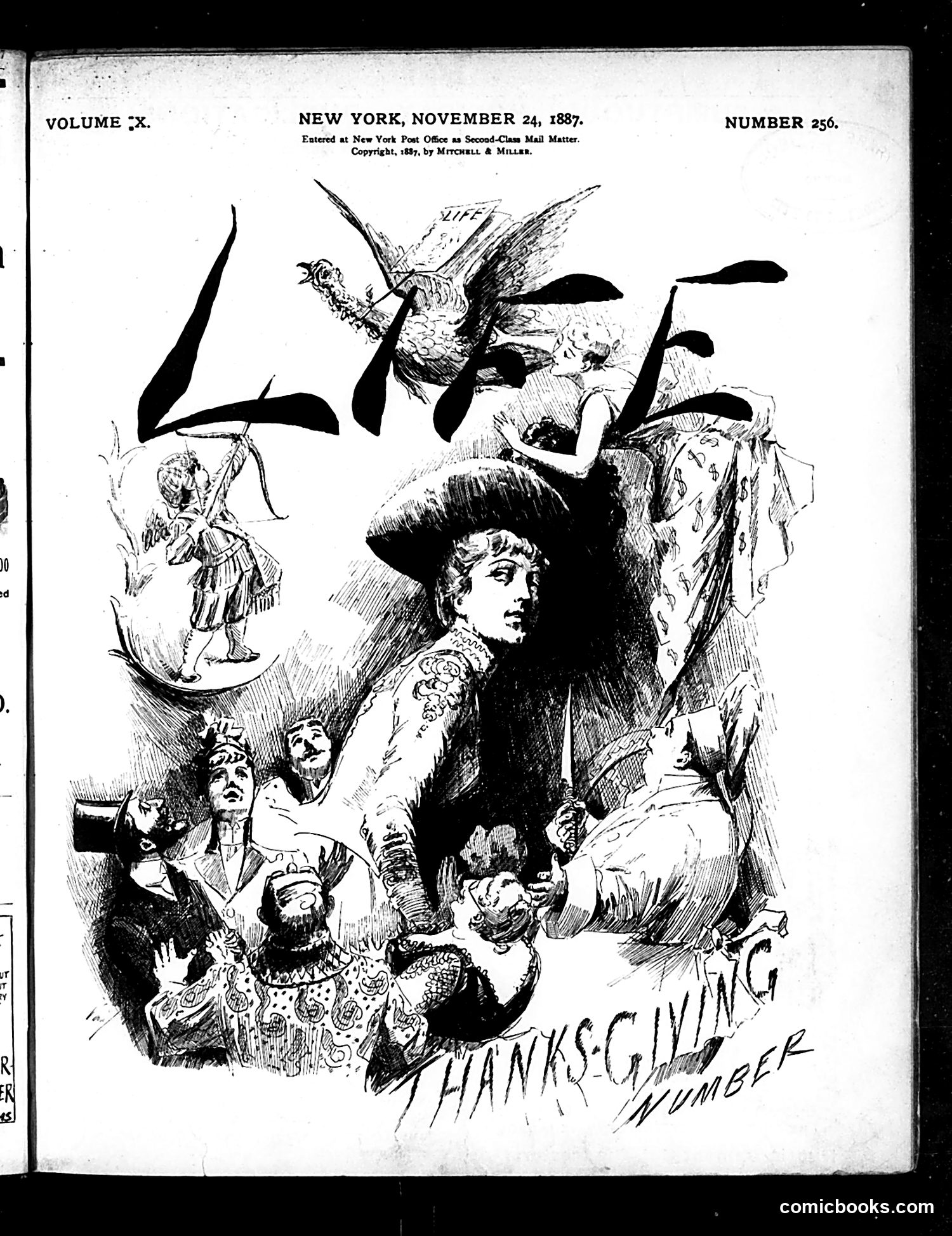
This is the cover illustration for *Life* magazine's Thanksgiving issue. The cartoon depicts a cornucopia-style composition with a large central figure (appears to be a woman in period dress and wide hat) surrounded by smaller figures, cherubs, and abundant harvest imagery including corn and vegetables. The large scrolling text reads "THANKSGIVING NUMBER," indicating this is thematic holiday artwork rather than political satire. The style is typical of 1880s commercial illustration—allegorical and decorative rather than pointed commentary. The composition celebrates American abundance and the holiday tradition through romantic, classical imagery rather than satirizing current events or public figures.
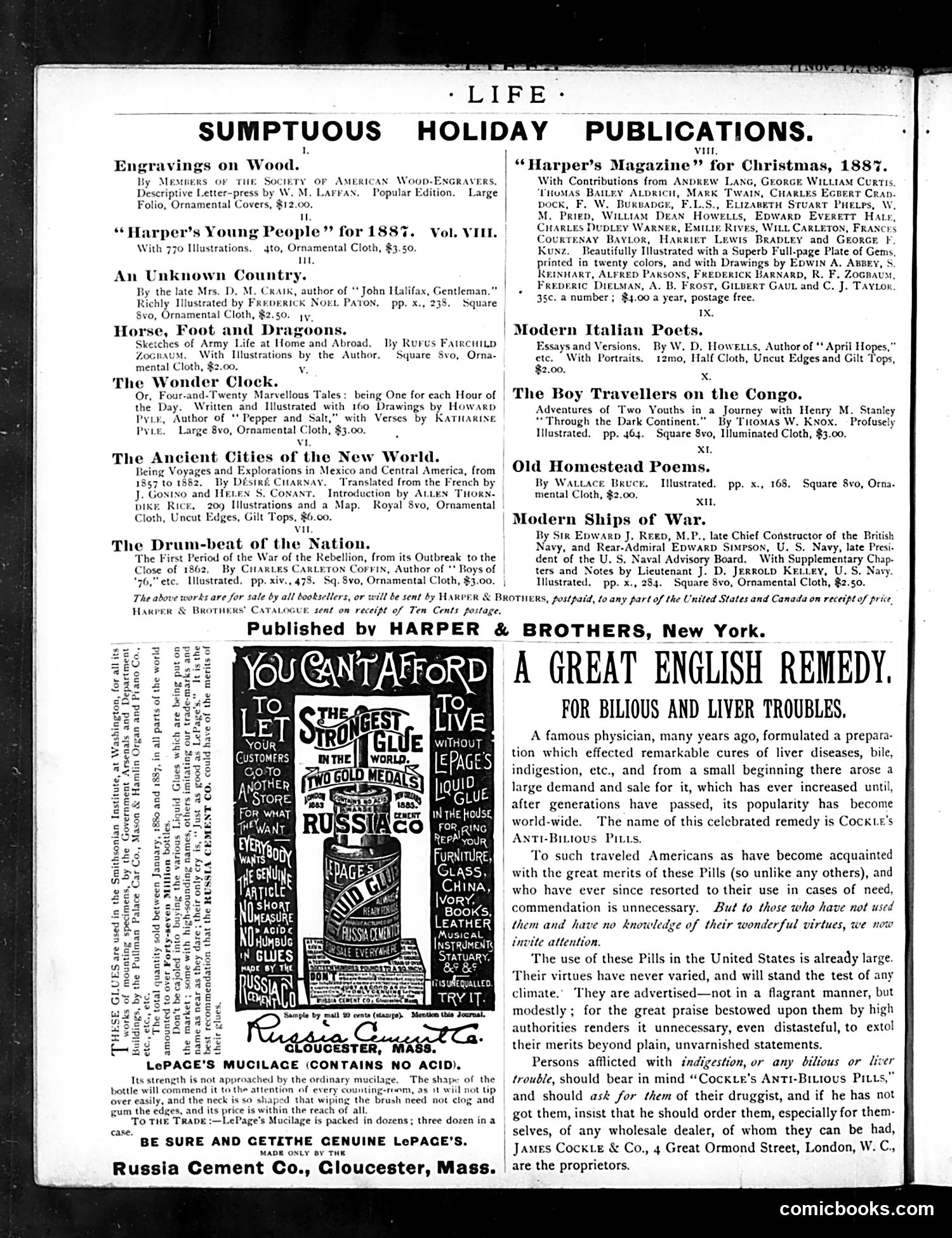
This page is primarily **advertising and book announcements** rather than political satire. The left column lists "Sumptuous Holiday Publications" from Harper & Brothers, including illustrated volumes on wood engravings, young people's literature, and travel narratives. The dominant visual element is a **LePage's Glue advertisement** featuring ornate lettering and product claims about adhesive strength. Below it runs a **Russia Cement Co. advertisement** from Gloucester, Massachusetts. The right side advertises **Cockie's Anti-Bilious Pills**, a patent medicine claiming to cure liver troubles and indigestion. The text explicitly targets American travelers and emphasizes the product's popularity despite modest advertising. The page represents late-Victorian consumer marketing rather than political commentary.
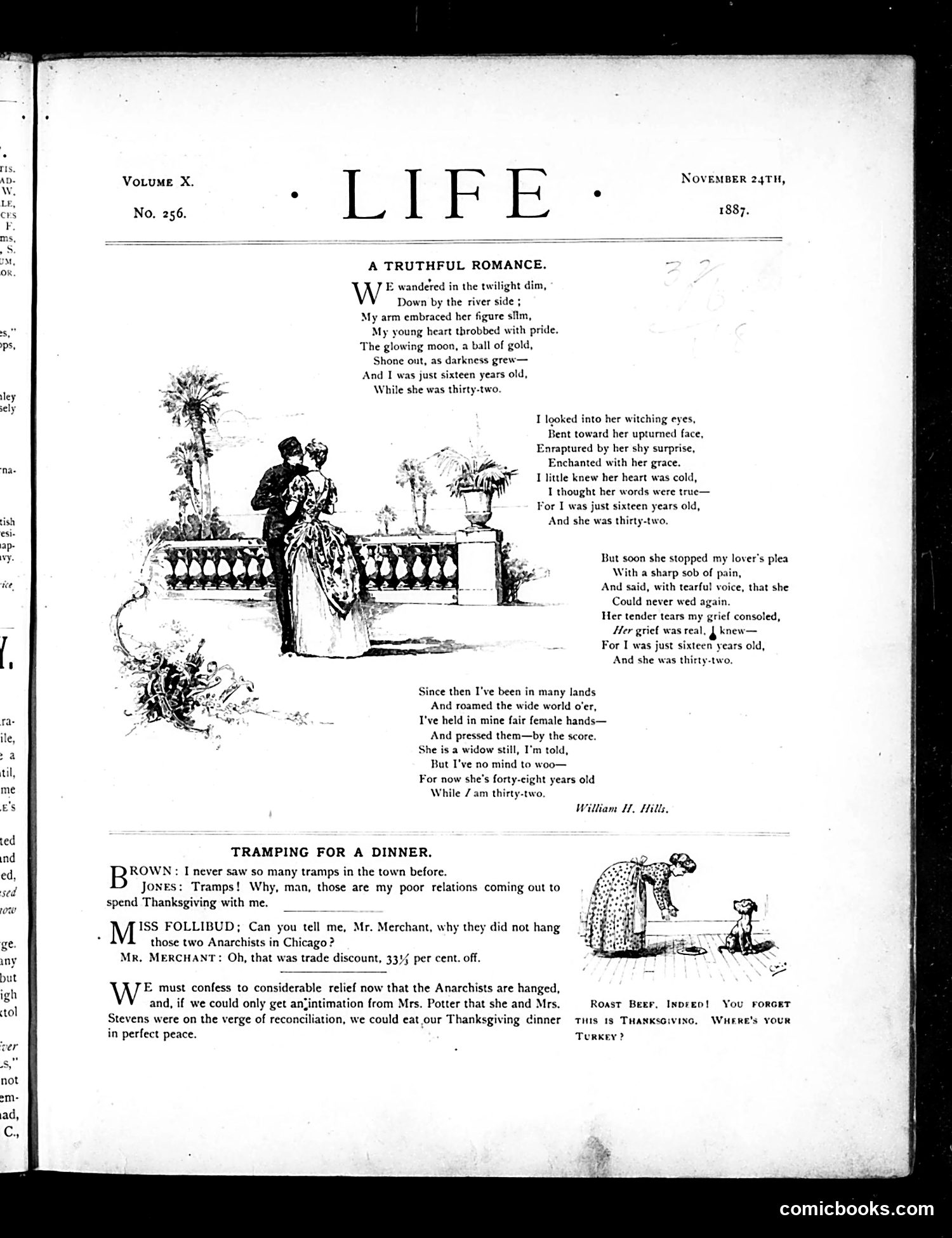
This satirical dialogue mocks the economic hardships of the era. Brown encounters tramps (poor wanderers) arriving in town for Thanksgiving dinner, claiming to be his "poor relations." Jones quips they're actually his relations *coming out to* spend the holiday with him. Miss Follibud asks why merchants didn't hang two suspicious characters in Chicago. Mr. Merchant reveals a "33½ percent cent-off" discount motivated their release—satirizing how commerce and bribery override justice. The final quip celebrates that anarchists have been hanged, allowing peaceful Thanksgiving dinner without fear of Mrs. Potter and Mrs. Stevens—a dark reference to contemporary anarchist anxieties, likely alluding to the recent Haymarket affair (1886).
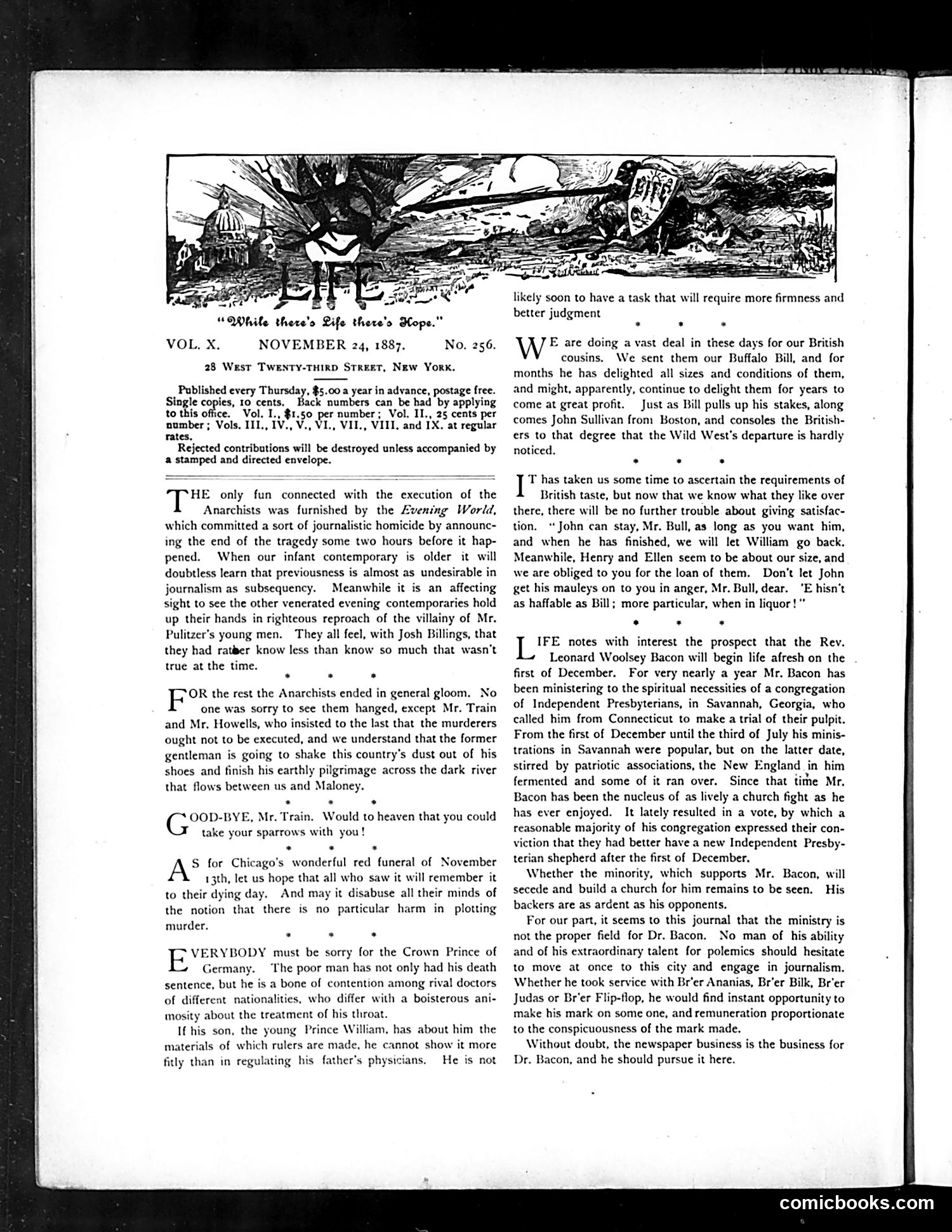
The page's main cartoon, titled "While there's Life there's Hope," depicts a grim reaper figure amid a desolate landscape, likely satirizing contemporary anxieties about death or social collapse. The text discusses several topics: the recent execution of anarchists (referenced as "the tragedy"), Chicago's famous anarchist trial; criticism of journalism's handling of the story; and commentary on various public figures including John Sullivan (boxer) and Rev. Leonard Woolsey Bacon. The satire targets journalistic sensationalism around the anarchist executions and comments on contemporary personalities and events. Without seeing all cartoon details clearly, the precise satirical targets remain partially unclear, though the overall tone criticizes both radical extremism and the press's coverage of it.
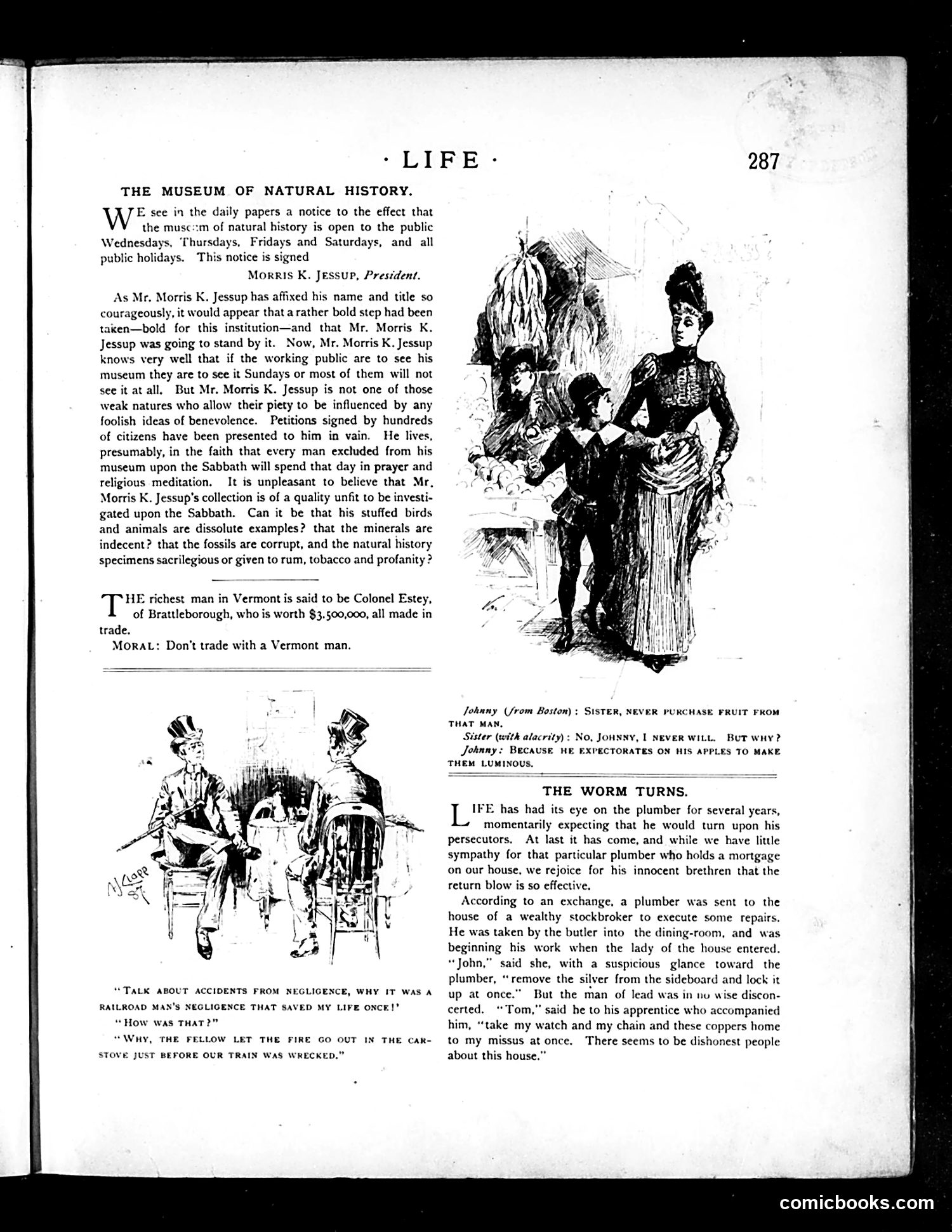
**"The Museum of Natural History"** section critiques Morris K. Jessup, who apparently demanded the museum open on Sundays for public viewing. The satire attacks his hypocrisy: he claims religious principle prevents him from visiting on the Sabbath, yet he wants others to work there on Sundays. The text questions whether his natural history collection—stuffed animals, fossils—deserves Sunday observance, sarcastically suggesting the specimens might be "corrupt" or "sacrificed to rum, tobacco and profanity." **"The Worm Turns"** describes a plumber's visit to a wealthy stockbroker's house. The lady of the house suspiciously demands he lock away silver and remove the lead man, fearing theft. The plumber's apprentice responds that honest people work there—satirizing wealthy households' reflexive distrust of working-class service providers. Both pieces mock class hypocrisy and self-righteousness.
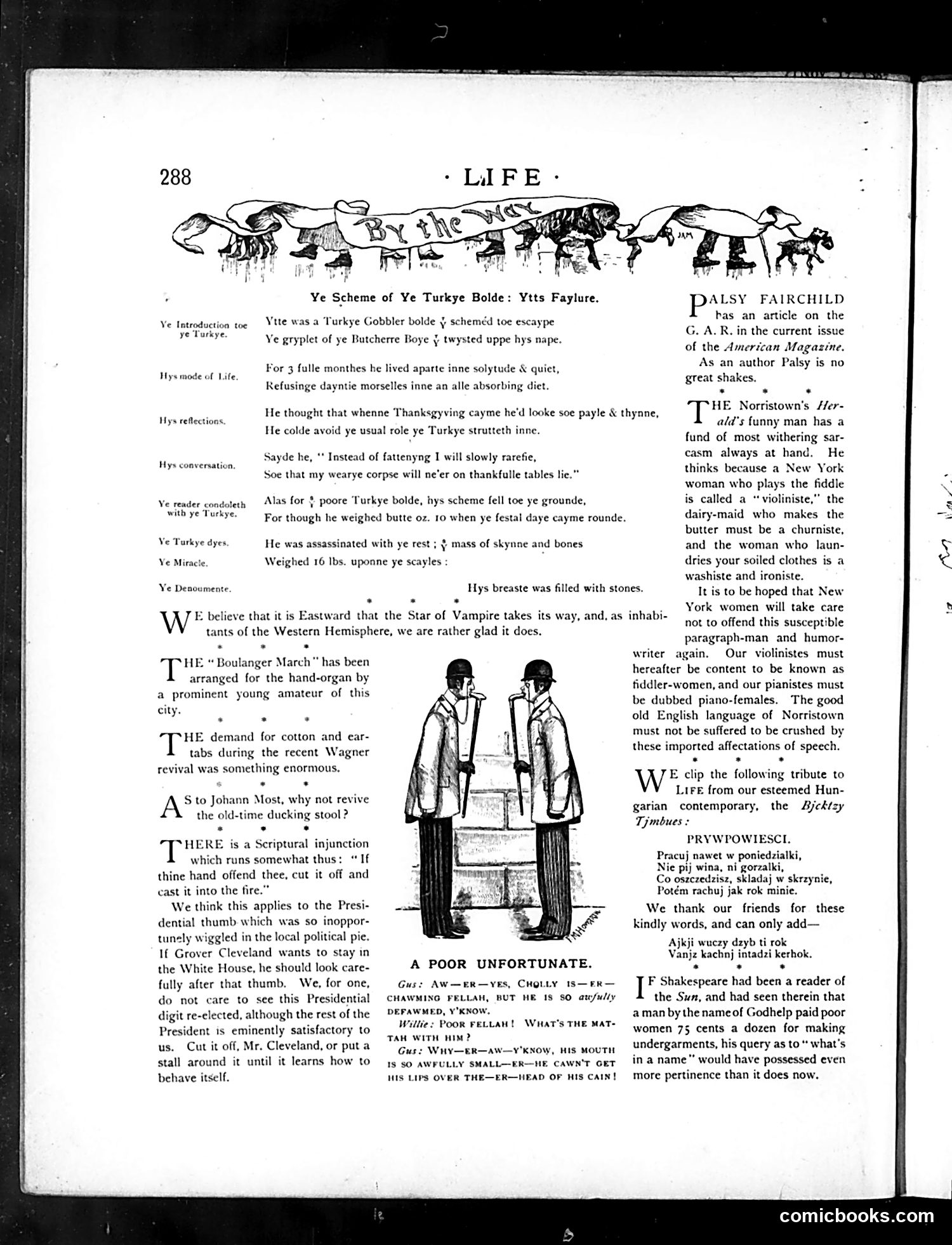
This page contains several unrelated satirical pieces rather than a single coherent cartoon. The main illustrated item is titled "A Poor Unfortunate," depicting two men in period dress examining what appears to be a third figure. The accompanying dialogue suggests mockery of someone's misfortune or physical condition, though the specific reference is unclear from the text alone. The page also includes humorous brief pieces on various topics: a mock-historical account of a turkey ("Ye Scheme of Ye Turkey Bolde"), commentary on New York women's affectations (violinists, dairy-maids, laundresses), and scattered quips about contemporary figures and customs. Without additional context about the publication date, identifying specific political figures or events referenced remains uncertain. The humor relies on period-specific social stereotypes and observations typical of American satirical magazines.
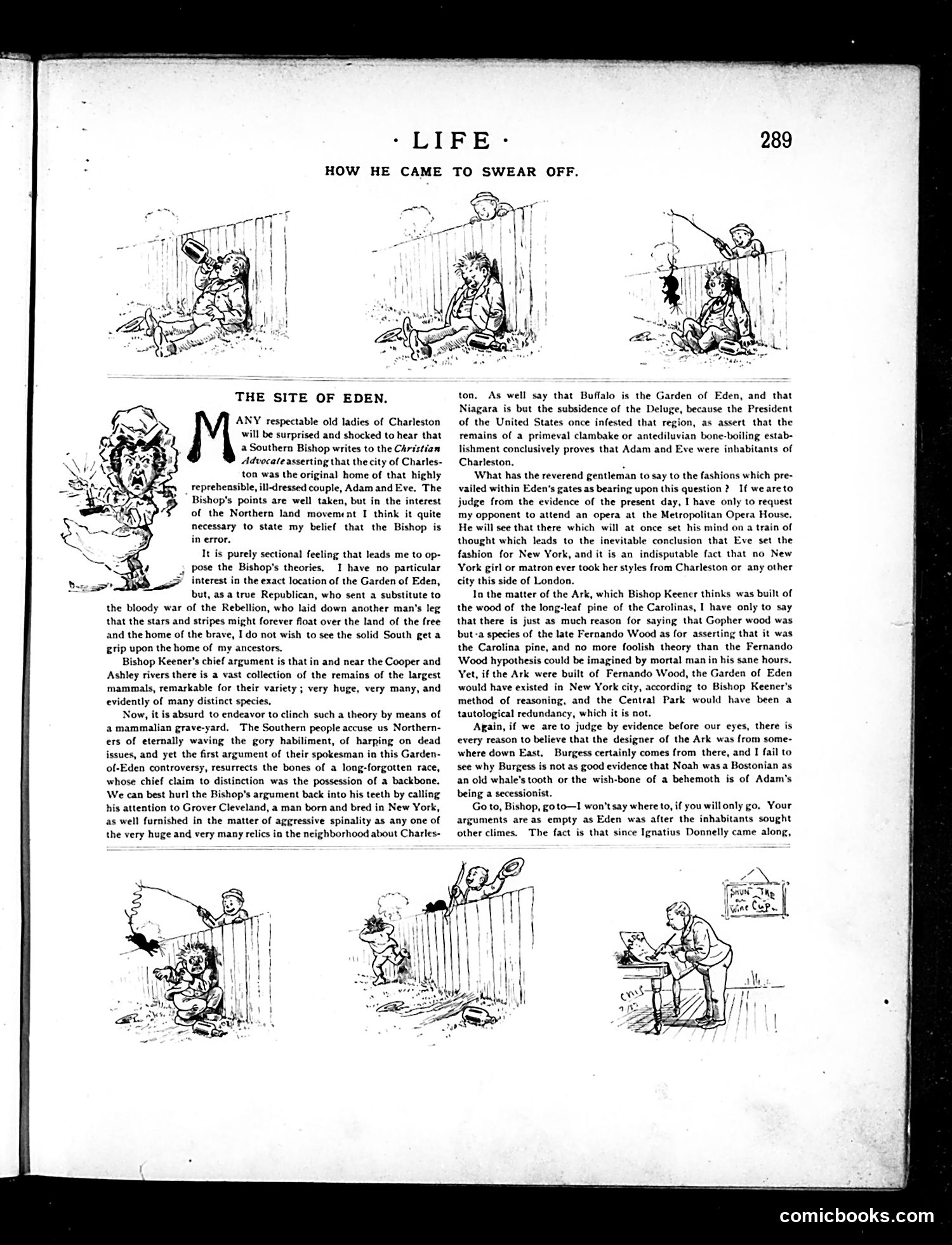
This page contains two distinct pieces: **Top Section:** A six-panel cartoon titled "How He Came to Swear Off" depicts a child progressively learning to swear, culminating in the child cursing—a humorous commentary on how children imitate adult behavior and profanity. **Bottom Section:** An article titled "The Site of Eden" debates whether Charleston, South Carolina represents the biblical Garden of Eden. The author satirizes a Southern bishop's theory by arguing that Charleston lacks characteristics befitting Eden. The piece mockingly counters the bishop's claims about geography and prehistory, suggesting his reasoning is backwards and unsupported—typical satirical deflation of a public figure's dubious scholarly claims. Both pieces showcase Life's characteristic blend of visual humor and written satire targeting social absurdities and public figures.
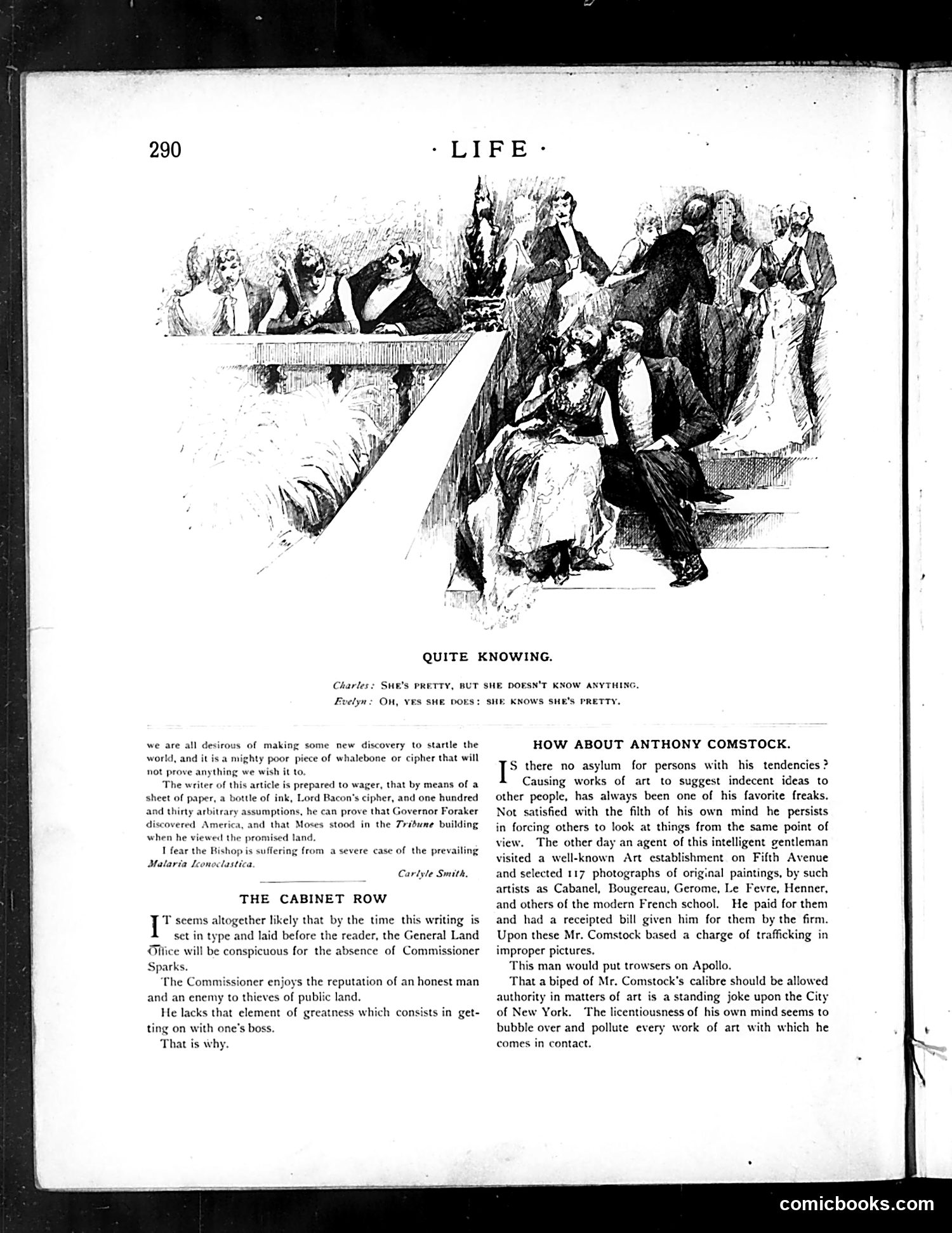
**The Cartoon "Quite Knowing":** This sketch depicts a social scene where a woman sits while men stand around her. The dialogue suggests she is attractive ("pretty") but intellectually uninformed. The humor targets gendered stereotypes about women's education and awareness. **"How About Anthony Comstock":** This article attacks Anthony Comstock, a real historical figure who served as a postal inspector and led anti-obscenity campaigns. The text accuses him of hypocrisy—specifically of forcing inappropriate art into the public sphere while claiming moral authority. The piece criticizes his tactics of purchasing "improper pictures" and using them to charge artists with trafficking obscene materials, suggesting his crusades may be motivated by his own questionable judgment rather than genuine moral concern.
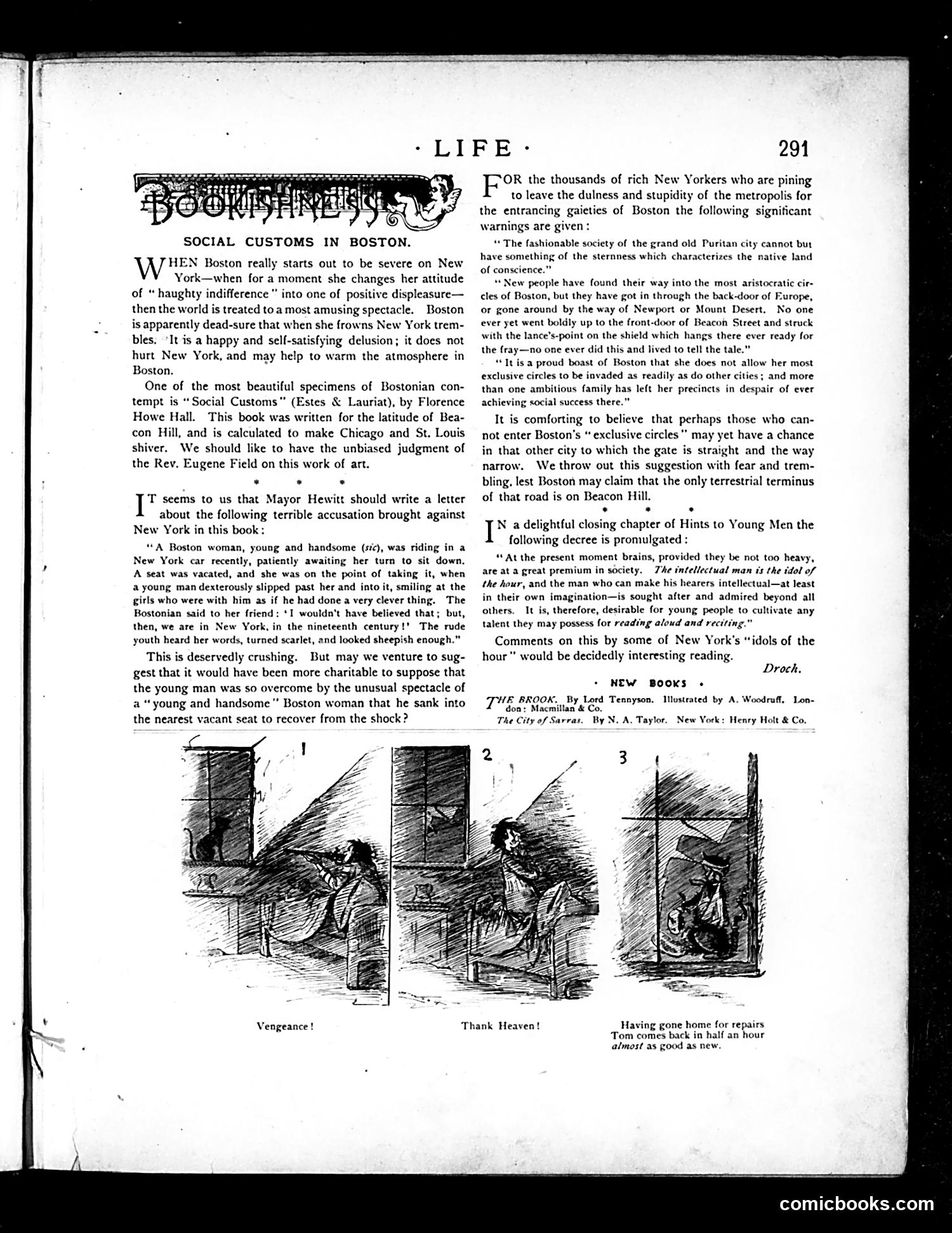
This page satirizes Boston's self-perceived aristocratic superiority over New York. The text criticizes Bostonians' snobbish attitude, claiming they view their city as culturally and socially superior—a position the author challenges as unwarranted. The three small cartoon panels at bottom appear to show domestic scenes with humorous captions: "Vengeance!", "Thank Heaven!", and "Having gone home for repairs / Tom comes back in half an hour / almost as good as new." These likely illustrate the absurdity of Boston pretension through everyday domestic life. The article references a book, *Social Customs in Boston* by Florence Howe Hall, using it as a springboard to mock Boston's exclusivity while suggesting that ambitious New Yorkers needn't feel inferior to Boston's "exclusive circles."
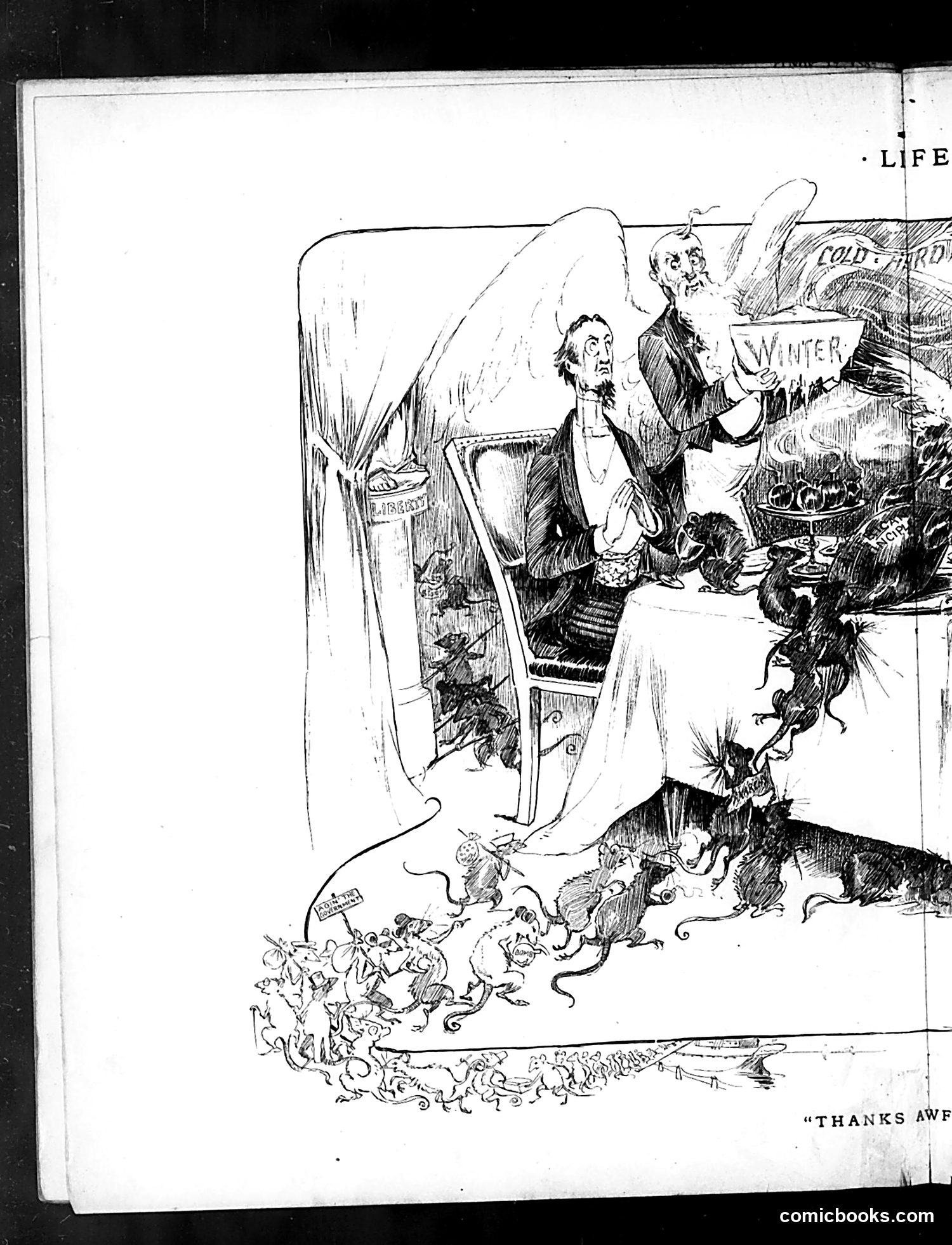
This political cartoon from Life magazine depicts a domestic scene where rats are pouring into a home through an open door during winter. Inside, well-dressed men appear oblivious or indifferent to the invasion, while a woman gestures in alarm. The rats likely represent a social or political problem—possibly poverty, crime, disease, or labor unrest—that the caption "THANKS AWF[UL]" (partially visible) suggests is unwelcome. The cartoon satirizes the wealthy or politically powerful ignoring serious societal problems affecting their households and nation. The contrast between the comfortable interior and the swarm of rats outside criticizes either negligence or complicity in allowing a crisis to fester. Without the complete caption and publication date, the specific issue remains unclear, but the visual metaphor is unmistakable: danger ignored becomes danger inside.
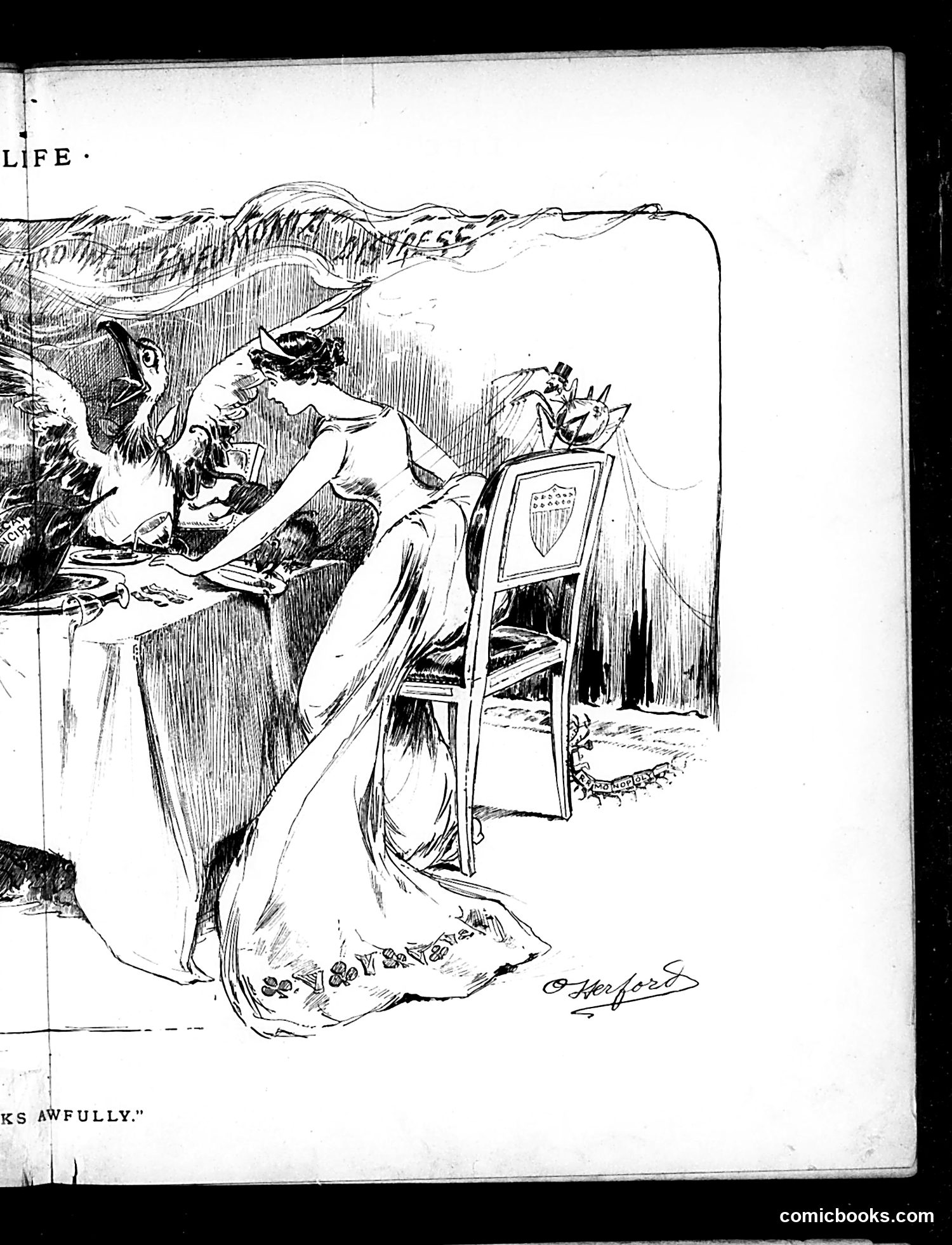
This appears to be a single illustrated cartoon from *Life* magazine. The image shows an elegantly dressed woman in flowing robes seated at what looks like a vanity or dressing table, gazing into a mirror. The style suggests early 20th-century Art Nouveau aesthetics. The OCR text is minimal and unhelpful—only "comicbooks.com" appears, which is the modern archive source rather than original magazine text. Without legible caption text or byline information visible in this image, I cannot definitively identify the specific political or social commentary intended, though the composition suggests themes of vanity, self-reflection, or feminine beauty standards typical of *Life*'s satirical content from that era. The artist's signature appears present but is not clearly legible to me.
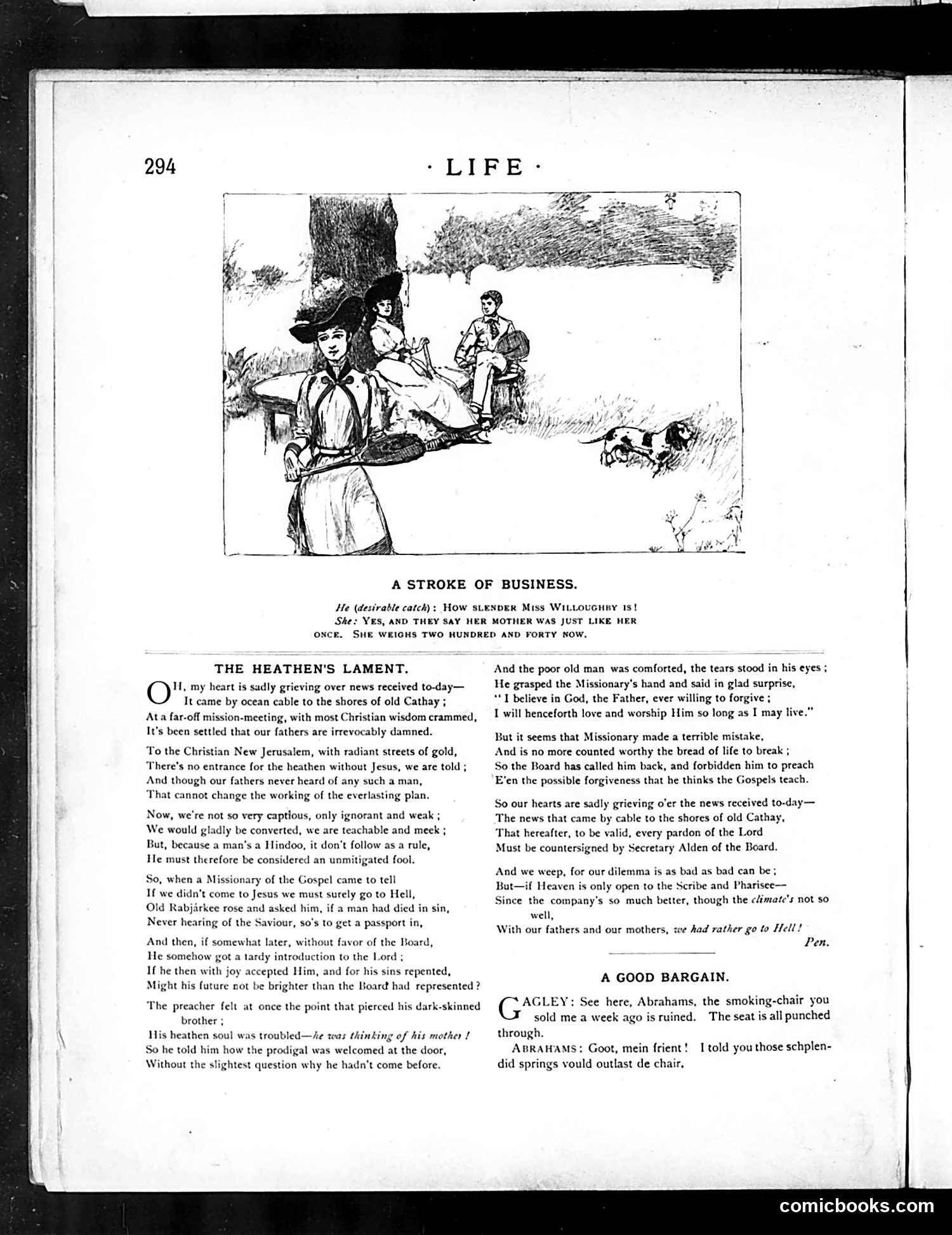
This page contains three satirical pieces: **"A Stroke of Business"** (top cartoon): A social commentary on marriage prospects. A man remarks on a woman's slenderness, implying she's a desirable match. Her reply—that her mother was similarly thin—suggests he should consider the genetic/hereditary implications before pursuing marriage. The satire targets superficial courtship among the wealthy. **"The Heathen's Lament"** (main poem): Satirizes Christian missionary work and ecclesiastical bureaucracy. A Hindu elder asks a sensible theological question: if someone dies unbaptized but later repents, wouldn't God forgive them? The missionary agrees—but a church Board punishes him for this compassionate interpretation, insisting all forgiveness be "countersigned by Secretary Alden of the Board." The satire mocks rigid institutional religion that prioritizes bureaucratic control over Christian mercy. **"A Good Bargain"** (dialogue): A quick joke about a Jewish merchant (indicated by dialect spelling) selling a defective smoking chair, then claiming the springs are the quality item—a play on deceptive sales tactics.
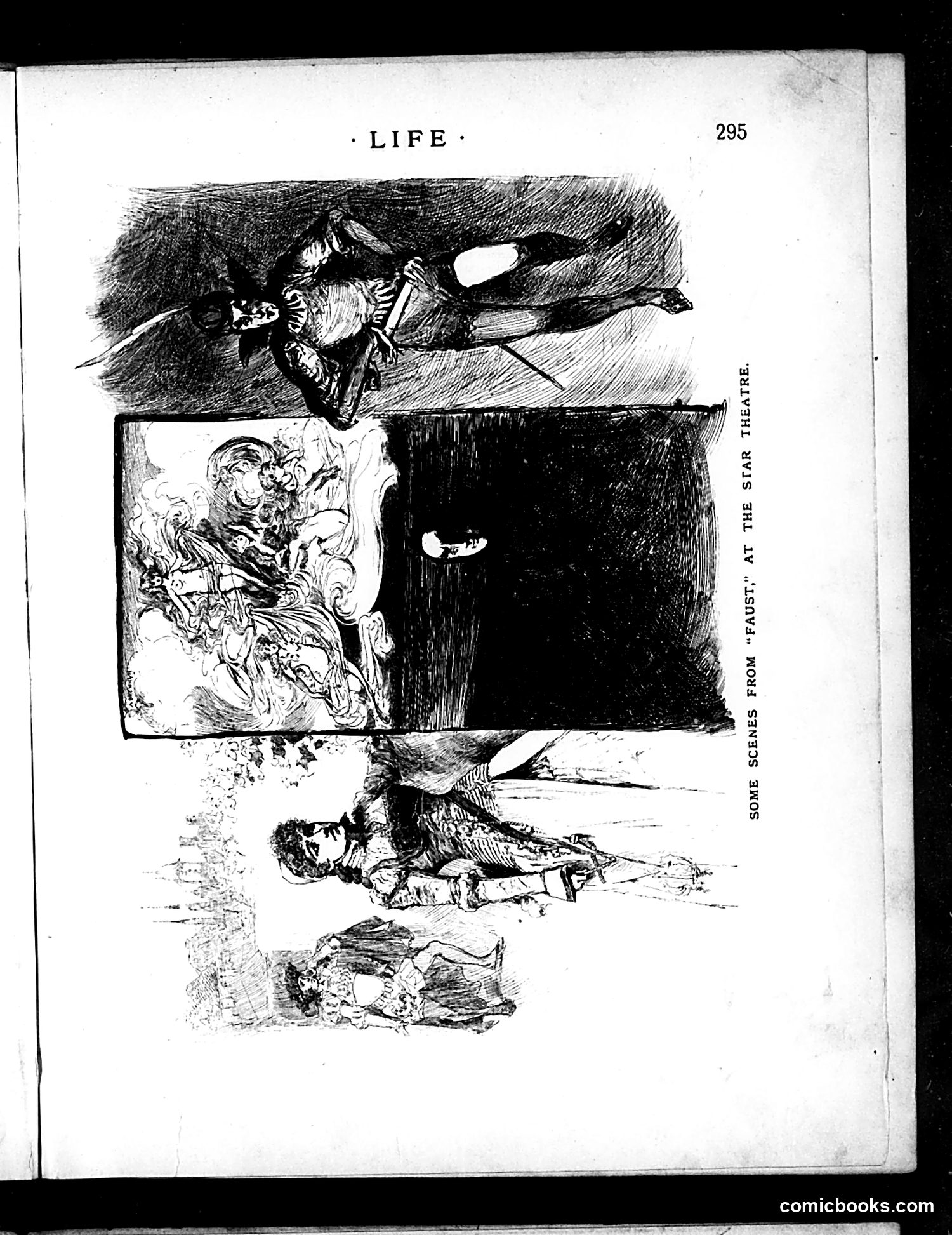
This page from *Life* magazine (page 295) contains theatrical illustrations labeled "Some Scenes from Faust: At the Star Theatre." The sketches appear to depict scenes from a stage production of Goethe's *Faust*, likely a contemporary theatrical adaptation. The images show dramatic moments including what appears to be supernatural or fantastical scenes—consistent with Faust's themes of the devil's bargain and magical transformation. The top illustration shows an ethereal or demonic figure, the middle panel depicts ornate dramatic action, and lower sketches show character interactions. The OCR text is heavily corrupted and unreadable, so I cannot determine specific satirical commentary. However, as *Life* was a satirical magazine, these theatrical reviews often included social commentary about performances, actors, or contemporary interpretations of classic works.
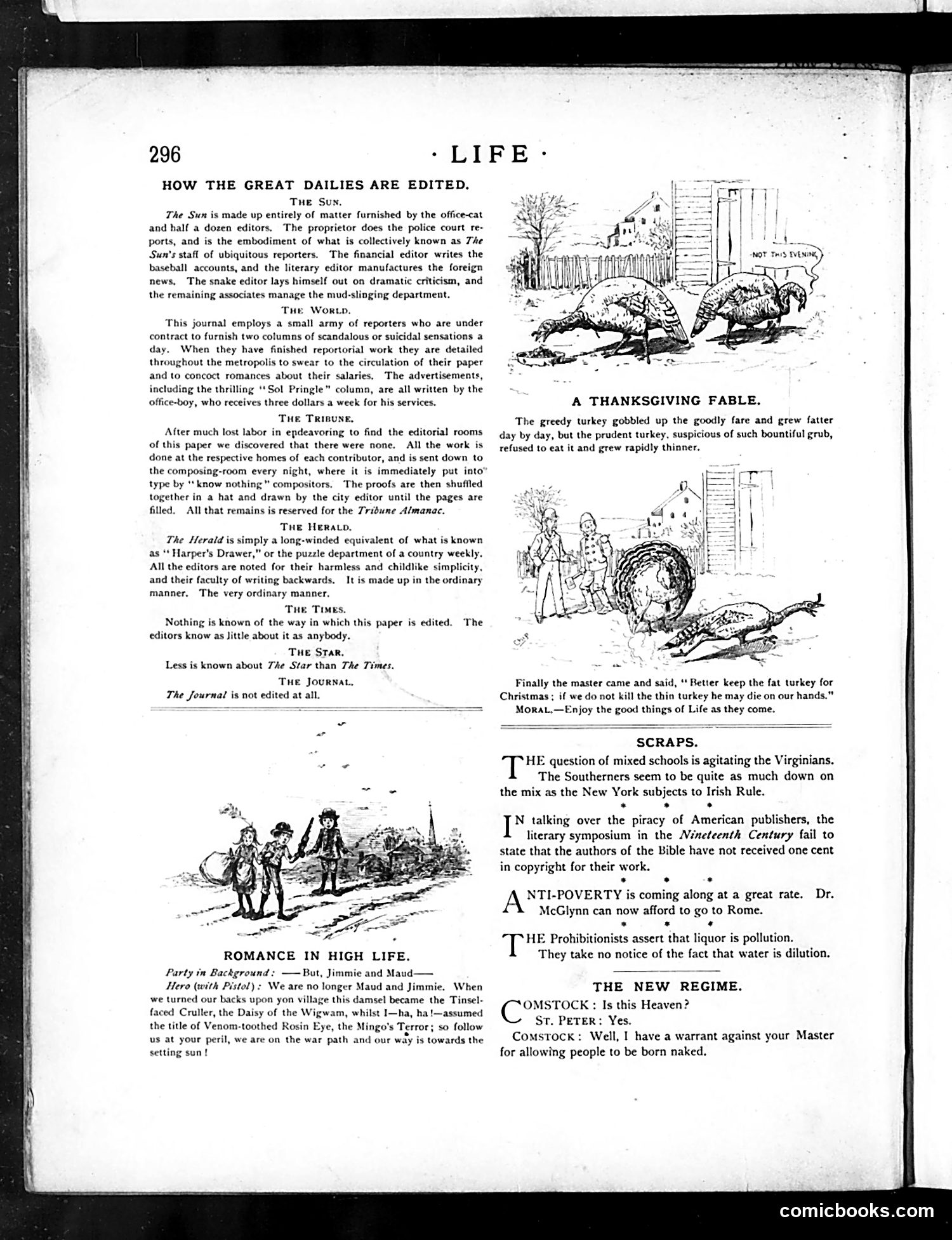
This page satirizes major American newspapers and includes unrelated humor pieces. **"How the Great Dailies Are Edited"** mocks New York papers' editorial processes: The *Sun* is run by an office cat and incompetent editors; the *World* employs reporters contracted to fabricate scandals; the *Tribune's* work is randomly shuffled from a hat; the *Herald* is merely puzzle-department filler; the *Times* and *Star* are edited by nobody; and the *Journal* isn't edited at all. This reflects contemporary criticism of yellow journalism and sensationalism in 1890s New York papers. **"A Thanksgiving Fable"** offers simple moral instruction: a greedy turkey dies from overeating while a cautious one survives—advising readers to enjoy life's pleasures moderately. **"Scraps"** contains brief topical jabs: Virginia debates on integrated schools, Bible authors receiving no copyright compensation, anti-poverty efforts, and a joke about Comstock (likely Anthony Comstock, the anti-vice crusader) bringing his censorious moral policing even to Heaven. The cartoons are crude period illustrations supporting these written pieces.
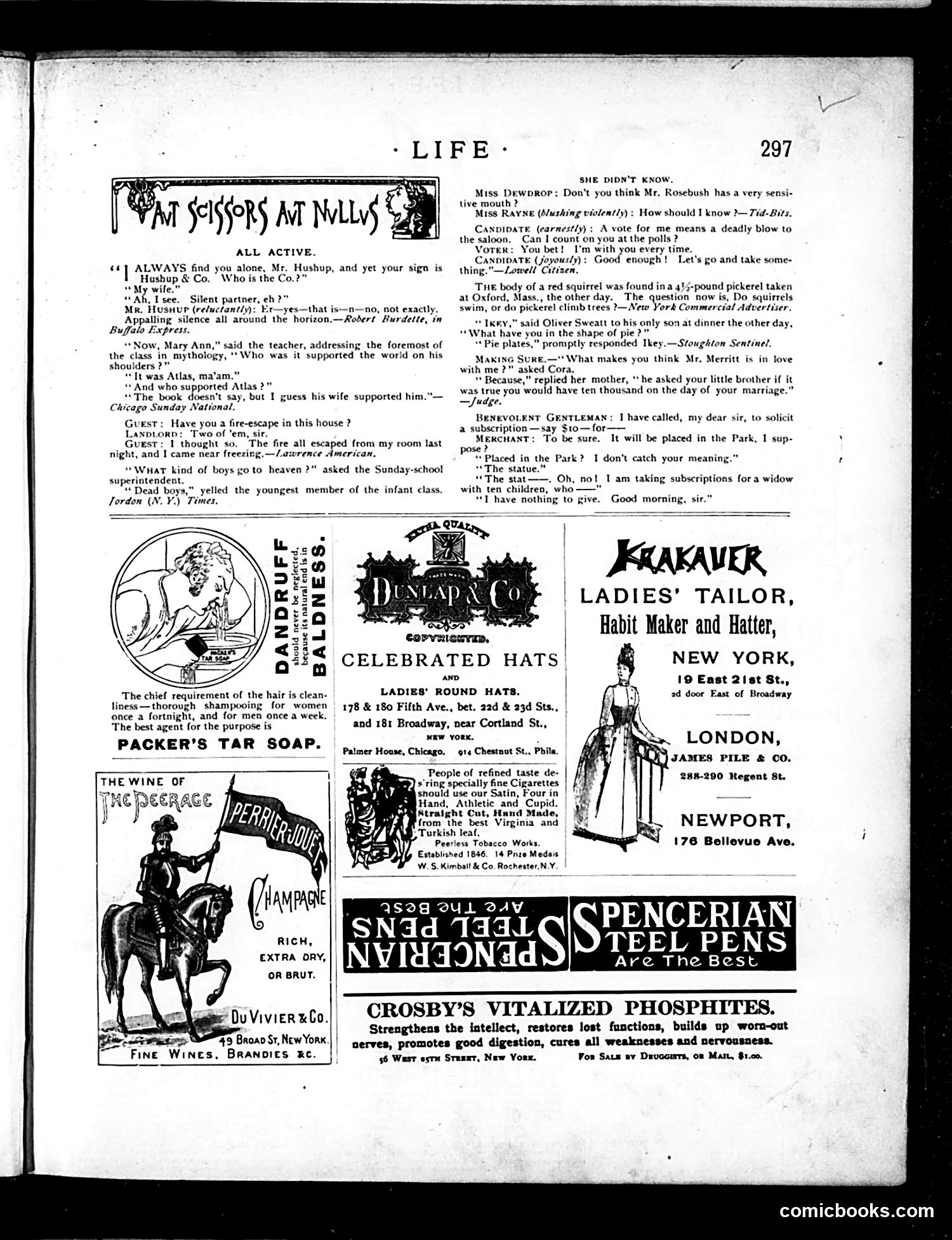
This page from *Life* magazine presents a collection of short humorous anecdotes ("Scissors at Nulls") lampooning everyday social situations and human foibles common to late 19th-century America. **Key jokes include:** - A businessman with a "silent partner" wife (satirizing women's legal invisibility in marriage) - A landlord claiming fire-escapes, when the tenant meant literal fire escaped his room (pun-based humor) - A politician promising to fight saloons, then immediately inviting his supporter for a drink (hypocrisy satire) - A mother's apparent mercenary calculation of her daughter's dowry (cynical commentary on marriage economics) The page is predominantly **advertisements** for period products: hair soap, champagne, ladies' tailoring, cigarettes, wine, and patent medicines like "Crosby's Vitalized Phosphites." These ads reflect contemporary consumer culture and dubious health claims typical of the era. The overall tone mocks Victorian propriety, marital dynamics, political dishonesty, and commercial excess—standard *Life* magazine satire of its era.
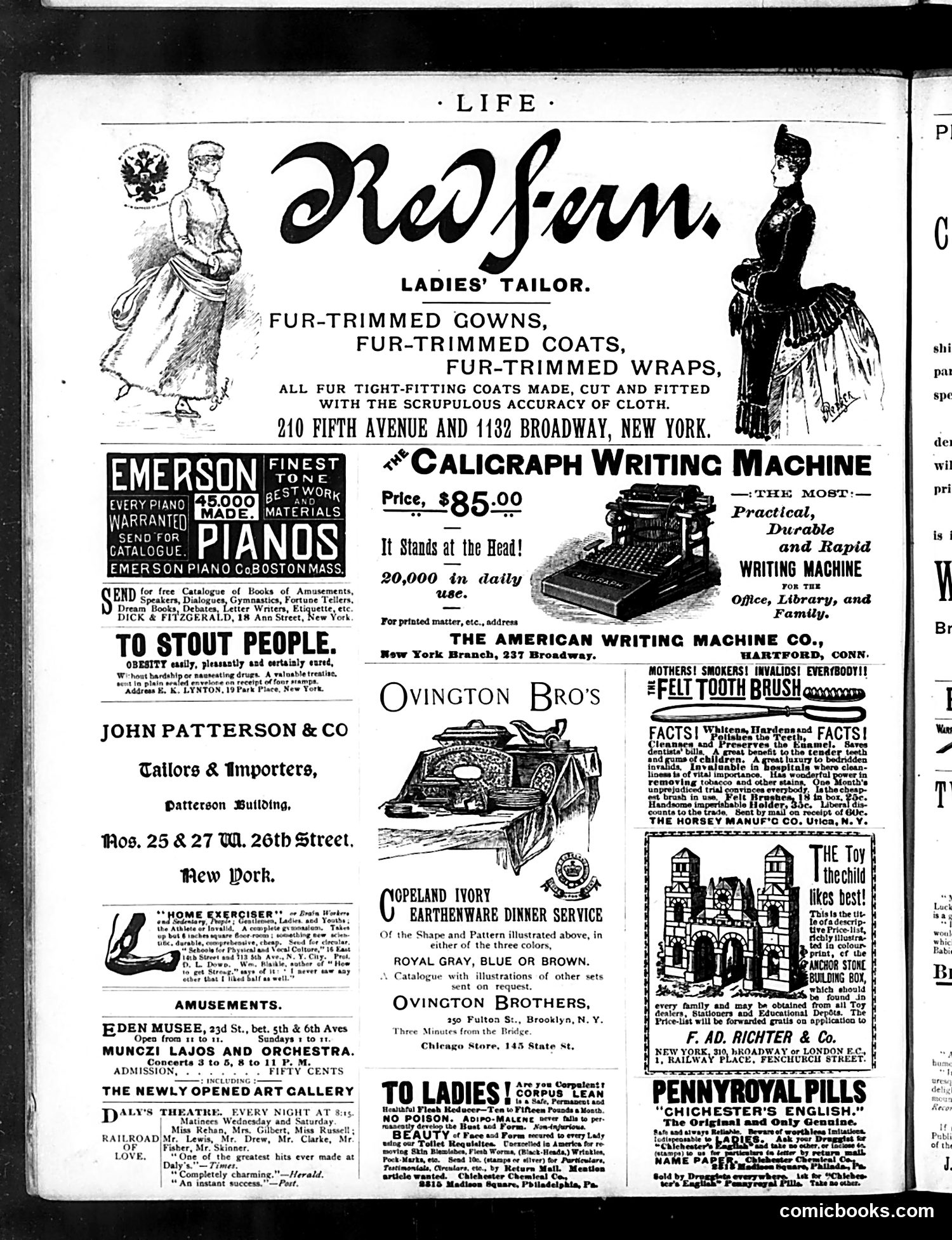
This is **primarily a page of advertisements**, not a political cartoon. It's from an early 20th-century issue of *Life* magazine. The page contains no satirical content or political commentary. Instead, it features commercial ads for: - **Red Farn**, a ladies' tailor offering fur-trimmed garments - **Emerson Pianos** - **Caligraph Writing Machine** (typewriter) - **John Patterson & Co**, tailors and importers - **Ovington Bros**, selling Copeland ivory dinnerware - Various other products including a "Felt Tooth Brush," toy blocks, and **Pennyroyal Pills** (a historically significant patent medicine marketed to women) The Pennyroyal Pills advertisement is notable to modern readers: this was a dangerous abortifacient drug marketed euphemistically to women, reflecting the era's approach to reproductive control and advertising standards that allowed such products. The page reflects turn-of-the-century consumer culture and advertising practices rather than satirical commentary.
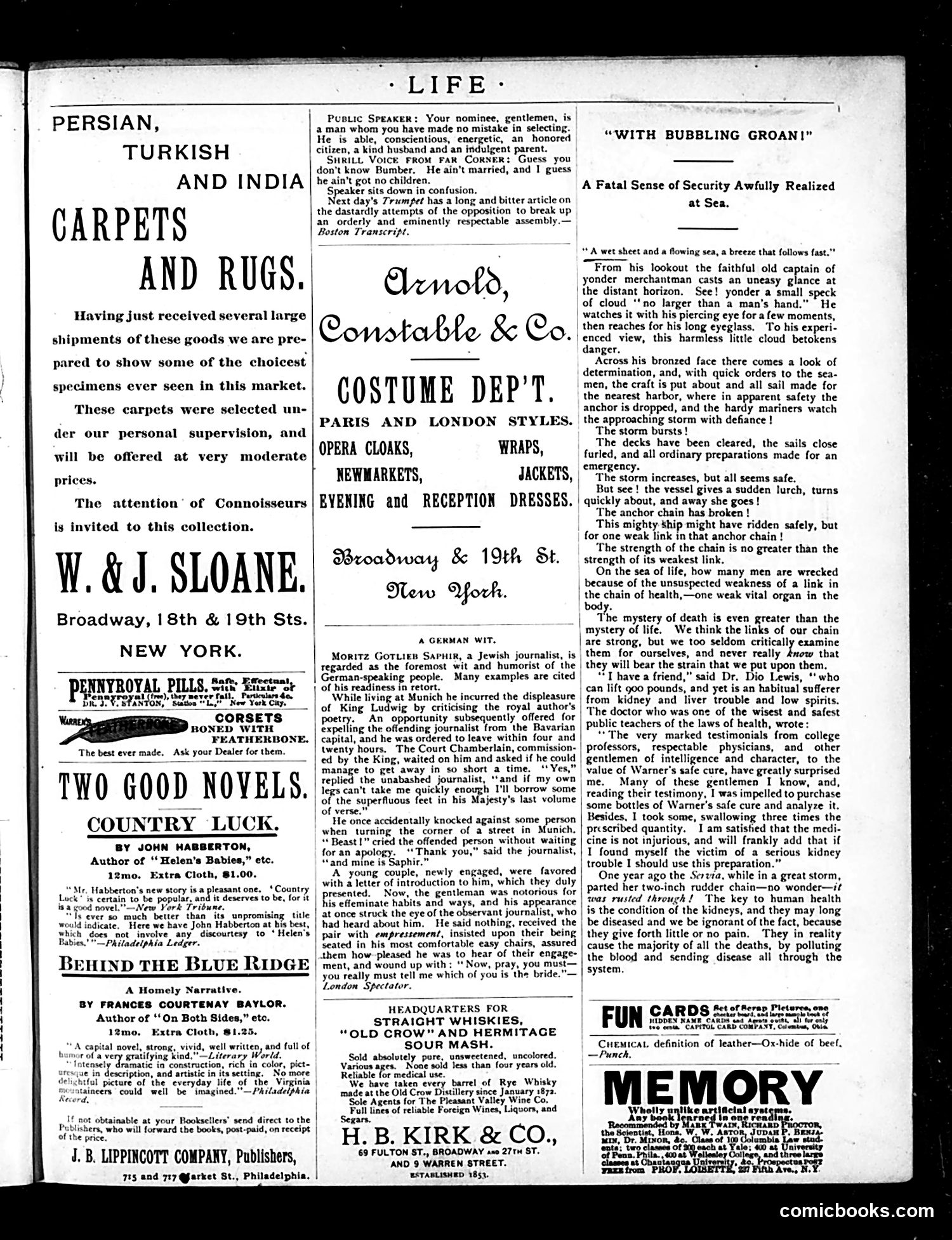
This page's main illustrated content is a serialized maritime narrative titled "With Bubbling Groan!: A Fatal Sense of Security Awfully Realized at Sea." The story depicts a ship encountering a storm, with the crew discovering a weakened anchor chain—a metaphor for fragility amid apparent safety. The narrative emphasizes human vulnerability at sea: "On the sea of life, how many men are wrecked because of the unsuspected weakness of a link in the chain of health,—one weak vital organ in the body." The piece uses maritime disaster as philosophical allegory, comparing physical maritime dangers to life's hidden perils. The text explicitly draws this parallel, suggesting readers consider how unseen weaknesses—whether in ships' chains or human bodies—spell doom. The remainder of the page consists entirely of period advertisements for carpets, novels, corsets, and clothing, plus anecdotes about German wit and journalism—typical *Life* magazine filler content from this era.
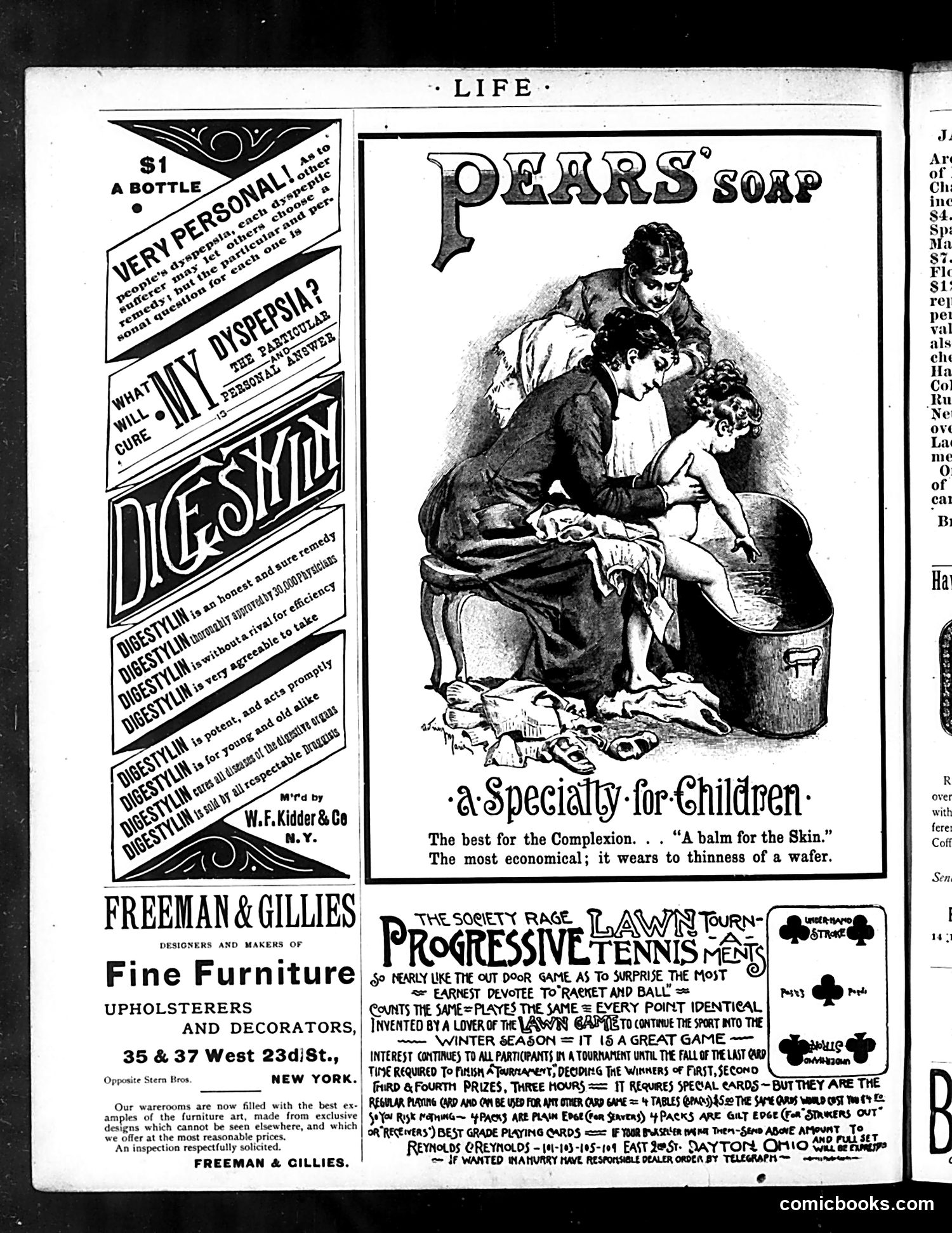
This page consists primarily of **advertisements** rather than editorial cartoons or satire. The main featured ad is **Pears' Soap**, depicting a domestic scene of an adult bathing a child—marketed as "a Specialty for Children" with claims about complexion and economy. This represents typical late-19th/early-20th-century advertising rhetoric emphasizing gentility and maternal care. Below are ads for: - **Freeman & Gillies Furniture** (upholstery and decoration services in New York) - **Progressive Lawn Tennis**, an indoor card game designed to simulate outdoor tennis during winter months The Progressive Lawn Tennis ad is the most notable for modern readers—it represents a Victorian-era solution to seasonal recreation, allowing lawn tennis enthusiasts to continue their "sport" indoors using specially designed playing cards during winter. This reflects both the era's enthusiasm for lawn tennis as a genteel pastime and the creative commercial solutions offered to the wealthy. The page is primarily commercial content typical of *Life* magazine's revenue model.
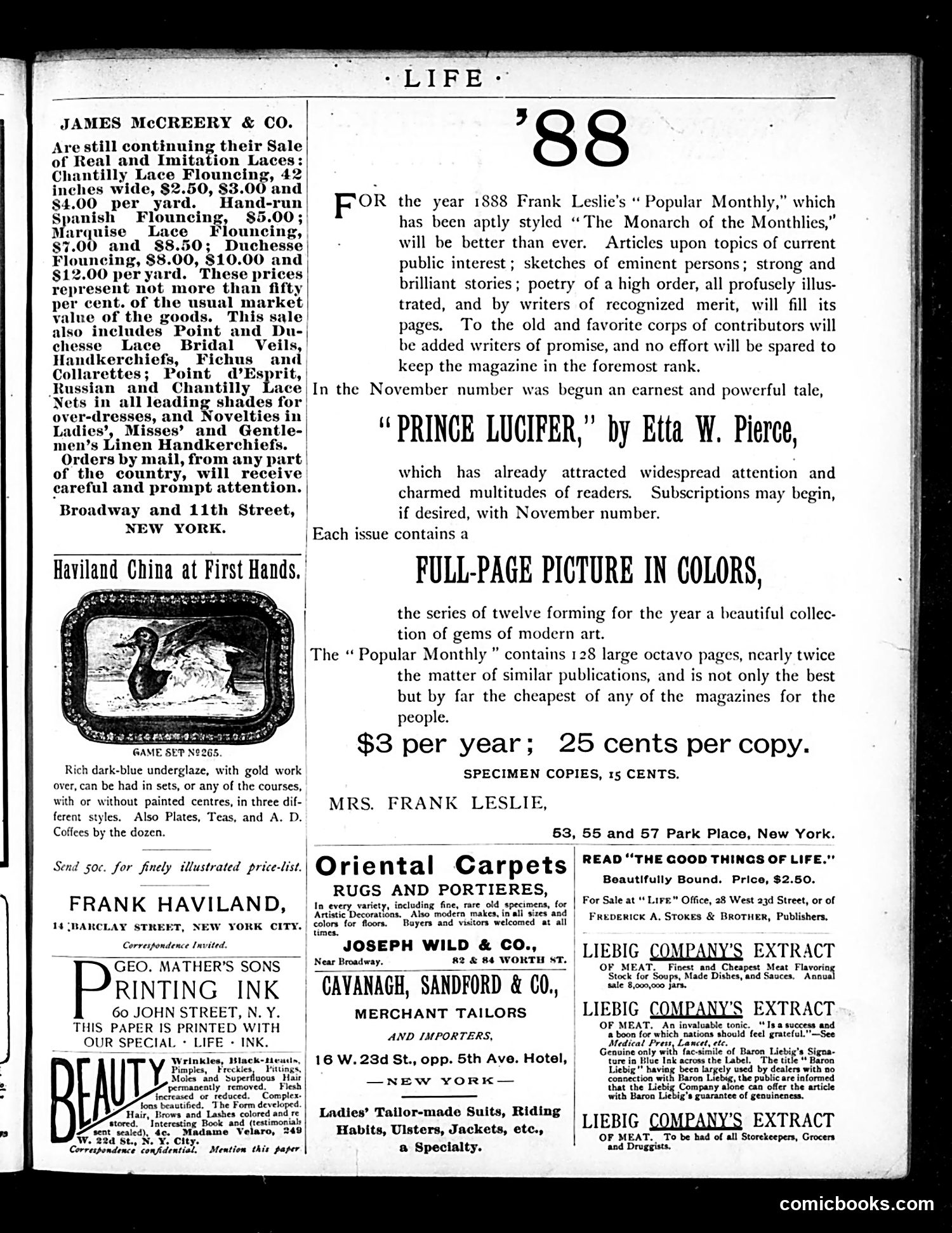
This page is primarily **advertising and announcements**, not editorial content with cartoons or satire to analyze. The page showcases **1888 commercial advertisements** for luxury goods (laces, china, carpets, tailoring services) and includes promotional material for *Frank Leslie's Popular Monthly* magazine, highlighting the serialized story "Prince Lucifer" by Etta W. Pierce and full-page color illustrations. There is **one small illustration** — a decorative engraving of a duck or waterfowl on china (labeled "Haviland China at First Hands") — but this is purely commercial imagery, not political satire. The only potentially humorous element is a beauty-services advertisement for removing "Moles," "Superfluous Hair," and "Wrinkles," which reflects late-Victorian anxieties about appearance, but this is marketing copy rather than satirical commentary. **No political cartoons or social satire appear on this page.**
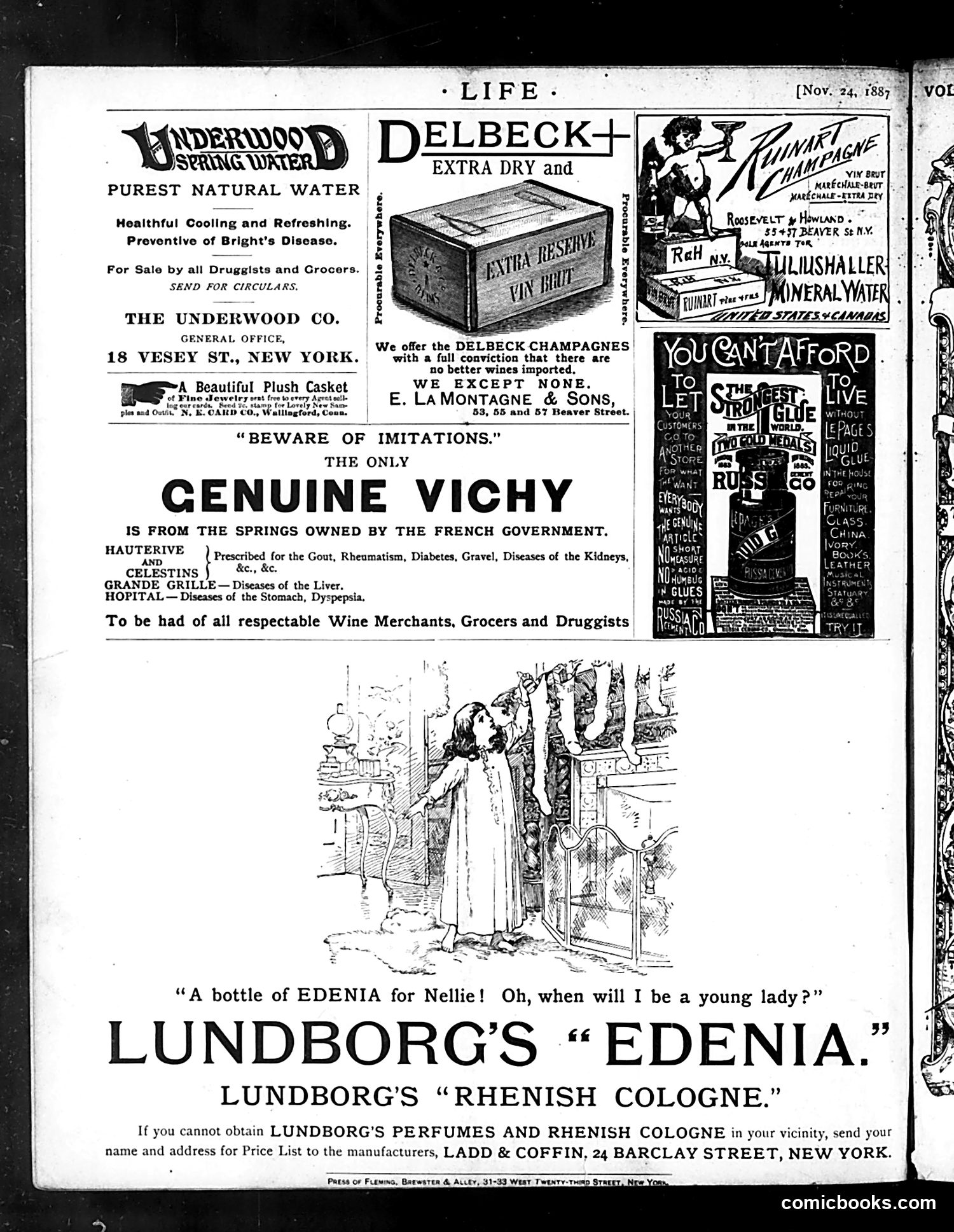
This is primarily a **advertisements page**, not a political cartoon. The page features various late-19th-century patent medicines and luxury goods typical of the era. The central illustration shows a young girl asking for "EDENIA" perfume, with the caption "Oh, when will I be a young lady?"—a common advertising trope suggesting the product promotes beauty and femininity. The ads promote **medicinal waters and tonics** (Underwood's water, Vichy, Edenia cologne) marketed as treatments for gout, rheumatism, dyspepsia, and Bright's disease—reflecting contemporary beliefs that mineral waters had curative properties. Notable is the **"Beware of Imitations"** warning for genuine Vichy, emphasizing that the French government-owned springs guaranteed authenticity—a selling point in an era of unregulated patent medicines and widespread counterfeiting. The page reflects Victorian consumer culture and medical pseudoscience before modern FDA regulation.