
Life, 1887-11-24 · page 9 of 20
Life — November 24, 1887 — page 9: what you’re looking at
What you’re looking at
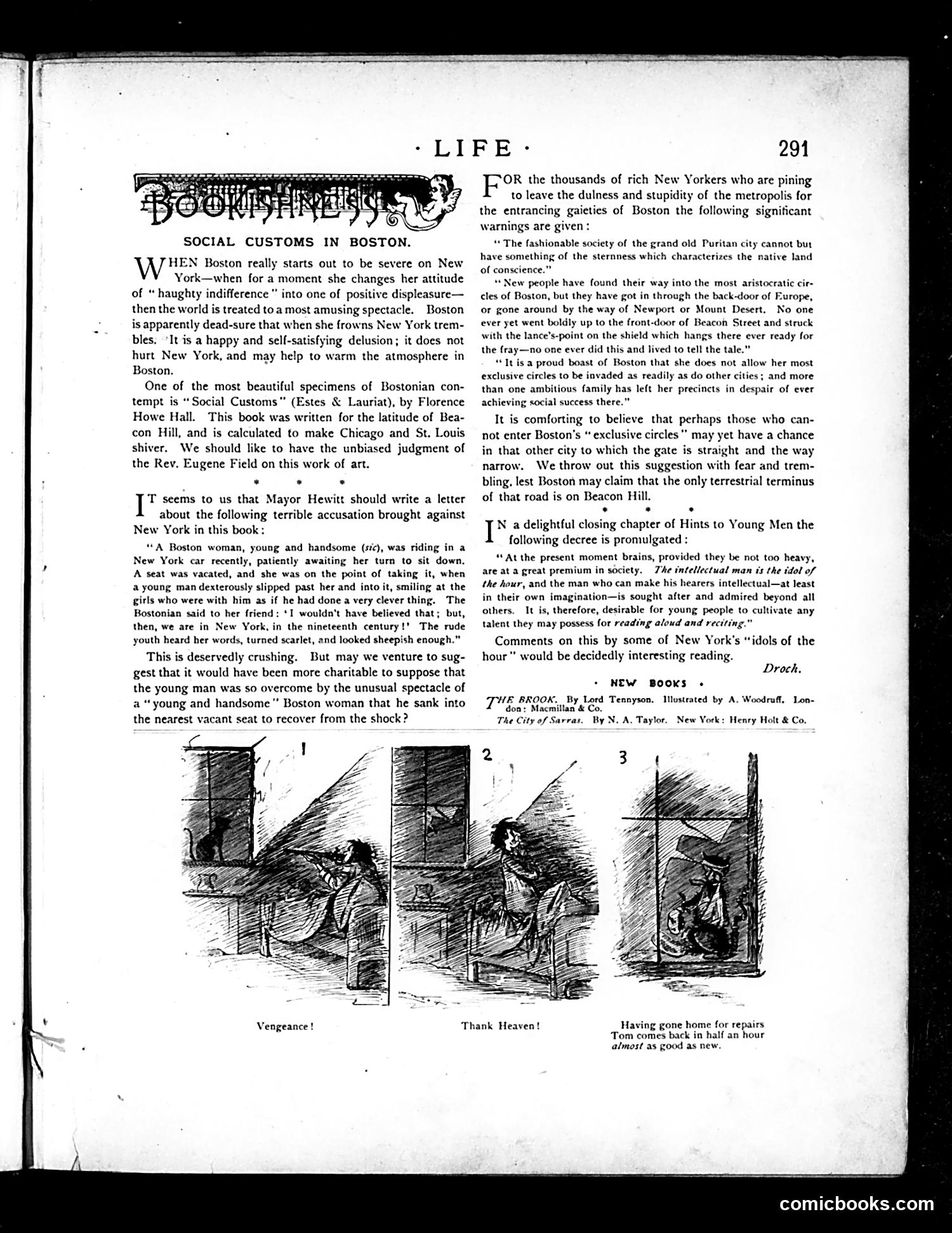
This page satirizes Boston's self-perceived aristocratic superiority over New York. The text criticizes Bostonians' snobbish attitude, claiming they view their city as culturally and socially superior—a position the author challenges as unwarranted. The three small cartoon panels at bottom appear to show domestic scenes with humorous captions: "Vengeance!", "Thank Heaven!", and "Having gone home for repairs / Tom comes back in half an hour / almost as good as new." These likely illustrate the absurdity of Boston pretension through everyday domestic life. The article references a book, *Social Customs in Boston* by Florence Howe Hall, using it as a springboard to mock Boston's exclusivity while suggesting that ambitious New Yorkers needn't feel inferior to Boston's "exclusive circles."
📄 Transcribed text from this page (OCR, searchable)
Machine-transcribed from the original scan — historical spelling and the odd misread are preserved.
- LIFE: SOCIAL CUSTOMS IN BOSTON. HEN Boston really starts out to be severe on New York—when for a moment she changes her attitude of “ haughty indifference” into one of positive displeasure— then the world is treated toa most amusing spectacle. Boston is apparently dead-sure that when she frowns New York trem- bles, ‘It is a happy and self-satisfying delusion; it does not hurt New York, and may help to warm the atmosphere in Boston. One of the most beautiful specimens of Bostonian con- tempt is “Social Customs” (Estes & Lauriat), by Florence Howe Hall. This book was written for the latitude of Bea- con Hill, and is calculated to make Chicago and St. Louis shiver, We should like to have the unbiased judgment of the Rev. Eugene Field on this work of art. * . . T seems to us that Mayor Hewitt should write a letter about the following terrible accusation brought against New York in this book: “A Boston woman, young and handsome (sic), was riding in a New York car recently, patiently awaiting her turn to sit down. A seat was vacated, and she was on the point of taking it, when a young man dexterously slipped past her and into it, smiling at the girls who were with him as if he had done a very clever thing. The Bostonian said to her friend: ‘I wouldn't have believed that; but, then, we are in New York, in the nineteenth century!" The rude youth heard her words, turned scarlet, and looked sheepish enough.” This is deservedly crushing. But may we venture to sug- gest that it would have been more charitable to suppose that the young man was so overcome by the unusual spectacle of a “young and handsome” Boston woman that he sank into the nearest vacant seat to recover from the shock? Vengeance! Thank Heaven! 291 ‘OR the thousands of rich New Yorkers who are pining to leave the dulness and stupidity of the metropolis for the entrancing gaietics of Boston the following significant warnings are given: “The fashionable society of the grand old Puritan city cannot but have something of the sternness which characterizes the native land of conscience.” “New people have found their way into the most aristocratic cir- cles of Boston, but they have got in through the back-door of Europe, or gone around by the way of Newport or Mount Desert. No one ever yet went boldly up to the front-door of Beacoh Street and struck with the lance’s-point on the shield which hangs there ever ready for the fray—no one ever did this and lived to tell the tale.” “It isa proud boast of Boston that she does not allow her most exclusive circles to be invaded as readily as do other cities; and more than one ambitious family has left her precincts in despair of ever achieving social success there.” It is comforting to believe that perhaps those who can- not enter Boston's “ exclusive circles" may yet have a chance in that other city to which the gate is straight and the way narrow. We throw out this suggestion with fear and trem- bling, lest Boston may claim that the only terrestrial terminus of that road is on Beacon Hill. . . . I N a delightful closing chapter of Hints to Young Men the following decree is promulgated : “At the present moment brains, provided they be not too heavy, are at a great premium in society. Tie intellectual man is the idol of the hour, and the man who can make his hearers intellectual—at least in their own imagination—is sought after and admired beyond all others. It is, therefore, desirable for young people to cultivate any talent they may possess for reading aloud and reciting.” Comments on this by some of New York's “idols of the hour” would be decidedly interesting reading. Droch, + NEW BOOKS «+ THE BROOK. By Lord Tennyson. doa: Macmillan & Co. The City of Sarras. By N, A. Taylor. Iostrated by A, Woodruff, Lon- New York: Henry Holt & Co, Having gone home for repairs Tom comes back in half an hour almost as good as new. comicbooks.com