
A complete issue · 16 pages · 1887
Life — November 17, 1887
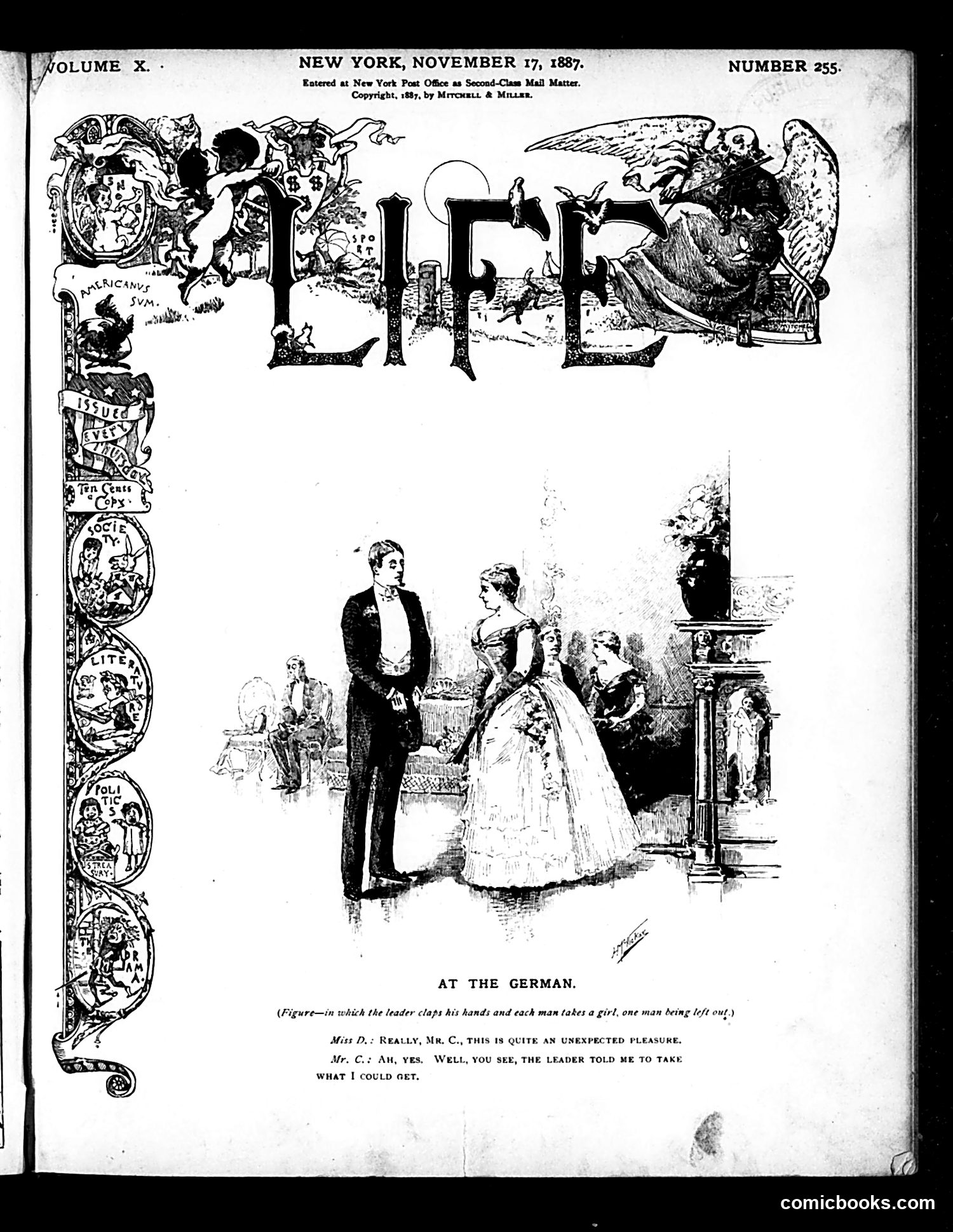
This satirical cartoon depicts a formal dance or social gathering scene. The caption explains the joke: at a German (a type of formal dance popular in the 1880s), "the leader clasps his hands and each man takes a girl, one man being left out." The humor lies in the social awkwardness of this dancing tradition—when there's an odd number of participants, one man is inevitably excluded and left without a partner. The dialogue between Miss D. and Mr. C. references the discomfort of this situation, with the woman expressing surprise at the "unexpected pleasure" of the arrangement while the man notes he was told to "take what I could get," suggesting he received an undesirable or consolation partner in this social game.
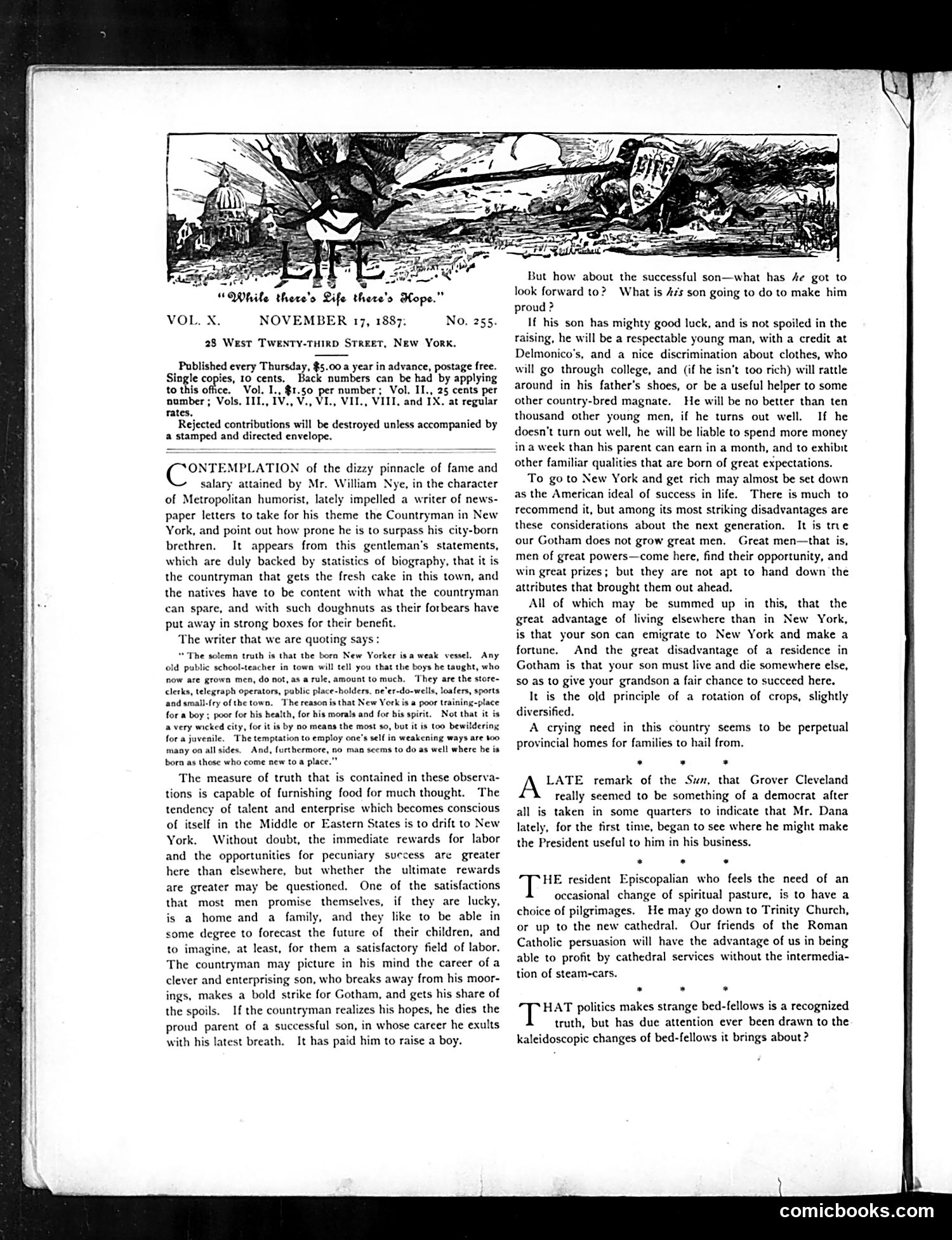
**The Cartoon:** The illustration at the top depicts a rural/countryside scene with the caption "While there's Life there's Hope." The image appears to contrast pastoral simplicity with urban complexity, supporting the editorial's theme about American success and geography. **The Content:** The page's main editorial discusses William Nye, a humorist and newspaper columnist, praising his success as a "countryman" writer in New York. The text argues that living outside New York offers advantages for raising successful sons—they avoid urban corruption and develop character. The satire critiques American assumptions that New York is essential for success, instead arguing provincial life builds better men. This reflects late-19th-century tension between rural and urban American values during rapid industrialization.
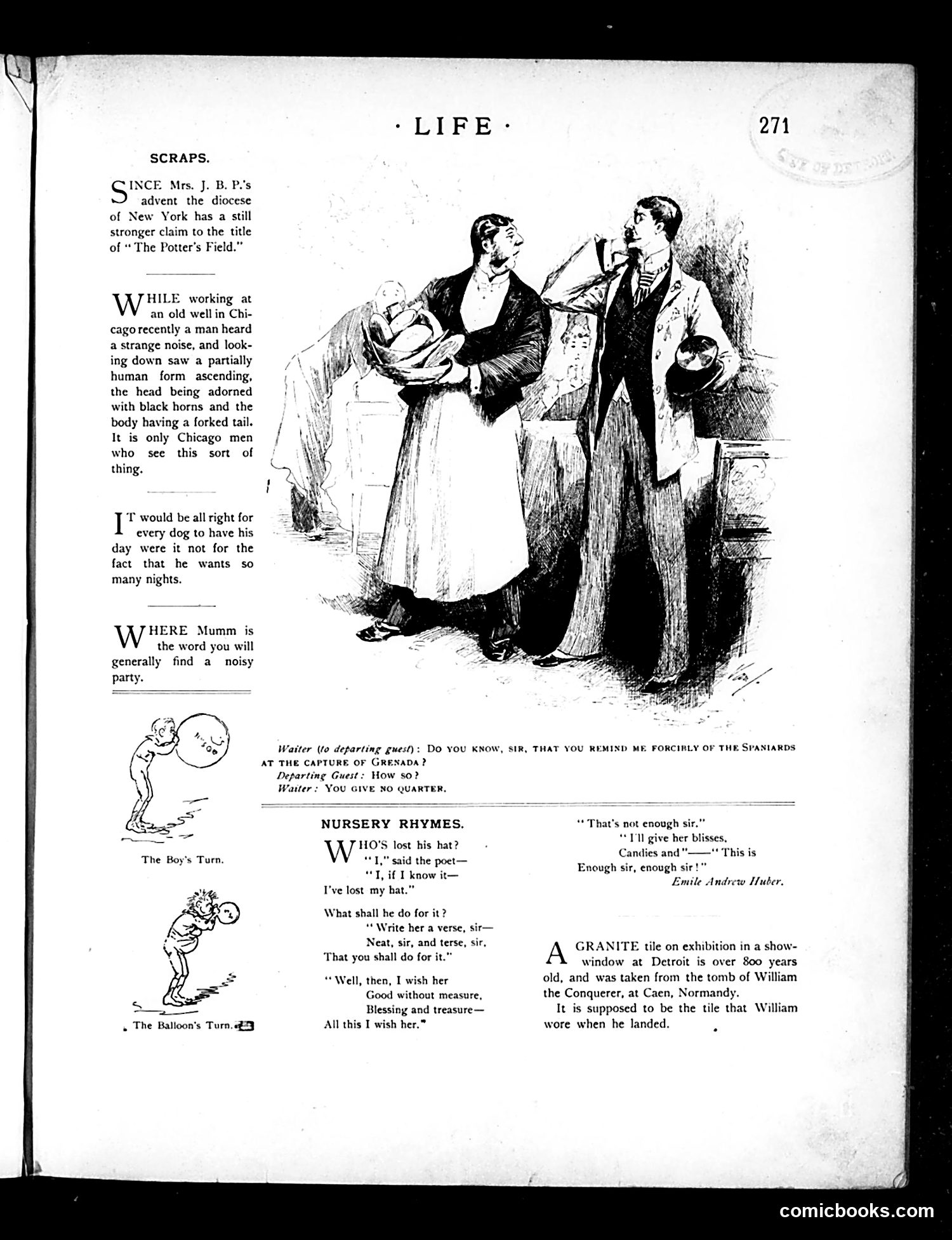
The main cartoon depicts two men examining what appears to be a strange creature or artifact. The caption references "The Potter's Field" and mentions a well in Chicago where something unusual was discovered—described as having "a partially human form ascending, the head being adorned with black horns and the body having a forked tail." This appears to be satirizing a sensational discovery claim or hoax circulating in Chicago at the time. The humor likely derives from the absurdity of the described creature and the credulity of those reporting it. The page also includes unrelated "Nursery Rhymes" content and a brief note about a granite tile in Detroit allegedly from William the Conqueror's tomb—further demonstrating the magazine's pattern of mocking curiosities and dubious historical claims.
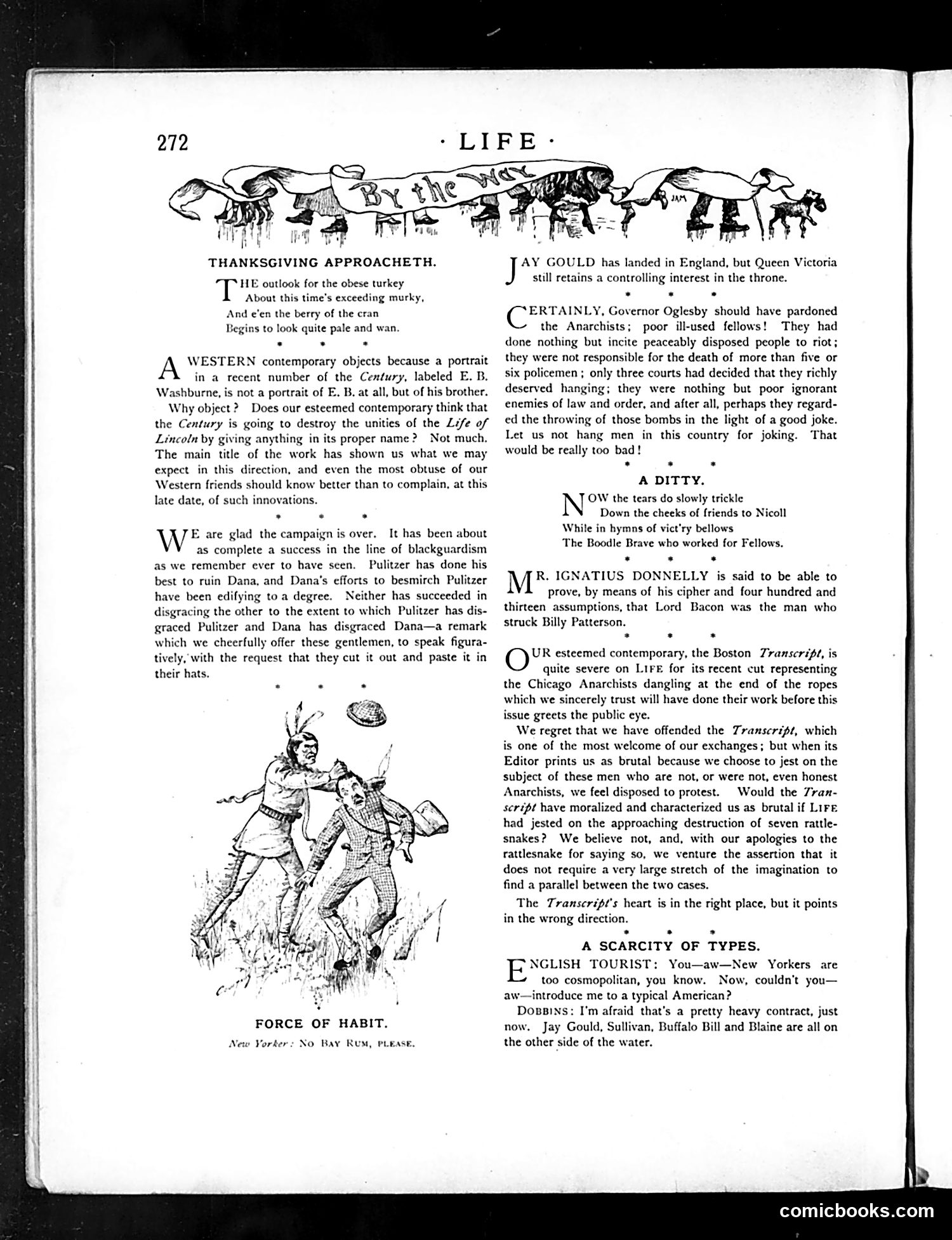
This cartoon depicts two figures in what appears to be a Native American confrontation, likely satirizing American frontier violence or colonial relations. The caption "FORCE OF HABIT" and subtitle "New Yorker: No rum, please" suggests commentary on drinking culture and stubborn behavioral patterns. The accompanying articles discuss anarchists, Governor Oglesby's pardon decisions, and contemporary political controversies. Without clearer identification of the specific historical figures or incident being referenced, the cartoon's precise political target remains unclear—though it appears to mock ingrained social behaviors or colonial attitudes toward Native Americans during a period when such imagery was considered acceptable satire.
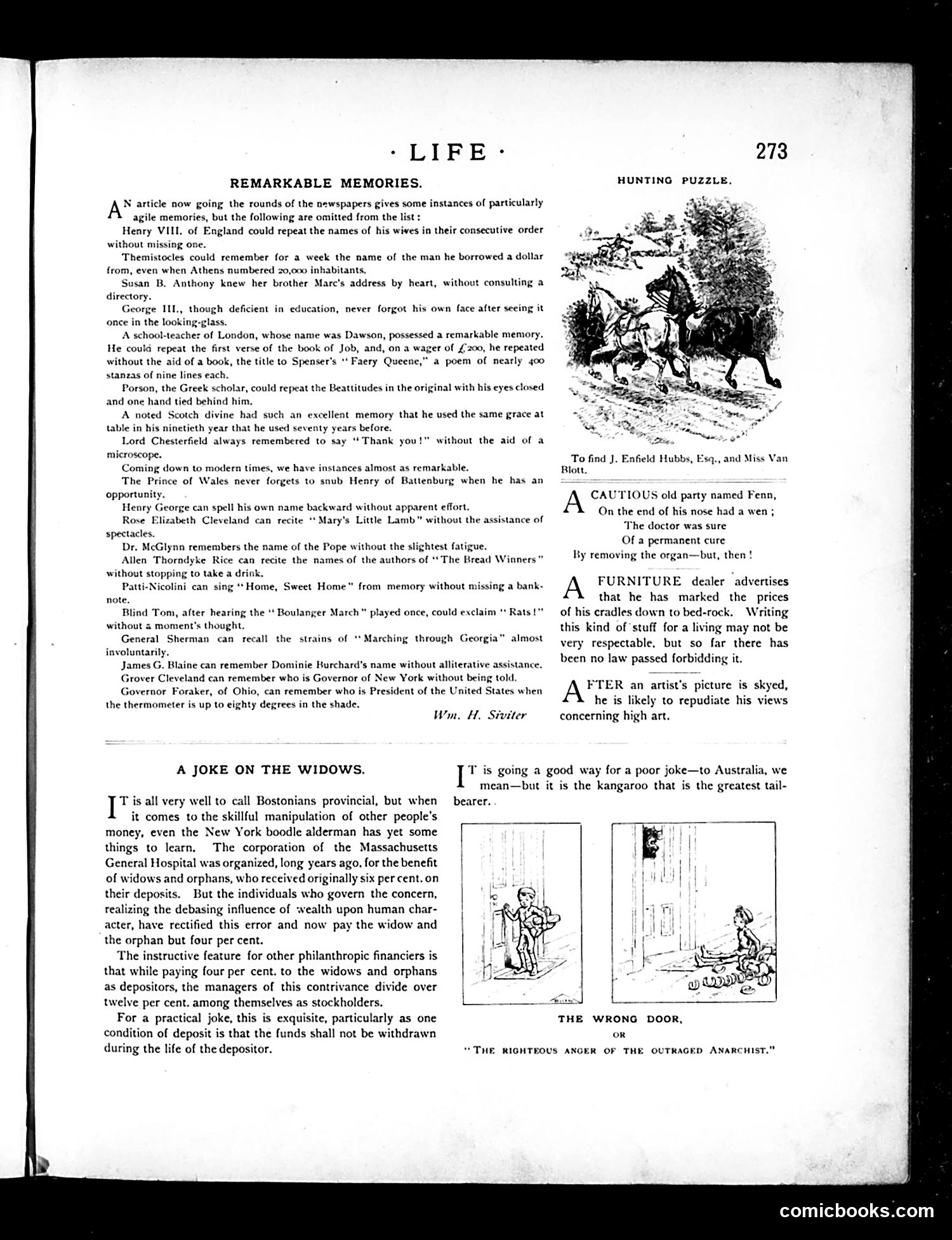
This cartoon depicts a slapstick scene where a man appears to have entered the wrong room, surprising a woman. The caption's reference to an "outraged Anarchist" suggests political satire, likely mocking anarchist movements that were prominent concerns in late 19th/early 20th-century America. The humor plays on the absurdity of an anarchist's "righteous anger" being triggered by a domestic embarrassment (entering the wrong door) rather than actual revolutionary grievances. The cartoon satirizes anarchists as ridiculous figures whose supposed moral outrage is trivial and comedic rather than substantive. This reflects the era's tendency to caricature political radicals as buffoonish rather than threatening.
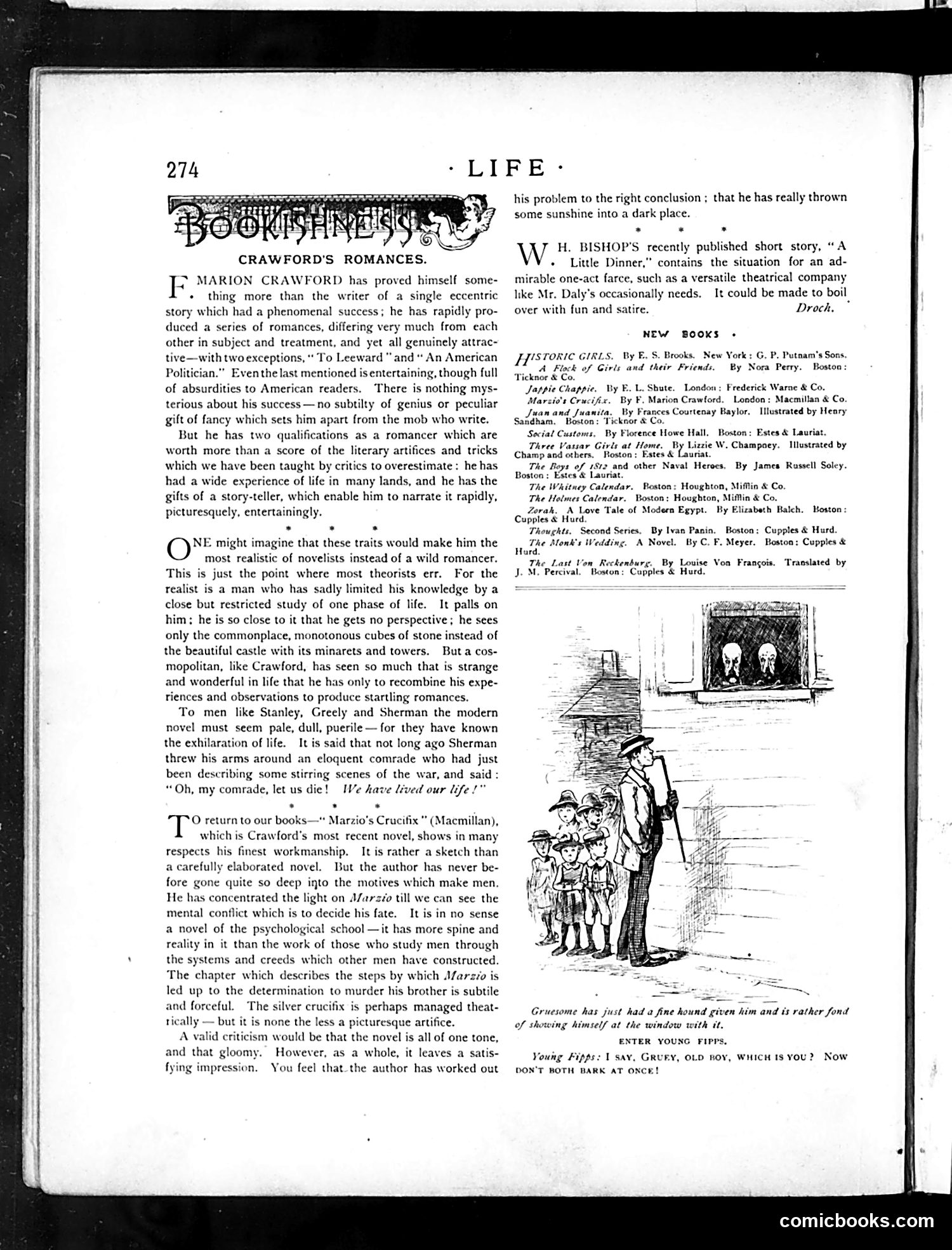
This page is primarily **literary criticism and book reviews**, not political satire. The main article "Crawford's Romances" discusses novelist Marion Crawford's works, praising his ability to blend romanticism with realism. The illustration appears to show a **social scene**: well-dressed figures at a window or gathering, with what looks like street children or poor people below. The caption reads "Ginevess has just had a fine hound given him and is rather fond of showing himself at the window with it." This is **satirical social commentary**—likely mocking the wealthy displaying their possessions and pets to impress others while poor people pass by. It's a critique of class display and superficial vanity, typical of Life magazine's social satire from this era.
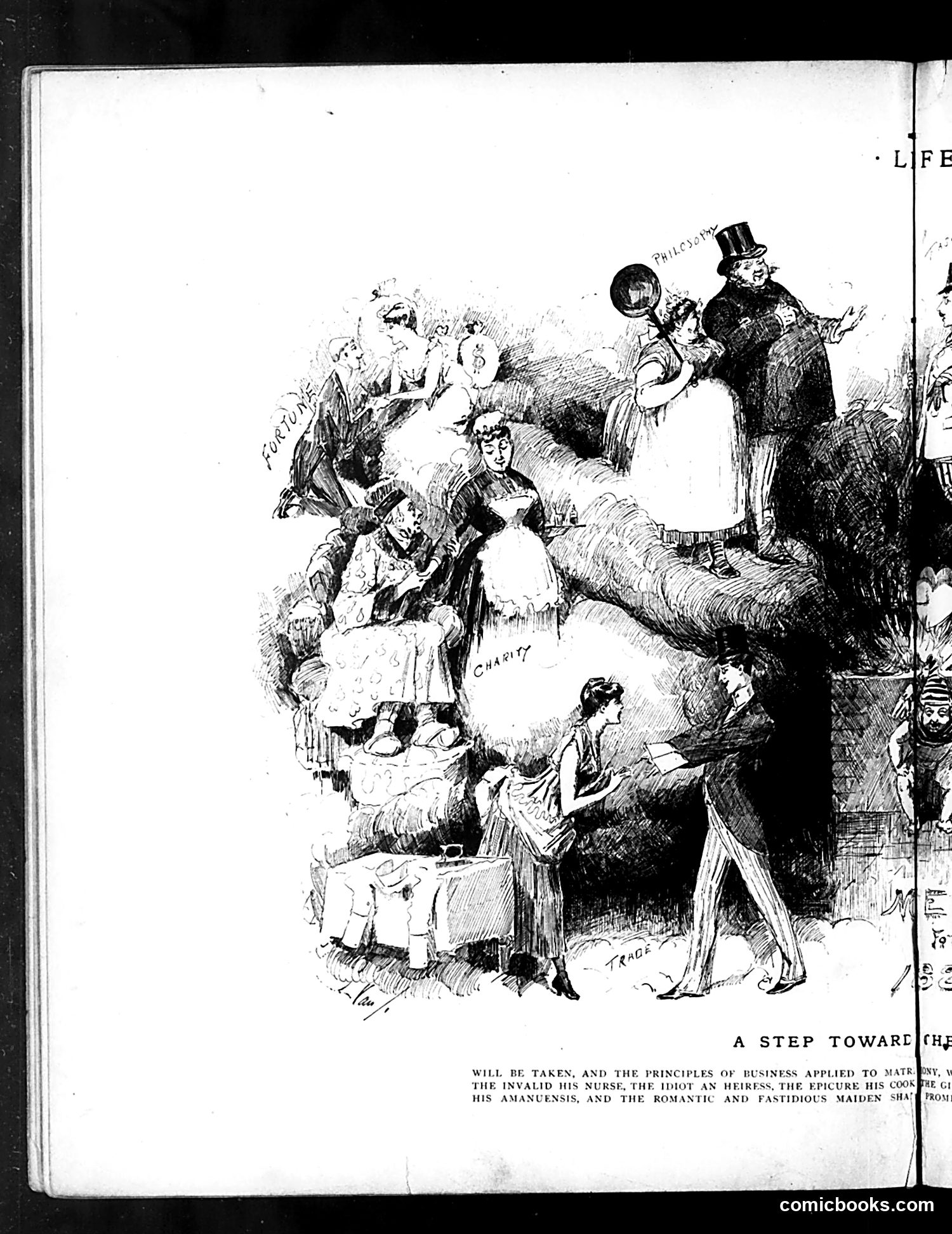
This satirical illustration depicts a hierarchical social commentary, likely from the early 20th century. The cartoon shows various figures arranged vertically, suggesting social stratification. The visible text references "business applied to matters" including "the invalid," "nurse," "idiot," "heiress," "epicure," "cook," "amusements," and "romantic and fastidious maiden." The composition appears to mock how wealthy or aristocratic society figures (notably the heiress) rely on servants and subordinates. A man in a top hat holds what appears to be a mirror labeled "philosophy," suggesting self-reflection or vanity. The overall satire critiques class hierarchies and the dependent relationships between the wealthy and working classes, presenting social dysfunction as built into these power structures. The title begins "A Step Toward..." but is cut off.
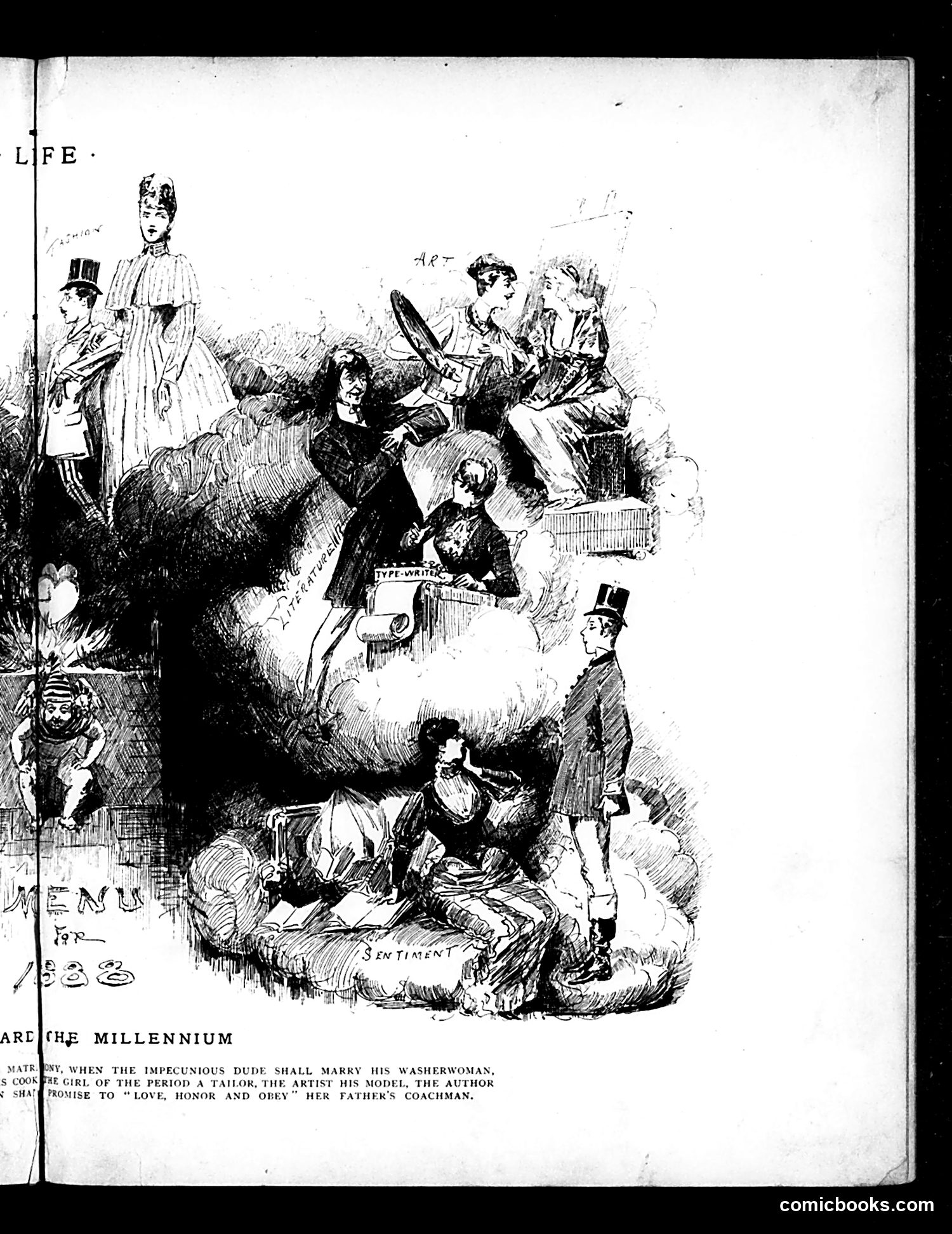
This satirical cartoon mocks romantic and social pretensions of the wealthy elite. The central figure appears to be a large, pompous character labeled "TYPE-WRITER" surrounded by well-dressed society people, soldiers, and courtiers arranged on clouds—suggesting heavenly or idealized aspiration. The caption references an improbable future marriage between "the impecunious dude" and a washerwoman, with promises that a tailor will become "the artist his model," and an author will "promise to love, honor and obey her father's coachman." The satire ridicules the Gilded Age fantasy of crossing class boundaries through romance and social climbing—suggesting such scenarios are as unlikely as the millennium itself arriving. The contrast between the elevated figures and those below emphasizes class tensions and the absurdity of such social reversals.
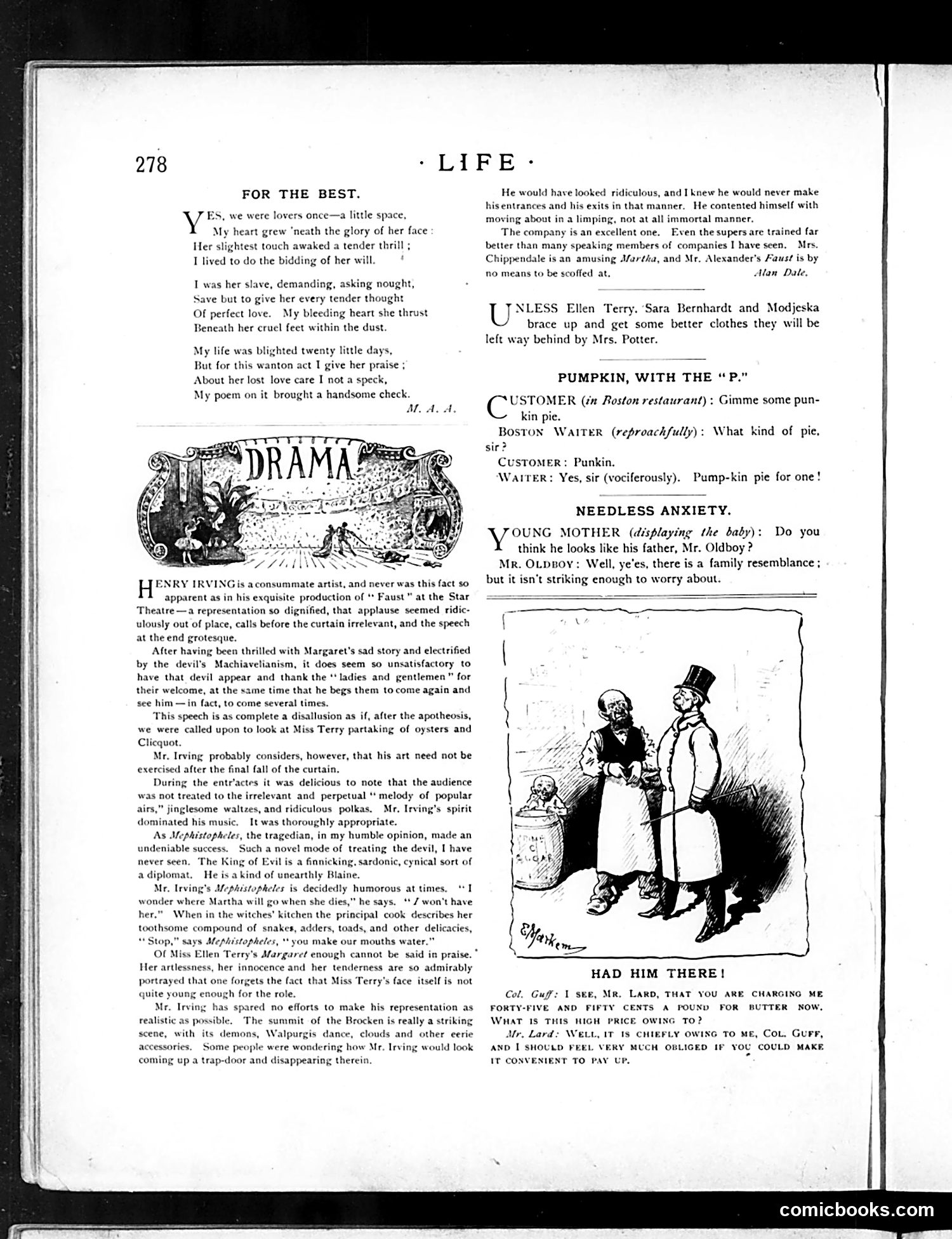
This cartoon depicts a common domestic dispute scenario. A well-dressed colonel ("Col. Guff") confronts a working-class man about an inflated butter price—forty-five to fifty cents a pound. The colonel demands explanation for this "high price" and threatens to report the seller to authorities unless payment is reduced. The satire targets wartime or post-war price gouging on essential goods. The colonel's indignant tone and class-based authority contrast with the working man's apparent composure. The title "Had Him There!" suggests the working man successfully deflates the colonel's outrage—likely through a witty riposte not fully captured in this portion of the text, leaving readers to infer his clever response.
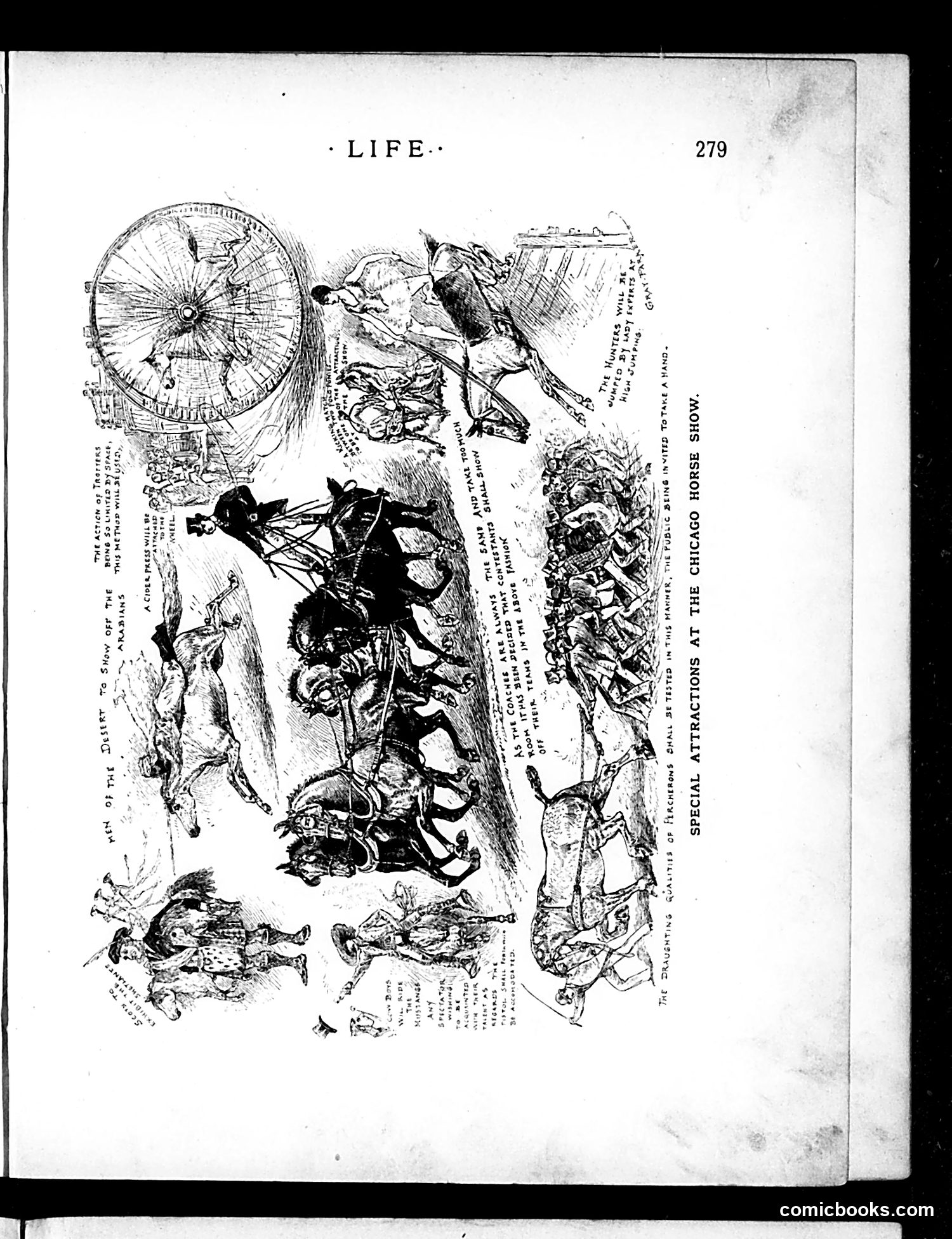
This page from *Life* magazine (page 279) presents "Serial Attractions at the Chicago Horse Show"—a satirical commentary on high society entertainment. The cartoon depicts multiple scenes arranged vertically, showing elaborately dressed figures at what appears to be the prestigious Chicago Horse Show, a real social event where wealthy Americans displayed horses and competed. The satire mocks the pretentiousness and theatrical absurdity of upper-class social gatherings. The figures are caricatured in exaggerated poses, suggesting the show was more about display and performance than genuine equestrian skill. The "serial attractions" format implies these society events were mere spectacles for entertainment—comparing fashionable elites to circus acts. The detailed text labels (though OCR-garbled here) likely identified specific attendees or social figures, making this topical satire for *Life*'s contemporary readers who would recognize the referenced Chicago society figures.
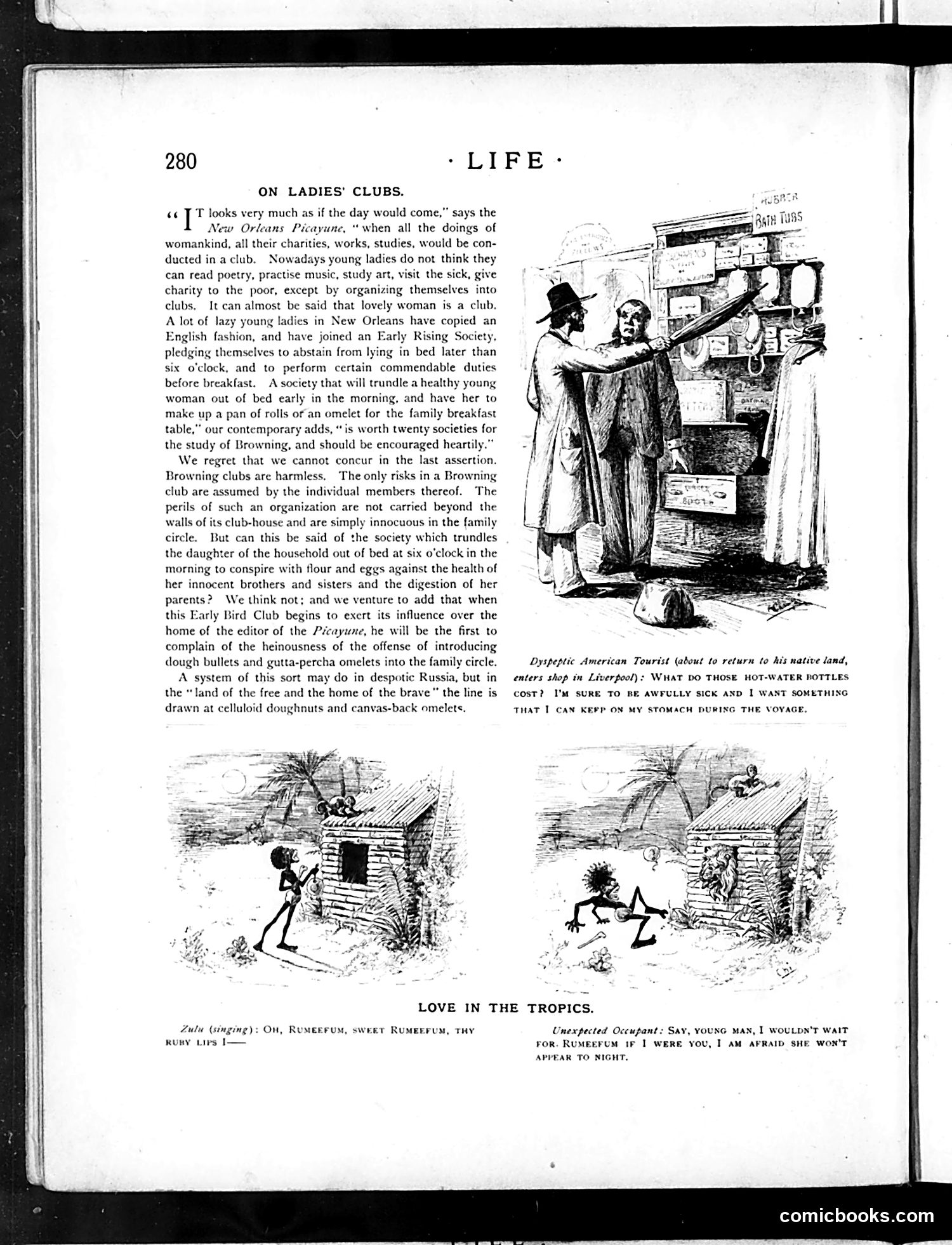
This page contains two satirical pieces critiquing modern trends: **"On Ladies' Clubs"** mocks the proliferation of women's clubs in the 1890s. The *New Orleans Picayune* is quoted praising an "Early Rising Society" where young women pledge to wake at 6 a.m. and prepare breakfast. Life's editors sardonically respond that while literary clubs like "Browning clubs" are harmless, forcing daughters out of bed to cook threatens family health—describing their attempts as "dough bullets" and "gutta-percha omelets." The joke critiques both excessive club-joining and the pretense that domestic drudgery, repackaged as a club pledge, constitutes self-improvement. **The remaining cartoons** offer unrelated humor: a dyspeptic American tourist buying hot-water bottles for his queasy voyage home, and a "Love in the Tropics" sketch where a man interrupts a Zulu's romantic serenade to his beloved Rumeefum, sardonically suggesting she won't appear. The satire assumes readers will recognize the contemporary fad of women's organizations and poke fun at their earnestness.
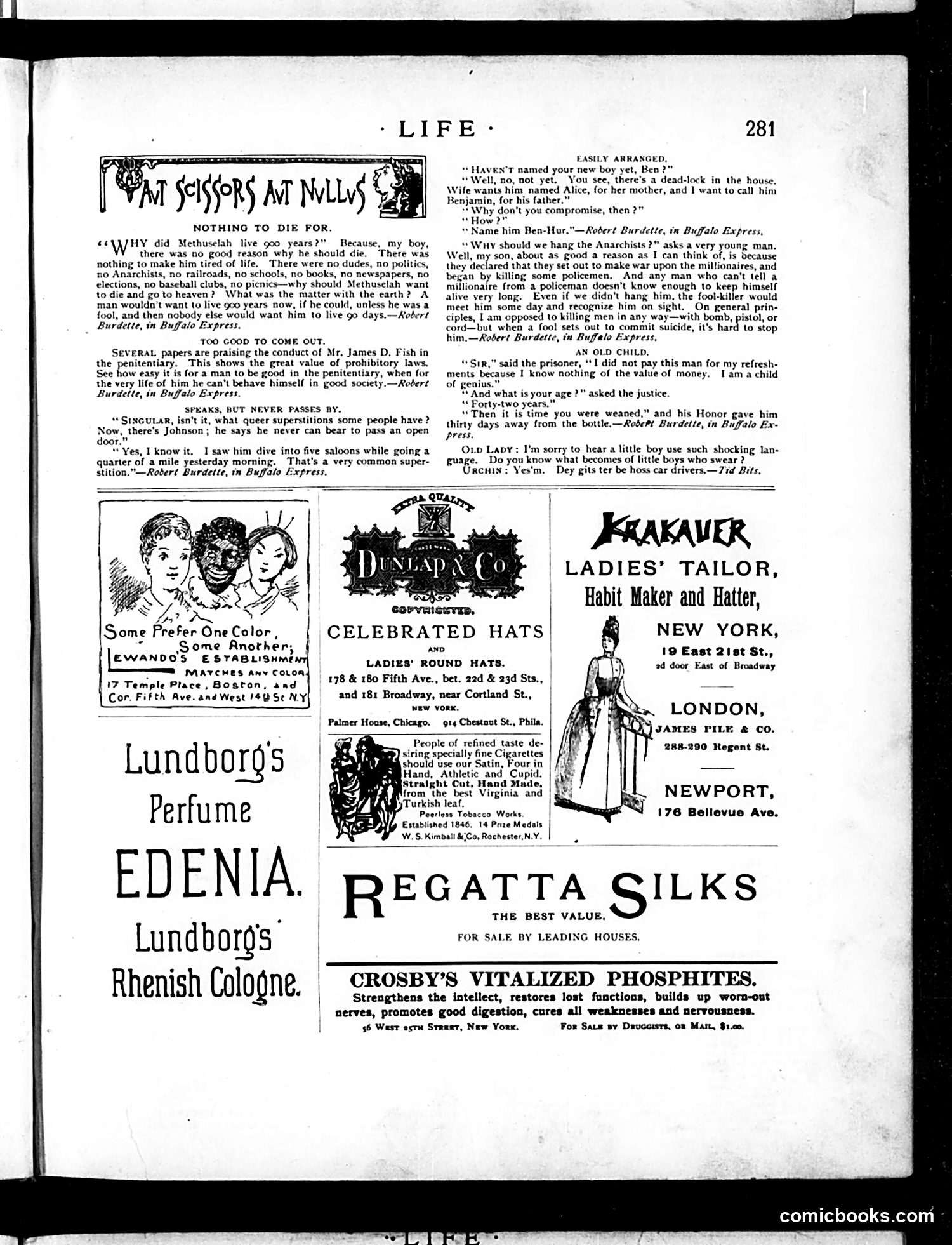
This page presents a collection of **short humorous quotes and observations** attributed to Robert Burdette (a popular humorist of the era), interspersed with period advertisements. The satirical content mocks contemporary American life through biting social commentary: - **"Nothing to Die For"** contrasts modern life unfavorably with biblical times, listing modern irritants (newspapers, elections, railroads) as reasons nobody would want to live long anymore. - **"Too Good to Come Out"** ironically notes that prohibitory laws work perfectly in penitentiaries—because prisoners have no choice—undermining arguments for such restrictions in free society. - **"Ben-Hur"** is a wordplay joke about naming compromise (combining "Ben" and "Hur"). - The **Anarchist piece** dismisses radical violence as foolish, mocking their inability to distinguish millionaires from policemen. The **cartoon illustration** (upper left) shows three stylized faces with the caption "Some Prefer One Color, Some Another"—likely commenting on superficial aesthetic choices. The remaining text consists of period advertisements for hats, perfume, and patent medicines typical of the era.
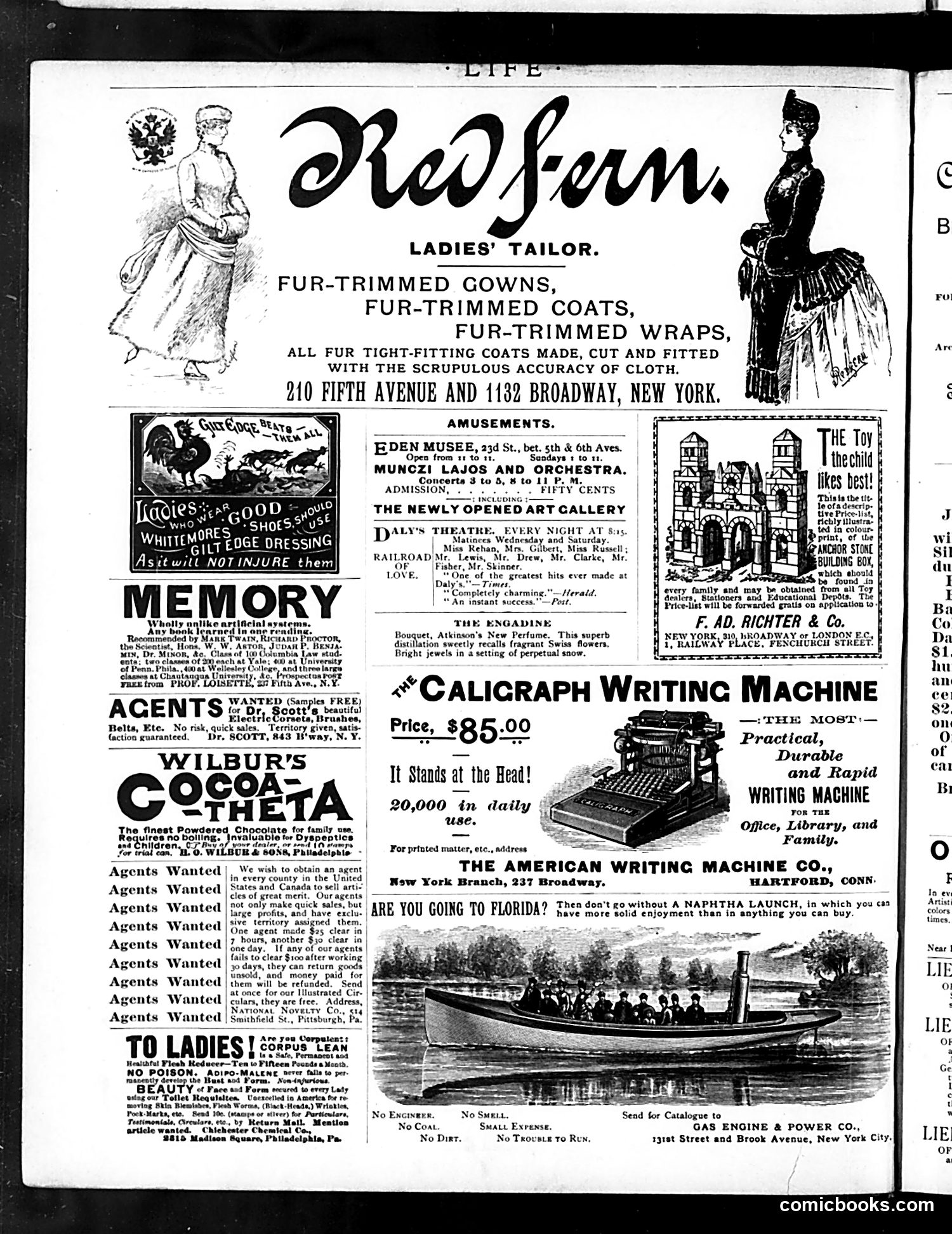
This is primarily an **advertising page** from Life magazine, not a satirical cartoon page. The layout consists of various commercial advertisements typical of late 19th/early 20th-century publications. **Key advertisements include:** - **Red Fern**: A ladies' tailor advertising fur-trimmed gowns and coats - **Memory**: A patent medicine or health product - **Wilbur's Cocoa**: Chocolate powder - **Caligraph Writing Machine**: Priced at $85, competing with other typewriter manufacturers - **Various "Agents Wanted"** notices for sales opportunities - **Beauty products** and "flesh reducers" targeting women - **Naphtha Launch**: A recreational boat - **Gas Engine & Power Co.**: Industrial equipment The page reflects **Gilded Age consumer culture**: luxury goods (fur-trimmed clothing), patent medicines, writing machines (new technology), and entrepreneurial opportunities. The repetitive "Agents Wanted" ads suggest aggressive direct-sales marketing of the era. There is **no discernible political satire** on this particular page—it's a straightforward commercial product showcase.
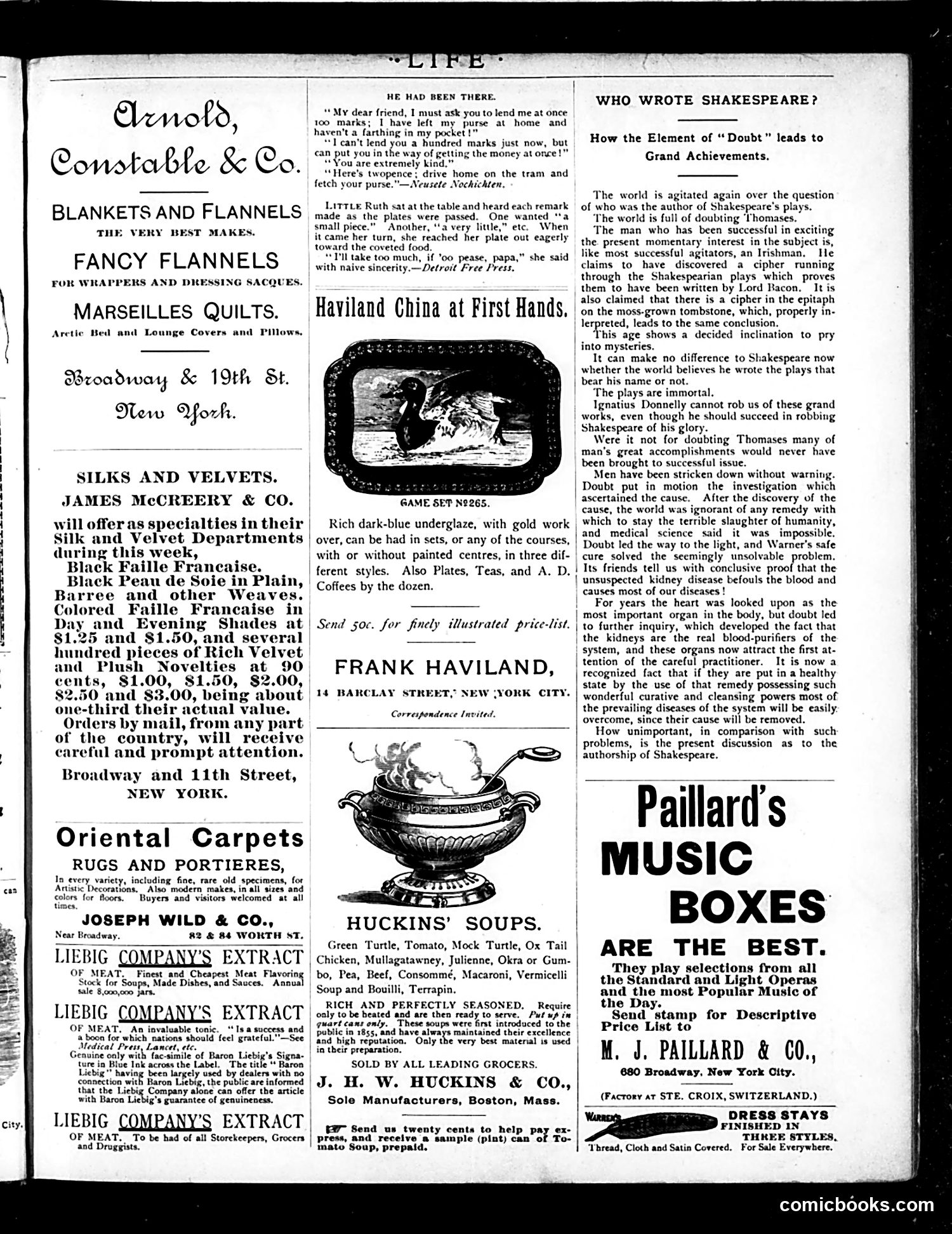
This page is primarily **advertising**, featuring department store promotions for textiles, home goods, and specialty items like Liebig's Meat Extract and Haviland China. The only notable editorial content is a brief article titled "WHO WROTE SHAKESPEARE?" discussing contemporary debate over the authorship of Shakespeare's plays. An Irishman (likely referring to someone like Delia Bacon or similar 19th-century theorists) has proposed that Lord Bacon actually wrote the plays, allegedly supported by "ciphers" embedded in the texts and Bacon's epitaph. The piece dismisses this speculation as unimportant to Shakespeare himself but notes the era's appetite for such mysteries. It reflects the late 19th-century "Bacon-Shakespeare" controversy that periodically captivated educated audiences. The page contains two short humorous anecdotes ("He Had Been There" and about "Little Ruth") unrelated to the main content.
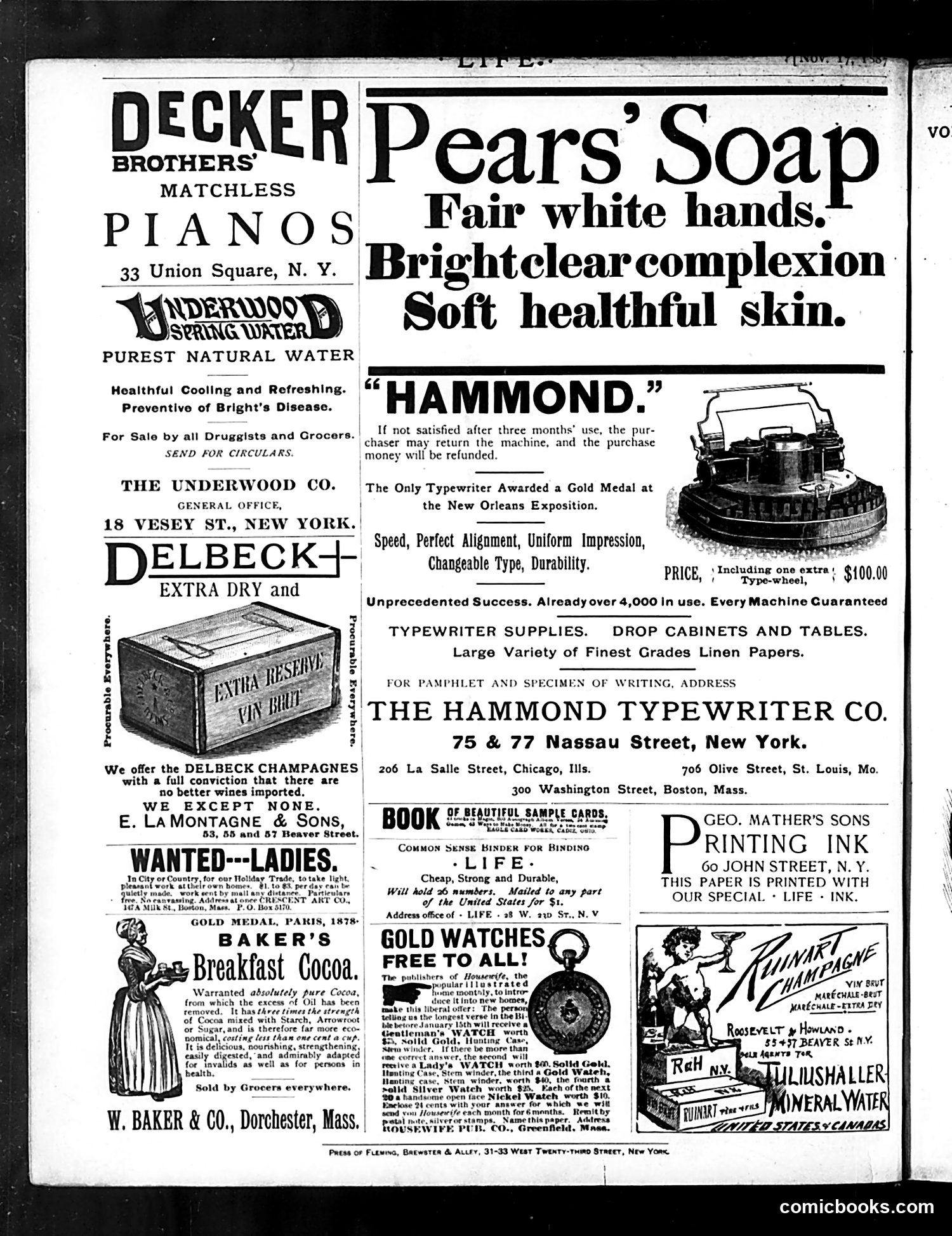
This page is primarily **advertisements**, not editorial content or political cartoons. It's a collection of late-19th-century product ads typical of *Life* magazine's revenue model. Notable ads include: - **Pears' Soap**: Promises "fair white hands" and "bright clear complexion"—reflecting period beauty standards that would be considered problematic today - **Hammond Typewriter**: Claims to be "the only typewriter awarded a gold medal" and costs $100 - **Baker's Breakfast Cocoa**: Marketed as economical and healthful - **Gold Watches Contest**: A promotional giveaway offering watches for answering Bible trivia The page reflects turn-of-the-century commercial culture: typewriter technology was novel and expensive, cocoa was marketed as health food, and soap advertisements emphasized whiteness and fair skin—reflecting the era's aesthetic prejudices. There are **no political cartoons or satirical illustrations** on this page—it's straightforward commercial advertising that reveals period consumer values and social attitudes.