
Life, 1887-11-17 · page 6 of 16
Life — November 17, 1887 — page 6: what you’re looking at
What you’re looking at
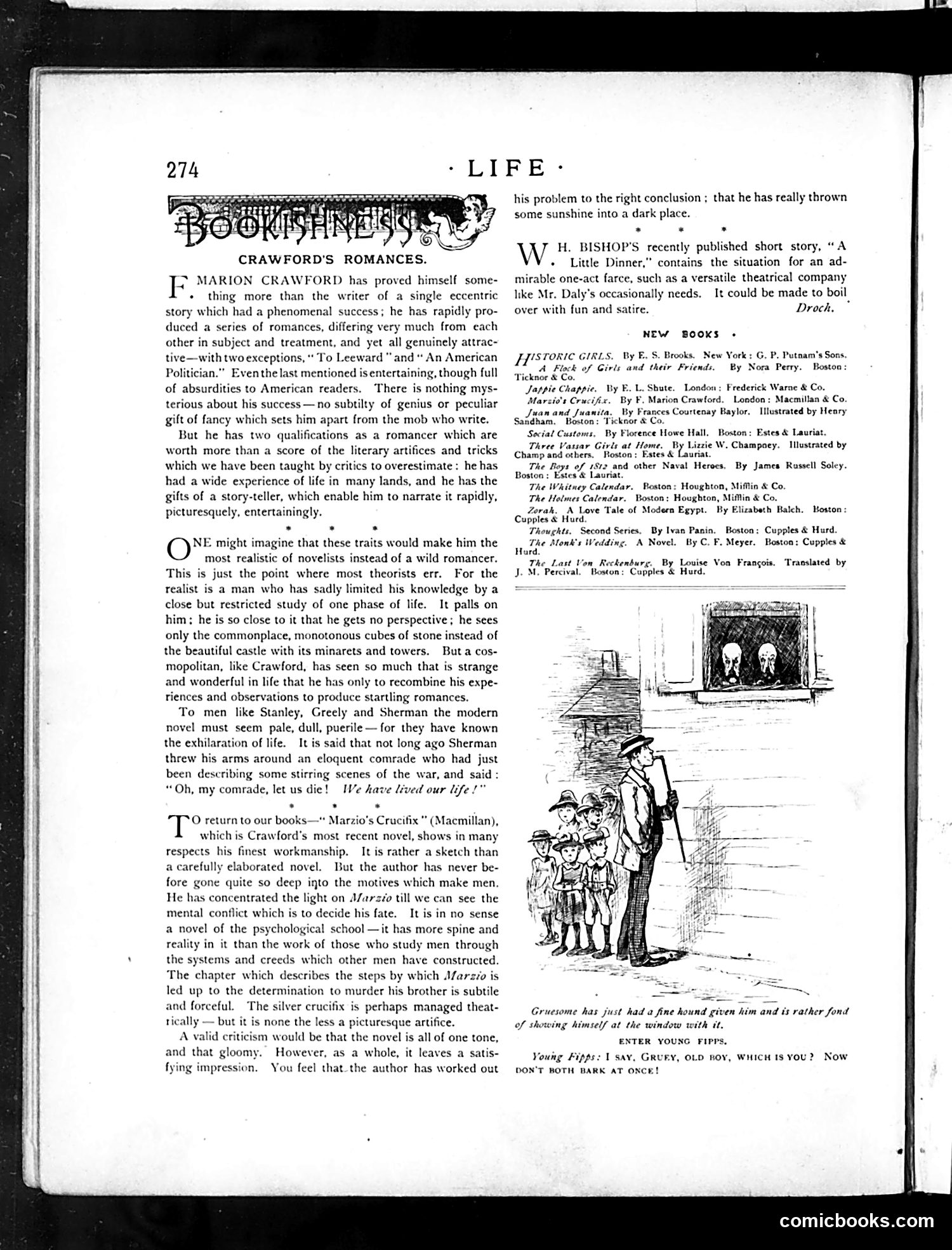
This page is primarily **literary criticism and book reviews**, not political satire. The main article "Crawford's Romances" discusses novelist Marion Crawford's works, praising his ability to blend romanticism with realism. The illustration appears to show a **social scene**: well-dressed figures at a window or gathering, with what looks like street children or poor people below. The caption reads "Ginevess has just had a fine hound given him and is rather fond of showing himself at the window with it." This is **satirical social commentary**—likely mocking the wealthy displaying their possessions and pets to impress others while poor people pass by. It's a critique of class display and superficial vanity, typical of Life magazine's social satire from this era.
📄 Transcribed text from this page (OCR, searchable)
Machine-transcribed from the original scan — historical spelling and the odd misread are preserved.
- LIFE: FE MARION CRAWFORD has proved himself some- + thing more than the writer of a single eccentric story which had a phenomenal success; he has rapidly pro- duced a series of romances, differing very much from each other in subject and treatment, and yet all genuinely attrac- tive—with two exceptions, * To Leeward "and “ An American Politician.” Even the last mentioned is entertaining, though full of absurdities to American readers. There is nothing mys- terious about his success—no subtilty of genius or peculiar gift of fancy which sets him apart from the mob who write. But he has two qualifications as a romancer which are worth more than a score of the literary artifices and tricks which we have been taught by critics to overestimate: he has had a wide experience of life in many lands, and he has the gifts of a story-teller, which enable him to narrate it rapidly, picturesquely, entertainingly, NE might imagine that these traits would make him the most realistic of novelists instead of a wild romancer. This is just the point where most theorists err. For the realist is a man who has sadly limited his knowledge by a close but restricted study of one phase of life. It palls on him; he is so close to it that he gets no perspective; he sees only the commonplace, monotonous cubes of stone instead of the beautiful castle with its minarets and towers. Buta cos- mopolitan, like Crawford, has seen so much that is strange and wonderful in life that he has only to recombine his expe- riences and observations to produce startling romances. To men like Stanley, Greely and Sherman the modern novel must seem pale, dull, puerile—for they have known the exhilaration of life. It is said that not long ago Sherman threw his arms around an eloquent comrade who had just been describing some stirring scenes of the war, and said “Oh, my comrade, let us die! We have lived our life!" O return to our books—* Marzio’s Crucifix " (Macmillan), which is Crawford’s most recent novel, shows in many respects his finest workmanship. It is rather a sketch than a carefully elaborated novel. But the author has never be- fore gone quite so deep into the motives which make men, He has concentrated the light on A/arzéo till we can see the mental conflict which is to decide his fate. It is in no sense a novel of the psychological school —it has more spine and reality in it than the work of those who study men through the systems and creeds which other men have constructed. The chapter which describes the steps by which Afarzco is led up to the determination to murder his brother is subtile and forceful. The silver crucifix is perhaps managed theat- i s none the less a picturesque artifice. alid criticism would be that the novel is all of one tone, gloomy. However, as a whole, it leaves a satis- ion. You feel that-the author has worked out his problem to the right conclusion ; that he has really thrown some sunshine into a dark place. . . . W H. BISHOP'S recently published short story, “A + Little Dinner,” contains the situation for an ad- mirable one-act farce, such as a versatile theatrical company like Mr. Daly's occasionally needs. It could be made to boil over with fun and satire. Droch. NEW BOOKS - JfISTORIC GIRLS. By E, S. Brooks. New York: G. P. Putnam's Sons, ‘A Flock of Girls and their Friends. By Nora Perry. Boston: Marsio's Crucifix. By F. Marion Crawford. London: Macmillan & Co. Juan and Juanita, By Frances Courtenay Baylor, Illustrated by Henry Saidham. Boston: Ticknor & Co. Social Customs, By Florence Howe Hall. Boston: Estes & Lauriat Three Vatsar Girls at Home. By Liztie W. Champaey, Illustrated by Champ and others. Roston: Estes & Cauriat. The Boys of 15 d other Naval Heroes, By James Rassell Soley. Boston: Estes & Lauriat. The Whitney Calendar. Boston: Houghton, Mi Min & Co. The Holmes Calendar. Boston: Houghton, Mifin & Co. Zerak. A Love Tale of Modern Egypt. By Elizabeth Balch. Moston : Cupples & Hurd. Thoughts, Second Series. By Ivan Panin. Bostoa: Cupples & Hurd. The Monk's Wedding. A Novel. By C. F. Meyer. Boston: Cupples & Hard. The Last Von Reckenburg. By Louise Von Francois. Translated by J. M, Percival. Boston: Cupples & Hurd, Gruesome has just hada fine hound given him and is rather fond of showing himself at the window with it, ENTER YOUNG FIPPs, Young Fipps: | say, GRURY, OLD ROY, WHICH Is You? Now DON'T BOTH BARK AT ONC comicbooks.com