
Life, 1887-11-17 · page 2 of 16
Life — November 17, 1887 — page 2: what you’re looking at
What you’re looking at
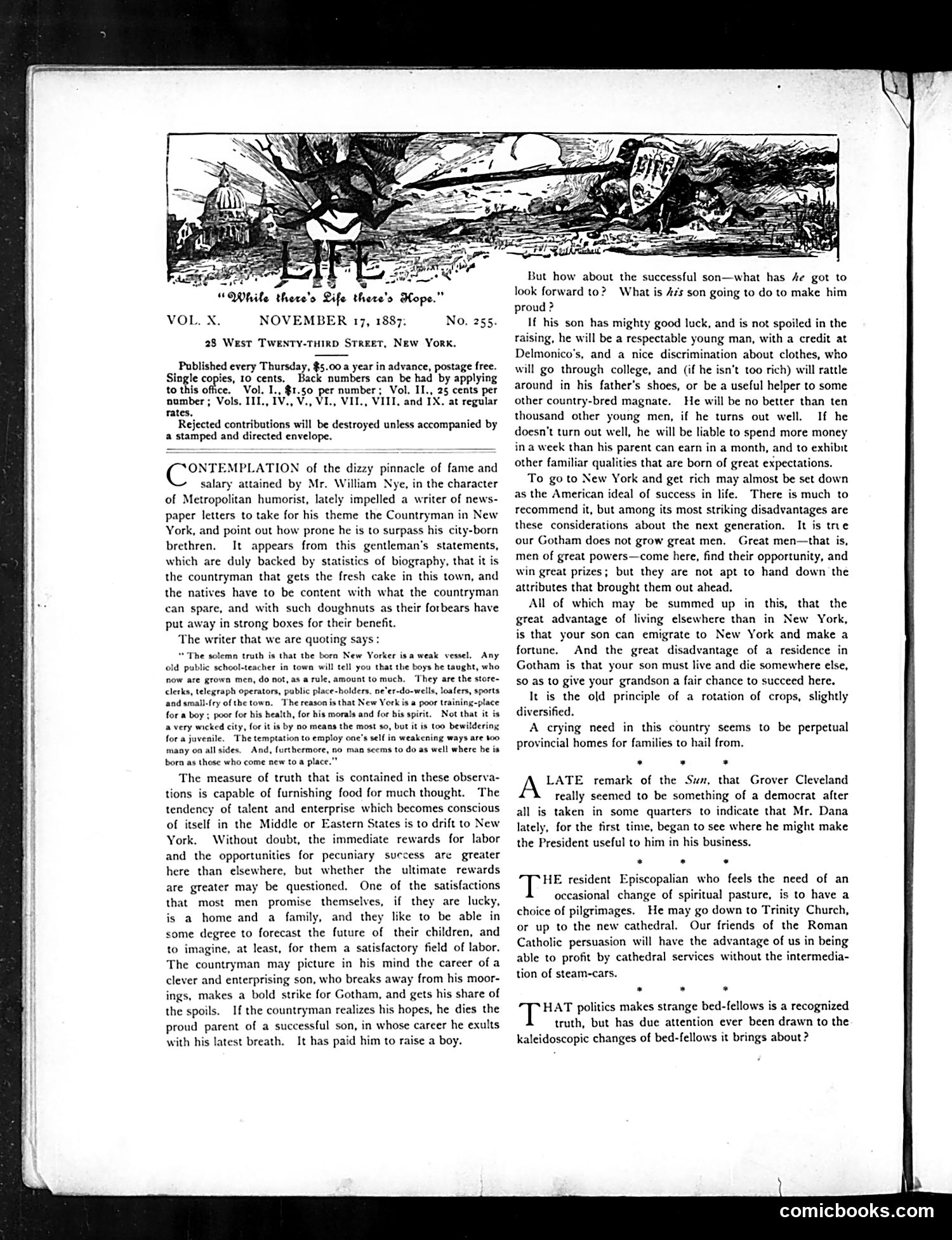
**The Cartoon:** The illustration at the top depicts a rural/countryside scene with the caption "While there's Life there's Hope." The image appears to contrast pastoral simplicity with urban complexity, supporting the editorial's theme about American success and geography. **The Content:** The page's main editorial discusses William Nye, a humorist and newspaper columnist, praising his success as a "countryman" writer in New York. The text argues that living outside New York offers advantages for raising successful sons—they avoid urban corruption and develop character. The satire critiques American assumptions that New York is essential for success, instead arguing provincial life builds better men. This reflects late-19th-century tension between rural and urban American values during rapid industrialization.
📄 Transcribed text from this page (OCR, searchable)
Machine-transcribed from the original scan — historical spelling and the odd misread are preserved.
: a eS) ) “Dhile there's Life there's NOVEMBER 17, 1887: 28 West TWENTY-THIRD STREET, New York. Published every Thursday, $5.00 a year in advance, postage free. Single copies, 10 cents, Back numbers can be had by applying to this office. Vol. I., $1.50 per number; Vol. II., 25 cents per number ; Vols. III., 1V., V., VI., VII., VIII. and IX, at regular rates. Rejected contributions will be destroyed unless accompanied by a stamped and directed envelope. ONTEMPLATION of the dizzy pinnacle of fame and salary attained by Mr. William Nye, in the character of Metropolitan humorist, lately impelled a writer of news- paper letters to take for his theme the Countryman in New York, and point out how prone he is to surpass his city-born brethren. It appears from this gentleman's statements, which are duly backed by statistics of biography, that it is the countryman that gets the fresh cake in this town, and the natives have to be content with what the countryman can spare, and with such doughnuts as their forbears have put away in strong boxes for their benefit. ‘The writer that we are quoting says: “The solemn truth is that the born New Vorker isa weak vessel. Any old public school-teacher in town will tell you that the boys he taught, who now are grown men, do not, as a rule, amount to much. ‘They are the store~ clerks, telegraph operators, public place-holders, ne'er-do-wells, loafers, sports and small-fry of the towo. ‘The reason is that New York is a poor training-place for a boy ; poor for his health, for his morals and for his spirit. Not that it is a very wicked city, for it is by no means the most so, but it is too bewildering fora juvenile. The temptation to employ one’s self in weakening ways are too many on all sides. And, furthermore, no man seems to do as well where he is born as those who come new to a place.” The measure of truth that is contained in these observa- tions is capable of furnishing food for much thought. The tendency of talent and enterprise which becomes conscious of itself in the Middle or Eastern States is to drift to New York. Without doubt, the immediate rewards for labor and the opportunities for pecuniary success are greater here than elsewhere, but whether the ultimate rewards are greater may be questioned. One of the satisfactions that most men promise themselves, if they are lucky, is a home and a family, and they like to be able in some degree to forecast the future of their children, and to imagine, at least, for them a satisfactory field of labor. The countryman may picture in his mind the career of a clever and enterprising son, who breaks away from his moor- ings, makes a bold strike for Gotham, and gets his share of the spoils. If the countryman realizes his hopes, he dies the proud parent of a successful son, in whose career he exults with his latest breath. It has paid him to raise a boy. But how about the successful son—what has Ae got to look forward to? What is 47s son going to do to make him proud ? If his son has mighty good luck, and is not spoiled in the raising, he will be a respectable young man, with a credit at Delmonico’s, and a nice discrimination about clothes, who will go through college, and (if he isn’t too rich) will rattle around in his father’s shoes, or be a useful helper to some other country-bred magnate. He will be no better than ten thousand other young men, if he turns out well. If he doesn’t turn out well, he will be liable to spend more money in a week than his parent can earn in a month, and to exhibit other familiar qualities that are born of great expectations. To goto New York and get rich may almost be set down as the American ideal of success in life. There is much to recommend it, but among its most striking disadvantages are these considerations about the next generation. It is tre our Gotham does not grow great men. Great men—that is, men of great powers—come here, find their opportunity, and win great prizes; but they are not apt to hand down the attributes that brought them out ahead. All of which may be summed up in this, that the great advantage of living elsewhere than in New York, is that your son can emigrate to New York and make a fortune. And the great disadvantage of a residence in Gotham is that your son must live and die somewhere else, sO as to give your grandson a fair chance to succeed here, It is the old principle of a rotation of crops, slightly diversified. A crying need in this country seems to be perpetual provincial homes for families to hail from. LATE remark of the Sun, that Grover Cleveland really seemed to be something of a democrat after all is taken in some quarters to indicate that Mr. Dana lately, for the first time, began to see where he might make the President useful to him in his business. . . . TE resident Episcopalian who feels the need of an occasional change of spiritual pasture, is to have a choice of pilgrimages. He may go down to Trinity Church, or up to the new cathedral. Our friends of the Roman Catholic persuasion will have the advantage of us in being able to profit by cathedral services without the intermedia- tion of steam-cars. . . . T HAT politics makes strange bed-fellows is a recognized truth, but has due attention ever been drawn to the kaleidoscopic changes of bed-fellows it brings about ? comicbooks.com