
A complete issue · 16 pages · 1887
Life — October 27, 1887
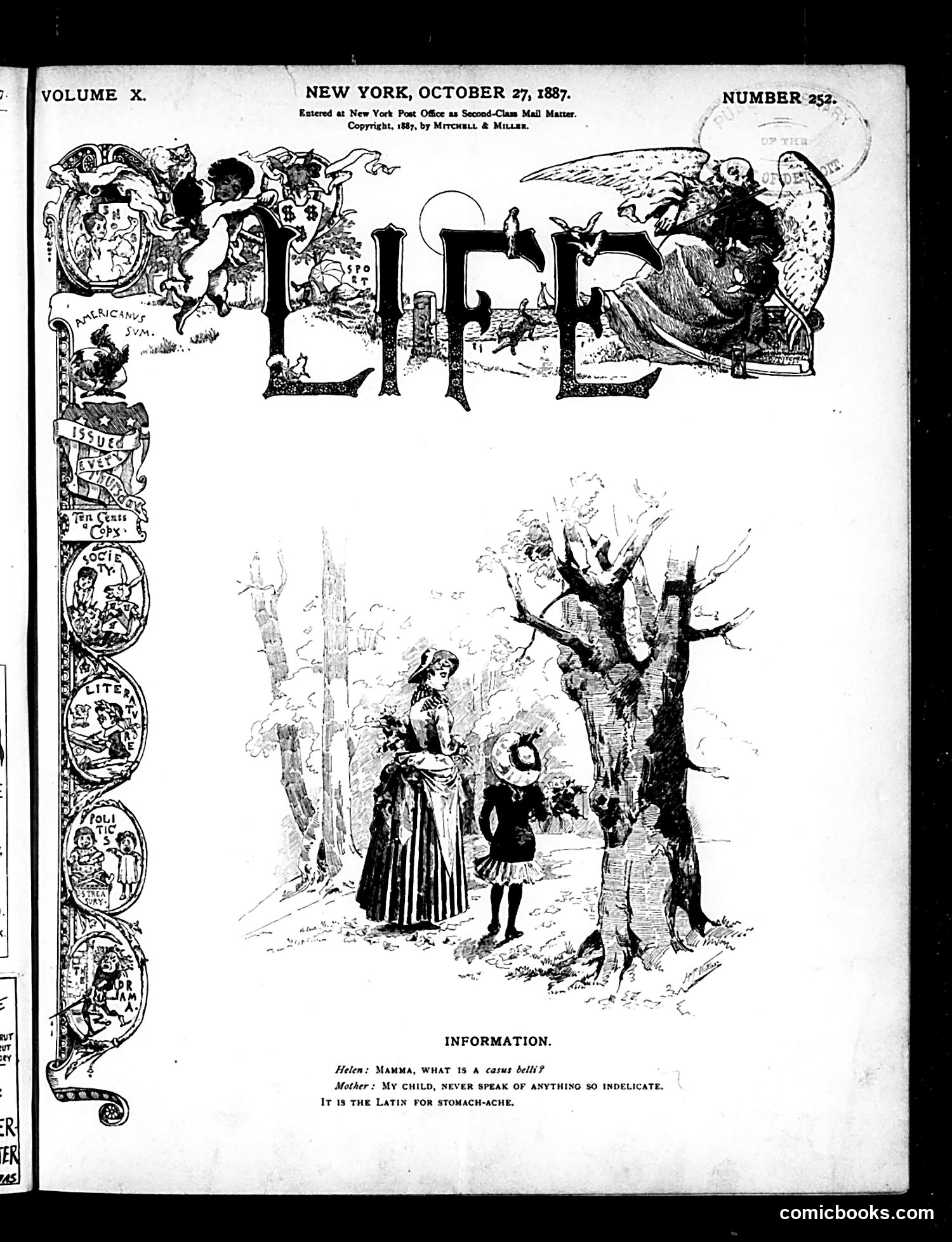
This page features a satirical cartoon illustrating a dialogue between a child and mother about the term "colic bill." The child asks what a colic bill is, and the mother responds that it's a Latin term for stomach-ache—a humorous deflection suggesting she won't discuss the actual subject matter with her child. The illustration depicts a woman and child in a rural setting beside a gnarled tree, rendered in Victorian-era engraving style. The joke appears to rely on double meaning: "colic bill" likely references a legislative proposal or political controversy of 1887 that the mother considers inappropriate for the child to know about. The exact political bill referenced is unclear without additional historical context, but the satire mocks parental evasion and adult hypocrisy about shielding children from unsuitable topics.
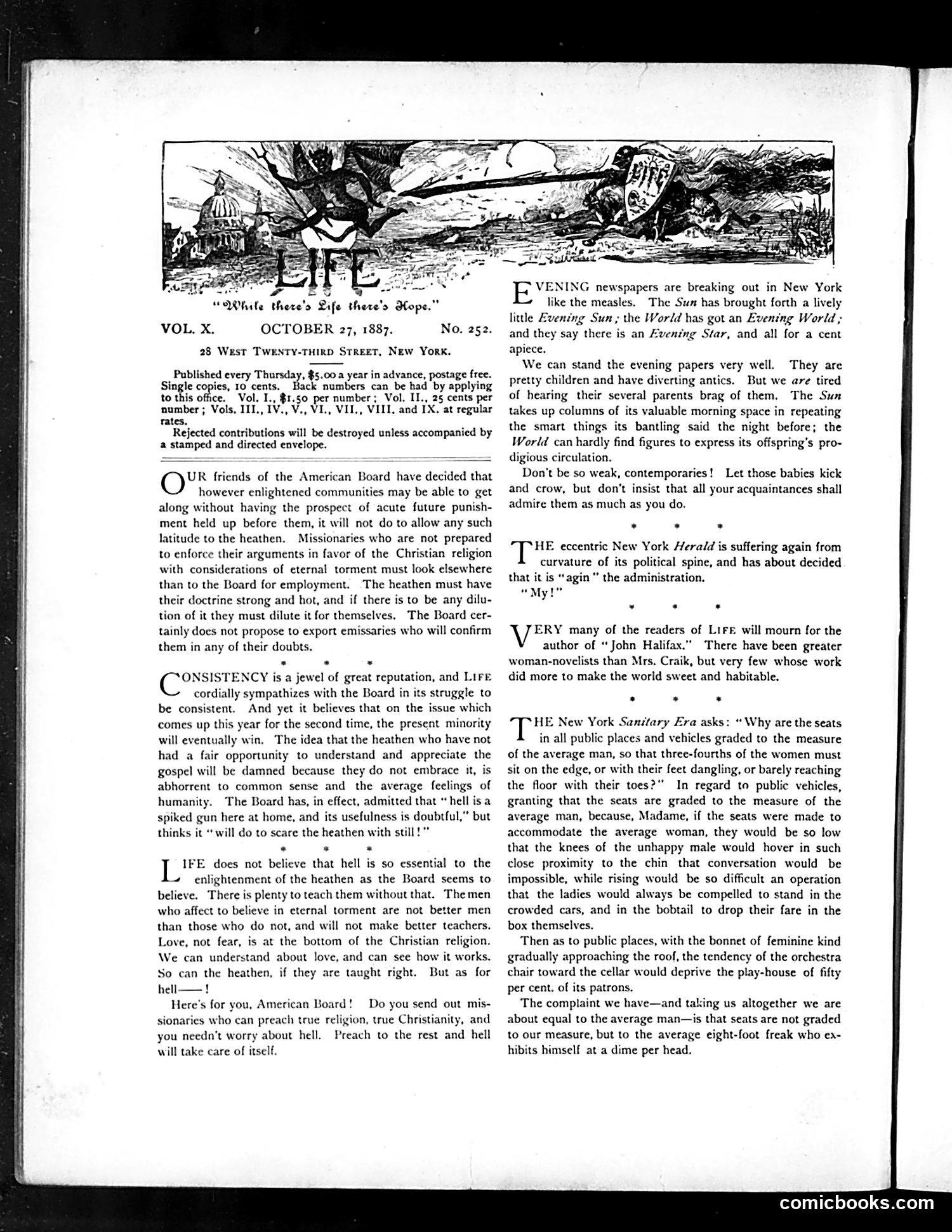
The masthead cartoon depicts a grim reaper figure labeled "LIFE" standing over a corpse, with the caption "Whate there's Life there's Hope." This is ironic—a memento mori image subverting the optimistic proverb. The page contains editorial commentary rather than political cartoons. Articles criticize: 1. **The American Board's enforcement doctrine** — attacking Christian missionaries' harsh punishments of native converts 2. **Evening newspapers proliferating in New York** — mocking their sensationalism and cheap pricing (one cent) 3. **The Herald's political weakness** — noting its editorial inconsistency 4. **Theater seating inequality** — satirizing that seats aren't proportioned for average human bodies, forcing women into uncomfortable positions The satire targets institutional hypocrisy, commercialism, and poor public design through reasoned argument rather than visual caricature.
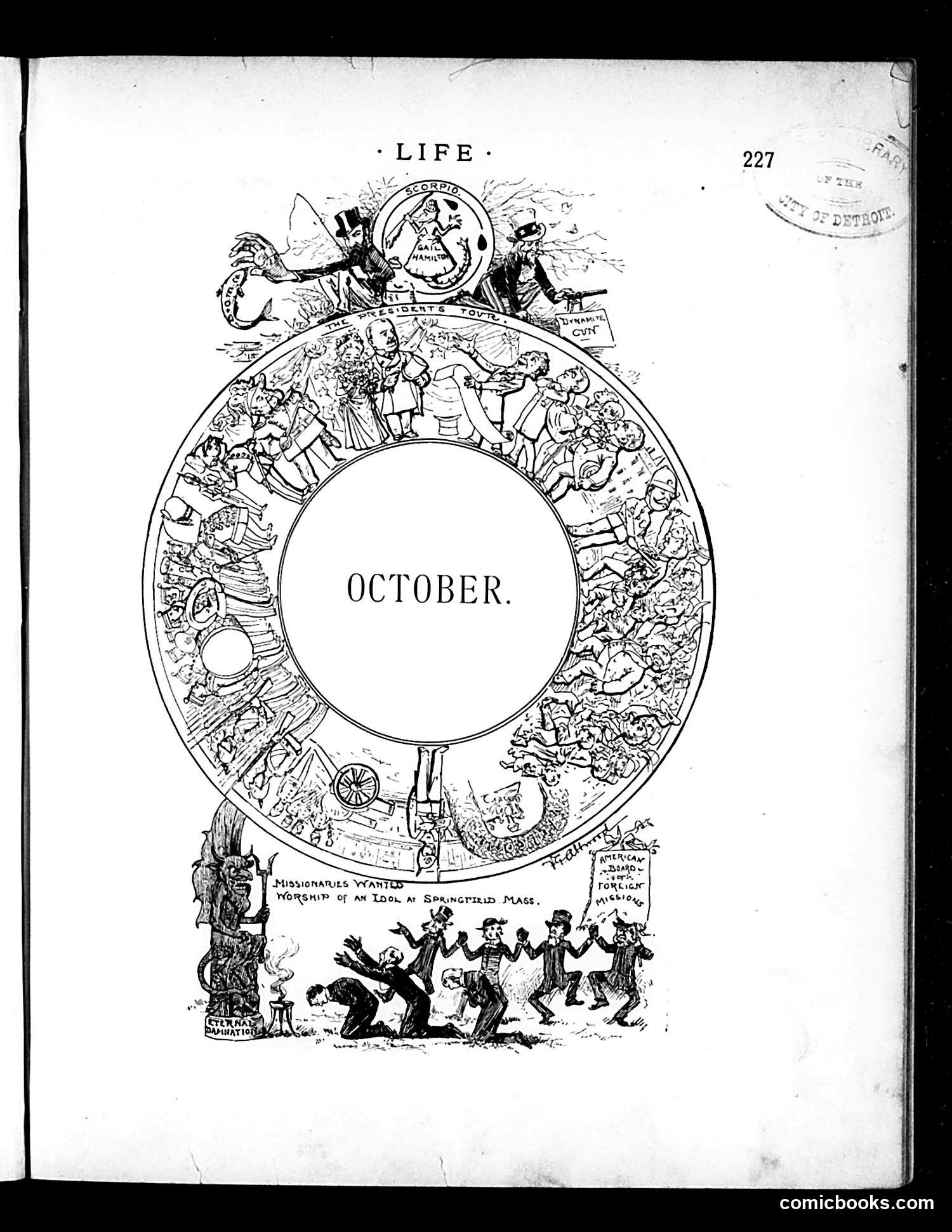
This is Life magazine's October calendar page (page 227). The central circular design depicts various October activities and scenes arranged around the month's name. At the bottom, there's a satirical caption reading "Missionaries Wanted Worship of an Idol at Springfield Mass." accompanied by caricatured figures - appearing to reference local religious or social controversy in Springfield, Massachusetts. The figures depicted suggest mockery of what the cartoonist considered misguided worship or false devotion. The overall design is typical of Life's approach: combining seasonal calendar imagery with biting social commentary about contemporary American culture and local issues, using exaggeration and caricature to ridicule subjects the magazine's editors found worthy of public ridicule.
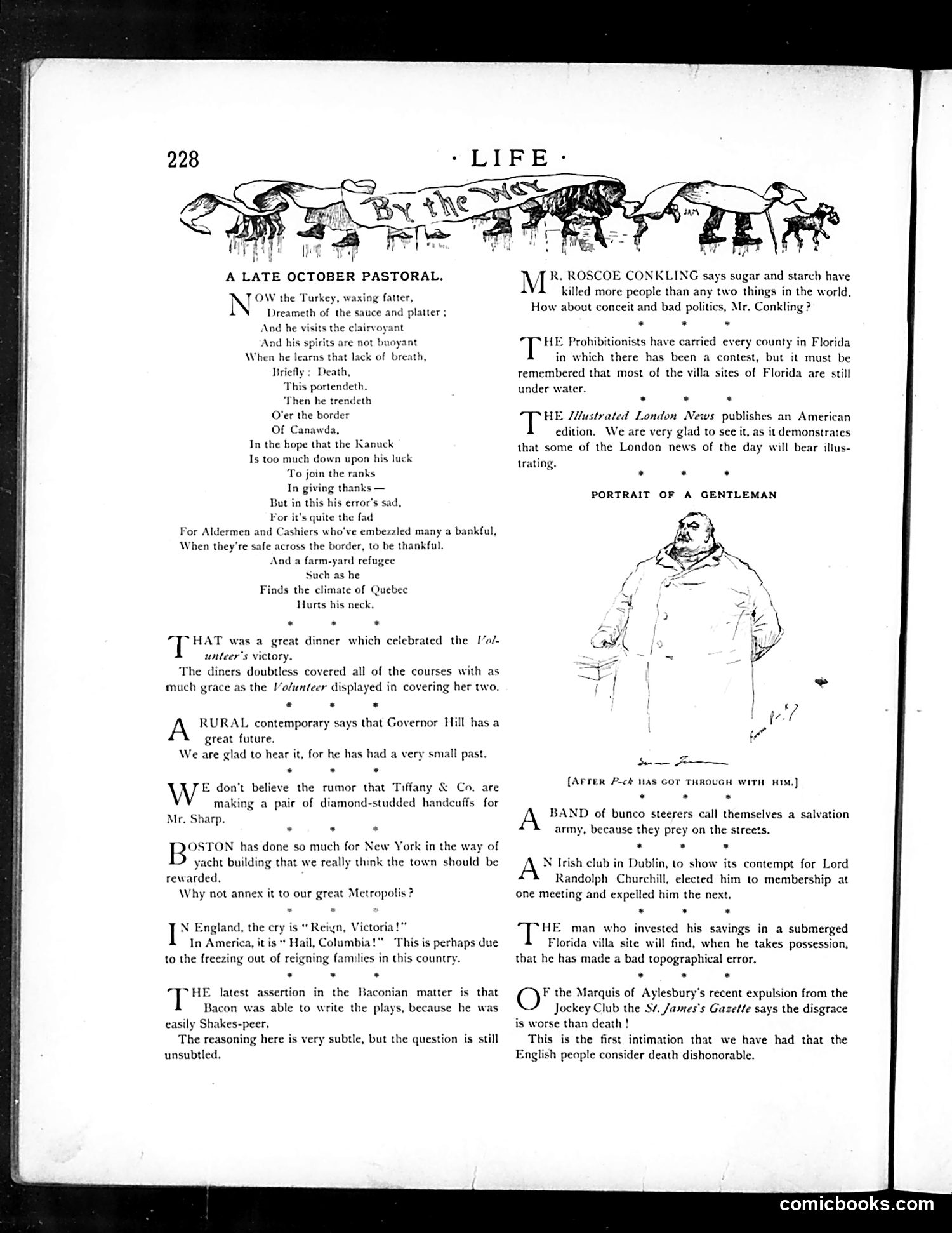
This page combines poetry ("A Late October Pastoral") with various brief satirical commentary pieces and a sketch labeled "Portrait of a Gentleman" (captioned "[After P—d has got through with him]"). The satirical items target: - Sugar/starch's health impacts (Roscoe Conkling quote) - Florida real estate fraud (villa sites underwater) - The Illustrated London News's American edition - Political figures: references to Governor Hill, Tiffany & Co., and the "Haonian matter" regarding Bacon's authorship of Shakespeare - The Marquis of Aylesbury's expulsion from the Jockey Club The sketch appears to depict someone altered by "P—d" (likely a person or publication), though the specific reference is unclear. The overall tone is typical of Life's gossipy, insider commentary on contemporary scandals and public figures.
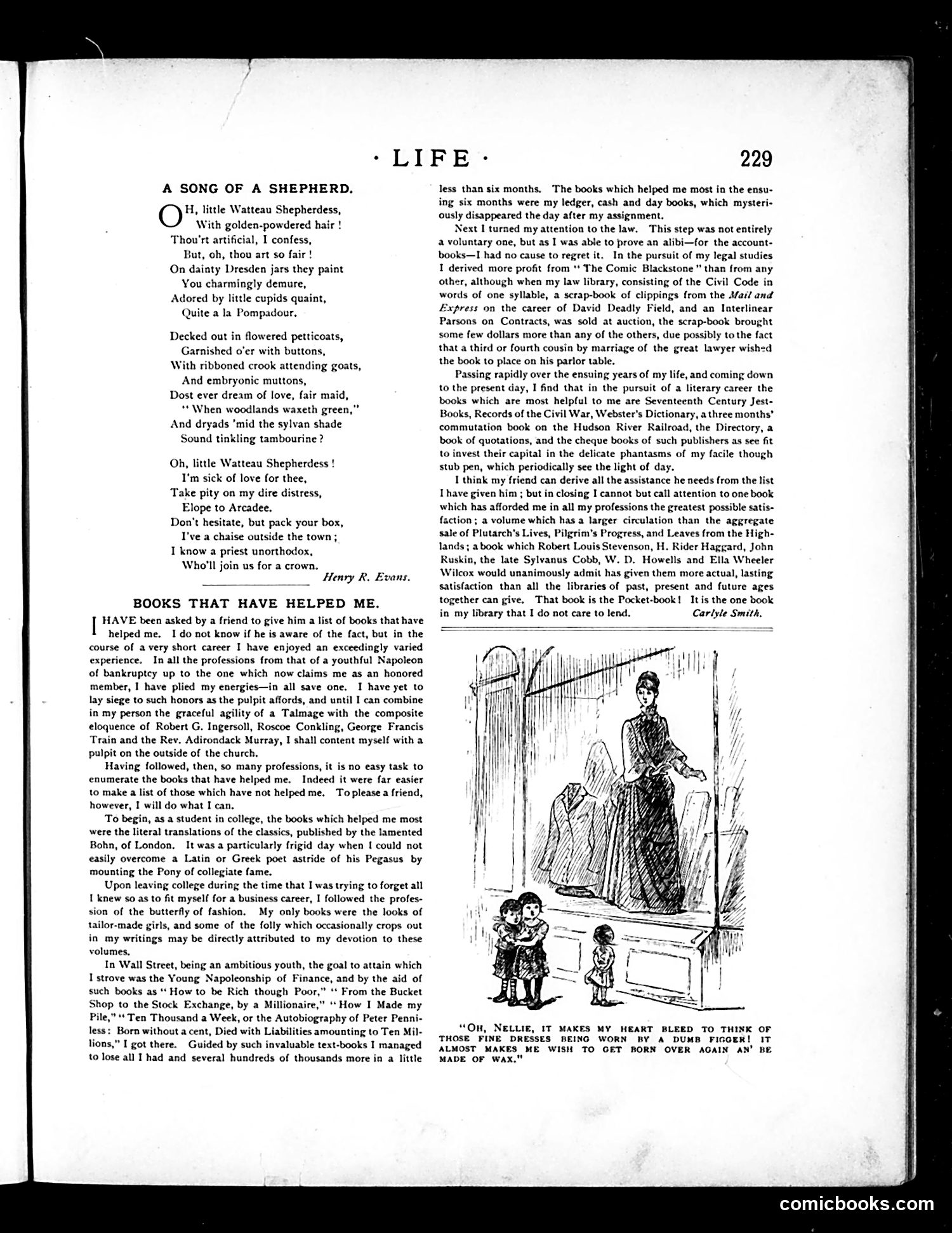
The page contains two distinct elements: **Left side:** A poem titled "A Song of a Shepherd" by Henry E. Evanx, addressing a shepherdess with romantic verse, followed by an essay titled "Books That Have Helped Me" by Carolyn Smith, discussing literature that aided her career development across various professions. **Right side:** A single cartoon showing a woman (labeled "Nellie") looking at dressed-up children, with the caption: "Oh, Nellie, it makes my heart bleed to think of those fine dresses being worn by a dumb finger! It almost makes me wish to get born over again an' be more particular about my parents." The cartoon satirizes class anxiety and conspicuous consumption—mocking the concern that fine clothing is "wasted" on children of lower social status, while the speaker regrets their own social position. It's social commentary on American class consciousness and parental shame circa early 1900s.
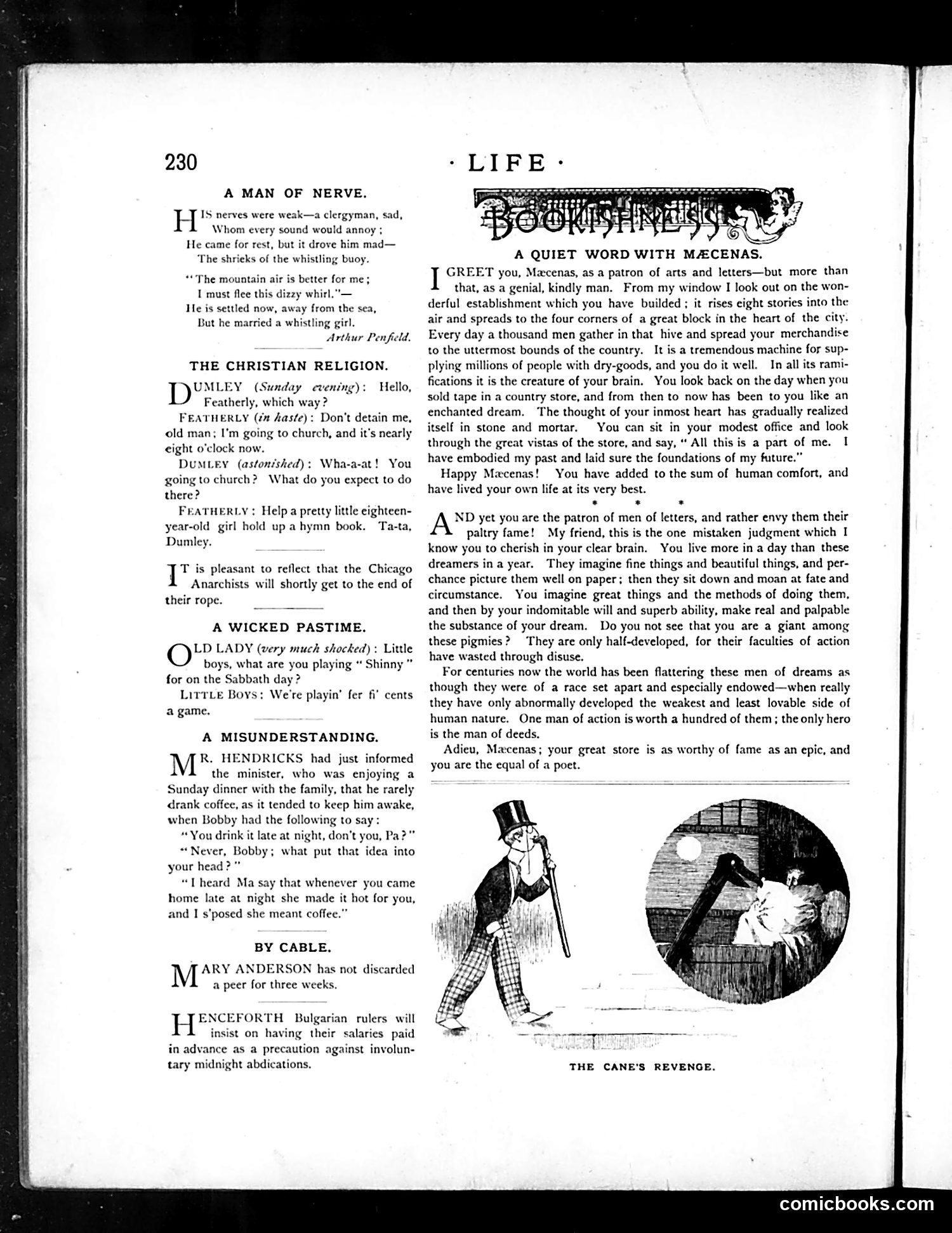
This page contains several short satirical pieces rather than a single cartoon. The main illustration, "The Cane's Revenge," depicts a man with a cane confronting what appears to be a woman in an interior setting—likely satirizing a social or romantic misunderstanding. The text sections include social commentary on various topics: "A Man of Nerve" criticizes weakness; "The Christian Religion" mocks religious hypocrisy; "A Wicked Pastime" satirizes Sabbath violations; and "A Misunderstanding" humorously portrays family dinner conversation about coffee consumption. The pieces represent typical Life magazine humor—gentle mockery of everyday social conventions, religious practices, and domestic situations rather than hard political satire. Without clearer context or dates, specific references remain unclear, though the overall tone critiques Victorian-era social pretension and behavior.
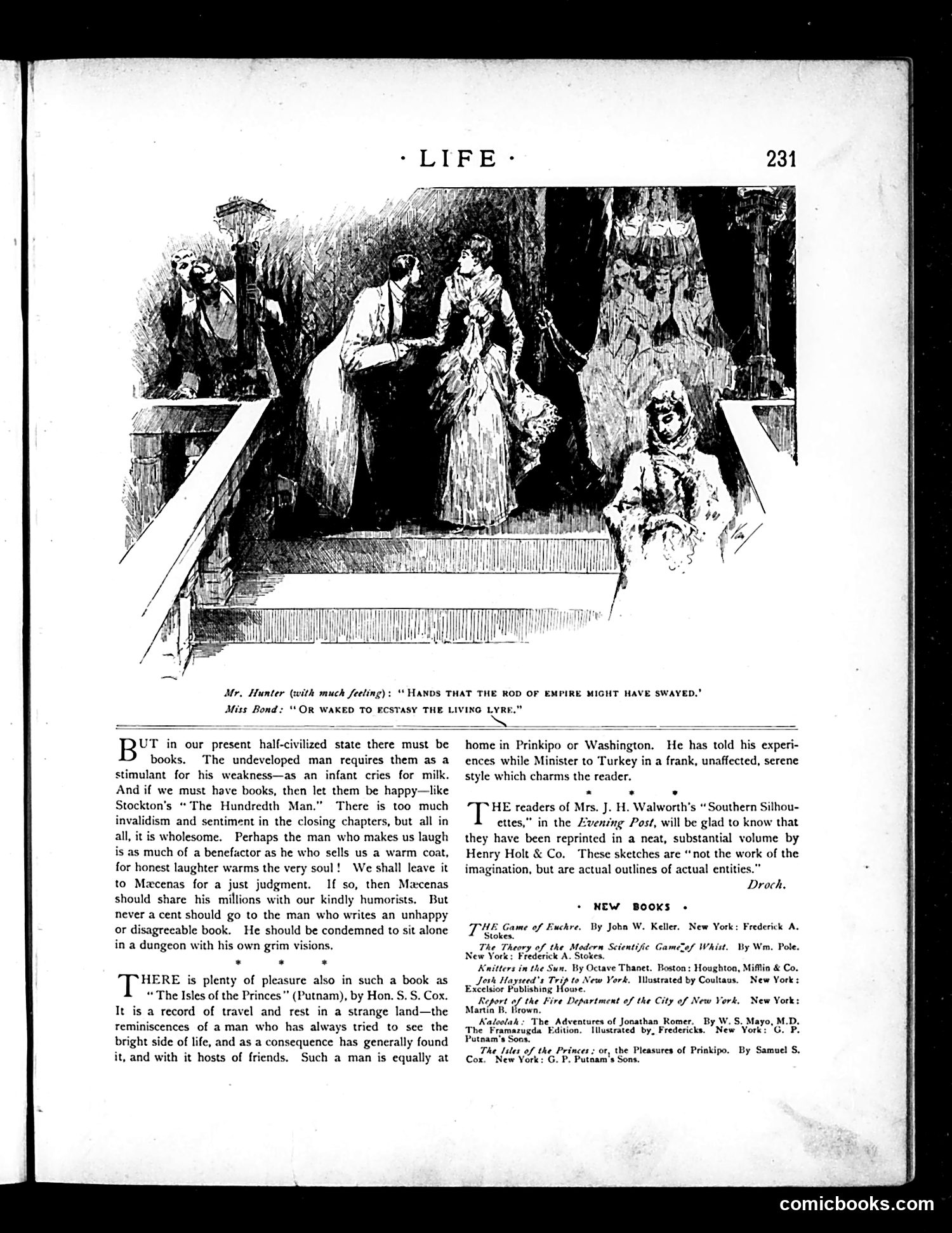
The cartoon depicts a theatrical or operatic scene with elegantly dressed figures in what appears to be a box seat. The caption attributes dialogue to "Mr. Hunter" and "Miss Rood," with Hunter saying "Hands that the rod of empire might have swayed" and Rood responding "Or waked to ecstasy the living lyre." These are literary quotations (likely from poetry), suggesting the cartoon satirizes theatrical pretension or affected cultural refinement. The figures appear to be upper-class attendees at a performance, possibly mocking their artificial sophistication or romantic posturing. Without additional context about who "Mr. Hunter" and "Miss Rood" represent, the satire seems directed at generic social pretension rather than specific political figures. The humor likely appealed to *Life* magazine's contemporary readers familiar with both the literary references and the social types being lampooned.
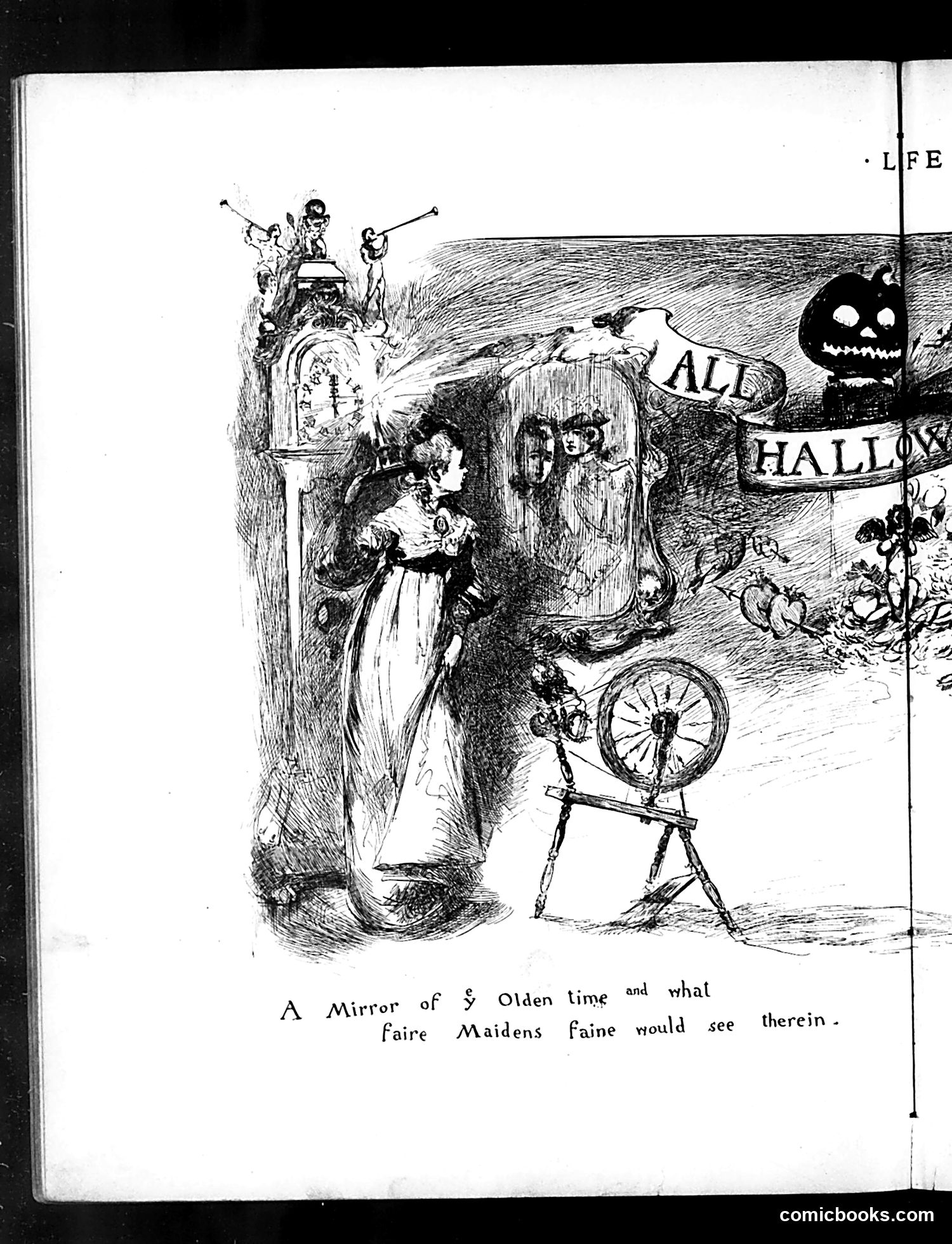
This is a satirical illustration captioned "A Mirror of $ Olden time and what faire Maidens faine would see therein." The cartoon depicts a young woman in classical dress gazing into an ornate mirror. The reflection shows Halloween imagery—a jack-o'-lantern with "HALLO" text, a skeleton, and other spooky elements. A spinning wheel sits nearby. The satire appears to mock the romantic fantasies of young women, contrasting their idealized visions (classical maiden aesthetics) with darker, more grotesque modern realities. The Halloween imagery suggests the "olden time" romanticism is exposed as hollow or frightening when examined closely. The specific reference to "faire Maidens" and their delusions likely critiques contemporary attitudes toward femininity, idealism, or courtship during this period of Life magazine.
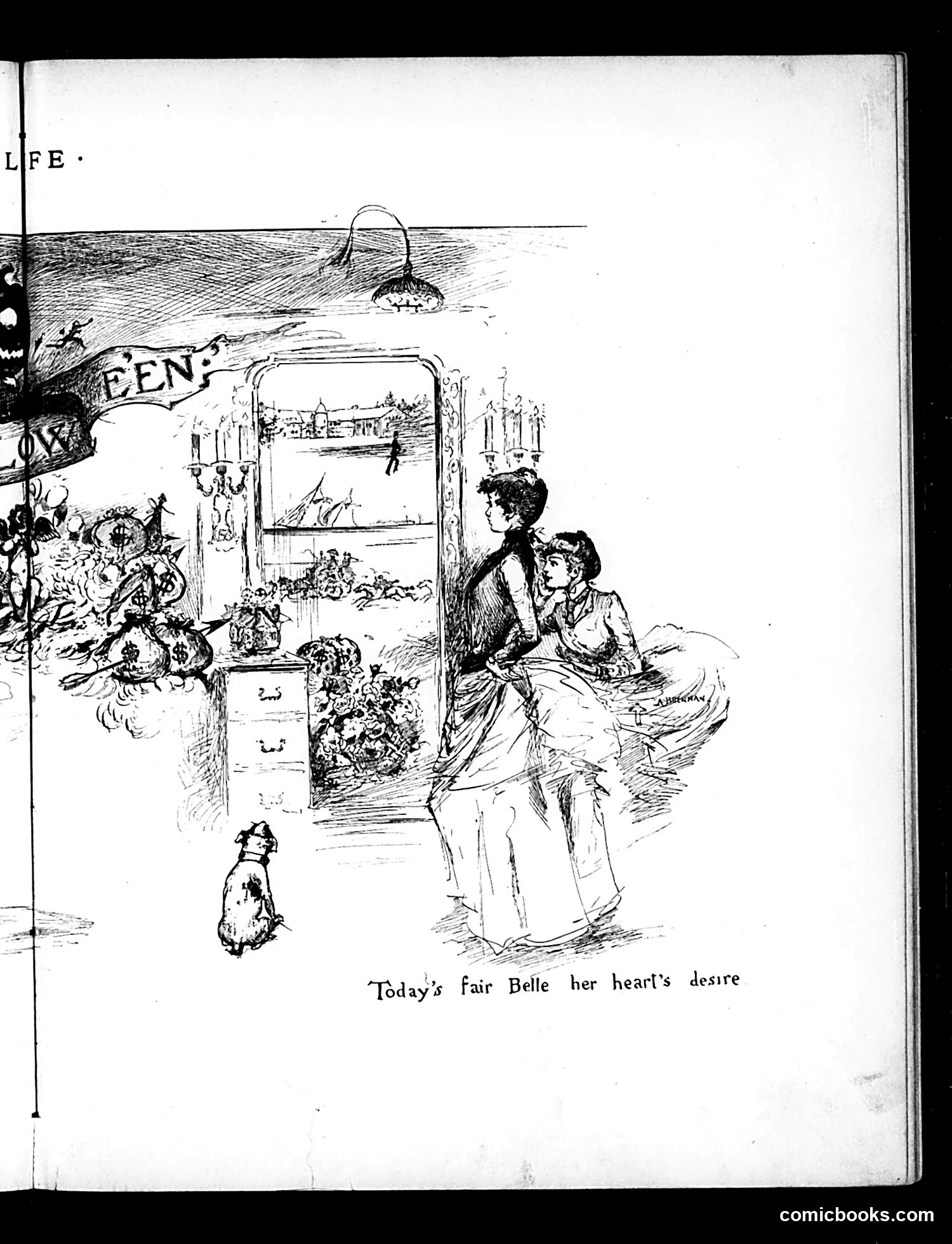
This illustration from *Life* magazine depicts a romantic domestic scene with the caption "Today's fair Belle her heart's desire." The image shows two women in period dress looking out an open door toward a scenic landscape with a body of water and distant buildings. There's a small dog in the foreground. The room is decorated with flowers, candles, and ornamental items suggesting an elegant interior. The word "Belle" likely references a fashionable young woman of the era. The cartoon appears to satirize romantic ideals or domestic aspirations of upper-class women—specifically the contrast between what women are told should make them happy (romantic scenery, refined surroundings) versus their actual desires. The "fair Belle" gazes toward the window, suggesting her heart yearns for something beyond these conventional domestic trappings.
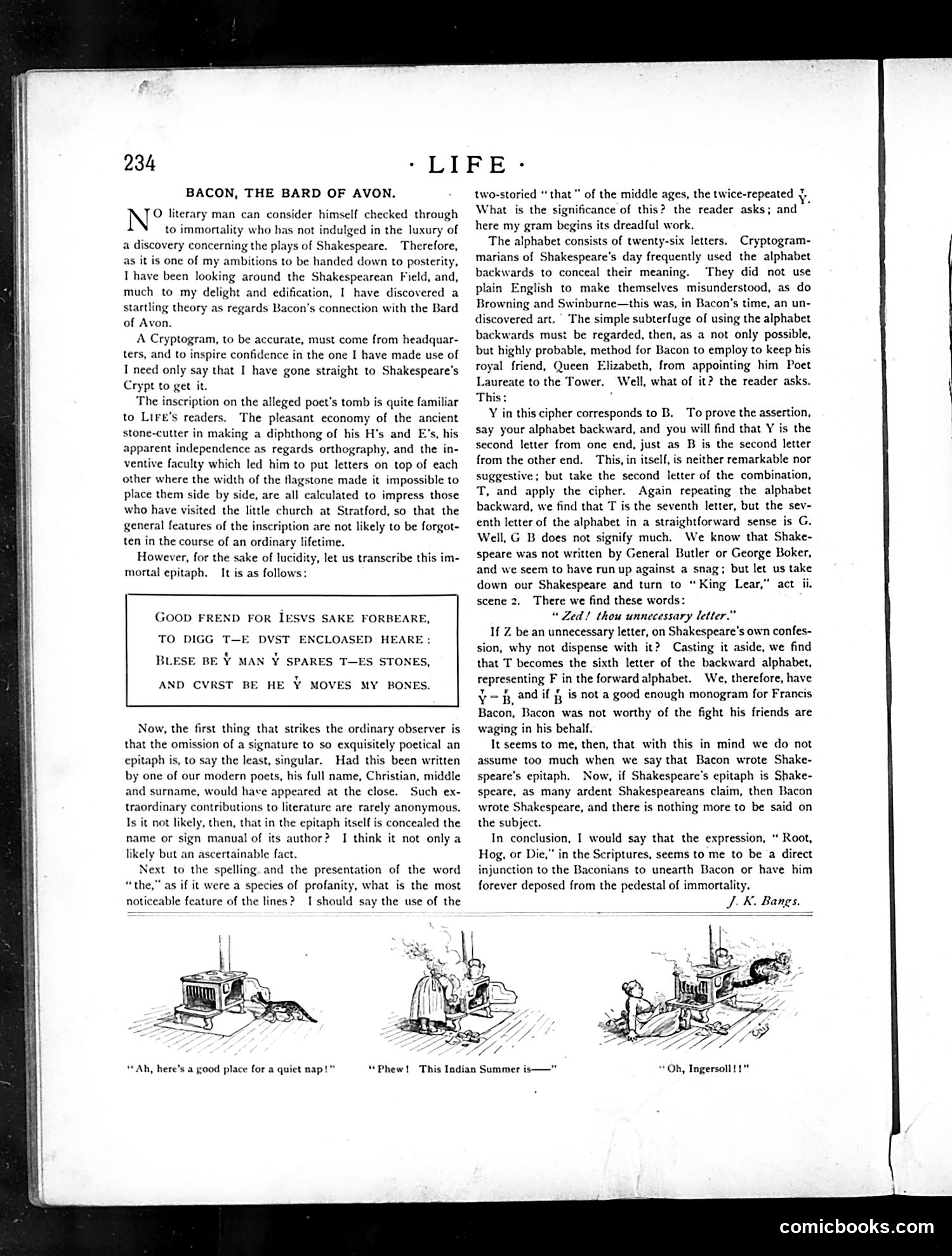
This page discusses a cryptographic theory claiming Francis Bacon wrote Shakespeare's works. The author argues that using backward alphabet ciphers, one can "prove" Bacon authored Shakespeare's epitaph. The piece methodically dismantles this theory, showing the cipher method is unreliable and concludes Bacon was unworthy of the effort his supporters expend defending him. Below the text are three small cartoon panels depicting what appear to be social scenes—a man napping, someone commenting on summer heat, and someone exclaiming in surprise. These cartoons seem unrelated to the Shakespeare/Bacon discussion above, likely serving as filler or standalone humor for the magazine. The article's tone is skeptical of pseudohistorical claims made through dubious "evidence."
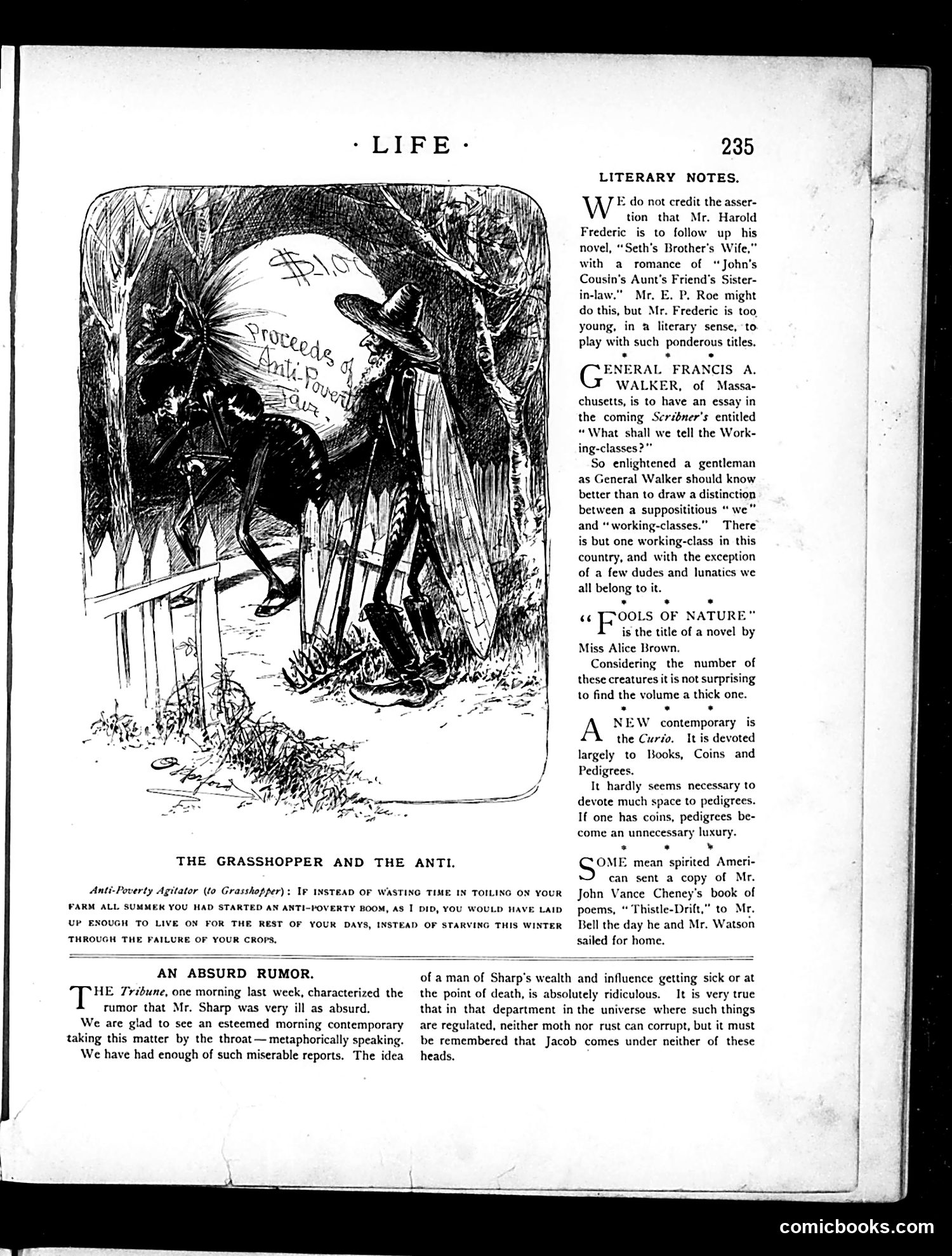
This cartoon satirizes anti-poverty activists and reformers of the era. A grasshopper (representing an impoverished farmer facing crop failure) is lectured by an "Anti-Poverty Agitator" who claims he became wealthy not through honest labor, but by starting an "anti-poverty boom"—suggesting he profited by *talking about* poverty rather than solving it. The joke targets the perceived hypocrisy of anti-poverty crusaders: while the farmer actually worked hard farming, the agitator got rich promoting anti-poverty causes themselves. It's a critique of reformers who seemingly exploited social causes for personal gain, a common satirical theme in Gilded Age *Life* magazine.
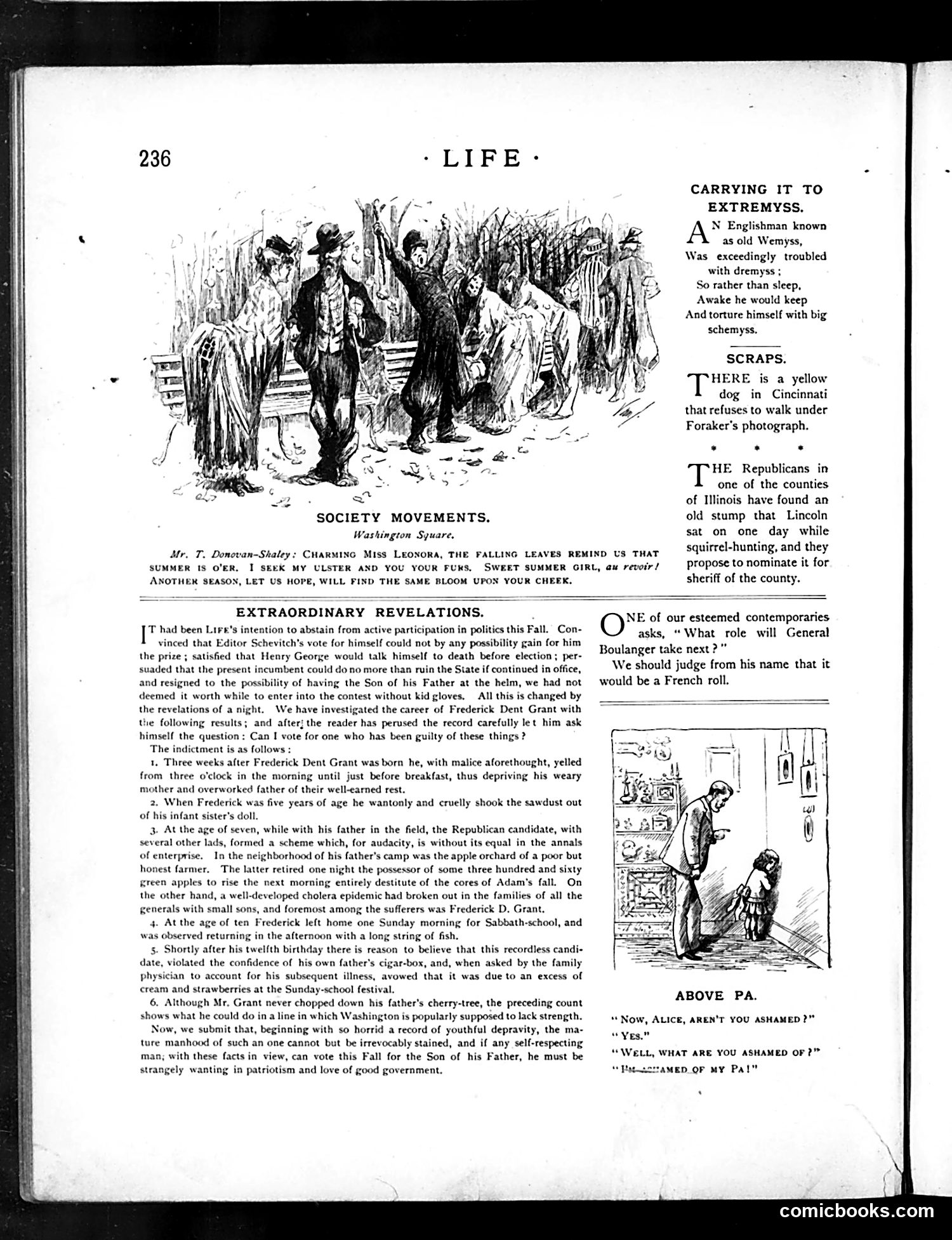
This page mocks Frederick Dent Grant (son of former President Ulysses S. Grant), the Republican candidate for New York governor in 1886. The lengthy "Extraordinary Revelations" section is brutal satire, fabricating absurdly trivial childhood "crimes" to discredit him. The fake charges escalate from infantile crying to stealing apples and eating cream at a church festival—deliberately mundane compared to George Washington's legendary honesty (the cherry-tree reference). The satire suggests Grant has no legitimate scandals, so Life invents ridiculous ones instead. The overall point: Grant is unfit for office, though the magazine admits it has no real ammunition against him beyond his family name and Republican affiliation. The other sketches—a yellow dog refusing Foraker's photograph, Lincoln's log stump nominated for sheriff—continue mocking Ohio and Illinois Republican absurdities.
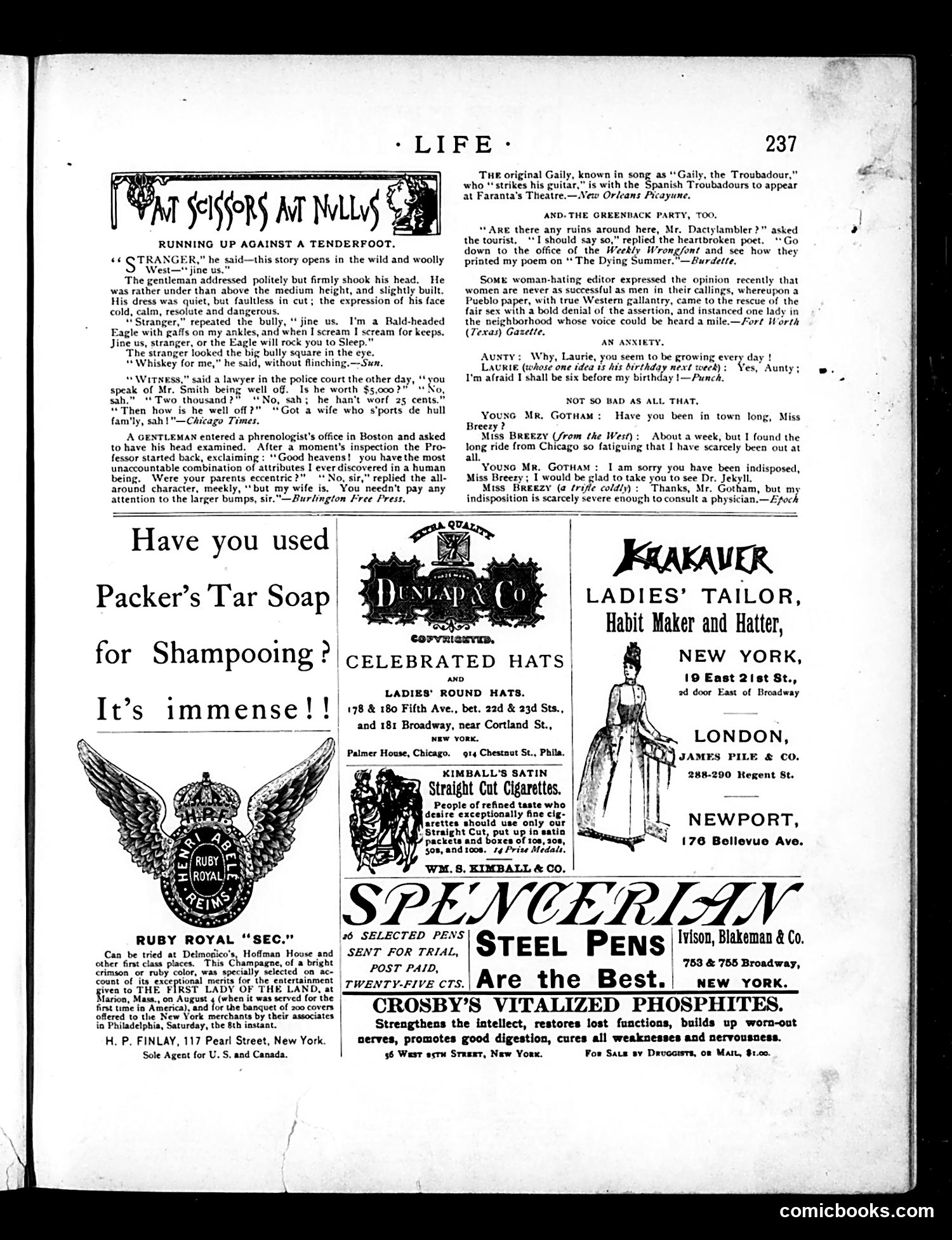
This page is primarily **advertising and humor sketches** rather than political cartoons. The main content consists of three brief comedic anecdotes: 1. **"Scissors at Nullys"**: A Western bully confronts a well-dressed, composed stranger, demanding he join their gang. The stranger's calm response ("Whiskey for me") undercuts the bully's bluster—humor from unexpected composure. 2. **Lawyer/Smith joke**: Wordplay about a man being "well off" despite having no money—he's supported entirely by his wife's income. 3. **Phrenologist sketch**: A Boston doctor examining a man's head finds inexplicable contradictions, which the man attributes to his wife's eccentric nature. The remaining content is **period advertisements** for products (Packer's Tar Soap, Ruby Royal cigars, Dunlap hats, Krakauer tailoring) and brief additional jokes about tourists, poets, and a child's birthday anxiety. The humor relies on era-specific references (phrenology, Western stereotypes) and domestic satire about marriage dynamics common to 1880s-era "Life" magazine.
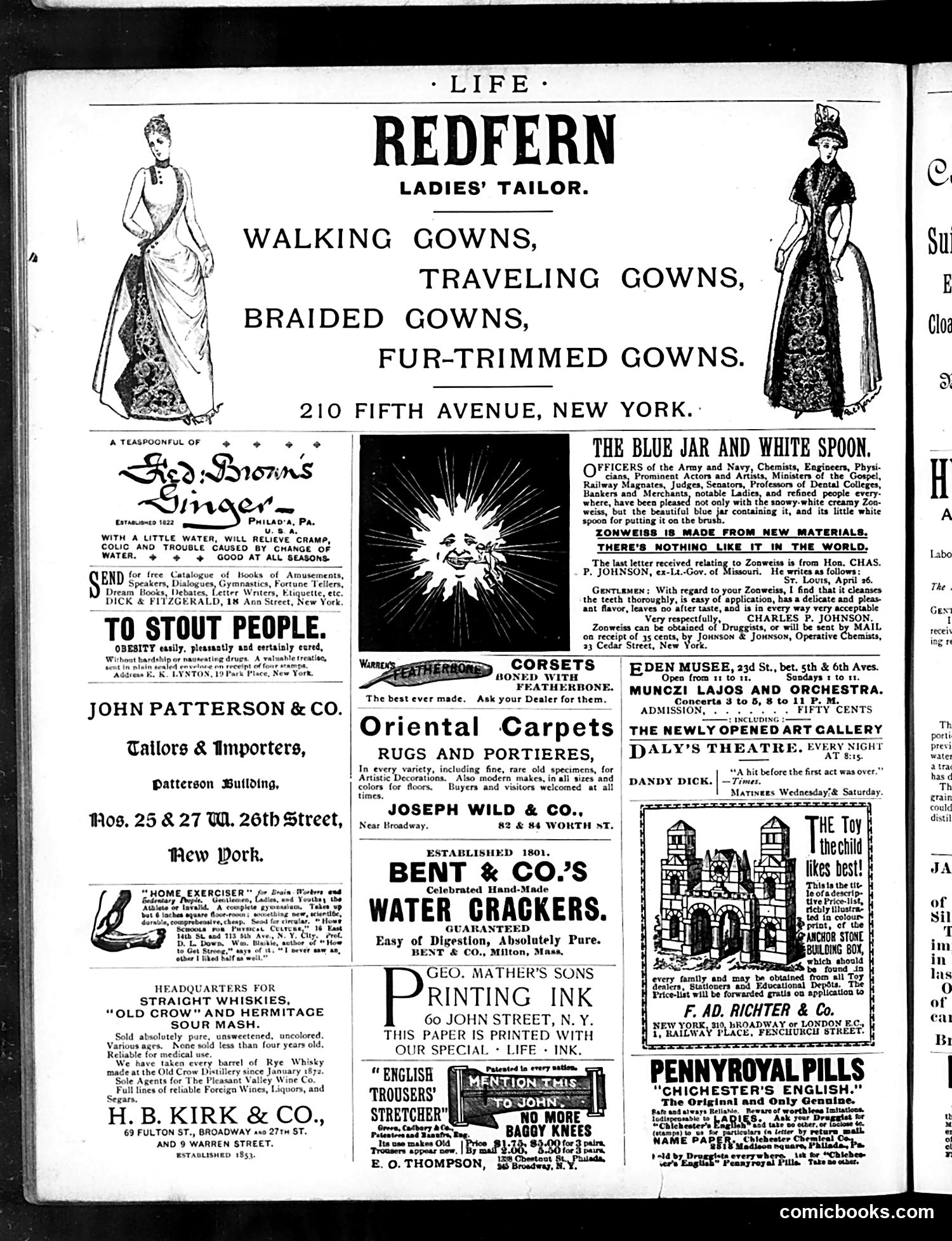
This page is primarily **advertising**, not editorial content or political satire. It consists of commercial advertisements for various products and services circa the late 19th century, including ladies' fashion (Redfern tailoring), dental products (Zonweiss toothpaste), furniture and carpets, printing ink, water crackers, whiskey, and patent medicines (Pennyroyal Pills). The only apparent illustrated content is "The Blue Jar and White Spoon" advertisement featuring a smiling face in a sunburst, promoting Zonweiss toothpaste. There is also a small illustration for "The Toy" theater advertisement showing a castle-like building. This is a typical Life magazine advertising section from the era—no political cartoon or satirical commentary is present on this particular page.
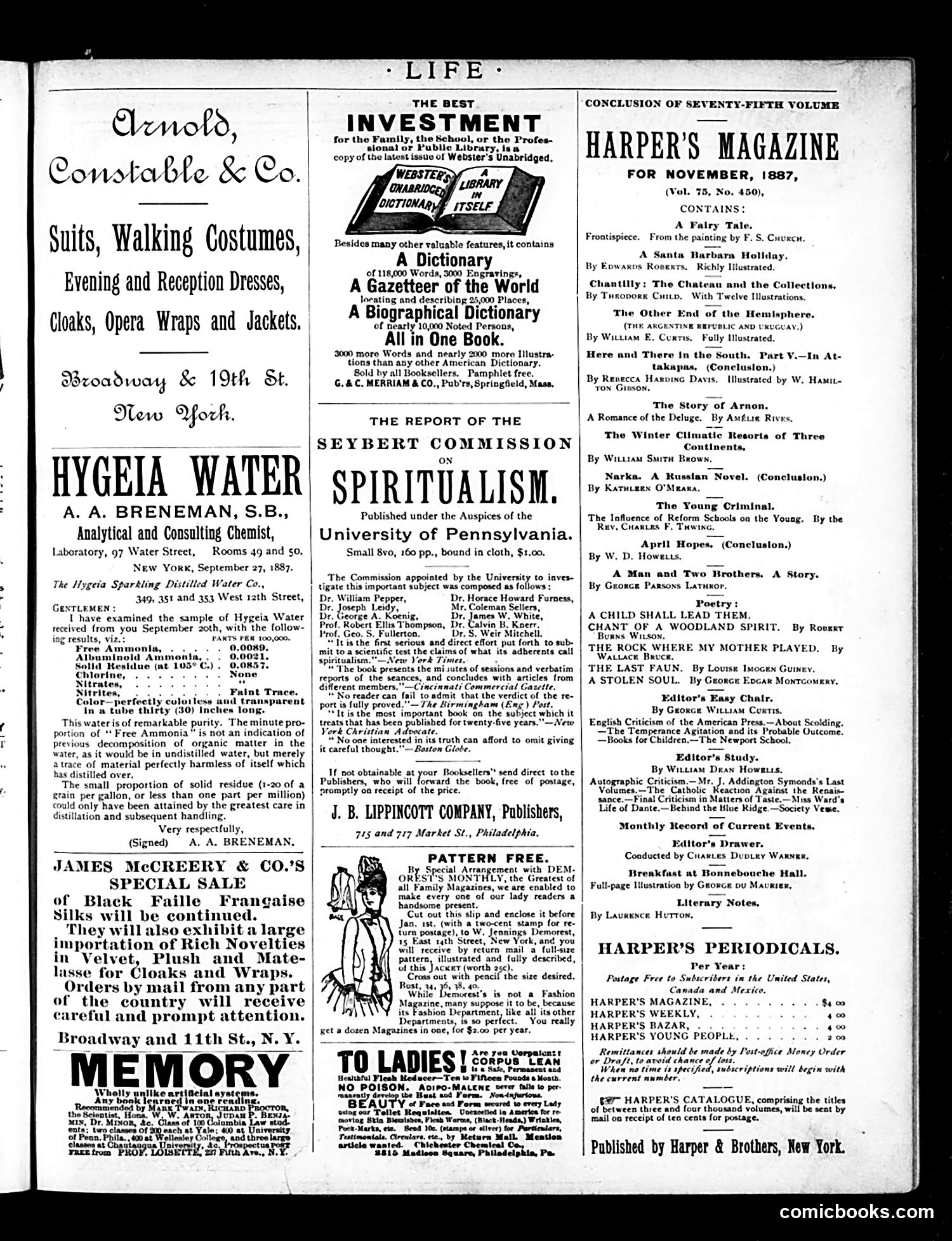
This page is primarily **advertising and announcements** rather than political cartoon content. It features: - Fashion advertisements (Arnold, Constable & Co.; James McCeery & Co.) - A chemistry analysis letter certifying water purity from the Hygeia Sparkling Distilled Water Company - An advertisement for Webster's Unabridged Dictionary - An announcement of "The Report of the Seybert Commission on Spiritualism," published by the University of Pennsylvania, with quoted endorsements from various newspapers praising its scientific investigation of spiritualist claims - A pattern offer advertisement - Table of contents for Harper's Magazine The spiritualism commission listing is the only content with potential historical interest—it represents late-19th-century efforts to apply scientific scrutiny to spiritualist phenomena, which were popular at the time. The endorsements emphasize the "scientific" nature of the investigation.
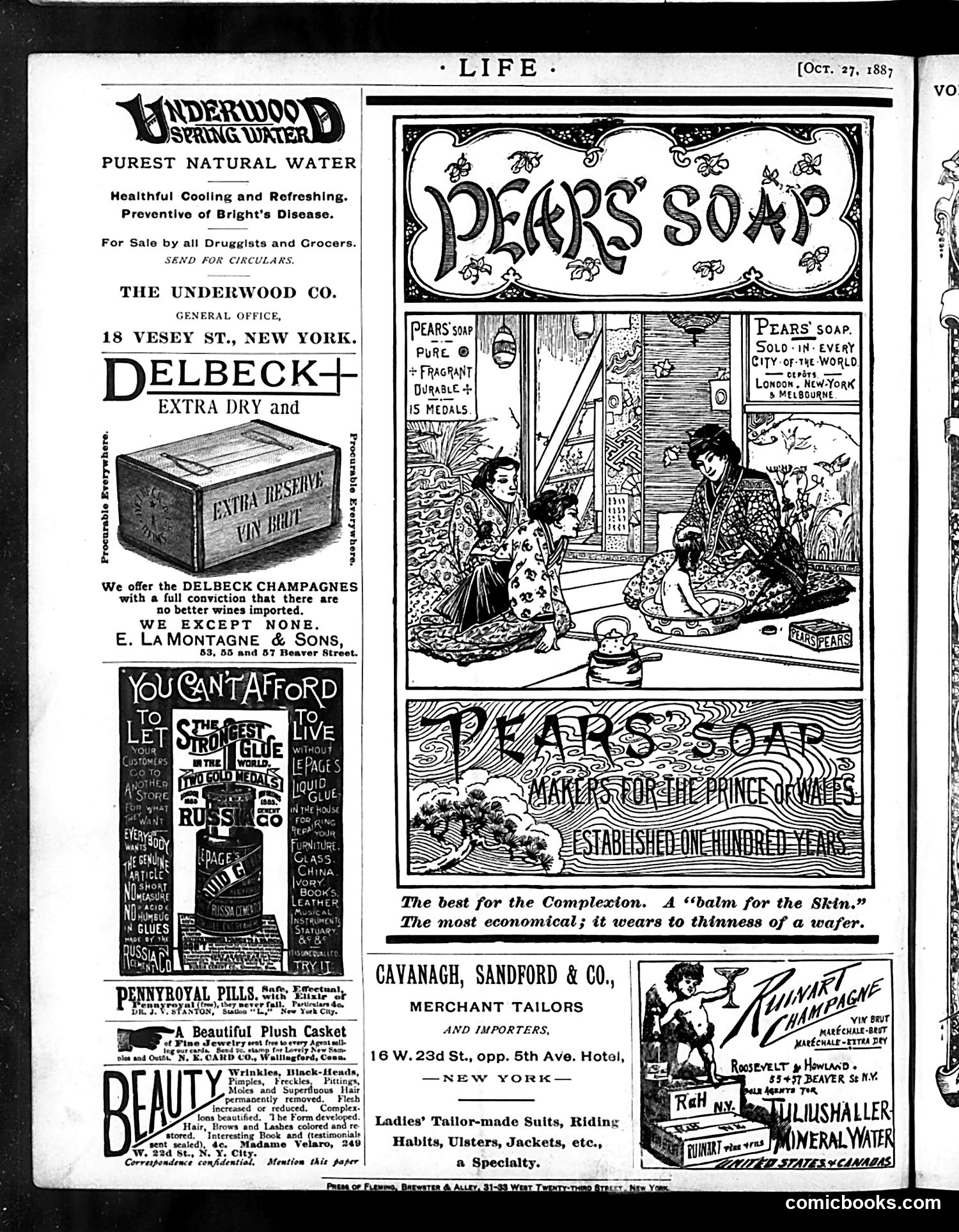
This page is primarily **advertising content** from October 27, 1887, rather than political satire. The dominant feature is a large **Pears' Soap advertisement** showcasing an illustrated scene of what appears to be an affluent Asian or East Asian household—women in traditional dress using the product indoors. The advertisement's tagline claims Pears' Soap is "the best for the Complexion" and "most economical." The imagery likely reflects Victorian-era marketing that exoticized non-Western cultures to sell luxury goods to British and American audiences. The page also contains numerous other period advertisements for champagne, pills, beauty treatments, and tailoring services—typical of late 19th-century magazine content that relied heavily on paid advertising for revenue. **There is no apparent political cartoon or satire on this page**—it is straightforward commercial advertising material.