
Life, 1887-10-27 · page 2 of 16
Life — October 27, 1887 — page 2: what you’re looking at
What you’re looking at
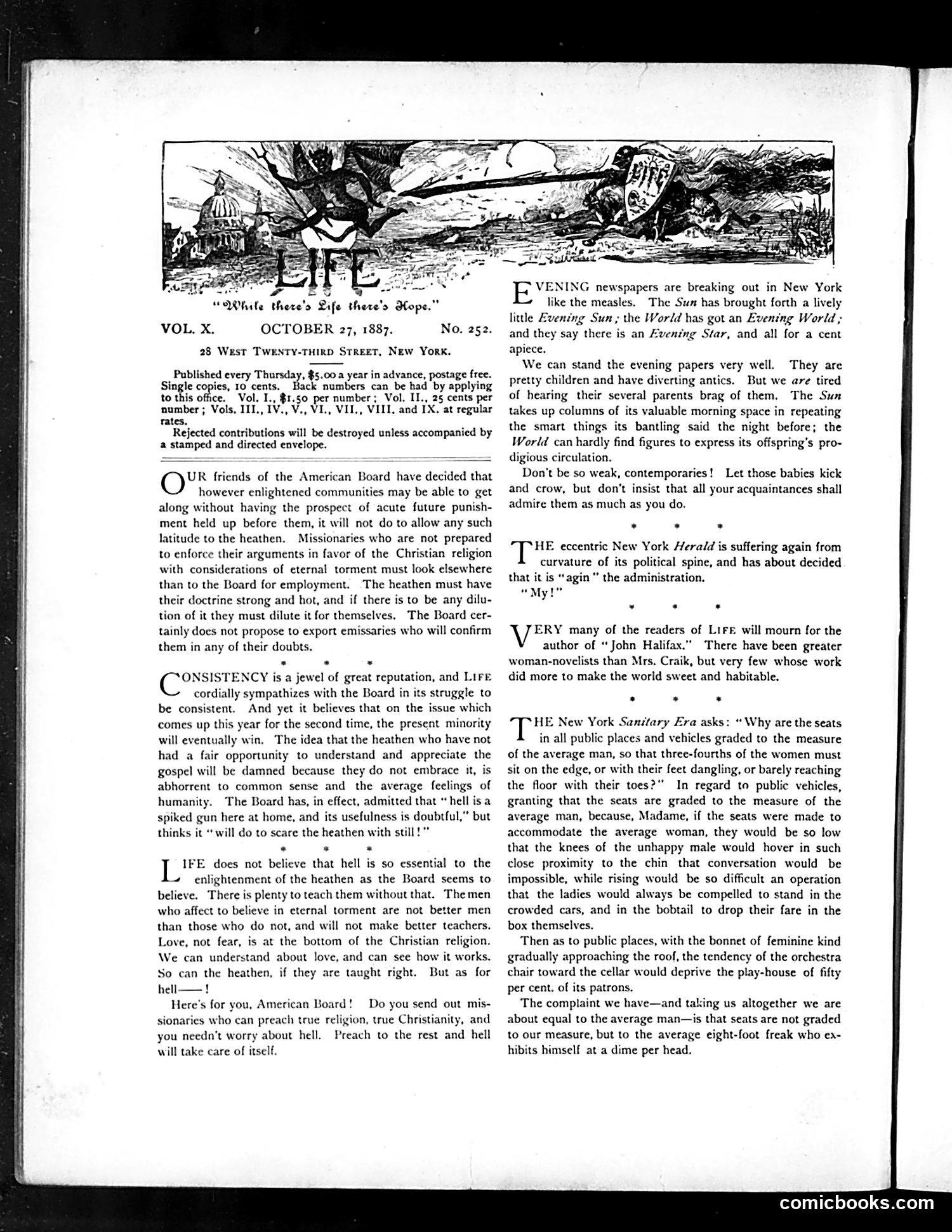
The masthead cartoon depicts a grim reaper figure labeled "LIFE" standing over a corpse, with the caption "Whate there's Life there's Hope." This is ironic—a memento mori image subverting the optimistic proverb. The page contains editorial commentary rather than political cartoons. Articles criticize: 1. **The American Board's enforcement doctrine** — attacking Christian missionaries' harsh punishments of native converts 2. **Evening newspapers proliferating in New York** — mocking their sensationalism and cheap pricing (one cent) 3. **The Herald's political weakness** — noting its editorial inconsistency 4. **Theater seating inequality** — satirizing that seats aren't proportioned for average human bodies, forcing women into uncomfortable positions The satire targets institutional hypocrisy, commercialism, and poor public design through reasoned argument rather than visual caricature.
📄 Transcribed text from this page (OCR, searchable)
Machine-transcribed from the original scan — historical spelling and the odd misread are preserved.
= # S 8 7 “Wale there's Life there's Hope.” VOL. X. OCTOBER 27, 1887. 28 West TWENTY-THIRD STREET, New York. No. 252. Published every Thursday, $5.00 a year in advance, postage free. Single copies, 10 cents. Back numbers can be had by applying to this office. Vol. I., $1.50 per number; Vol. II., 25 cents per number; Vols, III, IV., V., VI., VIL, VIII. and IX. at regular rates, Rejected contributions will be destroyed unless accompanied by a stamped and directed envelope. ov friends of the American Board have decided that however enlightened communities may be able to get along without having the prospect of acute future punish- ment held up before them, it will not do to allow any such latitude to the heathen, Missionaries who are not prepared to enforce their arguments in favor of the Christian religion with considerations of eternal torment must look elsewhere than to the Board for employment. The heathen must have their doctrine strong and hot, and if there is to be any dilu- tion of it they must dilute it for themselves. The Board cer- tainly does not propose to export emissaries who will confirm them in any of their doubts. . . . ONS NCY is a jewel of great reputation, and LIFE cordially sympathizes with the Board in its struggle to be consistent. And yet it believes that on the issue which comes up this year for the second time, the present minority will eventually win. The idea that the heathen who have not had a fair opportunity to understand and appreciate the gospel will be damned because they do not embrace it, is abhorrent to common sense and the average feelings of humanity. The Board has, in effect, admitted that “ hell is a spiked gun here at home, and its usefulness is doubtful,” but thinks it “will do to scare the heathen with still!” . . * I IFE does not believe that hell is so essential to the —~ enlightenment of the heathen as the Board seems to believe. There is plenty to teach them without that. Themen who affect to believe in eternal torment are not better men than those who do not, and will not make better teachers. Love, not fear, is at the bottom of the Christian religion. We can understand about love, and can see how it works. So can the heathen, if they are taught right. But as for hell ! Here's for you, American Board! Do you send out mis- sionaries who can preach true religion, true Christianity, and you needn't worry about hell. Preach to the rest and hell will take care of itself. EYEnine newspapers are breaking out in New York like the measles. The Su# has brought forth a lively little Evening Sun ; the World has got an Evening World ; and they say there is an Evening Star, and all for a cent apiece. We can stand the evening papers very well. They are pretty children and have diverting antics. But we are tired of hearing their several parents brag of them. The Sun takes up columns of its valuable morning space in repeating the smart things its bantling said the night before; the World can hardly find figures to express its offspring’s pro- digious circulation. Don’t be so weak, contemporaries! Let those babies kick and crow, but don’t insist that all your acquaintances shall admire them as much as you do. * * * HE eccentric New York Hera/d is suffering again from curvature of its political spine, and has about decided that it is “agin " the administration. “ My!" ERY many of the readers of Lire will mourn for the author of “ John Halifax.” There have been greater woman-novelists than Mrs. Craik, but very few whose work did more to make the world sweet and habitable. HE New York Sanitary Era asks: “ Why are the seats in all public places and vehicles graded to the measure of the average man, so that three-fourths of the women must sit on the edge, or with their feet dangling, or barely reaching the floor with their toes?" In regard to public vehicles, granting that the seats are graded to the measure of the average man, because, Madame, if the seats were made to accommodate the average woman, they would be so low that the knees of the unhappy male would hover in such close proximity to the chin that conversation would be impossible, while rising would be so difficult an operation that the ladies would always be compelled to stand in the crowded cars, and in the bobtail to drop their fare in the box themselves. Then as to public places, with the bonnet of feminine kind gradually approaching the roof, the tendency of the orchestra chair toward the cellar would deprive the play-house of fifty per cent. of its patrons. The complaint we have—and taking us altogether we are about equal to the average man—is that seats are not graded to our measure, but to the average eight-foot freak who ea- hibits himself at a dime per head. comicbooks.com