
Life, 1887-10-27 · page 10 of 16
Life — October 27, 1887 — page 10: what you’re looking at
What you’re looking at
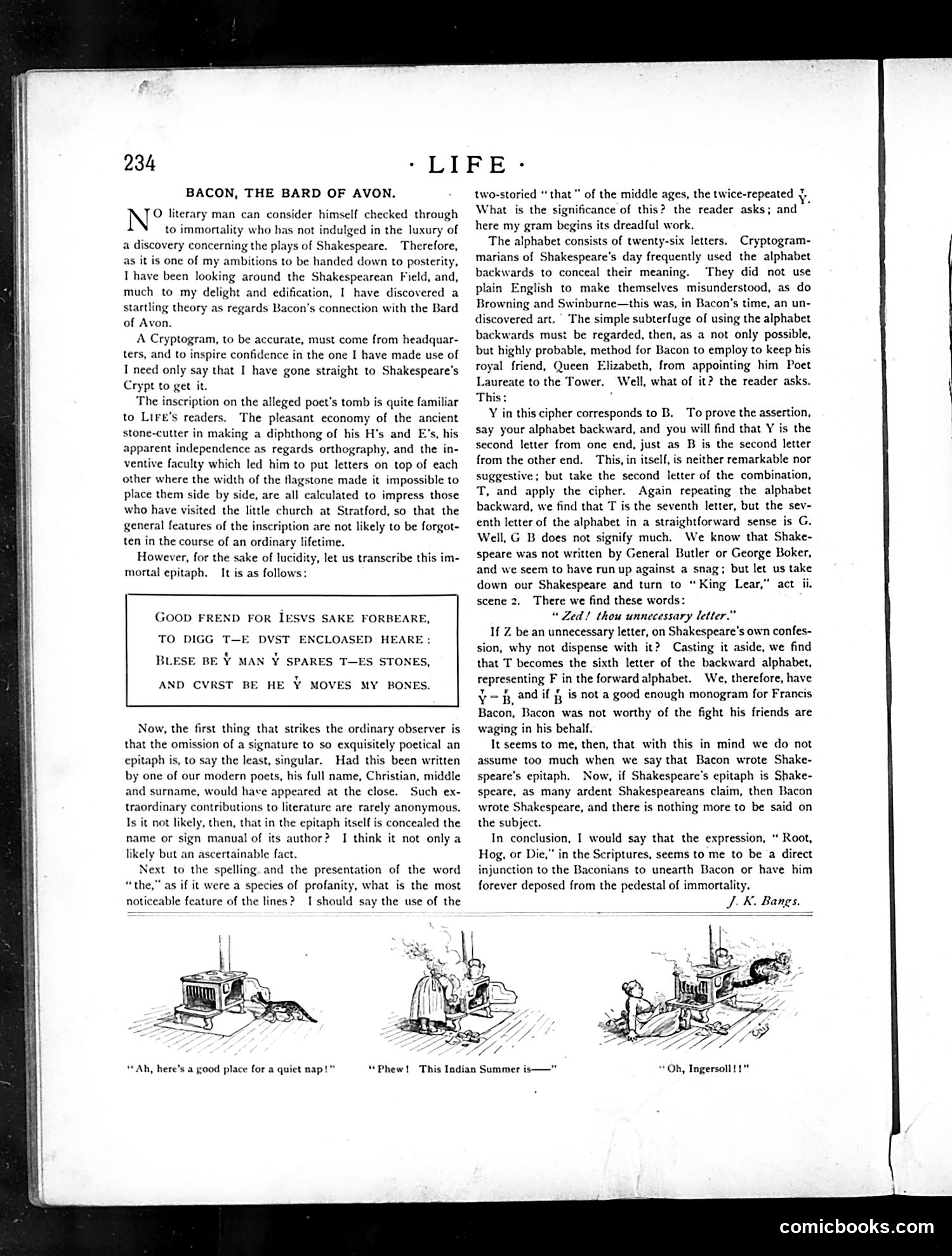
This page discusses a cryptographic theory claiming Francis Bacon wrote Shakespeare's works. The author argues that using backward alphabet ciphers, one can "prove" Bacon authored Shakespeare's epitaph. The piece methodically dismantles this theory, showing the cipher method is unreliable and concludes Bacon was unworthy of the effort his supporters expend defending him. Below the text are three small cartoon panels depicting what appear to be social scenes—a man napping, someone commenting on summer heat, and someone exclaiming in surprise. These cartoons seem unrelated to the Shakespeare/Bacon discussion above, likely serving as filler or standalone humor for the magazine. The article's tone is skeptical of pseudohistorical claims made through dubious "evidence."
📄 Transcribed text from this page (OCR, searchable)
Machine-transcribed from the original scan — historical spelling and the odd misread are preserved.
- LIFE: BACON, THE BARD OF AVON. N° literary man can consider himself checked through to immortality who has not indulged in the luxury of a discovery concerning the plays of Shakespeare. Therefore, as it is one of my ambitions to be handed down to posterit: I have been looking around the Shakespearean Field, and, much to my delight and edification, | have discovered a startling theory as regards Bacon's connection with the Bard of Avon. A Cryptogram, to be accurate, must come from headquar- and to inspire confidence in the one I have made use of I need only say that I have gone straight to Shakespeare's Crypt to get it. The inscription on the alleged poet's tomb is quite familiar to Lire’s readers. The pleasant economy of the ancient stone-cutter in making a diphthong of his H’s and E’s, his apparent independence as regards orthography, and the in- ventive faculty which led him to put letters on top of each other where the width of the flagstone made it impossible to place them side by side, are all calculated to impress those who have visited the little church at Stratford, so that the general features of the inscription are not likely to be forgot- ten in the course of an ordinary lifetime. However, for the sake of lucidity, let us transcribe this im- mortal epitaph. It is as follows: GooD FREND FOR IrESvs TO DIGG T. SAKE FORBEARE, DVST ENCLOASED HEARE : BLESE BE Y MAN Y SPARES T-E STONES, AND CVRST BE HE ¥ MOVES MY BONES. Now, the first thing that strikes the ordinary observer is that the omission of a signature to so exquisitely poetical an epitaph is, to say the least, singular. Had this been written by one of our modern poets, his full name, Christian, middle and surname, would have appeared at the close. Such ex- traordinary contributions to literature are rarely anonymous. Is it not likely, then, that in the epitaph itself is concealed the name or sign manual of its author? I think it not only a likely but an ascertainable fact. Next to the spelling. and the presentation of the word “the,” as if it were a species of profanity, what is the most noticeable feature of the lines? I should say the use of the “Ah, here's a good place for a quiet nap!” “Phew! This Indian Summer is——" two-storied “that” of the middle ages, the twice-repeated Y. What is the significance of this? the reader asks; and here my gram be dreadful work. The alphabet consists of twenty-six letters. Cryptogram- marians of Shakespeare's day frequently used the alphabet backwards to conceal their meaning. They did not use plain English to make themselves misunderstood, as do Browning and Swinburne—this was, in Bacon's time, an un- discovered art. The simple subterfuge of using the alphabet backwards must be regarded, then, as a not only possible, but highly probable, method for Bacon to employ to keep his royal friend, Queen Elizabeth, from appointing him Poet Laureate to the Tower. Well, what of it? the reader asks. This: ' Y in this cipher corresponds to B. To prove the assertion, say your alphabet backward, and you will find that Y is the second letter from one end, just as B is the second letter from the other end. This, in itself, is neither remarkable nor suggestive; but take the second letter of the combination, T, and apply the cipher. Again repeating the alphabet backward, we find that T is the seventh letter, but the sev- enth letter of the alphabet in a straightforward sense is G. Well, G B does not signify much. We know that Shake- speare was not written by General Butler or George Boker, and we seem to have run up against a snag; but let us take down our Shakespeare and turn to “King Lear,” act ii. scene 2. There we find these words: “Zed! thou unnecessary letter.” If Z be an unnecessary letter, on Shakespeare's own confes- sion, why not dispense with it? Casting it aside, we find that T becomes the sixth letter of the backward alphabet, representing F in the forward alphabet. We, therefore, have Yr B, and if f is not a good enough monogram for Francis Bacon, Bacon was not worthy of the fight his friends are waging in his behalf. It seems to me, then, that with this in mind we do not assume too much when we say that Bacon wrote Shake- speare’s epitaph. Now, if Shakespeare's epitaph is Shake- speare, as many ardent Shakespeareans claim, then Bacon wrote Shakespeare, and there is nothing more to be said on the subject. In conclusion, I would say that the expression, “ Root, Hog, or Die,” in the Scriptures, seems to me to be a direct injunction to the Baconians to unearth Bacon or have him forever deposed from the pedestal of immortality. “Oh, Ingersoll !1" comicbooks.com