
A complete issue · 16 pages · 1887
Life — October 6, 1887
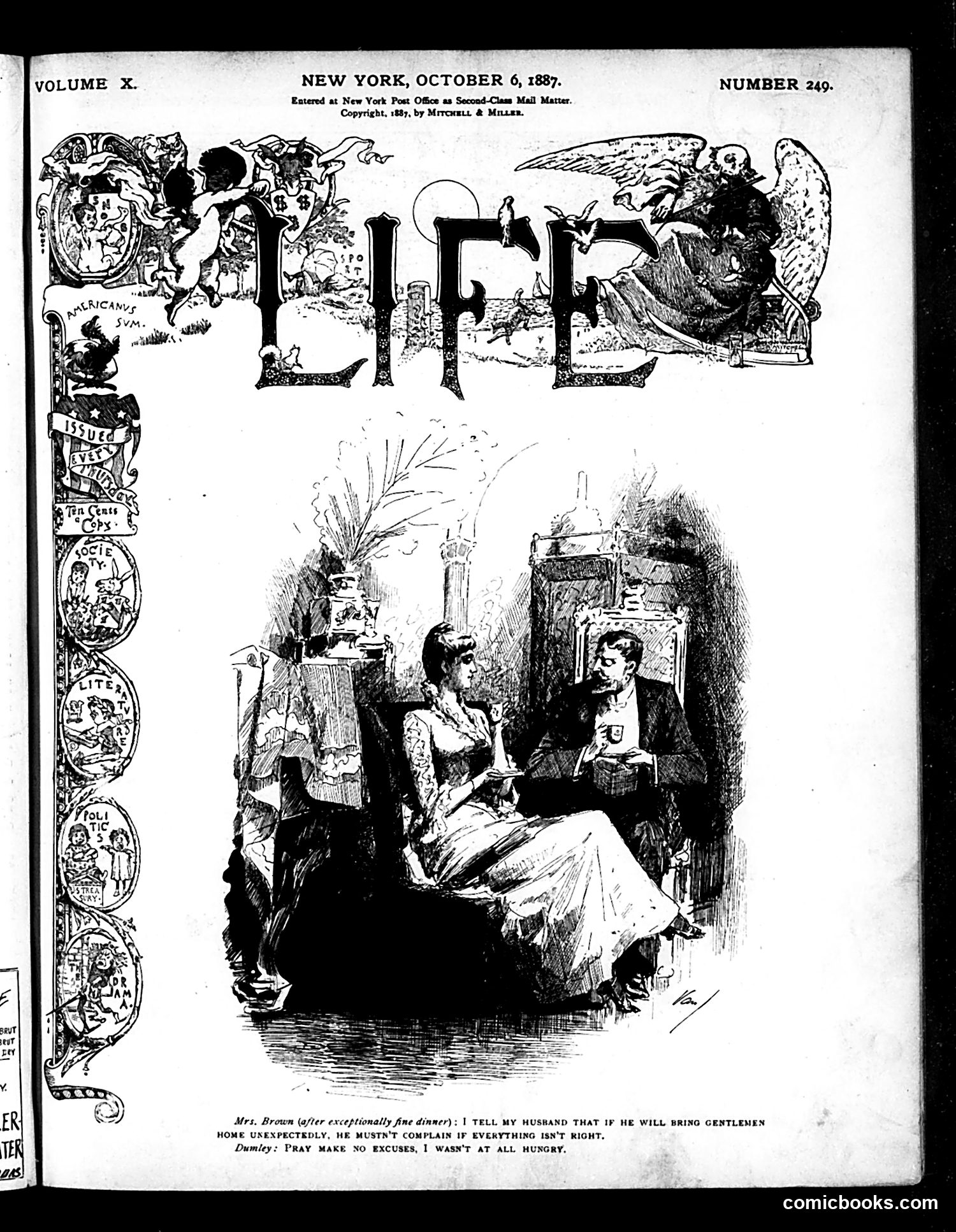
This page from the satirical magazine *Life* features a domestic humor cartoon mocking marital discord. The caption presents a dialogue where Mrs. Brown, after an "exceptionally fine dinner," warns her husband that if he brings gentlemen home unexpectedly, he must not complain if everything isn't perfect. Her husband responds that she should make no excuses—he wasn't hungry anyway. The satire targets the tension between Victorian domestic expectations and reality: wives were expected to maintain perfect households at all times, yet husbands brought guests home unannounced. The joke inverts typical complaint patterns, with the husband preemptively shutting down his wife's apologies, suggesting both marital tension and the absurdity of impossible domestic standards.
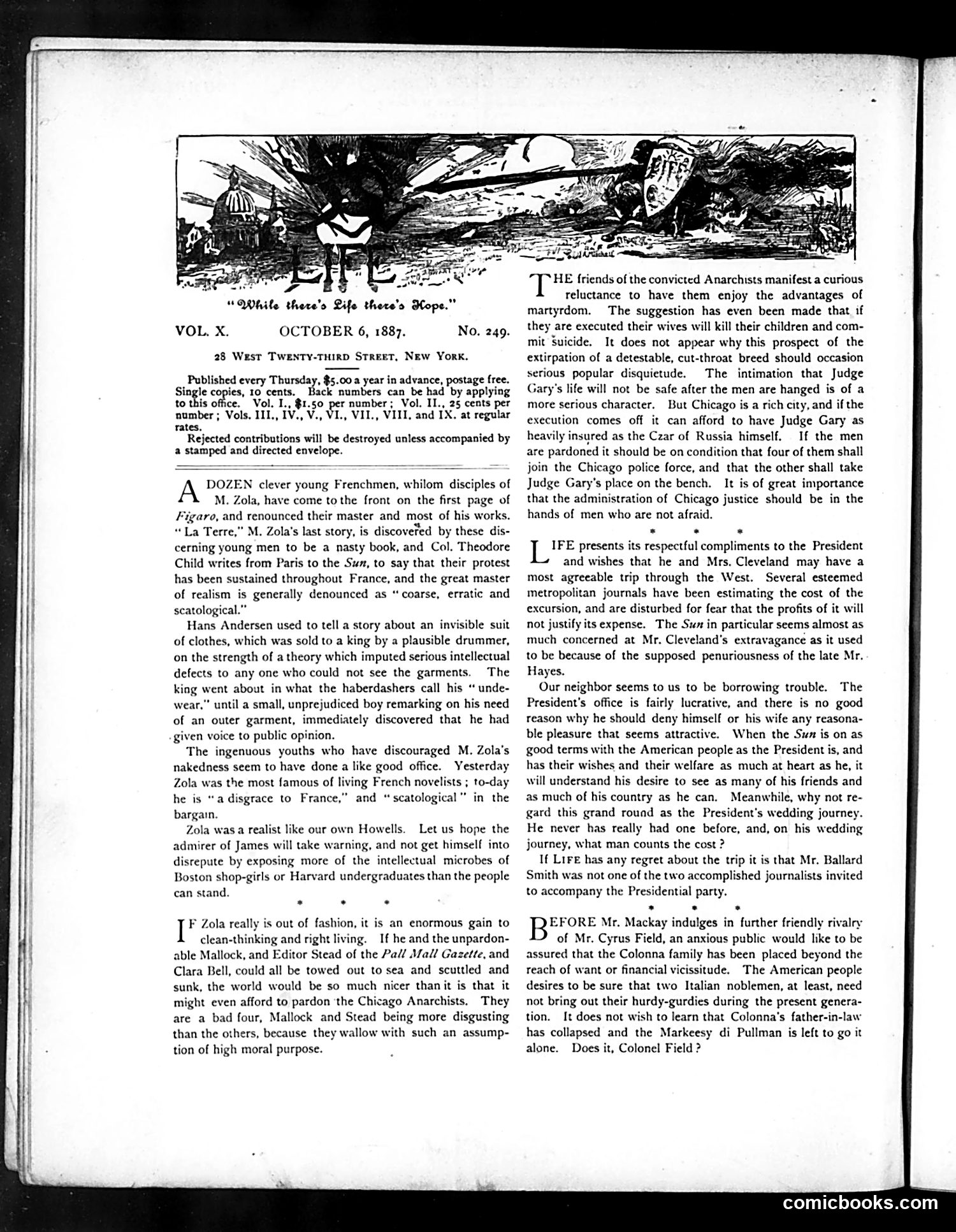
The masthead cartoon depicts anarchists or revolutionaries amid chaos—explosions, violence, and destruction. The accompanying text discusses convicted anarchists facing execution, debating whether their wives should be killed alongside them as "martyrdom." The satire mocks both the anarchists' ideology and public anxiety about them. Below, the editorial critiques French novelist Émile Zola's declining reputation. It sarcastically suggests that if realistic, socially-conscious literature goes "out of fashion," society could tolerate mediocre writers like James and Howells instead. The piece attacks Chicago editors Malloch and Stead (of the *Pall Mall Gazette*) for their moral self-righteousness while producing inferior work. The page also comments on President Cleveland's western tour and Italian nobility visiting America.
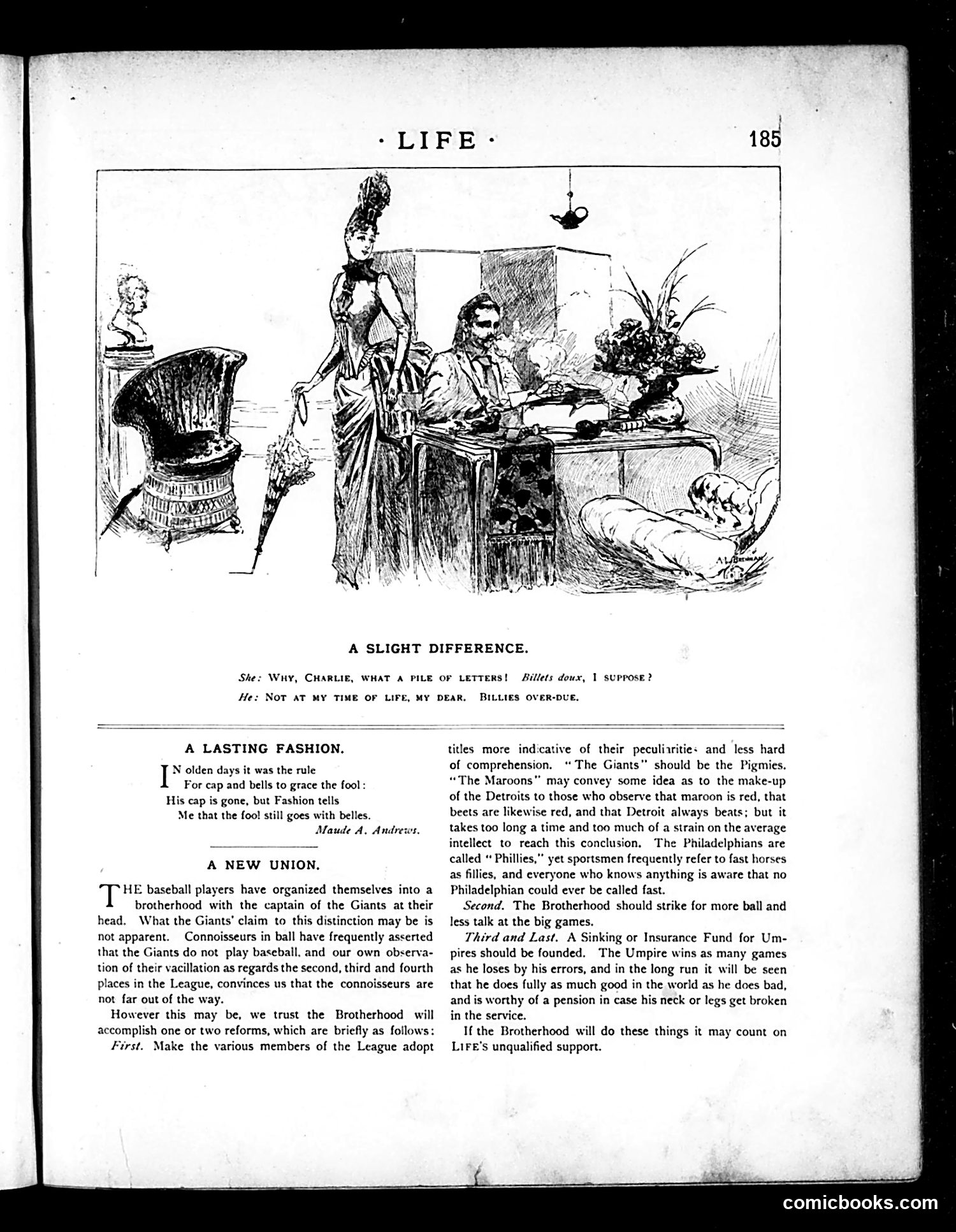
**"A Slight Difference"** (top cartoon): A woman confronts a man named Charlie about a pile of letters, calling them "billets doux" (love letters). He protests they're "billies over-due"—a pun playing on the homophone between romantic letters and overdue bills. The satire mocks domestic nagging about unpaid debts. **"A Lasting Fashion"** and **"A New Baseball Union"** (articles below): These discuss baseball league organization and propose reforms including: standardized rules across teams, a "Sinking or Insurance Fund" for injured umpires, and pension protections for players. The text advocates for Life's support of these labor improvements in professional baseball. The page combines light domestic humor with serious sports labor advocacy.
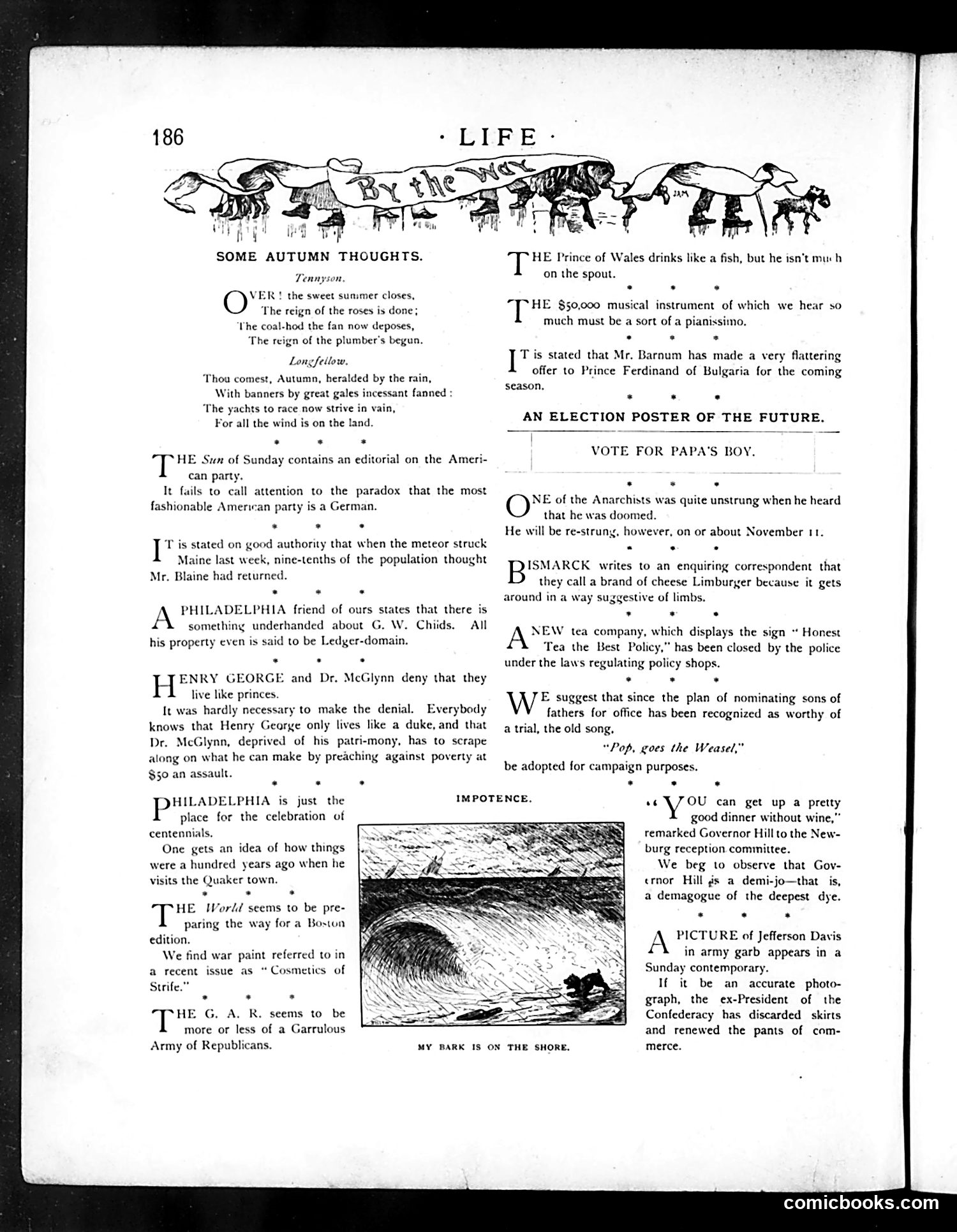
This page contains brief satirical items rather than a single cartoon. Notable content includes: **"An Election Poster of the Future"** section mocks nominating "sons of fathers for office," suggesting this practice deserves the campaign slogan "Pop, goes the Weasel!"—a playful pun on the nursery rhyme. **The main illustration** titled "MY BARK IS ON THE SHORE" depicts a dark, stormy seascape. Without additional context, its satirical meaning is unclear, though the caption suggests it may reference a political or social figure's precarious situation. Other items joke about the Prince of Wales, a $50,000 piano, and Barnum's offer to Ferdinand of Bulgaria—typical of *Life's* gossipy, lighthearted political commentary mixing domestic and international references.
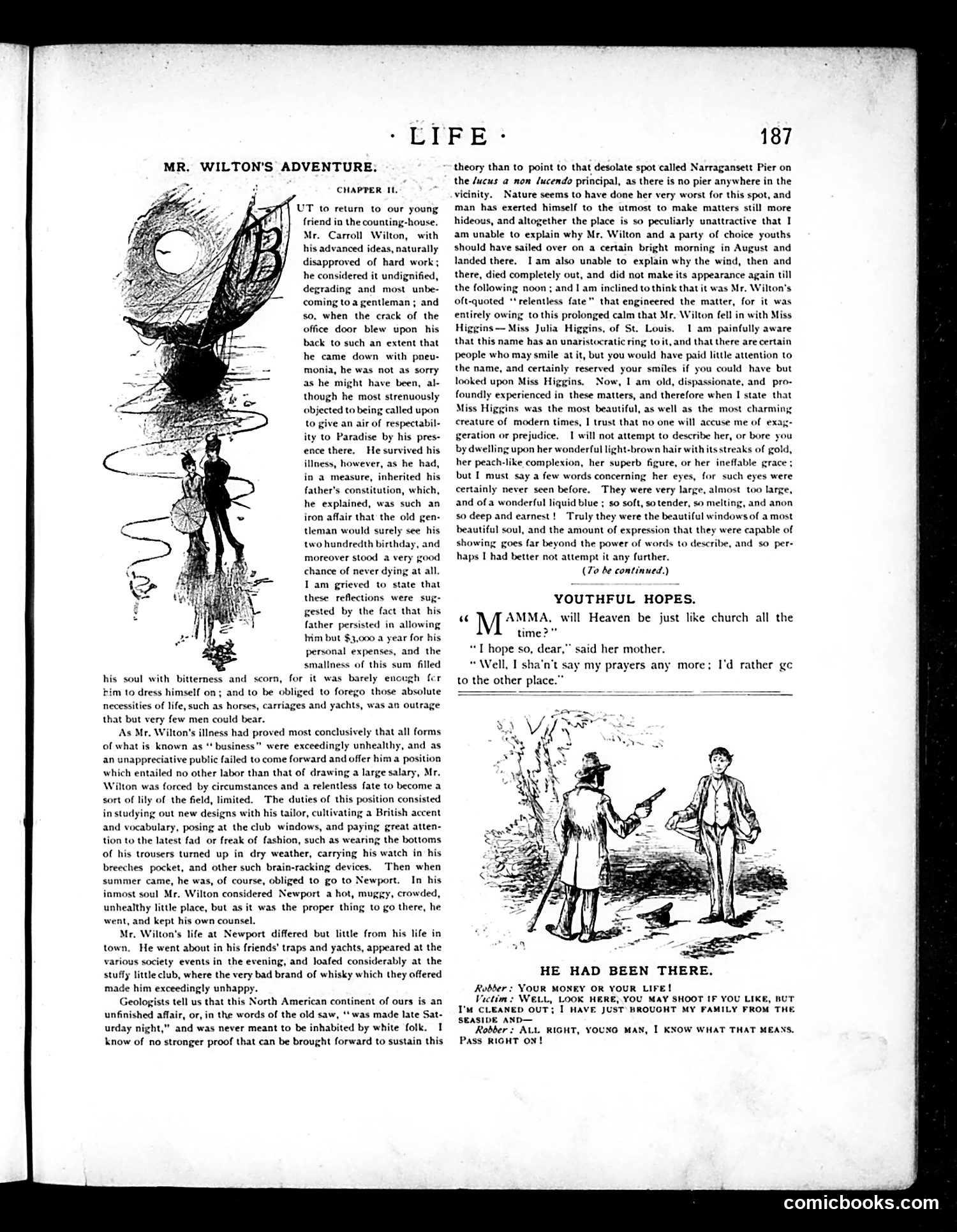
This page contains two distinct satirical pieces: **"Mr. Wilton's Adventure" (upper section):** A narrative story with illustrations mocking a gentleman's pretensions. The text ridicules Mr. Carroll Wilton for his affected mannerisms, British accent affectations, and obsession with fashion—described as "most unbecoming to a gentleman." The satire targets nouveau riche Americans adopting artificial European sophistication while neglecting actual work and responsibility. His collapse from pneumonia is presented as darkly comedic comeuppance. **"Youthful Hopes" (lower section):** A brief comedic dialogue between a mother and child about Heaven, followed by an illustration captioned "HE HAD BEEN THERE." The joke appears to reference someone's disreputable past or moral failings, suggesting they've already experienced Hell-like conditions. Both pieces exemplify Life's characteristic social satire targeting American class pretension and hypocrisy in the early 20th century.
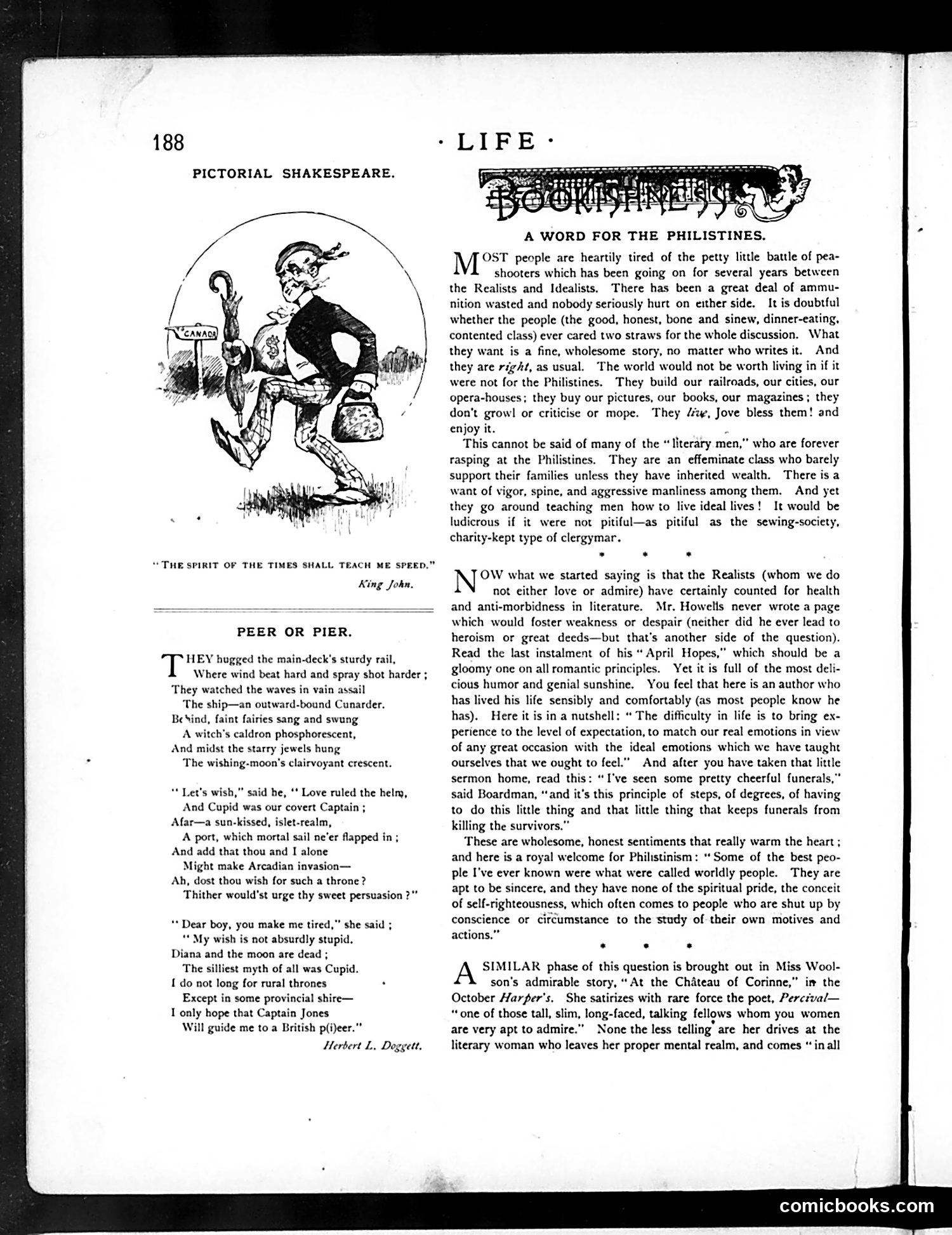
The page contains two sections: a cartoon titled "Pictorial Shakespeare" and a poem titled "Peer or Pier." **The Cartoon:** Shows a caricatured figure in exaggerated pose, apparently satirizing pretentious behavior. The specific identity of the figure is unclear from the image alone, though the title suggests it parodies Shakespeare references or classical allusions. **The Text Content:** The articles critique two groups—"Realists" and "Idealists" in literature, and "literary men" who criticize popular culture (the "Philistines"). The author argues against intellectuals who disparage common people's entertainment preferences (railroads, opera, magazines, pictures). The piece defends the "Philistines" as honest, hardworking people entitled to simple pleasures without condescension from literary elites. The satire targets intellectual snobbery and class-based cultural gatekeeping.
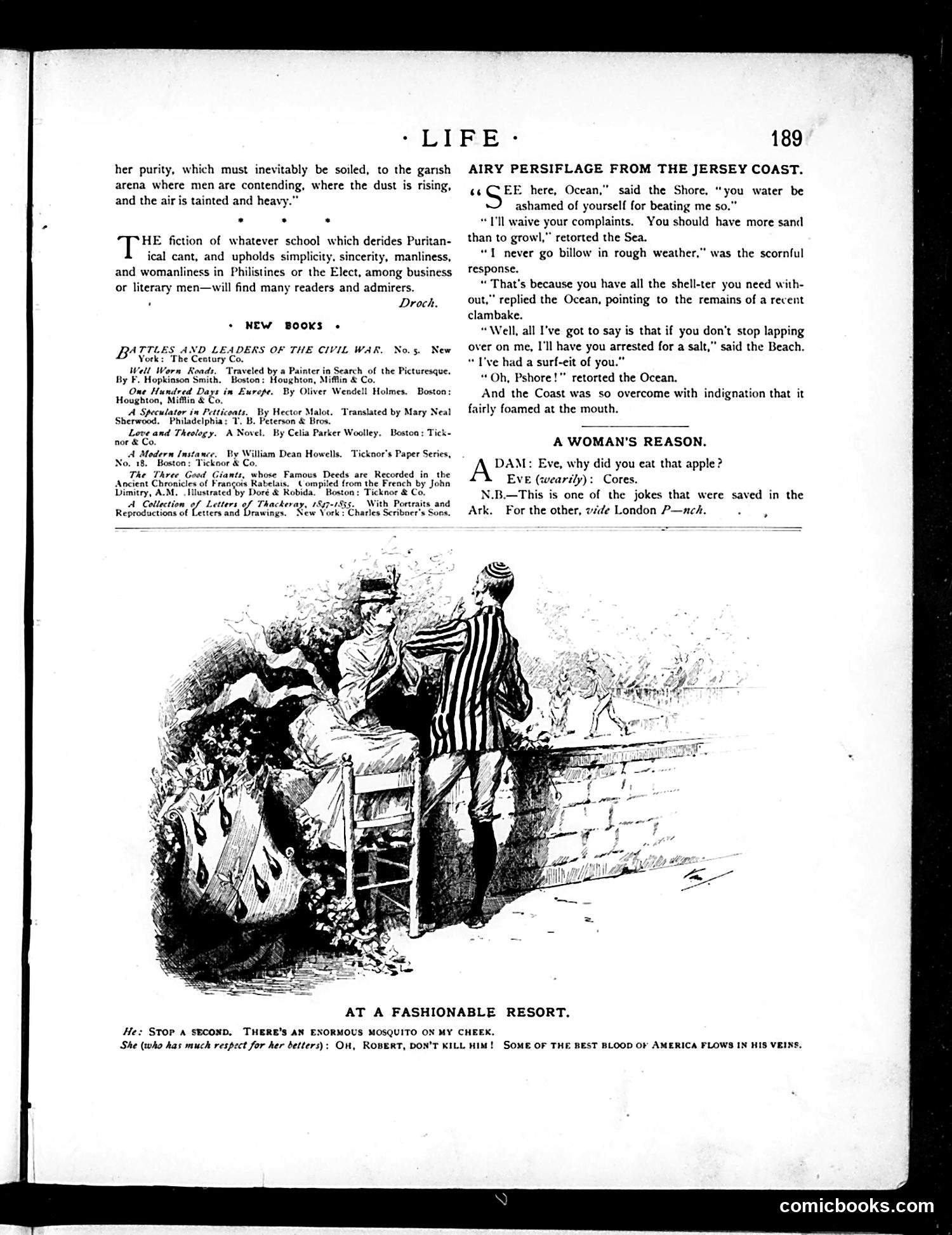
**Main Cartoon: "At a Fashionable Resort"** This cartoon depicts a woman seated outdoors swatting at a mosquito on a man's cheek. She exclaims to stop because "some of the best blood of America flows in his veins." The satire mocks upper-class pretension at resort destinations—suggesting wealthy Americans inflate their own importance and social status to absurd degrees. The woman's concern prioritizes the man's elite "bloodline" over practical pest control, ridiciculing how the fashionable set obsess over pedigree and social standing even in trivial situations. **Secondary Content:** The page includes a humorous exchange titled "A Woman's Reason" playing on the stereotype that women's logic is flawed or based on emotion rather than rationality.
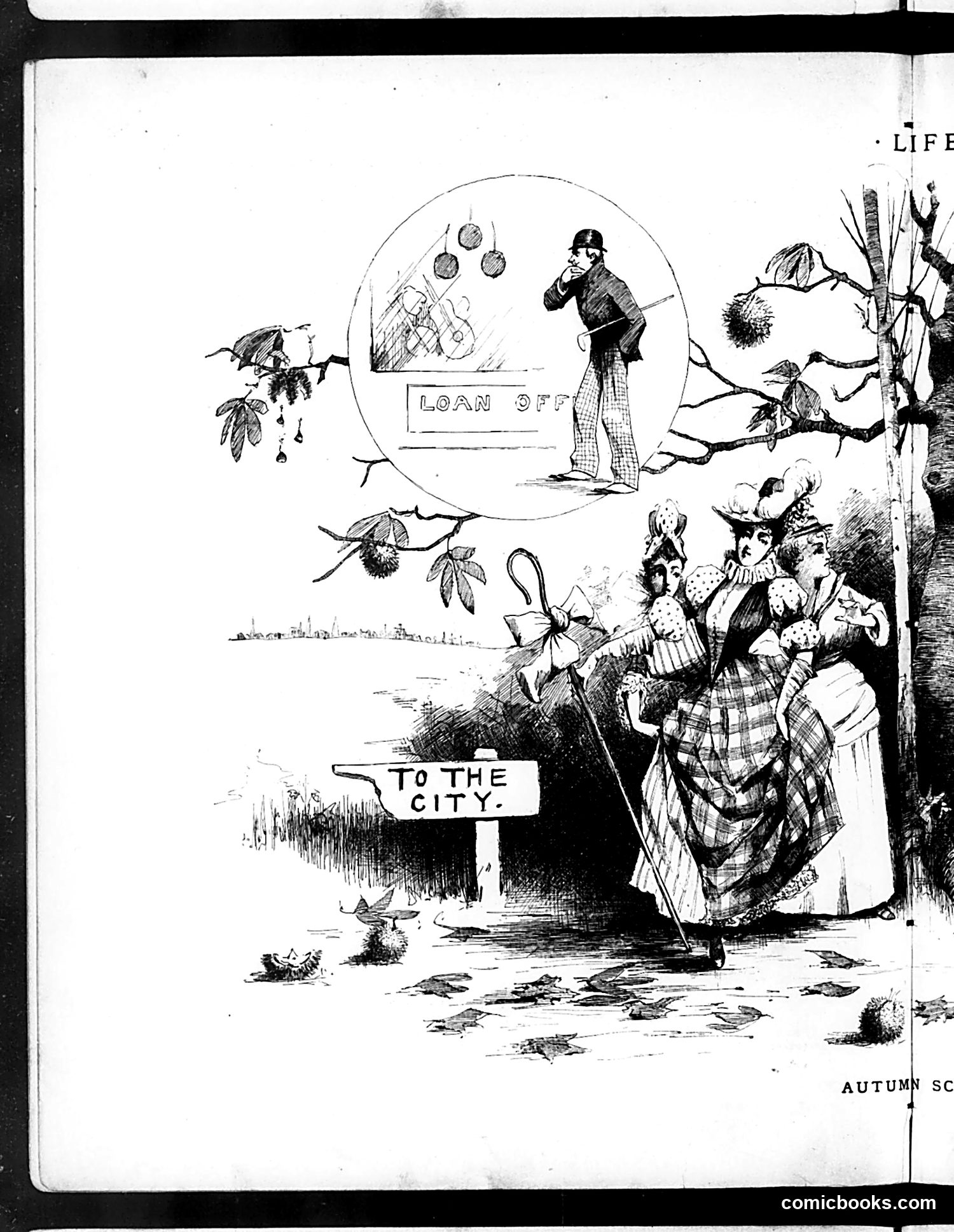
This is a satirical cartoon from *Life* magazine showing wealthy, fashionably-dressed urban women being directed "TO THE CITY" by a sign, while a man in the circular bubble above displays a "LOAN OFF" sign with hanging ornaments (suggesting financial instruments or debt). Dead leaves and wilted plants surround the scene, emphasizing autumn and decay. The satire appears to critique the financial practices of wealthy city dwellers, likely referencing loan schemes or speculative financial instruments popular among the urban elite. The contrast between the women's fine clothing and the withering natural environment suggests the artificiality or unsustainability of their wealth. The man's gesture toward a "loan off" implies either predatory lending or the collapse of financial schemes, making the journey "to the city" potentially disastrous.
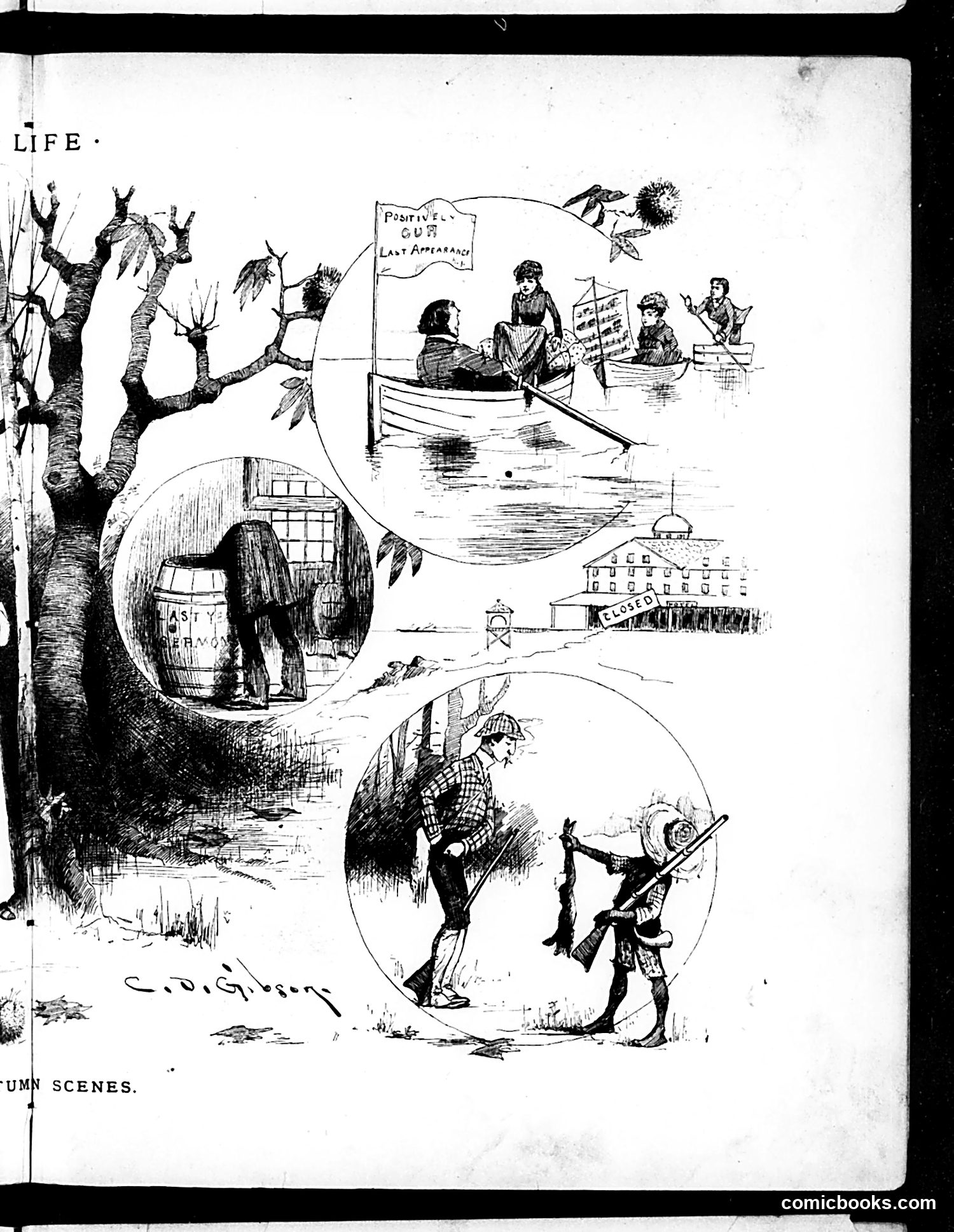
This is a satirical composite illustration titled "Life: Autumn Scenes" signed by C. D. Gibson (a prominent Life cartoonist). The page depicts various leisure activities organized in circular vignettes: The top scene shows people boating, with a flag reading "Positively Our Last Appearance"—likely satirizing summer visitors departing as autumn arrives. The middle circle shows an elephant in what appears to be a barrel or enclosed space, suggesting confinement or restraint. The bottom scene depicts hunters or sportsmen in autumn hunting attire. The overall theme appears to mock seasonal recreational activities and the social rituals of autumn—particularly hunting season and the end of summer leisure for the wealthy classes. The "last appearance" flag suggests commentary on transient fashions or social habits.
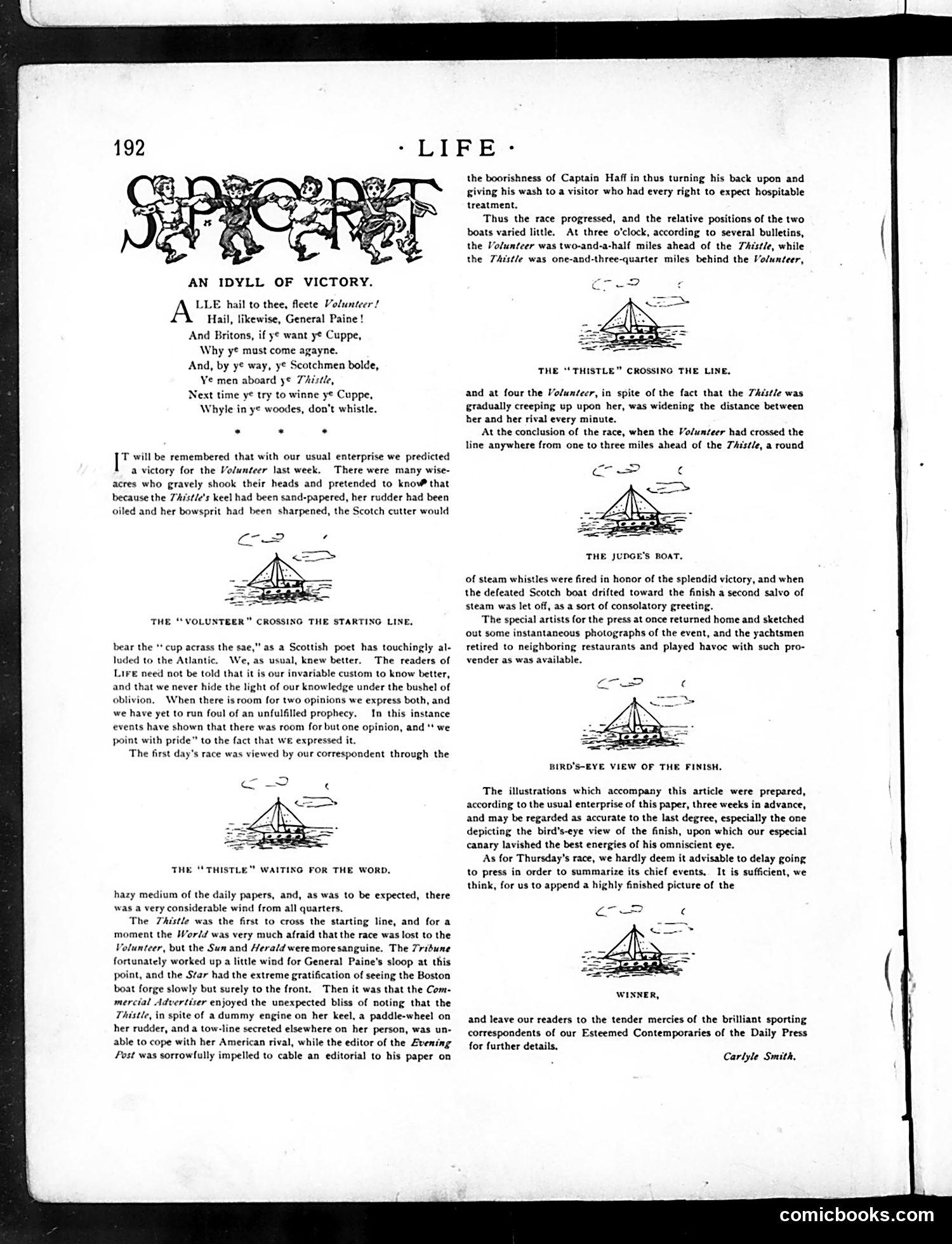
This page describes a boat race between two vessels: the *Volunteer* and the *Thistle*. The text celebrates the *Volunteer*'s victory in what appears to be an America's Cup yacht race. The article uses mock-heroic language ("An Idyll of Victory"), treating the sporting competition as epic drama. It mocks the pre-race predictions and newspaper coverage, noting that multiple papers had confidently predicted a *Volunteer* win. The small accompanying illustrations show the boats at various race stages (starting line, during competition, finish line, and bird's-eye view). The satirical tone suggests Life is gently ridiculing the intense media hype and nationalistic fervor surrounding this sporting event, presenting it as overblown spectacle worthy of parody.
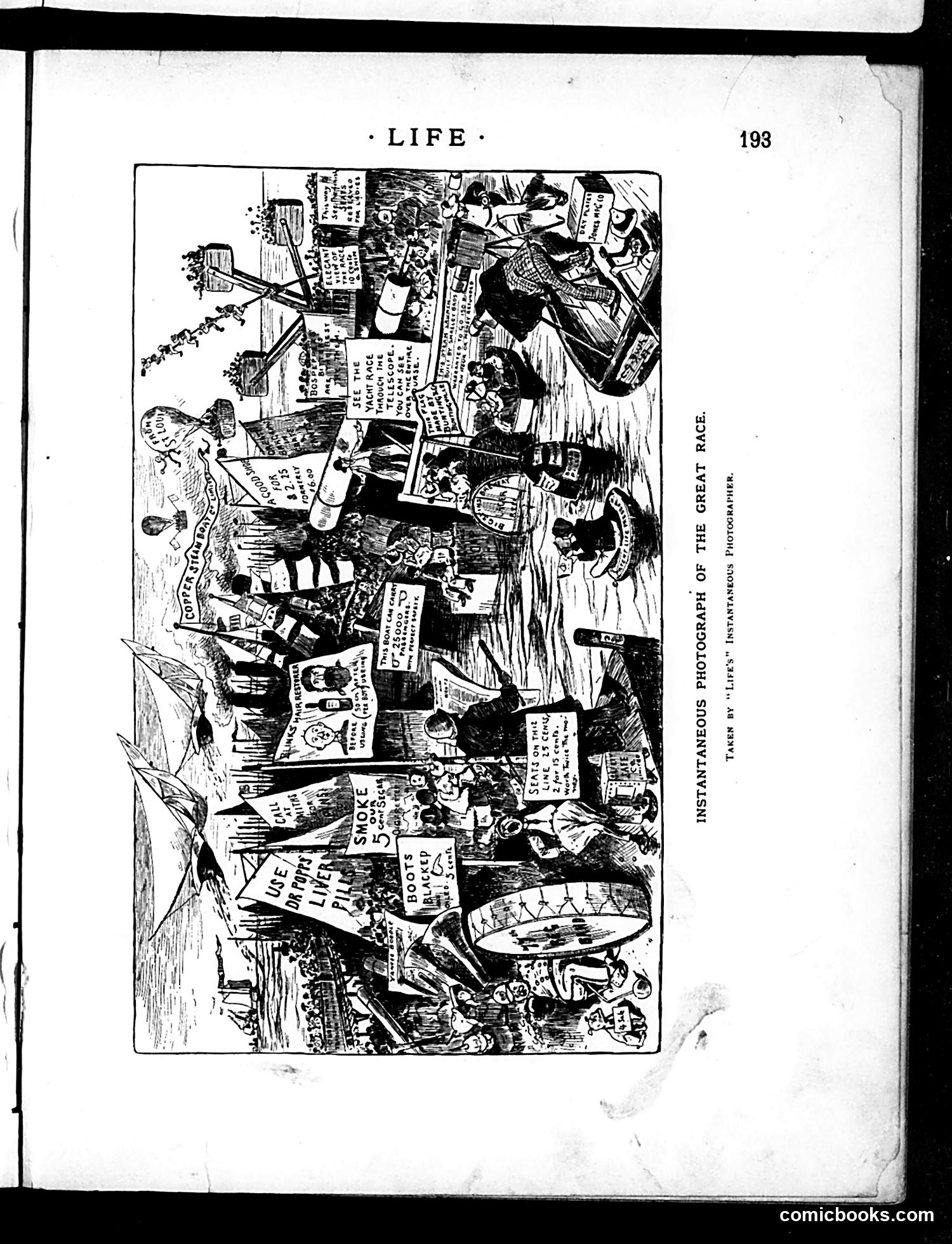
This is a satirical cartoon depicting what appears to be a chaotic street scene or parade, rendered upside-down (likely intentionally, for comedic effect). The image shows numerous figures, signs, and activity compressed into a busy composition. Multiple banners and signs are visible throughout, though most text is illegible at this resolution. The title suggests this is mocking some kind of "great race"—possibly a political campaign, sporting event, or social competition of the era. The "instantaneous photograph" reference likely satirizes photography's then-new ability to capture motion, here used to ridicule the frenetic pace and disorder of whatever event is depicted. The crowded, overlapping figures and signs emphasize chaos and confusion rather than organized spectacle. Without clearer text legibility, specific identifications remain unclear.
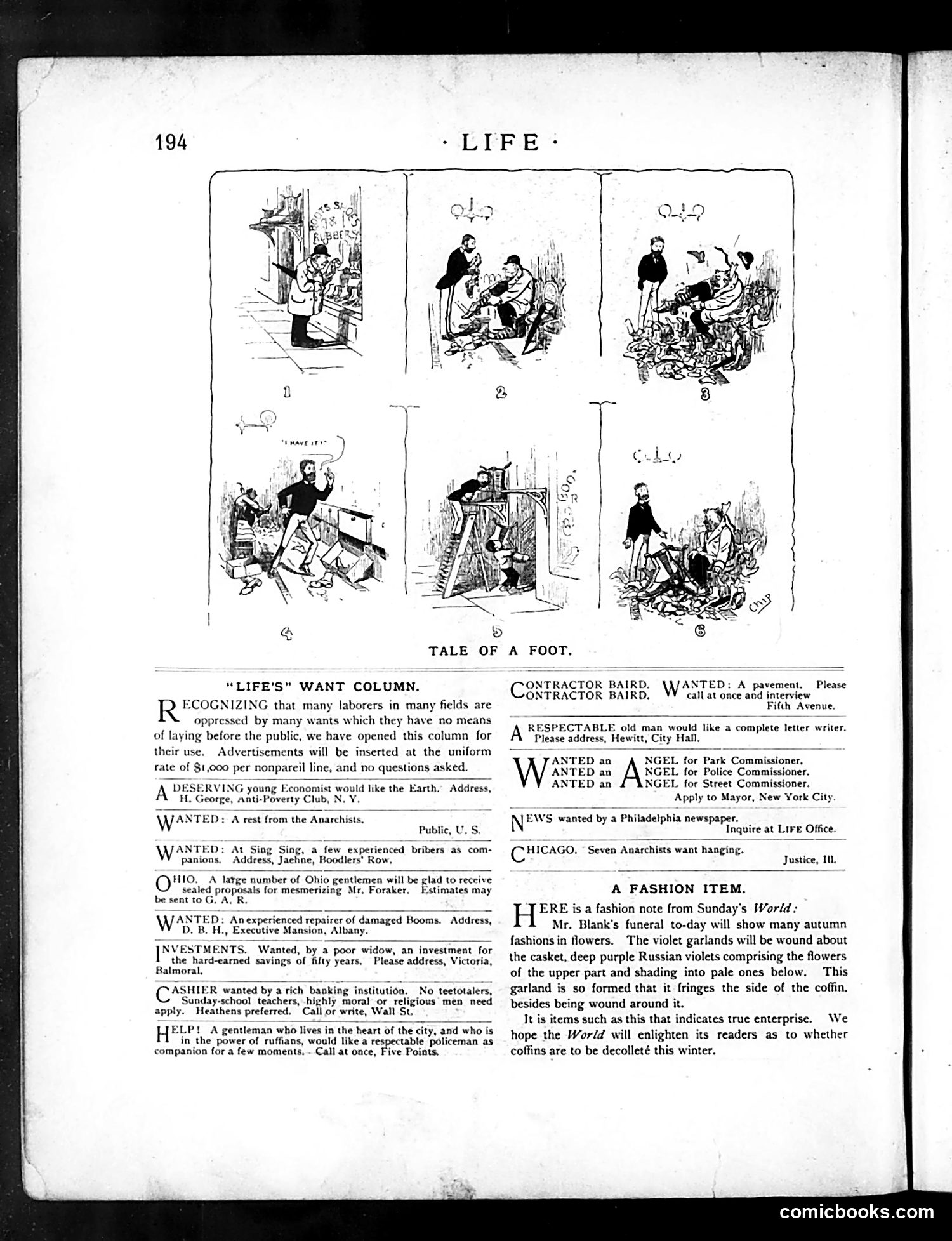
This page combines satirical "want ads" with social commentary typical of late 19th-century Life magazine. The six cartoon panels above ("Tale of a Foot") appear to depict a sequential narrative, though the specific storyline is unclear from this image alone. The "Want Column" is satirical classifieds mocking contemporary corruption and incompetence: - References to **Contractor Baird** (likely a real NYC figure involved in graft) - Requests for "angels" as city commissioners, implying current officeholders are anything but angelic - A "cashier wanted" that specifically excludes moral men—mocking banker dishonesty - Mentions of "ruffians," "boodlers" (corrupt politicians), and anarchists, reflecting genuine anxieties of the 1890s The **fashion satire** at bottom ridicules sensationalist newspaper coverage—mocking the *World* newspaper for treating funeral flowers as newsworthy "fashion items." Overall, this page attacks municipal corruption, newspaper excess, and urban crime through comedic exaggeration.
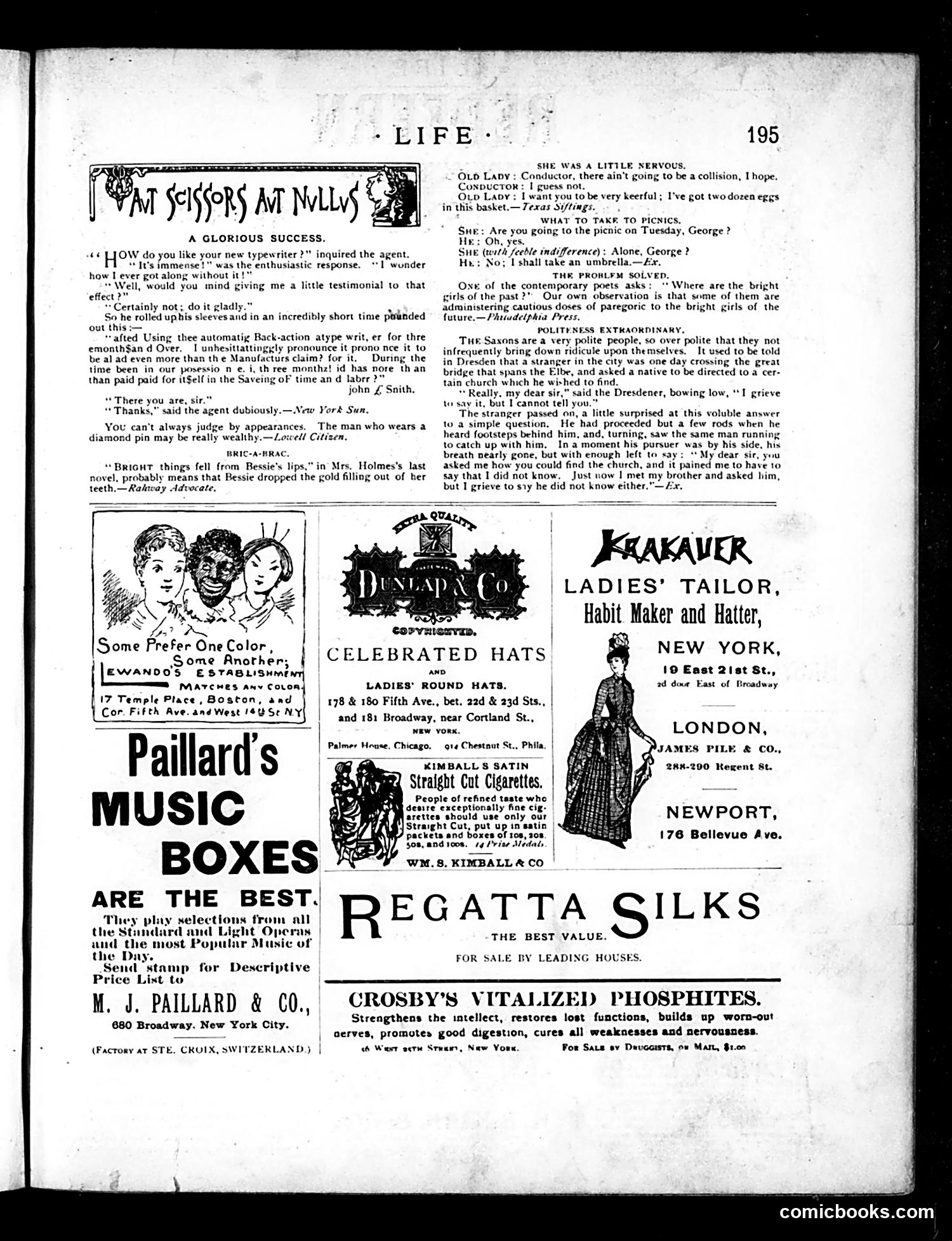
This page is primarily **advertising with short humorous anecdotes** rather than political cartoons. The main joke ("A Glorious Success") satirizes **typewriter testimonials**: a salesman asks a user for a endorsement, who then types one full of garbled errors and typos—ironically proving the machine *doesn't* work well. The humor lies in the unintended contradiction. Other brief items mock social pretension and absent-mindedness: a man wearing a diamond pin may not be wealthy; a nervous woman worries about eggs more than danger; a woman asks a man to a picnic "alone"; and an overly polite Saxon runs after a stranger to admit he still doesn't know the church location. The page is dominated by **period advertisements** for typewriters, music boxes, hats, cigarettes, silks, and phosphite tonics—typical of Life's revenue model. The small illustration shows three faces (unclear identity) related to the "prefer one color" advertisement. No identifiable political figures or events appear.
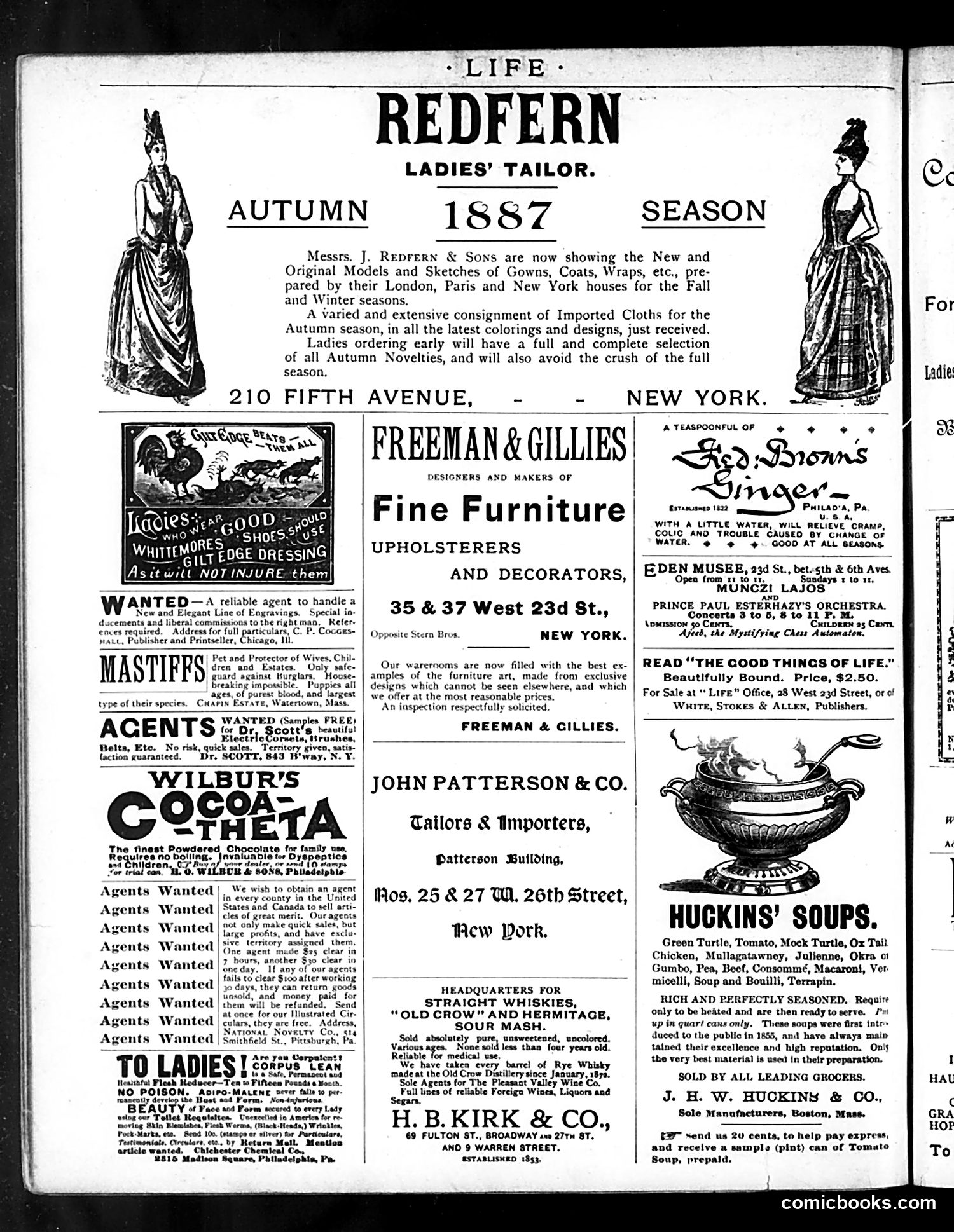
This page is primarily **a collection of advertisements** with no visible political cartoons or satirical content requiring historical explanation. The ads reflect 1887 consumer culture: ladies' fashion (Redfern tailoring), furniture, whiskey, chocolate, and various patent remedies targeting women—including a "Flesh Reducer" and skin treatments claiming to remove blemishes and "flesh worms." These dubious beauty products exemplify the era's unregulated patent medicine market. Notable is the prevalence of "Agents Wanted" advertisements, suggesting aggressive direct-sales recruitment was common. The whiskey ads emphasize age and purity ("sold absolutely pure, unsweetened, uncolored"), reflecting post-Civil War quality concerns. The page offers social history—consumer goods, marketing tactics, and beauty standards of the 1880s—rather than satirical commentary requiring modern context.
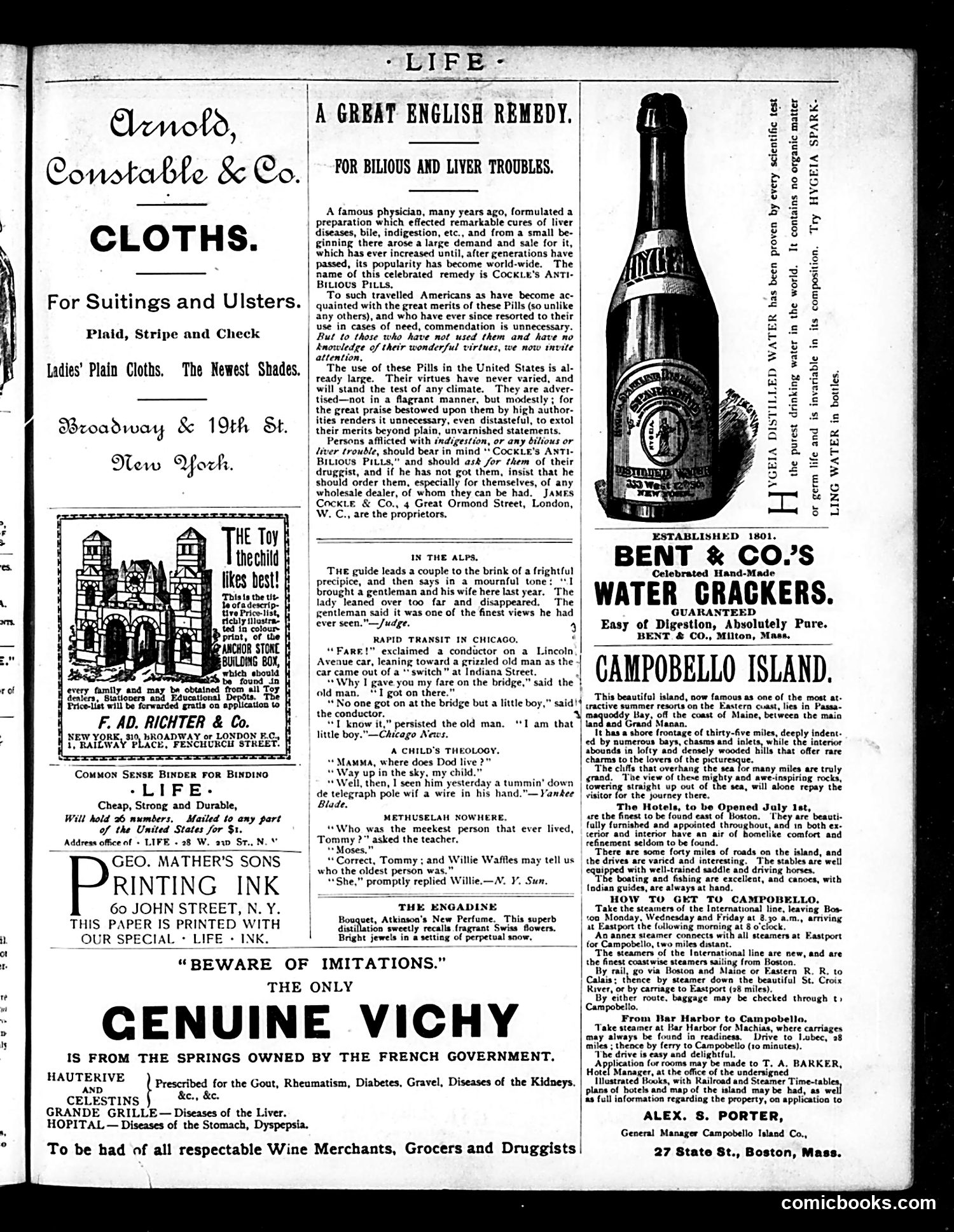
This page is predominantly **advertising**, with minimal satirical content. The cartoons present are brief, mild humor pieces: **"In the Alps"**: A dark joke about a tour guide whose female client fell to her death—yet the widower praised the view. The satire mocks male obliviousness and callousness. **"Rapid Transit in Chicago"**: A conductor-versus-passenger dispute over fare payment. The joke relies on the old man's confused claim he paid at a bridge (he didn't board there), exploiting common transit confusion for humor. **"A Child's Theology"**: A child's innocent misunderstanding—seeing God as a workman on a telegraph pole. Light religious satire through childish literalism. The page is otherwise filled with **period advertisements**: Cockle's Anti-Bilious Pills (a British remedy), Bent & Co.'s Water Crackers, Campobello Island tourism, clothing, and French Vichy water. These ads reveal late-19th-century commercial and health concerns, particularly patent medicines' prominence in American publications.
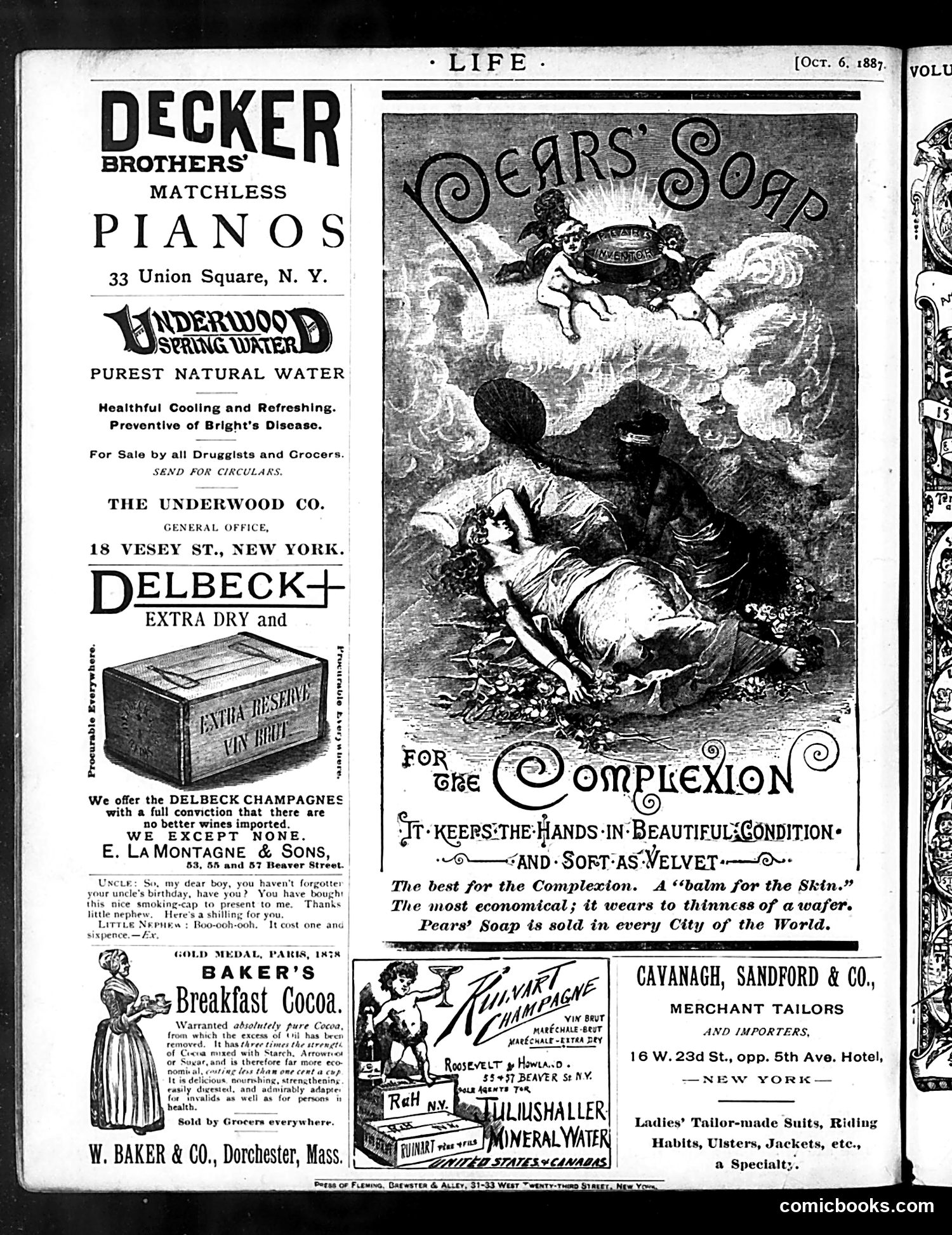
This page is primarily **advertising**, not political satire. It contains commercial notices for luxury goods typical of late 19th-century American markets: pianos, spring water, champagne, cocoa, soap, and tailoring services. The one narrative element is a small joke between an uncle and nephew about a birthday gift. The uncle expects an expensive present but receives only an inexpensive smoking cap costing one shilling and sixpence. The child's tearful response ("Boo-ooh-ooh") suggests either disappointment at giving so little or shame at the uncle's implied ingratitude. The advertisements emphasize genteel consumption—Pears' Soap promises beauty, Baker's Cocoa advertises purity and health benefits, Delbeck Champagne claims superiority. These reflect Victorian-era marketing strategies targeting middle and upper-class consumers through appeals to refinement, health, and status. The page reveals period attitudes about consumption and social aspiration rather than political commentary.