
Life, 1887-10-06 · page 2 of 16
Life — October 6, 1887 — page 2: what you’re looking at
What you’re looking at
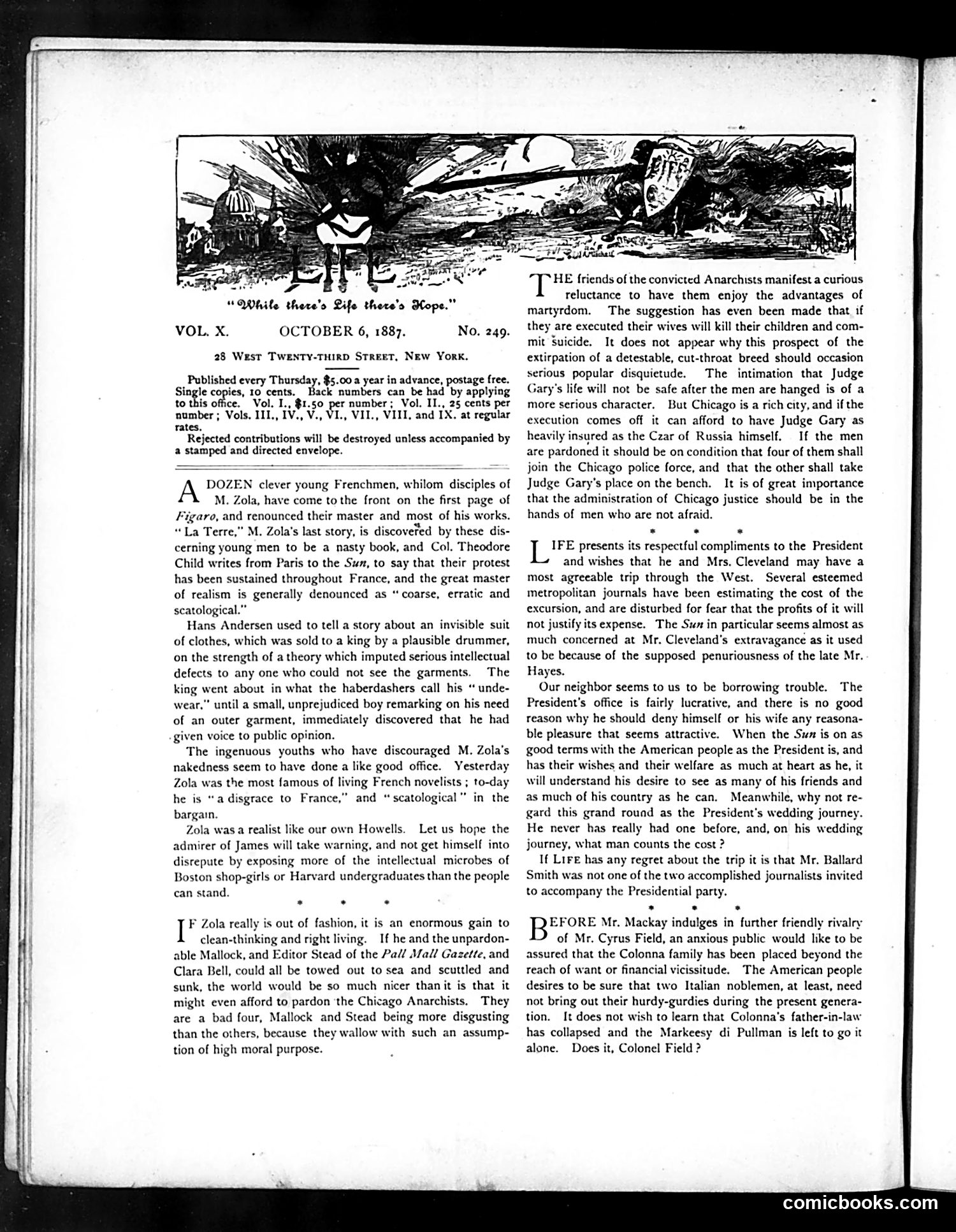
The masthead cartoon depicts anarchists or revolutionaries amid chaos—explosions, violence, and destruction. The accompanying text discusses convicted anarchists facing execution, debating whether their wives should be killed alongside them as "martyrdom." The satire mocks both the anarchists' ideology and public anxiety about them. Below, the editorial critiques French novelist Émile Zola's declining reputation. It sarcastically suggests that if realistic, socially-conscious literature goes "out of fashion," society could tolerate mediocre writers like James and Howells instead. The piece attacks Chicago editors Malloch and Stead (of the *Pall Mall Gazette*) for their moral self-righteousness while producing inferior work. The page also comments on President Cleveland's western tour and Italian nobility visiting America.
📄 Transcribed text from this page (OCR, searchable)
Machine-transcribed from the original scan — historical spelling and the odd misread are preserved.
aes \ “OWMhile there's Life there's Hope.” VOL. x. OCTOBER 6, 1887. 28 West TWENTY-THIRD STREET, New York. No. 249. Published every Thursday, $5.00 a year in advance, postage free. Single copies, 10 cents. ick numbers can be had by applying to this office. Vol. I., $1.50 per number; Vol. II., 25 cents per I, VIL, VIIL, and IX. at regular number ; Vols. III,, IV., V., rates, Rejected contributions will be destroyed unless accompanied by a stamped and directed envelope. N clever young Frenchmen, whilom disciples of . Zola, have come tothe front on the first page of Figaro, and renounced their master and most of his works. “La Terre,” M. Zola’s last story, is discovered by these dis- cerning young men to be a nasty book, and Col. Theodore Child writes from Paris to the Sum, to say that their protest has been sustained throughout France, and the great master of realism is generally denounced as “coarse, erratic and scatological.”” Hans Andersen used to tell a story about an invisible suit of clothes, which was sold to a king by a plausible drummer, on the strength of a theory which imputed serious intellectual defects to any one who could not see the garments. The king went about in what the haberdashers call his “ unde- wear,” until a small, unprejudiced boy remarking on his need of an outer garment, immediately discovered that he had given voice to public opinion. The ingenuous youths who have discouraged M. Zola’s nakedness seem to have done a like good office. Yesterday Zola was the most famous of living French novelists ; to-day he is “adisgrace to France,” and “ scatological" in the bargain. Zola was a realist like our own Howells. Let us hope the admirer of James will take warning, and not get himself into disrepute by exposing more of the intellectual microbes of Boston shop-girls or Harvard undergraduates than the people can stand. . . . F Zola really is out of fashion, it is an enormous gain to clean-thinking and right living. If he and the unpardon- able Mallock, and Editor Stead of the Pail Mall Gazette, and Clara Bell, could all be towed out to sea and scuttled and sunk, the world would be so much nicer thanit is that it might even afford to pardon ‘the Chicago Anarchists. They are a bad four, Mallock and Stead being more disgusting than the others, because they wallow with such an assump- tion of high moral purpose. HE friends of the convicted Anarchists manifest a curious reluctance to have them enjoy the advantages of martyrdom. The suggestion has even been made that if they are executed their wives will kill their children and com- mit Suicide. It does not appear why this prospect of the extirpation of a detestable, cut-throat breed should occasion serious popular disquietude. The intimation that Judge Gary's life will not be safe after the men are hanged is of a more serious character. But Chicago is a rich city, and if the execution comes off it can afford to have Judge Gary as heavily insured as the Czar of Russia himself. If the men are pardoned it should be on condition that four of them shall join the Chicago police force, and that the other shall take Judge Gary's place on the bench. It is of great importance that the administration of Chicago justice should be in the hands of men who are not afraid. . . . IFE presents its respectful compliments to the President and wishes that he and Mrs. Cleveland may have a most agreeable trip through the West. Several esteemed metropolitan journals have been estimating the cost of the excursion, and are disturbed for fear that the profits of it will not justify its expense. The Suv in particular seems almost as much concerned at Mr. Cleveland's extravagance as it used to be because of the supposed penuriousness of the late Mr. Hayes. Our neighbor seems to us to be borrowing trouble. The President's office is fairly lucrative, and there is no good reason why he should deny himself or his wife any reasona- ble pleasure that seems attractive. When the Sua is on as good terms with the American people as the President is, and has their wishes and their welfare as much at heart as he, it will understand his desire to see as many of his friends and as much of his country as he can. Meanwhile, why not re- gard this grand round as the President's wedding journey. He never has really had one before, and, on his wedding journey, what man counts the cost ? If Lire has any regret about the trip it is that Mr. Ballard Smith was not one of the two accomplished journalists invited to accompany the Presidential party. . . . EFORE Mr. Mackay indulges in further friendly rivalry of Mr. Cyrus Field, an anxious public would like to be assured that the Colonna family has been placed beyond the reach of want or financial vicissitude. The American people desires to be sure that two Italian noblemen, at least, need not bring out their hurdy-gurdies during the present genera- tion. It does not wish to learn that Colonna’s father-in-law has collapsed and the Markeesy di Pullman is left to go it alone. Does it, Colonel Field ? comicbooks.com >