
Life, 1887-10-06 · page 6 of 16
Life — October 6, 1887 — page 6: what you’re looking at
What you’re looking at
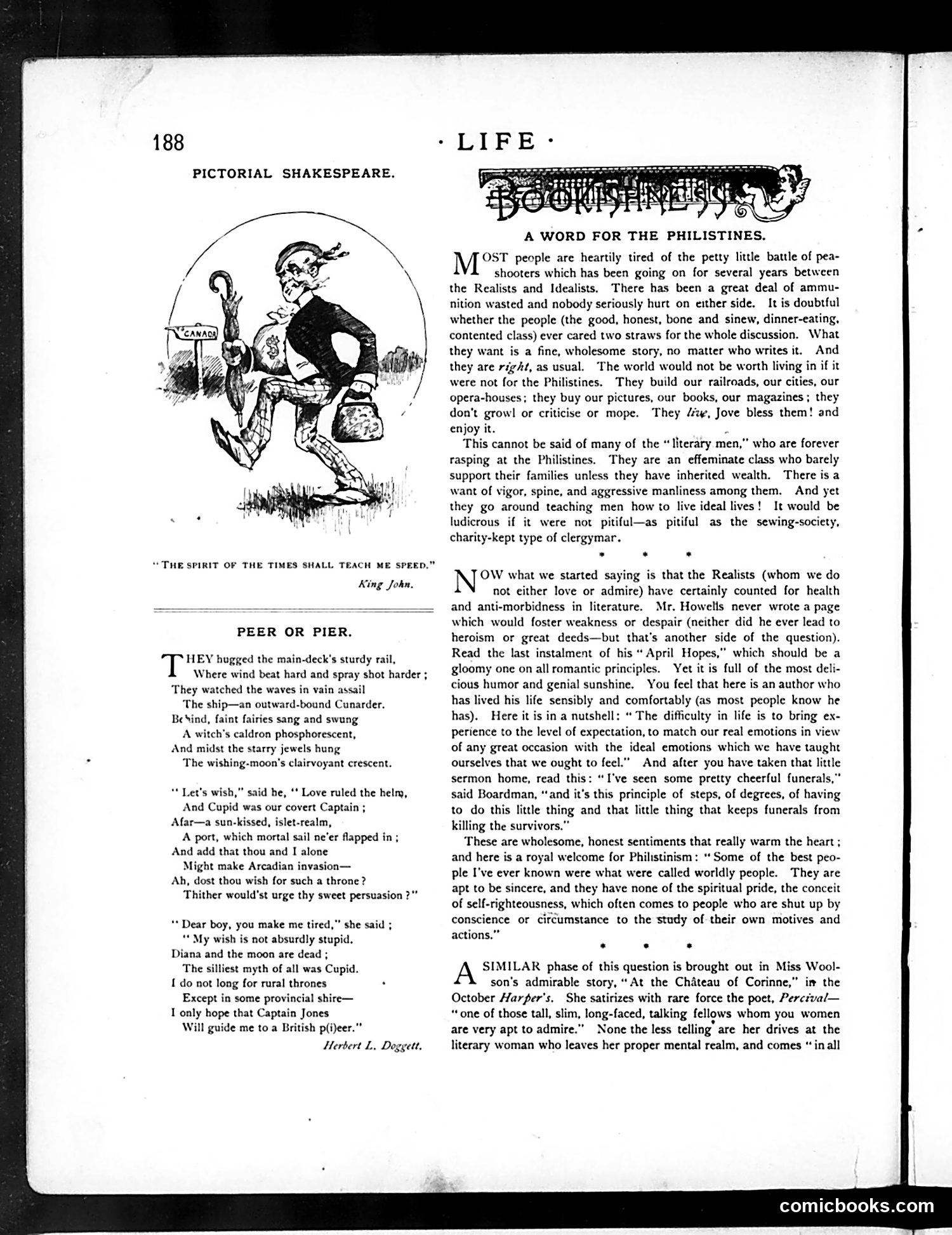
The page contains two sections: a cartoon titled "Pictorial Shakespeare" and a poem titled "Peer or Pier." **The Cartoon:** Shows a caricatured figure in exaggerated pose, apparently satirizing pretentious behavior. The specific identity of the figure is unclear from the image alone, though the title suggests it parodies Shakespeare references or classical allusions. **The Text Content:** The articles critique two groups—"Realists" and "Idealists" in literature, and "literary men" who criticize popular culture (the "Philistines"). The author argues against intellectuals who disparage common people's entertainment preferences (railroads, opera, magazines, pictures). The piece defends the "Philistines" as honest, hardworking people entitled to simple pleasures without condescension from literary elites. The satire targets intellectual snobbery and class-based cultural gatekeeping.
📄 Transcribed text from this page (OCR, searchable)
Machine-transcribed from the original scan — historical spelling and the odd misread are preserved.
188 PICTORIAL SHAKESPEARE. “THE SPIRIT OF THE TIMES SHALL TEACH ME SPEED.” King John. PEER OR PIER. HEY hugged the main-deck’s sturdy rail, Where wind beat hard and spray shot harder ; They watched the waves in vain assail ‘The ship—an outward-bound Cunarder. Be Sind, faint fairies sang and swung A witch's caldron phosphorescent, And midst the starry jewels hung The wishing-moon’s clairvoyant crescent. “* Let's wish,” said he, * Love ruled the helm, And Cupid was our covert Captain ; Afar—a sun-kissed, islet-realm, A port, which mortal sail ne'er flapped in; And add that thou and I alone Might make Arcadian invasion— Ah, dost thou wish for such a throne? Thither would'st urge thy sweet persuasion ?” ** Dear boy, you make me tired,” she said ; “* My wish is not absurdly stupid. Diana and the moon are dead ; The silliest myth of all was Cupid. 1 do not long for rural thrones Except in some provincial shire— I only hope that Captain Jones Will guide me to a British p(ieer."” Herbert L, Doggett, A WORD FOR THE PHILISTINES. OST people are heartily tired of the petty little battle of pea- shooters which has been going on for several years between the Realists and Idealists. There has been a great deal of ammu- nition wasted and nobody seriously hurt on either side. It is doubtful whether the people (the good, honest, bone and sinew, dinner-eating, contented class) ever cared two straws for the whole discussion. What they want is a fine, wholesome story, no matter who writes it. And they are right, as usual. The world would not be worth living in if it were not for the Philistines. They build our railroads, our cities, our opera-houses; they buy our pictures, our books, our magazines; they don’t growl or criticise or mope. They /, Jove bless them! and enjoy it. 7 This cannot be said of many of the “literary men,” who are forever rasping at the Philistines. They are an effeminate class who barely support their families unless they have inherited wealth. There is a want of vigor, spine, and aggressive manliness among them. And yet they go around teaching men how to live ideal lives! It would be ludicrous if it were not pitiful—as pitiful as the sewing-society, charity-kept type of clergymar. OW what we started saying is that the Realists (whom we do not either love or admire) have certainly counted for health and anti-morbidness in literature. Mr. Howells never wrote a page which would foster weakness or despair (neither did he ever lead to heroism or great deeds—but that’s another side of the question). Read the last instalment of his “ April Hopes,” which should be a gloomy one on all romantic principles. Yet it is full of the most deli- cious humor and genial sunshine. You feel that here is an author who has lived his life sensibly and comfortably (as most people know he has). Here it is in a nutshell: “ The difficulty in life is to bring ex- perience to the level of expectation, to match our real emotions in view of any great occasion with the ideal emotions which we have taught ourselves that we ought to feel.” And after you have taken that little sermon home, read this: “I've seen some pretty cheerful funerals,” said Boardman, “and it's this principle of steps, of degrees, of having to do this little thing and that little thing that keeps funerals from killing the survivors.” These are wholesome, honest sentiments that really warm the heart; and here is a royal welcome for Philistinism: Some of the best peo- ple I've ever known were what were called worldly people. They are apt to be sincere, and they have none of the spiritual pride, the conceit of self-righteousness, which often comes to people who are shut up by conscience or circumstance to the study of their own motives and actions.” . . . SIMILAR phase of this question is brought out in Miss Wool- son's admirable story, “At the Chateau of Corinne,” im the October Harper's. She satirizes with rare force the poet, Percéval— “one of those tall, slim, long-faced, talking fellows whom you women are very apt to admire.” None the less telling are her drives at the literary woman who leaves her proper mental realm, and comes “in all comicbooks.com