
A complete issue · 16 pages · 1887
Life — September 15, 1887
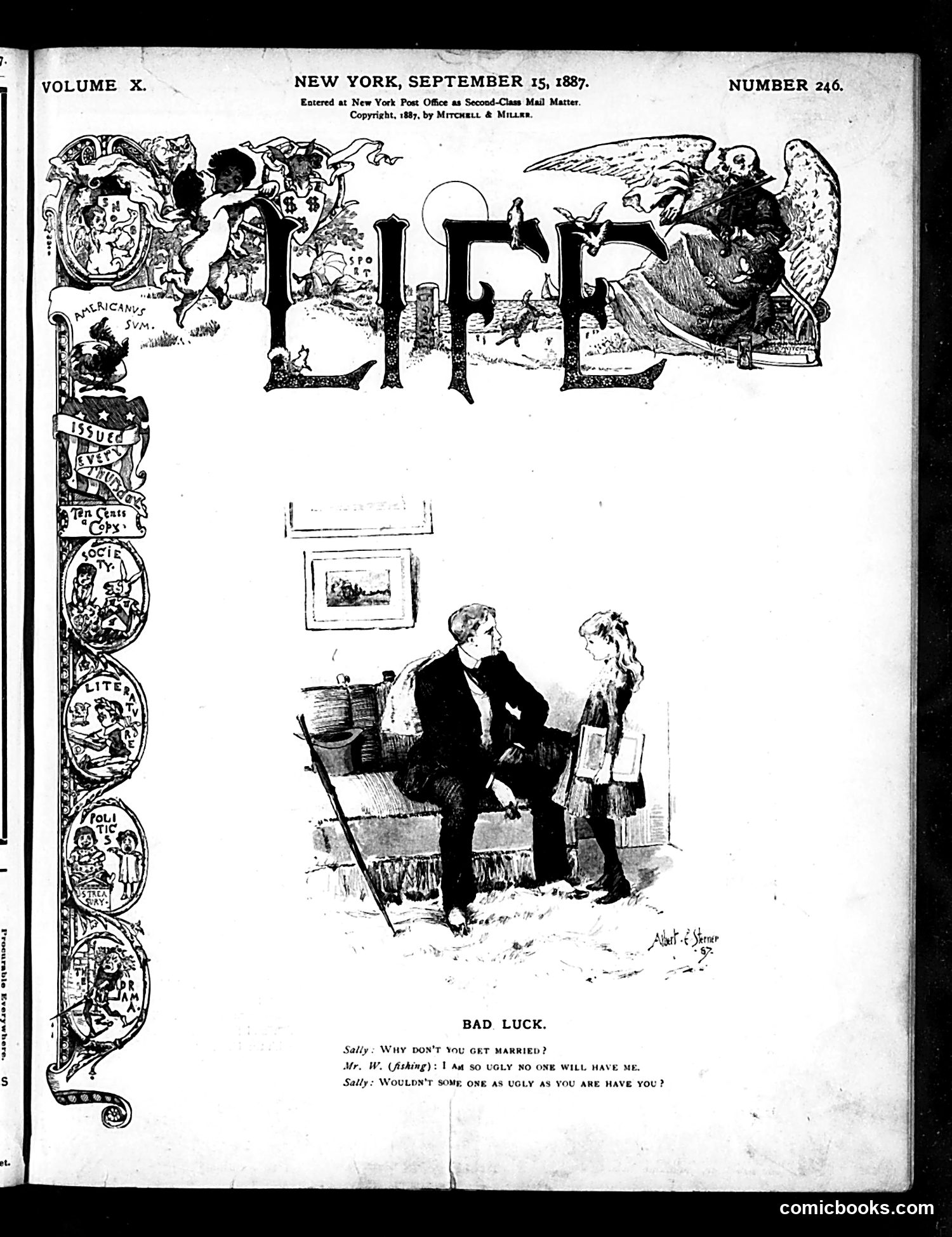
This cartoon satirizes an unmarried man's romantic failures. The dialogue presents a domestic scene where a woman (Sally) asks Mr. W. why he won't marry. His response—"I am so ugly no one will have me"—prompts Sally's cutting reply: "Wouldn't some one as ugly as you are have you?" The humor relies on the era's conventional mockery of physical appearance and romantic prospects. The cartoon suggests that even someone as unattractive as Mr. W. should be able to find a similarly plain partner, yet apparently cannot. It's gentle social satire about bachelorhood and the period's assumptions about marriage being achievable for anyone willing to lower standards sufficiently. The artist is credited as Albert E. Sterner.
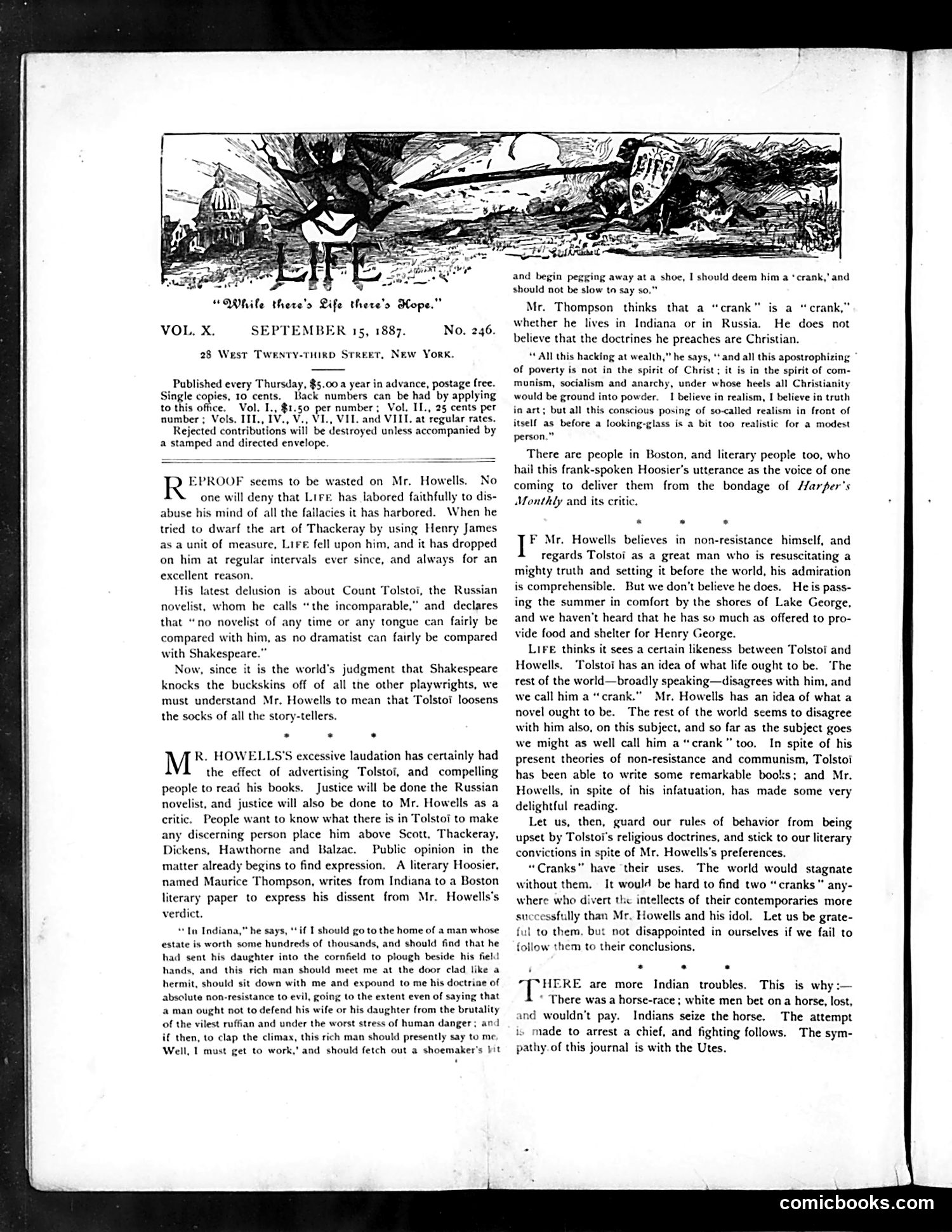
The cartoon's header reads "Where there's Life there's Hope," depicting what appears to be a skeletal or death-like figure amid a chaotic landscape with buildings and destruction. The accompanying text discusses Mr. Howells (likely William Dean Howells, the prominent American novelist and critic) and his literary views, particularly his admiration for Tolstoy and theories of non-resistance. The satire criticizes Howells for excessive praise of Russian writer Leo Tolstoy and his pacifist doctrines, which the *Life* editors view as impractical and detached from reality. The text mocks Howells's literary judgments and suggests his ideas about non-resistance are unrealistic, contrasting his comfortable Boston position with actual human suffering and practical survival needs.
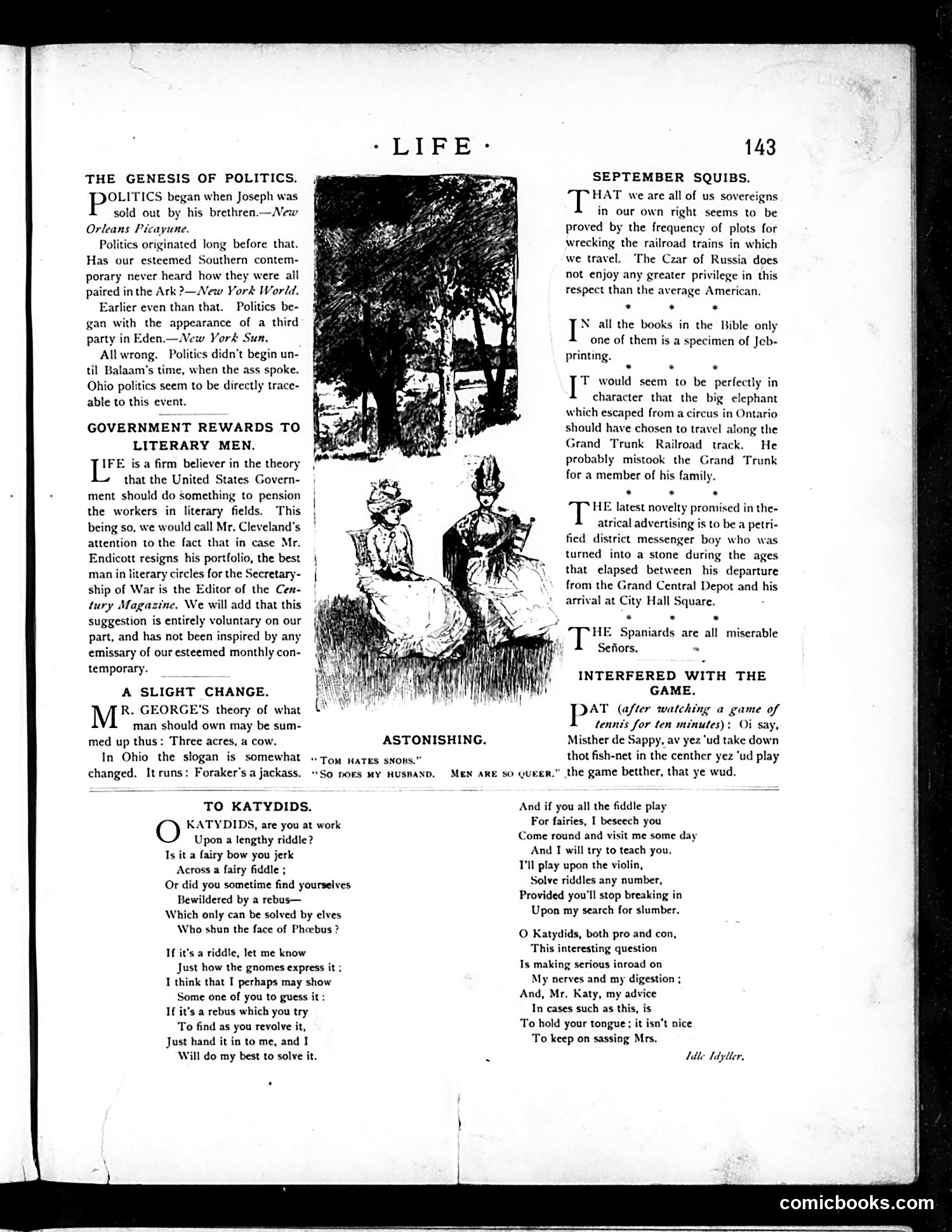
The central cartoon depicts two figures in conversation. The male figure (left) appears to be a husband, while the female figure (right, wearing a crown-like hat) is labeled "Mrs. de Sappy" in the accompanying text. The joke, titled "ASTONISHING," plays on gender stereotypes about marriage: the husband complains "Tom hates snobs" while the wife responds "So does my husband"—implying either that the husband contradicts himself or that the wife doesn't recognize her own husband's stated position. This satirizes the miscommunication or inattention common in marriages. The surrounding text includes short satirical pieces on politics, government, and social observations typical of Life magazine's commentary style, though these are separate from the main cartoon's humor.
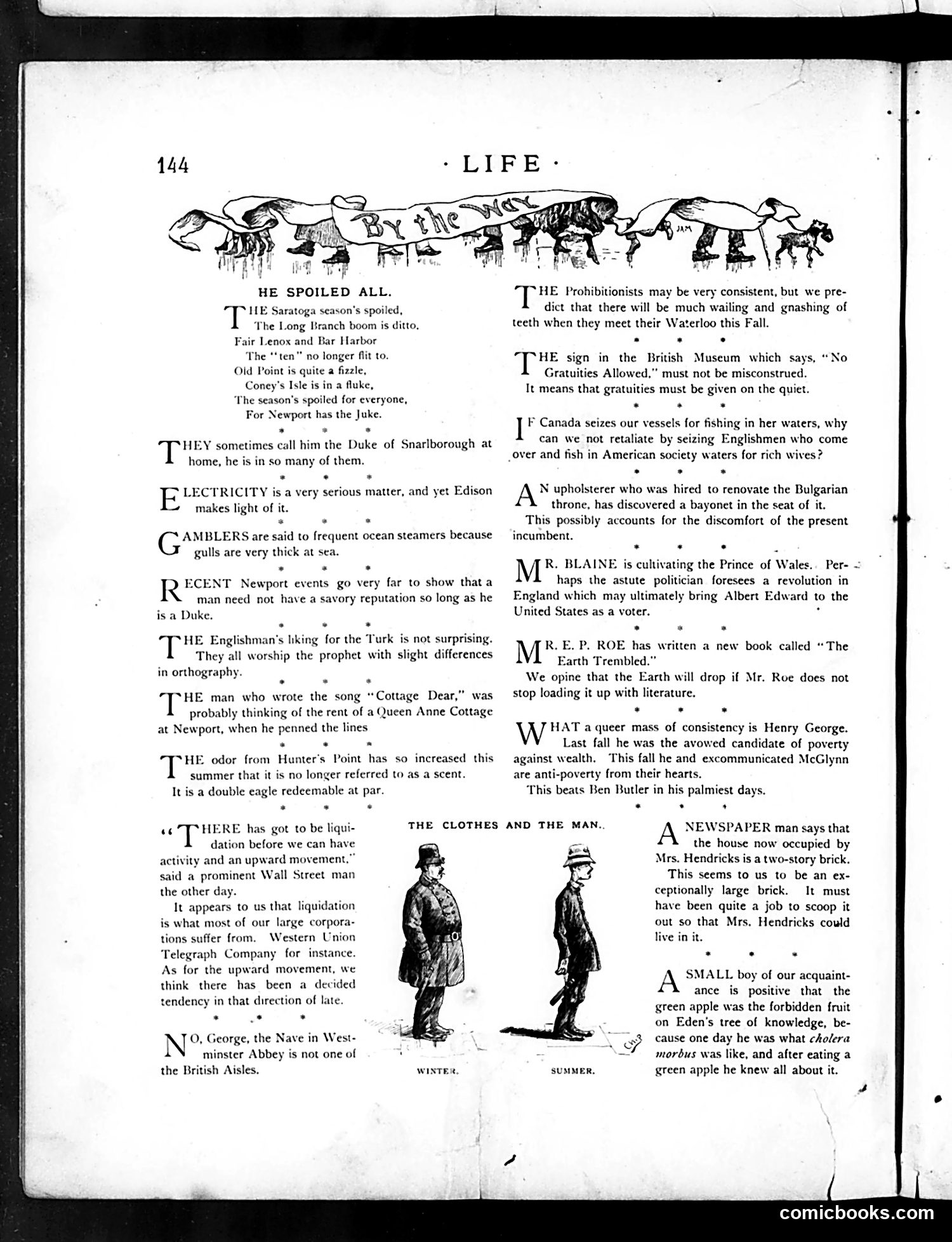
This page contains satirical commentary on contemporary issues rather than political cartoons. The main illustrated item, "The Clothes and the Man," shows two figures in winter and summer dress—a visual joke about how clothing transforms appearance. The text items mock various targets: Prohibitionists facing future resistance, a Canadian fishing dispute, a Bulgarian throne renovation discovery, and Henry George's political consistency despite poverty advocacy. One prominent item references "Mr. Blaine cultivating the Prince of Wales," suggesting political maneuvering. Another mocks Mr. E.P. Roe's book "The Earth Trembled." The satire focuses on social hypocrisy, political inconsistency, and contemporary news absurdities rather than depicting specific named individuals in caricature. The humor relies on readers' familiarity with contemporary figures and events from what appears to be the late 19th century.
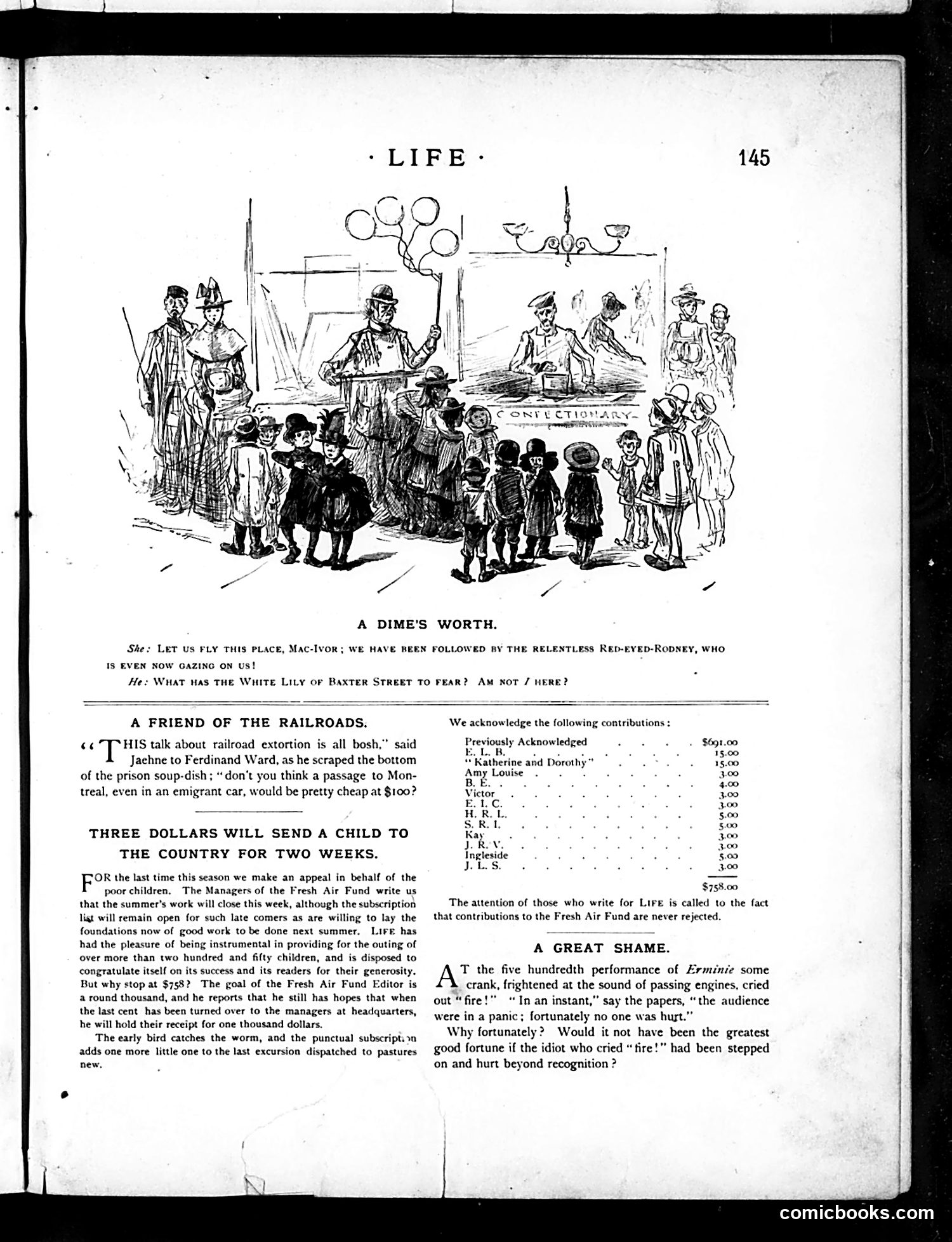
**"A Dime's Worth"** cartoon depicts a street confectionary or candy stand surrounded by children and vendors. The dialogue references "Red-eyed Rodney" and "White Lily of Baxter Street"—likely popular theatrical characters of the era, suggesting this satirizes sensational melodrama consumed by working-class audiences. **"A Friend of the Railroads"** presents dialogue mocking railroad expansion costs, with a character dismissing concerns about expensive rail projects. **"Three Dollars Will Send a Child to the Country"** is a charitable appeal for the Fresh Air Fund, requesting donations to send poor urban children to rural areas for summer respite—a genuine Progressive-era social welfare initiative. **"A Great Shame"** describes a theater mishap during a performance of *Erminie*, where an actor's frightened cry during an engine noise caused panic, nearly injuring an audience member.
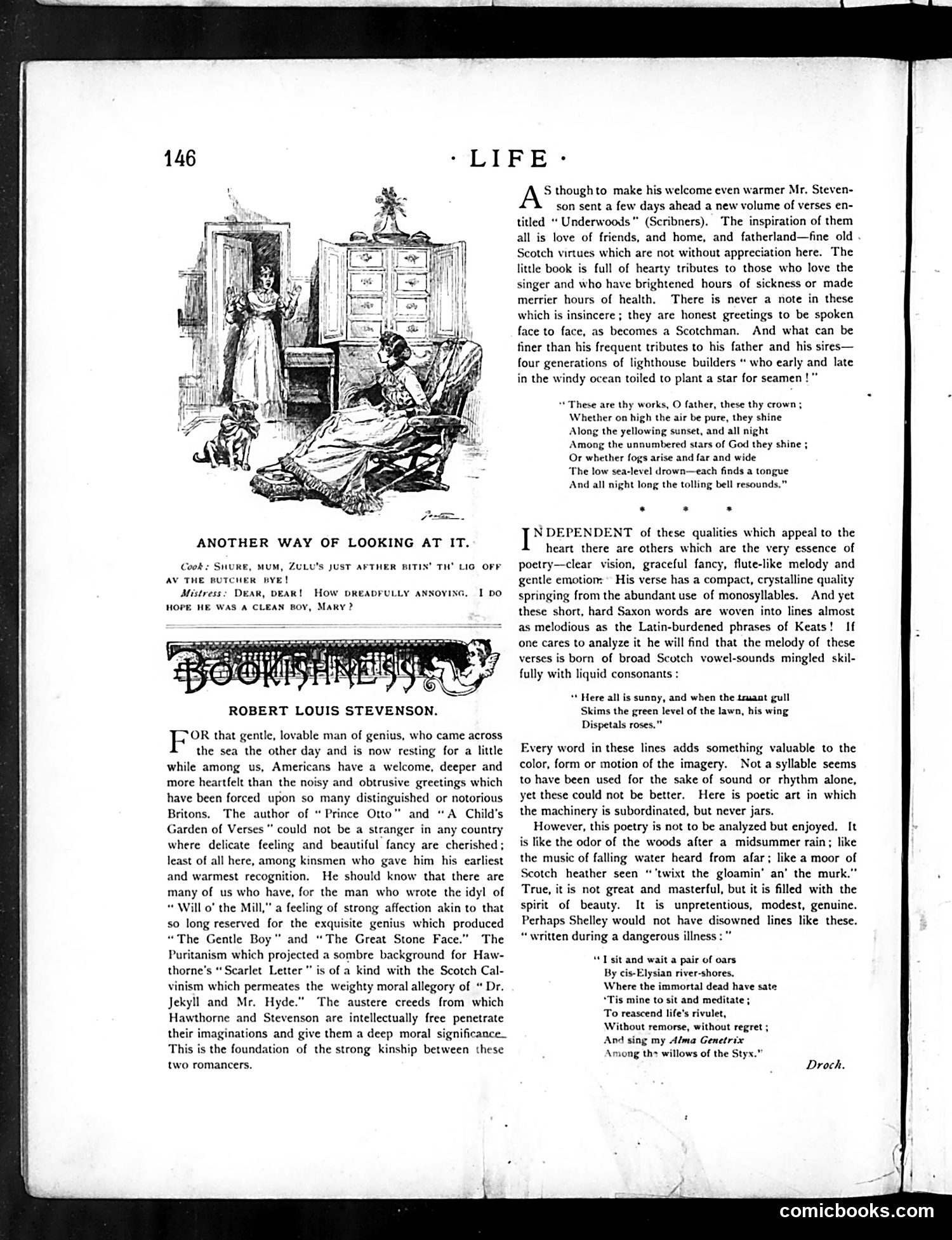
This cartoon satirizes domestic service dynamics in the Victorian era. The scene shows a mistress discovering her maid has removed her wig—a humorous reversal of power and dignity. The dialogue reveals the joke's social commentary: the servant (Mary) notes the mistress (Zulu) looks like "a clean boy" without her wig, implying her appearance depends entirely on artifice. The maid's cheek in making this observation—comparing her employer unfavorably to a boy—represents a moment of unexpected leveling between classes. The title suggests an alternative perspective on social hierarchy: stripping away appearances (literal and figurative) reveals uncomfortable truths about status and vanity. It's gentle satire on how much Victorian women's authority relied on costume and presentation rather than genuine power.
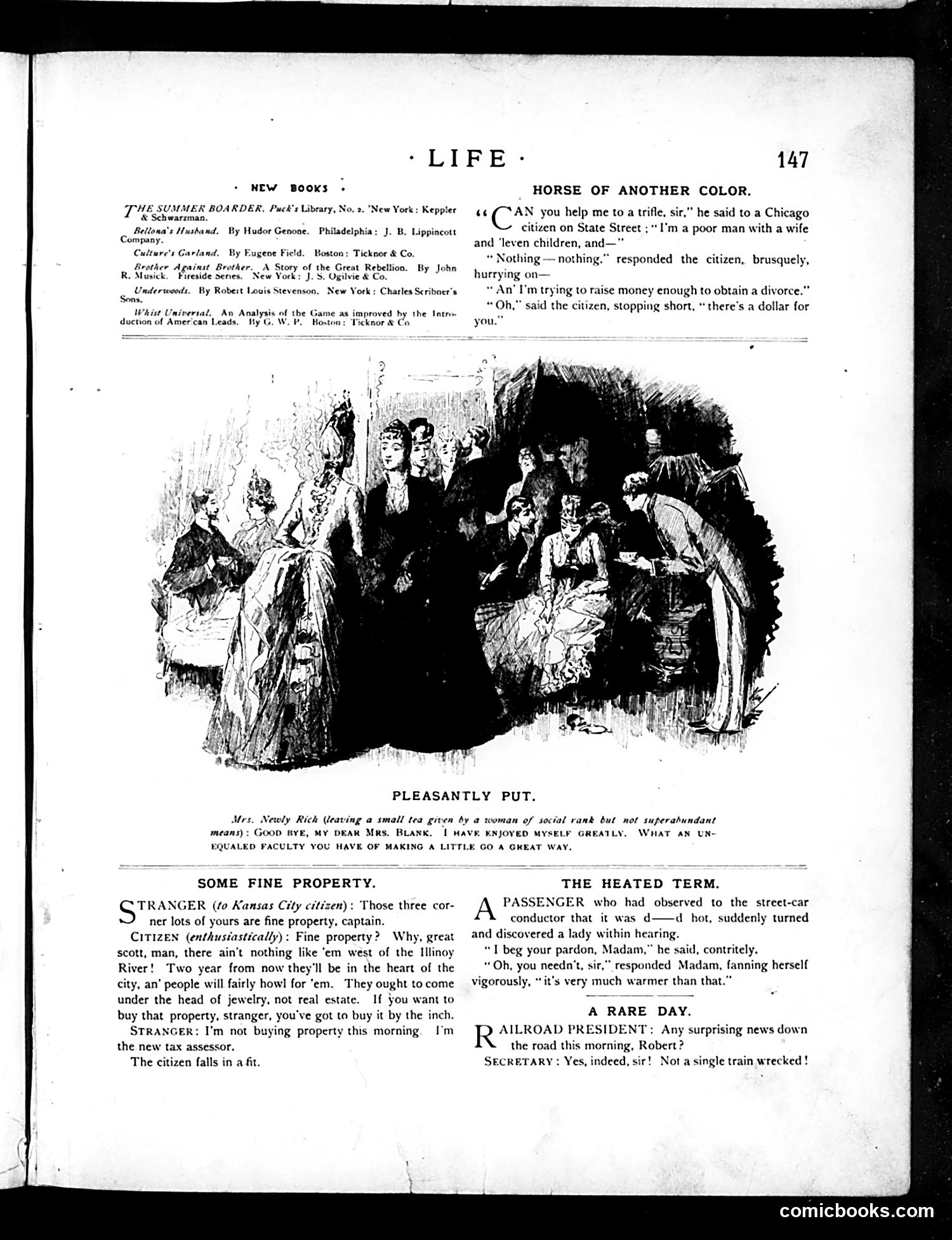
This sketch depicts a wealthy woman of "social rank" receiving a compliment from an inferior social class. The caption reveals the satire: she's praised for her "equaled faculty...of making a little go a great way" — a backhanded compliment suggesting she's skilled at being stingy while maintaining appearances. The accompanying dialogues mock urban social interactions. "Some Fine Property" features a Kansas City citizen trying to sell expensive property while the tax assessor ironically falls in a fit — suggesting the absurdity of real-estate speculation. "The Heated Term" and "A Rare Day" are brief comedic exchanges about weather and railroad operations, offering gentle social humor about everyday life and class dynamics.
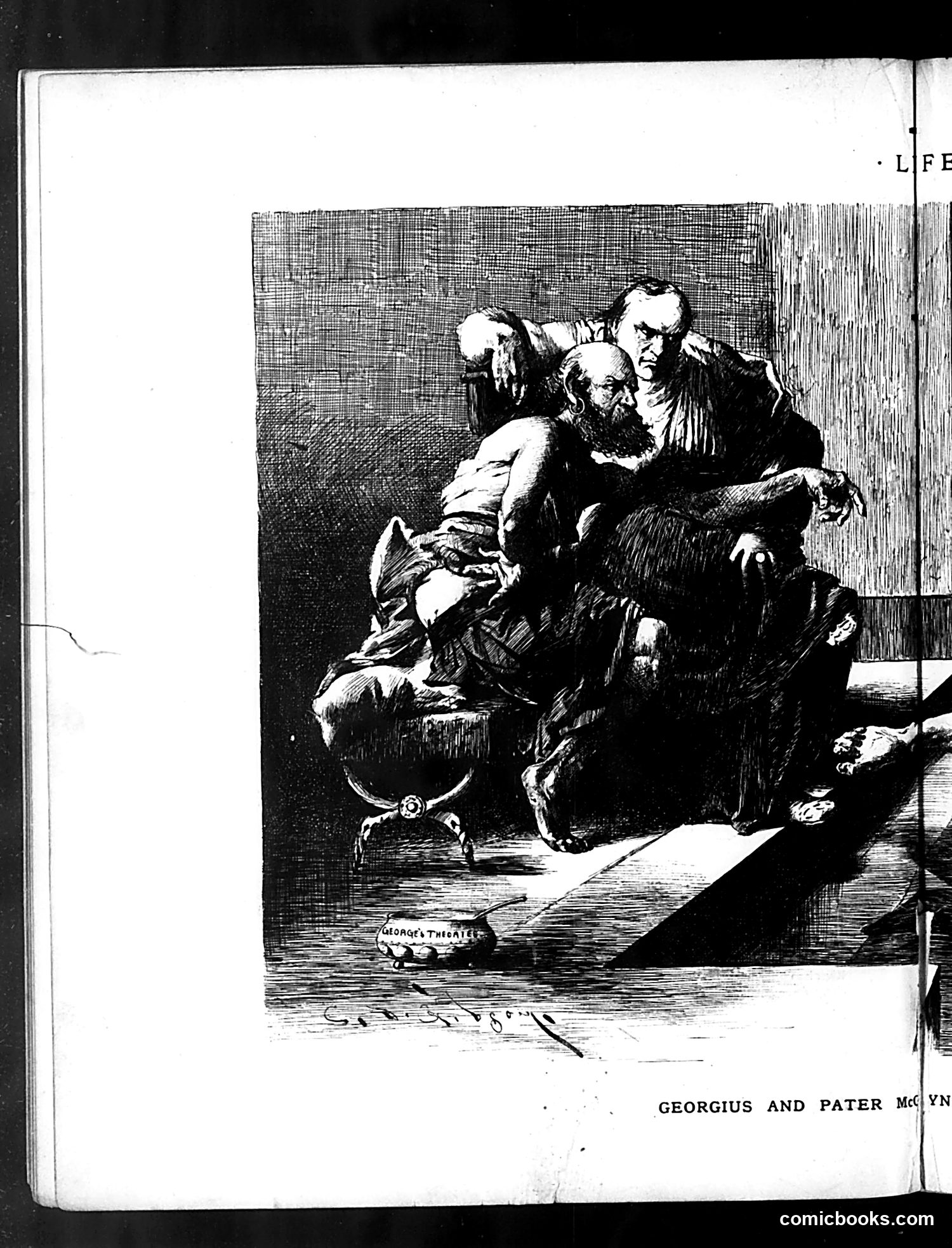
This etching depicts three figures in what appears to be a dramatic confrontation scene. The caption identifies them as "Georgius and Pater McCynn," though the full context of who these individuals represent is unclear from this page alone. The scene shows two men observing or accosting a third figure who appears to be in distress or a compromised position. The artistic style—a detailed black-and-white etching with heavy cross-hatching—suggests this is satirical commentary on specific contemporary figures or a political/social scandal of the period. Without additional context about the publication date or Life magazine's specific satirical targets, the exact meaning of this cartoon remains uncertain, though the dramatic staging suggests it mocked a notable public incident or personality conflict.
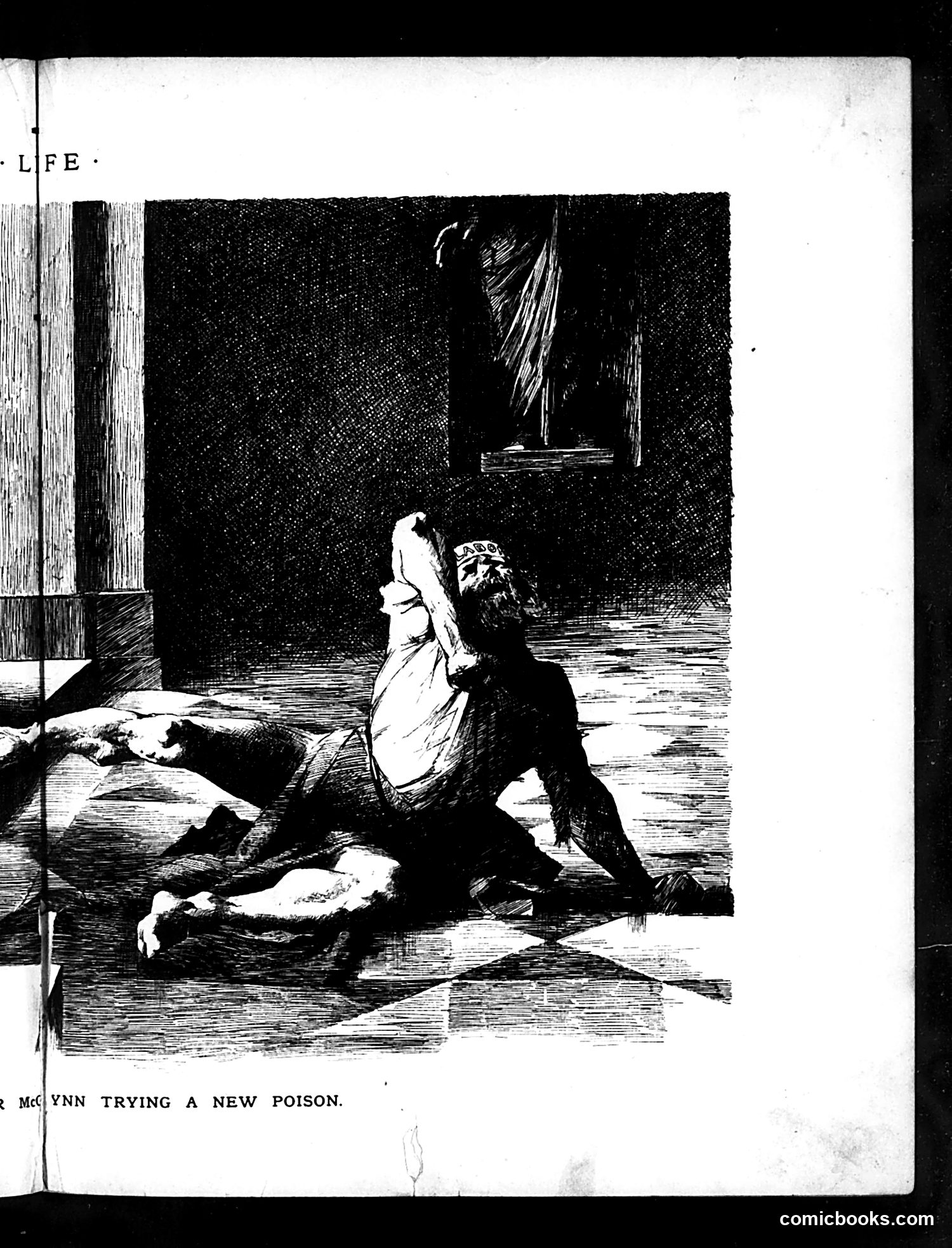
This political cartoon depicts a figure labeled McCann (likely a political or public figure from Life magazine's era) attempting to administer poison to someone. The scene shows a dark interior space with the perpetrator in period dress leaning over a victim on the ground. The satire appears to reference McCann's political schemes or policies characterized as harmful or "poisonous" to the public. Without additional context about which McCann this refers to or the specific historical period, the exact political grievance remains unclear. However, the metaphorical framing of political action as attempted poisoning was common in satirical publications of the era to convey that a figure's policies or actions were dangerous to society.
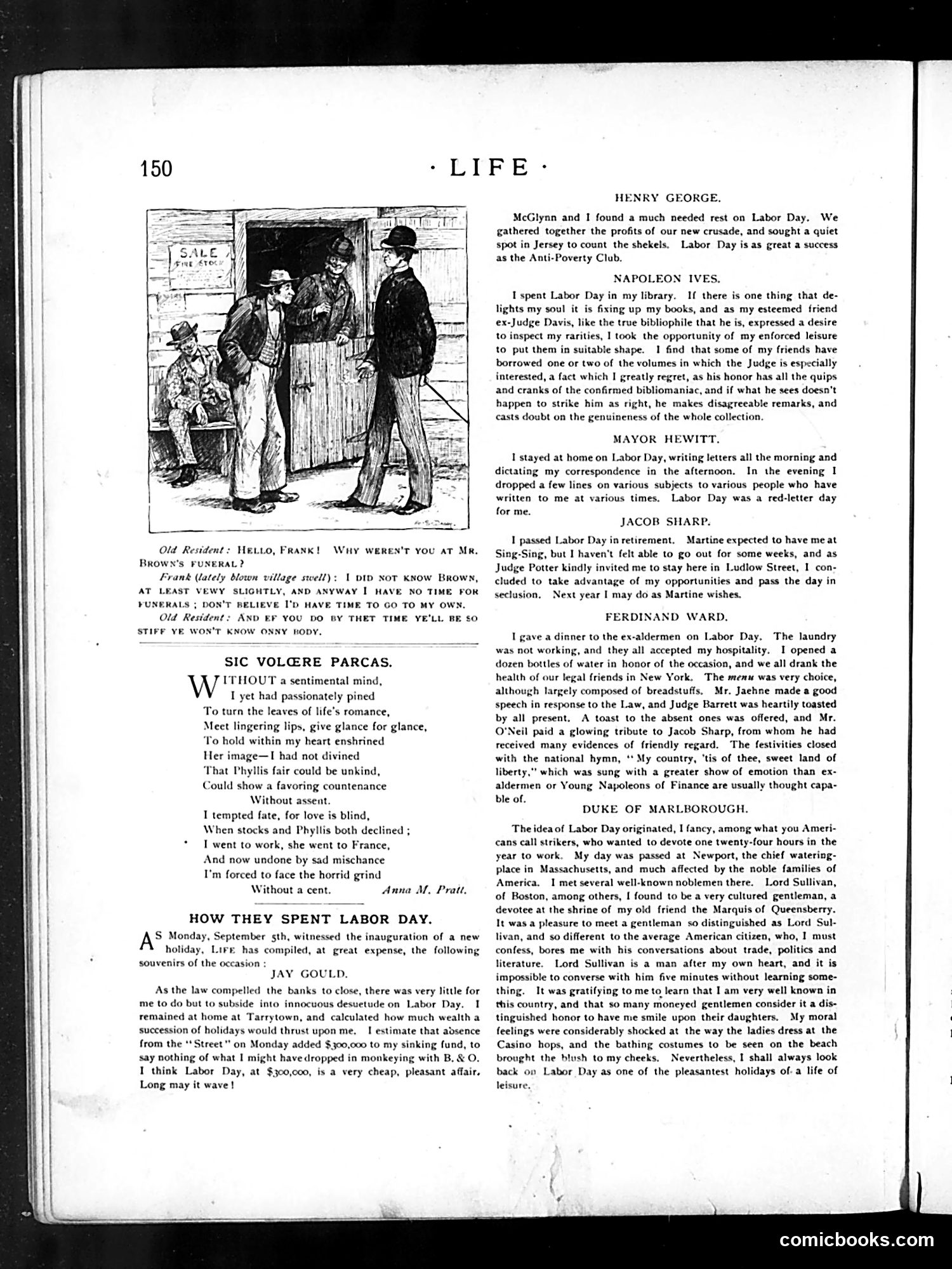
The cartoon depicts a street scene with men in period dress (appearing to be late 1800s) outside what looks like a funeral parlor. The dialogue between an "Old Resident" and "Frank" involves a crude joke: when asked why Frank isn't at Mr. Brown's funeral, Frank claims not to know Brown and lacks time for funerals—prompting the Old Resident to sarcastically suggest Frank will be dead soon enough to attend his own. The humor relies on dark irony about mortality and social obligation. The surrounding text contains accounts of how various prominent citizens spent Labor Day (established as a U.S. holiday in 1894), suggesting this page satirizes both the pretensions of the wealthy and working-class observations about death and leisure.
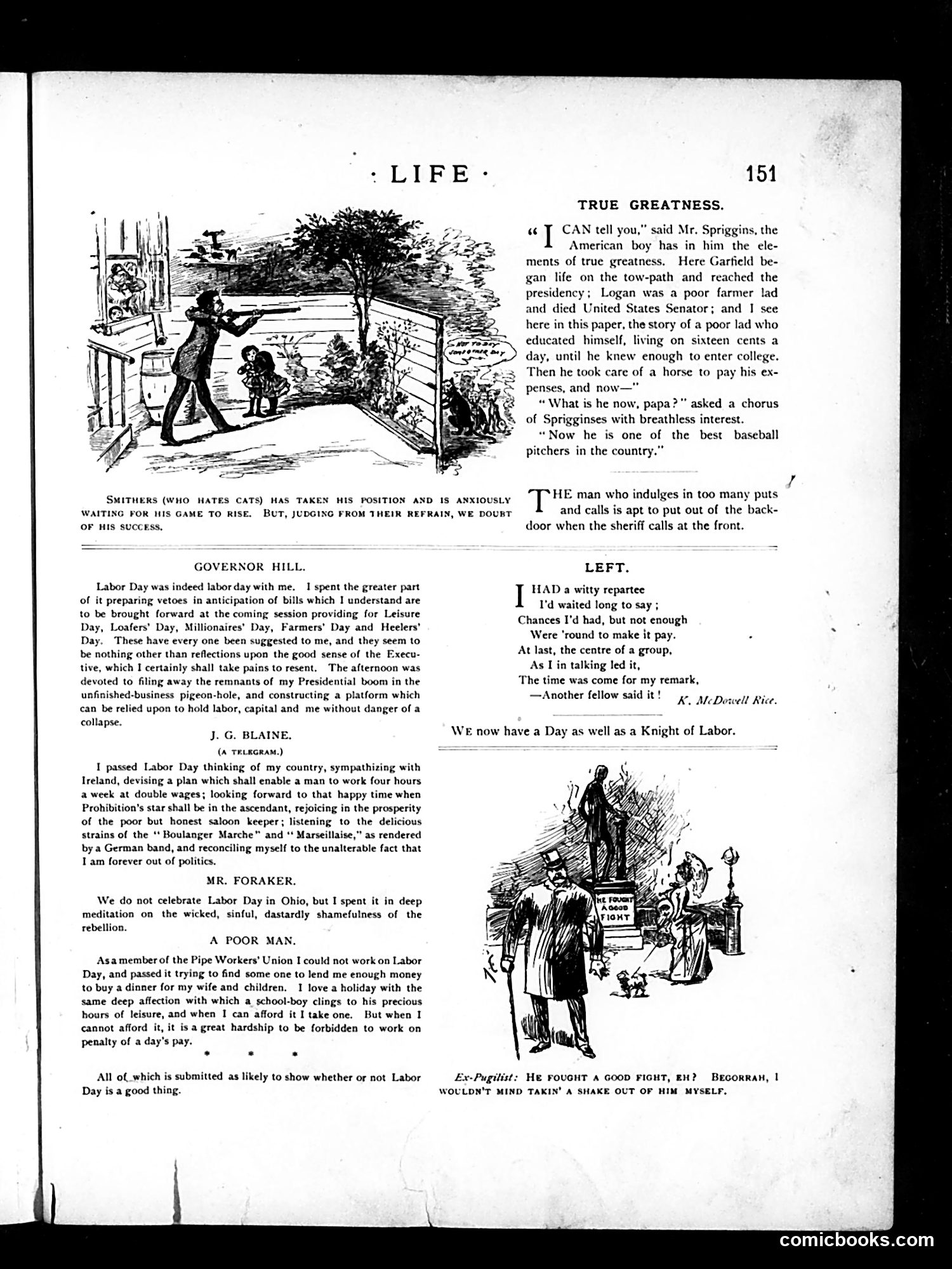
This page satirizes Labor Day through multiple perspectives. The top cartoon shows "Smithers" (a cat-hater) waiting anxiously while cats thwart his plans—likely metaphorizing labor disputes where workers ("cats") undermine management expectations. The main content presents mock statements from prominent politicians (Governor Hill, J.G. Blaine, Mr. Foraker) about Labor Day, each revealing their actual indifference or hostility toward labor causes. Hill dismisses labor-related bills as frivolous; Blaine rambles distractedly; Foraker broods on the Civil War rebellion instead. The "True Greatness" section mocks American rags-to-riches mythology: a boy's path from poverty to college culminates merely in becoming a baseball pitcher—deflating the supposed nobility of self-improvement. The final cartoon contrasts "A Knight of Labor" (labor movement advocate) with an ex-pugilist, suggesting organized labor leaders and working-class figures are barely distinguishable from street fighters. The overall satire: politicians exploit Labor Day rhetoric while harboring contempt for actual workers, and labor's "heroes" are unremarkable figures.
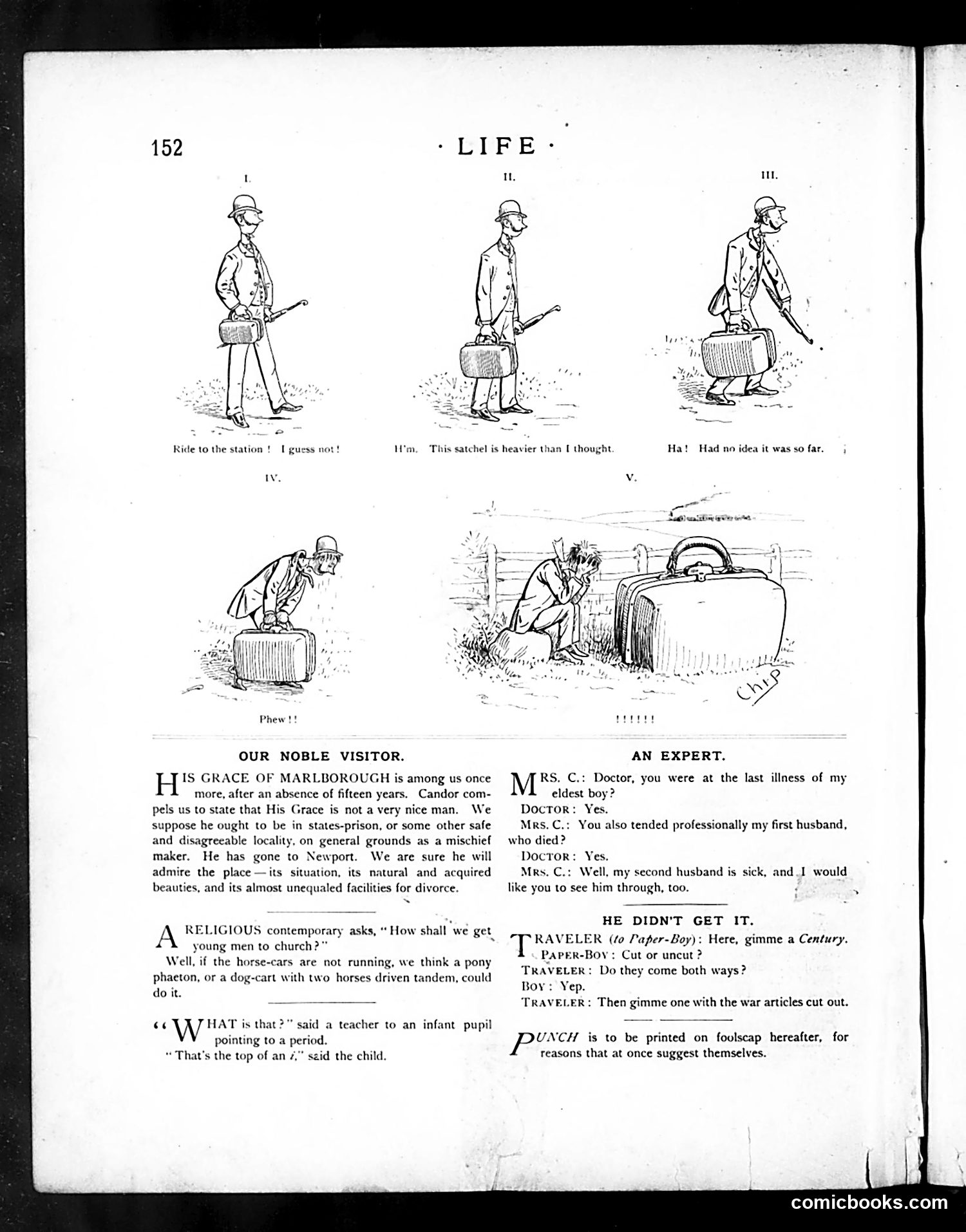
This five-panel comic satirizes a wealthy English aristocrat (the Duke of Marlborough, identified in the accompanying text) returning to America after fifteen years. The progression shows him arriving with increasingly burdensome luggage, culminating in him collapsing under its weight—a visual metaphor for the baggage of his notorious reputation. The accompanying article sarcastically welcomes him while making clear he's disreputable ("ought to be in states-prison"). The joke is that despite his unsavory character, he'll enjoy Newport's elegant facilities, particularly noting its "almost unequaled facilities for divorce"—a pointed jab at both the aristocrat's moral failings and wealthy Americans' marital instability. The other short pieces mock various contemporary targets: churches needing better transportation to attract young men, and a newspaper reader wanting war articles removed from his Century magazine.
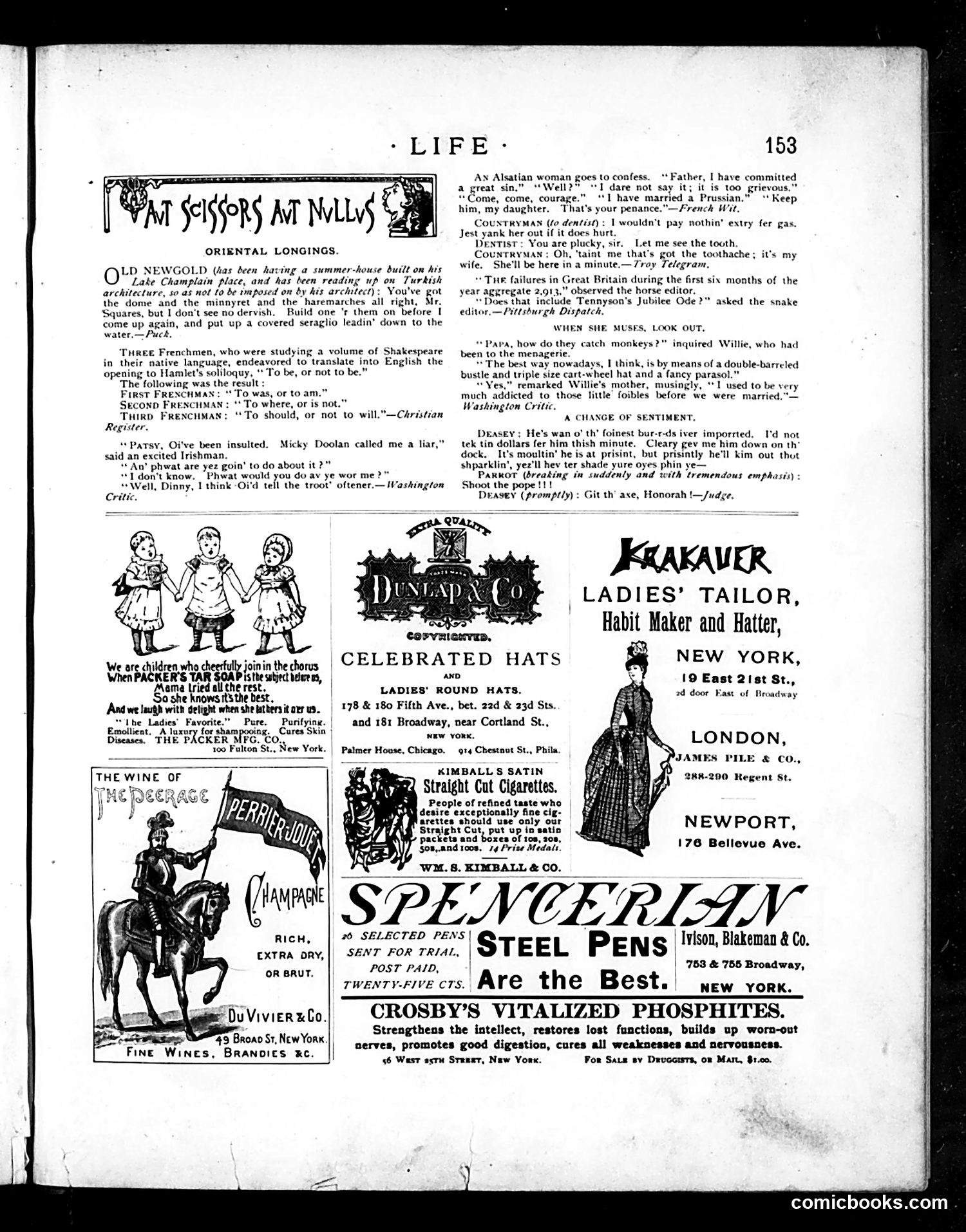
This page contains several short humorous anecdotes typical of *Life* magazine's satirical style: **"Oriental Longings"** mocks wealthy Americans' superficial adoption of exotic architecture. A rich man (Mr. Newgold) demands his Lake Champlain summer house include Turkish features—including a "dervish" (Islamic holy man)—revealing his ignorance of what these elements actually are. **The Hamlet translation joke** ridicules French attempts to translate Shakespeare, producing nonsensical phrases like "To was, or to am." **"A Change of Sentiment"** features an Irish character (Deasey) selling a parrot to Cleary. The parrot unexpectedly shouts "Shoot the pope!!!"—a stereotypical anti-Catholic outburst that prompts Deasey to demand an axe, suggesting he'll destroy the bird for its offensive statement. The page is largely **advertisements** for period products (hats, cigars, steel pens, wine). The humor relies on ethnic stereotyping (Irish dialect, French incompetence) and religious prejudice common to that era.
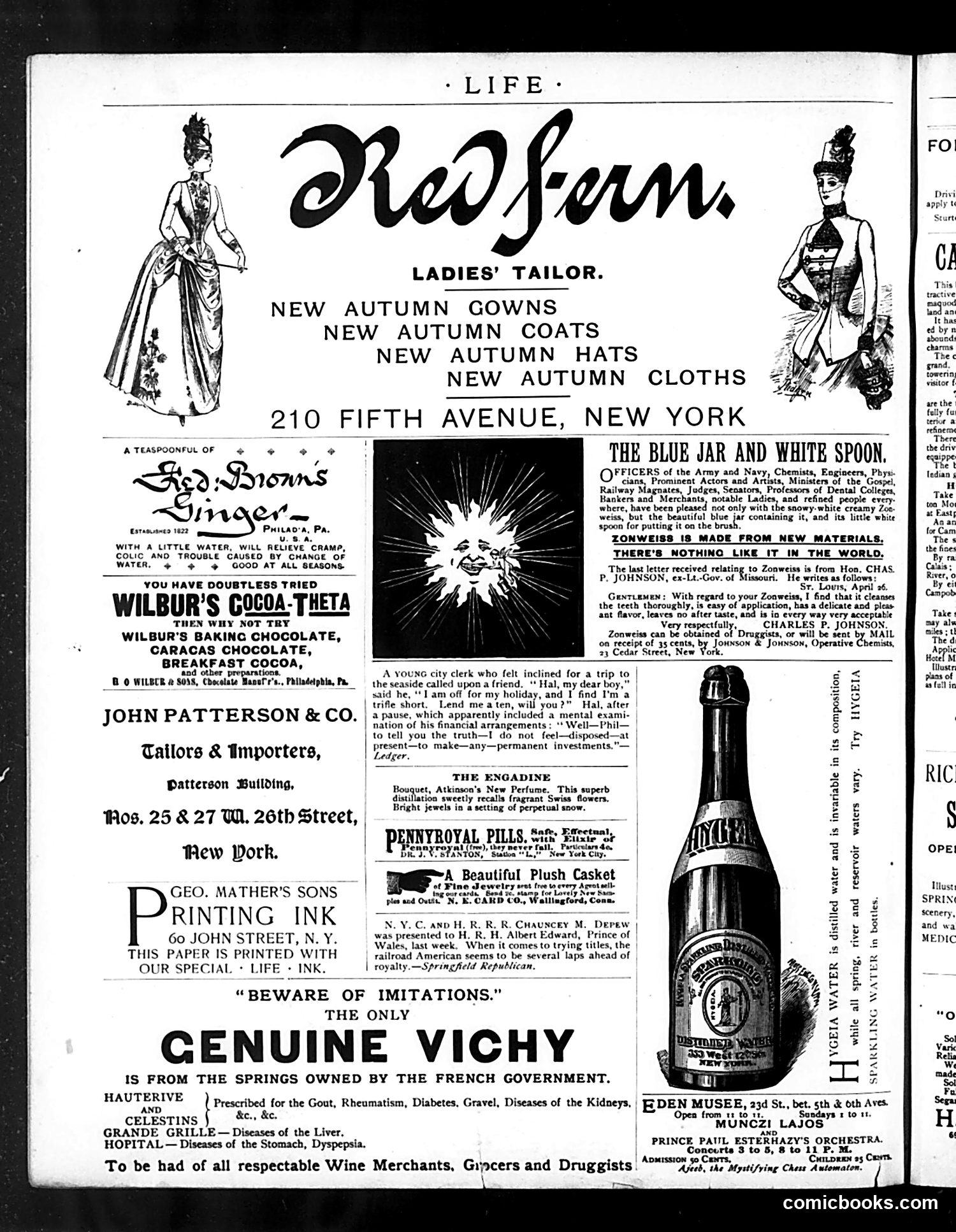
This is primarily an **advertising page** rather than a satirical cartoon spread. The page consists almost entirely of commercial advertisements from the early 20th century. The main content includes ads for: - **Red Fern Ladies' Tailor** (Fifth Avenue, NYC) - **Wilbur's Cocoa and Chocolate** - **John Patterson & Co.** (tailors and importers) - **Vichy Water** (mineral water with health claims) - Various patent medicines and beauty products There are two brief **humorous anecdotes** embedded in the text: 1. One about "Zonweiss" (a teeth-cleaning product) endorsed by various prominent men 2. A joke about a city clerk borrowing money from a friend, using evasive financial language The page includes two period fashion illustrations of women in elaborate dresses on either side of the Red Fern header. **For modern readers**: This reflects an era when magazines were primarily funded by advertising, with editorial content interspersed. The health claims and endorsements would be considered questionable by today's standards.
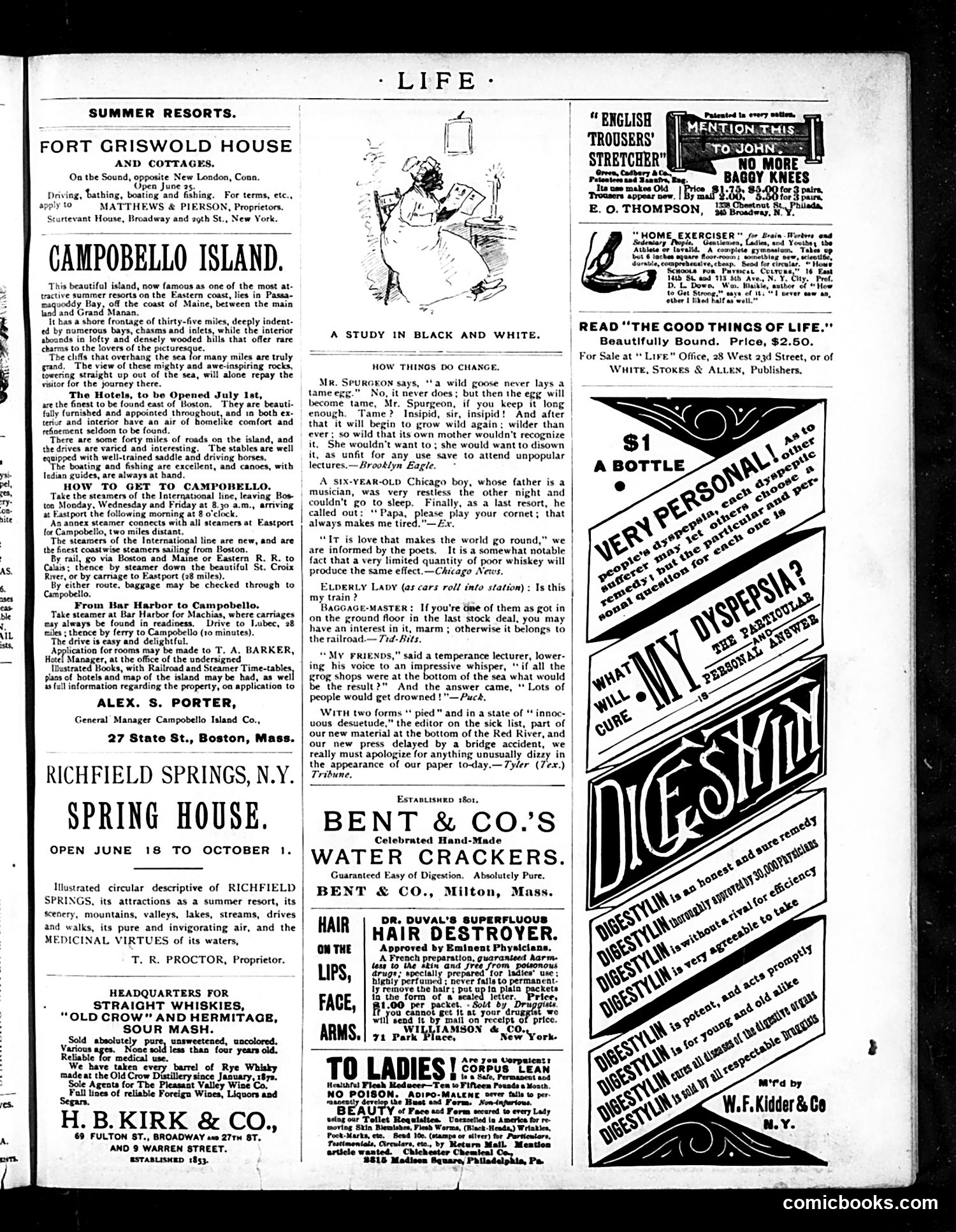
This page is primarily **advertisements for summer resorts and products**, with one small satirical cartoon titled "A Study in Black and White" depicting a woman at a desk surrounded by papers and correspondence. The accompanying text, "How Things Do Change," quotes preacher Charles Spurgeon on wild geese and tame eggs, then applies this metaphor to human behavior—suggesting that wild or untamed things become domesticated through time and habit. The cartoon likely illustrates this theme: the overwhelmed woman surrounded by paperwork represents how something (possibly courtship, business, or social obligations) that begins wild or exciting becomes tedious and routine through repetition and accumulation of mundane tasks. The satire comments on the wearing effects of domestic life or administrative burden on what was once spirited or passionate—a gentle jab at how civilization and routine tame human nature.
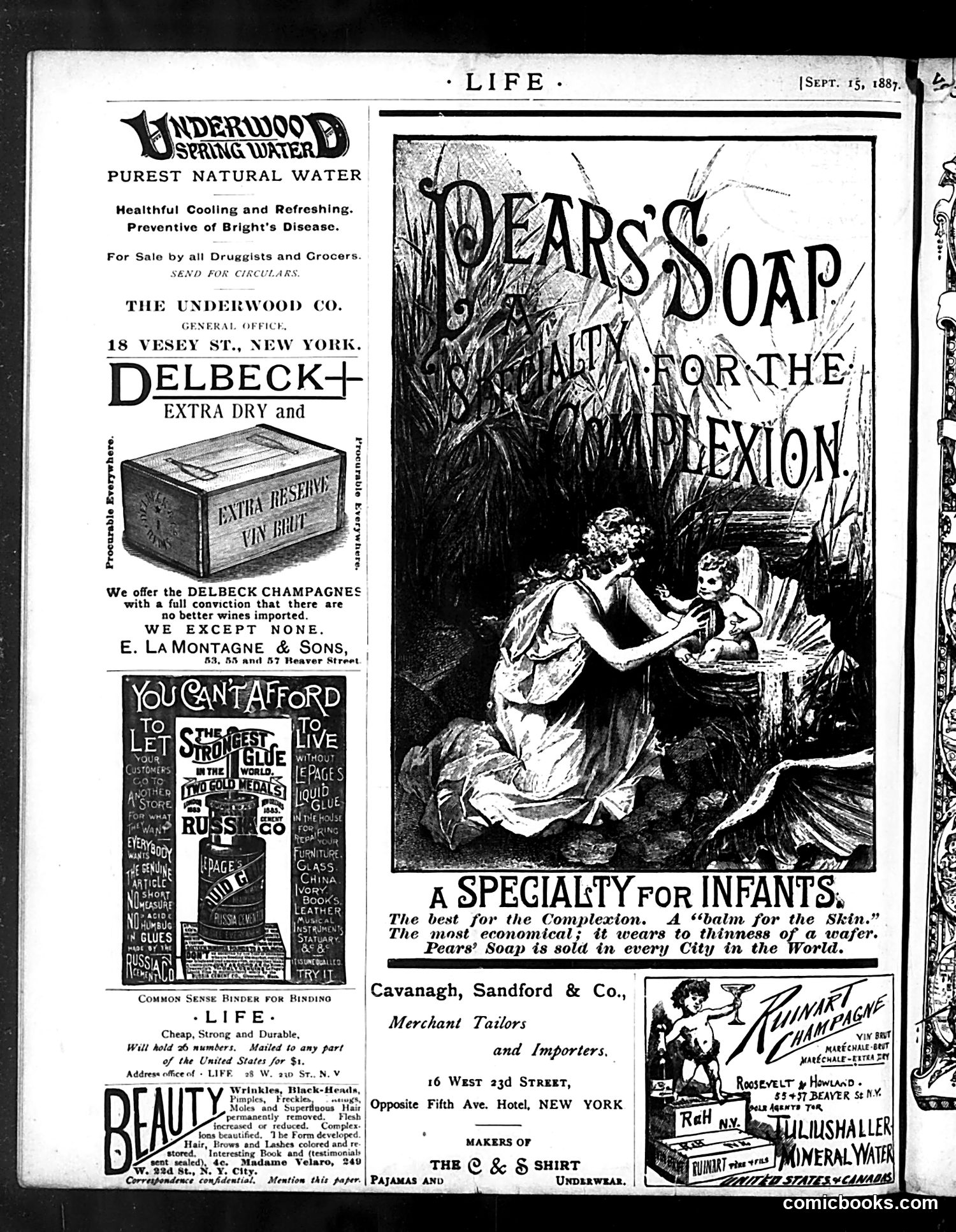
This page is primarily **advertising**, not political satire. It contains Victorian-era product advertisements with minimal editorial content. The main visual element is a **Pears' Soap advertisement** featuring cherubic figures in a classical style, promoting the product as beneficial for infants' skin and complexion. The ad emphasizes the soap's economy and global availability. Surrounding this are ads for luxury goods typical of the era: Underwood Spring Water (claimed to prevent Bright's Disease, a kidney ailment), Delbeck Champagne, Russian Rye Whiskey, and services from a New York merchant tailor and beauty practitioner offering skin treatments. The advertisement for "Common Sense Binder for Binding Life" suggests readers could preserve magazine issues. **No clear political cartoon or satire is evident.** This represents straightforward late-19th-century consumer advertising targeting wealthy New York readers, reflecting period attitudes about health remedies and cosmetic treatments that would strike modern readers as dubious or dated.