
Life, 1887-09-15 · page 2 of 16
Life — September 15, 1887 — page 2: what you’re looking at
What you’re looking at
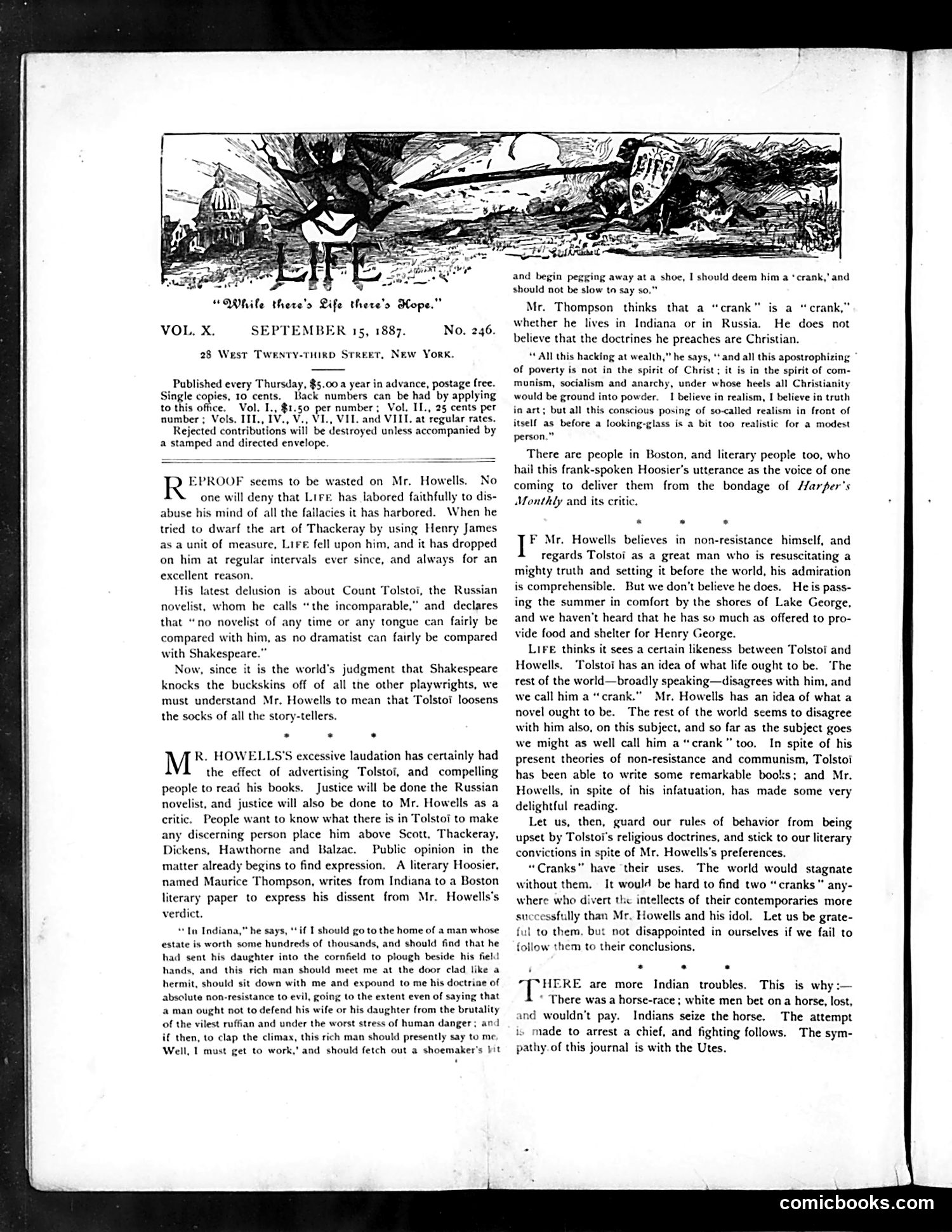
The cartoon's header reads "Where there's Life there's Hope," depicting what appears to be a skeletal or death-like figure amid a chaotic landscape with buildings and destruction. The accompanying text discusses Mr. Howells (likely William Dean Howells, the prominent American novelist and critic) and his literary views, particularly his admiration for Tolstoy and theories of non-resistance. The satire criticizes Howells for excessive praise of Russian writer Leo Tolstoy and his pacifist doctrines, which the *Life* editors view as impractical and detached from reality. The text mocks Howells's literary judgments and suggests his ideas about non-resistance are unrealistic, contrasting his comfortable Boston position with actual human suffering and practical survival needs.
📄 Transcribed text from this page (OCR, searchable)
Machine-transcribed from the original scan — historical spelling and the odd misread are preserved.
VOL, X. SEPTEMBER 15, 1887. 28 West TWeNty-TiiRD No. 246. REET, New York. Published every Thursday, $5.00 a year in advance, postage free. Single copies, 10 cents. Back numbers can be had by applying to this office. Vol. I., $1.50 per number; Vol. IT, 25 cents per number; Vols. IIL., IV., V., VI., VIL. and VIII. at regular rates. Rejected contributions will be destroyed unless accompanied by a stamped and directed envelope. I EPROOF seems to be wasted on Mr. Howells. No one will deny that Lire has labored faithfully to dis- abuse his mind of all the failacies it has harbored. When he tried to dwarf the art of Thackeray by using Henry James as a unit of measure, LIFE fell upon him, and it has dropped on him at regular intervals ever since, and always for an excellent reason. His latest delusion is about Count Tolstoi, the Russian novelist, whom he cal he incomparable,” and declares that “no novelist of any time or any tongue can fairly be compared with him, as no dramatist can fairly be compared with Shakespeare.” Now, since it is the world's judgment that Shakespeare knocks the buckskins off of all the other playwrights, we must understand Mr. Howells to mean that Tolstoi loosens the socks of all the story-tellers. . . . R. HOWELLS'S excessive laudation has certainly had the effect of advertising Tolstoi, and compelling people to read his books. Justice will be done the Russian novelist, and justice will also be done to Mr. Howells as a critic. People want to know what there is in Tolstoi to make any discerning person place him above Scott, Thackeray, Dickens, Hawthorne and Balzac. Public opinion in the matter already begins to find expression, A literary Hoosier, named Maurice Thompson, writes from Indiana to a Boston literary paper to express his dissent from Mr. Howells's verdict. *+ In Indiana,” he says, “if I should go to the home of a man whose estate is worth some hundreds of thousands, and should find that he had sent his daughter into the cornfield to plough beside his field hands, and this rich man should meet me at the door clad like a hermit, should sit down with me and expound to me his doctrine of absolute non-resistance to evil, going to the extent even of saying that a man ought not to defend his wife or his daughter from the brutality of the vilest ruffian and under the worst stress of human danger; and if then, to clap the climax, this rich man should presently say to me Well, I must get to work,’ and should fetch out a shoemaker's bit and begin pegging away at a shoe, I should deem him a ‘crank,’ and should not be slow to say so." Mr. Thompson thinks that a “crank” is a “crank,” whether he lives in Indiana or in Russia. He does not believe that the doctrines he preaches are Christian. “All this hacking at wealth,” he says, “and all this apostrophizing of poverty is not in the spirit of Christ; it is in the spirit of com- monism, socialism and anarchy, under whose heels all Christianity would be ground into powder. I believe in realism, I believe in truth in art; but all this conscious posing of so-called realism in front of itself as before a looking-glass is a bit too realistic for a modest person.” There are people in Boston, and literary people too, who hail this frank-spoken Hoosier’s utterance as the voice of one coming to deliver them from the bondage of Harper's Monthly and its critic, « * . F Mr. Howells believes in non-resistance himself, and regards Tolstoi as a great man who is resuscitating a mighty truth and setting it before the world, his admiration is comprehensible, But we don’t believe he does. He is pass- ing the summer in comfort by the shores of Lake George, and we haven't heard that he has so much as offered to pro- vide food and shelter for Henry George. LIFE thinks it sees a certain likeness between Tolstoi and Howells. Tolstoi has an idea of what life ought to be. ‘The rest of the world—broadly speaking—disagrees with him, and we call him a “crank.” Mr. Howells has an idea of what a novel ought to be. The rest of the world seems to disagree with him also, on this subject, and so far as the subject goes we might as well call him a‘ crank” too, In spite of his present theories of non-resistance and communism, Tolstoi has been able to write some remarkable books; and Mr. Howells, in spite of his infatuation, has made some very delightful reading. Let us, then, guard our rules of behavior from being upset by Tolstoi’s religious doctrines, and stick to our literary convictions in spite of Mr. Howells’s preferences. “Cranks” have their uses. The world would stagnate without them. It would be hard to find two “ cranks" any- where who divert the intellects of their contemporaries more successfully than Mr, Howells and his idol. Let us be grate- ful to them, but not disappointed in ourselves if we fail to follow them to their conclusions, ‘THERE are more Indian troubles. This is why :— * There was a horse-race; white men bet on a horse, lost, and wouldn't pay. Indians seize the horse. The attempt is made to arrest a chief, and fighting follows. The sym- pathy. of this journal is with the Utes. comicbooks.com