
Life, 1887-09-15 · page 6 of 16
Life — September 15, 1887 — page 6: what you’re looking at
What you’re looking at
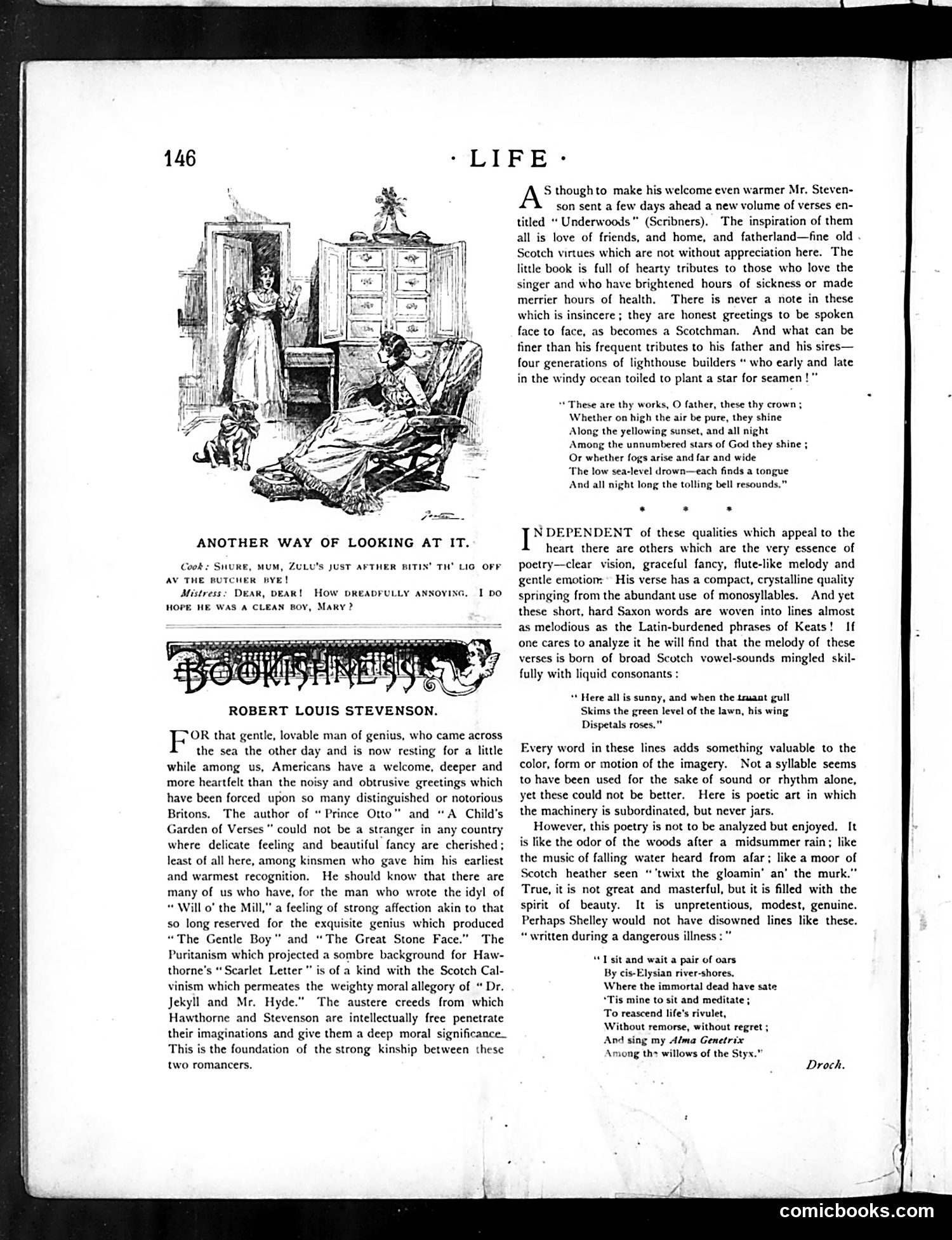
This cartoon satirizes domestic service dynamics in the Victorian era. The scene shows a mistress discovering her maid has removed her wig—a humorous reversal of power and dignity. The dialogue reveals the joke's social commentary: the servant (Mary) notes the mistress (Zulu) looks like "a clean boy" without her wig, implying her appearance depends entirely on artifice. The maid's cheek in making this observation—comparing her employer unfavorably to a boy—represents a moment of unexpected leveling between classes. The title suggests an alternative perspective on social hierarchy: stripping away appearances (literal and figurative) reveals uncomfortable truths about status and vanity. It's gentle satire on how much Victorian women's authority relied on costume and presentation rather than genuine power.
📄 Transcribed text from this page (OCR, searchable)
Machine-transcribed from the original scan — historical spelling and the odd misread are preserved.
‘LIFE: ANOTHER WAY OF LOOKING AT IT. Cook: SHURE, AV THE BUTCHER BYE! Mistress: DEAR, DEAR! HOW DREADFULLY ANNOYING, HOPE HE WAS A CLEAN Boy, Mary? MUM, ZULU'S JUST AFTHER BITIN’ TH’ LIG OFF I po ROBERT LOUIS STEVENSON. OR that gentle, lovable man of genius, who came across the sea the other day and is now resting for a little while among us, Americans have a welcome, deeper and more heartfelt than the noisy and obtrusive greetings which have been forced upon so many distinguished or notorious Britons. The author of “Prince Otto” and “A Child's Garden of Verses could not be a stranger in any country where delicate feeling and beautiful fancy are cherished ; least of all here, among kinsmen who gave him his earliest and warmest recognition. He should know that there are many of us who have, for the man who wrote the idyl of * Will o' the Mill,” a feeling of strong affection akin to that so long reserved for the exquisite genius which produced “The Gentle Boy” and “The Great Stone Face.” The Puritanism which projected a sombre background for Haw- thorne’s “Scarlet Letter” is of a kind with the Scotch Cal- vinism which permeates the weighty moral allegory of “ Dr. Jekyll and Mr. Hyde." The austere creeds from which Hawthorne and Stevenson are intellectually free penetrate their imaginations and give them a deep moral significance_ This is the foundation of the strong kinship between these two romancers. S thoughto make his welcome even warmer Mr. Steven- son sent a few days ahead a new volume of verses en- titled “ Underwoods” (Scribners). The inspiration of them all is love of friends, and home, and fatherland—fine old Scotch virtues which are not without appreciation here. The little book is full of hearty tributes to those who love the singer and who have brightened hours of sickness or made merrier hours of health. There is never a note in these which is insincere ; they are honest greetings to be spoken face to face, as becomes a Scotchman. And what can be finer than his frequent tributes to his father and his sires— four generations of lighthouse builders “ who early and late in the windy ocean toiled to plant a star for seamen!" “These are thy works, O father, these thy crown ; Whether on high the air be pure, they shine Along the yellowing sunset, and all night Among the unnumbered stars of God they shine ; Or whether fogs arise and far and wide ‘The low sea-level drown—each finds a tongue And all night long the tolling bell resounds.” * * . DEPENDENT of these qualities which appeal to the heart there are others which are the very essence of poetry—clear vision, graceful fancy, flute-like melody and gentle emotion: His verse has a compact, crystalline quality springing from the abundant use of monosyllables. And yet these short, hard Saxon words are woven into lines almost as melodious as the Latin-burdened phrases of Keats! If one cares to analyze it he will find that the melody of these verses is born of broad Scotch vowel-sounds mingled skil- fully with liquid consonants : “+ Here all is sunny, and when the truant gull Skims the green level of the lawn, his wing Dispetals roses.” Every word in these lines adds something valuable to the color, form or motion of the imagery. Nota syllable seems to have been used for the sake of sound or rhythm alone, yet these could not be better. Here is poetic art in which the machinery is subordinated, but never jars. However, this poetry is not to be analyzed but enjoyed. [t is like the odor of the woods after a midsummer rain; like the music of falling water heard from afar; like a moor of Scotch heather seen “‘twixt the gloamin’ an’ the murk.” True, it is not great and masterful, but it is filled with the spirit of beauty. It is unpretentious, modest, genuine. Perhaps Shelley would not have disowned lines like these. “ written during a dangerous illnes: “Lsit and wait a pair of oars By cis-Elysian river-shores, Where the immortal dead have sate ‘Tis mine to sit and meditate; To reascend life's rivulet, Without remorse, without regret ; And sing my Alma Genetrix Among ths willows of the Styx.” comicbooks.com