
A complete issue · 16 pages · 1887
Life — September 8, 1887
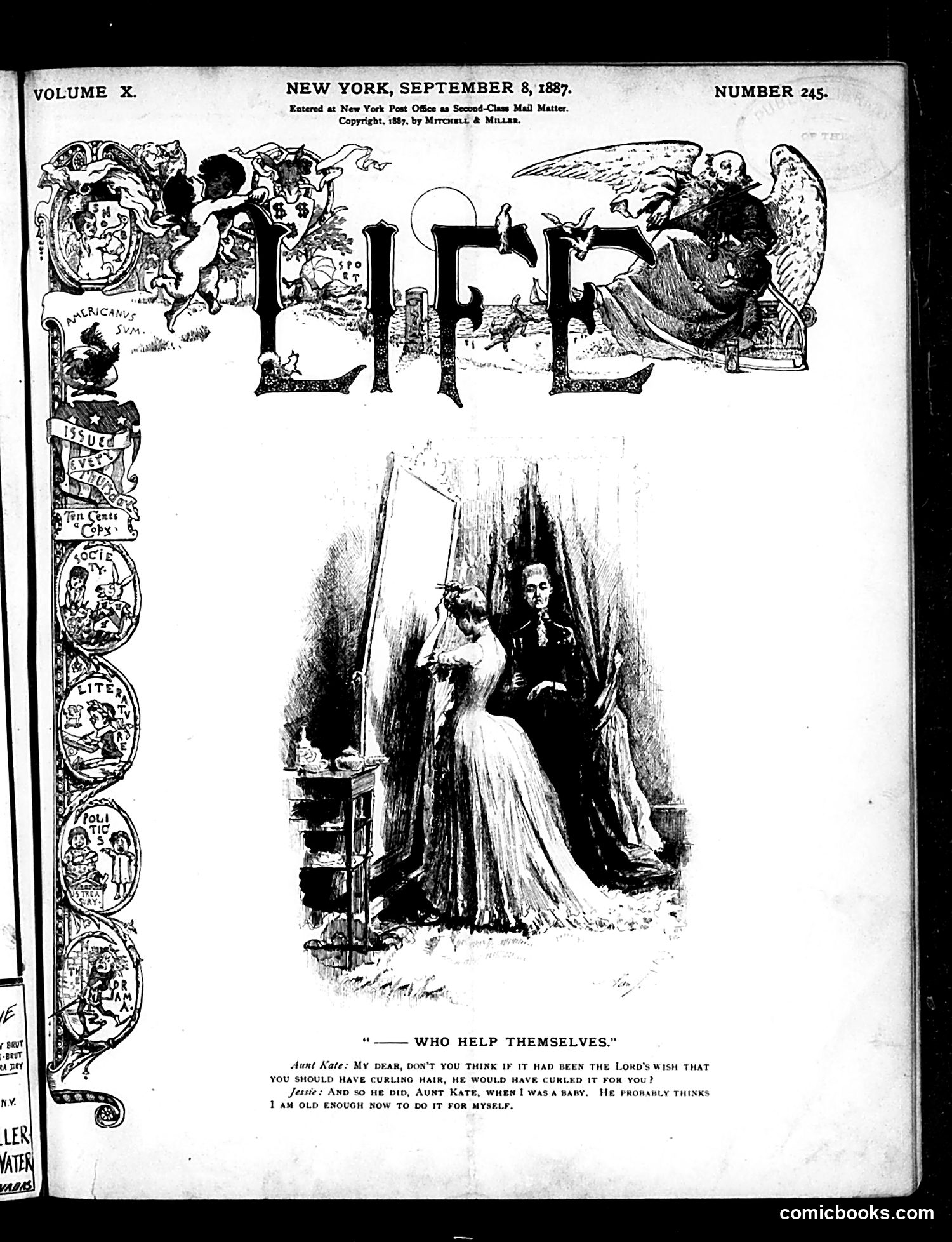
This page features a single illustration with accompanying dialogue. The image shows two figures in what appears to be a domestic interior—a woman in light clothing and a man in dark formal dress in a curtained alcove or doorway. The caption quotes dialogue between "Aunt Kate" and "Jesse," discussing curled hair. Aunt Kate says if it were "the Lord's wish," she would have curled Jesse's hair; Jesse responds that he's old enough now to do it himself. The satire appears to critique self-improvement or "self-help" attitudes—the title "Who Help Themselves" suggests ironic commentary on contemporary self-reliance philosophies. The specific reference and historical context remain unclear without additional information about the individuals or events referenced.
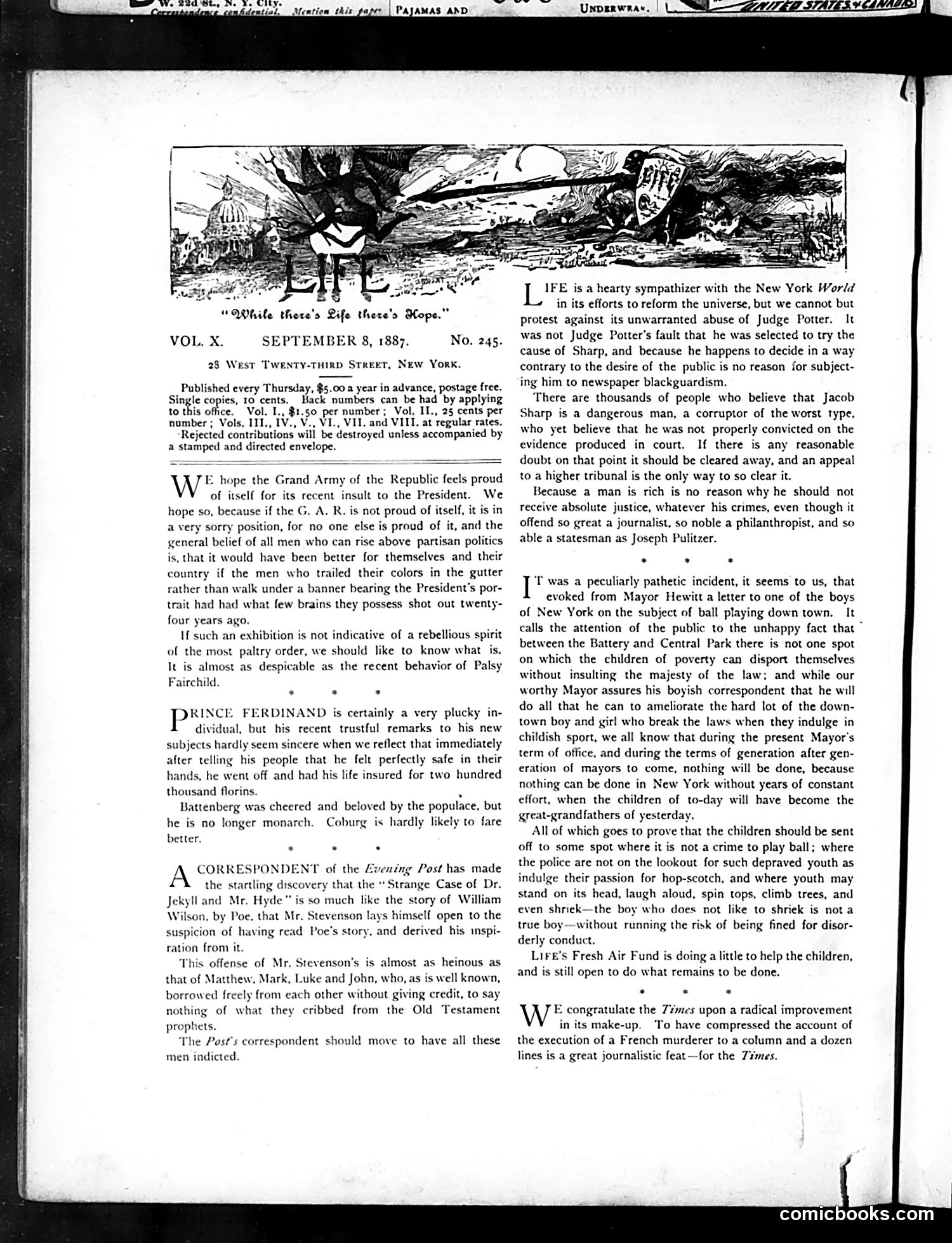
**The Cartoon:** The masthead illustration shows a figure labeled "Life" standing amid classical ruins and turmoil, with the caption "While there's Life there's Hope." **The Content:** The editorial discusses Judge Potter's role in prosecuting Jacob Sharp, a political figure accused of corruption. Life argues Sharp deserves fair trial despite public suspicion of his guilt, and that only appeal to higher courts can clear doubts about his conviction. Other pieces critique Prince Ferdinand's political instability in Europe; praise the Times newspaper for its coverage of a French murderer's execution; and discuss Mayor Hewitt's efforts to improve conditions for poor children in New York City. The overall tone reflects Life's role as a reformist satirical publication addressing contemporary political corruption and urban social issues.
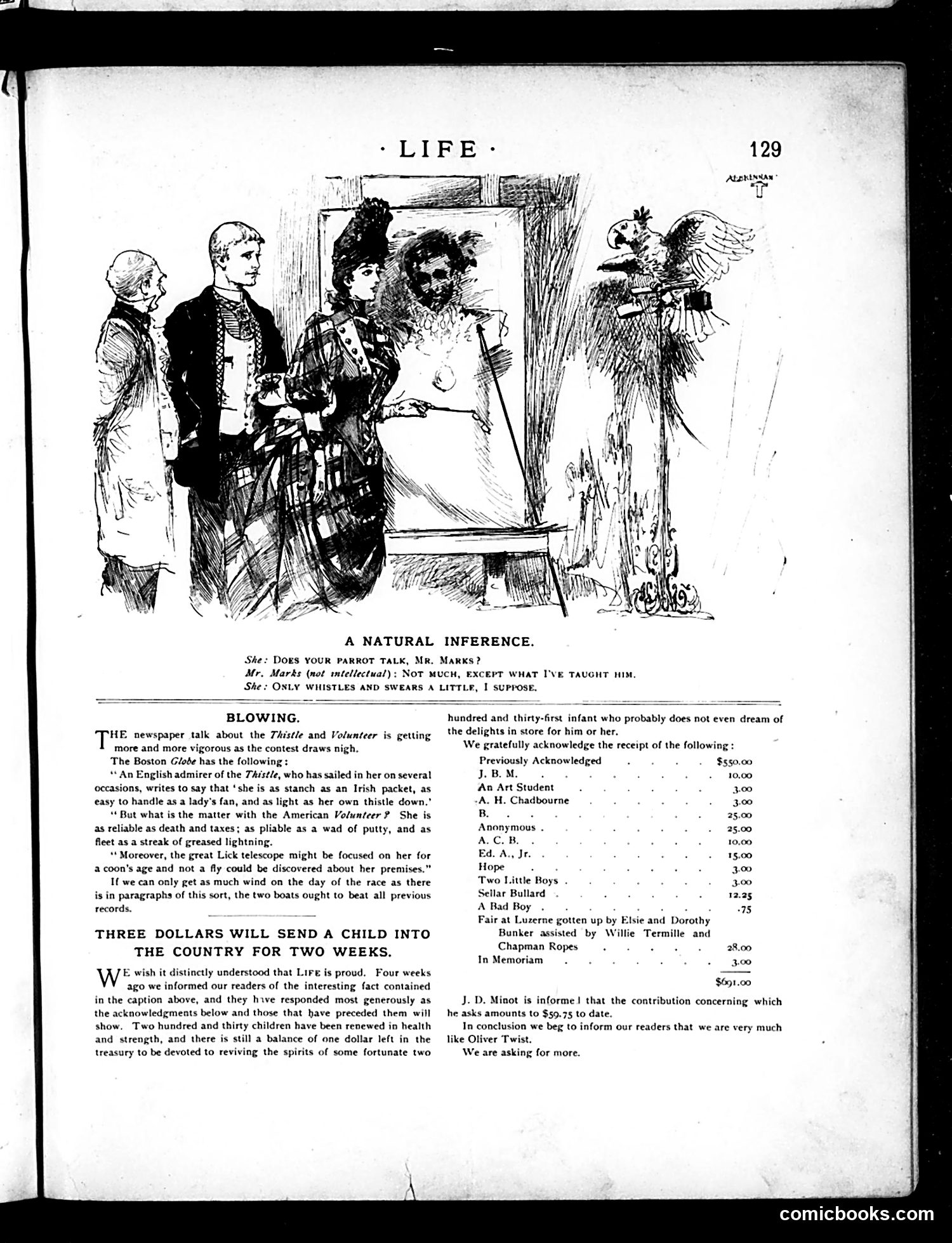
This cartoon satirizes perceptions of Irish immigrants and their supposed crude behavior. A well-dressed woman (labeled "She") asks Mr. Marks whether his parrot can talk. He responds that the parrot only "whistles and swears a little." The woman then makes a pointed inference: she assumes the parrot learned such language from Irish servants or laborers in the household. The joke relies on a common 19th-century American stereotype that Irish immigrants were uncouth, profane, and morally corrupting influences—particularly as domestic workers. By suggesting the parrot picked up vulgarities from them, the cartoon reinforces xenophobic assumptions about Irish people's supposed lack of refinement and propriety.
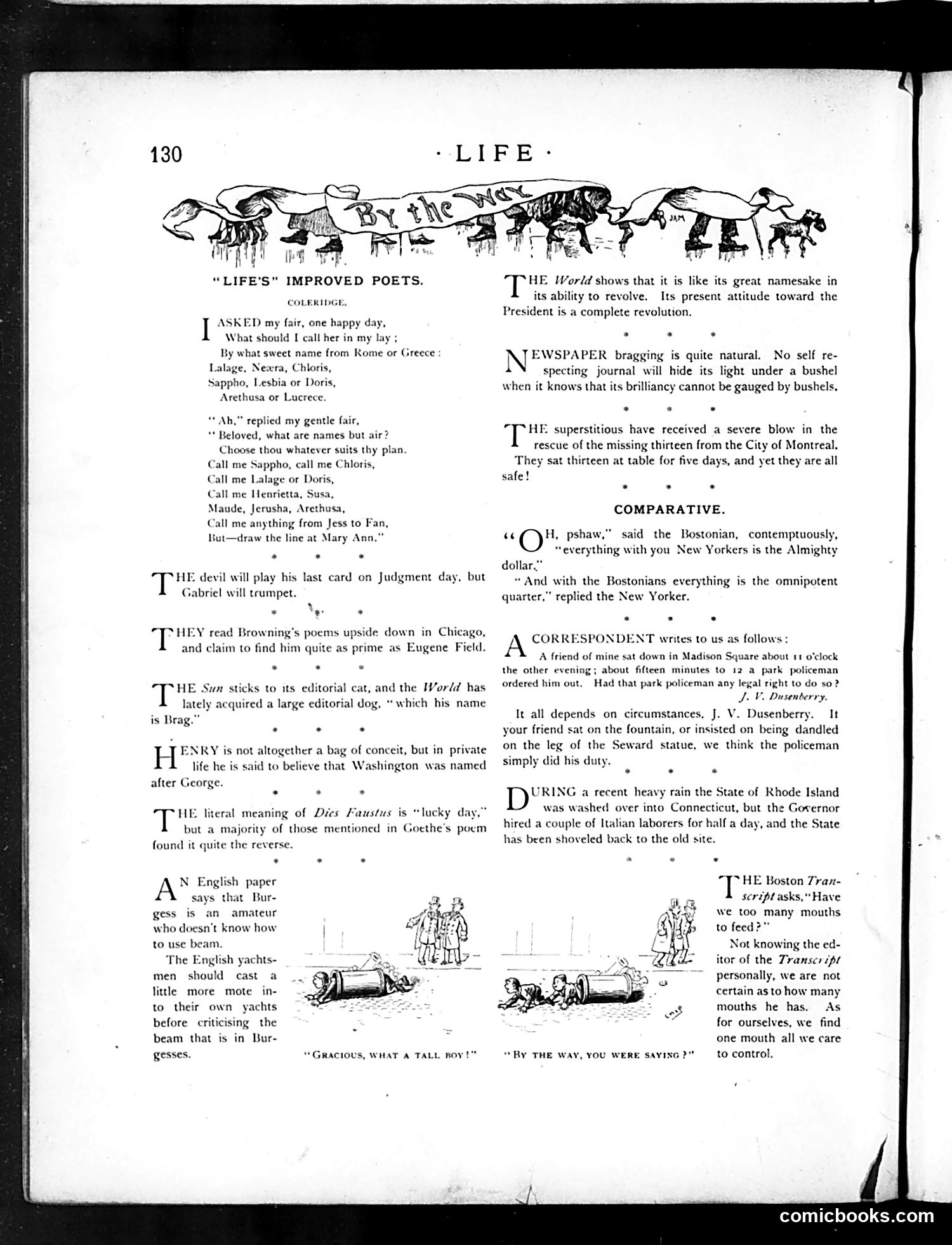
This page contains humorous commentary and verse rather than political cartoons. The "Improved Poets" section parodies Coleridge's famous poem structure. Key satirical items include: 1. **Newspaper boasting**: Mocks journals for hiding their "light under a bushel" when they possess brilliance. 2. **Montreal superstition story**: References a rescue of "thirteen from the City of Montreal" who sat at table for five days—apparently a superstitious test. 3. **Boston/New York comparison**: A Bostonian claims "everything with you New Yorkers is the Almighty dollar," while a New Yorker retorts it's their "omnipotent quarter"—satirizing perceived regional materialism. 4. **Bottom cartoons**: Show two similar scenes with figures and cannons, captioned "Gracious, what a tall boy!" and "By the way, you were saying?"—the humor appears visual rather than explicitly political.
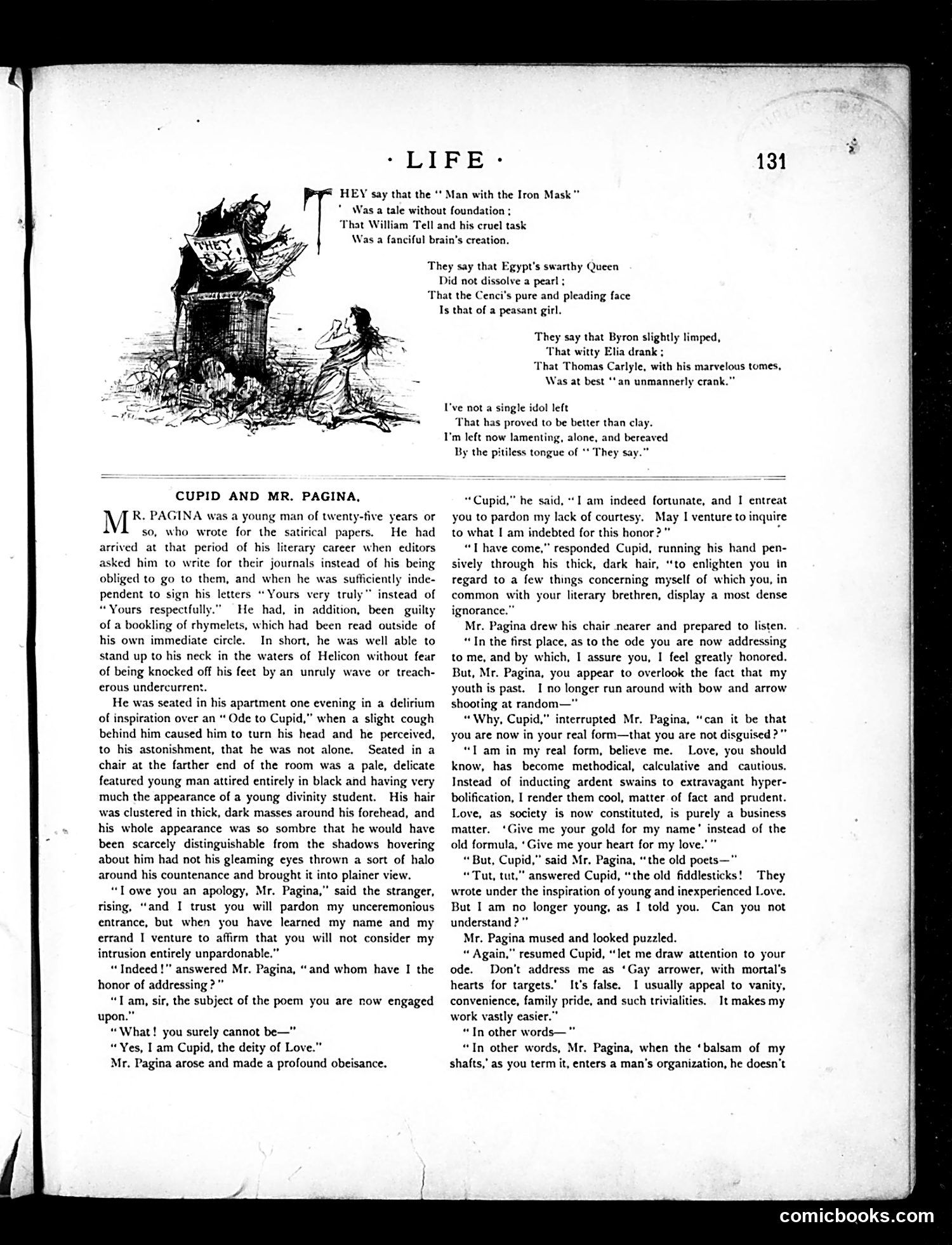
**The Poem (top):** A satirical attack on literary figures and famous stories. The author mocks tales like "The Man with the Iron Mask," William Tell, Cleopatra dissolving pearls, and Byron's limp, calling them fabrications. The final lines mock the phrase "They say," suggesting gossip and unfounded literary myths have replaced genuine artistry. **"Cupid and Mr. Pagina" (main story):** Satirizes a young satirical journalist who writes cynically about love and human nature. When Cupid (presented as an actual being) visits to challenge his worldview, Pagina defends his cold, calculated approach to life and relationships. The satire critiques modern skepticism and the reduction of human emotion to business logic—mocking the loss of romantic idealism in contemporary culture.
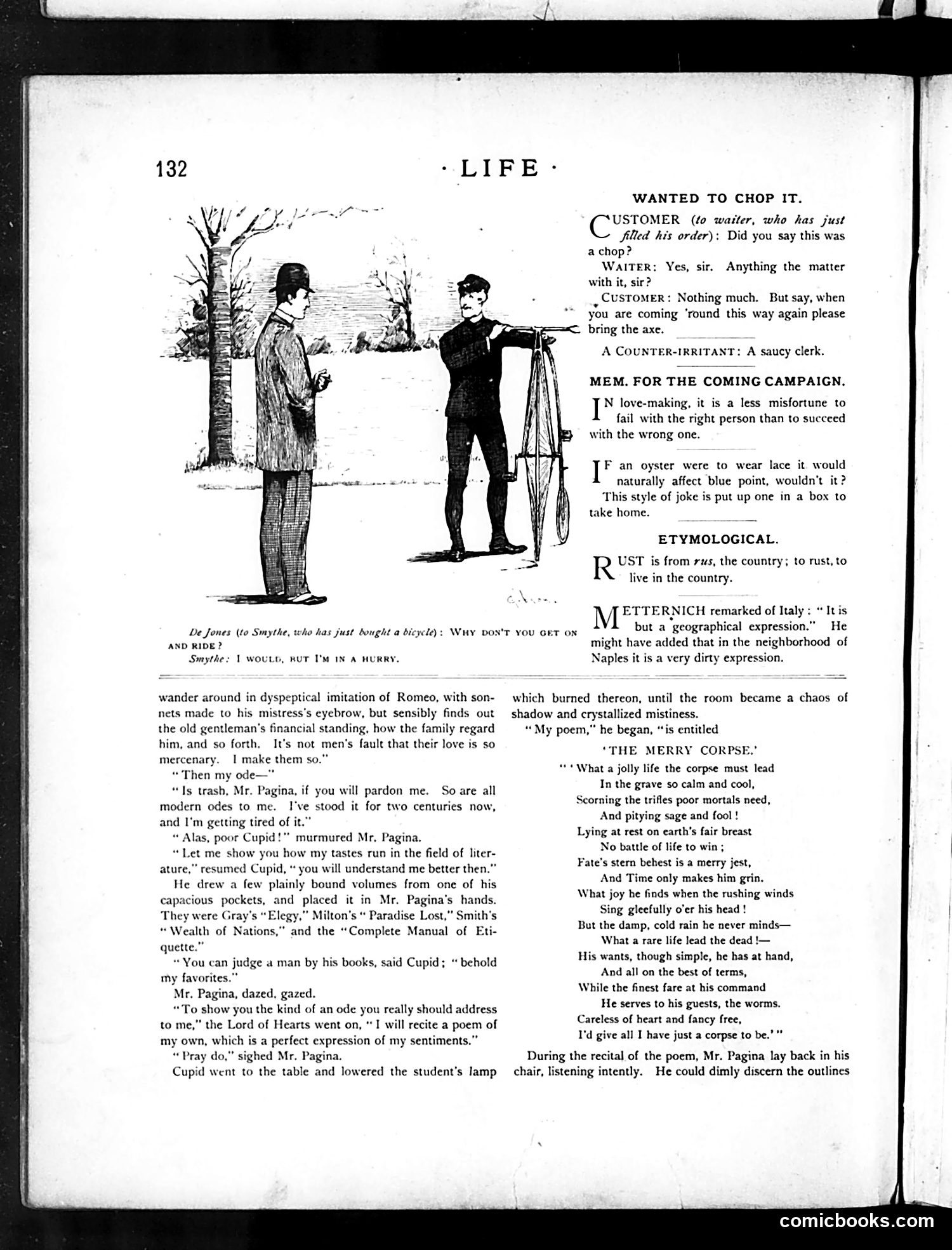
The main cartoon shows two men with a bicycle, titled "WANTED TO CHOP IT." The dialogue reveals a waiter has brought the wrong dish to a customer who ordered a chop. The customer sarcastically instructs the waiter to bring an axe next time—a visual joke playing on the double meaning of "chop" (food item versus cutting implement). Below this is comedic text about romance and an absurdist joke about an oyster wearing lace. The page also includes etymological notes and a poem titled "THE MERRY CORPSE," which appears to be satirical verse about death and life's ironies. The humor is typical of early-20th-century Life magazine: wordplay, social commentary on class (waiter/customer dynamics), and philosophical satire about mortality.
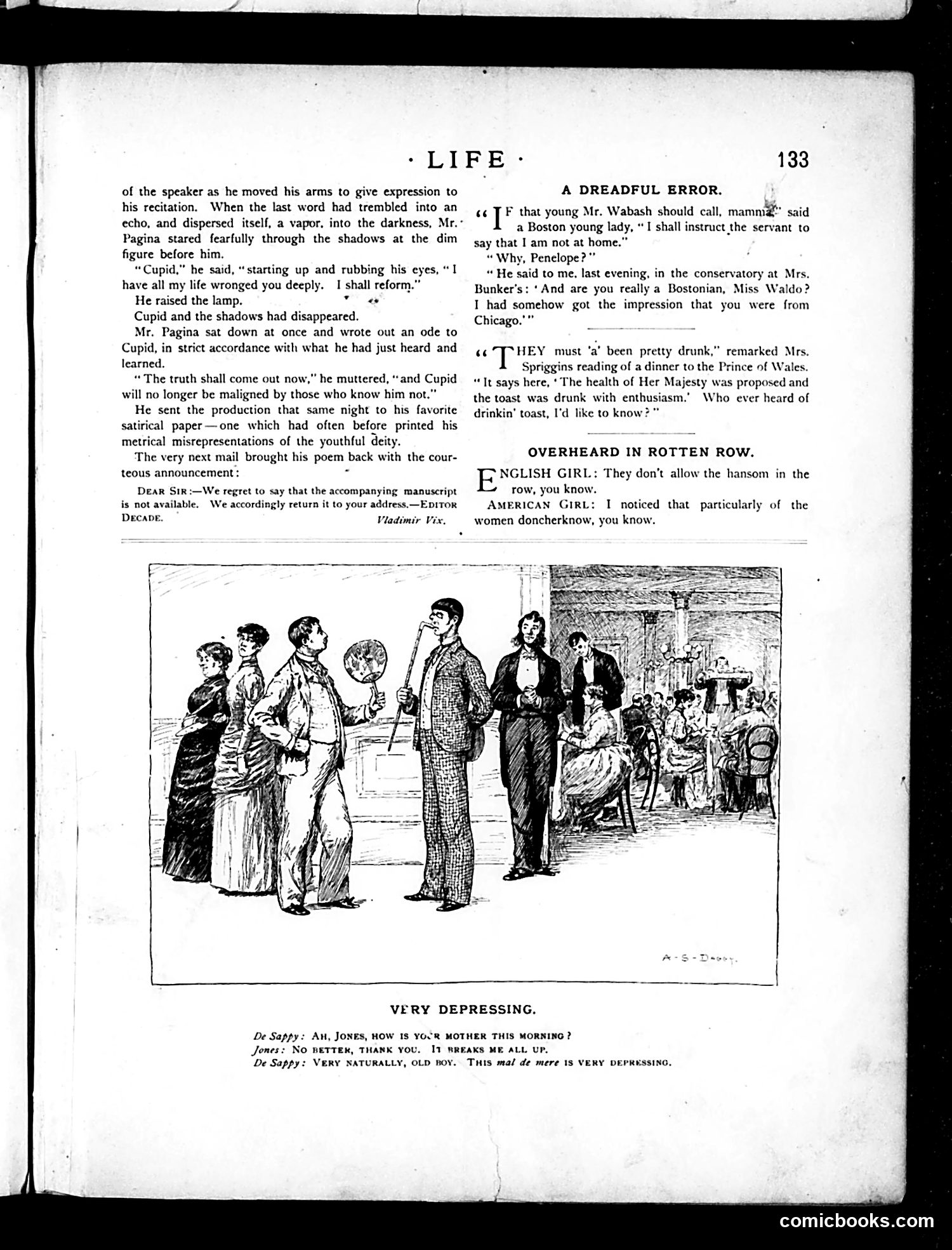
This page contains three separate satirical pieces: 1. **"A Dreadful Error"**: A dialogue joke about a Bostonian woman (Miss Waldo) mistakenly thought to be from Chicago—apparently a humorous jab at regional American identities. 2. **"Overheard in Rotten Row"**: A brief exchange contrasting English and American women's behavior regarding "the hansom in the row" (hansom cabs)—likely poking fun at transatlantic social customs and propriety differences. 3. **"Very Depressing"**: A cartoon showing a social gathering with the caption mocking Jones's bad news about his mother's health, suggesting the phrase "very depressing" is an understatement—social satire about English understatement and politeness conventions. The illustrations depict period-appropriate Victorian-era clothing and social settings, typical of Life's genteel humor targeting upper-class society.
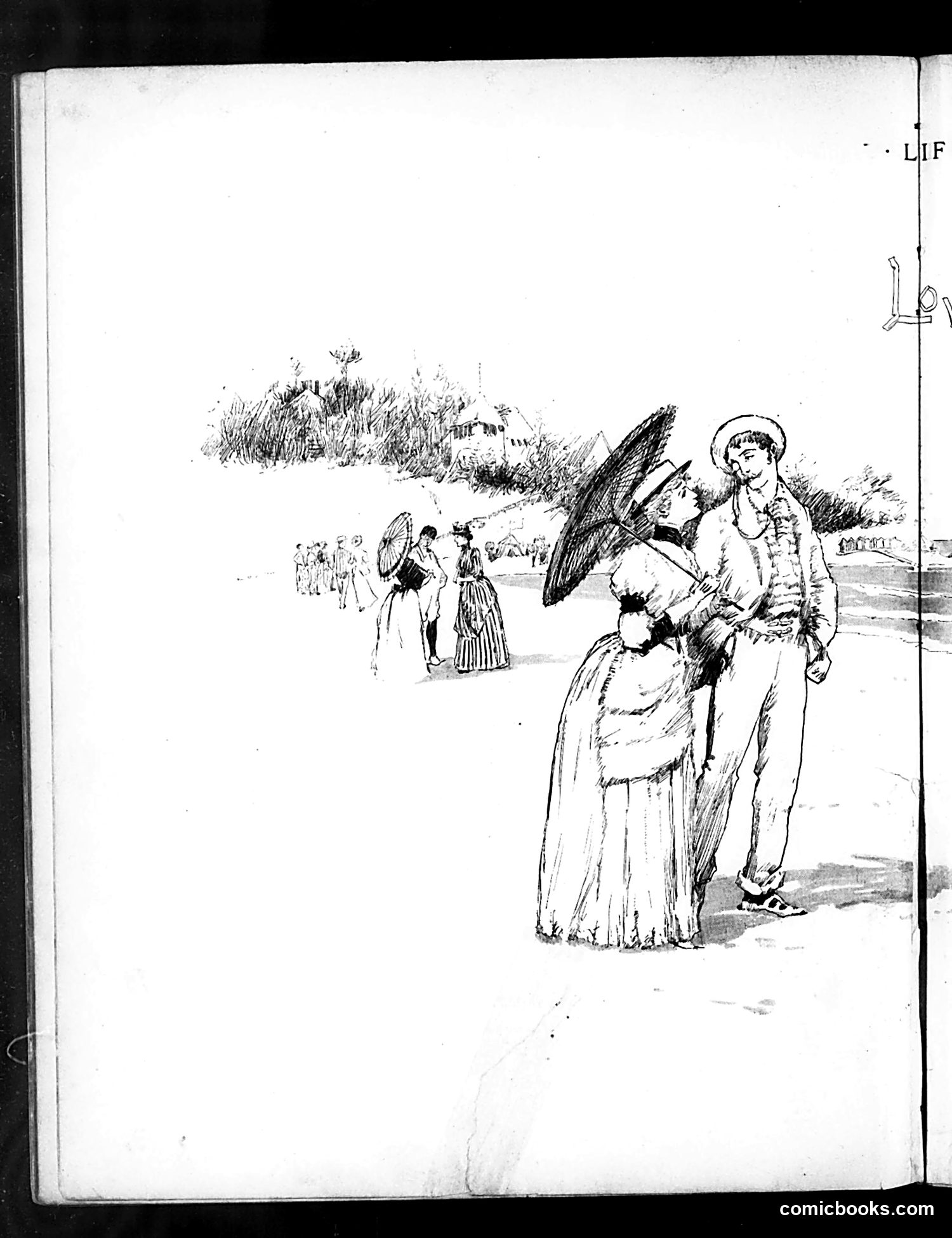
This appears to be a sketch from *Life* magazine showing a romantic or flirtation scene. In the foreground, a winged figure (appearing to be Cupid or an angel) stands with a young woman and an attentive man, suggesting the facilitating of romantic connection. In the background, other figures gather near what looks like a picnic or outdoor social gathering beneath trees. The satire likely comments on courtship rituals or the role of chance/fate (represented by the winged figure) in romantic encounters. The contrast between the intimate foreground couple and the social gathering behind them may joke about public versus private romantic moments, or how romance unfolds within social gatherings. Without visible text explaining the cartoon's specific context or title, the exact satirical point remains somewhat unclear, though it appears to mock contemporary courtship conventions.
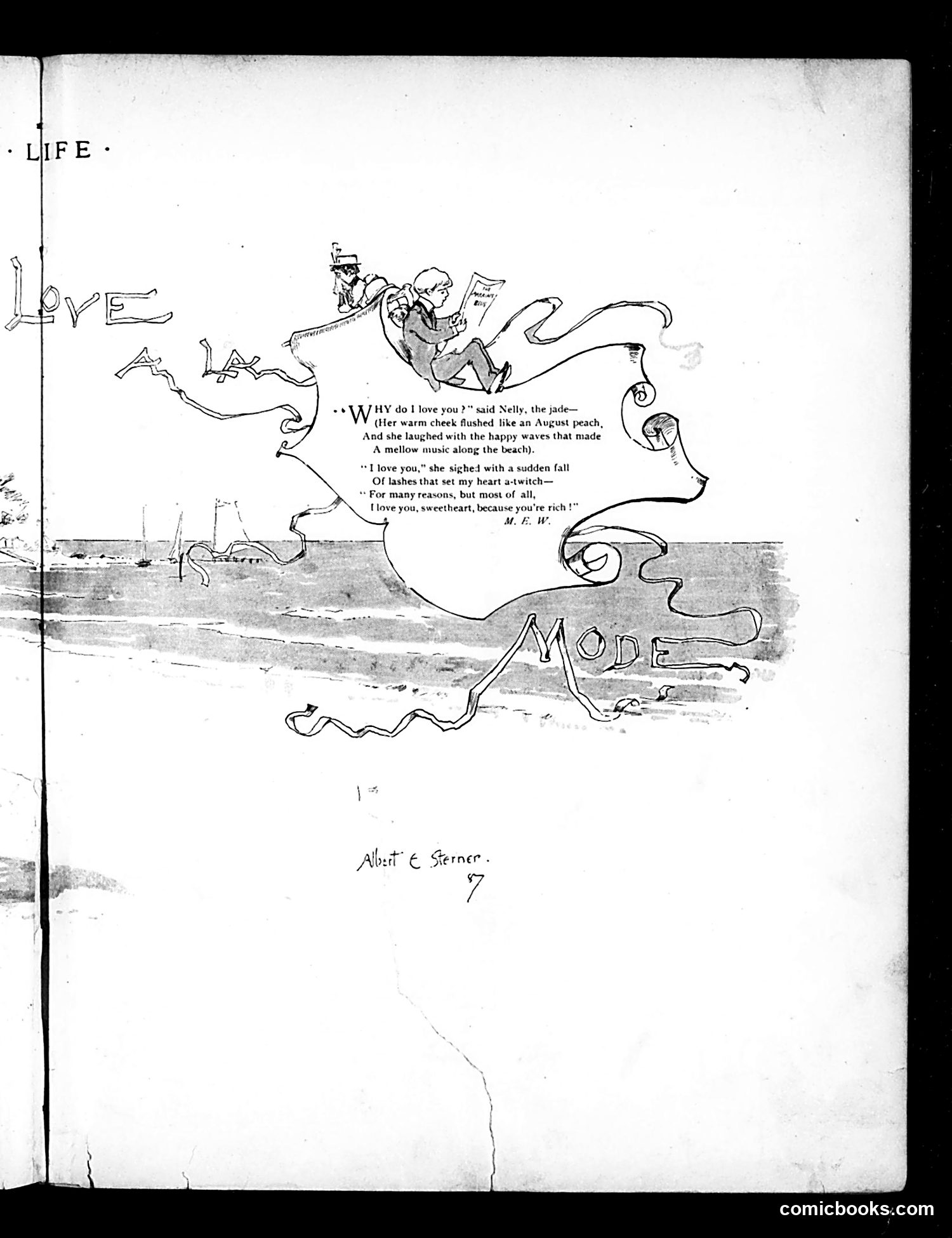
This page features a romantic cartoon by Albert E. Sterner depicting a couple in a small boat on a beach. The illustration uses flowing, Art Nouveau-style lines to frame the scene. The dialogue shows a man (identified as "Nelly, the jade") asking why she loves him. Her response satirizes gold-digging relationships: she loves him primarily "because you're rich." The poem emphasizes the mercenary nature of her affection despite romantic language about his "warm cheek" and "happy waves." The satire targets wealthy men who naively believe women's romantic declarations, when financial security is actually the primary attraction. This reflects early 20th-century social commentary on marriage and class disparities, where wealth determined romantic desirability.
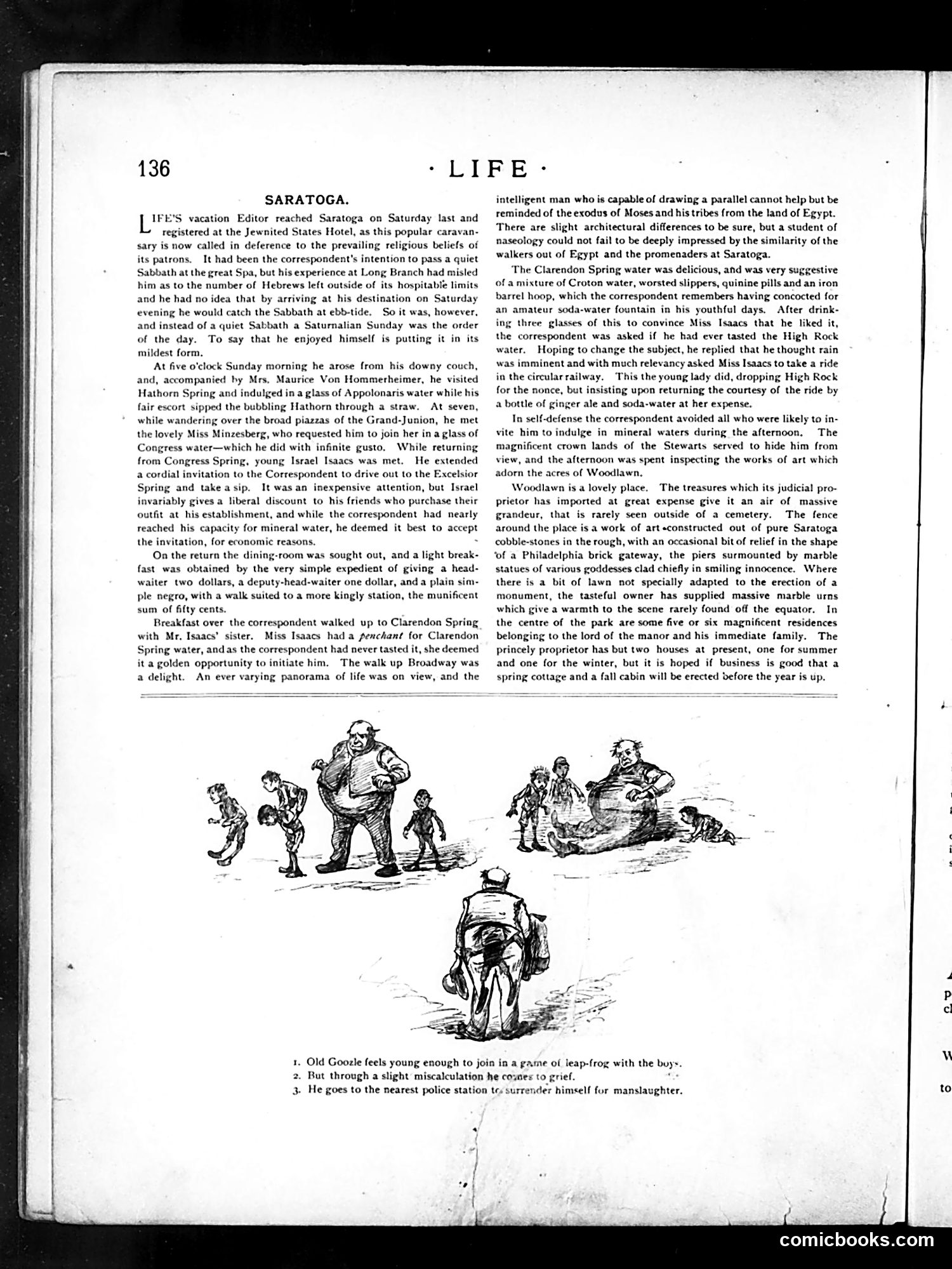
This three-panel satirical sequence depicts an elderly gentleman's misadventure at a fashionable resort. Panel 1 shows him attempting to join children in a "game of leap-frog," appearing foolish and undignified. Panel 2 reveals his miscalculation caused injury—he grieves over the outcome. Panel 3 shows him surrendering himself to police for "manslaughter." The satire mocks older men trying to recapture youth at Saratoga Springs, a popular vacation destination. The escalating absurdity—from embarrassing behavior to accidental harm to legal consequences—exaggerates the foolishness of age-inappropriate conduct. The accompanying article describes Saratoga's leisure attractions, making the contrast between dignified vacation pursuits and this character's undignified antics the humor's foundation.
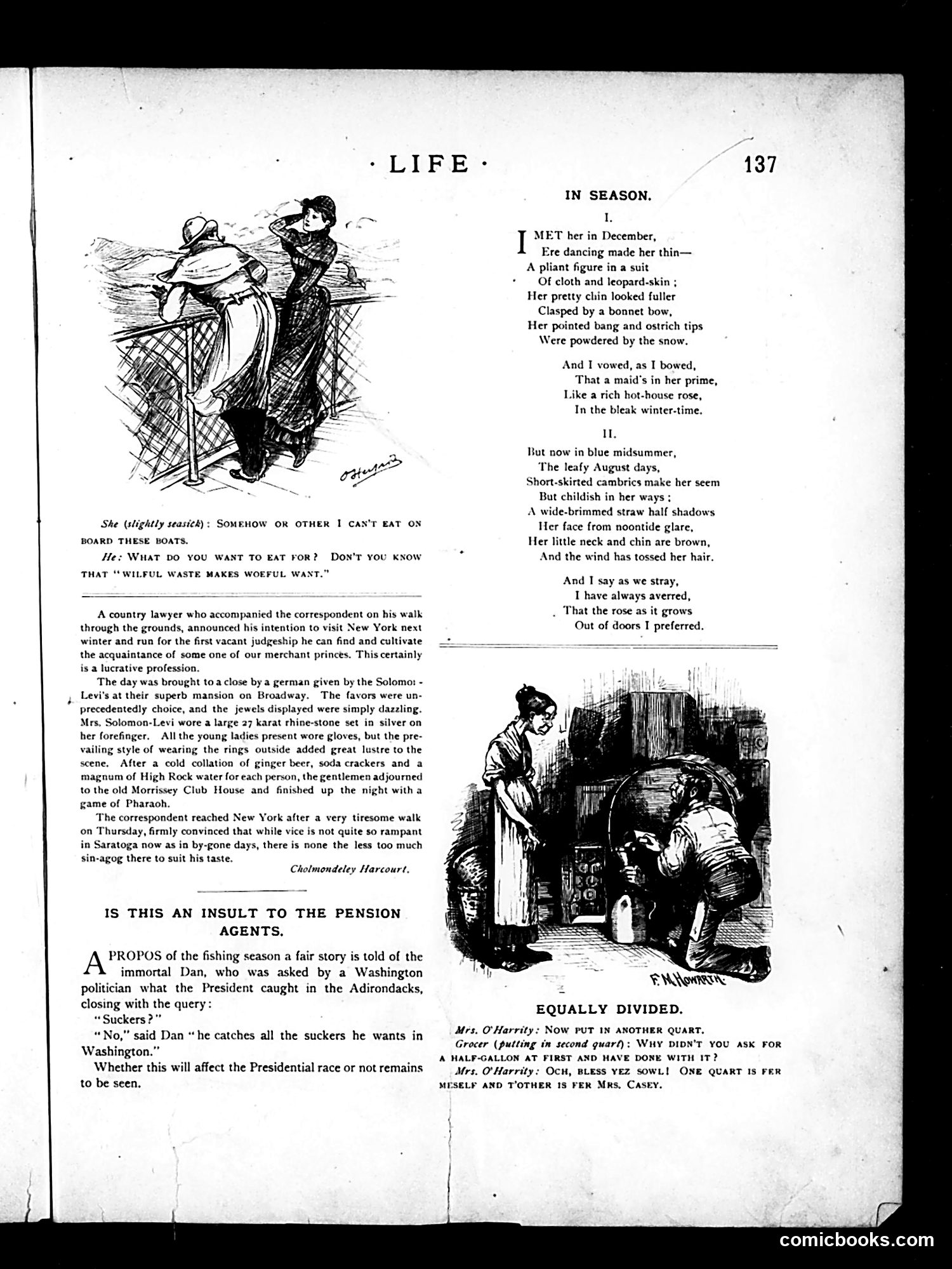
This page from *Life* contains multiple satirical pieces typical of the era's humor magazine: **"In Season" (poem)**: A romantic poem contrasting a woman's appearance in winter versus summer—idealized and bundled in December, but less appealing in thin summer clothes. The satire appears to mock romantic idealization and male inconsistency. **"Is This an Insult to the Pension Agents"**: A political joke where "Dan" (likely a well-known figure, unclear from context) responds to a question about what the President caught fishing in the Adirondacks. When asked "Suckers?", Dan replies the President "catches all the suckers he wants in Washington"—a jab at Washington politicians as gullible dupes. **"Equally Divided" (cartoon)**: Two working-class Irish women (indicated by names O'Harrity and Casey) discuss dividing a quart of liquor—one quart for herself, one for her friend. The humor mocks Irish-American drinking culture and working-class domestic life. The page reflects late-19th/early-20th-century satirical targets: politics, gender, and ethnic stereotypes.
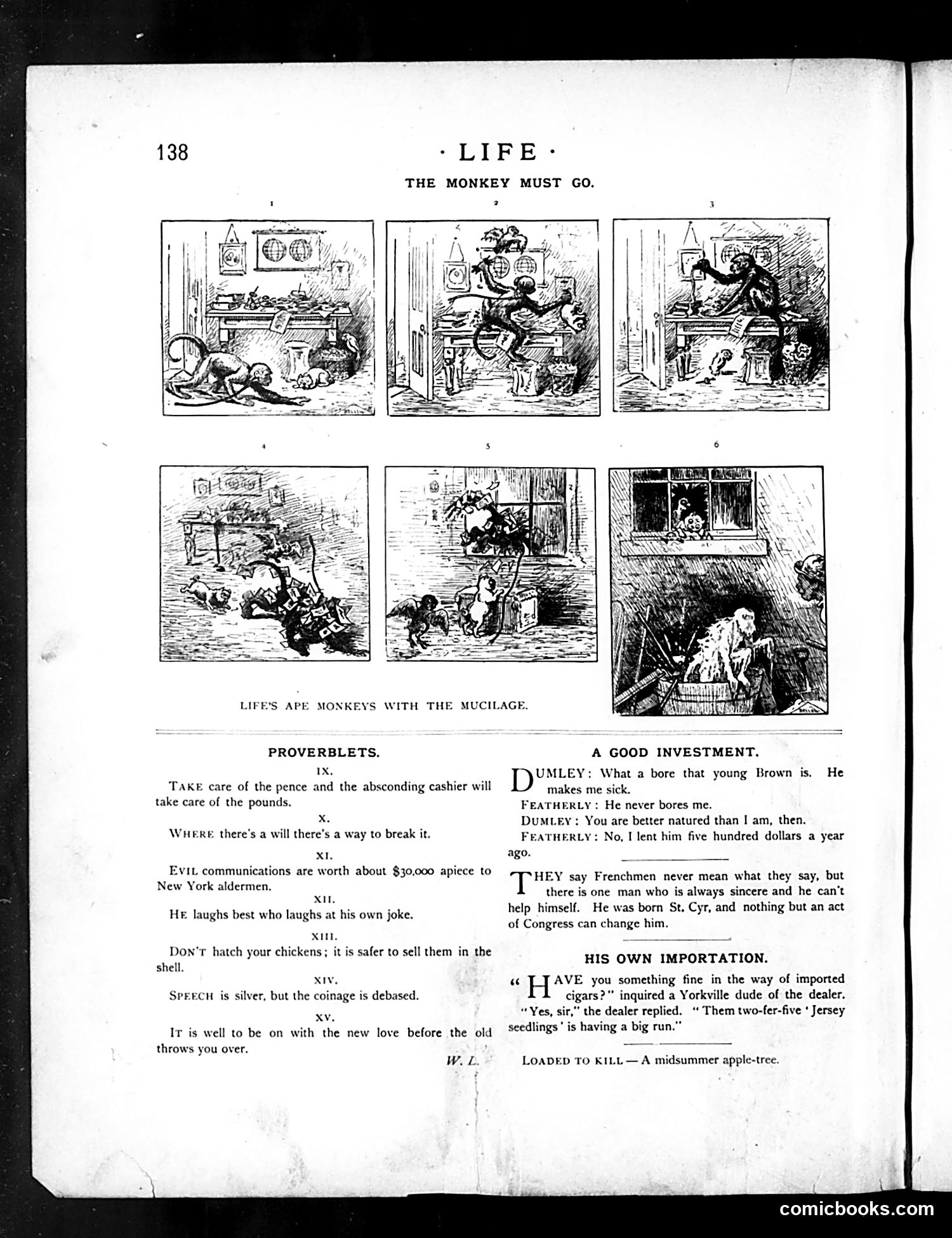
This page contains a six-panel comic strip (top) depicting a mischievous monkey wreaking havoc in an office or study, followed by separate satirical text sections below. The comic illustrates the phrase "Life's ape monkeys with the mucilage"—visual wordplay on the saying "life plays tricks on us." The lower sections are short satirical quips mocking contemporary society: - **"Proverlets"** (left): Cynical reversals of common sayings. For example, proverb XI mocks New York aldermen's corruption ("Evil communications are worth about $30,000 apiece"). Proverb X suggests wills exist to be broken. - **"A Good Investment"** (right): A dialogue joke where Featherly claims not to find young Brown boring because he lent Brown $500 a year ago—implying the debt makes him indifferent to Brown's company. - **"His Own Importation"**: Mocks a Yorkville (wealthy NYC neighborhood) snob asking for imported cigars, only to be sold cheap Jersey cigars labeled as "two-fer-five." The satire targets corruption, greed, hypocrisy, and class pretension in Gilded Age America.
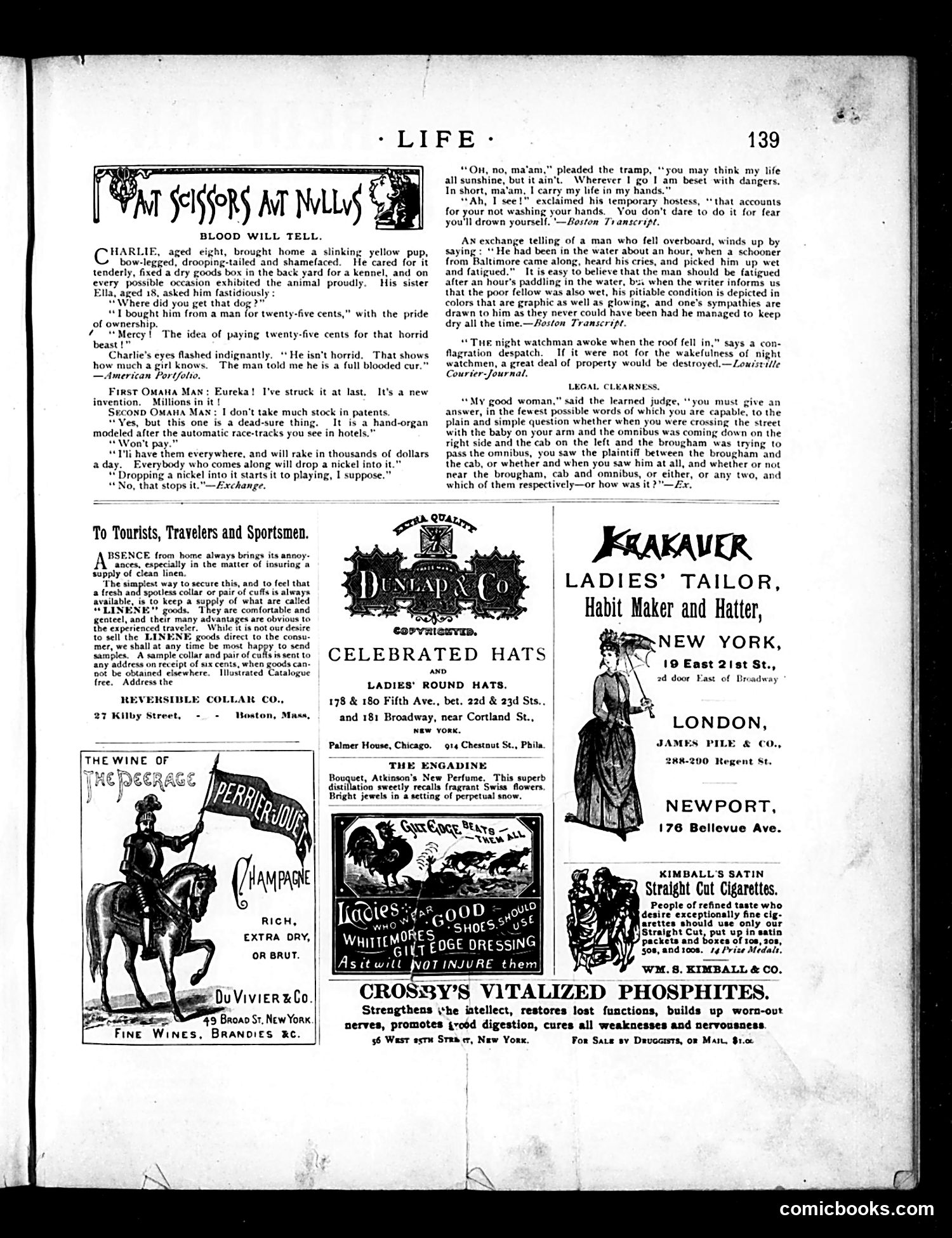
This page from *Life* magazine contains mostly **advertisements and humorous short anecdotes** rather than political cartoons. The main satirical content includes: **"Blood Will Tell"** — A joke about class and breeding. An eight-year-old boy buys a shabby dog for 25 cents and proudly claims it's "full blooded." His snobbish 18-year-old sister insults the dog; he defends it by invoking the dog's pedigree. The humor mocks both the boy's misunderstanding of "blood" (breeding/ancestry) and the sister's pretentious class consciousness. **The Omaha Man cartoon** — Two prospectors discuss a coin-operated hand organ modeled on slot machines. The joke: inserting a nickel *stops* the music rather than starting it—a absurdist punchline mocking get-rich-quick schemes and mechanical inventions. **Other anecdotes** poke fun at tramps, newspaper reporting, and legal jargon through wordplay and situational irony. The page is primarily filled with period advertisements for hats, wine, clothing, and patent medicines—typical of late-19th-century magazines.
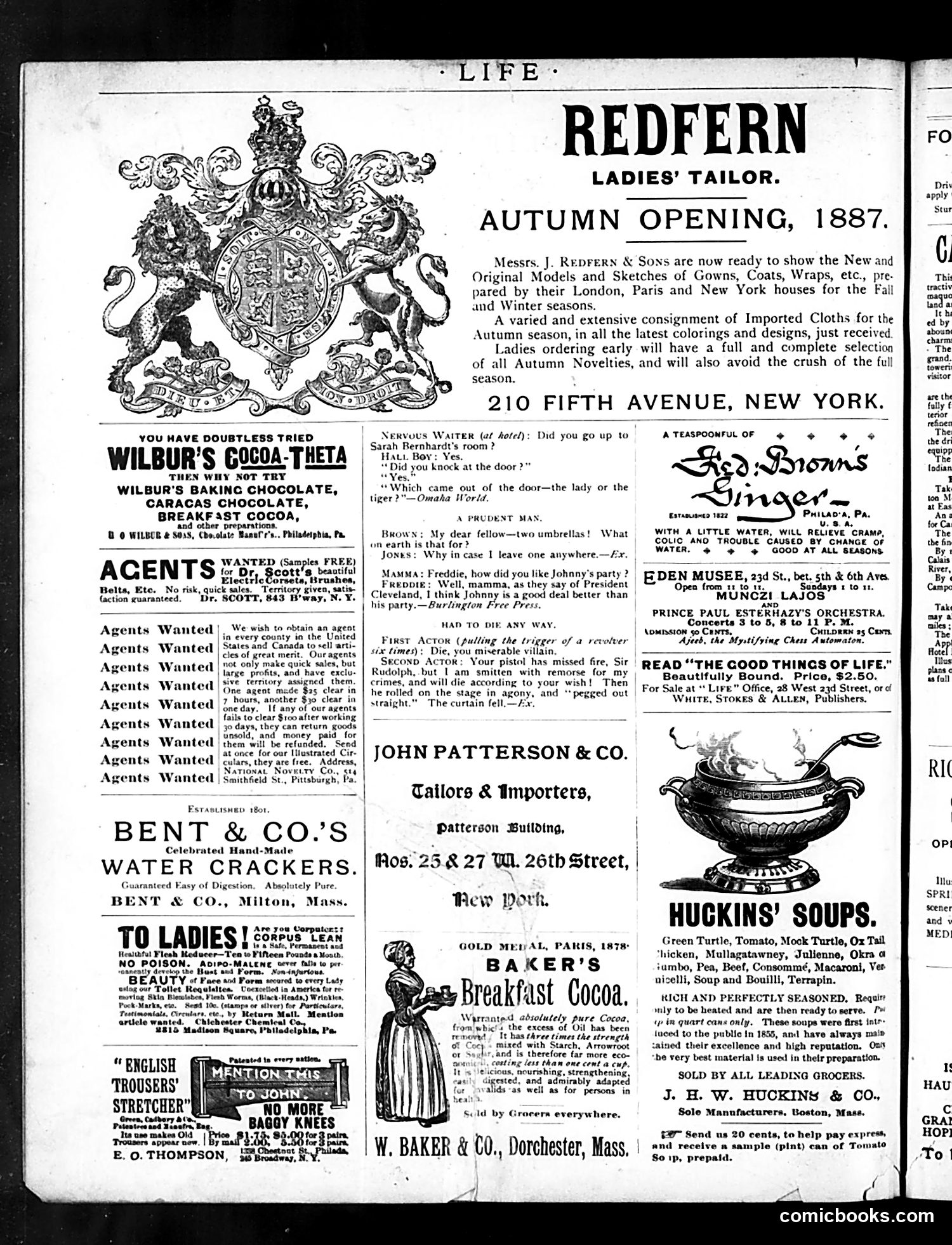
This page from *Life* magazine (1887) is almost entirely **commercial advertisements** rather than political satire or comics requiring historical context. The main content includes: - **Redfern Ladies' Tailor** advertisement (top): announces fall/winter fashions from their London, Paris, and New York design houses - **Various product ads**: Wilbur's cocoa, water crackers, chocolate, breakfast cocoa, beauty products, trouser anti-sagging devices - **Agent recruitment notices**: seeking salespeople across America The only **satirical content** appears to be brief humorous anecdotes: - A nervous hotel waiter joke about Sarah Bernhardt - A child's response comparing his friend Johnny to President Cleveland - A theatrical scene about an actor's faulty prop pistol These are generic jokes without specific political targets—the Cleveland reference is mild wordplay, not sharp satire. The page demonstrates *Life*'s mixed format of humor and paid advertising typical of late-19th-century magazines.
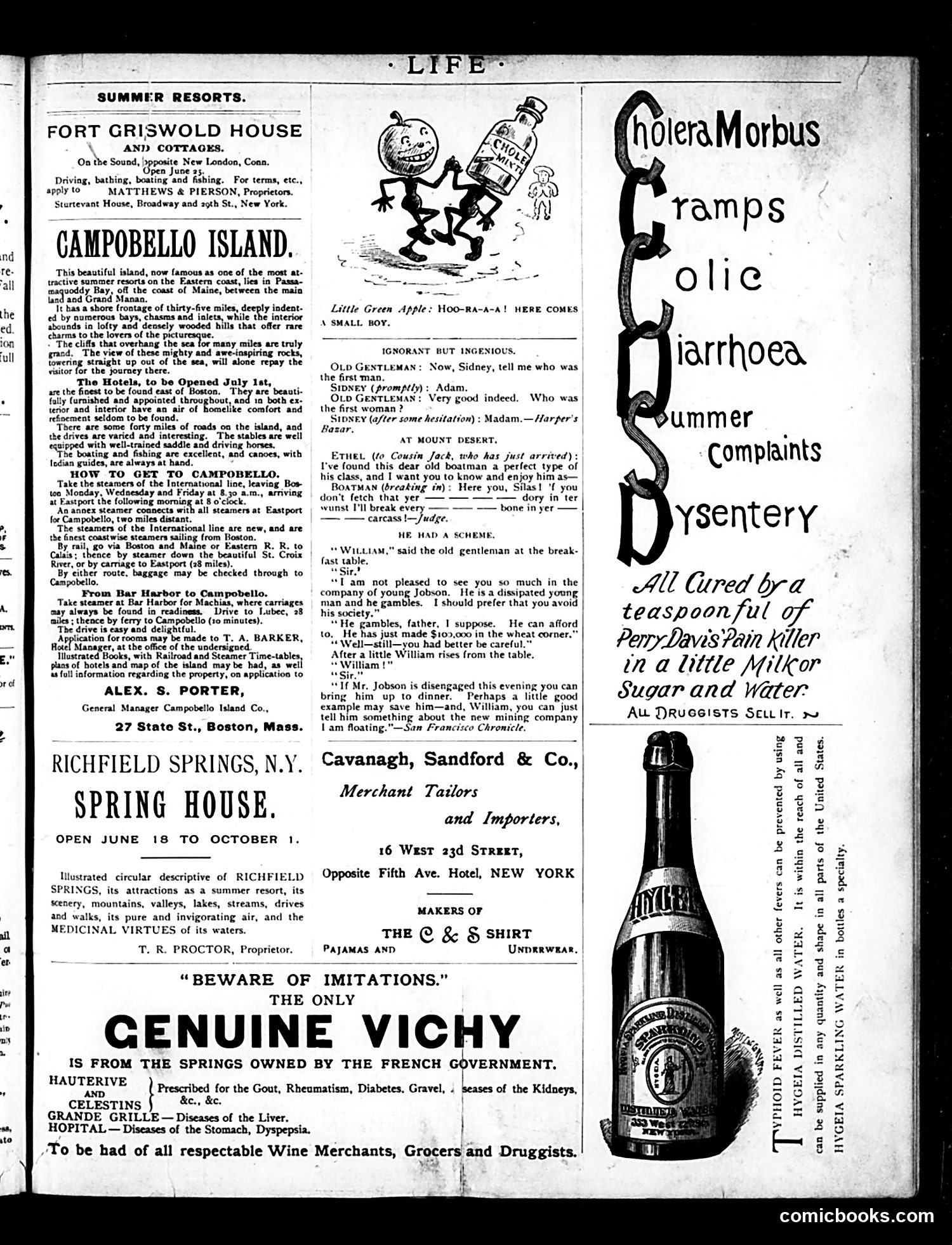
This page is primarily **advertising for summer resorts** rather than political satire. The dominant content includes promotional notices for vacation destinations (Fort Griswold House, Campobello Island, Richfield Springs) with detailed travel information. The page contains **three brief humorous sketches** rather than political cartoons: 1. **"Little Green Apple"** depicts a small boy anthropomorphized as fruit, establishing a visual pun. 2. **"Ignorant but Ingenious"** shows a child's innocent wordplay: when asked who was the "first man," the boy answers "Adam"; asked about the "first woman," he responds "Madam"—a homophone joke treating the title as a name. 3. **"At Mount Desert"** and **"He Had a Scheme"** appear to be dialogue-based humor pieces about social interactions at vacation spots. These are gentle domestic comedy sketches typical of *Life* magazine's lighter content, not satirical commentary. The page also advertises patent medicines and merchant tailors—standard period advertising.
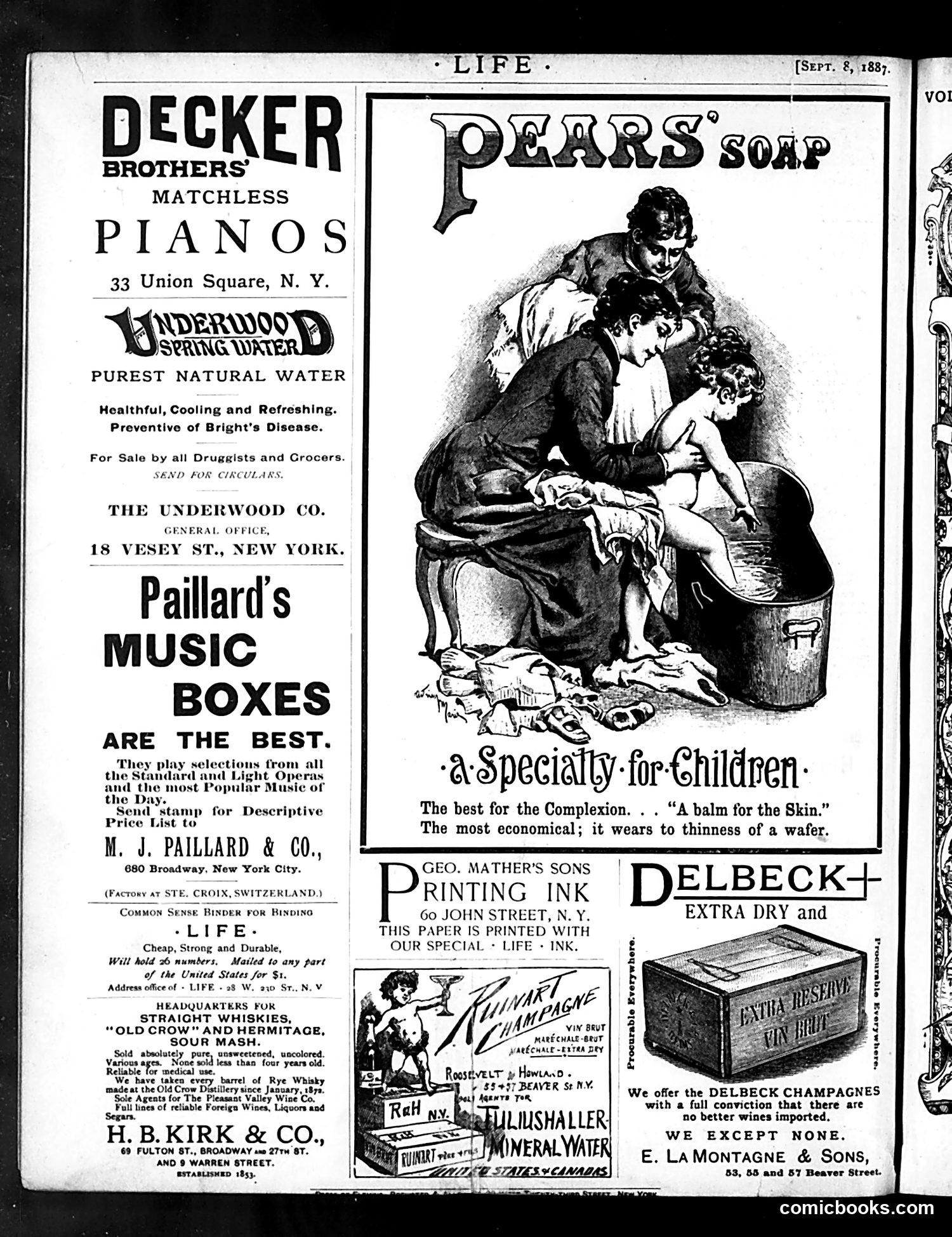
This page is **primarily advertising**, not editorial content or satire. It features commercial advertisements from the 1880s for consumer goods and services: pianos, spring water, music boxes, soap, champagne, whiskey, printing ink, and publication binders. The **only illustration with potential satirical content** is the Pears' Soap advertisement, which shows a woman bathing a child—a domestic scene marketing soap "for Children" as beneficial for complexion and skin. This reflects Victorian-era advertising conventions rather than political satire. The text emphasizes product quality claims typical of the period: "purest natural water," "healthful," and medical endorsements. The whiskey ad specifically notes its reliability "for medical use," reflecting late-19th-century attitudes toward alcohol as medicinal. This represents **Life magazine functioning as a commercial vehicle** rather than showcasing satirical cartoons or political commentary, which the magazine was otherwise known for.