
Life, 1887-09-08 · page 5 of 16
Life — September 8, 1887 — page 5: what you’re looking at
What you’re looking at
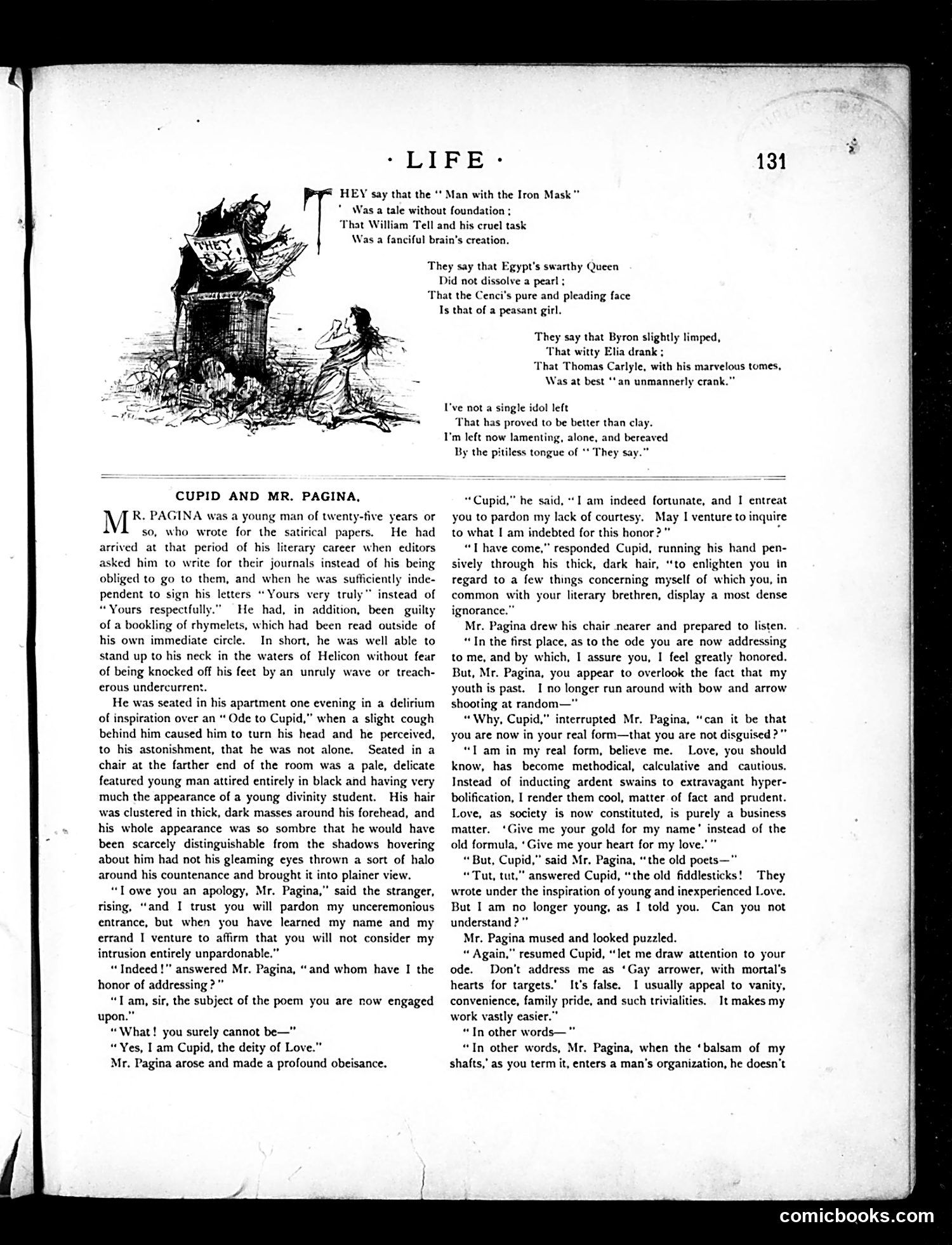
**The Poem (top):** A satirical attack on literary figures and famous stories. The author mocks tales like "The Man with the Iron Mask," William Tell, Cleopatra dissolving pearls, and Byron's limp, calling them fabrications. The final lines mock the phrase "They say," suggesting gossip and unfounded literary myths have replaced genuine artistry. **"Cupid and Mr. Pagina" (main story):** Satirizes a young satirical journalist who writes cynically about love and human nature. When Cupid (presented as an actual being) visits to challenge his worldview, Pagina defends his cold, calculated approach to life and relationships. The satire critiques modern skepticism and the reduction of human emotion to business logic—mocking the loss of romantic idealism in contemporary culture.
📄 Transcribed text from this page (OCR, searchable)
Machine-transcribed from the original scan — historical spelling and the odd misread are preserved.
> LI HEY say that the ‘ FE - * Man with the Iron Mask” Was a tale without foundation ; That William Tell and his cruel task Was a fanciful brain’s creation. They say that Egypt's swarthy Queen Did not dissolve a pearl ; ‘That the Cenci’s pure and pleading face CUPID AND MR. PAGINA, M R. PAGINA was a young man of twenty-five years or LVL 50, who wrote for the satirical papers. He had arrived at that period of his literary career when editors asked him to write for their journals instead of his being obliged to go to them, and when he was sufficiently inde- pendent to sign his letters “Yours very truly” instead of “Yours respectful He had, in addition, been guilty of a bookling of rhymelets, which had been read outside of his own immediate circle. In short, he was well able to stand up to his neck in the waters of Helicon without fear of being knocked off his feet by an unruly wave or treach- erous undercurrent. He was seated in his apartment one evening in a delirium of inspiration over an “ Ode to Cupid,” when a slight cough behind him caused him to turn his head and he perceived, to his astonishment, that he was not alone. Seated in a chair at the farther end of the room was a pale, delicate featured young man attired entirely in black and having very much the appearance of a young divinity student. His hair was clustered in thick, dark masses around his forehead, and his whole appearance was so sombre that he would have been scarcely distinguishable from the shadows hovering about him had not his gleaming eyes thrown a sort of halo around his countenance and brought it into plainer view. “LT owe you an apology, Mr. Pagina,” said the stranger, rising, “and I trust you will pardon my unceremonious entrance, but when you have learned my name and my errand I venture to affirm that you will not consider my intrusion entirely unpardonable.” “Indeed !" answered Mr. Pagina, “and whom have I the honor of addressing ?"” “Tam, sir, the subject of the poem you are now engaged upon.” “What! you surely cannot be—” “Yes, I am Cupid, the deity of Love.” Mr. Pagina arose and made a profound obeisance. Ts that of a peasant girl. They say that Byron slightly limped, That witty Elia drank ; ‘That Thomas Carlyle, with his marvelous tomes, Was at best ‘tan unmannerly crank.” I've not a single idol left ‘That has proved to be better than clay. I'm left now lamenting, alone, and bereaved By the pitiless tongue of * They say.” “Cupid,” he said, “I am indeed fortunate, and I entreat you to pardon my lack of courtesy. May I venture to inquire to what I am indebted for this honor?" . “T have come,” responded Cupid, running his hand pen- sively through his thick, dark hair, “to enlighten you in regard to a few things concerning myself of which you, in common with your literary brethren, display a most dense ignorance.” Mr. Pagina drew his chair nearer and prepared to listen. “In the first place, as to the ode you are now addressing to me, and by which, I assure you, I feel greatly honored. But, Mr. Pagina, you appear to overlook the fact that my youth is past. I no longer run around with bow and arrow shooting at random—" “Why, Cupid,” interrupted Mr. Pagina, “can it be that you are now in your real form—that you are not disguised?” “Iam in my real form, believe me. Love, you should know, has become methodical, calculative and cautious. Instead of inducting ardent swains to extravagant hyper- bolification, I render them cool, matter of fact and prudent. Love, as society is now constituted, is purely a business matter. ‘Give me your gold for my name’ instead of the old formula, ‘Give me your heart for my love.’”” “But, Cupid,” said Mr. Pagina, “the old poets—" “Tut, tut,” answered Cupid, “the old fiddlesticks! They wrote under the inspiration of young and inexperienced Love. But I am no longer young, as I told you. Can you not understand ?” Mr. Pagina mused and looked puzzled. “ Again,” resumed Cupid, “let me draw attention to your ode. Don't address me as ‘Gay arrower, with mortal's hearts for targets.’ It’s false. I usually appeal to vanity, convenience, family pride, and such trivialities. It makes my work vastly easier.” “In other words—” “In other words, Mr. Pagina, when the ‘balsam of my shafts,’ as you term it, enters a man’s organization, he doesn’t comicbooks.com