
Life, 1887-09-08 · page 6 of 16
Life — September 8, 1887 — page 6: what you’re looking at
What you’re looking at
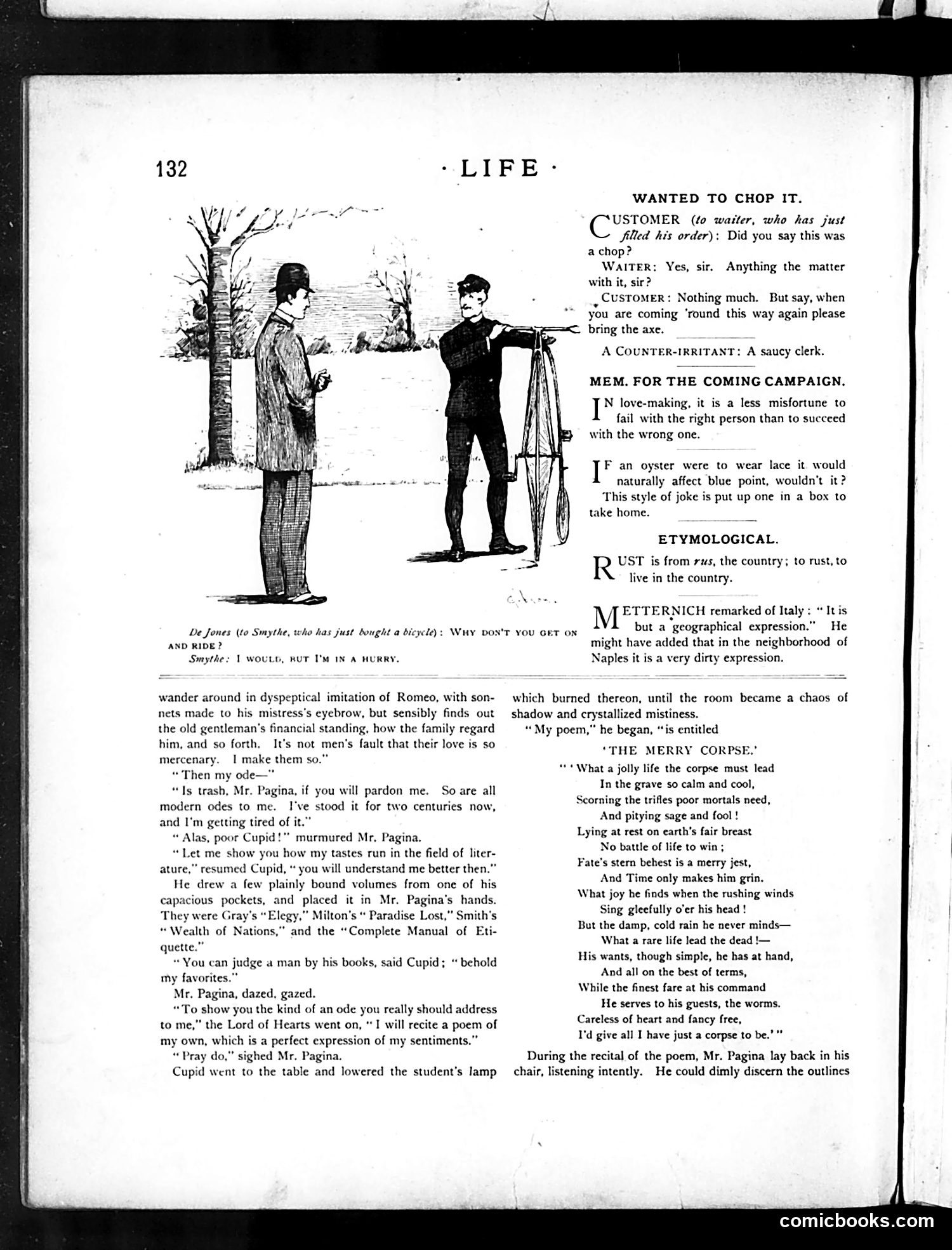
The main cartoon shows two men with a bicycle, titled "WANTED TO CHOP IT." The dialogue reveals a waiter has brought the wrong dish to a customer who ordered a chop. The customer sarcastically instructs the waiter to bring an axe next time—a visual joke playing on the double meaning of "chop" (food item versus cutting implement). Below this is comedic text about romance and an absurdist joke about an oyster wearing lace. The page also includes etymological notes and a poem titled "THE MERRY CORPSE," which appears to be satirical verse about death and life's ironies. The humor is typical of early-20th-century Life magazine: wordplay, social commentary on class (waiter/customer dynamics), and philosophical satire about mortality.
📄 Transcribed text from this page (OCR, searchable)
Machine-transcribed from the original scan — historical spelling and the odd misread are preserved.
De Jones (to Smythe, who has just bought a bicycle): NAY DON'T YOU GET ON AND RIDE? Smythe: | WoUuLb, RUT I'M IN A HURRY. wander around in dyspeptical imitation of Romeo, with son- nets made to his mistress’s eyebrow, but sensibly finds out the old gentleman's financial standing, how the family regard him, and so forth, It’s not men’s fault that their love is so mercenary. I make them so.” “Then my ode— “Is trash, Mr. Pagina, if you will pardon me. So are all modern odes to me. I've stood it for two centuries now, and I'm getting tired of it. “ Alas, poor Cupid!" murmured Mr. Pagina. “Let me show you how my tastes run in the field of liter- ature,” resumed Cupid, “ you will understand me better then.” He drew a few plainly bound volumes from one of his capacious pockets, and placed it in Mr. Pagina’s hands. They were Gray's “Elegy,” Milton's “ Paradise Lost,” Smith's “Wealth of Nations,” and the “Complete Manual of Eti- quette.” “You can judge a man by his books, said Cupid; “ behold my favorites.” Mr. Pagina, dazed, gazed. » show you the kind of an ode you really should address to me,” the Lord of Hearts went on, “I will recite a poem of my own, which is a perfect expression of my sentiments.” “ Pray do,” sighed Mr. Pagina. Cupid went to the table and lowered the student's lamp WANTED TO CHOP IT. USTOMER (¢o watter, who has just filled his order): Did you say this was a chop? WAITER: Yes, sir. with it, sir? Cus! ‘OMER: Nothing much. But say, when you are coming ‘round this way again please bring the axe. Anything the matter A COUNTER-IRRITANT: A saucy clerk. MEM. FOR THE COMING CAMPAIGN, N love-making, it is a less misfortune to fail with the right person than to succeed with the wrong one. ]F an oyster were to wear lace it. would naturally affect blue point, wouldn't it? This style of joke is put up one in a box to take home. ETYMOLOGICAL. UST is from rus, the country; to rust, to live in the country. ETTERNICH remarked of Italy ; “ It is but a “geographical expression.” He might have added that in the neighborhood of Naples it is a very dirty expression. M which burned thereon, until the room became a chaos of shadow and crystallized mistiness. “My poem,” he began, “‘is entitled ‘THE MERRY CORPSE.’ “What a jolly life the corpse must lead In the grave so calm and cool, Scorning the trifles poor mortals need, And pitying sage and fool! Lying at rest on earth's fair breast No battle of life to win; Fate's stern behest is a merry jest, And Time only makes him grin. What joy he finds when the rushing winds Sing gleefully o'er his head ! But the damp, cold rain he never minds— What a rare life lead the dead !— His wants, though simple, he has at hand, And all on the best of terms, While the finest fare at his command He serves to his guests, the worms. Careless of heart and fancy free, I'd give all I have just a corpse to be.’ During the recital of the poem, Mr. Pagina lay back in his chair, listening intently. He could dimly discern the outlines | comicbooks.com