
Life, 1887-09-08 · page 2 of 16
Life — September 8, 1887 — page 2: what you’re looking at
What you’re looking at
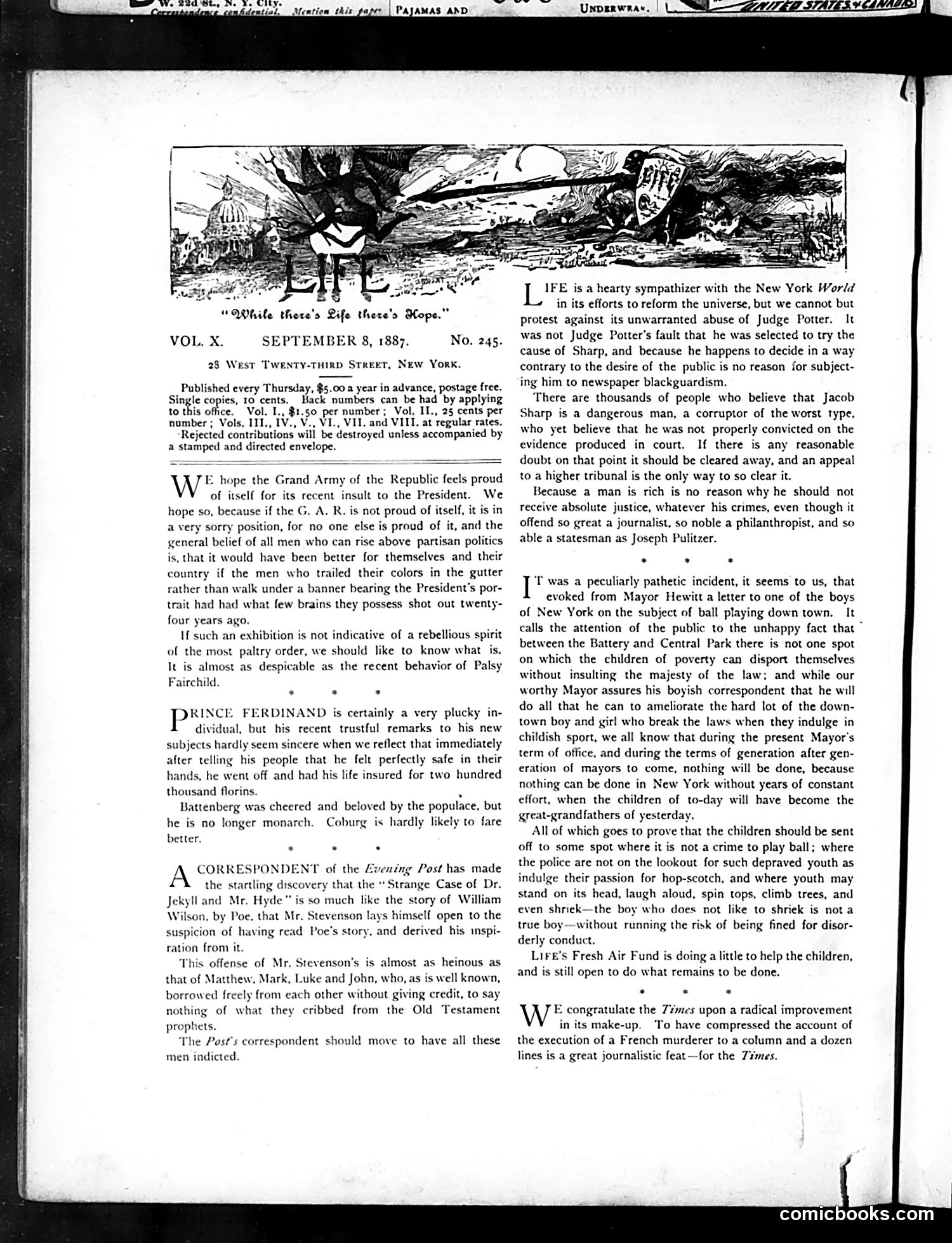
**The Cartoon:** The masthead illustration shows a figure labeled "Life" standing amid classical ruins and turmoil, with the caption "While there's Life there's Hope." **The Content:** The editorial discusses Judge Potter's role in prosecuting Jacob Sharp, a political figure accused of corruption. Life argues Sharp deserves fair trial despite public suspicion of his guilt, and that only appeal to higher courts can clear doubts about his conviction. Other pieces critique Prince Ferdinand's political instability in Europe; praise the Times newspaper for its coverage of a French murderer's execution; and discuss Mayor Hewitt's efforts to improve conditions for poor children in New York City. The overall tone reflects Life's role as a reformist satirical publication addressing contemporary political corruption and urban social issues.
📄 Transcribed text from this page (OCR, searchable)
Machine-transcribed from the original scan — historical spelling and the odd misread are preserved.
BIE Shey SV. Mention this | Pajamas AND Unpgrwras. | |_SL-—2h STATES FOE VOL. X. SEPTEMBER 8, 1887. 28 West TweNTy-THIRD STREET, NEw York. No. 245. Published every Thursday, $5.00 a year in advance, postage free. Single copies, 10 cents. Back numbers can be had by applying to this ofhice. 50 per number; Vol. II., 25 cents per number ; ,V., VL, VIL. and VIII, at regular rates. Rejected contributions will be destroyed unless accompanied by a stamped and directed envelope. W hope the Grand Army of the Republic feels proud of itself for its recent insult to the President. We hope so, because if the G. A. R. is not proud of itself, it is in a very sorry position, for no one else is proud of it, and the general belief of all men who can rise above partisan politics is, that it would have been better for themselves and their country if the men who trailed their colors in the gutter rather than walk under a banner bearing the President's por- trait had had what few brains they possess shot out twenty- four years ago. If such an exhibition is not indicative of a rebellious spirit of the most paltry order, we should like to know what is. It is almost as despicable as the recent behavior of Palsy Fairchild. * . . RINCE FERDINAND is certainly a very plucky in- dividual, but his recent trustful remarks to his new subjects hardly seem sincere when we reflect that immediately after telling his people that he felt perfectly safe in their hands, he went off and had his life insured for two hundred thousand florins. . Battenberg was cheered and beloved by the populace, but he is no longer monarch. Coburg is hardly likely to fare better. CORRESPONDENT of the ning Post has made the startling discovery that the “ Strange Case of Dr. Jekyll and Mr. Hyde” is so much like the story of William Wilson, by Poe, that Mr. Stevenson lays himself open to the suspicion of having read Poe's story, and derived his inspi- ration from it. This offense of Mr. Stevenson's is almost as heinous as that of Matthew, Mark, Luke and John, who, as is well known, borrowed freely from each other without giving credit, to say nothing of what they cribbed from the Old Testament prophets. ‘The Post's correspondent should move to have all these men indicted. IFE is a hearty sympathizer with the New York World in its efforts to reform the universe, but we cannot but Protest against its unwarranted abuse of Judge Potter. It was not Judge Potter’s fault that he was selected to try the cause of Sharp, and because he happens to decide in a way contrary to the desire of the public is no reason for subject- ing him to newspaper blackguardism. There are thousands of people who believe that Jacob Sharp is a dangerous man, a corruptor of the worst type, who yet believe that he was not properly convicted on the evidence produced in court. If there is any reasonable doubt on that point it should be cleared away, and an appeal to a higher tribunal is the only way to so clear it. Because a man is rich is no reason why he should not receive absolute justice, whatever his crimes, even though it offend so great a journalist, so noble a philanthropist, and so able a statesman as Joseph Pulitzer. . . . I’ was a peculiarly pathetic incident, it seems to us, that evoked from Mayor Hewitt a letter to one of the boys of New York on the subject of ball playing down town. It calls the attention of the public to the unhappy fact that” between the Battery and Central Park there is not one spot on which the children of poverty can disport themselves without insulting the majesty of the law; and while our worthy Mayor assures his boyish correspondent that he will do all that he can to ameliorate the hard lot of the down- town boy and girl who break the laws when they indulge in childish sport, we all know that during the present Mayor's term of office, and during the terms of generation after gen- eration of mayors to come, nothing will be done, because nothing can be done in New York without years of constant effort, when the children of to-day will have become the great-grandfathers of yesterday. All of which goes to prove that the children should be sent off to some spot where it is not a crime to play ball; where the police are not on the lookout for such depraved youth as indulge their passion for hop-scotch, and where youth may stand on its head, laugh aloud, spin tops, climb trees, and even shriek—the boy who does not like to shriek is nota true boy—without running the risk of being fined for disor- derly conduct. Lire’s Fresh Air Fund is doing a little to help the children, and is still open to do what remains to be done. E congratulate the 7¢mes upon a radical improvement in its make-up. To have compressed the account of the execution of a French murderer to a column and a dozen lines is a great journalistic feat—for the 7zmes. comicbooks.com