
A complete issue · 16 pages · 1887
Life — August 25, 1887
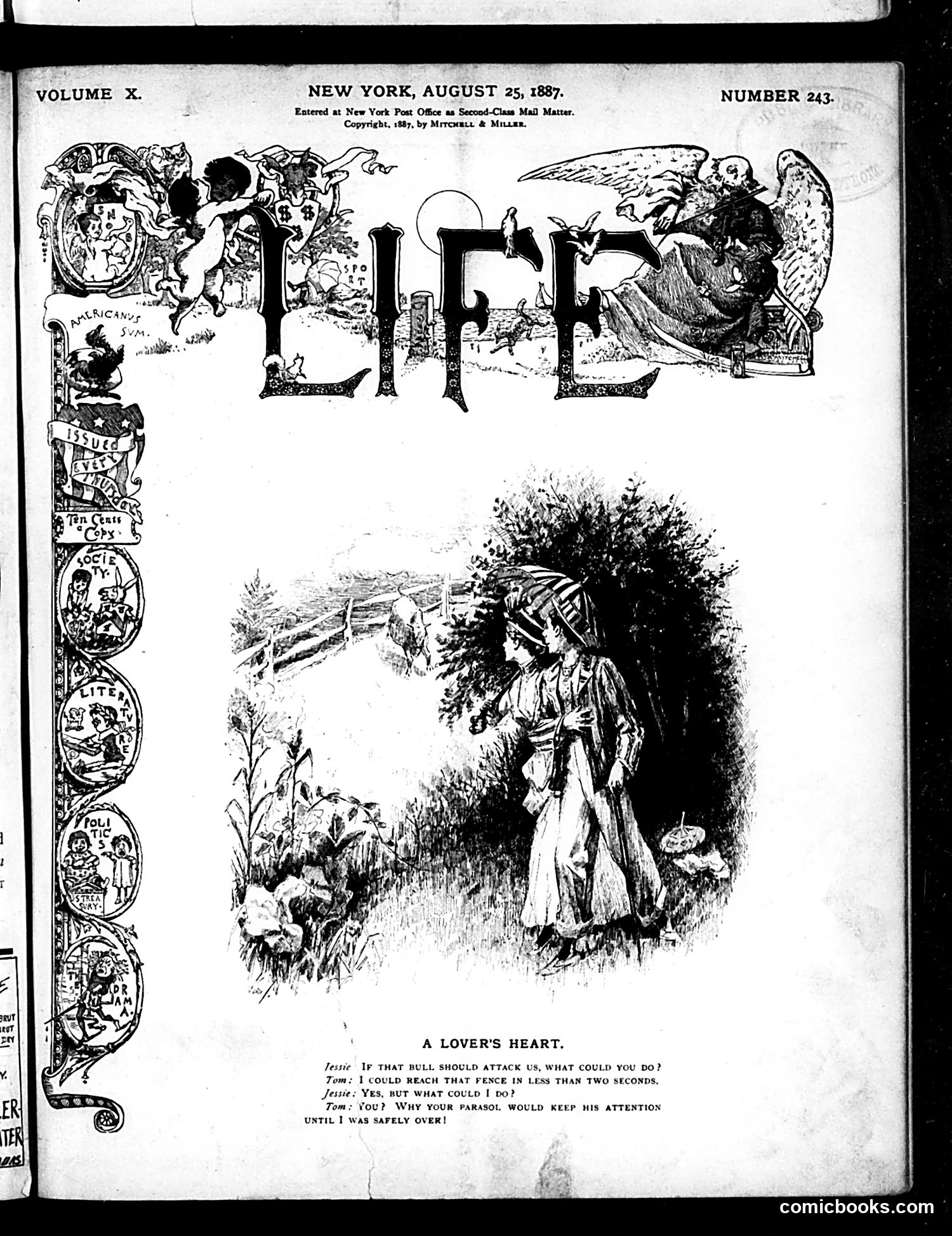
This page features a romantic illustration titled "A Lover's Heart," depicting a couple in a rural setting. The dialogue presents a playful domestic scenario: when Jessie asks Tom what he'd do if a bull attacked them, Tom confidently claims he'd reach the fence in two seconds. Jessie skeptically responds that his parasol wouldn't help, and Tom admits he'd need the parasol to keep her attention during the escape. The humor relies on a Victorian-era romantic trope: the stereotype of male gallantry being secondary to male self-preservation, and the woman's focus remaining on romantic attention even during danger. The ornate decorative border and earnest illustration style were typical of Life's satirical approach to mocking sentimental romantic conventions of the period.
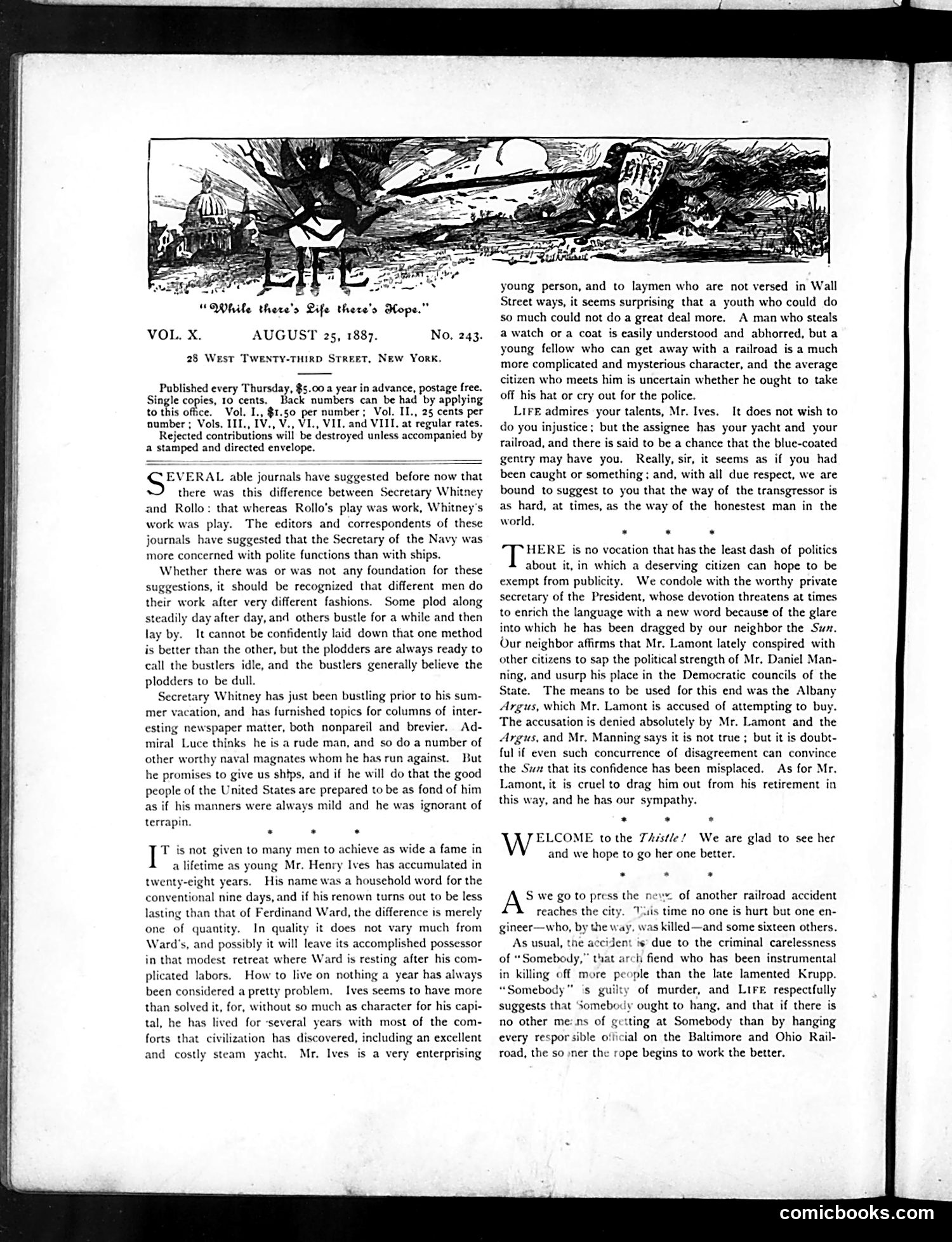
The cartoon's header reads "While there's Life there's Mops"—a play on the proverb "while there's life there's hope." The image appears to be a satirical landscape scene, though specific figures are difficult to identify clearly in this reproduction. The text discusses Secretary of the Navy Whitney and his administrative work, comparing him to previous naval secretaries Rollo and others. It references debates about whether Navy administrative positions require specialized naval expertise versus political appointment. The article also discusses railroad accidents and criticism of railroad officials for safety negligence, with mention of the "Baltimore and Ohio Railroad" and calls for accountability. The overall tone critiques both political appointees and corporate responsibility for public safety.
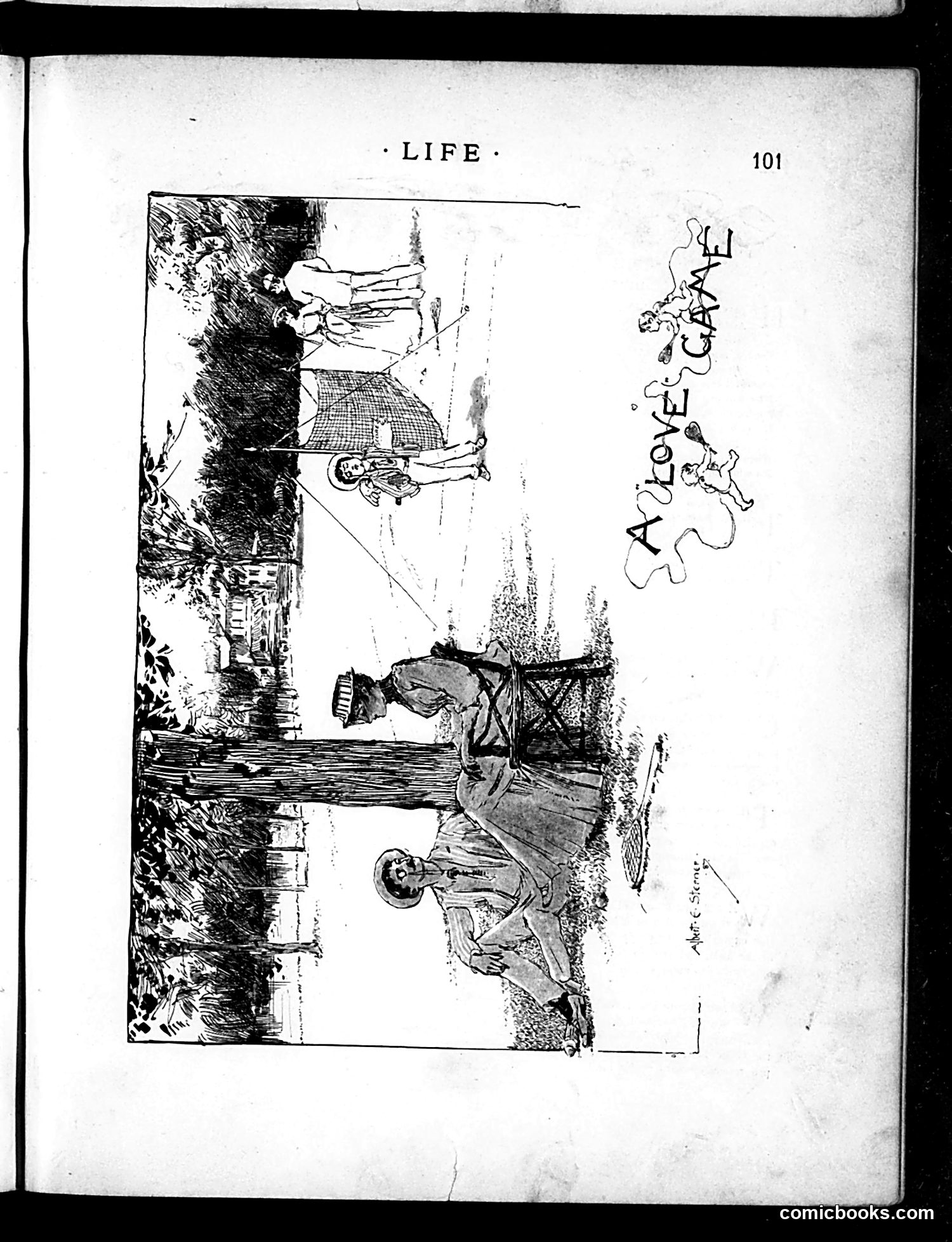
This appears to be a satirical sketch showing a domestic dispute scene. The title "A Lover's Quarrel" suggests commentary on romantic or marital conflict. The image shows figures in what appears to be an interior setting with period furnishings, rotated 90 degrees on the page. Without clearer visibility of specific identifying details or accompanying article text, I cannot definitively identify which particular public figures or events this cartoon references. The style and presentation suggest it's social satire typical of *Life* magazine's humor—likely poking fun at relationship dynamics or courtship customs of the era. The artwork credit appears present but is not clearly legible in this reproduction.
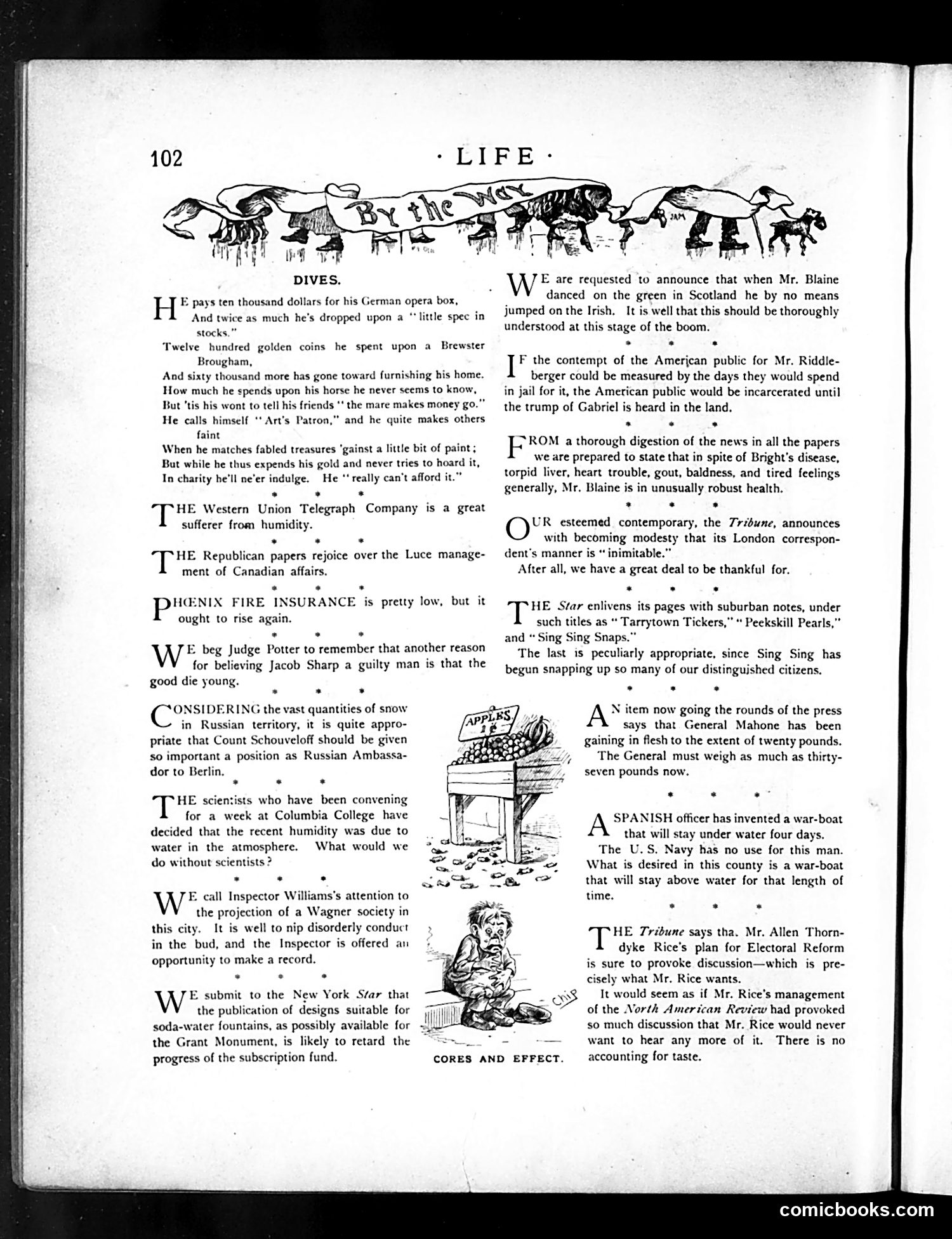
This page contains **satirical commentary on contemporary figures and events**, not political cartoons per se. The text references: - **Mr. Blaine** dancing in Scotland and jumping on the Irish—appearing to mock a public figure's behavior - **Mr. Riddelberger**'s potential jail time (context unclear from this excerpt) - **Mr. Bright's disease** and health issues - **General Mahone** gaining weight (twenty to thirty-seven pounds) - **A Spanish officer's** submarine invention The two illustrations labeled "**CORKS AND EFFECT**" appear to show a figure in distress or comic situations, likely supporting specific satirical commentary in the left column's "DIVES" section. Without fuller context about dates and specific political figures referenced, the precise targets remain partially unclear, though the magazine's intent to mock public figures' follies and absurdities is evident.
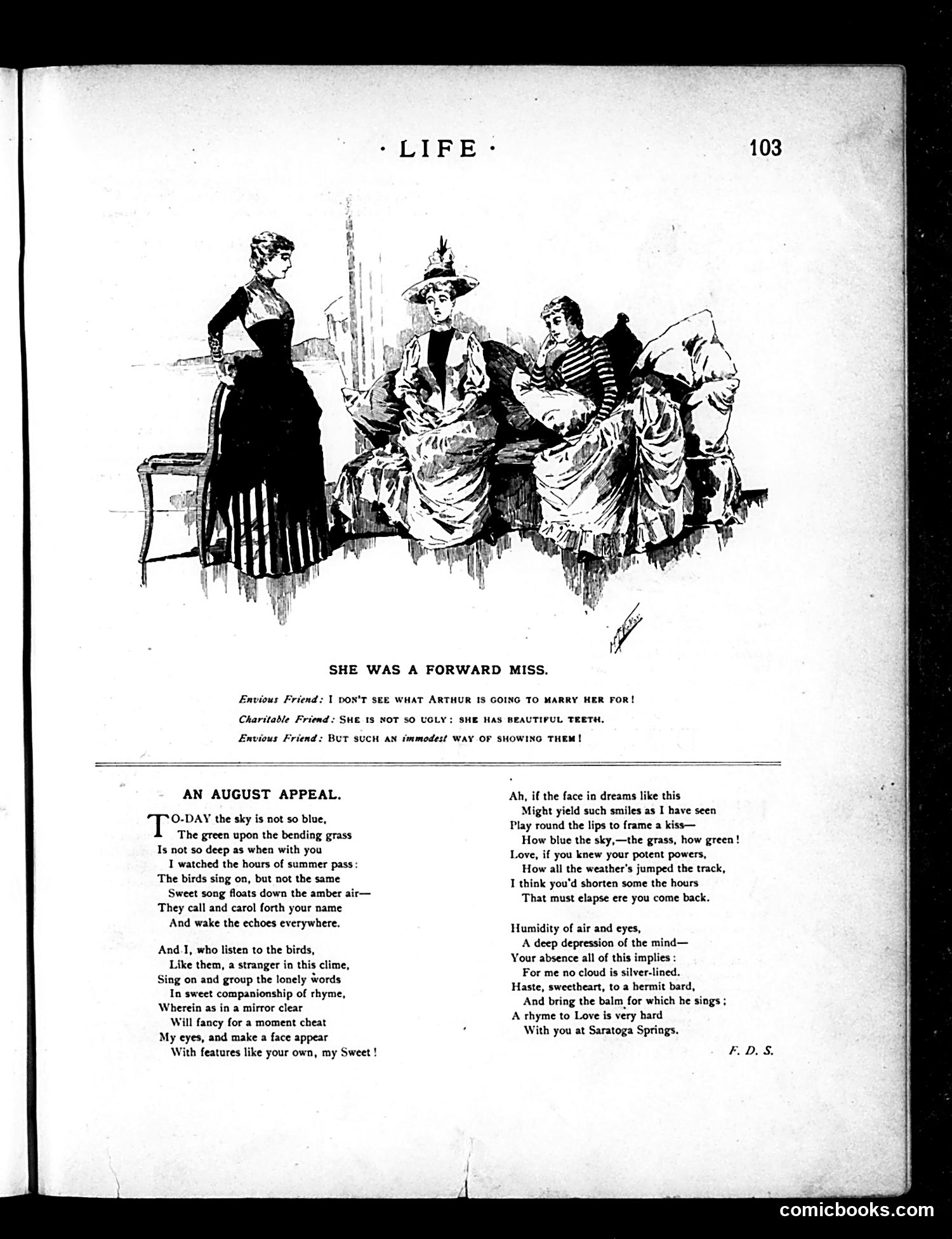
The top cartoon "She Was a Forward Miss" satirizes changing social conventions around courtship and propriety. Three scandalized friends gossip about a woman's inappropriate behavior: she shows her teeth when smiling (considered immodest), has beautiful teeth (drawing male attention), and worst—displays them openly (suggesting boldness or impropriety). The joke targets Victorian-era attitudes about feminine modesty. A woman visibly smiling with exposed teeth was considered "forward" or sexually aggressive by contemporary standards. Below, "An August Appeal" is a romantic poem signed "F.D.S." addressed to someone absent at Saratoga Springs (a fashionable resort). It expresses longing and melancholy during summer separation. The page reflects early-1900s social attitudes about gender presentation and romantic sentimentality.
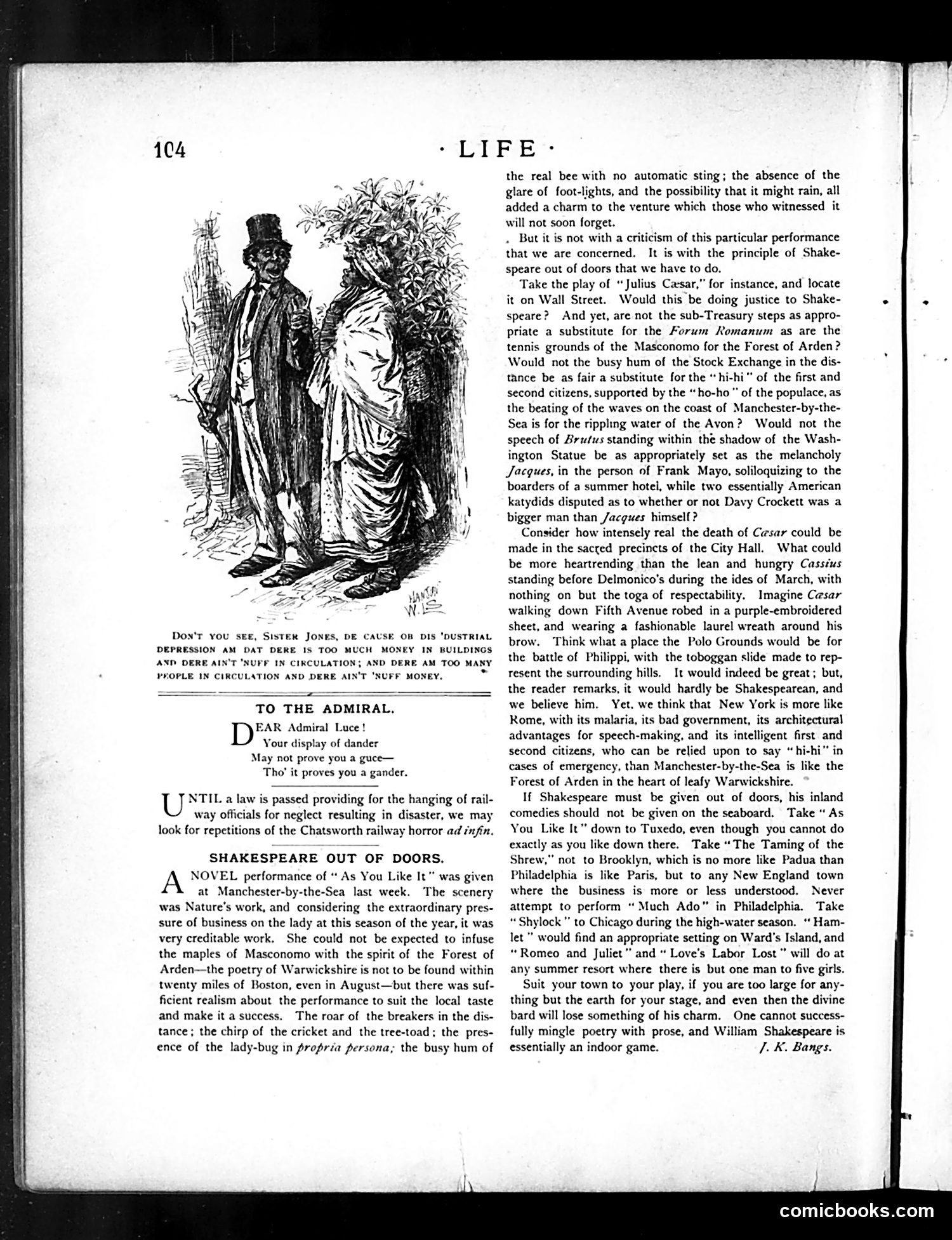
The main illustration shows two caricatured figures in period dress, likely representing characters from Shakespeare. Below the image is a caption critiquing the practice of performing Shakespeare outdoors in unconventional locations. The articles criticize contemporary attempts to stage Shakespeare plays outside traditional theaters—particularly "As You Like It" performed at Manchester-by-the-Sea. The authors argue that Shakespeare requires proper theatrical venues and that outdoor productions or performances in unsuitable locations (beaches, city streets, etc.) diminish the work's impact. The satire targets what appears to be an early 20th-century trend of popularizing Shakespeare through unconventional staging. The piece suggests such attempts, while well-intentioned, fundamentally misunderstand that Shakespeare is "essentially an indoor game" requiring professional theatrical conditions to succeed artistically.
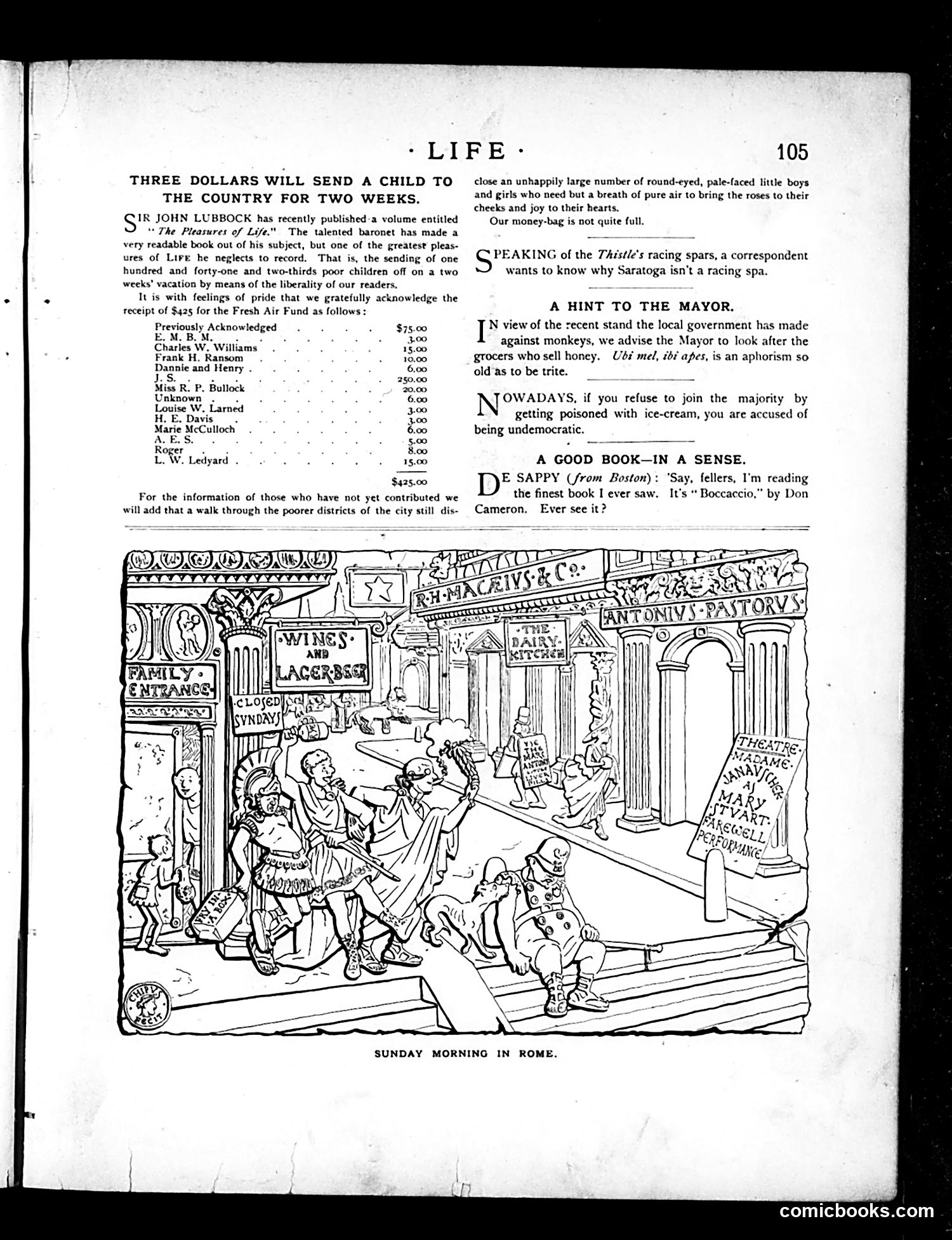
The page contains satirical commentary and a classical illustration titled "Sunday Morning in Rome." **Top Section:** Brief humorous social commentary including jabs at: - Local government inefficiency ("A Hint to the Mayor") - Food safety concerns (honey being sold as old/spoiled) - Political conformity (criticizing those who refuse ice-cream poisoning as "undemocratic") **Main Illustration:** A detailed engraving depicting a crowded Roman marketplace or forum with classical architecture. Multiple figures—merchants, citizens, and what appear to be performers or street vendors—interact in a busy public space. The scene illustrates everyday life in ancient Rome with period-appropriate dress and architectural elements (columns, storefronts). The illustration serves as visual contrast to the modern satirical commentary above, exemplifying Life's typical format mixing contemporary social satire with classical or historical imagery for effect.
This appears to be an illustration from *Life* magazine showing a theatrical or fantastical scene. The image depicts several figures in period costume (appearing to be 18th or 19th century dress) gathered around what looks like an elaborate oriental pagoda or Asian-inspired structure. The figures include winged beings (possibly angels or allegorical characters) and people in elaborate clothing. Without clearer context or visible caption text, the specific satirical target is unclear. It may reference contemporary theatrical productions, orientalism trends in American culture, or a political allegory involving Asian affairs—common *Life* magazine subjects. The ornate, chaotic composition and theatrical staging suggest social satire, but the precise meaning requires additional contextual information not fully legible in this reproduction.
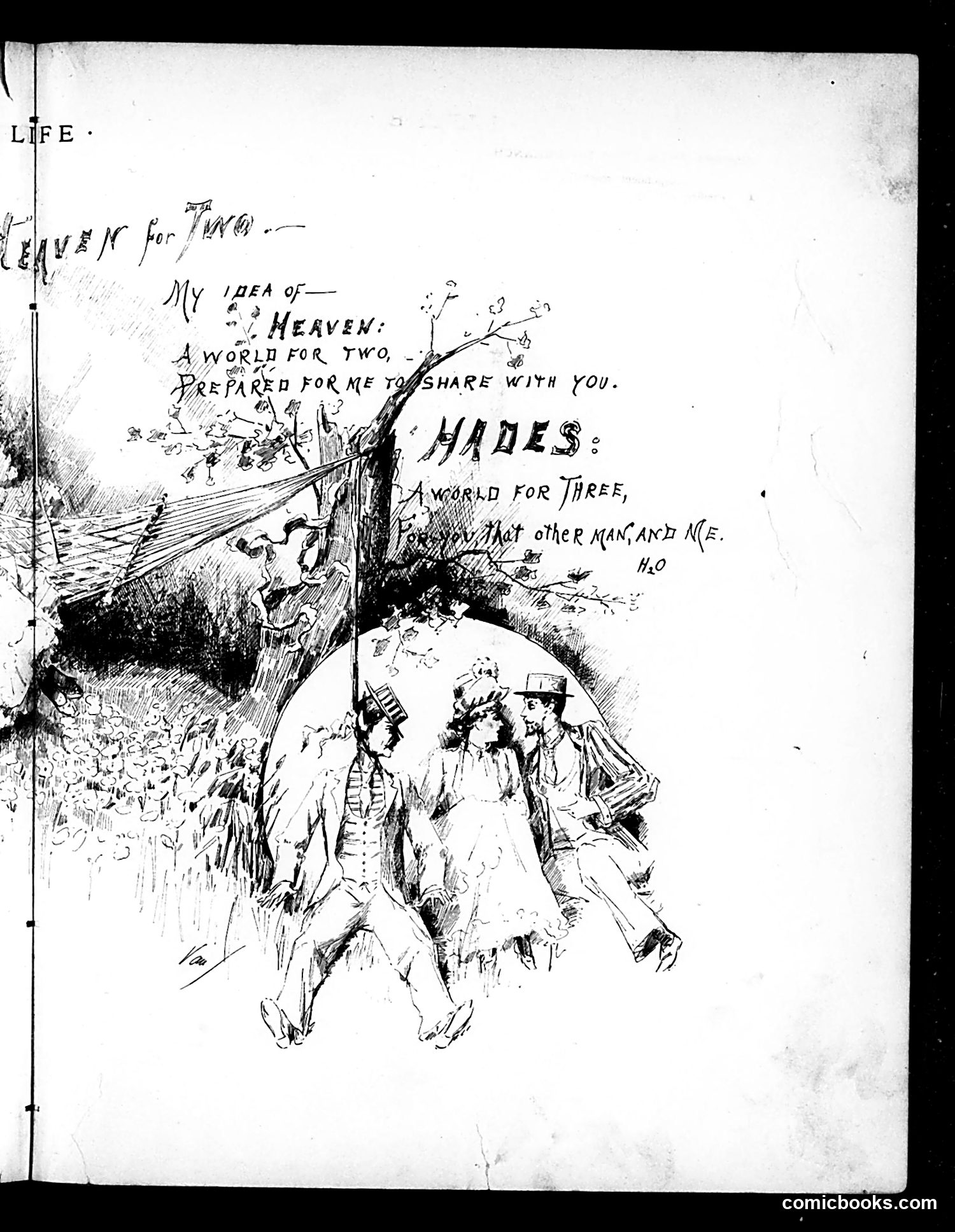
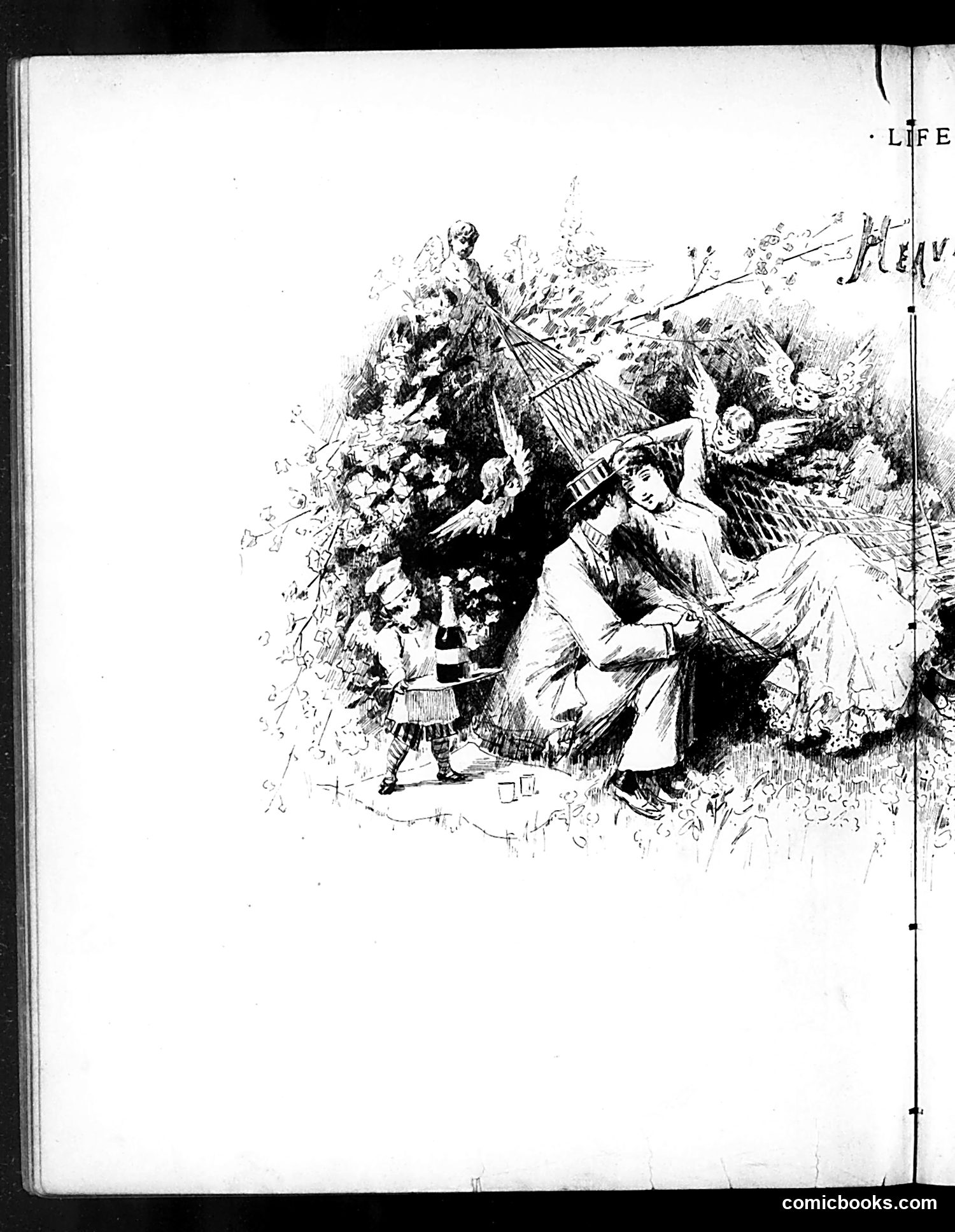
This page presents a satirical poem titled "Life" about visions of the afterlife. The text describes three heavenly scenarios: - **Heaven for Two**: A world prepared for the speaker and addressee to share - **Hades for Three**: A world for "all that other man and wife" The accompanying sketch shows three figures beneath a gnarled tree—two women and a man in period dress—suggesting a romantic triangle or domestic entanglement. The illustration satirizes the eternal consequences of infidelity or complicated romantic relationships, treating them as worthy of afterlife judgment. This appears to be Victorian-era social satire mocking romantic complications and morality through the lens of religious cosmology. Without visible publication date context, the specific references remain somewhat unclear, but the humor targets domestic scandal and relationship drama.
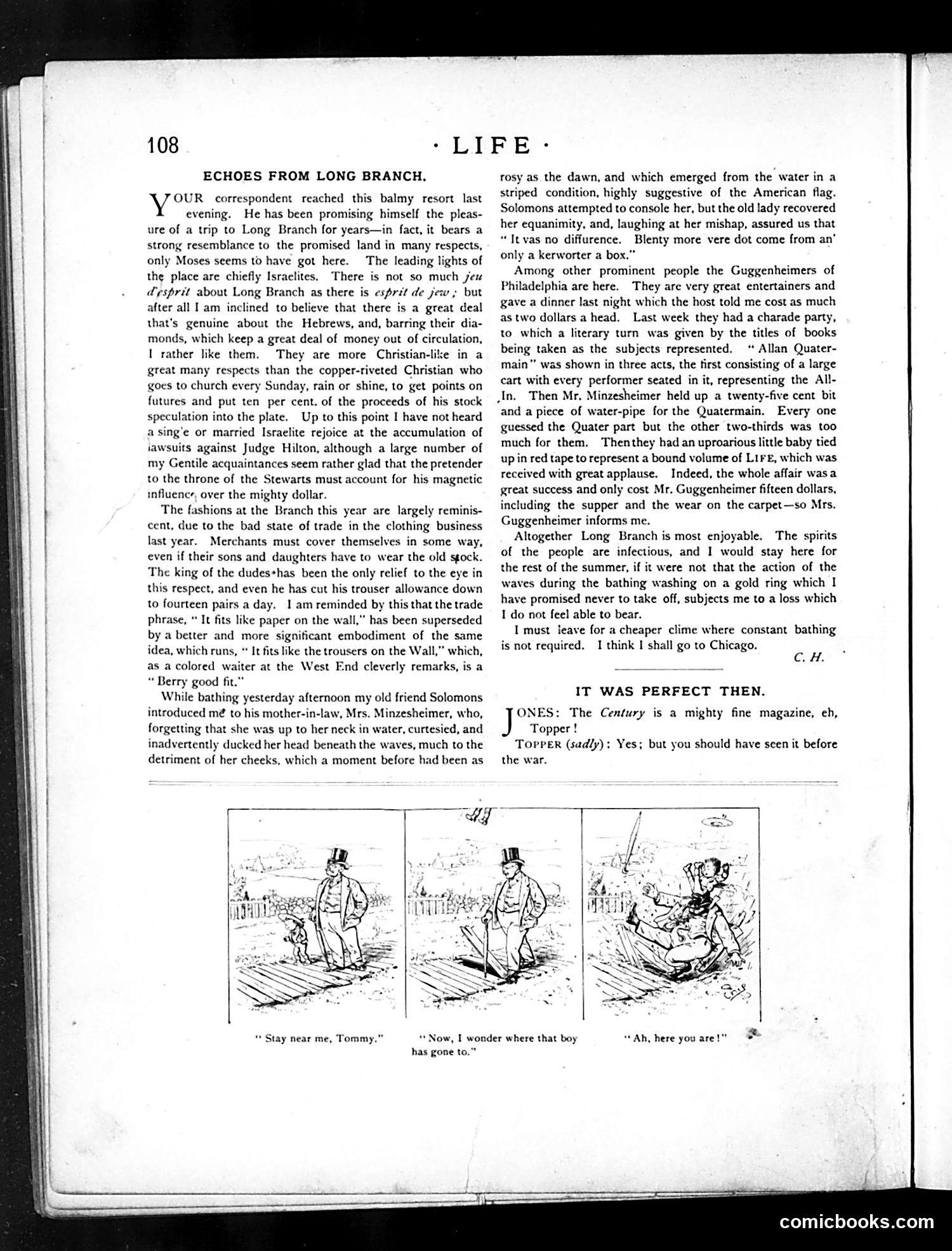
This page contains two distinct sections: **Upper section:** A letter titled "Echoes from Long Branch" describes a resort visit. The writer discusses local Jewish merchants, fashion trends, and social activities including a charade party featuring "Allan Quartermain" performed with props. The piece satirizes resort life and fashion conventions of the era, noting women's clothing restrictions and commenting on Jewish business practices with period-typical stereotyping. **Lower section:** A three-panel comic strip shows a man in a top hat with a small boy. The sequence reads "Stay near me, Tommy" / "Now, I wonder where that boy has gone to" / "Ah, here you are!" The humor relies on the boy repeatedly disappearing and reappearing, playing on adult-child dynamics and supervision. The overall tone reflects typical late-19th/early-20th century American satirical magazine content.
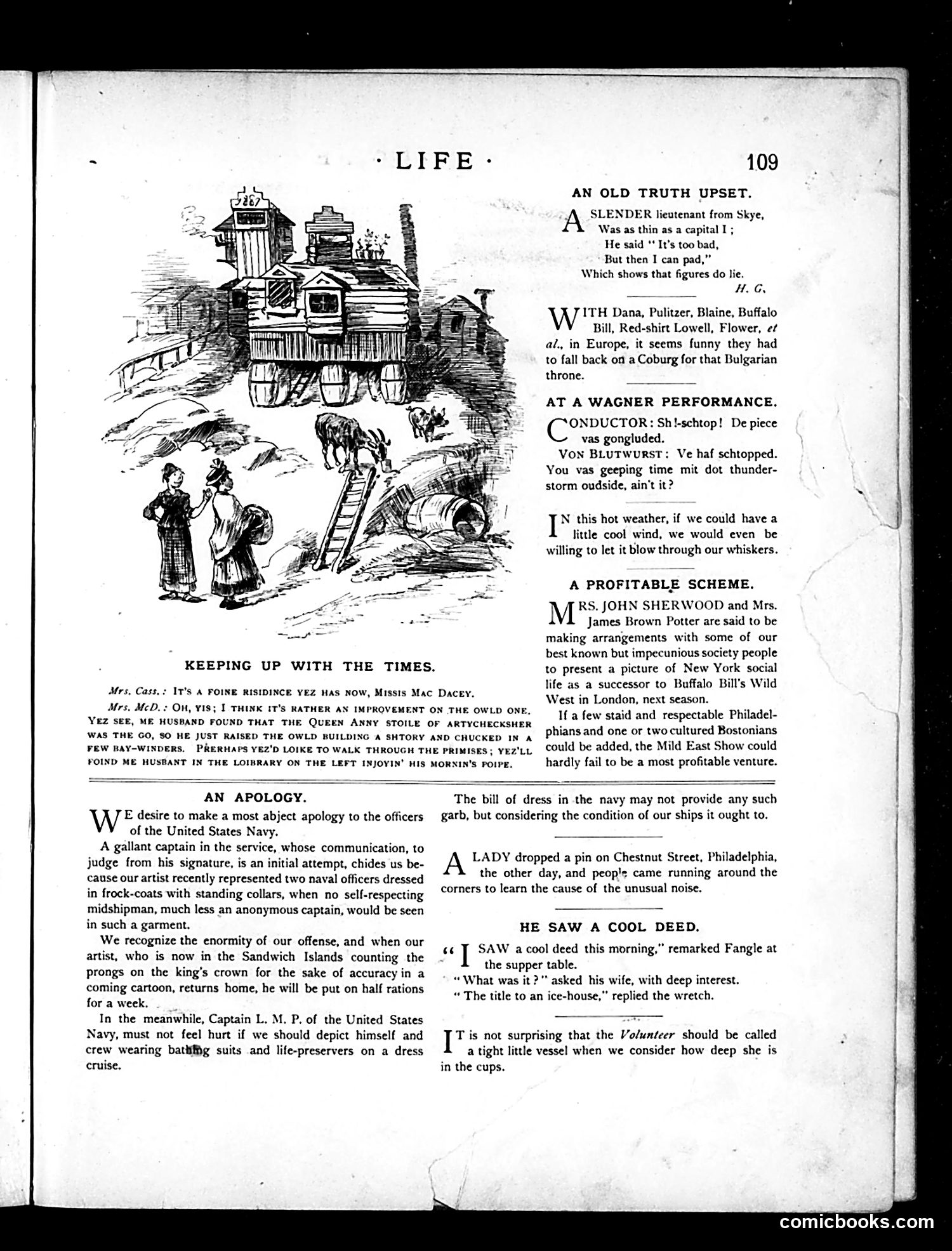
This page contains several brief satirical pieces typical of Life magazine's humor: **"Keeping Up with the Times"** depicts two Irish working-class women discussing home improvements, with thick dialect humor. One woman's husband added a story to their building using "Queen Anne style" architecture—satirizing how ordinary people adopt fashionable architectural trends without understanding them. **"At a Wagner Performance"** mocks German immigrants through caricatured dialect and names (Von Blutwurst), joking that they kept time with thunder rather than the conductor during the complex opera. **"A Profitable Scheme"** satirizes wealthy New Yorkers planning to exhibit high-society life as entertainment (like Buffalo Bill's Wild West Show), suggesting even adding "staid" Philadelphians and "cultured Bostonians" for authenticity. The remaining items are brief wordplay jokes about a pin dropped in Philadelphia and naval dress codes. The humor relies on ethnic stereotypes, puns, and social commentary typical of 1880s-90s American satire.
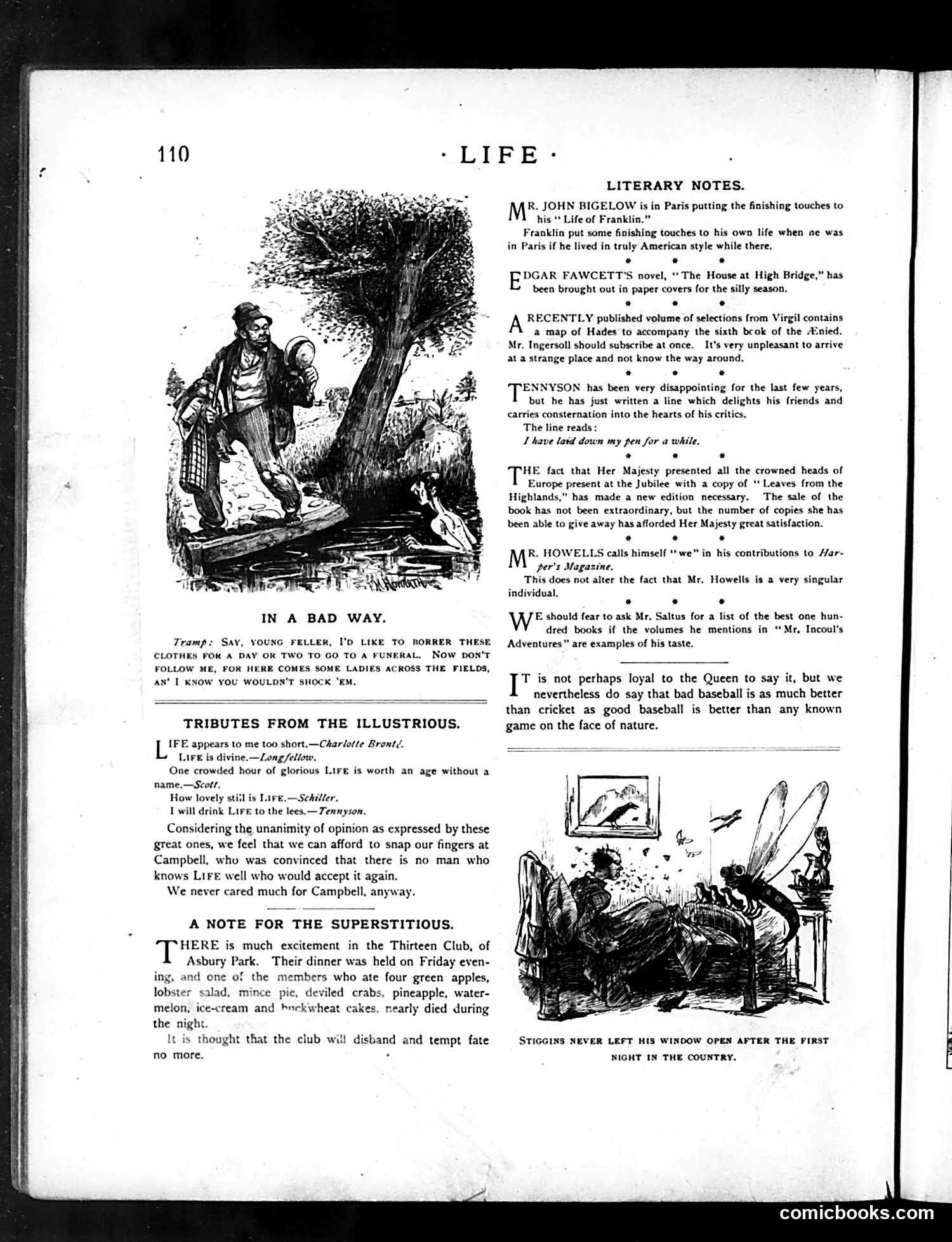
**The Cartoon ("In a Bad Way"):** A tramp attempts to borrow a well-dressed man's clothes for a funeral, explicitly asking him not to follow because ladies are approaching—the joke being that the tramp plans to use the respectable outfit for some disreputable purpose, not an actual funeral. It's satirizing both class pretense and dishonesty. **Literary Notes Section:** This is pure satirical commentary on contemporary authors and literary figures: - Mocks biographer John Bigelow's "Life of Franklin" - Jokes that Tennyson's announcement he's stopped writing (taking a break) delights critics - References Robert Ingersoll (likely the agnostic lecturer) needing directions to Hades - Praises Queen Victoria's gift copies of "Leaves from the Highlands," sarcastically noting the extraordinary sales were achieved only through royal generosity **The Superstitious Note:** Mocks the "Thirteen Club" (an actual group that deliberately defied superstitions), suggesting a member's near-fatal illness from excessive food validates superstition—ironic humor about scientific skepticism versus folk belief.
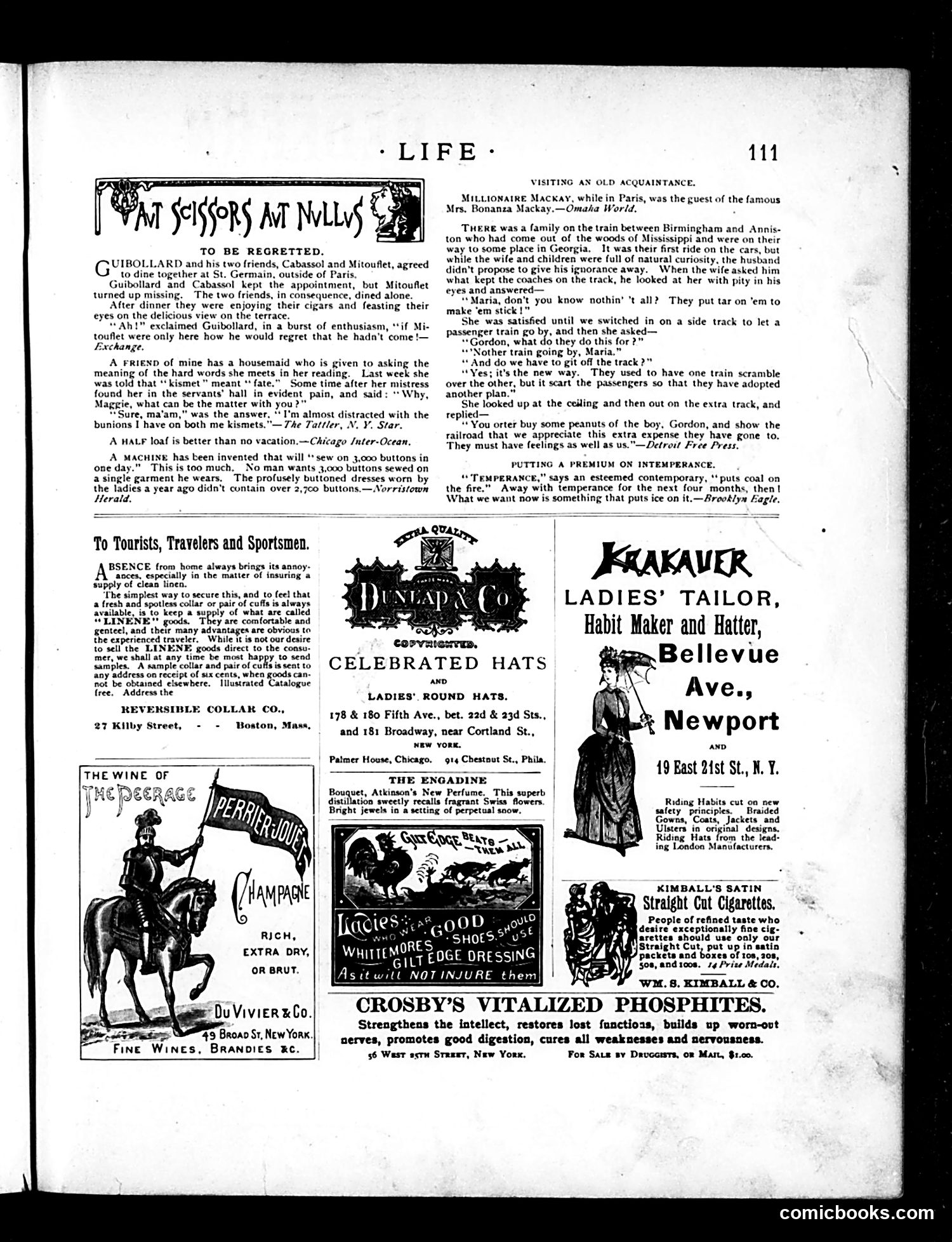
This page is primarily **advertisements and brief humorous anecdotes** rather than political cartoons. The main content consists of short joke pieces typical of Life's satirical style: - **"Fat Señors at Nullas"**: A mild anecdote about French diners regretting a friend's absence - **Servant's malapropism**: A housemaid confuses "kismet" (fate) with "kismets" (her bunions) - **Train dialogue**: A rural Mississippi family on their first train ride, with the ignorant father explaining that tar keeps coaches on tracks - **Millionaire society gossip**: A brief reference to wealthy New Yorkers visiting Paris The **advertisements** dominate—featuring wine, hats, tailoring services, cigarettes, and patent medicines. These ads reveal period consumer culture. The humor relies on **class and regional stereotypes**: rural ignorance, servant incompetence, and wealthy social pretension. No specific political events are referenced. This is typical Life content: light satirical sketches mocking ordinary social situations rather than serious political commentary.
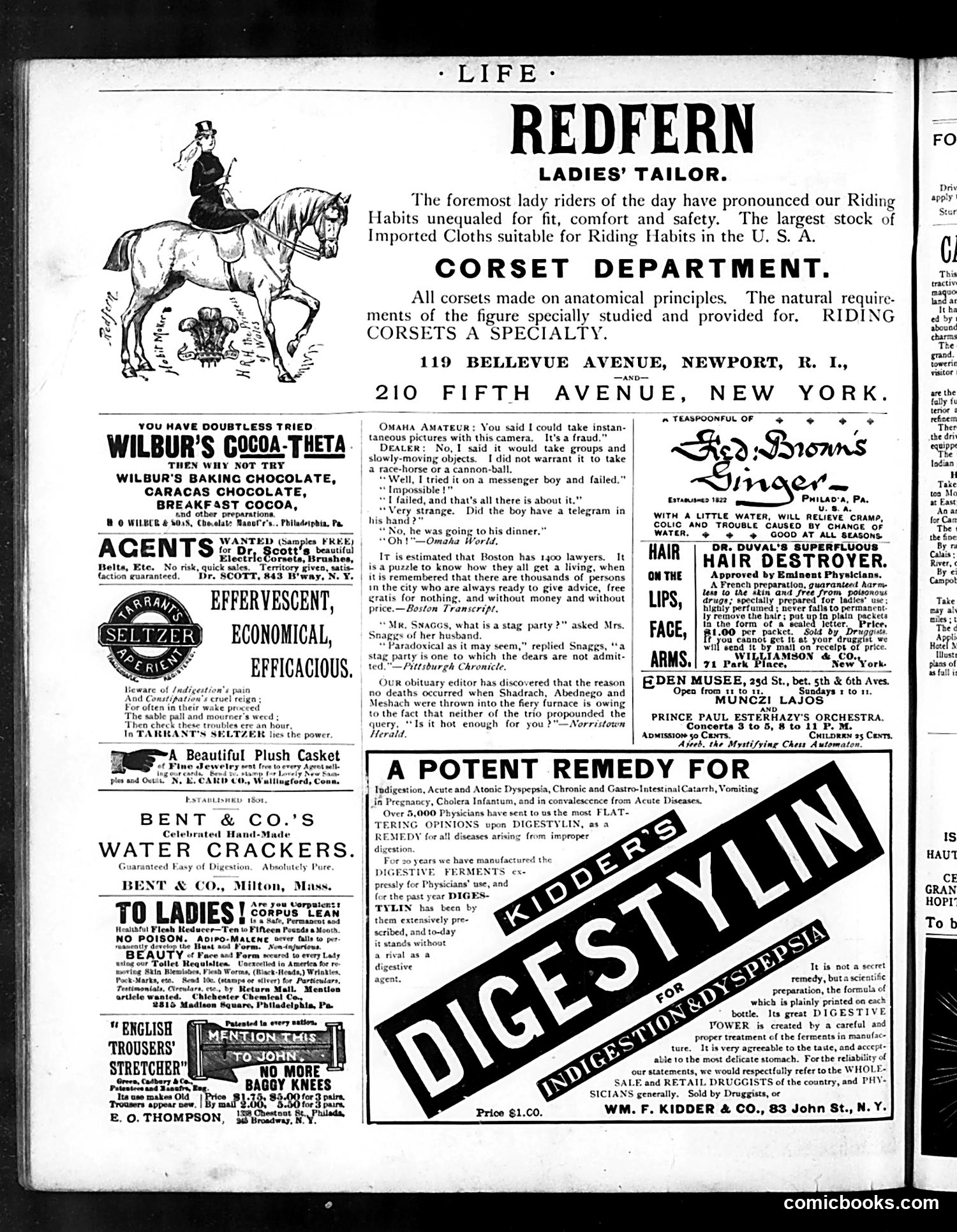
This page is primarily **advertising**, typical of late 19th-century American magazines. The main content consists of commercial notices for various products and services, with minimal editorial material. **Notable elements:** The large central advertisement for "Kidders Digestite" promotes a patent medicine claiming to cure numerous gastrointestinal ailments. Such remedies were common in this era, before FDA regulation of medical claims. Small humorous anecdotes appear, including an "Omaha Amateur" joke about a defective camera and a "Mr. Snaggs" joke about a "stag party" (a men-only social gathering). These reflect period social customs. **Featured advertisements** include riding habits from Redfern (a prestigious ladies' tailor), corsets emphasizing "anatomical principles," and various beauty/health products—hair removers, flesh reducers, and digestive aids—reflecting Victorian-era concerns about appearance and health. The page reflects advertising practices and consumer anxieties of the period rather than containing political satire or caricatures. It's essentially a commercial product showcase dressed in satirical magazine format.
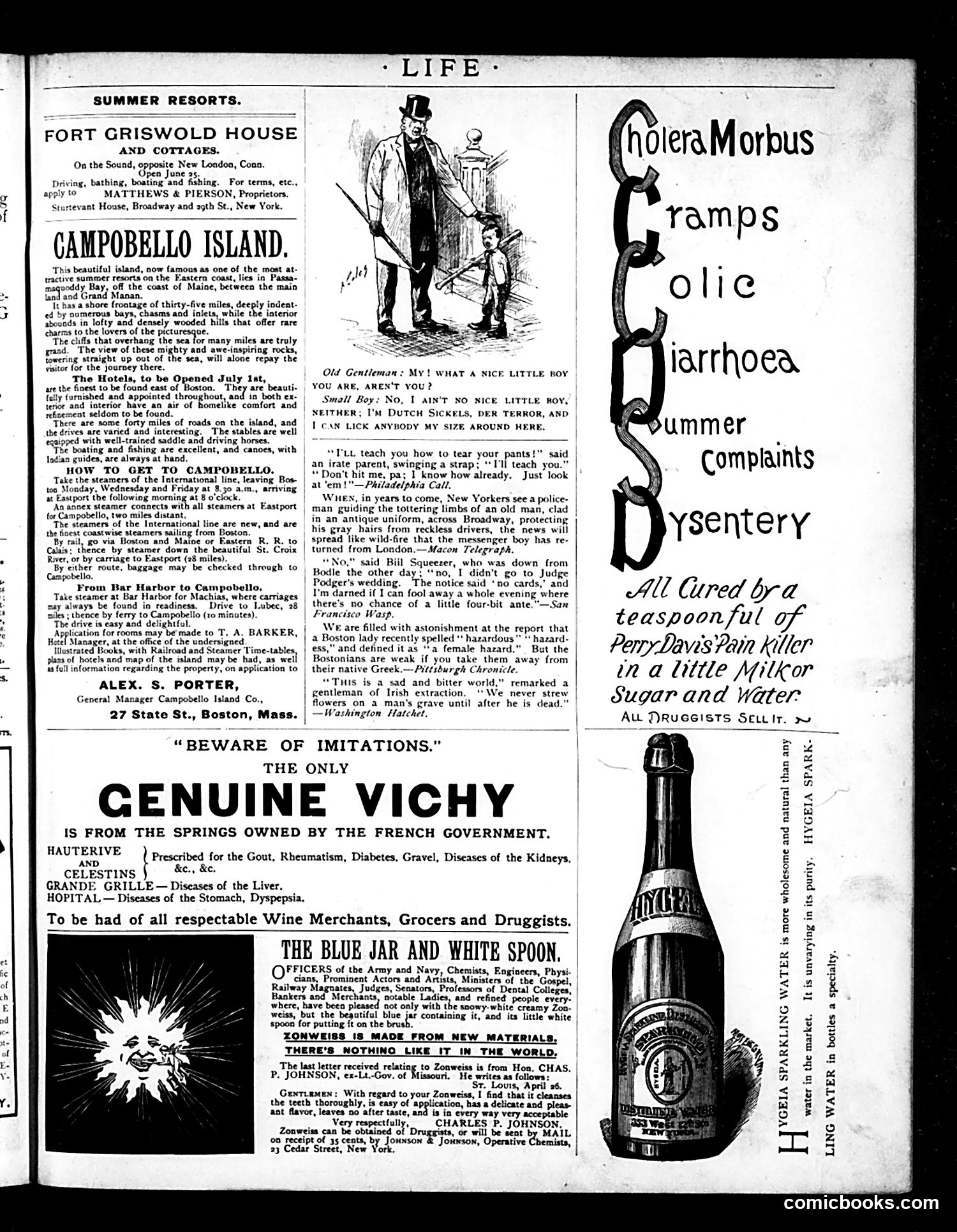
This page is primarily **advertising and humor**, not political satire. The dominant content includes resort advertisements (Fort Griswold House, Campobello Island) and patent medicine ads (Vichy water, Perry Davis Pain Killer). The cartoon/humor section features three brief jokes about **street urchins and working-class behavior**: 1. A "Dutch Sickels" character bragging he can tear his own pants (satirizing poor children's clothing) 2. A joke about a future messenger boy returning from London 3. A story about "Bill Squeezer" avoiding a wedding with "no cards" (no gambling) These are gentle, observational humor pieces mocking lower-class manners and young street boys' behavior—typical of *Life* magazine's satirical style. The central illustration shows a genteel older man with a street child, reinforcing the class-contrast humor. There's no clear political reference; this appears to be a standard issue mixing travel advertisements with lighthearted social commentary.
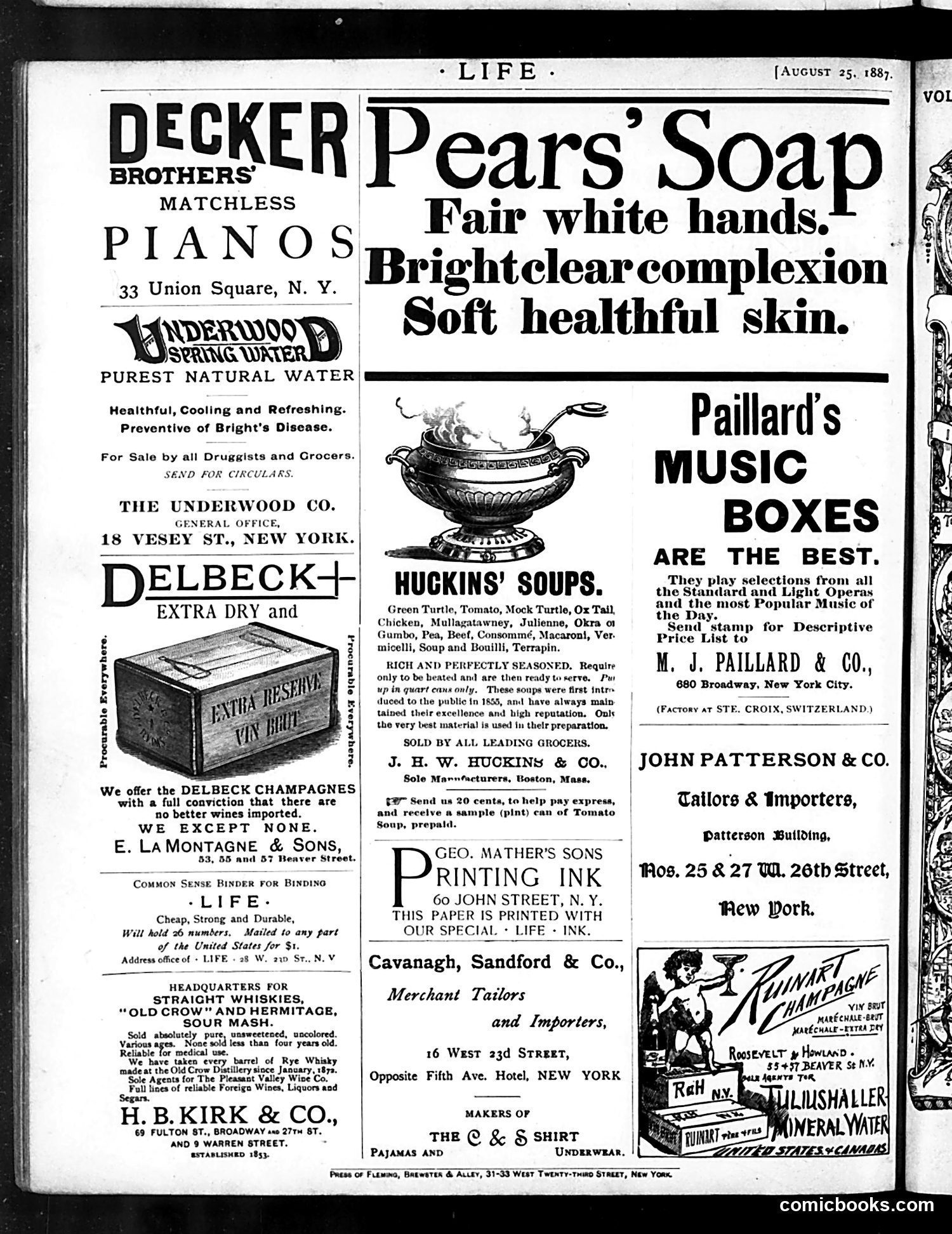
This is primarily an **advertisement page** with no visible political cartoons or satirical content. The page consists entirely of commercial ads from late-19th-century businesses. Notable advertisements include: - **Pears' Soap** (prominent): Marketed with claims of producing "fair white hands" and "bright clear complexion"—reflecting Victorian beauty standards emphasizing pale skin - **Delbeck Champagne**, **Underwood Spring Water**, and **Old Crow Whiskey**: Luxury beverages - **Huckins' Soups**: Canned soups advertised as pre-made convenience foods - **Paillard Music Boxes**: Mechanical music devices - Various **tailoring services** for wealthy New York clientele The ads reveal 1880s consumer culture, manufacturing capabilities, and social aspirations. No satire or political commentary is present—this is a straightforward commercial page from Life magazine's advertising section.