
Life, 1887-08-25 · page 6 of 16
Life — August 25, 1887 — page 6: what you’re looking at
What you’re looking at
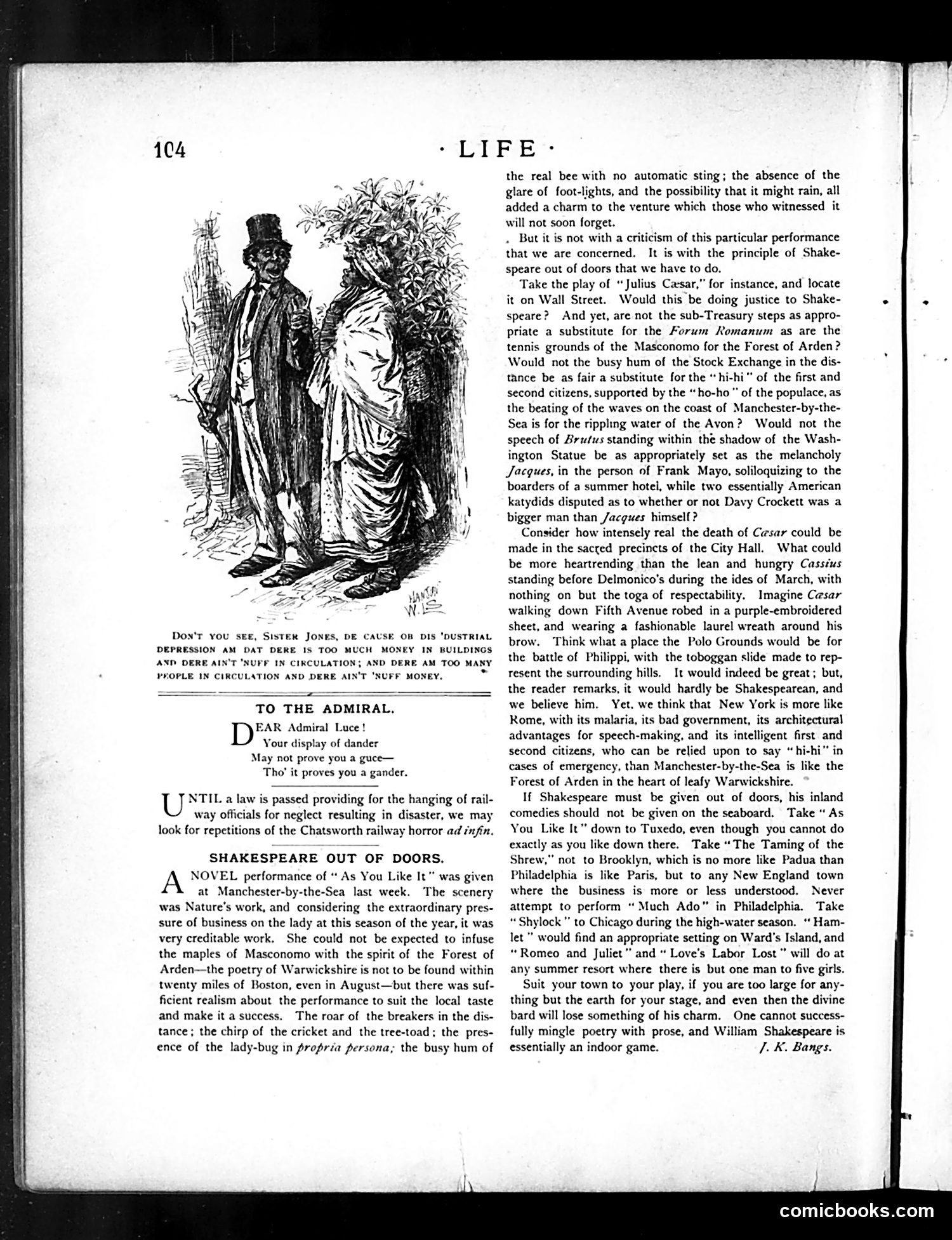
The main illustration shows two caricatured figures in period dress, likely representing characters from Shakespeare. Below the image is a caption critiquing the practice of performing Shakespeare outdoors in unconventional locations. The articles criticize contemporary attempts to stage Shakespeare plays outside traditional theaters—particularly "As You Like It" performed at Manchester-by-the-Sea. The authors argue that Shakespeare requires proper theatrical venues and that outdoor productions or performances in unsuitable locations (beaches, city streets, etc.) diminish the work's impact. The satire targets what appears to be an early 20th-century trend of popularizing Shakespeare through unconventional staging. The piece suggests such attempts, while well-intentioned, fundamentally misunderstand that Shakespeare is "essentially an indoor game" requiring professional theatrical conditions to succeed artistically.
📄 Transcribed text from this page (OCR, searchable)
Machine-transcribed from the original scan — historical spelling and the odd misread are preserved.
- LIFE: Doy'r You See, SISTER JONES, DE CAUSE OB DIS 'DUSTRIAL DEPRESSION AM DAT DERE 1S TOO MUCH MONEY IN BUILDINGS AND DERE AIN'T ‘NUFF IN CIRCULATION; AND DERE AM TOO MANY PROPLE IN CIRCULATION AND DERE AIN'T 'NUFF MONEY. " TO THE ADMIRAL. EAR Admiral Luce! Your display of dander May not prove you a guce— Tho’ it proves you a gander. NTIL a law is passed providing for the hanging of rail- way officials for neglect resulting in disaster, we may look for repetitions of the Chatsworth railway horror ad /nfin. SHAKESPEARE OUT OF DOORS. NOVEL performance of * As You Like It” was given at Manchester-by-the-Sea last week. The scenery was Nature's work, and considering the extraordinary pres- sure of business on the lady at this season of the year, it was very creditable work. She could not be expected to infuse the maples of Masconomo with the spirit of the Forest of Arden—the poetry of Warwickshire is not to be found within twenty miles of Boston, even in August—but there was suf- ficient realism about the performance to suit the local taste and make it a success. The roar of the breakers in the dis- tance; the chirp of the cricket and the tree-toad; the pres- ence of the lady-bug in propria persona; the busy hum of the real bee with no automatic sting; the absence of the glare of foot-lights, and the possibility that it might rain, all added a charm to the venture which those who witnessed it will not soon forget. . But it is not with a criticism of this particular performance that we are concerned. It is with the principle of Shake- speare out of doors that we have to do. Take the play of “Julius Casar,” for instance, and locate it on Wall Street. Would this be doing justice to Shake- speare? And yet, are not the sub-Treasury steps as appro- priate a substitute for the Forum Romanum as are the tennis grounds of the Masconomo for the Forest of Arden? Would not the busy hum of the Stock Exchange in the dis- tance be as fair a substitute for the “hi-hi” of the first and second citizens, supported by the “ho-ho ™ of the populace, as the beating of the waves on the coast of Manchester-by-the- Sea is for the rippling water of the Avon? Would not the speech of Brutus standing within the shadow of the Wash- ington Statue be as appropriately set as the melancholy Jacques, in the person of Frank Mayo, soliloquizing to the boarders of a summer hotel, while two essentially American katydids disputed as to whether or not Davy Crockett was a bigger man than /acgues himself? Consider how intensely real the death of Czsar could be made in the sacred precincts of the City Hall. What could be more heartrending than the lean and hungry Casséus standing before Delmonico’s during the ides of March, with nothing on but the toga of respectability. Imagine Cesar walking down Fifth Avenue robed in a purple-embroidered sheet, and wearing a fashionable laurel wreath around his brow. Think what a place the Polo Grounds would be for the battle of Philippi, with the toboggan slide made to rep- resent the surrounding hills. It would indeed be great; but, the reader remarks, it would hardly be Shakespearean, and we believe him. Yet, we think that New York is more like Rome, with its malaria, its bad government, its architectural advantages for speech-making, and its intelligent first and second citizens, who can be relied upon to say “hi-hi” in cases of emergency, than Manchester-by-the-Sea is like the Forest of Arden in the heart of leafy Warwickshire. If Shakespeare must be given out of doors, his inland comedies should not be given on the seaboard. Take “As You Like It down to Tuxedo, even though you cannot do exactly as you like down there. Take “The Taming of the Shrew,” not to Brooklyn, which is no more like Padua than Philadelphia is like Paris, but to any New England town where the business is more or less understood, Never attempt to perform “ Much Ado” in Philadelphia. Take “Shylock” to Chicago during the high-water season. ‘* Ham- let " would find an appropriate setting on Ward's Island, and “Romeo and Juliet and “ Love's Labor Lost” will do at any summer resort where there is but one man to five girls. Suit your town to your play, if you are too large for any- thing but the earth for your stage, and even then the divine bard will lose something of his charm. One cannot success- fully mingle poetry with prose, and William Shakespeare is essentially an indoor game. I. K. Bangs. comicbooks.com