
Life, 1887-08-25 · page 2 of 16
Life — August 25, 1887 — page 2: what you’re looking at
What you’re looking at
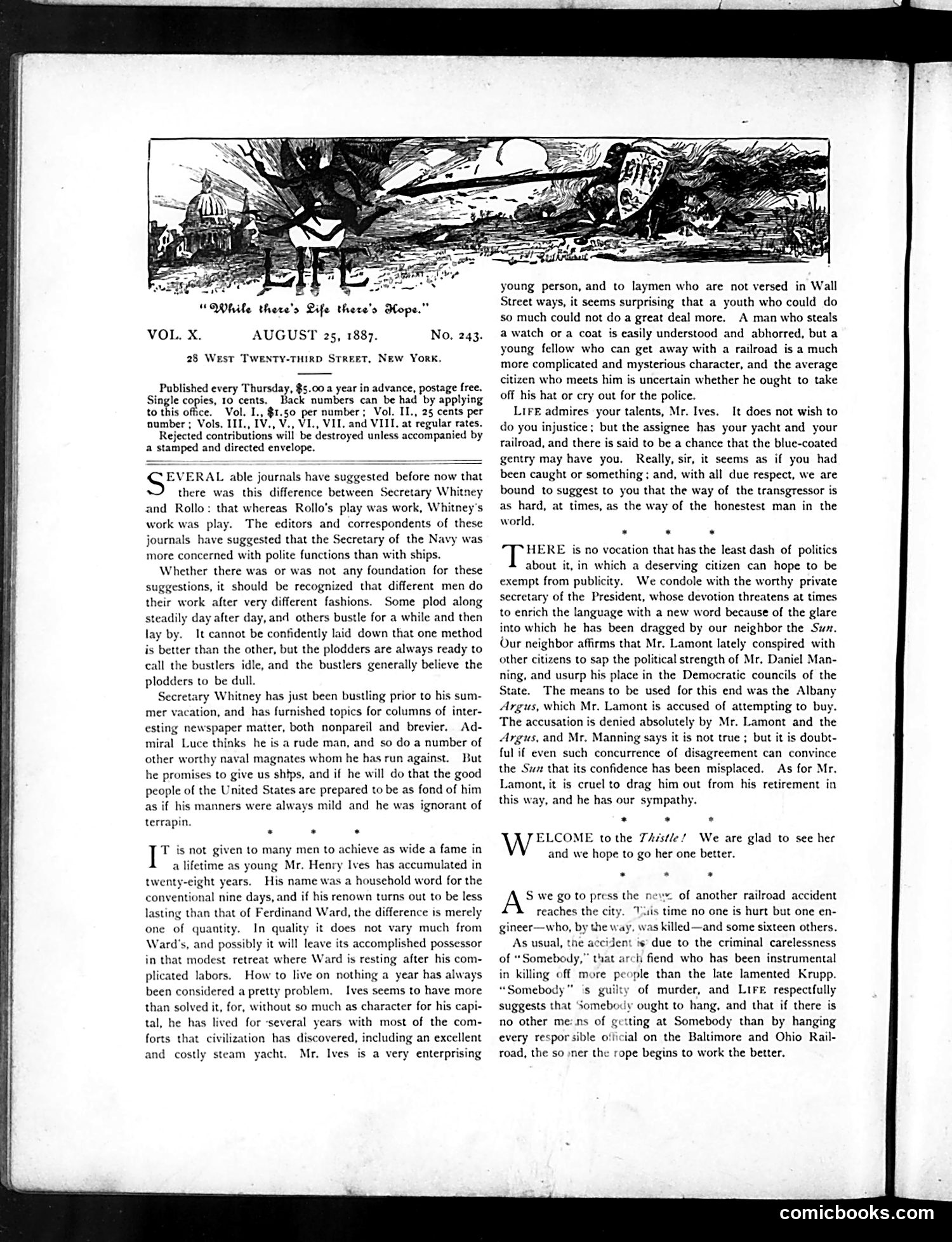
The cartoon's header reads "While there's Life there's Mops"—a play on the proverb "while there's life there's hope." The image appears to be a satirical landscape scene, though specific figures are difficult to identify clearly in this reproduction. The text discusses Secretary of the Navy Whitney and his administrative work, comparing him to previous naval secretaries Rollo and others. It references debates about whether Navy administrative positions require specialized naval expertise versus political appointment. The article also discusses railroad accidents and criticism of railroad officials for safety negligence, with mention of the "Baltimore and Ohio Railroad" and calls for accountability. The overall tone critiques both political appointees and corporate responsibility for public safety.
📄 Transcribed text from this page (OCR, searchable)
Machine-transcribed from the original scan — historical spelling and the odd misread are preserved.
ND Pov N x é “While there's Life there's Hope.” VOL. X. AUGUST 25, 1887. 28 West Twenty-THirD Street, New York. No. 243. Published every Thursday, $5.00 a year in advance, postage free. Single copies, 10 cents, Back numbers can be had by applying to this office. Vol. I., $1.50 per number; Vol. II., 25 cents per number; Vols. III., IV., V., VI., VII. and VIII, at regular rates. Rejected contributions will be destroyed unless accompanied by a stamped and directed envelope. VERAL able journals have suggested before now that there was this difference between Secretary Whitney and Rollo: that whereas Rollo's play was work, Whitney's work was play. The editors and correspondents of these journals have suggested that the Secretary of the Navy was more concerned with polite functions than with ships. Whether there was or was not any foundation for these suggestions, it should be recognized that different men do their work after very different fashions. Some plod along steadily day after day, and others bustle for a while and then lay by. It cannot be confidently laid down that one method is better than the other, but the plodders are always ready to call the bustlers idle, and the bustlers generally believe the plodders to be dull. Secretary Whitney has just been bustling prior to his sum- mer vacation, and has furnished topics for columns of inter- esting newspaper matter, both nonpareil and brevier. Ad- miral Luce thinks he is a rude man, and so do a number of other worthy naval magnates whom he has run against. But he promises to give us shtps, and if he will do that the good people of the United States are prepared to be as fond of him as if his manners were always mild and he was ignorant of terrapin. . * . I T is not given to many men to achieve as wide a fame in a lifetime as young Mr. Henry Ives has accumulated in twenty-eight years. His name was a household word for the conventional nine days, and if his renown turns out to be less lasting than that of Ferdinand Ward, the difference is merely one of quantity. In quality it does not vary much from Ward's, and possibly it will leave its accomplished possessor in that modest retreat where Ward is resting after his com- plicated labors. How to live on nothing a year has always been considered a pretty problem. Ives seems to have more than solved it, for, without so much as character for his capi- tal, he has lived for ‘several years with most of the com- forts that civilization has discovered, including an excellent and costly steam yacht. Mr. Ives is a very enterprising young person, and to laymen who are not versed in Wall Street ways, it seems surprising that a youth who could do so much could not do a great deal more. A man who steals a watch or a coat is easily understood and abhorred, but a young fellow who can get away with a railroad is a much more complicated and mysterious character, and the average citizen who meets him is uncertain whether he ought to take off his hat or cry out for the police. LIFE admires your talents, Mr. Ives. It does not wish to do you injustice; but the assignee has your yacht and your railroad, and there is said to be a chance that the blue-coated gentry may have you. Really, sir, it seems as if you had been caught or something ; and, with all due respect, we are bound to suggest to you that the way of the transgressor is as hard, at times, as the way of the honestest man in the world, HERE is no vocation that has the least dash of politics about it, in which a deserving citizen can hope to be exempt from publicity. We condole with the worthy private secretary of the President, whose devotion threatens at times to enrich the language with a new word because of the glare into which he has been dragged by our neighbor the Sux. Our neighbor affirms that Mr. Lamont lately conspired with other citizens to sap the political strength of Mr. Daniel Man- ning, and usurp his place in the Democratic councils of the State. The means to be used for this end was the Albany Argus, which Mr. Lamont is accused of attempting to buy. The accusation is denied absolutely by Mr. Lamont and the Argus, and Mr. Manning says it is not true ; but it is doubt- ful if even such concurrence of disagreement can convince the Si that its confidence has been misplaced. As for Mr, Lamont, it is cruel to drag him out from his retirement in this way, and he has our sympathy. ELCOME tothe 7iistle/ We are glad to see her and we hope to go her one better. S we go to press the news of another railroad accident reaches the city. ‘Vuis time no one is hurt but one en- gineer—who, by the way, was killed—and some sixteen others. As usual, the accident is’ due to the criminal carelessness of “Somebody,” that arch fiend who has been instrumental in killing off more people than the late lamented Krupp. “Somebody” 's guilty of murder, and LIFE respectfully suggests that Somebody ought to hang, and that if there is no other me:ns of getting at Somebody than by hanging every respor sible official on the Baltimore and Ohio Rail- road, the so »ner the rope begins to work the better. comicbooks.com